
Bloomberg

Ukraine Latest: Kyiv Residents Urged to Conserve Electricity

(Bloomberg) —

Russian forces caused “serious damage” to an electrical installation near Kyiv on Saturday, the grid operator Ukrenegro said, with emergency blackouts possible even after power was restored. 

Residents in the Kyiv area and in neighboring regions were urged to immediately cut their electric use. “If we don’t follow this advice, we will have to take out the candles and suffer all the consequences,” said Kyrylo Tymoshenko, deputy head of Ukraine’s presidential administration.

South Korea’s top central banker urged China to get more involved in persuading Russia to end its war in Ukraine. The US and Saudi Arabia on Friday pledged more aid for Kyiv as Russia’s invasion grinds toward the end of its eighth month. 

(See RSAN on the Bloomberg Terminal for the Russian Sanctions Dashboard.) 

Key Developments

  • Russia Failed to Swap Out Western Military Parts: 2021 Audit
  • Ukraine IT Sector Tested as Putin Bombs Civilian Infrastructure
  • Saudi Arabia Announces $400M in Aid to Ukraine
  • Putin Says Has No Regrets About Ukraine Invasion After Reverses
  • Musk Tweets Complicate US Diplomacy From Ukraine to Taiwan
  • Canada Wants ‘Arsonist’ Russia to Be Barred From IMF and G-20

On the Ground

Russian forces launched missiles at the Kyiv region again overnight, with damage reported to energy systems. Kamikaze drone attacks also took place in the Dnipro regions and Zaporizhzhia regions. Ukraine’s military estimates Russian still has about 300 Iranian-made drones with plans “to buy several thousand more.” A large number of wounded people are being admitted to medical facilities in the regions annexed by Russia last month after a vote called illegal by the UN. Several people were wounded by Russian shelling in the Nikopol region in southern Ukraine that a regional administrator said were designed to cause “maximum damage to civilians.” 

(All times CET)

S. Korean Central Banker Calls on China’s Help to End War (5:30 p.m.)

Bank of Korea Governor Rhee Chang-yong urged Beijing to take on a more active role in trying to end the Russian war in Ukraine and calm the world’s geopolitical situation. 

“I really hope that China can play a very important role,” Rhee said in Washington on Saturday. “I really hope that my old friends in China can step up efforts to stop the Russian war.” 

If any country can talk to Russian President Vladimir Putin, it’s China, he said, adding that Beijing can be a “bridge between Russia and the West” and help its own relations with Washington in the process.  

More Ships Sail With Ukrainian Farm Products (5:25 p.m.)

Another seven vessels with a total of 101,000 tons of agriculture products left Ukraine’s Odesa-area ports on Saturday for destinations in Asia and Europe, Ukraine’s infrastructure ministry said on Facebook.

Since the safe-transit agreement was reached with Russia in late July, 7.5 million tns of grains and other farm products have departed on 341 ships, the ministry said. 

Fire at Oil Depot in Russia’s Belgorod (5 p.m.)

A major fire at an oil depot near the Russian city of Belgorod was caused by a second day of Ukrainian cross-border shelling, the region’s governor said. 

Social media posts showed black smoke billowing in the area. Belgorod is about 60 miles north of the Ukrainian border.  Ukraine hasn’t commented.   

Poland Says Oil Flows Resume on Druzhba Pipeline (4:14 p.m.)

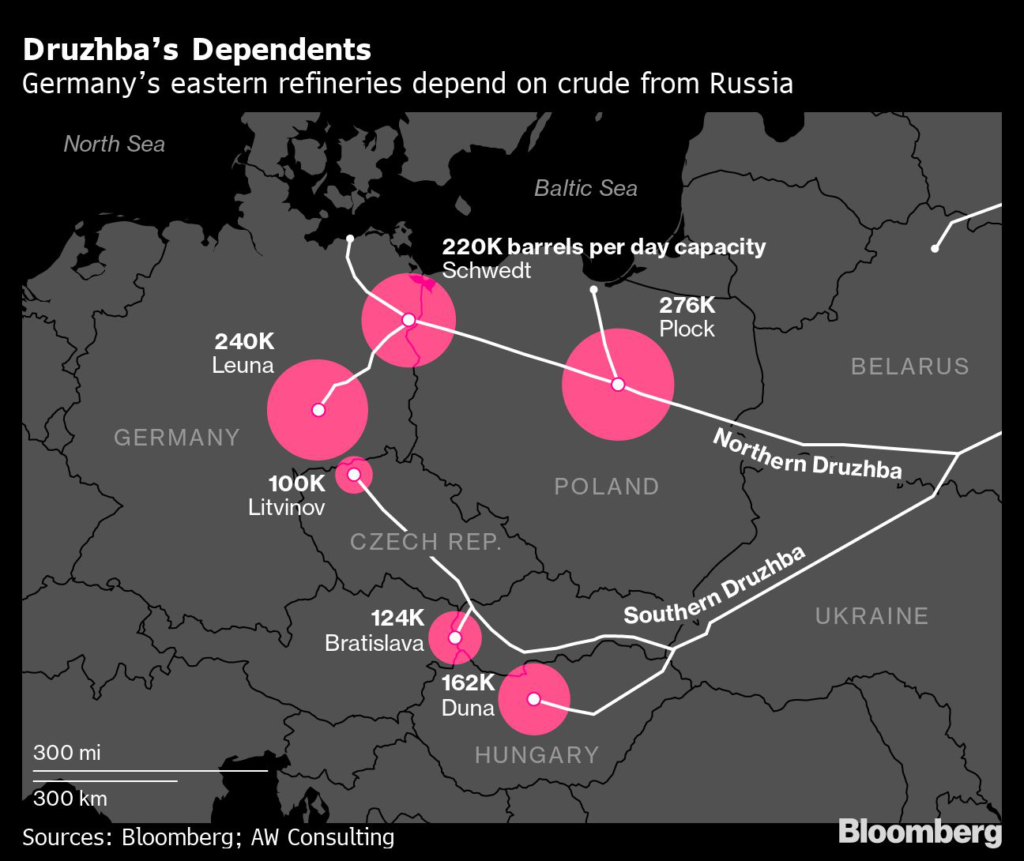
Oil flows via the northern leg of the Druzhba pipeline, which supplies, Germany and Poland with Russian crude oil, resumed in full on Saturday after an accident earlier in the week, according to Poland’s pipeline operator PERN. 

Poland early ruled out third-party involvement in the incident, at a time Europe is on high alert about potential sabotage to infrastructure. 

Ukraine Expects Red Cross Officials in East on Monday (1:57 p.m.)

Ukraine expects representatives of International Committee of the Red Cross to reach the “contact line” in the country’s east on Monday, Andriy Yermak, head of Ukraine’s Office of the President, said on a video call with new ICRC President Mirjana Spoljaric Egger.

Yermak urged Egger, who took up her post this month, to do everything possible to send the ICRC mission to the penal colony in Olenivka in the Donetsk region and to have access to prisoners of war. “This is my priority,” Egger said on the call, according to a post on the presidential website. 

In late July, more than 50 Ukrainian POWs were killed in shelling at the prison that Ukraine has blamed on Russia. Moscow has said Kyiv was responsible for the attack. 

First Russian Troops Arrive in Belarus for Joint Force (11:22 a.m.)

Russian forces have started arriving in Belarus to man the new joint force with troops there, the defense ministry in Minsk said on Saturday.

“The first convoys of Russian servicemen from the regional force group have arrived in Belarus,” the ministry said, saying their mission was to “strengthen the protection and defence of the border.” 

Belarusian President Alexander Lukashenko said Monday that he and Russia’s president had agreed to deploy a regional grouping of forces. Moscow launched its failed push toward Kyiv in February from Belarusian territory. Observers this week have cited the movement of Belarusian military equipment to Russia, potentially to shore up dwindling supplies. 

Grid Operator Reports Russian Strike on Kyiv Region (9:10 a.m.)

Russian forces struck “critical” energy infrastructure in the Kyiv region, causing “severe destruction,” the grid operator Ukrenergo said on Facebook. Repairs are under way. 

Ukrenegro warned of potential emergency shutdowns and asked consumers to use power sparingly. “Such measures give our specialists the opportunity to stabilize the situation as soon as possible and carry out the necessary restorative work,” it said.  

The strike comes after Russian President Vladimir Putin said on Friday that seven of 29 of sites targeted in a mass bombing of Ukraine earlier in the week “were not damaged as planned by the Defence Ministry,” and that “the attacks will be renewed.”  

Russian Reservists Buy Own Body Armor at Inflated Prices, UK Says (8 a.m.) 

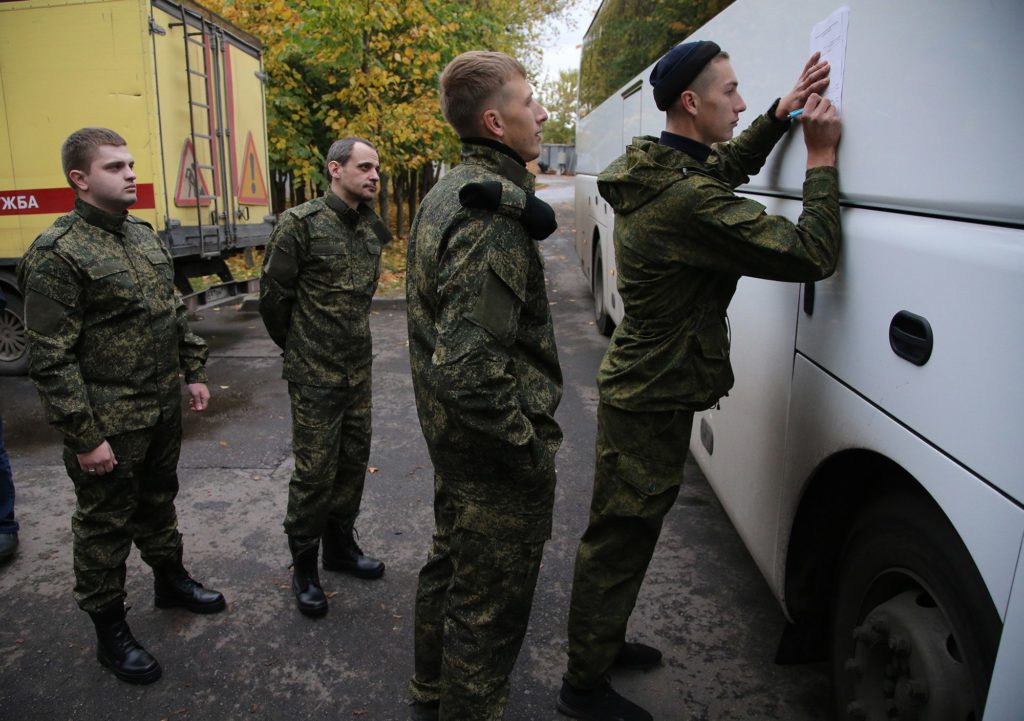
Many newly-mobilized Russian reservists have been deployed to Ukraine this month with personal equipment “almost certainly lower than the already poor provision of previously deployed troops,” the UK defence ministry said. 

Many reservists are likely being required to buy their own body armor including 6B45 vests, which are currently selling online in Russia for 40,000 rubles ($640), up from about 12,000 rubles in April, the UK said on Twitter. 

Russian authorities in 2020 announced that 300,000 sets of the armor had been supplied to the Russian military, the UK said, suggesting much of the equipment has since gone astray. 

Canada Wants ‘Arsonist’ Russia Banned From IMF, G-20 (6 a.m.)

Canada is pushing for Russia to be shunned from the international community entirely over its invasion of Ukraine, now approaching the eight-month mark. 

Finance Minister and Deputy Prime Minister Chrystia Freeland didn’t hold back on her opposition to Russian officials being at the International Monetary Fund and World Bank meetings this week. 

“The IMF and World Bank meetings are meetings of the firefighters — of ministers and central bank governors, whose jobs is to protect the global economy,” Freeland, who’s of Ukrainian heritage, said Friday. “Russia right now is the arsonist. Russia shouldn’t have been at the IMF meetings. Arsonists have no place in meetings of the firefighters.”  

Russia Failed to End Reliance on Western Parts, Audit Shows (3:20 a.m.)

Even before sanctions cut off access to vital components and technologies for Putin’s defense industry, an internal Russian government review found years of attempts to reduce reliance on imports had largely failed.

Previously unreported assessments show a program with specific targets was put in place from 2019 to slash Russia’s dependence on Western parts for its arsenal by 2025 — everything from radar to advanced submarines to anti-missile defense systems. But an internal review of the plan 10 months before Putin invaded Ukraine found it was falling short on almost every metric.

Read more: Russia Failed to Swap Out Western Military Parts: 2021 Audit

Zelenskiy Speaks to Saudi Crown Prince (5 a.m.) 

Ukrainian President Ukrainian President Volodymyr Zelenskiy said he had spoken to Mohammed bin Salman, the crown prince of Saudi Arabia, and expressed gratitude for his support of “Ukraine’s territorial integrity.”  

Following Zelenskiy’s reference to “macro-financial aid,” the Saudi Press Agency reported that Riyadh will give $400 million in humanitarian aid to Ukraine.  

US to Give Another $725 Million in Security Aid (2:55 a.m.) 

The Biden administration on Friday announced $725 million in additional security aid for Ukraine. The package includes more ammunition for the HIMARS long-range artillery systems, which Ukraine has credited with helping its military counteroffensive in the east and south of the country by striking deep behind Russian lines.  

“In the wake of Russia’s brutal missile attacks on civilians across Ukraine, the mounting evidence of atrocities by Russia’s forces, and the firm and unequivocal rejection by 143 nations at the United Nations of Russia’s illegal attempted annexation of parts of Ukraine, the United States is offering additional military assistance to help Ukraine’s proud defenders protect their country,” Secretary of State Antony Blinken said in a statement.


More stories like this are available on bloomberg.com

©2022 Bloomberg L.P.

NFT Bargain-Hunting Is in as Crypto Bust Craters Prices

(Bloomberg) — A year ago, Daniel Maegaard, one of the higher-profile collectors of nonfungible tokens, was spending tens of thousands of dollars on CryptoPunks featuring funky-looking people or apes. In the last few months, he’s been buying NFTs that typically sell for less than $2,000.

The shift is indicative of the metamorphosis taking place in the market for the once-coveted digital images promoted by the likes of Justin Bieber and Madonna. NFT sales plunged 67% sequentially in the third quarter as speculators and celebrities made an exodus, leaving the sector mostly to the dedicated long-term believers in the various potential use cases, and collectors betting that the plunge in prices will rekindle speculative demand.    

“There’s more upside potential compared to other NFT projects with much higher market capitalizations,” said the 32-year-old Maegaard, who began investing in NFTs connected to land sales in the blockchain-based game Axie Infinity in early 2019. 

Cheaper NFT collections and $100 gaming NFTs have been generally selling better than the expensive stuff, though Maegaard said he did sell a CryptoPunk depicting an ape in a hoodie for $4.45 million on Sept. 28. On average, an Ethereum blockchain-based NFT fetched $120 on Oct. 3, compared with $1,631 in early February, according to market data researcher NonFungible. On the Ronin blockchain used by Axie Infinity, average prices were down to $16 as of Oct. 3, from $69 in February, the researcher found. 

The steep decline in cryptocurrency prices overall this year is credited mostly for the decline. On top of that, there is mounting concern about whether NFTs are likely to be viewed as securities, in light of the US Securities and Exchange Commission’s investigation of Yuga Labs Inc., the creators of the popular Bored Ape Yacht Club tokens.

“It is definitely not a super interesting space for short-term trading these days,” said Gauthier Zuppinger, co-founder of NonFungible. “Which may be an explanation why the space is currently at a pretty low pace.” 

That’s transforming the competitive landscape, especially for NFT trading platforms, as buyers search for bargains and many new collections debut outside of the Ethereum blockchain. OpenSea, the world’s biggest NFT marketplace, had a 38% market share in September, down from nearly 85% in March, according to tracker DappRadar. Rival platforms x2y2 and Magic Eden have boomed — with Magic Eden more than doubling its sales in September. Magic Eden had a 13.4% market share in September, up from also less than 1% in March, according to DappRadar. Last month, x2y2 boosted its share to 31.3%, up from less than 1% in March. 

One reason for Magic Eden’s success: the average price of an NFT there is $43, according to DappRadar, versus $82 on OpenSea over the last 30 days. Folks are more apt to scoop up cheaper tokens as they play games, instead of looking to invest thousands or even millions into art they hope will double in price some day.

“The NFT market is showing signs of evolution, where the NFT traders went from degens” — a slang word for crypto believers — to more rational investors, said Pedro Herrera, head of research at DappRadar. “There is a highly competitive environment across marketplaces.”

In the week of Sept. 19, mints of new NFTs reached all-time highs, according to researcher Nansen — largely due to debut of small NFT collections with low prices. 

But, Nansen cautions, that doesn’t mean that large, expensive collections are out for good. An index of blue-chip NFTs like Bored Ape Yacht Club, Azuki, CryptoPunks and Doodles still often outperforms others, said Martin Lee, a research analyst at Nansen. 

“So while average transactions might be lower in dollar/ETH value, a large bulk of attention and value accrual still resides within the more expensive, well-known collections,” Lee said.

What has changed, perhaps, is the investor mindset.

“The mania of paying outrageous prices for unexceptional NFTs is gone for good,” said crypto investor Aaron Brown, who writes for Bloomberg Opinion. “I see potential appreciation for NFTs with substance, although I expect NFTs to show the same kind of ups and downs, fads and forgetfulness, of all collectible markets.” 

More stories like this are available on bloomberg.com

©2022 Bloomberg L.P.
UK’s Asos in Talks With Banks to Boost ‘Financial Flexibility’

(Bloomberg) —

British fast-fashion company Asos Plc said it was close to agreeing on changes to its banking facilities to give it “increased financial flexibility.”

The company said in a statement Saturday that it was in the “final stages” of talks to amend covenants on credit facilities that are due to expire in 2024. The comments came as Sky News reported that the firm’s lenders were hiring restructuring advisers, including AlixPartners.

“Asos retains a strong liquidity position and this is a prudent step in the current environment,” the company said. 

The online-only retailer is having a difficult year and issued a profit warning in June as the cost-of-living crisis sapped consumers’ spending power. The company warned in April that its earnings goal was at risk from inflation and disruption from the war in Ukraine.

Once a stock-market favorite, Asos has struggled with supply chain issues and the move away from online shopping after Covid restrictions were lifted. The stock has lost around three-quarters of its value this year. 

More stories like this are available on bloomberg.com

©2022 Bloomberg L.P.

Ukraine Latest: Russia Hits Energy Infrastructure in Kyiv Region

(Bloomberg) —

Russian forces struck energy infrastructure in the Kyiv region early Saturday, the grid operator Ukrenegro said, with emergency blackouts possible. 

It’s potentially one of the targets Russian President Vladimir Putin said on Friday was “not damaged as planned” during a barrage of more than 80 missiles strikes on Oct. 14. Putin said Russia would “renew” those attacks even while not planning “massive strikes” for now. 

The Pentagon on Friday announced $725 million in additional security aid for Ukraine. Putin said he has no regrets about the invasion of Ukraine, planned as a quick “special operation” and now well into its eighth month. The controversial mobilization of some 300,000 reservists is almost complete, Putin told reporters in Kazakhstan.  

(See RSAN on the Bloomberg Terminal for the Russian Sanctions Dashboard.) 

Key Developments

  • Russia Failed to Swap Out Western Military Parts: 2021 Audit
  • Ukraine IT Sector Tested as Putin Bombs Civilian Infrastructure
  • Musk’s Starlink Isn’t the Only Option for Ukraine, Pentagon Says
  • Putin Says Has No Regrets About Ukraine Invasion After Reverses
  • Musk Tweets Complicate US Diplomacy From Ukraine to Taiwan
  • Canada Wants ‘Arsonist’ Russia to Be Barred From IMF and G-20

On the Ground

Russian forces launched missiles at the Kyiv region again overnight, with damage reported to energy systems. Kamikaze drone attacks also took place in the Dnipro regions and Zaporizhzhia regions. Ukraine’s military estimates Russian still has about 300 Iranian-made drones with plans “to buy several thousand more.” Over the past 24 hours Russian troops have launched six rocket and 30 at infrastructure and civilian targets across Ukraine’s east and south, according to a General Staff update. A large number of wounded people are being admitted to medical facilities in the regions annexed by Russia last month after a vote called illegal by the UN. Hospital overcrowding and a high mortality rate was reported in Tokmak in the Zaporizhzhia region. Russian casualties in the area include dozens of newly-mobilized forces, Ukraine said.  

(All times CET)

Ukraine Expects ICRC Officials in East on Monday (1:57 p.m.)

Ukraine expects representatives of International Committee of the Red Cross to reach the “contact line” in the country’s east on Monday, Andriy Yermak, head of Ukraine’s Office of the President, said on a video call with new ICRC President Mirjana Spoljaric Egger.

Yermak urged Egger, who took up her post this month, to do everything possible to send the ICRC mission to the penal colony in Olenivka in the Donetsk region and to have access to prisoners of war. “This is my priority,” Egger said on the call, according to a post on the presidential website. 

In late July, more than 50 Ukrainian POWs were killed in shelling at the prison that Ukraine has blamed on Russia. Moscow has said Kyiv was responsible for the attack. 

First Russian Troops Arrive in Belarus for Joint Force (11:22 a.m.)

Russian forces have started arriving in Belarus to man the new joint force with troops there, the defense ministry in Minsk said on Saturday.

“The first convoys of Russian servicemen from the regional force group have arrived in Belarus,” the ministry said, saying their mission was to “strengthen the protection and defence of the border.” 

Belarusian President Alexander Lukashenko said Monday that he and Russia’s president had agreed to deploy a regional grouping of forces. Moscow launched its failed push toward Kyiv in February from Belarusian territory. Observers this week have cited the movement of Belarusian military equipment to Russia, potentially to shore up dwindling supplies. 

Grid Operator Reports Russian Strike on Kyiv Region (9:10 a.m.)

Russian forces struck “critical” energy infrastructure in the Kyiv region, causing “severe destruction,” the grid operator Ukrenergo said on Facebook. Repairs are under way. 

Ukrenegro warned of potential emergency shutdowns and asked consumers to use power sparingly. “Such measures give our specialists the opportunity to stabilize the situation as soon as possible and carry out the necessary restorative work,” it said.  

The strike comes after Russian President Vladimir Putin said on Friday that seven of 29 of sites targeted in a mass bombing of Ukraine earlier in the week “were not damaged as planned by the Defence Ministry,” and that “the attacks will be renewed.”  

Russian Reservists Buy Own Body Armor at Inflated Prices, UK Says (8 a.m.) 

Many newly-mobilized Russian reservists have been deployed to Ukraine this month with personal equipment “almost certainly lower than the already poor provision of previously deployed troops,” the UK defence ministry said. 

Many reservists are likely being required to buy their own body armor including 6B45 vests, which are currently selling online in Russia for 40,000 rubles ($640), up from about 12,000 rubles in April, the UK said on Twitter. 

Russian authorities in 2020 announced that 300,000 sets of the armor had been supplied to the Russian military, the UK said, suggesting much of the equipment has since gone astray. 

Canada Wants ‘Arsonist’ Russia Banned From IMF, G-20 (6 a.m.)

Canada is pushing for Russia to be shunned from the international community entirely over its invasion of Ukraine, now approaching the eight-month mark. 

Finance Minister and Deputy Prime Minister Chrystia Freeland didn’t hold back on her opposition to Russian officials being at the International Monetary Fund and World Bank meetings this week. 

“The IMF and World Bank meetings are meetings of the firefighters — of ministers and central bank governors, whose jobs is to protect the global economy,” Freeland, who’s of Ukrainian heritage, said Friday. “Russia right now is the arsonist. Russia shouldn’t have been at the IMF meetings. Arsonists have no place in meetings of the firefighters.”  

Russia Failed to End Reliance on Western Parts, Audit Shows (3:20 a.m.)

Even before sanctions cut off access to vital components and technologies for Putin’s defense industry, an internal Russian government review found years of attempts to reduce reliance on imports had largely failed.

Previously unreported assessments show a program with specific targets was put in place from 2019 to slash Russia’s dependence on Western parts for its arsenal by 2025 — everything from radar to advanced submarines to anti-missile defense systems. But an internal review of the plan 10 months before Putin invaded Ukraine found it was falling short on almost every metric.

Read more: Russia Failed to Swap Out Western Military Parts: 2021 Audit

US to Give Another $725 Million in Security Aid (2:55 a.m.) 

The Biden administration on Friday announced $725 million in additional security aid for Ukraine. The package includes more ammunition for the HIMARS long-range artillery systems, which Ukraine has credited with helping its military counteroffensive in the east and south of the country by striking deep behind Russian lines.  

“In the wake of Russia’s brutal missile attacks on civilians across Ukraine, the mounting evidence of atrocities by Russia’s forces, and the firm and unequivocal rejection by 143 nations at the United Nations of Russia’s illegal attempted annexation of parts of Ukraine, the United States is offering additional military assistance to help Ukraine’s proud defenders protect their country,” Secretary of State Antony Blinken said in a statement.

Zelenskiy Speaks to Saudi Crown Prince (1:50 a.m.)

Ukrainian President Ukrainian President Volodymyr Zelenskiy said he had spoken to Mohammed bin Salman, the crown prince of Saudi Arabia, and expressed gratitude for his support of “Ukraine’s territorial integrity.”     

“We agreed to interact in the release of prisoners of war. We agreed on the provision of macro-financial aid to Ukraine,” Zelenskiy tweeted on Friday. His praise of crown prince came as the Biden administration has been engaged in an escalating and unusually public feud with the kingdom since OPEC+ announced an oil production cut. In September, the Saudis helped broker an exchange that freed 215 Ukrainian prisoners of war for an ally of Putin and others held by Ukraine.

IAEA Says Back-Up Power to Nuclear Plant Is Restored (8:04 p.m.)

The International Atomic Energy Agency said in a tweet that backup power has been restored to the Russian-seized Zaporizhzhia nuclear power plant in Ukraine.

The plant has received additional fuel for its diesel generators, and now has at least 10 days worth in case external power is lost again, the UN agency said. 


More stories like this are available on bloomberg.com

©2022 Bloomberg L.P.
Fire Disrupts Services at South Korean Tech Giants Kakao, Naver

(Bloomberg) — A blaze at a data center disrupted services at two of South Korea’s major tech companies — Kakao Corp. and Naver Corp. — keeping their servers down for hours on Saturday.

The fire broke out at around 3:30 p.m. local time at SK Inc. C&C’s building in Pangyo, south of Seoul where several major software companies are based, according to Yonhap News Agency. The building houses servers of Naver and Kakao, as well as some of SK Group’s units, Yonhap reported. 

Several malfunctions have been caused by the fire, including messenger delivery failures and login issues, according to statements from Kakao and Naver. Kakao’s messenger service has about 53 million users globally, 89% of whom are in the domestic market, according to a filing in August. Naver said various services are down, including its shopping, news and blogs. 

Both companies said they are working on restoring their services as soon as possible. No injuries or casualties have been reported, according to Yonhap. 

More stories like this are available on bloomberg.com

©2022 Bloomberg L.P.
Charting the Global Economy: IMF Warns of Deteriorating Outlook

(Bloomberg) — The International Monetary Fund cut its global growth forecast and stressed that economies are becoming increasingly vulnerable to monetary policy missteps that compound headwinds from the war in Ukraine and sluggishness in China. 

A widely followed gauge of underlying consumer prices in the US accelerated to a 40-year high. Persistent inflation is raising prospects the Federal Reserve will adhere to a stout monetary policy strategy, fueling a surge in the dollar that has economic and financial repercussions for the rest of the world. 

Here are some of the charts that appeared on Bloomberg this week on the latest developments in the global economy:

World

The IMF warned of a worsening outlook for the global economy, cutting its forecast for global growth next year to 2.7%, from 2.9% seen in July, adding that it sees a 25% probability that growth will slow to less than 2%. The risk of policy miscalculation has risen sharply as growth remains fragile and markets show signs of stress, the IMF said in its World Economic Outlook. About one-third of the global economy risks contracting next year, with the US, European Union and China all continuing to stall.

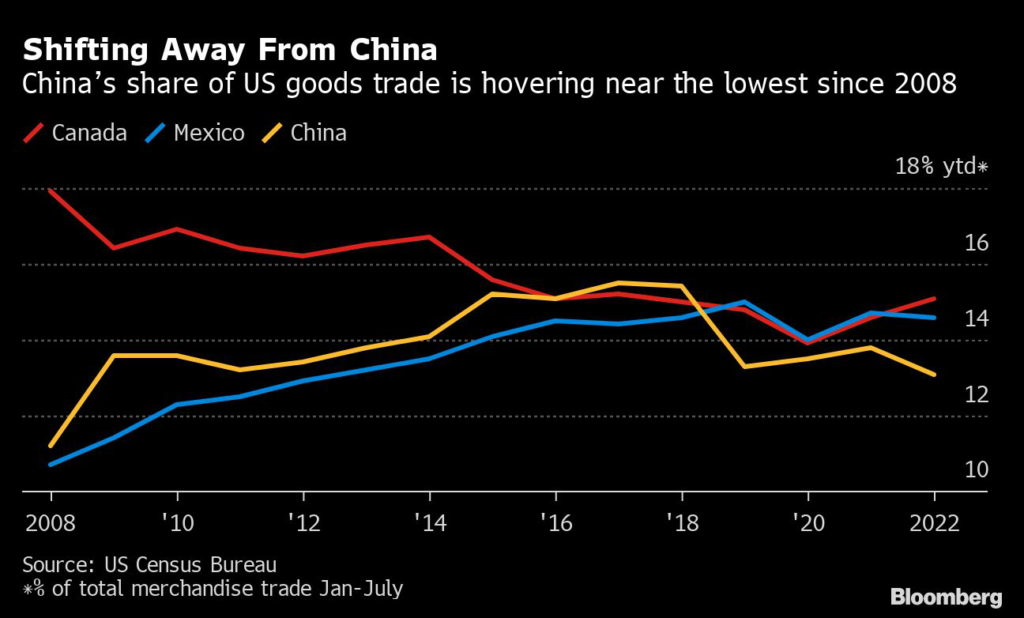
Several years of supply-chain instability are pushing an increasing number of US retail companies to shift some production from China to North America. The unrelenting problems have convinced some executives that it’s time to rethink the corporate playbook of the past several decades.

UK

The UK remained gripped by financial market turmoil. Prime Minister Liz Truss reacted by firing her chancellor and reversing part of her tax cut package. But Bloomberg Economics calculates she still needs to find £24 billion more to return the debt to a sustainable track.


US

A closely watched measure of consumer prices rose by more than forecast to a 40-year high in September, pressuring the Fed to raise interest rates even more aggressively to stamp out persistent inflation.

Retail sales stalled last month as shoppers grew more guarded about discretionary purchases amid the worst inflationary environment in decades and rising interest rates. Seven of 13 retail categories declined, including a drop in receipts at auto dealers, furniture outlets, sporting goods stores and electronics merchants.

Europe

Europe’s energy crunch will likely trigger a contraction in the German economy next year for only the third time since the financial crisis, according to updated government forecasts. Gross domestic product is set to shrink by 0.4% in 2023 as soaring power costs crimp industrial output and dampen consumer spending, slashing a forecast of 2.5% expansion made at the end of April.

Inflation in Norway and Denmark unexpectedly surged to new multi-decade highs last month, dispelling expectations that price growth in the Nordic region has peaked and raising the risk of deeper recessions. Denmark’s inflation rate rose to 10% in September, reaching double digits for the first time in four decades, while price growth in Norway accelerated to 6.9% — the fastest pace in 34 years. 

Asia

Bloomberg Economics has sketched out four scenarios for China’s economy over the decades ahead, with a base case of 4.6% growth on average over the next decade. Their model suggests a growth rate above 5% over that time period — as predicted pre-pandemic — is now out of reach, due to the lasting impact of Covid Zero policies, a faster decline in fertility than previously expected and lower investment due to a gradually shrinking real estate sector.

China used a controversial tool to inject funds into policy banks for the first time in more than two years, as Beijing increasingly relies on the semi-official lenders to support the economy while monetary easing is constrained by rising global interest rates. The relaunch of the tool suggests the government is seeking every possible way to expand the funding source for policy banks.

The Bank of Korea raised its seven-day repurchase rate a half-percentage point to a 10-year high of 3%. Two board members of the South Korean central bank voted against the decision as concerns over slowing growth and a downturn in the property market fueled renewed caution over the central bank’s policy trajectory.

Emerging Markets

Brazil’s consumer prices fell for the third consecutive month, burnishing President Jair Bolsonaro’s economic credentials ahead of the second round of presidential elections on Oct. 30. Official data showed the monthly inflation rate fell 0.29% in September, the largest drop for the month since the start of the data series in 1980.

More stories like this are available on bloomberg.com

©2022 Bloomberg L.P.

Ukraine Latest: Russia Strikes Energy Targets in Kyiv Region

(Bloomberg) —

Russian forces struck energy infrastructure in the Kyiv region early Saturday, the grid operator Ukrenegro said, with emergency blackouts possible. 

It’s potentially one of the targets Russian President Vladimir Putin said on Friday was “not damaged as planned” during a barrage of more than 80 missiles strikes on Oct. 14. Putin said Russia would “renew” those attacks even while not planning “massive strikes” for now. 

The Pentagon on Friday announced $725 million in additional security aid for Ukraine. Putin said he has no regrets about the invasion of Ukraine, planned as a quick “special operation” and now well into its eighth month. The controversial mobilization of some 300,000 reservists is almost complete, Putin told reporters in Kazakhstan.  

(See RSAN on the Bloomberg Terminal for the Russian Sanctions Dashboard.) 

Key Developments

  • Russia Failed to Swap Out Western Military Parts: 2021 Audit
  • Ukraine IT Sector Tested as Putin Bombs Civilian Infrastructure
  • Musk’s Starlink Isn’t the Only Option for Ukraine, Pentagon Says
  • Putin Says Has No Regrets About Ukraine Invasion After Reverses
  • Musk Tweets Complicate US Diplomacy From Ukraine to Taiwan
  • Canada Wants ‘Arsonist’ Russia to Be Barred From IMF and G-20

On the Ground

Russian forces launched missiles at the Kyiv region again overnight, with damage reported to energy systems. Kamikaze drone attacks also took place in the Dnipro regions and Zaporizhzhia regions. Ukraine’s military estimates Russian still has about 300 Iranian-made drones with plans “to buy several thousand more.” Over the past 24 hours Russian troops have launched six rocket and 30 at infrastructure and civilian targets across Ukraine’s east and south, according to a General Staff update. A large number of wounded people are being admitted to medical facilities in the regions annexed by Russia last month after a vote called illegal by the UN. Hospital overcrowding and a high mortality rate was reported in Tokmak in the Zaporizhzhia region. Russian casualties in the area include dozens of newly-mobilized forces, Ukraine said.  

(All times CET)

Grid Operator Reports Russian Strike on Kyiv Region (9:10 a.m.)

Russian forces struck “critical” energy infrastructure in the Kyiv region, causing “severe destruction,” the grid operator Ukrenergo said on Facebook. Repairs are under way. 

Ukrenegro warned of potential emergency shutdowns and asked consumers to use power sparingly. “Such measures give our specialists the opportunity to stabilize the situation as soon as possible and carry out the necessary restorative work,” it said.  

The strike comes after Russian President Vladimir Putin said on Friday that seven of 29 of sites targeted in a mass bombing of Ukraine earlier in the week “were not damaged as planned by the Defence Ministry,” and that “the attacks will be renewed.”  

Russian Reservists Buy Own Body Armor at Inflated Prices, UK Says (8 a.m.) 

Many newly-mobilized Russian reservists have been deployed to Ukraine this month with personal equipment “almost certainly lower than the already poor provision of previously deployed troops,” the UK defence ministry said. 

Many reservists are likely being required to buy their own body armor including 6B45 vests, which are currently selling online in Russia for 40,000 rubles ($640), up from about 12,000 rubles in April, the UK said on Twitter. 

Russian authorities in 2020 announced that 300,000 sets of the armor had been supplied to the Russian military, the UK said, suggesting much of the equipment has since gone astray. 

Canada Wants ‘Arsonist’ Russia Banned From IMF, G-20 (6 a.m.)

Canada is pushing for Russia to be shunned from the international community entirely over its invasion of Ukraine, now approaching the eight-month mark. 

Finance Minister and Deputy Prime Minister Chrystia Freeland didn’t hold back on her opposition to Russian officials being at the International Monetary Fund and World Bank meetings this week. 

“The IMF and World Bank meetings are meetings of the firefighters — of ministers and central bank governors, whose jobs is to protect the global economy,” Freeland, who’s of Ukrainian heritage, said Friday. “Russia right now is the arsonist. Russia shouldn’t have been at the IMF meetings. Arsonists have no place in meetings of the firefighters.”  

Russia Failed to End Reliance on Western Parts, Audit Shows (3:20 a.m.)

Even before sanctions cut off access to vital components and technologies for Putin’s defense industry, an internal Russian government review found years of attempts to reduce reliance on imports had largely failed.

Previously unreported assessments show a program with specific targets was put in place from 2019 to slash Russia’s dependence on Western parts for its arsenal by 2025 — everything from radar to advanced submarines to anti-missile defense systems. But an internal review of the plan 10 months before Putin invaded Ukraine found it was falling short on almost every metric.

Read more: Russia Failed to Swap Out Western Military Parts: 2021 Audit

US to Give Another $725 Million in Security Aid (2:55 a.m.) 

The Biden administration on Friday announced $725 million in additional security aid for Ukraine. The package includes more ammunition for the HIMARS long-range artillery systems, which Ukraine has credited with helping its military counteroffensive in the east and south of the country by striking deep behind Russian lines.  

“In the wake of Russia’s brutal missile attacks on civilians across Ukraine, the mounting evidence of atrocities by Russia’s forces, and the firm and unequivocal rejection by 143 nations at the United Nations of Russia’s illegal attempted annexation of parts of Ukraine, the United States is offering additional military assistance to help Ukraine’s proud defenders protect their country,” Secretary of State Antony Blinken said in a statement.

Zelenskiy Speaks to Saudi Crown Prince (1:50 a.m.)

Ukrainian President Ukrainian President Volodymyr Zelenskiy said he had spoken to Mohammed bin Salman, the crown prince of Saudi Arabia, and expressed gratitude for his support of “Ukraine’s territorial integrity.”     

“We agreed to interact in the release of prisoners of war. We agreed on the provision of macro-financial aid to Ukraine,” Zelenskiy tweeted on Friday. His praise of crown prince came as the Biden administration has been engaged in an escalating and unusually public feud with the kingdom since OPEC+ announced an oil production cut. In September, the Saudis helped broker an exchange that freed 215 Ukrainian prisoners of war for an ally of Putin and others held by Ukraine.

IAEA Says Back-Up Power to Nuclear Plant Is Restored (8:04 p.m.)

The International Atomic Energy Agency said in a tweet that backup power has been restored to the Russian-seized Zaporizhzhia nuclear power plant in Ukraine.

The plant has received additional fuel for its diesel generators, and now has at least 10 days worth in case external power is lost again, the UN agency said. 


More stories like this are available on bloomberg.com

©2022 Bloomberg L.P.

Ukraine IT Sector Tested as Putin Bombs Civilian Infrastructure

(Bloomberg) — Oleksandr Ruban, the chief executive officer of an Odesa-based firm that provides communications technology services, was ready when a Russian missile this week left one of his offices in the dark and offline. 

After the strike knocked out power, Ringostat’s four employees at its Cherkasy office fired up a diesel generator and their Starlink terminal, and continued to support clients from Canada to Kazakhstan who in many cases didn’t know the services were coming from a war zone. 

Ruban’s contingency planning is an example of how Ukraine’s IT industry has managed to be a rare bright spot amid the country’s economic collapse following the Russian invasion. But the sector, already navigating a loss of talent and investor jitters due to Europe’s deadliest conflict since World War II, this week had to contend with a wave of internet and power outages as Russia renewed attacks on cities far from the front. 

“We had a dream that one day IT will become Ukraine’s leading industry,” said Roman Prokofiev, co-founder and CEO of job search website Jooble, which operates in 69 countries. “We didn’t wish this dream to come true this way.” 

The Kremlin this week targeted civilian infrastructure across the country, killing at least three dozen people, after President Vladimir Putin accused Ukraine of carrying out an attack on a road and rail bridge to Crimea, a Black Sea peninsula Russia annexed in 2014. Kyiv hasn’t claimed credit. 

The strikes led to power outages in many cities, including the capital Kyiv and Lviv, an IT center in the west that hosts many professionals seeking refuge from the fighting.

Without electricity, Starlink satellites are for many the only way to connect to the internet. Yet, the service’s future in Ukraine is in question after SpaceX CEO Elon Musk on Friday threatened to cut financial support in response to Ukrainian officials slamming him over comments suggesting the government cede territory in exchange a peace deal with Russia.

A prohibition on conscription-aged men leaving the country may have contributed to the sector’s resilience, according to a study published last month by Johannes Wachs, a researcher at the Complexity Science Hub Vienna. He found Russian software developers were significantly more likely to have relocated after the war began than their Ukrainian counterparts. 

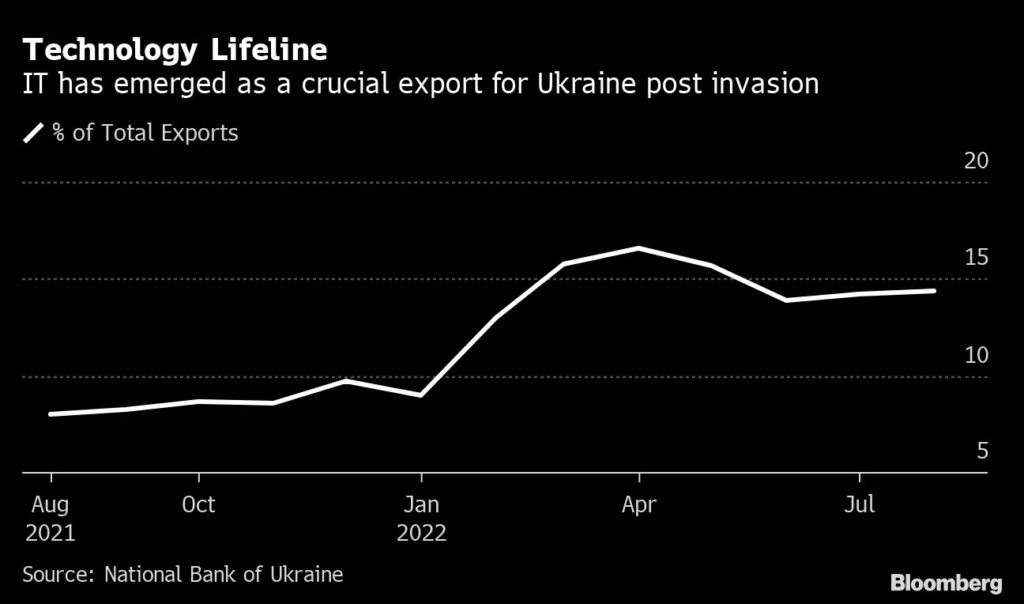
About 1.1% of Ukraine’s workforce worked in IT before the war, and sales have grown this year, with the industry becoming a key source of foreign currency as the broader economy is forecast to shrink by about a third in 2022. 

Wartime Deficit

IT firms notched more than $5 billion in sales abroad in the first eight months of the year, boosting their share of the country’s export revenues to 14%, according to central bank data. 

The International Monetary Fund estimates Kyiv will need at least $3 billion a month in financing next year to cover its wartime deficit. 

California-based digital product engineering company GlobalLogic, which was acquired by Hitachi Ltd. last year, employs more than 6,000 people in Ukraine and has arranged diesel supplies to ensure business continuity, according to Anna Shcherbakova, the company’s head of operations in the country.

But with the war in its eighth month and showing no sign of ending, GlobalLogic’s customers are increasingly concerned about its Ukraine exposure, according to Andrii Yavorskiy, a vice-president for strategy and technology. He said the company has responded by hiring more staff outside of Ukraine.

“IT is an industry that has been operating and growing even during the war,” said Stepan Veselovskyi, the CEO of the Lviv IT cluster, a community of more than 200 tech companies. “If we lose it as well, due to power outages or internet disruptions, we’ll be forced to seek even more money from other nations.”

More stories like this are available on bloomberg.com

©2022 Bloomberg L.P.

Coinbase CEO to Sell 2% Stake In Next Year For Science Research

(Bloomberg) — Coinbase Global Inc. chief executive officer Brian Armstrong plans to sell about 2% of his holdings in the company over the next year to fund scientific research, he said on Twitter late Friday.

Armstrong owns 16% of Coinbase and controls 59.5% of its voting shares, according to the company’s 2022 proxy statement.

More stories like this are available on bloomberg.com

©2022 Bloomberg L.P.

Apple’s Oklahoma Store Is Second to Unionize After Vote

(Bloomberg) — A majority of Apple Inc. retail workers at a store in Oklahoma City have voted to unionize, expanding labor’s new foothold at the world’s most valuable company.

The US National Labor Relations Board counted ballots Friday night from an election held among about 95 employees at the store, located in the city’s upscale Penn Square Mall. Workers voted to join the Communications Workers of America, making theirs the second store to unionize among Apple’s roughly 270 US outlets.

The CWA’s victory follows a June vote by staff at a Maryland store to join another labor group — the International Association of Machinists — marking one of several groundbreaking victories this year at previously union-free US companies.

Labor organizers have also made inroads at Amazon.com Inc., Trader Joe’s and Chipotle Mexican Grill Inc. — as well as Starbucks Corp., where the union’s swift spread from one initial victory in Buffalo, New York, to hundreds of successful votes around the country illustrated just how galvanizing a win can be.

“We believe the open, direct and collaborative relationship we have with our valued team members is the best way to provide an excellent experience for our customers, and for our teams,” Apple said in a statement. 

“We’re proud to provide our team members with strong compensation and exceptional benefits. Since 2018, we’ve increased our starting rates in the US by 45% and we’ve made many significant enhancements to our industry-leading benefits, including new educational and family support programs.”

As with the Machinists’ victory in Towson, Maryland, the Oklahoma vote could quickly embolden Apple workers who have been privately discussing organizing elsewhere. The fact that the effort prevailed in a deep-red state, whose unionization rate is only around half the US average, underscores the campaign’s potential to spread nationwide.

With two stores unionizing, Apple will have a tougher time maintaining the status quo, said Epstein Becker & Green attorney Steven Swirsky.

“If I lost one, it could concern me,” Swirsky, who advises companies on how to avoid unionization, said prior to the vote. “If you lose more than one, then it starts to become hard to explain away.”

The Oklahoma City win is a watershed moment for the CWA as it faces off against Apple and competes with the Machinists to organize the company. The group has said that it’s in touch with Apple store workers around the country and has filed unionization petitions at two locations so far: the Oklahoma site and one in Atlanta. In the latter case, the union withdrew its petition for an election the week before a scheduled vote, citing alleged misconduct by Apple.

At the Oklahoma City store — one of two Apple locations in the state — employees said they built an organizing committee of about 20 people and signed up 70% of the workforce over the course of five days before filing for this week’s vote.

The company has made its opposition to the union clear. Apple warned against putting “another organization in the middle of our relationship” in a spring video message to employees. In that address, Senior Vice President Deirdre O’Brien described a union as “an organization that doesn’t have a deep understanding of Apple or our business, and most importantly, one that I do not believe shares our commitment to you.”

The Cupertino, California-based company has also increased employee benefits and pay this year, potentially undercutting the union’s case. In May, Apple said it was hiking its national minimum retail wage to $22 an hour. Just this week, the company announced a suite of new benefits, but told its unionized store in Maryland that employees there wouldn’t be receiving the perks without negotiating first.

The CWA has filed claims with the NLRB accusing Apple of breaking the law in its efforts to stop the union, including through threats, interrogations, surveillance and mandatory anti-union meetings in Oklahoma. Earlier this month, the agency’s general counsel issued a complaint against Apple in a New York City case, accusing the company of interrogating employees about their workplace activism and discriminating against union supporters by selectively enforcing a no-soliciting policy.

Apple has said that it disagreed with those allegations. “We are fortunate to have incredible retail team members and we deeply value everything they bring to Apple,” the company said in a statement earlier this month. “We regularly communicate with our teams and always want to ensure everyone’s experience at Apple is the best it can be.”

The CWA’s win is no guarantee of an actual contract with Apple. Under US labor law, management is required to hold contract talks “in good faith” once workers vote to unionize, but there’s no obligation to make substantial concessions on the issues workers want addressed.

Securing a collective bargaining agreement tends to take more than a year after workers vote to unionize, and the process can drag on much longer — especially if a company is motivated to avoid encouraging further organizing efforts elsewhere.

Leaders of the Oklahoma City union campaign have said they hope to secure more transparency and input on issues like safety, scheduling and pay.

“We like our jobs,” Leigha Briscoe, a member of the store’s organizing committee, said in an interview last month. “And we know that it can be better. We know that it can be more equitable.”

(Adds comment from Apple in fifth and sixth paragraphs.)

More stories like this are available on bloomberg.com

©2022 Bloomberg L.P.

Close Bitnami banner
Bitnami