Bloomberg

Prosus to Sell Russian Classifieds Business for $2.4 Billion

(Bloomberg) — Prosus NV agreed to sell Russian classified-ads business Avito to subsidiaries of businessman Ivan Tavrin’s investment group for 151 billion rubles ($2.4 billion), furthering the firm’s exit from the country following the invasion of Ukraine.

Proceeds from the sale will be used for general corporate purposes, the Amsterdam-based e-commerce company said in a statement Friday. Avito was valued at about $1.38 billion as of end March, it said.

Tavrin, 45, is a former partner of billionaire Alisher Usmanov and ex-chief executive officer of Russian wireless carrier MegaFon PJSC.

More stories like this are available on bloomberg.com

©2022 Bloomberg L.P.

Blockchain.com Gets More Funding Despite Tough Crypto Market

(Bloomberg) — Crypto exchange Blockchain.com said Friday that it had raised fresh funding in a strategic financing round led by UK-based investment firm Kingsway Capital, as firms throughout the industry take steps in a difficult environment to withstand the headwinds caused by this year’s downturn. 

The round, which also included investment from Baillie Gifford and Lightspeed Venture Partners, closed during the third quarter at a time when venture investing in crypto startups fell to its lowest level in more than a year. Blockchain.com declined to disclose the funding amount or its valuation. The company previously raised capital at a $14 billion valuation in March in a round that included Lightspeed Venture Partners and Baillie Gifford. 

The new investment shows how some crypto startups are raising money despite the turmoil in the sector. Crypto custodian Copper Technologies Ltd, which is based in the UK, recently raised $196 million. 

Token prices have slumped this year and startup valuations are likely under pressure. Long-standing executives are also departing high-profile firms. 

Blockchain.com is led by Chief Executive Officer Peter Smith. It laid off 25% of its staff, or about 150 people, in July and took a financial hit after the collapse of crypto hedge fund Three Arrows Capital.

The company, which also offers a digital-wallet service that allows users to hold cryptocurrencies like Bitcoin, seems to be pushing ahead despite the onset of crypto winter. 

Blockchain.com said in a statement that it had recently received regulatory approvals to operate in Italy, Dubai, Singapore and the Cayman Islands. 

More stories like this are available on bloomberg.com

©2022 Bloomberg L.P.

Stocks Extend Drop on Inflation Views; Yields Rise: Markets Wrap

(Bloomberg) — US stocks fell after a report showed US year-ahead inflation expectations rose for the first time in seven months. The dollar gained and Treasuries fell.

The S&P 500 and the tech-heavy Nasdaq 100 turned sharply lower after a University of Michigan survey showed year-ahead inflation expectations rose in early October and the long-term outlook also crept up. Treasuries fell, with the policy sensitive two-year yield rising back toward 4.5%.

The uptick is potentially worrisome for the Federal Reserve’s efforts to keep expectations anchored. It also follows government figures on Thursday that showed a key measure of consumer prices accelerated in September to a 40-year high. On Thursday, stocks roared back from early losses to post solid gains.

“Yesterday you had this amazing, powerful intraday rally that was completely wrong,” said Phil Orlando, chief equity market strategist at Federated Hermes. “Then you look at the Michigan numbers this morning that’s consistent with what we’re seeing in the economy, and the stock market now is down to reflect that number. That’s correct.”

In Corporate America, big banks including JPMorgan Chase & Co. and Wells Fargo & Co. rose after reporting results, while Morgan Stanley slipped as equity trading revenue disappointed in the first wave of results. US banks are expected to post the biggest profit decline of any S&P 500 Index sector, according to data compiled by Bloomberg Intelligence. The fear is Fed tightening will spark defaults and force banks to set aside higher provisions against losses. 

Another report showed US retail sales stagnated in September, suggesting inflation was starting to curb consumer purchases. Excluding gasoline, retail sales were up 0.1% compared with a forecast for an advance of 0.2%.

On the geopolitical front, Russian President Vladamir Putin said there’s no need for massive strikes on Ukraine right now and a direct clash with NATO would be catastrophic. He also said that Moscow’s aim is not to “destroy” its neighbor.

Elsewhere, oil headed for weekly losses as signs of a global economic slowdown and tighter monetary policy threaten to sap energy consumption. The International Energy Agency earlier warned crude production cuts agreed by OPEC+ group risked causing a price spike that tipped the global economy into recession. 

Crypto assets gained, with Bitcoin touching a one-week high, within reach of surpassing the $20,000 level. 

Some of the main moves in markets:

Stocks

  • The S&P 500 fell 1.3% as of 11:20 a.m. New York time
  • The Nasdaq 100 fell 1.8%
  • The Dow Jones Industrial Average fell 0.5%
  • The Stoxx Europe 600 rose 0.5%
  • The MSCI World index fell 0.5%

Currencies

  • The Bloomberg Dollar Spot Index rose 0.5%
  • The euro fell 0.3% to $0.9748
  • The British pound fell 1% to $1.1218
  • The Japanese yen fell 0.9% to 148.49 per dollar

Cryptocurrencies

  • Bitcoin was little changed at $19,370.89
  • Ether rose 1.4% to $1,311.43

Bonds

  • The yield on 10-year Treasuries advanced seven basis points to 4.01%
  • Germany’s 10-year yield advanced seven basis points to 2.35%
  • Britain’s 10-year yield advanced 13 basis points to 4.32%

Commodities

  • West Texas Intermediate crude fell 3.4% to $86.06 a barrel
  • Gold futures fell 1.4% to $1,654.20 an ounce

More stories like this are available on bloomberg.com

©2022 Bloomberg L.P.

Text-to-Image Tools Make Cool Art But Can Conjure NSFW Pictures, Too

(Bloomberg) — New artificial intelligence tools have drawn attention in recent months by giving internet users a novel way to create new images – not by drawing them or snapping photographs, but by describing in a few words anything they want to see. On free sites like Dall-E, developed by the research group OpenAI, and Stable Diffusion, released by the London startup Stability AI, a command to create “a picture of a woman sitting at a cafe in the style of Picasso” generates an image in seconds that can mimic the look of the master himself.

But while these new tools capture the magic of recent breakthroughs in computer science, they can also reflect the biases and seedier predilections of material that’s posted on the internet. That’s because developers build these tools by drawing on massive troves of data and images from all over the web, potentially infecting their results with abusive, racist, stereotypical or pornographic content.

The image generator with the highest profile is Dall-E. Funded in part by Microsoft Corp. and co-founded by billionaire Elon Musk, OpenAI just expanded Dall-E to general audiences. This week, Microsoft said it will begin offering Dall-E through its Azure cloud-computing service to select customers and use it in a new design app as part of its Office suite of productivity software. Meta Platforms Inc.’s Facebook announced a tool that creates video from text prompts.With these tools rapidly proliferating, many researchers and companies say they’re trying to filter out the problematic content that goes in or comes out, or banning certain types of queries. OpenAI said it does both.But some other tools that are also available to the public don’t use filters, or apply them only to the results, and not to the data being used to feed them. In a test run by a reporter in September on Stable Diffusion, typing in the word “Latina” generated a number of photos that were blocked for adult content, or images of women in lingerie, posed provocatively. Users can also access unfiltered versions of Stable Diffusion. Other results may reinforce gender bias or negative stereotypes. For example, asking Stable Diffusion to create images for the word “nurse” returned images of women only, while typing “doctor” brought up pictures of just men.

One of the primary collections of images paired with text descriptions used to “train” some of these services, called LAION-5B and used for Stable Diffusion, doesn’t apply a filter to its data, and therefore contains images from pornography, racist memes and other problematic content. When an AI model relies on that data to “learn” to create an image, the offensive visuals can show up in the results. Stable Diffusion does apply a filter to results in the version it hosts on Hugging Face, an online repository of AI programs, but unfiltered versions of its model are also available.“Models like this are very general, and they can be used to create some wonderful, amazing things worthy of sharing, as well as some unsavory sorts of things,” said Mark Riedl, professor in the College of Computing, School of Interactive Computing at Georgia Tech. “The history of technology is that technology runs ahead of ethical questions and legal questions. We kind of figure this out as things are happening, and often we get a crash course when things go wrong.”Midjourney, another such tool created by an independent research lab, hasn’t disclosed how it trains its model, but its content rules forbid the creation of images that are “disrespectful, aggressive, or otherwise abusive,” and bans adult content and gore. Midjourney says it blocks some keywords and moderates content, but warns that “sometimes content from a simple prompt is nevertheless disturbing: It may be unexpectedly porny or bloody, for instance. We are working on reducing the frequency of such output.”Using a website called HaveIBeenTrained.com, which was designed to let people look for copyrighted or unauthorized images in the LAION-5B dataset, queries in September on the word “nurse” also returned adult content. A query for “Black man” mostly brings up meme images, many of them featuring offensive stereotypes. Researchers previously had found an earlier version of LAION returned pornographic images, including violent rape scenes, in response to benign search terms, especially if they had any connection to women or certain nationalities — for instance, on queries like “mummy” or “aunty,” as well as “Asian,” “Indian” or “Nigerian.”

One of the issues is that datasets used to train AI models are growing too big to thoroughly cull problematic material. Sometimes their creators scan a huge corpus of internet content and, at best, may warn users about the possible risks or set up ways to block harmful results from view. Companies and users trying these models may ignore the warnings or bypass the blocks. Dall-E uses its own dataset to train its model, which OpenAI hasn’t detailed or released publicly. 

Timnit Gebru, founder and executive director of the Distributed Artificial Intelligence Research Institute, said companies and nonprofits involved in this kind of work shouldn’t be developing and using models so large that they cannot account for what’s in them. Part of the problem is the emphasis on creating general-purpose models, rather than smaller, task-oriented ones. For example, if someone wanted to build a model that would aid graphic designers in creating a company logo, they’d use a smaller, higher-quality dataset, she said.Gebru also takes issue with the notion that scanning the internet for a massive volume of images or text results is a representative sample of  human experience. She and her co-authors raised these concerns in a 2021 paper on the ethical issues with large language models. The same issues extend to images, she said. 

“Size doesn’t guarantee diversity, and what you see on the internet is not reflective of quote-unquote humanity,” said Gebru, specifically citing as flawed a statement by Stability AI that its model “is the culmination of many hours of collective effort to create a single file that compresses the visual information of humanity into a few gigabytes.” 


LAION, a nonprofit AI group, said it doesn’t host the 5.85 billion images in its dataset, but rather provides links to existing ones available on the public internet that come from another research project, Common Crawl. The group said its dataset is aimed at users from the academic community. 

“Since we are providing data for scientific use, it is important to keep a large variety of images, including NSFW-images, accessible for research purposes,” LAION said in an emailed response to questions from Bloomberg, using an acronym for “not safe for work.”  “NSFW images are for instance very valuable for developing better detectors for such undesirable contents and can contribute to AI safety research,” Anyone creating models for non-research uses should always use filtered data, the group said. 

The group said it provides filtering tools and has worked on techniques to better identify material that is offensive, copyrighted or violent. It’s working on a way for people to report problematic image-text pairs. LAION also noted that the practice of scraping the internet to create datasets for model training is also done by “profit-oriented industry companies like Facebook, Google, Amazon, OpenAI and many others — without making transparent which data is used for model training. We as a nonprofit organization are committed to transparency.” The organization said its system lets researchers “develop measures that increase safety of applications.”

Still, the risks inherent in this kind of technology are not news to model creators. A disclaimer from Stability AI reads, “Despite how impressive being able to turn text into image is, beware to the fact that this model may output content that reinforces or exacerbates societal biases, as well as realistic faces, pornography and violence.” Stability AI declined to comment.

At OpenAI, researchers have tried to make sure Dall-E reflects global diversity, the company said. A search on Dall-E returned four images of nurses featuring multiple ethnicities, and a male-appearing nurse. For the word “doctor,” Dall-E generated three women of different ethnic appearances and a Black man. OpenAI also said it pre-filtered its data for egregious violence and sexual imagery. A request to generate explicit content returned the image of an orange tabby cat and a corgi dog, and the words “this request may not follow our content policy.”

Google has opted to distribute its models, Imagen and Parti, internally for now. “Google has a responsibility to provide users with the safest possible experience before asking them to experience ongoing research,” Google said in an emailed statement. “We believe the correct approach is to take this process gradually.” Microsoft said its Dall-E features will be run through a content filter it built as part of its AI cloud services. A Meta spokesperson said the company’s video-generating tool is currently a research project that is not yet in production, and as part of its research Meta is “continuing to explore ways to further refine and mitigate potential risk,” including reviewing and filtering training data.

“Companies will do what they can do to try to prevent some of these bad outcomes, but at the end of the day, the models are out there,” Georgia Tech’s Riedl said. “People can use them for whatever purposes — maybe purposes we haven’t even envisioned.”

More stories like this are available on bloomberg.com

©2022 Bloomberg L.P.

Jury in Nikola Founder’s Fraud Trial Gets Case for Deliberation

(Bloomberg) — The jurors in the criminal fraud trial of Nikola Corp. founder Trevor Milton got the case for deliberation Friday morning, after the judge instructed them on the law.

Milton, 40, is charged with two counts of securities fraud and two counts of wire fraud for misleading investors about the electric truck company’s prospects. His lawyers say he never made a statement he didn’t believe to be true and that, at any rate, federal prosecutors haven’t shown that his remarks influenced investors’ decisions.

The case is US v. Milton, 21-cr-478, US District Court, Southern District of New York (Manhattan).

Read More

  • ‘Lie After Lie After Lie’: Nikola Founder Blasted, Defended, in Closings
  • Nikola CEO Says He Learned Truck Had No Power After His Hire 
  • Nikola Whistleblowers Tell Their Side of the Trevor Milton Saga

More stories like this are available on bloomberg.com

©2022 Bloomberg L.P.

UBS Joins Wall Street Chorus Warning of More US Credit Defaults

(Bloomberg) — The odds are rising that corporate borrowers will struggle to repay their debts as the Federal Reserve opts for jumbo interest-rate hikes to combat inflation, according to UBS Group AG.

Default rates for US leveraged loans could next year rise to 9% as long as the Fed stays on its aggressive monetary-policy path, strategists led by Matthew Mish wrote in a Friday note. They expect high-yield bonds to default at a peak rate of 6.5% in 2023.

“The prospect of a higher terminal fed funds rate for longer raises the risks of a more severe credit cycle, in our view,” the strategists wrote. “Spread widening and downgrade risks are not priced in.”


UBS joins a chorus on Wall Street warning that defaults could become more common as company cash cushions erode and borrowing costs rise. Analysts at Moody’s Investors Service and Citigroup Inc. both increased their default forecasts earlier this month.

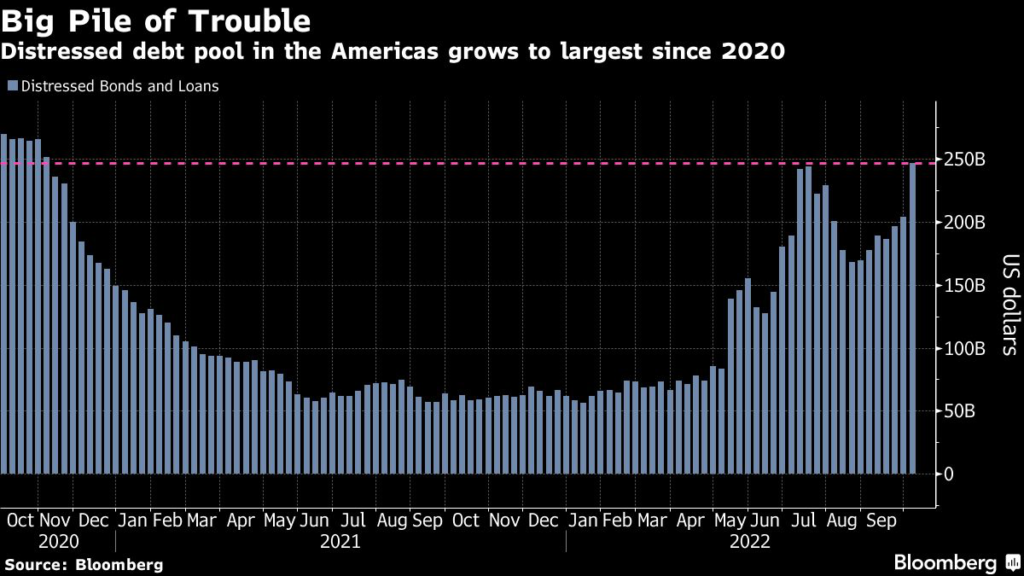
Read: Pile of Troubled Debt Surges to Highest Since Nov. 2020

The Fed is under even greater pressure to handle the hottest inflation in 40 years after a reading of September consumer prices came in above expectations. Higher interest rates make it more costly for companies with floating-rate loans to cover the interest on their debt.

At the same time, risky debt in the Americas is piling up. The heap of dollar-denominated corporate bonds and loans trading at distressed levels had risen to $246.6 billion as of Oct. 7, a 21% jump from a week earlier, according to data compiled by Bloomberg.

For UBS, the uptick in risk extends across the credit spectrum. Spreads for investment-grade debt will likely rise to 170 basis points by the end of the year, according to UBS, from 163 basis points currently. 

The strategists recommend allocating cash to super-safe A rated companies rather than those at the bottom of the investment-grade group. Risk is rising that firms with a BBB grade could get slashed to junk as conditions worsen. BBB companies in the consumer cyclicals, consumer finance and telecommunications sectors are at greatest risk for downgrades.

UBS also favors junk bonds over leveraged loans.

More stories like this are available on bloomberg.com

©2022 Bloomberg L.P.

IMF Warns Argentina of Ad-Hoc FX Rates Amid 100% Inflation

(Bloomberg) — The International Monetary Fund is urging Argentina against unconventional currency measures such as creating multiple exchange rates at a time when inflation is expected to reach 100% by the end of this year.

IMF Western Hemisphere Director Ilan Goldfajn cautioned Argentine officials against “different FX measures or prices or things like that.” 

“We continue to believe that this is the way forward not to have ad-hoc and separate measures,” Goldfajn told Bloomberg News in an interview on the sidelines of the IMF’s annual meetings in Washington. “If you have them, you should do it in a temporary basis and unwind them going forward.”

His comments come days after Argentina moved forward with new taxes applied to the official exchange rate for tourism abroad and some music concerts, piling onto a long list of informal exchange rates. 

Read more: Argentina Spawns FX Rates in Desperate Move to Avoid Devaluation

While Argentine officials don’t believe the new measures violate the program, Goldfajn is the second IMF official after Managing Director Kristalina Georgieva last week to push against the government’s currency strategy.

The IMF board approved a waiver for Argentina’s program last week for its “multiple currency practices,” after the government invented a new exchange rate just for soybean exporters in September. The waiver was approved because the exchange rate was temporary.

Goldfajn also conceded that Argentina’s inflation outlook has worsened since the $44 billion program began in March. Economists surveyed by the central bank in September see inflation reaching 100% by the end of this year. 

The fact that inflation expectations have “reached 100% is an issue that was not envisioned at the beginning,” Goldfajn said. On the program, “we believe that if it’s well implemented, we would like inflation to start to go down.”

Argentina’s dollar bonds have slumped to near-record lows around 20 cents on the dollar, and investors have been reluctant to bid up the notes despite the government’s progress in meeting targets under the IMF program. The nation’s $16.1 billion in bonds due in 2030 edged up 0.1 cent on Friday to 20.1 cents on the dollar.

Goldfajn said that his focus with Ecuador, another multi-billion-dollar IMF borrower in Latin America, is on implementing the nation’s current loan program rather than negotiating a new one, something that President Guillermo Lasso has indicated he’s interested in doing next year.

Asked about El Salvador, Goldfajn said that the nation is far from negotiating a program with the IMF based on fiscal, governance and Bitcoin issues that are “quite challenging at the moment.”

Other comments from Goldfajn:

IMF staff reviews on Argentina

  • “There’s also some forward looking in this review. We will look, if the budget is approved, it will need to be approved. So if it’s approved, it’s another sign that this is happening, and we will insist and we’ll continue to insist on the implementation of the program”

Argentina’s 2022 fiscal target of 2.5% of gross domestic product

  • “Whatever was delayed in the first half of the year needs to be compensated, and it’s already been started to be compensated.”

(Updates with bond prices in the ninth paragraph, further comments from Goldfajn)

More stories like this are available on bloomberg.com

©2022 Bloomberg L.P.

US Retail Sales Stagnate as Inflation, Rates Hit Consumers

(Bloomberg) — US retail sales stalled last month as shoppers grew more guarded about discretionary purchases amid the worst inflationary environment in decades and rising interest rates.

The value of overall retail purchases were little changed in September after an upwardly revised 0.4% gain in August, Commerce Department data showed Friday. Excluding gasoline, retail sales were up 0.1%. The figures aren’t adjusted for inflation.

Seven of 13 retail categories declined last month, according to the report, including a drop in receipts at auto dealers, furniture outlets, sporting goods stores and electronics merchants. The value of sales at gas stations fell 1.4%, reflecting cheaper fuel prices, but they’re now climbing.

It’s not clear the extent to which Hurricane Ian, which devastated Florida and parts of South Carolina late last month, impacted the data. That likely kept local residents from dining out while encouraging them to stock up in advance of the storm.

The weaker retail sales data underscore how consumers are feeling a bigger pinch from rampant price pressures. As inflation shows few signs of slowing, many Americans are still relying on credit cards and savings to keep up, and shelling out more on essentials leaves little leftover for discretionary purchases.

The Federal Reserve is expected to keep up its heightened pace of interest-rate hikes to quash demand across the economy, but the sales data suggest that’s already happening. The value of receipts at building materials outlets dropped 0.4% after robust gains in the prior two months, underscoring the impact of higher borrowing costs. Mortgage rates are currently the highest in two decades.

Risks are growing that tighter policy will tip the US into a recession at a time when consumers are already reeling from inflation, which could make the downturn that much more painful.

What Bloomberg Economics Says…

“Retail sales were better than they looked in September, enough to satisfy the Fed that stiff rate hikes are warranted through the end of the year. Even so, momentum is slowing as economic uncertainty rises, and lower prices may have helped restrain select categories as retail inventories climb.”

— Andrew Husby, economist 

For the full note, click here. 

Data out Thursday underscored the severity of the Fed’s inflation conundrum, with a key gauge of consumer prices jumping to a 40-year high last month. Inflation is well-outpacing wage gains, and much of the advance was traced to jumps in the cost of food, shelter and medical care.

“Higher borrowing costs and elevated inflation — that is not yet showing any sign of easing — will remain headwinds for spending going forward,” Rubeela Farooqi, chief US economist at High Frequency Economics, said in a note.

Besides not being adjusted for price increases, the retail sales report only captures a glimpse of services spending, where Americans have been shifting more of their dollars. A fuller picture of September household demand, which includes both services spending and inflation-adjusted figures, will be released later this month.

So-called control group sales — which are used to calculate gross domestic product and exclude food services, auto dealers, building materials stores and gasoline stations — increased 0.4% in September after an upwardly revised 0.2% advance in the prior month.

(Adds comment from Bloomberg Economics.)

More stories like this are available on bloomberg.com

©2022 Bloomberg L.P.

NYC Mayor Releases Tax Returns After Reluctance, Earned $245,324

(Bloomberg) — New York City Mayor Eric Adams released his 2021 tax returns on Friday, six months after he pledged to provide the public with information about his income, real estate earnings and charitable contributions.

The tax returns became an issue during his campaign for mayor after reports in The City found tax irregularities connected with his Brooklyn rental property. Adams initially refused to commit to releasing his returns before reversing course.

Adams reported $245,324 in federal adjusted gross income, including a nearly $180,000 salary from the city, police pension and and rental income, according to tax documents seen by Bloomberg.

He paid $56,074 in federal taxes, and had a 24% federal effective rate. He also paid $19,393 in state and local taxes for the year, and had a 10.1% state and local effective tax rate based on his New York state filing.

Read More: NYC Mayor Adams Tells Preet Bharara He’ll Release Tax Details

Adams claimed zero charitable gifts in his 2021 taxes. A City Hall spokesperson said that the mayor gave about $5,000 to charity last year but didn’t claim the donations because of a lack of receipts. The mayor also gave to individuals who were victims of crime, the spokesperson said.

A cryptocurrency booster who vowed to take his first three city paychecks in Bitcoin and Ethereum, Adams also checked a box on his tax filings signifying that he bought virtual currency in 2021. He didn’t claim capital gains or losses, suggesting he hadn’t sold crypto currency during 2021.

While the mayor reported receiving $24,600 in rental income on a Brooklyn townhouse where he has lived and rented out units, Adams claimed nearly all of it as expenses, paying taxes on only $3,429. There are four units at the property, including three rental units. 

The mayor, who has faced controversy about where he lives, also stated in the tax filings that he spent all of 2021 living in New York City. 

Adams is releasing the tax filings now because he filed an extension, a spokesperson said. The mayor tested positive for Covid shortly before the federal tax deadline.

While the disclosure of tax details is not required by law, the last five mayors in New York City released at least portions of their returns. That includes Adams’s predecessor Bill de Blasio, as well as Ed Koch, David Dinkins, Rudy Giuliani and Michael Bloomberg, the founder and majority owner of Bloomberg LP, the parent company of Bloomberg News.

More stories like this are available on bloomberg.com

©2022 Bloomberg L.P.
Meta’s Shares Are a Hard Sell as Good Old Facebook Days Are Over

(Bloomberg) — In most market environments, a company with one of the lowest valuations in the Nasdaq 100 Index, a solid balance sheet and sales growth averaging 34% a year would be an obvious buy. In the case of Meta Platforms Inc., it’s not so obvious. 

Since Mark Zuckerberg’s announcement a year ago of a name change and strategy overhaul for the owner of Facebook, the stock has wiped out more than half the gain it had seen since its initial public offering a decade ago. That’s cost Meta $600 billion in market value and a spot in the elite club of the US’s 10 biggest companies.

Analysts predict Meta’s revenue will drop this year for the first time ever, as competition and cooling economies, among other factors, cut into ad sales. User growth at its flagship product, Facebook, has slowed as a younger generation flocks to newer sites like TikTok. Meanwhile, the company is spending billions to realize Zuckerberg’s vision of the metaverse, that still-to-be-realized virtual world where people will work, shop and socialize. 

“There’s so many red flags relative to Meta,” said Matthew Kanterman, director of research at Ball Metaverse Research Partners. 

Which brings us back to the case for Meta being an obvious buy. So-called value investors, who love stocks that are widely out of favor, already started to build positions in the company this year. They may find it even more attractive now that it’s priced at only 10 times forward earnings, down from an average of 28 over the past decade and cheaper than old-school, dotcom-era tech favorites such as Intel Corp. and Cisco Systems Inc. 

Analysts predict that sales growth will resume in 2023 and rebound to double digits the year after that. The Menlo Park, California-based company is focused on a capitalizing on Instagram Reels, its rival to the TikTok video-sharing app. 

And Zuckerberg last month said the company will freeze hiring and restructure some teams to trim expenses and realign priorities, an acknowledgment that its days as a growth darling are over.

“While macro challenges persist, we believe improved Reels monetization, newer ad formats, and a greater focus on expenses create a compelling risk/reward in shares,” Ronald Josey, an analyst at Citigroup Inc., wrote in a report last week. He sees the stock gaining 70% in the next year.

Still, Meta is one for the brave in a world where tech stocks face an uphill battle of rising interest rates. The stock has fallen 61% in 2022, almost double the decline of the Nasdaq 100, pushing its market value down to around $350 billion from more than $1 trillion at its peak last year.


Tech Chart of the Day

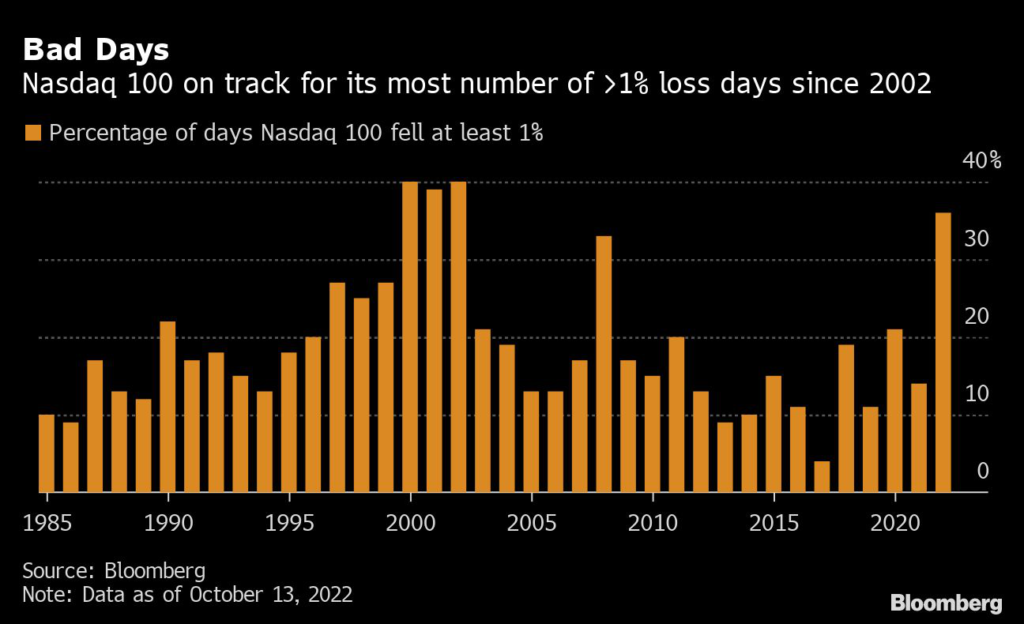
Thursday’s roaring rebound aside, this has not been a good year for technology stocks, with the Nasdaq 100 ending at least 1% lower in about a third of the trading sessions. That puts the tech gauge on track for the most number of days with at least a 1% drop since 2002. The Nasdaq 100 rose 1% on Friday.


Top Tech Stories

  • Twitter Inc.’s lawyers tried again last week to learn what Elon Musk had told federal authorities who were investigating his attempt to take the social media company private. The attorneys wrote to a judge on Oct. 6 saying they needed documents about the probes, according to a letter unsealed in court Thursday.
  • Musk warned his company SpaceX cannot help carry the cost of high-speed broadband internet for Ukraine indefinitely, after an earlier furor over his public comments suggesting the government in Kyiv cede territory in exchange for peace with Russia.
  • Fantasy sports site FanDuel won its appeal in a New York case brought by former founders, early investors and employees who claimed they were cheated out of the proceeds of its 2018 merger with Irish bookmaker Flutter Entertainment Plc.
  • Meta Platforms urged a judge to reject the US Federal Trade Commission’s attempt to block the company’s acquisition of virtual reality app Within Unlimited, saying the agency’s claims about competition in the area are based on “pure speculation.”
  • The Biden administration’s restrictions on semiconductor technology exports to China are designed to help the US maintain as large a lead in technology as possible over rivals, said a US official, who also addressed national security concerns such as China’s efforts to develop artificial intelligence that has military uses.
  • Taiwan Semiconductor Manufacturing Co. shares had their biggest jump in three months after the company slashed its 2022 capital spending target by roughly 10% and reported better-than-expected earnings.

(Updates to market open.)

More stories like this are available on bloomberg.com

©2022 Bloomberg L.P.

Close Bitnami banner
Bitnami