Bloomberg

FTC’s Phillips Steps Down, Leaves Agency With Republican Vacancy

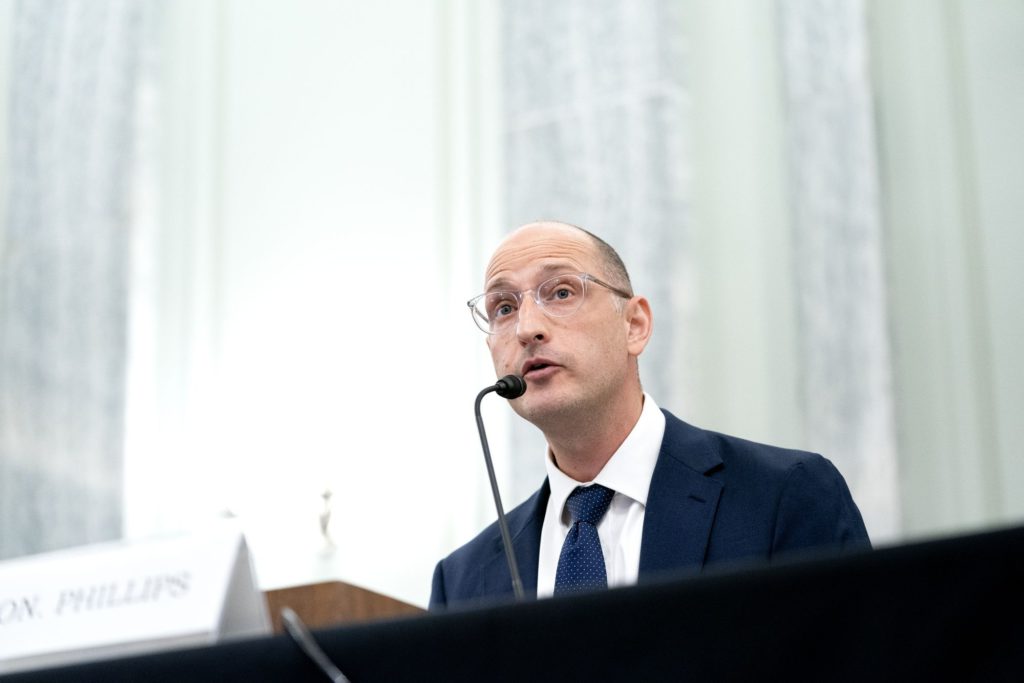
(Bloomberg) — Federal Trade Commissioner Noah Phillips will step down from his position Friday, leaving a Republican vacancy at the antitrust and consumer protection agency.

Phillips, a former Senate staffer, joined the agency in May 2018. He announced his intent to resign in August.

His departure will take the five-member commission down to four, with three Democrats and one Republican. 

Phillips has been an antagonist to FTC Chair Lina Khan, frequently voting against cases and policy statements she has made a priority. He twice voted against the agency’s monopolization case challenging Meta Platforms Inc. and more recently voted against a lawsuit to block Meta from acquiring virtual reality startup Within Unlimited. He has also opposed Khan’s efforts to undertake rulemaking, voting against a proposal this summer for FTC rules on “commercial surveillance.”

Khan, in a statement, made no mention of any ill-will toward Phillips.

“I’m grateful to Commissioner Phillips for his service to the FTC and to the American public,” Khan wrote. “Our agency has greatly benefited from his intellect and insights. I have appreciated his respectful engagement, especially when we’ve disagreed, and very much enjoyed being his colleague.”

President Joe Biden will select Phillips’ successor, though the president generally defers to Senate Minority Leader Mitch McConnell of Kentucky to suggest candidates to fill Republican vacancies. McConnell has been meeting with possible candidates since Phillips announced his resignation.       

Possible contenders include Mark Meador, a staffer for Utah Senator Mike Lee, the top Republican on Senate Judiciary’s antitrust panel; Svetlana Gans, a partner at the law firm Gibson Dunn & Crutcher LLP who served as chief of staff to former FTC Acting Chair Maureen Ohlhausen; and Olivia Trusty, a senior aide to Mississippi Senator Roger Wicker, the top Republican on the Senate Commerce Committee.

More stories like this are available on bloomberg.com

©2022 Bloomberg L.P.

Musk Sends Ukraine a Broadside With Threat to Cut Starlink Funds

(Bloomberg) — Elon Musk dramatically upped the ante with Ukraine on Friday with a threat to cut financial support for the Starlink satellite access that has played a pivotal role in the fight against Russia, with the world’s richest man saying he could not keep funding the service and others should step in.

Musk warned his company SpaceX cannot carry the cost of high-speed broadband internet for Ukraine indefinitely. It comes after sharp criticism from Kyiv for Musk’s public comments suggesting the government cede territory in exchange for peace with Russia.

Responding to recent comments from a Ukrainian envoy that he should “f*** off” for his proposals, which included UN-monitored referendums in Russian-occupied eastern Ukraine, Musk retorted on Twitter on Friday: “We’re just following his recommendation.”

As well as helping Ukraine’s forces on the ground, Starlink terminals have supported infrastructure across the country, and any move to withdraw them could potentially hinder progress in counteroffensives against Russian troops. It would also risk a backlash not just from Ukraine but also its allies who have provided financial and military support for months without conditions.

There was no indication that Musk was intending immediate action to withdraw Starlink from Ukraine. SpaceX “is not asking to recoup past expenses” on Starlink services in Ukraine, he said in another post, but it cannot sustain the financial aid or send thousands more terminals to Ukraine. 

Starlink terminals in Ukraine are using data as much as 100 times the amount of typical households, Musk added. A week ago he tweeted that Starlink in Ukraine had cost SpaceX $80 million, which would likely surpass $100 million by the end of the year. Musk’s net worth is $209.2 billion, according to Bloomberg data.

Mykhailo Fedorov, Ukraine’s minister for digital transformation, has said previously the country is getting Starlink terminals free of charge, although he added there might be a different arrangement between Musk and the US Agency for International Development and European entities which provided Starlinks to Ukraine. 

CNN reported on Thursday that SpaceX warned the Pentagon in September it may no longer partially fund Starlink in Ukraine unless the US military provides tens of millions of dollars of support per month. A White House spokesperson declined to comment on the CNN report.

“The Department continues to work with industry to explore solutions for Ukraine’s armed forces as they repel Russia’s brutal and unprovoked aggression,” Pentagon spokesman Todd Breasseale said in a statement that did not address whether a letter was received. “We do not have anything else to add at this time.”

There was no immediate comment from the Ukraine president’s office or the digitalization ministry.

Ukraine has 20,000 Starlink terminals, provided evenly by USAID, Poland, the European Union and private companies, according to an Oct. 5 report from state-run news agency Ukrinform that cited Ministry of Digitalization data.

Poland purchased 11,700 Starlink terminals for Ukraine, including 5,000 acquired by state-controlled refiner PKN Orlen SA, according to Janusz Cieszynski, the government official in charge of cybersecurity.

“SpaceX promised to cover the service cost for the terminals purchased by Orlen,” he said by phone. The Polish government, meanwhile, is “covering the full cost of service” for each terminal it bought “amounting to around $50 monthly” per device.

Musk angered Ukrainians — from President Volodymyr Zelenskiy down — with his recent suggestion that Ukraine should seek a negotiated solution to the invasion by Russia and cede Crimea, which was annexed by Moscow in 2014, for good. 

Musk also launched a Twitter poll asking citizens of recently annexed occupied parts of eastern Ukraine and Crimea to decide if they want to live in Russia or Ukraine, days after Ukraine, Europe and the US denounced the annexation moves of President Vladimir Putin.

At the time, Ukraine’s top diplomat in Germany, Andrij Melnyk, didn’t mince words in his response to Musk’s suggestion. In a further tweet, Melnyk had a dig at Musk’s Tesla vehicles.

On Friday, Musk responded to Melnyk’s remarks.

Ian Bremmer, head of political-risk consultancy Eurasia Group, wrote in a note to clients this week that Musk told him about speaking recently with Putin. 

Bremmer said that conversation came before Musk posted his tweets urging Ukraine to find a negotiated solution to the war. Both Musk and the Kremlin subsequently denied he had spoken with Putin this year.

EXPLAINER: How Musk Sparked a Race to Send Satellites into ‘LEO’

(Updates with fresh Tweets from Musk on Ukraine)

More stories like this are available on bloomberg.com

©2022 Bloomberg L.P.

US Equity Futures Tick Higher as Earnings Roll In: Markets Wrap

(Bloomberg) — US equity futures rose in choppy trading as JPMorgan Chase & Co. kicked off key earnings reports from big Wall Street banks. Bonds advanced, led by UK gilts which benefited from reports the government was preparing to scrap parts of its controversial tax-cutting plans.

Contracts on the S&P 500 and Nasdaq 100 erased earlier losses as corporate results started rolling in. JPMorgan shares rose about 2% in premarket trading after it beat Wall Street targets for earnings and revenue. Morgan Stanley shares dropped about 3% as equity trading revenue missed estimates. 

US banks are expected to post the biggest profit decline of any S&P 500 Index sector, according to data compiled by Bloomberg Intelligence. The fear is Fed tightening will spark defaults and force banks to set aside higher provisions against losses. 

“Even though investors may look through a disappointing CPI print, it will be a much higher bar to look through weak corporate earnings.” Invesco global market strategist David Chao told clients. “Growth is below trend and decelerating because the Fed is still tightening. This is a tough backdrop for risk assets.”

In Britain, government bonds rallied sharply as Prime Minister Liz Truss prepared to reverse parts of her tax-cutting program and ousted chancellor Kwasi Kwarteng. The pound weakened.

Her plans have roiled UK markets for weeks, forcing the Bank of England to launch an emergency bond-buying program. That program expires later on Friday.

“It does seem pretty clear that the government is preparing a U-turn on at least a very big chunk, if not half, the permanent tax cuts in the budget,” BlackRock Inc.’s chief macroeconomic strategist, Rupert Harrison, told Bloomberg Television. “And if we don’t get that, then the markets will react very negatively.”

A report showed US retail sales stagnated in September, suggesting inflation was starting to curb consumer purchases. Excluding gasoline, retail sales were up 0.1% compared with a forecast for an advance of 0.2%.

Elsewhere, oil headed for weekly losses as signs of a global economic slowdown and tighter monetary policy threaten to sap energy consumption. The International Energy Agency earlier warned crude production cuts agreed by OPEC+ group risked causing a price spike that tipped the global economy into recession. 

Crypto assets gained, with Bitcoin touching a one-week high, within reach of surpassing the $20,000 level. 

Some of the main moves in markets:

Stocks

  • Futures on the S&P 500 rose 0.5% as of 8:48 a.m. New York time
  • Futures on the Nasdaq 100 rose 0.5%
  • Futures on the Dow Jones Industrial Average rose 0.5%
  • The Stoxx Europe 600 rose 1.5%
  • The MSCI World index rose 0.6%

Currencies

  • The Bloomberg Dollar Spot Index rose 0.3%
  • The euro fell 0.4% to $0.9736
  • The British pound fell 0.9% to $1.1229
  • The Japanese yen fell 0.4% to 147.77 per dollar

Cryptocurrencies

  • Bitcoin rose 2.1% to $19,789.9
  • Ether rose 3.4% to $1,337.65

Bonds

  • The yield on 10-year Treasuries declined eight basis points to 3.86%
  • Germany’s 10-year yield declined 11 basis points to 2.18%
  • Britain’s 10-year yield declined 18 basis points to 4.02%

Commodities

  • West Texas Intermediate crude fell 2.1% to $87.26 a barrel
  • Gold futures fell 1% to $1,659.70 an ounce

More stories like this are available on bloomberg.com

©2022 Bloomberg L.P.

The Rise and Fall of Ocado: Middle-England’s Favorite Grocer Suffers Share Price Drop

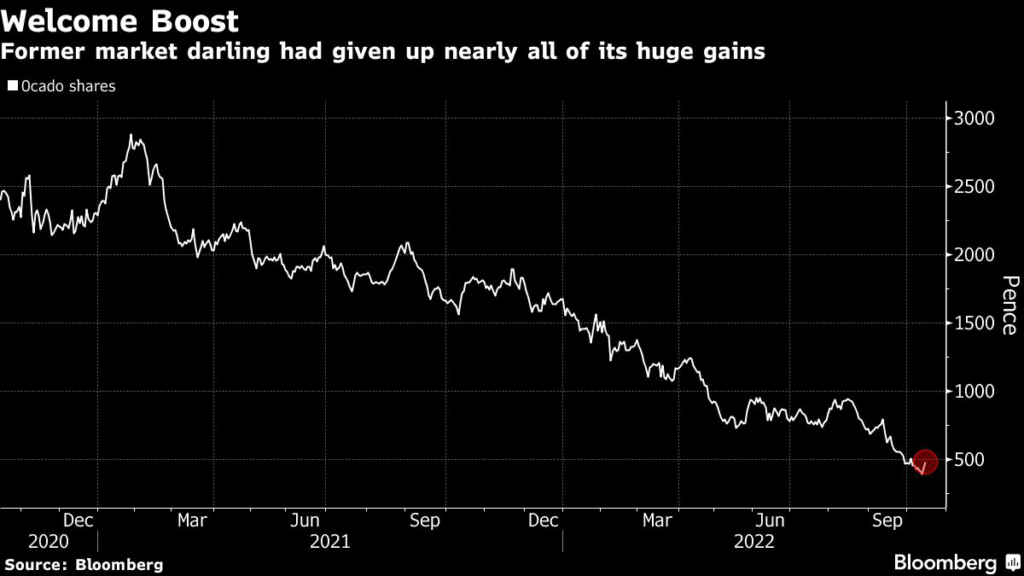
(Bloomberg) — Ocado Group Plc’s stock has gotten a much-needed boost from merger news involving one of its partners, stemming a slump that had seen the technology-focused UK grocer lose three quarters of its value this year.

Shares of Ocado rallied as much as 12% on Friday, after an 11% gain in the prior session, as Kroger Co. said it agreed to acquire rival Albertsons Cos. to create a US grocery giant, confirming an earlier Bloomberg report. The deal could mean an increase in the number of automated warehouses that Ocado is building for Kroger, according to Morgan Stanley. 

“The bull case here would be that Ocado’s exclusive relationship with Kroger could enable Ocado’s customer fulfillment centers to service the volumes from Albertsons in the future,” analyst Luke Holbrook wrote in a note to clients before Kroger and Albertsons confirmed their plans to combine. 

Holbrook expects the deal could potentially add seven more of Ocado’s customer fulfillment centers (CFCs) for Albertsons. Estimating a net present value of the CFC at roughly at 55 million pounds each, he says that could translate into a 47-pence-per-share gain for the UK company.

Kroger and Ocado already have a plan to build as many as 20 automated grocery warehouses in the US to help Kroger turbocharge its e-commerce operation.


The news pushed up more than Ocado’s equity: the company’s £500 million of convertible bonds maturing in 2025 also gained, while remaining well within so-called “distressed” territory, when prices drop below 80 cents on the dollar.

The upmarket grocery brand associated with Britain’s more affluent neighborhoods was once a market darling, but has suffered a remarkable change in fortunes, wiping out a 600% rally that began in 2018 and peaked during the pandemic.

It failed to capitalize on a surge in delivery demand spurred by Covid-19 lockdowns, while cash-rich rivals like Tesco Plc pushed ahead. Ocado’s ambition to license its robotic warehouse systems globally has also hit a speed bump as online penetration slowed. A recent sales warning triggered ratings downgrades from analysts at Credit Suisse and HSBC. And Morgan Stanley last week cut its price target to the lowest among 21 analysts tracked by Bloomberg, to 420 pence versus the current level of about 480 pence.

A spokeswoman for Ocado declined to comment.

Meanwhile, several analysts have buy-equivalent ratings on Ocado, including Bernstein, whose 1,500 pence price target suggests the stock could more than triple in value. Ocado’s international solutions business is “under-appreciated by the market,” analyst William Woods wrote in a note to clients.

Ocado was 11% higher by 1:30 p.m. in London Friday, headed for its sharpest two-day gain since May 2018.

More stories like this are available on bloomberg.com

©2022 Bloomberg L.P.

Electric Car Investment Envy Spawns a ‘Tax Break Industrial Complex’

(Bloomberg) —

The electric vehicle revolution will be subsidized.

China has been at it for more than a decade, incentivizing purchases, backing homegrown battery makers and blocking foreign firms from competing. Europe has followed suit with generous aid both for consumers and companies.

Now that electrification has taken root globally, and there’s a climate change believer in the White House, the US has jumped into the fray in a bigger way than ever before. First, there was the $7 billion tucked into the infrastructure bill last year. Then, hundreds of millions made available by invoking the Defense Production Act. And now, the mother of them all, the Inflation Reduction Act, which extends generous tax credits to buy, build and charge EVs, and localize the battery supply chain to power them.

All this global competition gets a lot of attention, but there’s another subsidy battle raging within America’s shores: a cutthroat fight among states to land EV and battery investments.

There were lots of headlines following Ford’s announcement a year ago that it would invest $11.4 billion in Tennessee and Kentucky to build two new EV hubs, the largest outlay in its history. General Motors also set a company record with its $6.5 billion investment in Michigan early this year.

What often ends up in the finer print of stories about these developments — if it gets mentioned at all — are the tabs that taxpayers pick up. States rarely disclose the amounts in full, instead dribbling them out over months in bits and pieces, or in response to public information requests. Even then, calculating a full package is like putting together a jigsaw puzzle.

Bloomberg dove into this in depth in this story yesterday, which coincided with a new report from Good Jobs First, a vocal critic of corporate incentives. Among the sweeping policy questions the nonprofit researcher raises: Why should states subsidize EVs when consumer demand is clearly taking off?

Also complicating matters: the notion that electric vehicles may end up being job killers, more so than job creators, if you net out all the losses linked to internal combustion drivetrain components that no longer will be needed.

Good Jobs First does a detailed analysis of some of the deals states have cut with car companies and battery manufacturers. Georgia’s $1.5 billion incentive package for Rivian, for example, prominently touts average annual wages of $56,000. One needs to scroll down 130 pages to find that the wage floor is $20 an hour, which works out to about $36,000 a year. The state’s economic development agreement also allows Rivian to use “employee leasing” companies to count toward its job-creation goals.

In Kansas, the incentive deal for Panasonic that Good Jobs First values at $1.27 billion includes some favorable clauses for the Japanese battery company. According to the report, Panasonic has to invest capital for five years to win income tax credits, but doesn’t have to guarantee certain levels of employment or wages. If the factory is unprofitable and doesn’t owe any tax, the state is still obligated to pay out money each year, as long as the investments are made.

People on the left and the right of the US political spectrum say corporate incentives can be wasteful and unnecessary. Even state officials who participate in the “tax-break industrial complex,” as the Good Jobs First report calls this phenomenon, acknowledge that it’s an unsavory game. But the feeling is they have little choice if they want to compete for these new jobs.

More stories like this are available on bloomberg.com

©2022 Bloomberg L.P.

‘Secretive’ OnlyFans Tries to Open Up in Move to Mainstream

(Bloomberg) — OnlyFans Ltd. executives have mapped out a plan to become more transparent and highlight less-explicit content at a time when the company’s home country is finalizing strict new online safety laws. 

“Amazon sell books on sex and gardening. Nobody calls Amazon an adult bookstore, right?” said Keily Blair, the London-based company’s strategy chief. “Our content creators provide content on anything from gardening to lady gardens, and for some reason, OnlyFans is ‘an adult-content site.’” 

The online platform is trying to move away from its “secretive” past, Blair said in an interview, and is working to be more communicative with journalists, banking partners, regulators and “anybody who wants to come and have a conversation with us,” particularly those who are critical.

Among those who have focused on OnlyFans have been UK lawmakers, who have voiced concerns the platform could escape oversight if parts of the new Online Safety Bill — expected to come into effect next year — only apply to services where there are a so-called significant number of child users. 

OnlyFans has had meetings with UK MPs about the bill, and backs the incoming legislation, Blair said.

“We are vocal supporters of the Online Safety Bill and any suggestions that we have or would attempt to dodge its requirements are not supported by factual analysis, evidence or statements by OnlyFans,” a spokesperson said.

According to OnlyFans’s own transparency reports, published on its website, the company removed more than a million posts for violating their acceptable use policy since July 2021, and takes down hundreds of accounts per month. 

It’s contributed 230 new instances of child sexual abuse material to the National Center for Missing & Exploited Children database in the same period. In comparison, much larger platform Meta Platforms Inc. said it acted on more than 20 million cases of such material in the second quarter of this year. 

More than 1,000 workers are dedicated to safety, and OnlyFans is hiring between 40 to 50 people per month. Many of those are responsible for moderating the 20 million monthly posts coming from its more than 2 million creators. Every post is reviewed within 24 hours of posting, after being triaged by image and word-recognition systems, which prioritize higher-risk material, OnlyFans said. 

Read More: OnlyFans Drops Plan to Ban Porn Content Amid Creator Uproar

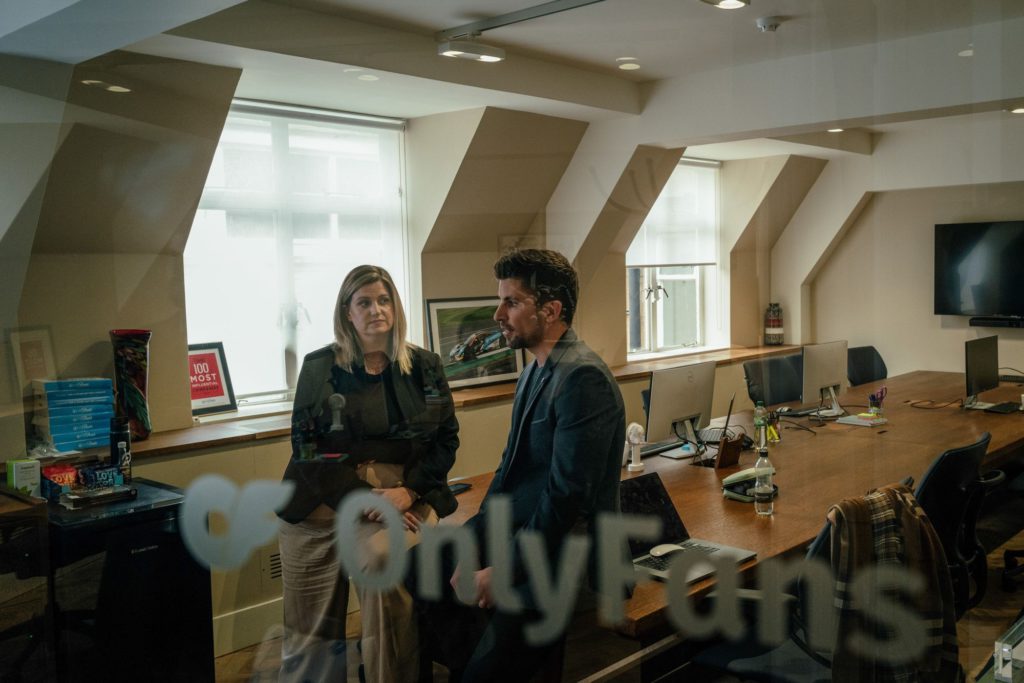
On a Tuesday visit, the offices were all but empty. But the company said its teams work remotely, and the moderators are contractors. OnlyFans doesn’t have a careers page on its website, and on LinkedIn there are just two vacancies advertised. 

Founded in 2016, OnlyFans is based in a small office in London’s Soho neighborhood – once the home of city’s red-light district but now home to media and fashion companies. The platform became wildly profitable during the Covid-19 pandemic, posting pretax profits of $433 million in the year ended Nov. 30, seven times more than it earned in the previous year. 

US-based investor Leonid Radvinsky, who acquired a majority stake in the business in 2018, has made more than $500 million in dividends from the platform since the end of 2020, the company said in its financial statements last month. 

OnlyFans subscribers pay content creators monthly fees and tips for access to exclusive photos, videos and conversations, and the company takes a 20% fee. It has attempted to broaden its offering beyond the adult content that it’s well known for, highlighting pages by chefs, musicians, celebrities and fitness trainers, and launching a mainstream streaming site similar to YouTube.  

Read More: OnlyFans Owner Gets Over $500 Million in Dividends in Two Years

“If you had an OnlyFans account, and you wanted to share cooking content on Monday, and spicier content on Tuesday, how would we categorize you? Are you a chef?” Blair said in a conference room that also acted as the main office, brimming with merchandise emblazoned with the blue and white OnlyFans logo, including t-shirts, hats and electric desk fans. 

Blair declined to comment on how much of the content hosted by the company is explicit.  

A search for “gardening” on OnlyFans’s free and safe-for-work streaming service OFTV brings up a video of a woman offering tips on planting pumpkins. The avatar for its creator’s OnlyFans account is more suggestive, wearing a small, purple bikini. A search for creators making “cooking” content on the site brings up similar, scantily clad results.

In August last year, OnlyFans said it would ban sexually explicit material, causing an uproar from creators and sex workers who had come to rely on the platform as a source of income. It soon reversed its plans, and blamed requests from “banking partners and payout providers” in its initial announcement.  

“Dear Sex Workers,” OnlyFans said in a tweet at the time, “The OnlyFans community would not be what it is today without you.” 

The public reaction convinced financial institutions to continue working with the company, Chief Financial Officer Lee Taylor said in the interview. He said OnlyFans now has a “vast” financial network across a range of payment processors, though he declined to name the payments firms that partner with the company. 

“The key focus for us is trying to challenge the mis-perceptions on us as a reputational risk,” Taylor said. The company is also looking at open banking partnerships, he said, which could bolster its identity verification and anti-money laundering controls. 

“We’re working with a couple of potential partners, which we’re hoping to announce later this month, or next month, to pick out some key tools in that technology that we can use,” he said.

(Updates with CFO quote in final paragraph.)

More stories like this are available on bloomberg.com

©2022 Bloomberg L.P.

US Tech Firms Hid Lobbying Efforts, European Parliament Says

(Bloomberg) — Meta Platforms Inc., Amazon.com Inc. and Alphabet Inc.’s Google funded an outside lobbying group to sway lawmakers on a major European tech law, but failed to disclose the connections, according to complaints filed by members of the European Parliament. 

In the complaints, three members of parliament said the big tech companies broke transparency rules for lobbyists and failed to list their members correctly, according to documents seen by Bloomberg and filed to the EU’s Transparency Register on Thursday.

The lawmakers are asking the transparency register to revoke the companies’ access to lobbying EU institutions if they’re found to violate the rules. 

The tech companies are accused of lobbying under the guise of a group that said it represents small and medium-sized businesses to try to influence the Digital Markets Act and Digital Services Act. The acts take aim at so-called gatekeepers, preventing them from giving preference to their own services and requiring the largest platforms to make messaging services interoperable. 

Read more: Big Tech Shadow Lobbying Campaigns Under Fire in EU Parliament

Lawmakers wrote they were unaware that messages from a group called the Connected Commerce Council during the run up to the DMA and DSA votes came from the likes of Google, Amazon and Meta.

“After the votes on both laws we learned the funding and source of these messages comes from a different angle,” they wrote.

The Connected Commerce Council, also known as 3C, said that it had received an inquiry from the Transparency Register in March and responded. The group was told the case was closed as of June. “Our filing is accurate and to the satisfaction of the Transparency Register,” Executive Director Rob Retzlaff said in an email. 

In a statement, Amazon denied working with the Connected Commerce Council on European issues, though it has partnered with the group in the US. “In the EU, Amazon has not asked the Connected Commerce Council to lobby on the DMA, DSA or any other European legislation,” the company said.

Google, meanwhile, said its work with the council “is clearly and transparently listed on our declaration.”

“We are committed to transparent engagement and declare our sponsorship and partnerships with various organizations in a comprehensive list on the register’s website,” Google said.

Meta didn’t respond to a request for comment on the news, which was first reported by Politico.

(Updates with comment from 3C in seventh paragraph)

More stories like this are available on bloomberg.com

©2022 Bloomberg L.P.
Crypto’s Justin Sun Says He Owns ‘Tens of Millions’ Huobi Tokens

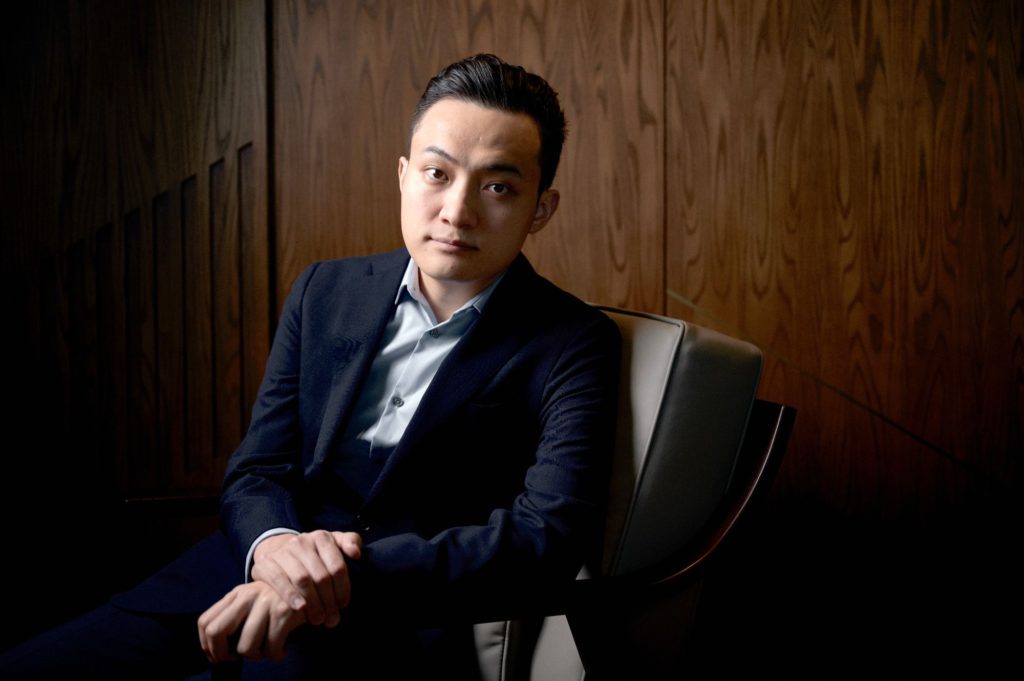
(Bloomberg) — Tron founder Justin Sun said he owns “tens of millions” of Huobi Tokens and that he intends to try and boost the latter now that he’s an adviser to its linked crypto exchange. 

“I would see myself as one of the biggest holders” of Huobi Tokens in the world, Sun said in a Bloomberg Television interview with Emily Chang on Thursday.

He added that he began accumulating the token associated with the Huobi crypto exchange in 2013. The coin has rallied about 80% in the last week after Sun became an adviser for the exchange.

Huobi is a top-10 crypto exchange globally, according to tracker CoinMarketCap, with about $879.5 million in volume in the last 24 hours. Sun said he hasn’t purchased a stake in the business.

Sun said he will also focus on taking Huobi global and eventually even back into China, if regulations allow.

Sun said his team has looked at assets of bankrupt crypto lender Celsius Network, but hasn’t decided whether to bid yet. Tron’s native token just became legal tender in the Commonwealth of Dominica, an island nation in the Caribbean.

The price of the HT token rose about 12% to $7.79 in the past 24 hours, according to pricing data from CoinMarketCap. 

(Adds trading in the Huobi token for Friday.)

More stories like this are available on bloomberg.com

©2022 Bloomberg L.P.

South Korea Cooperating With US on Chips, Still Has Concerns

(Bloomberg) — South Korea’s trade minister said key chip producers Samsung Electronics Co. and SK Hynix Inc. won approval from the US to keep operating in China, but that concerns remain over the impact of Washington’s sweeping new restrictions.  

“South Korea is fully cooperating with the US,” Ahn Duk-geun said in an interview with Bloomberg News, explaining that the US decisions were based on an understanding that Korean chipmakers’ fabs in China are crucial in stabilizing the global supply chain.

 “But we’re trying to ensure there’s no unnecessary problem with purely commercial-scale, low-end chips like the automotive ones at the center of supply shortages,” he said.

Ahn was speaking after the US imposed drastic new curbs on the ability of chip companies to do business in China, actions that incensed Beijing and provoked accusations of unfair targeting. The measures announced Oct. 7 also affect American allies, effectively forcing them to comply or to defy Washington. 

South Korean memory maker SK Hynix said Wednesday it had received approval from the US Department of Commerce to supply equipment needed to produce DRAM chips in its Chinese facilities without additional licensing for one year. Samsung also received a reprieve, according to people familiar with the matter. Samsung declined to comment.

The approvals are “absolutely different from a grace period,” Ahn said.

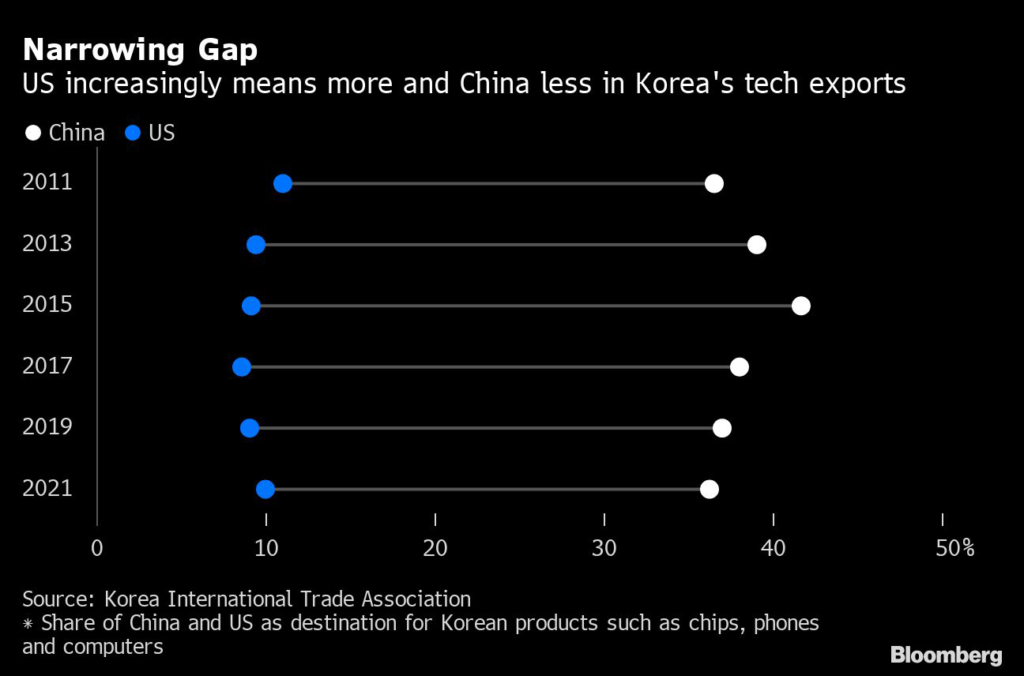
South Korea finds itself caught between its biggest trade partner in China and its US security partner over the Biden administration’s plans to secure supply chains for crucial components that steer clear of the government in Beijing.

Korean chip companies operating in China “might be doing their own calculations right now after the US export control measures were announced,” Ahn said. 

The Biden administration measures erect barriers of entry to China’s market by limiting the ability of US firms to sell equipment and tech to their Chinese counterpart. They led to a route of Asia’s top chip stocks this week, with more than $240 billion erased from the sector’s global market value at one point.

South Korea is finding it tough to keep pace with US plans for realignment of the semiconductor supply chains, Ahn said, adding: “But our stance is to cooperate and we’re trying to adjust the pace by considering the circumstances of our industries.”

Rahm Emanuel, the US Ambassador to Japan, told Bloomberg Television that the Biden administration’s moves present business opportunities for allies in line with US national security interests.

The US measures seek to stop China’s multibillion dollar drive to develop its own chip industry and advance its military capabilities. The impact could extend far beyond semiconductors and into industries that rely on high-end computing, from electric vehicles and aerospace to gadgets like smartphones.

“This will trigger Korean chipmakers’ changes in global operation strategy,” said Jeff Kim, analyst at KB Investment & Securities. He noted that about 45% of China’s memory chip demand is covered by South Korean semiconductors that are either imported from South Korea or made by Korean plants in China.

The flareup over chips follows South Korean anger at new US rules for electric vehicle and batteries that could disadvantage major South Korean brands like Hyundai and Kia, which don’t have operational EV plants in the US but are spending billions to do so in a matter a few years. 

Ahn said major South Korean manufacturers are taking “a cautious” approach as they look at steps to strengthen cooperation with the US. While South Korean chip companies may gradually phase out aspects of business with China that carry risks, it is too powerful economically to shun, he said.

“It’s true China is no longer the cash cow it used to be that we couldn’t do without,” Ahn said. “China and Korea are still very important trading partners to each other.” 

More stories like this are available on bloomberg.com

©2022 Bloomberg L.P.
Musk Ups Ante With Ukraine With Threat to Cut Starlink Funding

(Bloomberg) — Elon Musk upped the ante with Ukraine by threatening to cut off financial support for Starlink terminals that provide crucial broadband support in the war against Russia, putting pressure on other entities to step in and make up the shortfall.

Musk warned that his company SpaceX cannot help carry the cost of high-speed broadband internet for Ukraine indefinitely, after an earlier furor over his public comments suggesting the government in Kyiv cede territory in exchange for peace with Russia.

SpaceX “is not asking to recoup past expenses” on Starlink services in Ukraine, Musk said on Twitter on Friday, but it also cannot sustain the financial support or send thousands more terminals to Ukraine. 

The Starlink terminals deployed in Ukraine are using data as much as 100 times the amount of typical households, Musk added. A week ago he tweeted that Starlink in Ukraine had cost SpaceX $80 million, which would likely surpass $100 million by the end of the year.

Mykhailo Fedorov, Ukraine’s minister for digital transformation, has said previously the country is getting Starlink terminals free of charge, although he added there might be a different arrangement between Musk and the US Agency for International Development and European entities which provided Starlinks to Ukraine. 

The terminals are proving crucial in supporting infrastructure across Ukraine and for its troops on the ground against Russian forces.

CNN reported on Thursday that SpaceX warned the Pentagon in September it may no longer partially fund the Starlink service in Ukraine unless the US military provided tens of millions of dollars of support per month. 

Musk is the world’s richest man, with a net worth of $209.2 billion, according to Bloomberg data.

There was no immediate comment from the Ukraine president’s office or the digitalization ministry.

Ukraine has 20,000 Starlink terminals, provided evenly by USAID, Poland, the European Union and private companies, according to an Oct. 5 report from the state-run news agency Ukrinform that cited Ministry of Digitalization data.

Poland purchased 11,700 Starlink terminals for Ukraine, including 5,000 acquired by state-controlled refiner PKN Orlen SA, according to Janusz Cieszynski, government official in charge of cybersecurity.

“We cover the cost of the regular service payment for each of the purchased terminals,” he said by phone. “SpaceX promised to cover the service cost for the terminals purchased by Orlen, but the government of Poland is covering the full cost of service amounting to around $50 monthly for each terminal.”

Musk angered Ukrainians — from President Volodymyr Zelenskiy down — with his recent suggestion that Ukraine should seek a negotiated solution to the invasion by Russia and cede Crimea, which was annexed by Moscow in 2014, for good. Musk also launched a Twitter poll asking citizens of recently annexed occupied parts of eastern Ukraine and Crimea to decide if they want to live in Russia or Ukraine, days after Ukraine, Europe and the US denounced the annexation moves of President Vladimir Putin.

At the time, Ukraine’s top diplomat in Germany, Andrij Melnyk, didn’t mince words, using an expletive in a response to Musk’s suggestion.

On Friday, Musk responded to a Tweet criticizing a decision to cut spending — and referencing Melnyk’s profanity — by saying he’s “just following his recommendation.”

Ian Bremmer, head of political-risk consultancy Eurasia Group, wrote in a note to clients this week that Musk told him about speaking recently with Putin. Bremmer said that conversation came before Musk posted his tweets urging Ukraine to find a negotiated solution to the war. Both Musk and the Kremlin subseqently denied that he had spoken with Putin this year.

(Updates with fresh Tweets from Musk on Ukraine.)

More stories like this are available on bloomberg.com

©2022 Bloomberg L.P.
Close Bitnami banner
Bitnami