Bloomberg

US Stocks Rise Ahead of Fed; Short-Term Bonds Gain: Markets Wrap

(Bloomberg) — US stocks advanced and short-term Treasuries gained as investors debated whether inflation had eased enough to encourage the Federal Reserve to slow monetary tightening.

The S&P 500 and the tech-heavy Nasdaq 100 jumped after wavering earlier in the session. The policy-sensitive two-year Treasury yield hovered around 4.17%. The dollar slipped for a second day. 

A softer-than-expected figure for the US consumer price index stoked a rally across stocks and bonds on Tuesday, but the gains were tempered by caution that the Fed may still remain resolute on continuing rate hikes. While a 50 basis-point increase in Fed’s policy rate later Wednesday is firmly priced in, traders remain on the edge over what signals policymakers may offer on when the hikes will stop and whether a rate cut is possible next year.

“The whole concept that the Fed is going to pivot to us is way overdone,” said David Spika, president and chief investment officer of GuideStone Capital Management. “The bottom line is that inflation is still running over 7%, the Fed is going to have to continue to raise interest rates — Jerome Powell is going to make that very clear today.” 

If Powell highlights how perplexed he is that markets have eased since the last meeting, that would be interpreted as a hawkish signal, George Goncalves, head of US macro strategy at MUFG Securities Americas Inc., said in a note. 

“Markets are priced to a dovish outcome,” he said. “Anything short of it could still end up viewed as disappointing.”

In the UK, two-year gilts advanced. Inflation in the country fell from a 41-year high in November, raising the possibility that the worst of the cost-of-living squeeze is over.

Europe’s equity benchmark fell after posting the biggest single-day advance since Nov. 10 as caution prevailed over Fed’s messaging later in the day as well as expectations for rate hikes by the European Central Bank and Bank of England on Thursday.

West Texas Intermediate contracts rose for a third day and traded around $76 a barrel. Traders also weighed the demand outlook amid a rapid relaxation of Covid restrictions in China against the effect of new cases on economic activity in the country.

Key events this week:

  • FOMC rate decision and Fed Chair news conference, Wednesday
  • China medium-term lending, property investment, retail sales, industrial production, surveyed jobless, Thursday
  • ECB rate decision and ECB President Lagarde briefing, Thursday
  • Rate decisions for UK BOE, Mexico, Norway, Philippines, Switzerland, Taiwan, Thursday
  • US cross-border investment, business inventories, empire manufacturing, retail sales, initial jobless claims, industrial production, Thursday
  • Eurozone S&P Global PMI, CPI, Friday

Some of the main moves in markets:

Stocks

  • The S&P 500 rose 0.5% as of 10:08 a.m. New York time
  • The Nasdaq 100 rose 0.6%
  • The Dow Jones Industrial Average rose 0.4%
  • The Stoxx Europe 600 fell 0.2%
  • The MSCI World index rose 1.1%

Currencies

  • The Bloomberg Dollar Spot Index fell 0.1%
  • The euro rose 0.1% to $1.0646
  • The British pound rose 0.1% to $1.2384
  • The Japanese yen rose 0.5% to 134.96 per dollar

Cryptocurrencies

  • Bitcoin rose 1.6% to $18,048.1
  • Ether rose 1.5% to $1,339.44

Bonds

  • The yield on 10-year Treasuries declined one basis point to 3.49%
  • Germany’s 10-year yield advanced two basis points to 1.94%
  • Britain’s 10-year yield advanced three basis points to 3.33%

Commodities

  • West Texas Intermediate crude rose 1.8% to $76.77 a barrel
  • Gold futures fell 0.2% to $1,822 an ounce

This story was produced with the assistance of Bloomberg Automation.

–With assistance from Emily Graffeo and Isabelle Lee.

More stories like this are available on bloomberg.com

©2022 Bloomberg L.P.

Charter Falls Most Since 2020 as Spending Alarms Wall Street

(Bloomberg) — Charter Communications Inc. stock saw its biggest percentage drop in more than two years after announcing a large-scale broadband expansion plan that will cost far more than analysts anticipated.

The second largest US cable company unveiled a three-year network spending budget starting with $10.7 billion next year, $1 billion more than analysts estimated. The boost in spending will lead to “higher generational growth,” new chief executive officer, Chris Winfrey, told investors Tuesday evening.

The shift in spending toward infrastructure breaks from the industry’s lavish stock buyback trends and places a bigger bet on revenue growth that may be years away. Charter is also facing competition from fiber optic network operators and wireless home broadband providers.

“We see this as defensive relative to fiber,” Rosenblatt Securities analyst Barton Crockett wrote in a note Wednesday.

Cable, phone and satellite companies are vying for some of the $100 billion in federal funds aimed at expanding broadband service to poorer and more rural parts of the country. As past internet building booms have shown, one of the biggest risks to any venture is the high costs involved.

Charter fell as much as 14% Wednesday and was trading down 13.3% at $340.64 at 9:59 a.m. in New York. 

Charter and Comcast Corp., the largest US cable provider, have opted to take a different path than their telecom rivals. Instead of replacing their coaxial wires with higher-capacity fiber, the two companies have opted for a technology called DOCSIS 4.0 that uses amplifiers to allow existing cable systems to give customers multigigabit speeds.

Included in the overall capital spending plan is $5.5 billion over three years specifically for cable network upgrades to deliver higher-speed broadband connections to customers, Winfrey said.

The overhaul of the existing cable system is expected to cost about $100 per home passed and be completed by the end of 2024. Last month, Comcast said it would spend about $200 per home passed to upgrade its systems using amplifiers. That number compares with about $1,000 per home for laying new fiber optic cable lines. Neither amount includes the cost of connecting all the way to a home.

(Updates with share move.)

More stories like this are available on bloomberg.com

©2022 Bloomberg L.P.

Amazon Devices Chief Pledges Big Alexa Bets Despite Job Cuts

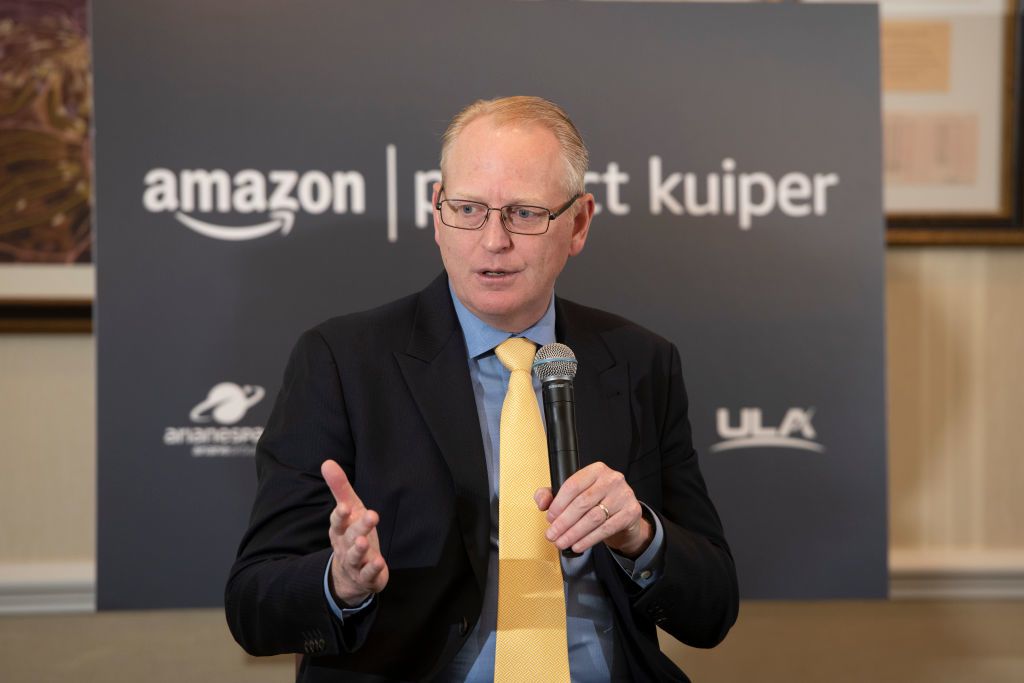
(Bloomberg) — Amazon.com Inc.’s devices chief said the company remains committed to building out the Alexa ecosystem despite job cuts in the once fast-growing division.  

When Amazon last month initiated its biggest-ever round of layoffs, they fell first and hardest on the Devices and Services group. The unit is responsible for the Alexa voice-activated assistant, Echo smart speakers, Fire streaming devices and home robots.

In an interview Tuesday, Senior Vice President Dave Limp called the cuts “a painful event and not one you ever want to do.”  

Still, he said: “Is there some lack of commitment to Amazon’s devices and services business? By any measure, the answer is no.” He cited continued big bets on Alexa, Zoox self-driving taxis and Kuiper internet satellites as evidence that Chief Executive Officer Andy Jassy is willing to invest billions on projects that might not pay off for years. 

“I’ve yet to be in a meeting where he doesn’t call out those as big inventions and big bets,” Limp said. “But at the same time, he also is inspecting them and spending time with them.”

Bloomberg and other news outlets reported that Amazon’s layoffs could total 10,000 employees companywide, though teams were still finalizing their plans. 

Job cuts in Limp’s division affected “well under 2,000 people,” he said, spread about evenly between groups working on the Alexa voice assistant and other teams. The group still employs “tens of thousands” of people, Limp said, with about 10,000 working specifically on Alexa-related projects—or about the same number as in 2018. Amazon also wound down teams working on Alexa-related telehealth services, original games and some unreleased projects. 

Alexa-powered Echo speakers were among the hottest consumer technology products when they debuted in 2014. People used the voice-activated devices to play music, find answers to trivia and other tasks. Amazon expanded the Alexa team rapidly in an effort to fulfill founder Jeff Bezos’s desire to re-create the Star Trek talking computer—and get there faster than Alphabet Inc. and Apple Inc.

But users have long expressed disappointment in what they see as the technology’s limitations. Many wound up using the speakers as a timer or weather announcer. Some stopped using them altogether. Inside Amazon, executives fretted that user engagement falls after the novelty wears off, Bloomberg reported last year. 

Limp insisted that engagement with Alexa has been growing and that the number of people using the software is at an all-time high. But he conceded that the devices group is still not profitable, though he disputed published reports that operating losses in recent years had totaled as much as $5 billion. (Limp declined to provide a precise figure.) 

The devices themselves are often sold at or near cost. Becoming profitable will require persuading customers who use the hardware to pay for such services as online shopping, music or audiobooks, Limp said.  

“I think the momentum of monetization of Alexa is on the right track,” he said.

On Alexa use 

The death of any consumer electronics business is when people start putting that device into a drawer. And I can assure you that is not happening with Alexa, Echo or other [technologies] that have Alexa on it.

On the proliferation of chatbots, like ChatGPT

I’ve spent a lot of time with a couple of these, just to benchmark them myself. I’d say our Q&A is one of the, if not the, best in the world. And these other models are not there yet. I think there’ll be different use cases for each of them. But, you know, the only downside—they work and they’re moving very fast—is just how expensive they are to train.

On virtual reality, augmented reality and the metaverse

I’ve been on record for a long time that I have nothing against VR, but I just don’t think it’s ever gonna be that big. It’ll have a gaming use case. It may have some enterprise use cases.

That being said, long-term, I think AR has a lot of benefits, and I think there will be a lot going on in AR because it’s less immersive. The last thing I want to do is drop into the metaverse for eight hours a day. Whatever your version of that metaverse is, that is a dystopian idea in my mind.

On Astro, Amazon’s limited-release home robot

I just feel like the whole industry’s not taking enough risk. And if you take that risk, you better be prepared to have very public failures too, right? You know, we did a ring with Alexa on it [that] didn’t work, and that’s okay. So Astro fits in that category, which is we have a long-term hypothesis, open to debate, that somewhere down the road, that every household is gonna have some form of robot in it. We have a lot of data that suggests why that’s the case. 

We have over 300,000 people in line for invites. The number of people that are converting is higher than we anticipated. 

On Jassy’s approach to new products, versus Bezos’s 

I think the places where he’s passionate, it might be they’re somewhat different and probably complementary to Jeff. Jeff was very into video and movies and those kinds of things. So he had lots of interesting suggestions and inventions in our Fire TV business as an example. Andy loves music. It’s like his passion is music. And so, his invention and inspection on things around Alexa and some of our speakers and those kinds of things has been awesome.

More stories like this are available on bloomberg.com

©2022 Bloomberg L.P.

Crypto’s Binance Seeks to Reassure Over Reserves, Says Debt Free

(Bloomberg) — Binance Holdings Ltd. founder Changpeng “CZ” Zhao said outflows from the largest cryptocurrency exchange have “stabilized” while warning employees that the industry’s recovery from rival FTX’s collapse will be “bumpy.”

In a tweet on Wednesday, Zhao said “things seem to have stabilized” and that “deposits are coming back in.” He’d earlier said Binance saw about $1.14 billion of net withdrawals on Tuesday. Binance has at least $60 billion in on-chain reserves, according to data from the blockchain analytics firm Nansen. 

Customers pulled funds from Binance’s platform this week amid a lack of confidence in the crypto sector following the implosion of rival exchange FTX. Sam Bankman-Fried, FTX’s co-founder, has been charged with fraud for allegedly misappropriating billions of dollars of customer money.

“People generalize. People get hurt by one exchange, and they lost money there, and they generalize that. That’s just human behavior,” Zhao said in a Twitter Space moderated by Binance on Wednesday. “There’s no amount of withdrawals that will put us under pressure.”

Binance weathered a record daily net outflow of Bitcoin and Ether in terms of the number of tokens withdrawn on Tuesday, according to research firm CryptoQuant. A net 40,353 Bitcoins and 278,017 Ether tokens were withdrawn, the figures indicate.

The crypto billionaire also sought to reassure his employees, saying in a memo to staff that Binance is in a strong financial position and “will survive any crypto winter.” 

“While we expect the next several months to be bumpy, we will get past this challenging period – and we’ll be stronger for having been through it,” he wrote in the memo, which was seen by Bloomberg News. 

A net $256 million flowed into Binance in the past 24 hours as of 12:25 p.m. in Singapore on Wednesday, according to data from Nansen. Over the past seven days, there was a net outflow of $1.2 billion. Nansen’s snapshot doesn’t take into account Bitcoin movements.

While Binance has seen outflows, Circle Internet Financial CEO Jeremy Allaire said during a CNBC interview Wednesday that demand has risen for its stablecoin, known as USDC. 

“We’ve seen a huge surge in USDC net issuance over the past 24 hours, increasing almost $2.5 billion dollars, while Binance USD declined by over $3 billion,” he told CNBC. 

Responding to questions about the recent outflows and concerns about transparency, a Binance spokesperson said by email: “People deposit and withdraw assets everyday for a variety of different reasons. User assets at Binance are all backed 1:1 and Binance’s capital structure is debt free.”

“We maintain hot wallet balances to ensure that we always have more than enough funds to fulfill withdrawal requests and we top up hot wallet balances accordingly,” the spokesperson added. Hot wallets are digital repositories for tokens that are connected to the internet.

Binance in a November blog post shared details of digital-asset wallet addresses with tokens worth about $69 billion. 

Last week, the exchange released a proof of reserves report. The document, based on a snapshot review by accounting firm Mazars, showed the exchange having sufficient crypto assets to balance its total platform liabilities. The report also acknowledged limitations, as it didn’t amount to a full financial audit that would give a clearer picture of Binance’s overall health.

“We are working collaboratively with Mazars to share all relevant financial information with them so that they can verify the accuracy of all the data we have shared as well as our process for extracting the data,” the spokesperson said. “We are working on getting the next update for additional tokens published as soon as possible.”

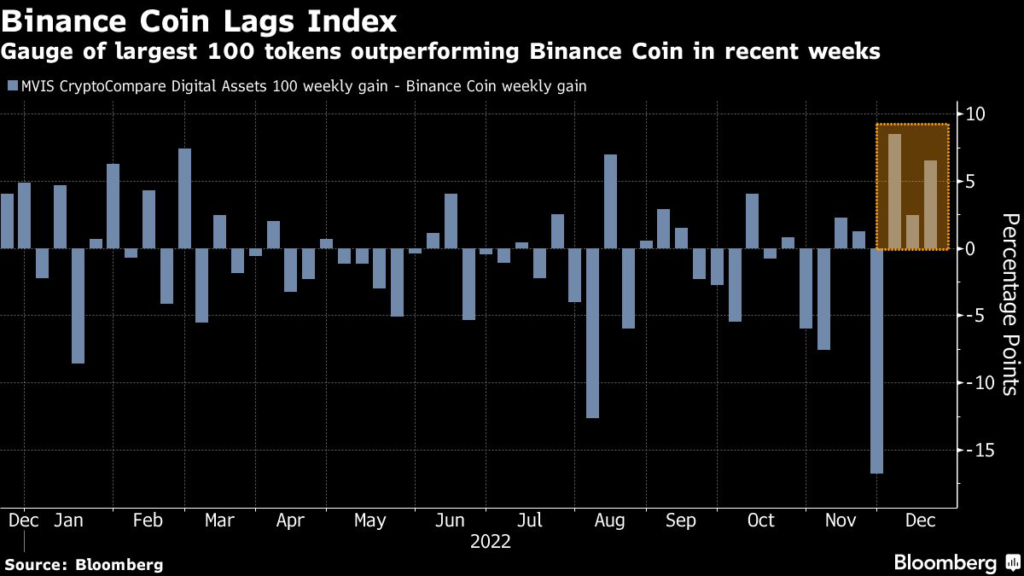
Binance Coin, the native token of Zhao’s ecosystem, could be viewed as an arbiter of investor sentiment toward the exchange. Over multi-year periods it’s significantly outperformed a gauge of the largest 100 tokens. But it’s down about 5% so far this week, even as the wider gauge has added roughly 2%, according to data compiled by Bloomberg.

For crypto market prices: CRYP; for top crypto news: TOP CRYPTO.

–With assistance from Emily Nicolle and Carly Wanna.

(Updates with comments from Circle CEO Jeremy Allaire in the ninth paragraph.)

More stories like this are available on bloomberg.com

©2022 Bloomberg L.P.

Twitter Suspends the Account That Tracked Elon Musk’s Private Jet

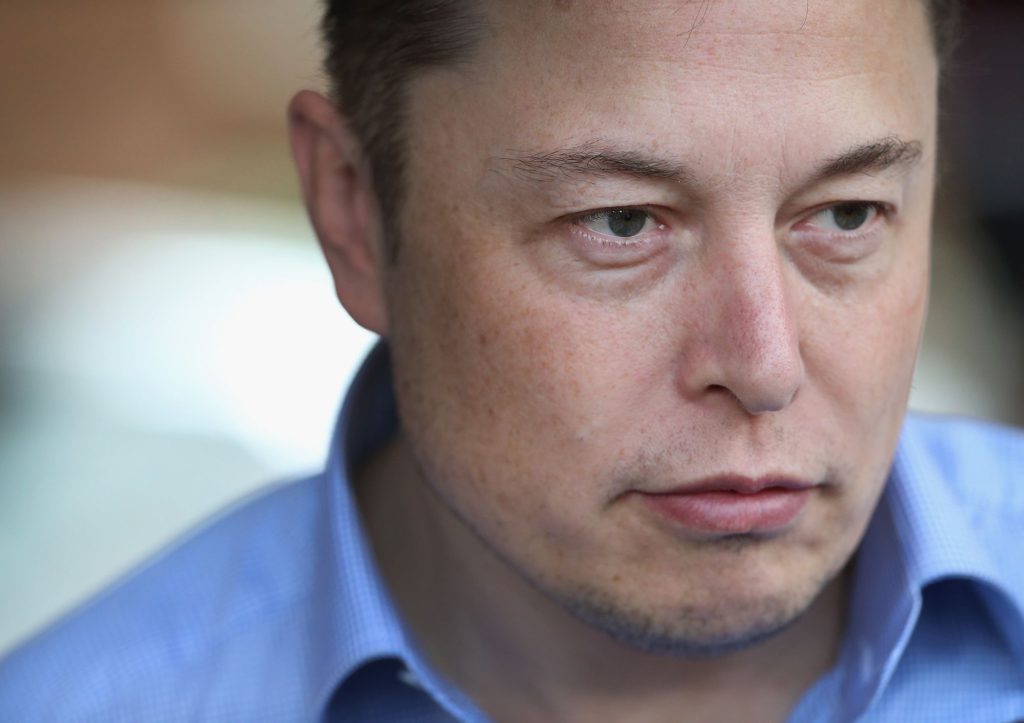
(Bloomberg) — A Twitter Inc. account tracking the movements of Elon Musk’s private jet has been suspended from the social media platform.

As of early Wednesday morning in New York, the @elonjet page showed a message that read “account suspended” with an explanation that Twitter suspends accounts that violate the platform’s rules. Musk bought Twitter for $44 billion in late October.

Musk and representatives for Twitter did not immediately respond to requests for comment. 

Jack Sweeney, who has run the account since June 2020, told Bloomberg News that, upon logging on to the account, his Twitter platform stated: “Your account is permanently suspended. After careful review we determined your account broke the Twitter rules. Your account is permanently in read-only mode.” 

Sweeney, a student at the University of Central Florida, said he hasn’t received any other notices from Twitter via email or other mediums.

The account tracks the movements of Musk’s private jet using publicly available flight data and gives automated alerts.

Sweeney, 20, turned down a $5,000 offer from the Tesla CEO in 2021 to shut down his bot account and countered with a demand to boost the payout to $50,000. Musk made multiple attempts to contact him to ask to shut it down, Sweeney has said.

Last month, Musk said in a tweet that his commitment to free speech “extends even to not banning the account following my plane, even though that is a direct personal safety risk.”

Sweeney operates other automated accounts through a business called Ground Control, including accounts that follow celebrity jets and one that purports to track planes used by Russian President Vladimir Putin and other government officials.

Read More: Teen Tracking Musk’s Jet on Twitter Is Making Contingency Plans

More stories like this are available on bloomberg.com

©2022 Bloomberg L.P.

US Equities Climb as Traders Await Fed Decision: Markets Wrap

(Bloomberg) — US stocks climbed and Treasuries were mixed as investors debated whether inflation had eased enough to encourage the Federal Reserve to slow monetary tightening.

The S&P 500 and the tech-heavy Nasdaq 100 rose tentatively. Shorter-term Treasuries gained and the dollar slipped for a second day. 

A softer-than-expected figure for the US consumer price index stoked a rally across stocks and bonds on Tuesday, but the gains were tempered by caution that the Fed may still remain resolute on continuing rate hikes. While a 50 basis-point increase in Fed’s policy rate later Wednesday is firmly priced in, traders remain on the edge over what signals policymakers may offer on when the hikes will stop and whether a rate cut is possible next year.

“The whole concept that the Fed is going to pivot to us is way overdone,” said David Spika, president and chief investment officer of GuideStone Capital Management. “The bottom line is that inflation is still running over 7%, the Fed is going to have to continue to raise interest rates — Jerome Powell is going to make that very clear today.” 

If Powell highlights how perplexed he is that markets have eased since the last meeting, that would be interpreted as a hawkish signal, said George Goncalves, head of US macro strategy at MUFG Securities Americas Inc., in a note. 

“Markets are priced to a dovish outcome,” he said. “Anything short of it could still end up viewed as disappointing.”

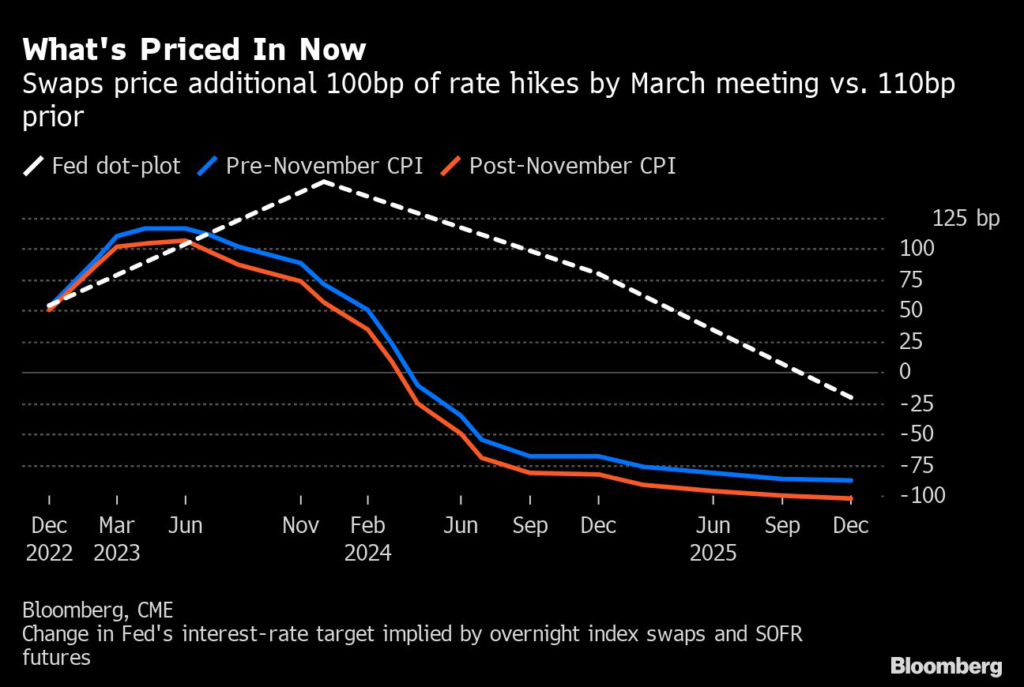
Treasuries with shorter-term maturities gained Wednesday, with the two-year yield shedding three basis points. The 10-year rate was little changed. Traders are betting that the Fed, after today’s move, will opt for 50 basis points more of hikes, and then an equivalent-sized cut by the end of next year.

In the UK, two-year gilts advanced. Inflation in the country fell from a 41-year high in November, raising the possibility that the worst of the cost-of-living squeeze is over.

Europe’s equity benchmark fell after posting the biggest single-day advance since Nov. 10 as caution prevailed over Fed’s messaging later in the day as well as expectations for rate hikes by the European Central Bank and Bank of England on Thursday.

West Texas Intermediate contracts rose for a third day and traded around $76 a barrel. Traders also weighed the demand outlook amid a rapid relaxation of Covid restrictions in China against the effect of new cases on economic activity in the country.

Key events this week:

  • FOMC rate decision and Fed Chair news conference, Wednesday
  • China medium-term lending, property investment, retail sales, industrial production, surveyed jobless, Thursday
  • ECB rate decision and ECB President Lagarde briefing, Thursday
  • Rate decisions for UK BOE, Mexico, Norway, Philippines, Switzerland, Taiwan, Thursday
  • US cross-border investment, business inventories, empire manufacturing, retail sales, initial jobless claims, industrial production, Thursday
  • Eurozone S&P Global PMI, CPI, Friday

Some of the main moves in markets:

Stocks

  • The S&P 500 rose 0.3% as of 9:37 a.m. New York time
  • The Nasdaq 100 rose 0.3%
  • The Dow Jones Industrial Average rose 0.2%
  • The Stoxx Europe 600 fell 0.3%
  • The MSCI World index rose 1.1%

Currencies

  • The Bloomberg Dollar Spot Index was little changed
  • The euro was little changed at $1.0639
  • The British pound was little changed at $1.2373
  • The Japanese yen rose 0.4% to 135.06 per dollar

Cryptocurrencies

  • Bitcoin rose 1.2% to $17,982.17
  • Ether rose 1.2% to $1,335.07

Bonds

  • The yield on 10-year Treasuries was little changed at 3.51%
  • Germany’s 10-year yield advanced two basis points to 1.95%
  • Britain’s 10-year yield advanced two basis points to 3.32%

Commodities

  • West Texas Intermediate crude rose 1.7% to $76.70 a barrel
  • Gold futures fell 0.2% to $1,821 an ounce

This story was produced with the assistance of Bloomberg Automation.

–With assistance from Emily Graffeo and Isabelle Lee.

More stories like this are available on bloomberg.com

©2022 Bloomberg L.P.

Avatar Sequel Helps Imax Bulls Make the Case That Cinema’s Not Dead

(Bloomberg) — The 2009 hit film Avatar was a watershed event for Imax Corp., and the release of the long-awaited sequel has underlined what investors see as a strong case for shares of the large-screen theater chain at a time when movie-going is out of fashion.

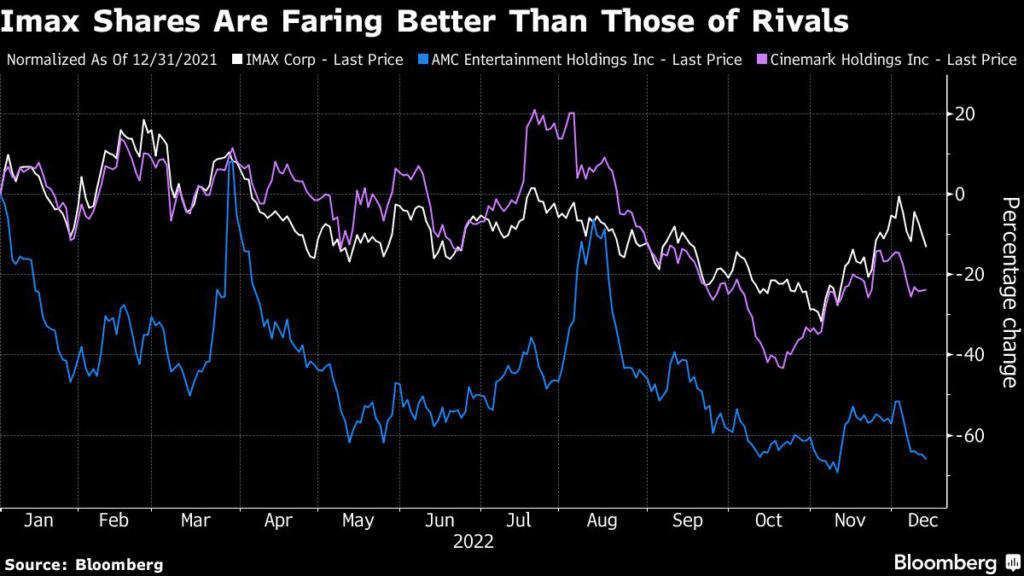
Imax’s shares have fallen less this year than those of rivals, benefiting from an environment that’s split between smaller films that increasingly go direct to streaming and blockbusters, where audiences have shown a willingness to pay up for a more immersive experience. The release Friday of Avatar: The Way of Water could prove to be the year’s foremost example of the latter.

Imax fell 1.1% on Wednesday.

“Avatar was developed with Imax equipment, for an Imax experience, so it will benefit from not only the box office, but also the exposure,” said Michael Obuchowski, chief investment officer at Merlin Asset Management, which owns the stock. “Imax is attractive any way I look at it, with a valuation that is incredibly attractive relative to its long-term growth potential, but the hype around Avatar will be really helpful.”

Imax shares have fallen 14% in 2022, compared with a 26% drop for Cinemark Holdings Inc. and a 66% collapse for AMC Entertainment Holdings Inc., one of last year’s most high-profile “meme” stocks. The S&P 500 Index is down 15.43%. 

Avatar, a science-fiction epic from director James Cameron, remains the highest-grossing film in Imax history. There were only 300 Imax screens when it was released in 2009, compared with more than 1,700 screens currently, the company said in an email.

The original opened just before Christmas 2009, but Cameron was already promoting the movie — and by extension, Imax cinemas — in the summer of that year. From June 30, 2009, through the end of 2010, Imax shares more than tripled. By early 2011, an analyst was calling Imax “the Louis Vuitton of theaters.”

An Imax spokesperson declined to give a projection on how the second film could perform, but said the company was “very optimistic.” 

Last month, Imax’s chief executive officer said the Walt Disney Co. sequel had “one of the highest pre-sale levels we’ve ever seen” for tickets, and noted it was cleared for release in China, Imax’s biggest market in terms of 2021 revenue. While China continues to struggle with Covid, Securities Daily last week reported that more than half of the country’s cinemas have resumed operations.

Big Screens 

This is a turbulent time for the film business: The pandemic shut cinemas around the globe, while at the same time streaming services sprang up that offer movies and TV shows with A-list talent and budgets, diminishing the allure of cinemas. According to Bloomberg Intelligence, year-to-date US box office receipts are a third lower than levels in 2019, the last pre-Covid year. 

However, 2022’s hits emphasize why more than 80% of analysts recommend buying Imax, compared with 50% for Cinemark, and none for AMC. The top-grossing films of the year — Top Gun: Maverick, Doctor Strange in the Multiverse of Madness, Black Panther: Wakanda Forever, and Jurassic World: Dominion — are the type of big-budget titles where studios favor theaters over streaming for initial releases, and which offer the type of spectacle Imax is associated with.

“The biggest movies are going to find an outlet, and Imax is the best venue for that,” said Jim Stoeffel, a portfolio manager at Royce Investment Partners, which owns Imax in several of its funds. “Its position in the industry is pretty secure, and I’m hard pressed to think of what might end that.”

Stoeffel also touted Imax’s valuation. The stock trades for 19.3 times estimated earnings and 2.4 times forward sales, both of which are below its 10-year average multiple. It is also cheaper than Cinemark and AMC in terms of forward earnings, while the 18% revenue growth expected next year eclipses the pace anticipated for the other chains.

“We see room for Imax to grow sales at a disproportionate level, and room on the valuation side,” Stoeffel said. “If Avatar is really big, we could see that upside come to fruition.”

Tech Chart of the Day

Tesla Inc. shares sank 4.1% Tuesday, with the electric-vehicle maker’s market value briefly dropping below the half-trillion-dollar mark. The stock, at its lowest since November 2020, is down 54% this year, compared with a 27% decline for the Nasdaq 100 Index. Tesla has recently been pressured by concern over electric-vehicle demand, as well as Chief Executive Officer Elon Musk’s preoccupation with the overhaul of Twitter.

Top Tech Stories

  • Apple Inc. is preparing to allow alternative app stores on its iPhones and iPads, part of a sweeping overhaul aimed at complying with strict European Union requirements coming in 2024.
  • The Biden administration plans to put Yangtze Memory Technologies and more than 30 other Chinese companies on a trade blacklist that would prevent them from buying certain American components, deepening tensions between the world’s two economic superpowers.
  • Dutch chip-gear giant ASML Holding NV has “given up enough” with the pre-existing restrictions on its sales to China, Chief Executive Officer Peter Wennink said.
  • Amazon.com Inc. faces a $280 million lawsuit from a Vietnamese manufacturer of warehouse storage systems that alleges the e-commerce giant abruptly scaled back orders after online spending growth cooled this year, leaving the manufacturer saddled with excess production capacity and raw materials.
  • Former Twitter Chief Executive Officer Jack Dorsey called recent online attacks on his former employees “dangerous” while taking the blame for controversial content decisions that the company made under his leadership.
  • Meta Platforms Inc. is facing a lawsuit in Kenya’s high court accusing the company of failing Africans by amplifying hate speech and incitement to violence on Facebook and calling for about $2 billion in restitution.
  • GoTo Group sold a stake in Indonesian convenience store operator Alfamart to focus on its main internet businesses and assuage investor concerns.
  • Paytm shares fell after the Indian fintech announced a buyback of as much as 8.5 billion rupees ($103 million), offering little respite to a stock down 75% since listing on bourses last year.
  • Food delivery unicorn Line Man Wongnai is in talks to acquire Delivery Hero SE’s Foodpanda in Thailand as it plans for a stock-market debut in the next few years, according to people familiar with the discussions.
  • Elon Musk’s prediction that Tesla would have an “epic” end of year looks more off base by the day. The ebullient outlook the CEO offered during the carmaker’s last earnings call has given way to price and production cuts in China. In the US, Tesla is offering consumers something previously unthinkable: a $3,750 incentive to take delivery of certain vehicles now, rather than wait for the new year.

–With assistance from Subrat Patnaik.

(Updates to market open.)

More stories like this are available on bloomberg.com

©2022 Bloomberg L.P.

Five Powerful Places That Reminded Me Why Travel Matters

(Bloomberg) — The year 2022 is when I traveled overseas in earnest for the first time since Covid-19 broke out, and it became one of my most meaningful years of travel. That might not seem surprising after a global pandemic restrained most of us, including this travel reporter, to backyards. But keeping my eye on the industry put a lot of things in perspective.

For years before Covid hit, I’d hop around the Caribbean and Central America, filling my days with ecolodge stays, rainforest hikes and community-led tours and sharing stories on how to explore this touristed region beyond experiencing just sand and sea. 

The pandemic predictably ended that blissful (if perpetually exhausting) run, and sent me on a path of reporting about the business side of tourism from within the walls of my home office. For two years, it meant diving into this industry’s negative impacts, made evident when global tourism vanished, and writing opinionated pieces as to how destinations might “build back better” to protect nature and benefit locals in a more equitable way. I wasn’t so optimistic that the industry would heed my advice.

How would I feel when international travel restarted and I got back on the road, as a tourist and as a skeptical tourism reporter?

This post-pandemic year of exploration unfolded as if the universe had tapped into my thoughts. And I learned: Being more intentional about our travel choices always pays off. 

From my first experience with Indigenous tourism in Canada, to learning Black American history I thought I knew (but didn’t), hiking my first volcano and getting out of my comfort zone at a Moroccan hammam, I’ve shed tears of joy at the sheer power of human connection.

Here are the five places I visited this year that reminded me why tourism remains a positive force in a world fraught with misunderstanding and misinformation.

Québec

“When I was young, my father used to tell me: ‘Don’t tell everyone that you’re Indigenous, you don’t need the attention,’ because I could pass as non-Indigenous,” said Dominic Ste-Marie. A member of the Huron-Wendat First Nations peoples in Canada, he had just concluded a fireside storytelling hour on their myths and legends. 

It’s one of many cultural activities available to guests at the upscale Hotel-Musée Premières Nations in Wendake, an urban reservation of the Huron-Wendat First Nations in Québec province. The storytelling takes place on hotel grounds, inside the Ekionkiestha’ National Longhouse—a towering structure made of wood and bark of the kind First Nations families in Canada used as a communal home in precolonial times.

While it sounds like a remote part of the country, we were staying a mere 15-minutes’ drive from Old Québec City. Indigenous tourism is a sector that contributed $1.9 billion to Canada’s gross domestic product in 2019. It’s predicted to boom as luxury travelers’ interest in Indigenous communities continues to grow in a world reckoning with race relations and our colonialist past. 

During the pandemic, there were grim discoveries of the remains of more than 1,000 Indigenous children in unmarked mass graves at former residential schools in Canada, state and Catholic Church-run boarding schools at which Indigenous children were abused and forced to assimilate into White Canadian society. Families from other parts of Canada are coming to Hotel-Musée Premières Nations in significant numbers, staff at the hotel said, bringing their children because parents want them to learn differently than they did about First Nations communities in Canada. 

Throughout my time here, it was impossible not to notice that tourism is a powerful tool for preserving a culture, instilling pride among its youth and boosting economic growth for communities. But experiencing Indigenous tourism in Québec, as I did, also made for a trip that’s packed with unique moments. My favorites were a talking stick crafts workshop at Musée Premières Nations, sampling First Nations and Inuit cuisine (bannock bread traditionally pit-cooked in sand; a kind of flatbread made of flour, water and sugar; bison soup, and deer meat poutine) and walking through the Onwha’ Lumina night forest show, which tells the story of the Huron-Wendat peoples through mesmerizing visual and musical sound effects. 

On my final day, I made it to Old Québec City, long on my list of places to visit, and dined at Sagamité restaurant in the heart of the colonial city. It was the first and only Indigenous-owned restaurant to open here in 2019. 

El Salvador

Are you skeptical? So was I. El Salvador attracted a ton of coverage when it adopted Bitcoin as a formal currency in 2021, the first country in the world to do so. But I was more intrigued by the government’s draconian crackdown on gangs as it unfolded on social media. It was leading to a rebound in the tourism industry; more safety means more visitors, to the point where the country’s tourism revenue has surpassed 2019 levels. 

I wasn’t prepared for what I experienced: excellent roads hugged by lush, green landscapes, scenic coastlines dotted with small, clifftop restaurants, the coffee plantations and the Pacific black-sand beaches where surfers ride the waves at sunset. 

Did you know El Salvador is home to over 100 volcanoes, 14 of them active? I’ll never forget the panoramic mountain views as I hiked toward the summit of Ilamatepec, or Santa Ana, the country’s highest volcano at 7,811 feet above sea level. The thrill of standing on the crater’s edge and staring into a deep-emerald sulfur pool is a memory that continues to overwhelm me, a reminder of the tiny place I occupy in the universe. While we were there, a group of about eight tourists showed up behind us, the most we’d seen during our trip. 

Countless moments revealed the soul of this tiny nation, with none quite like the Sunday we spent with our local guide Osmaro from Eco Tours Petate on the Ruta de Flores (Flower Route). The “flowers” represent five mountainside villages with Indigenous roots that are close to one another, starting from the Pacific resort town of El Zonte, an hour’s drive west of San Salvador.

We shopped handmade crafts in Nahuizalco at the Centro de Desarollo Artesanal, a boutique and school that are part of the government’s effort to revive artisanal skills through tourism. We walked along the colorful murals of Ataco, and enjoyed lunch at the lively Sunday food festival in Juayua. All the while, local families relaxed in beautifully landscaped central parks, and young Salvadorans sang their hearts out in central squares. At the end of each day, we’d relax in one of three infinity saltwater pools at Atami Resort, a family-friendly pick on El Salvador’s southern coastline. 

Cartagena, Colombia

Colombia was a week from electing its first Black female vice president when I visited in May 2022, and Bogota’s public squares were buzzing with political rallies. By contrast, Cartagena was crowded with tourists enjoying this seaside historical city. I promised my husband we would take fewer tours on our itinerary—an occupational hazard of mine—and would take in plenty of idle days at the luxurious Casa del Arzobispado.

We wound up exploring more than lazing by our hotel’s gorgeous courtyard pool. How could we come this far and not visit San Basilio de Palenque, the first free African settlement in the Americas? The village of Palenque was founded in 1691 by enslaved Africans who managed to flee the nightmare of Spanish-run slave plantations to form a settlement. 

A Colombian friend and Cartagena native put me in touch with Victor Simarra, born and raised in Palenque, to be our guide for a day. Victor led us on a walk while sharing stories of growing up in the village. He’d occasionally pause to greet people, which made us feel as if a friend were showing us his hometown. He is known for having helped preserve Palenque’s traditional cuisine and for guiding the women of the village into authoring an award-winning book of recipes. 

Already familiar with much of this region’s history, I wasn’t expecting to learn anything surprising. Palenque proved me wrong. At the community-run Casa Museo Palenque, portraits of African women in braids caught my attention: In colonial times in Cartagena, African women used their braids to communicate about escape routes from Spanish plantations. They also used their hair to hide gold coins and seeds of rice, corn and beans that they would then plant where they lived in hiding, in present-day Palenque. The village has become a major tourist draw, attracting Black American travelers in particular. 

Memphis

It’s curious that I knew more about Colombia’s colonial history than I did key of details of Black American history. For instance, I didn’t know that when Martin Luther King Jr. was assassinated, it took place in Memphis, at the Black-owned Lorraine Motel. Neither did I know that you can visit this location, now the powerful National Civil Rights Museum. I spent more than two hours immersed in historical multimedia displays about slavery in the US, racial segregation and the battle for civil rights, starting with the transatlantic slave trade. It wasn’t enough time. 

Memphis schooled me further when I visited Stax Records’ original studio location, home to the Stax Museum of American Soul Music. The vinyl records of soul music I’d heard my mother blast as a child, when we lived halfway around the world in West Africa—Otis Redding and Issac Hayes, among others—were created here.

Even more remarkable is that Stax Records was an interracial company whose studio featured Black and White artists and producers working side by side in the middle of a segregated city. After King was assassinated, Stax artists heightened their activism through music, fighting racism and segregation.

Morocco

Morocco’s historic advancement to the 2022 World Cup semifinals has earned it a lot of attention, but this North African country—also rich in musical heritage—was already becoming more popular. It’s now experiencing a rebound that was grandly visible in Marrakech: Last month, Yves Saint Laurent’s Majorelle Gardens overflowed with tourists Insta-posing on every corner.

As my trip took in Morocco’s medinas, non-European parts of walled cities and seaside towns, I fell in love with this country that effortlessly blends adventure and tradition with pampering. Whether it’s a three-course Moroccan lunch at the family-owned Riad Kniza, the sounds of live Moroccan ballads on guitar or dancing under the stars with Gnaoua musicians at Yes We Camp’s desert glamping lodge, each lavish moment surpassed the previous one. 

The most teachable moment came while I was getting a full Moroccan hammam treatment at Les Bains du Lotus, tucked inside the medina of Marrakech. Goodbye, modesty: The bathhouse attendant scrubbed and cleaned my body like a baby for two hours as I laid still in a flimsy paper thong. When she’d signal to sit up or turn around every 20 minutes or so, I’d blurt out: “That’s it, right?” Eventually, she burst into laughter at my discomfort. I joined in and stopped resisting, remembering that this is what travel is about.

More stories like this are available on bloomberg.com

©2022 Bloomberg L.P.

Charter Drops After Spending Plan Exceeds Wall Street View

(Bloomberg) — Charter Communications Inc. fell as much as 10% after announcing a large-scale broadband expansion plan that will cost far more than analysts anticipated.

The second largest US cable company unveiled a three-year network spending budget starting with $10.7 billion next year, $1 billion more than analysts estimated. The boost in spending will lead to “higher generational growth,” new chief executive officer, Chris Winfrey, told investors Tuesday evening.

The shift in spending toward infrastructure breaks from the industry’s lavish stock buyback trends and places a bigger bet on revenue growth that may be years away. Charter is also facing competition from fiber optic network operators and wireless home broadband providers.

“We see this as defensive relative to fiber,” Rosenblatt Securities analyst Barton Crockett wrote in a note Wednesday.

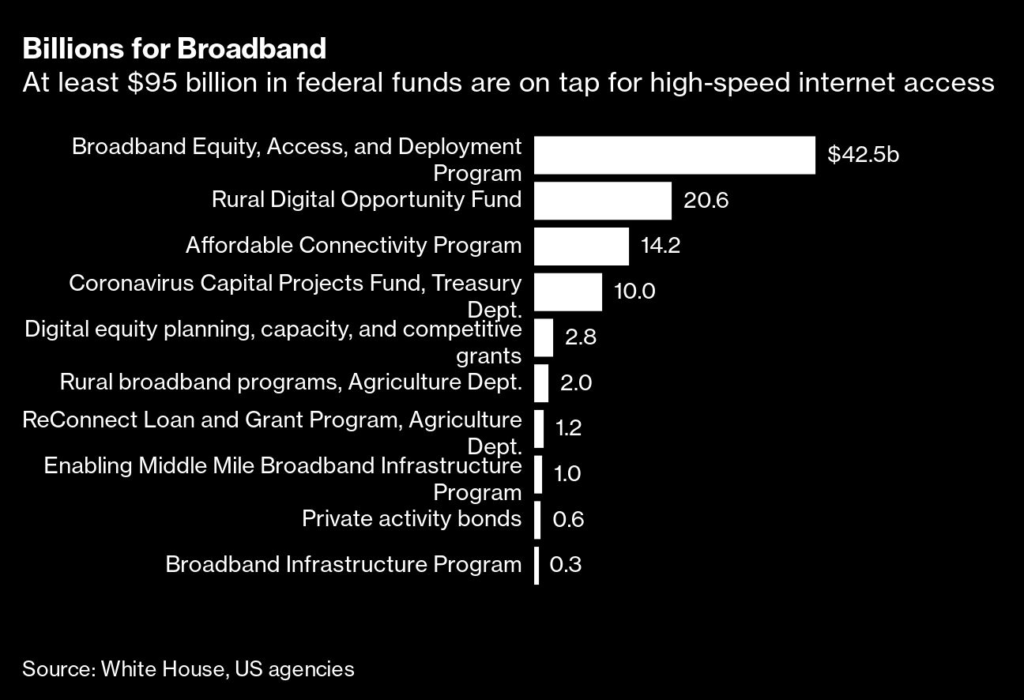
Cable, phone and satellite companies are vying for some of the $100 billion in federal funds aimed at expanding broadband service to poorer and more rural parts of the country. As past internet building booms have shown, one of the biggest risks to any venture is the high costs involved.

The stock slipped 10% in early trading at 8:58 a.m. in New York. Charter had already fallen 40% so far this year.

Charter and Comcast Corp., the largest US cable provider, have opted to take a different path than their telecom rivals. Instead of replacing their coaxial wires with higher-capacity fiber, the two companies have opted for a technology called DOCSIS 4.0 that uses amplifiers to allow existing cable systems to give customers multigigabit speeds.

Included in the overall capital spending plan is $5.5 billion over three years specifically for cable network upgrades to deliver higher-speed broadband connections to customers, Winfrey said.

The overhaul of the existing cable system is expected to cost about $100 per home passed and be completed by the end of 2024. Last month, Comcast said it would spend about $200 per home passed to upgrade its systems using amplifiers. That number compares with about $1,000 per home for laying new fiber optic cable lines. Neither amount includes the cost of connecting all the way to a home.

(Updates with capital spending increase starting in first paragraph and share move.)

More stories like this are available on bloomberg.com

©2022 Bloomberg L.P.
FTX US Eyed High-End Office Space in Miami Before Bankruptcy

(Bloomberg) — If FTX didn’t collapse, a handful of the crypto exchange’s executives would be working out of a posh office building in the heart of Miami’s financial district.

The now-bankrupt FTX was set to move into a 35-story, high-end tower at 1450 Brickell Ave. in Miami’s financial district, according to people familiar with the matter, who asked not to be named. The new office space would have housed most of FTX US, one of the few businesses of Sam Bankman-Fried’s crypto empire that he recently said remains solvent, at least to his knowledge. The move was part of FTX’s larger plan to relocate its US headquarters to Miami from Chicago.

Representatives from FTX in Miami did not respond to requests for comment.

According to an online listing for available space at 1450 Brickell, annual rent at the “state-of-the-art trophy tower” is roughly $90.00 per square foot. Blanca Commercial Real Estate, the broker responsible for leasing space at the property, declined to comment. 

A month before FTX’s unraveling, the company encouraged its staff to move to Miami by mid-November, according to crypto publication The Block. One FTX executive, Ramnik Arora, head of product at FTX, had planned a trip to Miami around that time, according to an October email seen by Bloomberg.

Before the company announced in September plans to relocate to Miami, FTX already had an outsized presence in the city. Last year, the company set up in smaller offices for just under 20 employees in the financial district. 

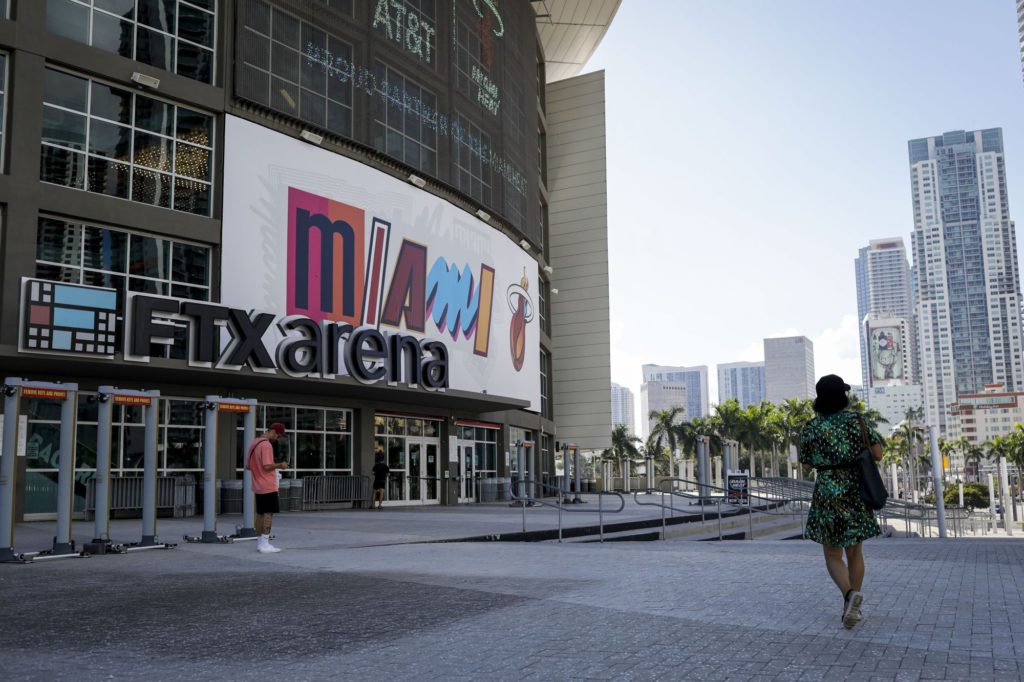
In 2021, the company signed a 19-year, $135 million sponsorship agreement with Miami-Dade County, giving Bankman-Fried the right to scrawl the company moniker atop the Miami Heat NBA team’s arena. 

Last year, the company held parties at the Art Basel Miami extravaganza and earlier this year it hosted a festival in South Beach for Formula 1’s Grand Prix and a community-oriented FTX Charity Hackathon.

Read more: Bankman-Fried’s FTX Trashed in Miami as Crypto Diehards Party On

When Bankman-Fried filed for bankruptcy in November, FTX’s relationship with Miami and Florida quickly soured. Miami-Dade County asked a federal bankruptcy court for the right to strip the FTX name off the arena.

Just two months earlier, Mayor Francis Suarez tweeted his support of the move, welcoming the company. 

–With assistance from Hannah Miller.

More stories like this are available on bloomberg.com

©2022 Bloomberg L.P.
Close Bitnami banner
Bitnami