Bloomberg

Tencent-Backed Airwallex Retains $5.5 Billion Value With Funding

(Bloomberg) — Payment platform startup Airwallex has raised $100 million in an extension of its series E funding round while keeping its previous valuation amid current market volatility.

Australian industry superannuation fund HostPlus and a North American pension fund participated in the extension along with existing investors including Tencent Holdings Ltd., Airwallex said in a statement Tuesday. The company was able to maintain its valuation at $5.5 billion, according to the statement, which didn’t identify the pension fund.

Other existing investors in the round extension were 1835i Ventures, Hermitage Capital, Lone Pine Capital, Salesforce Ventures, Sequoia Capital China and Square Peg. The new funds propelled Airwallex’s total funding to more than $900 million as it continues to boost global growth.

Airwallex had been in talks with prospective investors including payments giant Visa Inc. as it was seeking to raise from $100 million to $150 million, Bloomberg News reported in July. The company is considering an initial public offering as soon as 2024, people familiar with the matter have said.

Founded in 2015 by the owners of a coffee shop in Melbourne, Australia, Airwallex provides services including cross-border end-to-end payments and collection solutions for customers. It has more than 1,000 employees in 19 offices in countries including China, Australia, Japan, the US and the UK, according to its website. 

The company has hired Morgan Stanley investment banker Justin Yek as it continues to expand, Bloomberg News reported last month.

More stories like this are available on bloomberg.com

©2022 Bloomberg L.P.

Serena Williams’s Firm Invests in Nigerian Data Provider Stears

(Bloomberg) — Serena Williams’ venture capital firm is backing Nigerian data and insights firm Stears Inc. in a $3.3 million seed round led by MaC Venture Capital.

The investment is one of just a handful in Africa for Serena Ventures, whose founder announced that she would turn more of her attention to investing following her retirement from tennis after the US Open in September.

“One of the main reasons I invested in Stears is not because of my love and appreciation for Africa, but because Stears has strategically thought of how to increase the investment community on the continent,” Williams said in an emailed statement. “They’re aware of the complexities and have leverage with data and technology and I truly respect what they’re doing.”

Stears, based in Lagos, offers data collection, production, advisory and analysis services. Its products include Stears Insights, the company’s flagship digital publication, which provides analysis-driven content to its subscribers.

Other participants in the round included Melo7 Tech Partners LLC, Cascador, Hoaq Club and return investor Luminate Fund of the Omidyar Group, according to co-founder and Chief Executive Officer Preston Ideh. Stears declined to provide valuation information.

The company has grown thanks to paid subscriptions, making it a rare subscription success story in Nigeria, where consumers are generally unaccustomed to pay walls for information.

The Stears round comes in a year that has been a historic high for African startup funding. Even so, early-stage African companies tend to raise less than their US counterparts, according to data compiled by Bloomberg. The median investment for African seed rounds this year is $2.6 million, compared with a median of $4.5 million in the US.

Stears was launched in 2017 by four co-founders who met during secondary school at Loyola Jesuit College in Abuja, Nigeria, and at the London School of Economics and Imperial College in the UK.

The company plans to use the new funding to expand its coverage geographically by establishing a presence in East and Southern Africa, Ideh said. In addition, Stears will expand its product breadth beyond insights to data, deepen data partnerships, and collect its own proprietary data, to which it will license access, he said.

While it started as an online publication, Stears now considers its main competitors to be other data and intelligence providers, Ideh said in an interview. Some Stears readers rely on its Insights product as an alternative to Bloomberg News and other information services. The company plans to launch a service for proprietary data on Africa that will compete more directly with Bloomberg LP, according to a statement from the company.

Stears said in a statement that its user base has grown at around 6.5% month-on-month, doubling the company’s number of users over the last year. Enterprise customers make up more than 75% of revenue, up from 45% in 2021. The company said its revenue in the first half of 2022 surpassed that for all of 2021.

Institutional Clients

Its largest institutional clients — accounting for 90% of enterprise revenue — are international organizations such as the European Investment Bank, United Nations Development Programme and the UK’s Foreign, Commonwealth & Development Office, all of which use Stears to collect or analyze data. The remaining 10% of enterprise revenue comes from Nigerian companies’ corporate subscriptions.

Stears uses its data and analysis skills to produce interactive visualizations. Stears created Nigeria’s first real-time election tracker, which it says drew 2 million unique users during the 2019 general election cycle and attracted widespread readership and investor attention to the main site.

While Stears’ coverage currently concentrates on Nigeria, it plans to eventually have a continent-wide focus.

“Our mission has always been to be the world’s most trusted provider of African data and insight,” Ideh said.

The new financing brings Stears’ total cumulative funding to $4 million, following a 2019 pre-seed round led by Omidyar Group’s Luminate Fund.

The investment is the ninth in an African firm by MaC, whose co-founder and managing general partner Marlon Nichols is joining the Stears board.

“Data is a huge business, and I think Stears has figured out a unique process of acquiring and analyzing data, and also visualizing that data in a way that really resonates with both companies and governments,” Nichols said in an interview.

‘Tooth and Nail’

Serena Ventures fought “tooth and nail” to get into the round, which was challenging because it came together in September when Williams was playing in the US Open, said Alison Stillman, the firm’s founding general partner.

Most of the firm’s previous African investments have been in financial technology companies. Stillman said that Stears data products would prove valuable to her firm and others hoping to invest more in Africa.

”We have this whole thesis about how important Africa and the ecosystem is going to be,” she said. “But we also know that data is really hard to find right now.”

More stories like this are available on bloomberg.com

©2022 Bloomberg L.P.

China’s Shot at Overtaking the US Economy Is at Stake in Xi’s Next Term

(Bloomberg) — At the once-every-five-year Communist Party congress this month, where President Xi Jinping is set to secure rule until at least 2027, policies on the table will help determine how quickly China surpasses the US economy, or whether it ever will.  

Bloomberg Economics has sketched out four scenarios for China’s economy over the decades ahead, with a base case of 4.6% growth on average over the next decade. Their model suggests a growth rate above 5% over that time period — as predicted pre-pandemic — is now out of reach, due to the lasting impact of Covid Zero policies, a faster decline in fertility than previously expected and lower investment due to a gradually shrinking real estate sector.

If the property downturn is deeper than expected and Covid Zero restrictions remain beyond 2023, GDP growth may average below 4% over the next decade, meaning China likely wouldn’t overtake the US until the mid-2030s, and any lead may be reversed as demographics become a drag a decade later.

If China can shake off those twin constraints, continues to invest in manufacturing, and its educated workforce boosts productivity, an expansion rate above 5% becomes achievable once more, leading to a swifter ascent to No. 1.  

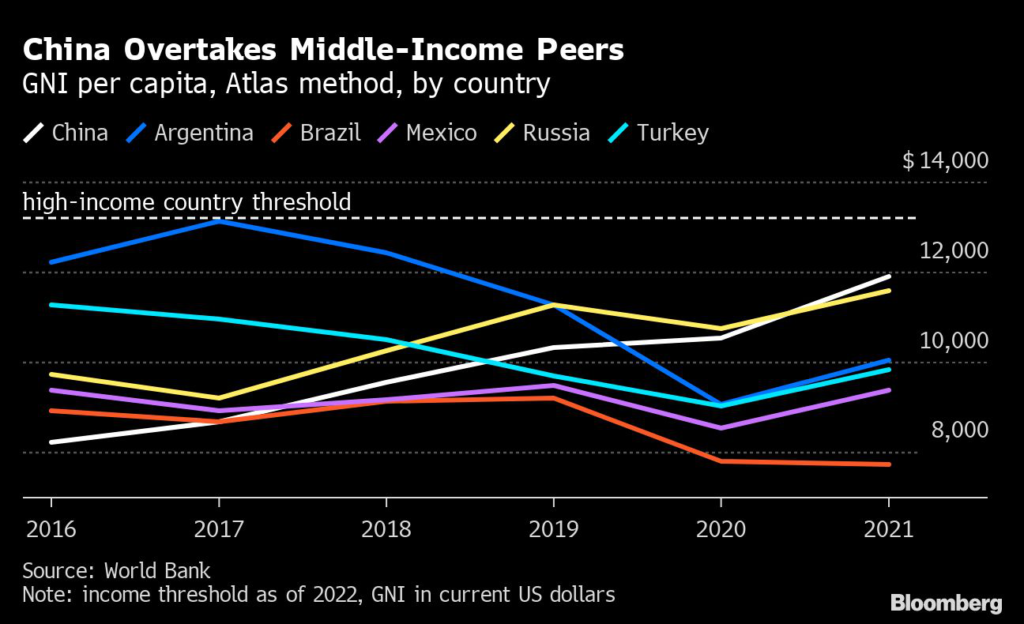
Judging by Xi’s longer-term record, it would be risky to bet he can’t pull it off. The size of China’s economy has more than doubled since 2010. When Xi took over in 2012, economists were discussing if China could be stuck in the “middle income trap.” But China’s per capita income has overtaken middle-income peers like Argentina and Russia since then, reaching the cusp of what the World Bank defines as “high income” status.

The reforms won’t be easy. Xi will need to push up the retirement age, increase taxes on the wealthy to fund better education and healthcare, and overcome resistance from local governments who don’t want to provide public services to migrants from other parts of China. The vast financial sector needs a shake up to ensure funds go to the most productive firms, and private companies, which employ most of the country’s workers, need to be allowed to compete more evenly with state-owned rivals.

Drawing on analysis from Bloomberg Economics’s Chang Shu and Eric Zhu, here’s a look at four scenarios for China’s economic growth over the decade ahead.Base case: A decade of growth between 4 and 5%

The Covid Zero policy is hammering China’s economy, leading some economists to lower GDP forecasts for this year to below 3%. So long as the policy continues, there’s little chance of significant improvement.

Government experts in China have said the policy can be relaxed when there are enough medical tools including treatments and second-generation vaccines available. Bloomberg Economics’ base case assumes gradual loosening from the second quarter of 2023.

China’s demographic challenge is also a constraint, with the population decline happening earlier than previously forecast. But it’s workforce size that matters for economic output, and the population is living longer — life expectancy now exceeds the US — so they can work longer too.

While China’s retirement age is currently 50 to 60 depending on gender and profession, if that is raised gradually to 65 over the next decade, the workforce can remain roughly stable at around 760 million workers over that period.

As countries get richer, workers skills — or “human capital” — becomes key to their productivity, offering China an economic offset to the looming population decline. New entrants to the workforce are far more educated than their predecessors: China will produce more than 10 million college graduates this year, nearly double the number a decade ago.

“There is an education tsunami coming to China,” says Bert Hofman, former China country director at the World Bank and now head of the East Asian Institute in Singapore.

It’s not all about universities. The share of 25 to 60-year-olds with a high-school education has risen to 37% and is on track to reach at least 50% by the end of this decade — moving closer to levels seen in countries like Portugal — if Beijing can continue to boost education spending.

There’s still considerable growth to be had from investment. China invests a higher proportion of GDP than any major country in recent history, and while much of that doesn’t produce high returns, the overall return on investment — whether in housing, infrastructure or manufacturing — remains in positive territory, while the return on assets in China’s industrial sector is still about 6% on average. One example: Electric vehicle plants backed by governments and built by companies such as BYD and Nio have made China a world leader in that emerging industry.“Even if you waste some of it, you still get growth from capital,” says Hofman. He calculates that even with a bare minimum of economic reforms, China could grow 3% annually through to 2035 just from its physical investment.

To achieve that, China will need to maintain its current high household savings rate, but allocate those funds more to manufacturing and service companies than real estate firms.

The property market’s ongoing malaise has been the other major brake on growth. The base case scenario sees an ongoing gradual decline in real estate investment — which is needed to align supply with demand — but no collapse. The real estate slowdown frees up resources to be invested in more productive areas.

And even though China’s unprecedented home building boom is now in the past, there’s still fundamental demand for housing. China’s urbanization rate — currently comparable to where the US was in the 1950s — still has room to grow, with an estimated 10 million people set to move to cities each year through to 2025. That process in turn boosts productivity, as workers in cities find it easier to match their skills with other workers.

China’s economy is now too large for foreign demand to drive it via export growth. Beijing needs reforms to ensure that Chinese companies can take advantage of a huge domestic market and consumer spending continues to grow. That’s where Xi’s signature policies “ dual circulation” and “ common prosperity” come in. The first is about breaking down economic barriers between China’s provinces. The second is about making sure more investment goes to poorer regions and making provision of healthcare more equal — likely requiring higher taxes on the wealthy.

In Bloomberg Economics’ model, the biggest contributor to growth over the next decade is total factor productivity, referring to changes which allow labor and physical investment to be used more effectively. One of those things is the adoption of new technology.

It’s hard to make predictions about that, but proxies such as spending on research and development, scientific publications, and patents have all shown strong growth. China now spends more of its GDP on R&D than many European countries.

Another boost will come as workers shift from jobs producing lower-value to higher-value goods and services. One area for upside: The share of workers in agriculture still has room to fall from around 25% today to somewhere closer to the 3% average in advanced economies. Companies like TikTok owner ByteDance Ltd. have helped farmers become live streamers.

There have also been big changes in market institutions under Xi, reducing barriers on how people can sell their labor, ownership in companies, as well as goods and services they produce. To take two examples: Since 2020, Chinese people have become entitled to buy housing and claim government benefits in any city with a population below 3 million — with the policy now gradually extending to larger cities. The amount private firms raised on Chinese stock markets has soared in recent years. The base case expects such reforms to continue.

Beijing’s regulatory crackdown on the likes of Alibaba and Tencent over recent years shows it’s wary of private firms which grow too large. Still, Xi wants a vibrant private sector, with the government rolling out policies to make it easier for small and medium-sized companies to receive loans, cutting business taxes and reducing red-tape. Beijing is supporting thousands of “little giant” start ups with funds and tax breaks, tilted toward firms that file patents outside of China.

“The key unknown is whether the party’s efforts to support its favored parts of the private sector can spur enough growth to outweigh the negative effects of its crackdown on other, less favored areas,” says Chang-Tai Hsieh, an economist at the University of Chicago.

China’s private-sector companies are generally more productive than their state-owned rivals due to the large number of poorly performing local government-owned enterprises, and Beijing’s reliance on the state sector to support growth during the pandemic has made the playing field “less even,” according to Margit Molnar, head of the Organisation for Economic Co-operation and Development’s China desk. But while Xi supports SOEs in sectors he sees as strategic for the economy, he’s also allowed locally owned state firms in non-strategic sectors to go bankrupt at unprecedented rates.

Eliminating majority state-ownership in non-strategic sectors such as hotels, catering, retail and wholesale would boost long-term GDP per capita by 1.3%, according to the OECD. “There are so many areas where reforms could bring about a boost to productivity,” says Molnar.

Bloomberg Economics’ base case incorporates a gradual decoupling from the US, with links never returning to their pre-pandemic levels. But politicians in both Europe and East Asia stress that decoupling from China is not their goal, meaning ongoing exchanges with advanced economies across the globe will remain as a growth driver.

As GDP levels are compared in US dollar terms, China’s race to number one status will be influenced by what happens to exchange rates. If China continues to open up its vast financial markets to overseas investors, a strengthening in its currency will help propel its rise.

Bear case: Slower than 4%

China’s leadership has been vague on when the Covid Zero policy will end. In a downside scenario, it isn’t relaxed until 2024, meaning at least another year of very low growth, with a long-term impact on productivity as unemployed workers miss chances to accumulate skills.

Pushback to pension reforms (even authoritarian governments like Russia’s have had to U-turn over raising the pension age) could mean the process isn’t finished until 2040, and the working-age population declines markedly over the decade as a result.

The property market slowdown — if mishandled — could lead to an even sharper slowdown in investment. In a nightmare scenario for Beijing, the drop in investment might take place rapidly, shrinking by 20% over 2022-2024. Another scenario is that the government overstimulates and as the policy support is withdrawn, a worse downturn occurs, turbo-charged by an even larger overhang of housing supply.

Any sudden decoupling from the US, if it imposes anything close to Russia-type sanctions on China, would be disastrous for China’s growth. While the blowback for the world would probably be too great for Washington to go that far, more aggressive decoupling — for example, Huawei-like curbs on all of China’s tech firms — would hit growth further.

The nightmare scenario: Sub 3% growth

Xi’s top priority over the past five years has been an effort to reduce the chance of a financial crisis by choking off shadow banking and slowing debt growth. But there are still many non-performing loans in the banking system, and if housing prices crash and too many banks or local governments need bailouts, growth could slow even more.

Things could get even worse if US allies join in on decoupling efforts. China’s output could be up to 8% smaller by 2030 if there’s strong decoupling from OECD economies versus a no decoupling scenario, according to International Monetary Fund analysis.

Another pandemic or climate change-related extreme weather could damage the economy severely. And a clash over Taiwan would also be disastrous.

An article by an anonymous analyst that was viewed more than 100,000 times on Chinese social media assessed China’s growth prospects to 2030, and highlighted Taiwan declaring  independence and triggering an invasion by mainland forces as the “biggest external risk in the next decade.” The article circulated earlier this year, in the wake of Russia’s invasion of Ukraine. 

The bull case: Above 5% growth

China’s official goal is to double GDP from 2020 levels by 2035, implying growth above 5% for most of this decade. That would need a faster reopening from Covid leading to a quicker resumption in reforms, such as raising the pension age by 2025 and relaxing big city residency restrictions, according to Bloomberg Economics’ model.

Longer term, efforts to boost fertility by providing cheaper childcare and more benefits to parents could pay off, though the impact won’t be clear until those kids enter the workforce in the 2040s.

Then there’s the boost as workers shift from producing less complex goods and services to more valuable ones — something that is easier for China because it has the world’s largest manufacturing base. One way of tracking that is through the Economic Complexity Index compiled by the Growth Lab at Harvard University, which looks at the range of products a country exports. China has risen to 17th from 24th place a decade ago.

The idea is that producing a range of products makes it easier to move up the ladder to more complex products. According to the lab, China’s complexity sets it up to be among the fastest growing economies to 2030 — it predicts growth above 5.8% over the next decade.

Some examples of growing complexity: China now has dozens of globally competitive biotech companies like BeiGene, which was unheard of a decade ago, while video game companies like Tencent and video app TikTok have had success on the global stage for the first time. Chinese companies lead the world in solar power, one of this decade’s clear growth sectors.

Many more success stories will be needed to fuel China’s long-term prospects, but in the short term it all comes down to two key challenges. 

“Policy can make a difference to the pace of the growth slowdown: Moving away from the Covid Zero orientation and stabilizing the property market could go a long way to boost short-term growth,” according to Chang and Zhu of Bloomberg Economics. “More importantly, combined with a renewed momentum in structural reforms aiming to boost productivity and labor, these can give the best hope of getting long-term growth back on pre-pandemic paths.”

More stories like this are available on bloomberg.com

©2022 Bloomberg L.P.

Twitch Tries to Win Back Streamers’ Trust After Compensation Changes

(Bloomberg) — Weeks after Amazon.com Inc.’s video livestreaming site Twitch announced controversial changes to the way creators make money on the platform, executives sought to rebuild trust with streamers at its annual TwitchCon convention.

Twitch’s director of community, Mary Kish, said that during the weekend convention in San Diego she had tough conversations with streamers over dinners and drinks. “I really empathize with them. This is their lives, their careers; they pay for their houses and feed their children with this money,” said Kish, who is a popular streamer herself. “These decisions are meant for long-term sustainability for both parties.”

Last month, Twitch announced that starting next June, it’s adjusting its revenue sharing model so that top streamers will keep 70% of revenue for the first $100,000 earned on the site through fans’ subscriptions, but that will drop to the standard 50/50 share split after that. The change was intended to remove inconsistencies in how Twitch arranged these deals, President Dan Clancy said in a blog post at the time. 

Increasingly, Twitch has been focused on financial sustainability with the goal of eventual profitability despite enormous costs tied to the technology necessary to support the 2.5 million hours of live content broadcast around the world daily. But the changes, including the revenue split and incentivizing streamers to run ads, have proven unpopular with the content creators that Twitch considers its primary customers.

At TwitchCon, executives and streamers met face-to-face and attempted to come to an understanding. Some sessions gave streamers the opportunity to directly approach Twitch staff about their monetary concerns. There were about 20 panels and sessions aimed at teaching streamers how to earn more money, grow their brands and gain enough popularity to attract sponsorships. Some focused on how to graduate from “affiliate” to “partner” status, a level that allows streamers to earn revenue through subscriptions and ads, and how to continue to monetize their business from there. 

The pool of breakout streaming stars able to pull in hundreds of thousands or even millions of dollars has become increasingly competitive after Twitch’s pandemic boon. The number of active streamers on the site has more than doubled since September 2019 to more than 7 million. The company has made moves to help more streamers make money, like lowering the level at which a streamer can withdraw revenue to $50 from $100, and rolling out products that Twitch says have boosted streamers’ revenue per hour by 27% over the last five years. But many streamers feel that Twitch has compromised their potential for profitability in exchange for the company’s own.

“They need to start listening to us and actually take us seriously,” said a partnered streamer who goes by Vio, who spoke directly to Twitch staff over the weekend. She said if anything, TwitchCon helped her bond with other streamers who share her frustrations. “Execs haven’t done anything to build trust, but I’m feeling more and more bonded with other people in the same boat.”

Although the recent changes only affect a small percentage of Twitch’s more than 50,000 partnered streamers, those who are the most popular and bring in the most revenue, backlash followed from people who felt Twitch had taken away a potential future financial opportunity to aspire to.

“When you look at your career, you’re not like, ‘I made it,’ and then never try to get a promotion again,” Kish said. “It’s similar with creators. They want to know what the next step is. We have a lot of work to do internally to be like, ‘What is the next step?’”

Executives addressed streamers’ monetary concerns privately and in a public session Sunday afternoon that was livestreamed. Although nearly 23,000 Twitch users have asked Twitch to move to a 70/30 revenue model for all streamers, Twitch Vice President of monetization Mike Minton told the audience that it “is simply is not viable for Twitch over the long-term.” 

Minton pointed to Amazon’s desire for Twitch to be independently sustainable. “Amazon expects the same thing of us as every Amazon business: that we’re able to thrive independently and financially,” Minton said. He declined to share any specific expectations or timelines from Amazon about profitability. He also acknowledged that Twitch doesn’t pay public rates for Amazon Web Serivces. Last month, in outlining the revenue sharing changes, Clancy cited the published rates as evidence of the costs of running Twitch’s service. 

Twitch has shifted its focus to running ads, a strategy that will boost streamers’ revenue but some complain that it’s not compatible with livestreaming.

“Many streamers weren’t open to running ads because it wasn’t worth it to them,” Minton said. Twitch is working on making ads less intrusive and is experimenting with skippable ads. 

One Twitch partner and TwitchCon attendee who goes by Vcruzzin said the ads incentive doesn’t align with his goals as a streamer. He wants to keep viewers engaged, and losing their interest isn’t worth it to him right now. “I do not plan on manually playing ads unless my ad incentive offer is something that will financially significantly help my family and I,” he said.

At the same time, Vcruzzin did attend TwitchCon’s live event addressing streamers’ concerns about monetization and left feeling more trust in the company. “There were a lot of things said that did give me confidence in the direction of where the company is going,” he said, adding, “No company is perfect.”

More stories like this are available on bloomberg.com

©2022 Bloomberg L.P.
China’s Crypto Emigres in Their Own Words, a Year After Curbs

(Bloomberg) — A little over a year ago, China declared all cryptocurrency transactions illegal, the final salvo in a crackdown that had been gathering pace for years. 

The government’s move sent convulsions through the local crypto industry, with everything from Bitcoin mining to trading slumping. According to its central bank, China went from accounting for some 90% of global Bitcoin transactions to just 10%.

While some entrepreneurs chose to stay in China and try to operate within the confines of the new regulatory regime, many others decamped for places like the US, Singapore, Thailand and Dubai. Bloomberg News spoke with four of them about their experiences and views on everything from web3 to cultural biases in crypto. Here are their stories:

Diane Dai, co-founder and chief marketing officer, Dodo 

Dai, 25, started Dodo, a decentralized crypto exchange, in 2020. She left China this year and during the summer settled temporarily in Bangkok before moving to Singapore. Like many fellow crypto nomads, she’s traveling from country to country, often timing moves with major industry conferences. Dodo counts Coinbase Ventures, Galaxy Digital and Pantera Capital among its backers. 

The lifestyle has several challenges, from navigating language to culture and biases, she says. Even so, Dai says the most-discussed topic among Chinese crypto entrepreneurs living overseas is how to secure a work visa, foreign residency or citizenship. 

“Chinese crypto entrepreneurs are a big group, so you are not fighting alone. In crypto, building a community is very important. Small habits like posting memes might come naturally for English-speaking founders, but for us it’s something to study and train for.

Without the protection of the Chinese Great Firewall, we must face global competition on Day One.”

Suji Yan, founder and CEO of Mask Network 

Yan, 26, a college dropout, founded web3 social network startup Mask Network in 2017 . The service allows users to send encrypted messages and tokens via Twitter and Facebook. After leaving Shanghai, Yan has spent time in Singapore, and says his goal is to not stay in any one country for more than half a year. Yan, who earlier initiated a Github campaign against what he views as the excessive “996” work culture in China, sees web3 as a revolution against centralized power. 

“When Chinese citizens participate in crypto, they are gaining a new identity – they are citizens of China, but they are also citizens of a digital nation. They even pay two sets of taxes: income tax and web3 tax in the form of gas fees.” 

Yan, who also founded Mask’s venture arm Bonfire Union, says a major challenge for Chinese crypto entrepreneurs is getting the attention of Silicon Valley venture capitalists, who often don’t bother to respond to pitches:

“It’s a violation of crypto’s fundamental ideology – to be international and borderless. I often comfort other Chinese founders who get rejected by American VCs. I told them ‘they are nationalists, and they don’t deserve to invest in internationalists.’”

Jerry Huang, co-founder of STEPN

Huang, 37, was among Chinese tech founders who rode the country’s smartphone boom about a decade ago, churning out quick-to-market mobile gaming hits. He’s lived in Sydney for the past nine years.

In December, Huang’s startup launched a fitness app called STEPN, which lets users buy virtual sneakers in the form of nonfungible tokens, which can then be used to earn digital tokens. Just a month later, STEPN raised $5 million from investors including Sequoia Capital and Sam Bankman-Fried ’s Alameda Research. 

It didn’t take long before STEPN was forced to make changes to avoid irking Chinese regulators. In May, the startup said it would cut off users in mainland China by blocking them based on GPS location. Huang says his firm never offered downloads or marketed to Chinese users; nonetheless, they accounted for about 5% of STEPN’s 2 million-plus users at the time.

“We targeted global markets and didn’t anticipate Chinese users to be as enthusiastic. But after we became sizable, it came to a time when we needed to self-censor to avoid systematic risks.”

Even so, Huang says he supports China’s crypto ban because it’s designed to protect retail investors:

“When your regulatory framework isn’t quite intact, and when your users aren’t that sensible, you’d better not open the market too soon. But I think it will change over time.”

Zeng Jiajun, founder of Soul Wallet 

Before moving to the US in mid-2021, Zeng, 29, worked as a product manager for content moderation at ByteDance, the parent company of TikTok. Now a graduate student at Northeastern University, Zeng has founded Soul Wallet, a smart-contract wallet that allows users to change private keys. 

“My Chinese background is very important and can add diversity to the Ethereum community. For a while my pinned tweet was ‘the separation of state and internet,’ and that’s what Ethereum was trying to do. What Bitcoin achieved was the separation of state and money. Now it’s about the separation of the internet from the state.

In the core Ethereum community, values is a huge issue: Do you care about anti-censorship, network’s credible neutrality? To many people the ideology is not the first [priority], they care more about tech and secondly the business prospects. So that will make them less easy to fit in with the crypto punks who are often idealists.”

If you do anti-censorship work in China, it will be difficult. I don’t think web3 is going to happen until China becomes a democratic country. Fundamentally, blockchain’s essence is to build a decentralized, anti-censorship thing. If it has to co-exist with censorship, it loses its flavor. Then you might as well use your own servers and machines.” 


More stories like this are available on bloomberg.com

©2022 Bloomberg L.P.

China’s Crypto Holdouts Test the Boundaries of Xi’s Crackdown

(Bloomberg) — This summer, word started spreading over Chinese social media about a conference in Dali, a city nestled among 4,000-meter (13,100-foot) peaks in the country’s southwest. 

The organizers expected fewer than 200 attendees, but ended up selling out the 1,000-person venue only to see more than double that number ultimately show up for the August event. The topic of the gathering: crypto, the sector China’s government declared largely illegal a year ago.

Before the clampdown, China was emerging as the epicenter of the crypto world, spawning giant exchanges like Binance Holdings Ltd. and the biggest Bitcoin mining firms. Beijing’s move to banish cryptocurrency trading and mining, announced in September 2021, seemed poised to snuff out the entire domestic industry. 

That’s not exactly how things turned out. Instead, what’s emerged is a mix of companies that hew to the Communist Party’s agenda promoting state-sanctioned blockchains and the digital yuan; some rogue Bitcoin miners; and crypto entrepreneurs trying to expand their fledgling firms without crossing any perceived red lines.  

How China ends up treating the crypto sector’s remnants will have big ramifications because digital assets ranging from Bitcoin to nonfungible tokens are at the heart of what proponents like venture capitalist Marc Andreessen refer to as web3, or the next iteration of today’s internet. 

Read more: Inside ‘Web3,’ Crypto’s Plan to Retool the Internet: QuickTake

China has “three red lines: crypto trading, over-the-counter transactions, and mining,” said Jason Kam, founder of Folius Ventures, an investment fund focused on Asian crypto startups. “At its core, the Chinese government is going to dampen speculation and capital outflow, but for the remainder of web3, such as developers writing code, the government has a ‘one eye open, one eye closed’ approach.” 

Finding Their Way

China’s decision in the 1990s to erect the Great Firewall gave the CCP unprecedented power to restrict the free flow of information online and set the stage for an internet industry from which Western companies like Alphabet Inc.’s Google and Twitter Inc. are largely shut out. The fear among many of China’s remaining crypto entrepreneurs is that the government will take a similar approach to Web3, stifling innovation and keeping internet users isolated from the rest of the world. 

Interviews with more than a dozen industry participants based in China, ranging from founders to programmers and operations specialists, paint a picture of a sector trying to find its path by experimenting with new products and services in the hope that regulators won’t crack down. They all asked not to be identified for fear of inviting government scrutiny. 

Researchers at Chainalysis Inc. tracking crypto adoption worldwide earlier this year noticed a surprising phenomenon: China was actually gaining ground on other nations, to such an extent that it placed 10th in Chainalysis’ latest global crypto adoption index, up from 13th in 2021. “Our data suggests that the ban has either been ineffective or loosely enforced,” they wrote. 

Read more: The $8.6 Billion Startup That Helps Governments Trace Crypto

“There are informal crypto markets that are operating in kind of a legal gray area,” said Kim Grauer, director of research at Chainalysis. “We’ve talked with merchants who are in Sub-Saharan Africa and Latin America who are purchasing goods from China, using cryptocurrency in this informal market capacity. We can see people within China are still visiting major centralized exchanges.”

Home to ‘HBO’ 

For a stretch of the industry’s brief history, China was a crypto powerhouse. As recently as 2017, it was home to the world’s three biggest cryptocurrency exchanges — Huobi, Binance, and OKX, collectively known as HBO. At its peak, the country was estimated to account for roughly three-quarters of the world’s Bitcoin mining capacity. Cheap labor and sophisticated supply chains gave mining-rig giants Bitmain Technologies Ltd. and Canaan Inc. a head start on Western rivals. 

Such was China’s gravitational pull that crypto entrepreneurs ranging from Ethereum co-founder Vitalik Buterin to FTX’s Sam Bankman-Fried flew there to seek funding for their nascent enterprises.

“China had always been one of the hot spot countries to stop at for any project that wanted to grow and strive for adoption,” said Edith Yeung, general partner at Race Capital, an early investor in FTX.  

But China also has an uneasy relationship with rampant speculation, with the inevitable busts seen as a potential threat to the CCP’s hold on power. And few asset classes are as susceptible to speculative manias as cryptocurrencies. Officials were also concerned about money laundering and hard-to-track currency outflows. 

In September 2017, the central bank and other regulators prohibited exchanges from facilitating trades between fiat money and crypto and banned initial coin offerings, where issuers raise money by selling new tokens. Authorities also started discouraging energy-gobbling Bitcoin mining, as President Xi Jinping sought to burnish China’s environmental credentials.

The final reckoning came in 2021. In May that year, a regulatory body led by Vice Premier Liu He called for a full-scale clampdown on crypto mining and trading. Then, on Sept. 24, authorities outlawed all cryptocurrency transactions and pledged to completely root out mining. 

“Crypto transactions and crypto services of all kind are banned in China. No room for discussion. No gray area,” Henri Arslanian, at the time crypto leader and partner at PwC, declared on Twitter.  

By then, Binance had already moved operations elsewhere. Two months later, Huobi would announce plans to relocate to Singapore and vow to sever ties with all users based in China (co-founder Leon Li recently sold his controlling stake). A large number of smaller crypto outfits also decamped. 

But even amid the carnage, widespread enthusiasm for digital assets remained. 

Dali Crypto Conference

As entrepreneurs, college students and current and former workers at China’s big tech companies descended on Dali in August for the crypto conference, Covid restrictions made a central location impractical. So attendees joined impromptu panels in bars and restaurants scattered around the city over three days. 

Local officials were enthusiastic about hosting a conference on topics like the metaverse, said one of the organizers, who asked to be identified only by his first name Kai due to the sensitivity of the matter. Even so, organizers took care to toe the line, avoiding soliciting sponsorships from crypto miners and centralized exchanges, Kai said. 

At that conference, just like at a much smaller gathering in Beijing in September, discussions tended to center on web3, envisioned as a more decentralized version of today’s internet built around blockchains — the digital ledgers underpinning much of crypto. And more specifically: What areas within web3 are safe to pursue, given China’s restrictions?

Web3, as described by protagonists, involves things the CCP approves of (blockchains) and frowns upon (cryptocurrencies like Bitcoin and Ether). It also features NFTs, the certificates of digital ownership that China’s government has embraced, at least partially. 

How China Is Embracing NFTs, With Strings Attached: QuickTake  

The ambiguity toward NFTs — for example, it’s fine to create and sell them, but trading them on secondary markets and using cryptocurrencies for settlement is banned — is in part what drove Frank Chen, 26, to leave his job as a product manager at Tencent Holdings Ltd. and found a project called Strxngers. 

In August, Strxngers released its first batch of NFTs resembling pixellated 80s-style computer game avatars. They sold out in seconds, according to Chen. 

“I picked NFT as an area to experiment within China because I don’t think the country is completely against it,” said Chen. “Before any regulation on digital collectibles comes out, there’s a currently gray area that allows people to experiment.”

There are signs, however, that even NFTs make authorities uneasy. In April, China’s banking, securities and internet finance associations warned of financial risks associated with such assets and barred industry members from providing trading venues or financing for them. 

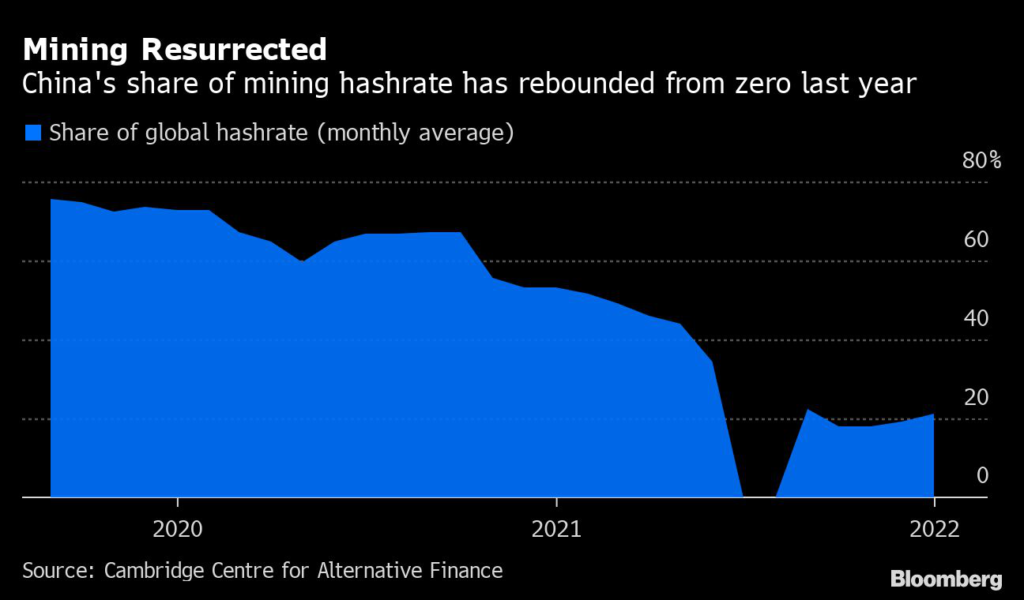
Even in areas the government has unambiguously declared illegal, enforcement has at times proved challenging. The most recent data from the Cambridge Center for Alternative Finance show miners in China still accounted for 21% of global mining capacity as of January, months after the ban. Cambridge in May said the resurgence indicates “significant underground mining activity” in China. 

The Chinese government hasn’t yet adopted a comprehensive official stance on web3. But at a conference in Shanghai in early September, Zhang Ping, a member of the Chinese Academy of Engineering, said that as currently envisaged, web3 poses a threat to China’s strategic interests. 

Instead, Zhang proposed a “permission-based” version of web3 tailored to the country’s own needs, featuring stablecoins pegged to the yuan and issued by commercial banks. 

If anyone could be said to be the face of the CCP’s preferred version of web3, it may be He Yifan, the chief executive of Beijing-based Red Date Technology. The company operates a hub of sorts for developers to build applications for everything from NFT transactions to drug-delivery tracing – all running on permission-based blockchains under state oversight. 

Unlike on a traditional blockchain like Ethereum, transaction costs are denominated in fiat currency and fixed at 0.05 yuan per transaction. Daily transactions on Red Date’s Blockchain-based Service Network have surged to over 1 million, according to He, comparable with volumes on Ethereum. 

 “Crypto is about trading and applications, and we are all about the tech infrastructure,” He said. “Two entirely different worlds.”

With the government looking poised to favor the latter of those worlds, the mood at the Dali conference was one of mixed feelings: optimism about the business opportunities web3 presents for Chinese developers, and pessimism about China’s place in it, said Kai, the organizer. 

“China is missing out on how the future of internet will be structured,” said Yeung of Race Capital. 

More stories like this are available on bloomberg.com

©2022 Bloomberg L.P.
Inside China’s Crypto Scene, a Year After Sweeping Crackdown

(Bloomberg) — This summer, word started spreading over Chinese social media about a conference in Dali, a city nestled among 4,000-meter (13,100-foot) peaks in the country’s southwest. 

The organizers expected fewer than 200 attendees, but ended up selling out the 1,000-person venue only to see more than double that number ultimately show up for the August event. The topic of the gathering: crypto, the sector China’s government declared largely illegal a year ago.

Before the clampdown, China was emerging as the epicenter of the crypto world, spawning giant exchanges like Binance Holdings Ltd. and the biggest Bitcoin mining firms. Beijing’s move to banish cryptocurrency trading and mining, announced in September 2021, seemed poised to snuff out the entire domestic industry. 

That’s not exactly how things turned out. Instead, what’s emerged is a mix of companies that hew to the Communist Party’s agenda promoting state-sanctioned blockchains and the digital yuan; some rogue Bitcoin miners; and crypto entrepreneurs trying to expand their fledgling firms without crossing any perceived red lines.  

How China ends up treating the crypto sector’s remnants will have big ramifications because digital assets ranging from Bitcoin to nonfungible tokens are at the heart of what proponents like venture capitalist Marc Andreessen refer to as web3, or the next iteration of today’s internet. 

Read more: Inside ‘Web3,’ Crypto’s Plan to Retool the Internet: QuickTake

China has “three red lines: crypto trading, over-the-counter transactions, and mining,” said Jason Kam, founder of Folius Ventures, an investment fund focused on Asian crypto startups. “At its core, the Chinese government is going to dampen speculation and capital outflow, but for the remainder of web3, such as developers writing code, the government has a ‘one eye open, one eye closed’ approach.” 

Finding Their Way

China’s decision in the 1990s to erect the Great Firewall gave the CCP unprecedented power to restrict the free flow of information online and set the stage for an internet industry from which Western companies like Alphabet Inc.’s Google and Twitter Inc. are largely shut out. The fear among many of China’s remaining crypto entrepreneurs is that the government will take a similar approach to Web3, stifling innovation and keeping internet users isolated from the rest of the world. 

Interviews with more than a dozen industry participants based in China, ranging from founders to programmers and operations specialists, paint a picture of a sector trying to find its path by experimenting with new products and services in the hope that regulators won’t crack down. They all asked not to be identified for fear of inviting government scrutiny. 

Researchers at Chainalysis Inc. tracking crypto adoption worldwide earlier this year noticed a surprising phenomenon: China was actually gaining ground on other nations, to such an extent that it placed 10th in Chainalysis’ latest global crypto adoption index, up from 13th in 2021. “Our data suggests that the ban has either been ineffective or loosely enforced,” they wrote. 

Read more: The $8.6 Billion Startup That Helps Governments Trace Crypto

“There are informal crypto markets that are operating in kind of a legal gray area,” said Kim Grauer, director of research at Chainalysis. “We’ve talked with merchants who are in Sub-Saharan Africa and Latin America who are purchasing goods from China, using cryptocurrency in this informal market capacity. We can see people within China are still visiting major centralized exchanges.”

Home to ‘HBO’ 

For a stretch of the industry’s brief history, China was a crypto powerhouse. As recently as 2017, it was home to the world’s three biggest cryptocurrency exchanges — Huobi, Binance, and OKX, collectively known as HBO. At its peak, the country was estimated to account for roughly three-quarters of the world’s Bitcoin mining capacity. Cheap labor and sophisticated supply chains gave mining-rig giants Bitmain Technologies Ltd. and Canaan Inc. a head start on Western rivals. 

Such was China’s gravitational pull that crypto entrepreneurs ranging from Ethereum co-founder Vitalik Buterin to FTX’s Sam Bankman-Fried flew there to seek funding for their nascent enterprises.

“China had always been one of the hot spot countries to stop at for any project that wanted to grow and strive for adoption,” said Edith Yeung, general partner at Race Capital, an early investor in FTX.  

But China also has an uneasy relationship with rampant speculation, with the inevitable busts seen as a potential threat to the CCP’s hold on power. And few asset classes are as susceptible to speculative manias as cryptocurrencies. Officials were also concerned about money laundering and hard-to-track currency outflows. 

In September 2017, the central bank and other regulators prohibited exchanges from facilitating trades between fiat money and crypto and banned initial coin offerings, where issuers raise money by selling new tokens. Authorities also started discouraging energy-gobbling Bitcoin mining, as President Xi Jinping sought to burnish China’s environmental credentials.

The final reckoning came in 2021. In May that year, a regulatory body led by Vice Premier Liu He called for a full-scale clampdown on crypto mining and trading. Then, on Sept. 24, authorities outlawed all cryptocurrency transactions and pledged to completely root out mining.

Read more: China’s Crypto Emigres in Their Own Words, a Year After Curbs

“Crypto transactions and crypto services of all kind are banned in China. No room for discussion. No gray area,” Henri Arslanian, at the time crypto leader and partner at PwC, declared on Twitter.  

By then, Binance had already moved operations elsewhere. Two months later, Huobi would announce plans to relocate to Singapore and vow to sever ties with all users based in China (co-founder Leon Li recently sold his controlling stake). A large number of smaller crypto outfits also decamped. 

But even amid the carnage, widespread enthusiasm for digital assets remained. 

Dali Crypto Conference

As entrepreneurs, college students and current and former workers at China’s big tech companies descended on Dali in August for the crypto conference, Covid restrictions made a central location impractical. So attendees joined impromptu panels in bars and restaurants scattered around the city over three days. 

Local officials were enthusiastic about hosting a conference on topics like the metaverse, said one of the organizers, who asked to be identified only by his first name Kai due to the sensitivity of the matter. Even so, organizers took care to toe the line, avoiding soliciting sponsorships from crypto miners and centralized exchanges, Kai said. 

At that conference, just like at a much smaller gathering in Beijing in September, discussions tended to center on web3, envisioned as a more decentralized version of today’s internet built around blockchains — the digital ledgers underpinning much of crypto. And more specifically: What areas within web3 are safe to pursue, given China’s restrictions?

Web3, as described by protagonists, involves things the CCP approves of (blockchains) and frowns upon (cryptocurrencies like Bitcoin and Ether). It also features NFTs, the certificates of digital ownership that China’s government has embraced, at least partially. 

How China Is Embracing NFTs, With Strings Attached: QuickTake  

The ambiguity toward NFTs — for example, it’s fine to create and sell them, but trading them on secondary markets and using cryptocurrencies for settlement is banned — is in part what drove Frank Chen, 26, to leave his job as a product manager at Tencent Holdings Ltd. and found a project called Strxngers. 

In August, Strxngers released its first batch of NFTs resembling pixellated 80s-style computer game avatars. They sold out in seconds, according to Chen. 

“I picked NFT as an area to experiment within China because I don’t think the country is completely against it,” said Chen. “Before any regulation on digital collectibles comes out, there’s a currently gray area that allows people to experiment.”

There are signs, however, that even NFTs make authorities uneasy. In April, China’s banking, securities and internet finance associations warned of financial risks associated with such assets and barred industry members from providing trading venues or financing for them. 

Even in areas the government has unambiguously declared illegal, enforcement has at times proved challenging. The most recent data from the Cambridge Center for Alternative Finance show miners in China still accounted for 21% of global mining capacity as of January, months after the ban. Cambridge in May said the resurgence indicates “significant underground mining activity” in China. 

The Chinese government hasn’t yet adopted a comprehensive official stance on web3. But at a conference in Shanghai in early September, Zhang Ping, a member of the Chinese Academy of Engineering, said that as currently envisaged, web3 poses a threat to China’s strategic interests. 

Instead, Zhang proposed a “permission-based” version of web3 tailored to the country’s own needs, featuring stablecoins pegged to the yuan and issued by commercial banks. 

If anyone could be said to be the face of the CCP’s preferred version of web3, it may be He Yifan, the chief executive of Beijing-based Red Date Technology. The company operates a hub of sorts for developers to build applications for everything from NFT transactions to drug-delivery tracing – all running on permission-based blockchains under state oversight. 

Unlike on a traditional blockchain like Ethereum, transaction costs are denominated in fiat currency and fixed at 0.05 yuan per transaction. Daily transactions on Red Date’s Blockchain-based Service Network have surged to over 1 million, according to He, comparable with volumes on Ethereum. 

 “Crypto is about trading and applications, and we are all about the tech infrastructure,” He said. “Two entirely different worlds.”

With the government looking poised to favor the latter of those worlds, the mood at the Dali conference was one of mixed feelings: optimism about the business opportunities web3 presents for Chinese developers, and pessimism about China’s place in it, said Kai, the organizer. 

“China is missing out on how the future of internet will be structured,” said Yeung of Race Capital. 

More stories like this are available on bloomberg.com

©2022 Bloomberg L.P.

Insight Partners to Buy Stake in $3.6 Billion Software Firm Aptean

(Bloomberg) — Investment firm Insight Partners has agreed to purchase a stake in enterprise software developer Aptean, the companies announced.

The purchase comes alongside an additional investment from existing shareholder TA Associates, according to a statement Monday, confirming an earlier Bloomberg News report. Following an initial 2012 investment under the CDC Software brand, Vista Equity Partners will exit its stake in Aptean as part of the current deal. Charlesbank Capital Partners will remain a shareholder in Aptean.

The sale of the minority stake values the software maker at about $3.55 billion, including debt, according to people with knowledge of the matter. Insight has agreed to buy a more than 20% stake in the company, said one of the people, who asked to not be identified as the details are private. 

Aptean, which was formed through the merger of CDC Software and Consona Corp., operates as a software developer for enterprise resource planning, supply-chain management and more. It’s headquartered in Alpharetta, Georgia, with additional offices across North America, Europe and Asia-Pacific. 

“Driven by the company’s significant investment in new cloud SaaS based-applications and strategic acquisitions, Aptean’s organic growth rate has accelerated, providing significant tailwinds for the future,” stated TA Associates Managing Director Hythem El-Nazer and Director Mike Libert. “We are excited to make an additional growth investment in Aptean, and look forward to deepening our partnership with the Aptean management team, Charlesbank and now Insight.”

The reinvestment by TA Associates gives the firm a stake of about 50%, some of the people said. Charlesbank Capital Partners is retaining a roughly 20% stake in the company, with the remainder owned by Aptean’s management team, led by Chief Executive Officer TVN Reddy, the people added.

“Insight’s investment and TA’s re-commitment demonstrate enduring confidence in our strategy and results,” Reddy said in the statement. “Together we will aim to accelerate the market success of our cloud-based solutions, as well as other organic and inorganic growth initiatives, to continue meeting the mission-critical needs of prospects and customers.”

(Updates with company statement starting in first paragraph)

More stories like this are available on bloomberg.com

©2022 Bloomberg L.P.

Bitcoin Mining Surges to a Record as Merge Opens Up Capacity

(Bloomberg) — The amount of computing power dedicated to Bitcoin mining surged to a record as more companies made use of the energy and data center space freed up after the upgrade of the Ethereum network, likely further compressing profit margins.

Mining difficulty, a measure of Bitcoin miners’ computing power for the blockchain, has jumped by 13.6% in the two-weeks ended Monday. That was also the largest bi-weekly adjustment since last May. The increase is in part thanks to the decline of Ether mining, analysts said. 

Known as the Merge, Ethereum’s technical upgrade has replaced as many as one million powerful computers with Ether holders to validate transaction data encrypted by the network and reduce its carbon footprint by 99%. Ether miners have to unplug their rigs as they no longer get token rewards after the Merge, leaving extra space in data centers to host Bitcoin mining machines and more electricity to power the rigs.   

“Rack space for Bitcoin miners was limited, freeing up the space paves the way for machines previously unplugged to get plugged in,” said Ethan Vera, chief operations officer at crypto-mining firm Luxor Technologies, which has provided services to both Ether and Bitcoin mining companies. Vera estimated around 4% of the current computing power for Bitcoin mining has been flowing from Ether mining to Bitcoin miners in the past two weeks. 

A higher level of computing power will lower mining revenue for Bitcoin miners who are already battered by low Bitcoin prices and soaring energy costs. The more mining power there is, the less Bitcoin each miner will receive as the network only gives a limited amount of the token reward after successfully processing a certain amount of data. 

Ether mining consumed about half of the energy used for Bitcoin mining before the Merge. While small miners run graphic cards at home, industrial scale crypto miners operate tens of thousands of the cards in their facilities.

“What’s critically important for Bitcoin mining is access to cheap electricity,” said Matthew Kimmell, digital asset analyst at crypto asset manager CoinShares. “If those Ethereum operations were built with cheap power sources in mine, then I think well-capitalized Bitcoin miners could have seen that as an expansion opportunity to buy those assets and deploy machines.” 

More resources from Ether miners are only one of the reasons for Bitcoin mining power’s surge. 

There have been fewer power curtailment from major miners as they head into the cooler months in the US and Europe, said Joe Burnett, head analyst at Blockware Solutions. While electricity cost has fallen month over month, it could rise again as people turn on their heaters in the winter, Vera said. 

While Bitcoin miners are able to tap into Ether miners’ data center space and energy infrastructure, they can’t use graphic cards. Instead, they operate specialized computers with a unique algorithm to mine Bitcoin. 

More stories like this are available on bloomberg.com

©2022 Bloomberg L.P.
UK Spy Chief Says China’s Digital Currency Could Evade Sanctions

(Bloomberg) — China is learning the lessons of Russia’s war in Ukraine and could use its centralized digital currency to avoid future sanctions, UK spy chief Jeremy Fleming will warn.

Fleming, the director of the intelligence, cyber and security agency GCHQ, will use a speech in London on Tuesday to argue the Chinese Communist Party leadership is using its “financial and scientific muscle” to manipulate strategically important technologies as a means to control companies and ordinary people. He will single out China’s currency as an example of that type of coercive behavior. 

The digital currency “introduces efficiencies and new ways of settling payments, but the way it’s being implemented allows the monitoring of citizen and forces companies to use the service,” Fleming will say. “It might, in future, also enable China to partially evade the sorts of international sanctions currently being applied to Putin’s regime in Russia.” 

China is a front-runner in the global race to launch central bank digital currencies and is testing a digital yuan, or e-CNY, in major cities including Beijing and Shanghai. Its operator, the People’s Bank of China argues that it “attaches great importance to protecting personal information and privacy.”

PBOC Official Vows to Protect User Privacy in Digital Yuan Push

The e-CNY is still in its early stages, and the yuan itself still pales in comparison with the dollar, making up 4% of the global currency market compared to 88% for its US counterpart, according to the most recent data from the Bank for International Settlements. 

Taiwan

While he didn’t make an explicit link in his pre-briefed remarks, Fleming’s comments suggest that China might at some point in the future be able to circumvent at least in part any sanctions resulting from a potential attack of Taiwan. Russia’s war in Ukraine has prompted the US to step up contingency planning for a possible Chinese assault on the island. China denies any plan for an invasion.

“Be in no doubt, the Chinese Communist Party is learning the lessons from that conflict,” Fleming will say. In a section of his speech discussing the Taiwanese semi-conductor industry, he’ll say that events in the Taiwan Straits “have the potential to directly impact the resilience of the UK and global future growth.”

More stories like this are available on bloomberg.com

©2022 Bloomberg L.P.

Close Bitnami banner
Bitnami