
Bloomberg

Stocks Fall as Growth Fears, Geopolitics in Focus: Markets Wrap

(Bloomberg) — US stocks fell for a fourth day as prospects for policy tightening and geopolitical risks weighed on investor sentiment. A gauge of dollar strength rose to the highest level this month.

The S&P 500 ended off lows in a choppy afternoon session that saw the benchmark almost reverse losses of more than 1%, before selling pressure gathered pace in the final minutes of trading. The Nasdaq 100 underperformed, with semiconductors among the worst performers after Washington’s move to further restrict China’s access to US technology added to signs of slowing chip demand worldwide. 

The pullback from the day’s low came after Federal Reserve Vice Chair Lael Brainard laid out a case for caution, noting that previous rate increases were still working through the economy. Earlier, Chicago Fed President Charles Evans said the Fed needs to quickly get to a level where policy makers can feel comfortable pausing in order to reduce the risk of overshooting. Treasury futures traded lower, while the US cash market was closed for Columbus Day.

The dollar rose against almost all of its major counterparts amid signs of a new escalation in the Russia-Ukraine war. In the UK, turbulence gripped the gilt market, with the selloff accelerating despite the Bank of England extending its emergency backstop measures. 

The mood remains fragile ahead of Thursday’s US inflation data and a raft of bank earnings that will kick off the third-quarter season in earnest. A hotter-than-expected inflation reading, coming on top of last week’s strong labor print, will heap pressure on the Fed to extend 75 basis-point rate hikes beyond this year.

“Inflation and the Fed should dominate this week,” wrote Paul Nolte, portfolio manager at Kingsview Investment Management. “If the discussion of higher rates remains front and center, the markets are likely to stay on their heels.”

Relentlessly hawkish central banks are making investors gloomy about the upcoming earnings season. JPMorgan Chase & Co. and Citigroup Inc. are among the big banks that will unveil earnings later this week.

“The market right now is trying to digest all this data coming in and then put it alongside some sort of Fed rate-hike path,” Shawn Cruz, head trading strategist at TD Ameritrade, said in an interview at Bloomberg’s New York headquarters. “And every time you get something that comes in not in the absolute rosy potential outcome for that data point, the market has some pretty big jitters. With the opening salvo from the earnings season coming from the banks, that’s going to drive a lot of volatility.”

Even after this year’s brutal selloff, markets have not priced all the risks stemming from higher interest rates and stubbornly high inflation. More than 60% of the 724 respondents to Bloomberg’s latest MLIV Pulse survey predicted the earnings season would push the S&P 500 Index lower. Strategists at Goldman Sachs Group Inc. and Morgan Stanley warned it would be a difficult reporting season, given risks such as slowing demand and soaring costs

“The bear market will not be over until the deteriorating fundamental picture is more fully discounted,” Morgan Stanley strategists told clients. 

On the corporate front:

  • Automakers Ford Motor Co. and General Motors Co. tumbled as the industry outlook darkened further with at least two Wall Street analysts predicting earnings will fall steeply next year.
  • Macau casino operators including Wynn Resorts Ltd. and Las Vegas Sands Corp. tumbled in US trading after data showed that tourism revenue fell sharply over China’s week-long National Day break.
  • Rivian Automotive Inc. declined after the electric-vehicle maker said it will recall about 13,000 vehicles it delivered to customers after discovering a minor structural defect.

Meanwhile, Britain stepped up efforts to support market functioning. The BOE extended emergency measures backing the bond market through early next month while Chancellor of the Exchequer Kwasi Kwarteng brought forward the date at which he will deliver his much-awaited fiscal strategy.

Despite the measures, 30-year borrowing costs rose above 4.5%. The pound fell for a fourth day.

Key events this week:

  • Earnings this week include: JPMorgan Chase & Co., Citigroup Inc., Morgan Stanley, BlackRock Inc., Delta Air Lines Inc., UnitedHealth Group Inc., U.S. Bancorp, Wells Fargo & Co.
  • IMF’s World Economic Outlook and Global Financial Stability Report, Tuesday
  • Fed’s Loretta Mester speaks, Tuesday
  • BOE’s Andrew Bailey speaks, Tuesday
  • FOMC minutes for September meeting, Wednesday
  • US PPI, mortgage applications, Wednesday
  • OPEC Monthly Oil Market Report, Wednesday
  • Fed’s Michelle Bowman and Neel Kashkari speak
  • ECB’s Christine Lagarde speaks
  • US CPI, initial jobless claims, Thursday
  • G-20 finance ministers and central bankers meet, Thursday
  • China CPI, PPI, trade, Friday
  • US retail sales, business inventories, University of Michigan consumer sentiment, Friday
  • BOE emergency bond buying is set to end, Friday

Some of the main moves in markets:

Stocks

  • The S&P 500 fell 0.7% as of 4 p.m. New York time
  • The Nasdaq 100 fell 1%
  • The MSCI World index fell 1%

Currencies

  • The Bloomberg Dollar Spot Index rose 0.3%
  • The euro fell 0.4% to $0.9703
  • The British pound fell 0.3% to $1.1057
  • The Japanese yen fell 0.3% to 145.72 per dollar

Cryptocurrencies

  • Bitcoin fell 1.4% to $19,212.65
  • Ether fell 1% to $1,307.48

Bonds

  • Germany’s 10-year yield advanced 15 basis points to 2.34%
  • Britain’s 10-year yield advanced 23 basis points to 4.47%

Commodities

  • West Texas Intermediate crude fell 2% to $90.80 a barrel
  • Gold futures fell 2% to $1,675.20 an ounce

More stories like this are available on bloomberg.com

©2022 Bloomberg L.P.
Chip Stocks Sink to Lowest Since 2020 as US Expands China Curbs

(Bloomberg) — Shares of semiconductor companies fell Monday, with the industry selling off globally after fresh US curbs on China’s access to American technology added to a disappointing start to the earnings season, stoking concern that the industry’s downturn is far from over.

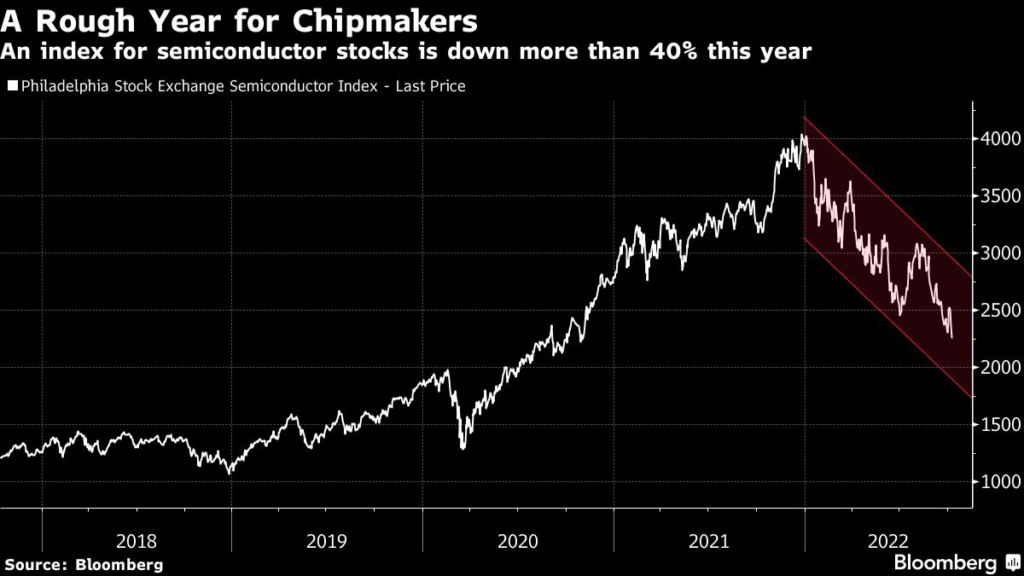
The Philadelphia Stock Exchange Semiconductor Index fell 3.5%, closing at its lowest level since November 2020. The index dropped nearly 10% over the past three trading days, and is now down more than 40% so far this year. Semiconductor capital equipment companies led the day’s declines, with Applied Materials Inc. tumbling 4.1%, Lam Research Corp. off 6.4% and KLA Corp. down 4.7%. Advance Micro Devices Inc. dropped 1.1%, ending at its lowest since July 2020, while Marvell Technology Inc. shed 4.8%.

US-listed shares of chip-equipment maker ASML Holding NV sank 2.9% and Chinese bellwether Semiconductor Manufacturing International Corp. fell 4% in Hong Kong, the most in five weeks. Declines were steeper in smaller stocks. 

The US measures include restrictions on the export of some types of chips used in artificial intelligence and supercomputing, and also tighter rules on the sale of semiconductor equipment to any Chinese company. Separately, the US also added more Chinese firms to a list of companies that it regards as “unverified,” which means US suppliers will face new hurdles in selling technologies to those entities. 

“The changes represent a further escalation, and we do not know what China might do in response,” wrote Stacy Rasgon, an analyst at Bernstein. “Potential retaliation remains a risk.”

The new strategy suggests that Washington aims to “freeze in” China at its current level, enabling the US to increase its lead, said Gabriel Wildau, an analyst at advisory firm Teneo Holdings LLC.

Chinese Foreign Ministry spokesperson Mao Ning said Saturday that the measures, which are set to enter into force this month, are unfair and will “also hurt the interests of US companies.” They “deal a blow to global industrial and supply chains and world economic recovery,” she said.

What Bloomberg Intelligence Says

“SMIC’s revenue could grow at a 50% slower pace vs. our expectations in 2023 on the US’s stricter equipment export license requirements, as 48% of its new capacity to be installed by next year is in 28- or smaller nanometer node advanced chip manufacturing.”

— Charles Shum, analyst

Click here for the full research

The new US rules come at a time when the chip industry is already grappling with an ominous start to the earnings season and has gone from a worldwide shortage of chips to a glut in a matter of months due to the boom-and-bust nature of semiconductor demand. 

Samsung Electronics Co., the world’s largest memory-chip maker, and PC-processor maker AMD reported results last week that suggested a deeper-than-feared slowdown ahead. 

Among smaller chip-related companies, equipment maker ACM Research Inc. plunged 27% in New York trading Monday, while its Shanghai-listed subsidiary, ACM Research Shanghai Inc., sank 20%. In Hong Kong, Hua Hong Semiconductor Ltd. fell 9.4% and Shanghai Fudan Microelectronics Group Co. plummeted 20%, the most since July 2020. China’s Will Semiconductor Co. and Maxscend Microelectronics Co. dropped more than 6% each.

The curbs are a “big setback to China” and “bad news” for global semiconductors, Nomura Holdings Inc. analyst David Wong wrote in a note. China’s localization efforts may also be “at risk as it may not be able to use advanced foundries in Taiwan and Korea,” he wrote.

The US Commerce Department has added Beijing Naura Magnetoelectric Technology Co., a subsidiary of Naura Technology Group Co., to its Unverified List, Naura Technology said in a filing. Naura Technology plunged by the daily limit of 10% in China.

To be sure, the intensifying Sino-American tensions could spur Beijing to step up support for homegrown firms in a bid to achieve its goal of becoming an independent chip powerhouse.

The fall in Chinese chip stocks may cast a pall over the sector globally. Markets in Japan, South Korea, Taiwan and Malaysia will get a chance to react on Tuesday as they were closed on Monday. 

“This will not only be negative to the Chinese semiconductor industry but also indirectly impact global semiconductor makers’ business opportunities longer term,” Citigroup analysts including Laura Chen wrote in a note.

The broader Chinese equity market also saw declines on Monday after returning from the Golden Week holiday, hurt by a global equities selloff and bleak holiday-spending data that deepened concerns about an economic recovery.

(Updates to market close.)

More stories like this are available on bloomberg.com

©2022 Bloomberg L.P.
US Airport Websites Knocked Offline by Pro-Russia Hackers

(Bloomberg) — A pro-Russian group is claiming credit for a series of disruptions that temporarily knocked the websites of some US airports offline. 

The group, called Killnet, has engaged in a series of cyberattacks in recent months against Western targets, including incidents that temporarily rendered some state government websites offline last week, according to cybersecurity experts.

The attack caused intermittent delays with accessing LaGuardia Airport’s website, for 15 minutes starting about 3 a.m., according to a Port Authority spokesperson. There was no operational impact.

Los Angeles International Airport issued a statement saying its website was partially disrupted and that the interruption was limited to portions of the public-facing website. There were no disruptions to internal airport systems nor were there any operational difficulties, according to the statement.

Websites for O’Hare and Midway airports in Chicago were offline Monday, according to a statement from the Chicago Department of Aviation, but no airport operations were affected. 

On Killnet’s Telegram channel, the group claims to have launched attacks against dozens of US airports though it wasn’t immediately clear how many of the airports were actually hit and whether the victims suffered any disruptions.

The Transportation Security Administration, which oversees airport security, referred questions to the individual airports. The Federal Aviation Administration said it would defer comments to TSA.

The FAA’s air-traffic website showed no indications of any flight disruptions from the cyberattacks. Similarly, the tracking website FlightAware.com showed relatively few delays or flight cancellations across the country. The FAA’s air-traffic computers are designed to remain off the internet and have dedicated communication lines to ensure they are safe from hacking.

Killnet mostly deploys distributed denial-of-service, or DDoS, attacks, which direct large amounts of junk online traffic toward a site to knock it offline. While disruptive and irritating, such attacks can usually be mitigated and the overall impact tends to be minimal. 

“It’s easy to overestimate DDoS attacks because they are so easy to notice and very visible,” said John Hultquist, vice president of threat intelligence for Mandiant Inc. “But, ultimately, they’re superficial and short-term.”

A representative for the US Cybersecurity and Infrastructure Security Agency said the agency is aware of reports of DDoS attacks targeting airport websites. The agency was coordinating with the affected parties and offering assistance, the representative said.

Last week, Killnet waged hacks against as many as 15 state websites, according to Check Point Research Technologies Ltd., which says the group represents better organized and more sophisticated style of hacktivism. Sergey Shykevich, threat intelligence group manager at Check Point Software, said Killnet started around the time of Russia’s invasion of Ukraine in February.

While the group initially focused on Ukraine, it quickly shifted to the West, he said, targeting Eastern Europe, Japan and the US. Killnet has claimed more than 550 attacks between late February and September but only 45 of them were against Ukraine, according to Check Point’s research.

Shykevich described the group as Russian-related, saying there isn’t any proof they are tied to the Russian government. The group’s attacks attacks focus on targets that have made negative remarks about Russian or don’t align with its politics, he said.

Killnet continued to boast about its attacks on its Telegram channel Monday, urging others to join. “How about join forces and put down all the US airports?” the group wrote with a melting-face emotive. “Let the Hunger Games begin in USA.” 

(Updates with details on LaGuardia website delays in third paragraph.)

More stories like this are available on bloomberg.com

©2022 Bloomberg L.P.

Market Sees 60% Chance Musk’s Twitter Deal Makes Oct. 28 Deadline, Cowen Says

(Bloomberg) — The market is pricing in just a bit more than the odds of a coin toss that Elon Musk’s deal with Twitter Inc. will close by Oct. 28, a court-issued deadline. That’s the calculation from Aaron Glick, a merger arbitrage strategist at Cowen Inc.  

“Based on my informal survey last week, arbitrage traders tend to think Twitter’s price holds up well if we are going back to court,” Glick said. “The average guess of where Twitter trades if the deal is not consummated came out to around $45.” 

With Twitter shares trading around $50.50 intraday Monday, that near-term downside assumption puts the deal’s October closing probability at roughly 60%, he said, which is up from less than 50% as of Friday’s close. Cowen makes markets in, and is long equity options in, Twitter.

Twitter shares climbed 2.4% during the session to close at $50.36 and snapped a three-day losing streak, after Bloomberg News reported that Musk appears to be running out of ways to evade his original $44 billion contract to buy the social media company. The stock has been trading at a more than 7% discount to the $54.20 offer price over the past few days, as funding uncertainties keep investors on edge about the deal’s outcome and timing.

Last week, a Delaware judge said that if the transaction isn’t done by Oct. 28, she will set a new trial date for Twitter and Musk in November.

(Updates stock moves and the chart at close.)

More stories like this are available on bloomberg.com

©2022 Bloomberg L.P.
Ex-Bridgewater Executive Deploys Hedge-Fund Playbook for New ETF

(Bloomberg) — A former Bridgewater Associates LP executive is offering hedge fund-like strategies to everyday investors.

Bob Elliott, who spent 13 years developing portfolio strategy at the world’s largest hedge fund, will launch Tuesday his inaugural exchange-traded fund, known as the Unlimited HFND Multi-Strategy Return Tracker ETF (ticker HFND).

Issued by his alternatives-focused firm Unlimited Funds, it joins a pool of hedge-fund replica ETFs and will use machine learning to track strategies beloved by the fast money, including global macro and equity long-short, according to a statement.

It’s the latest attempt to make hedge-fund strategies more accessible as the Federal Reserve tightens its monetary policy to combat inflation and volatility grips financial markets, sending a traditional balanced portfolio that allocates 60% to equities and 40% to bonds toward its worst year in over a decade. 

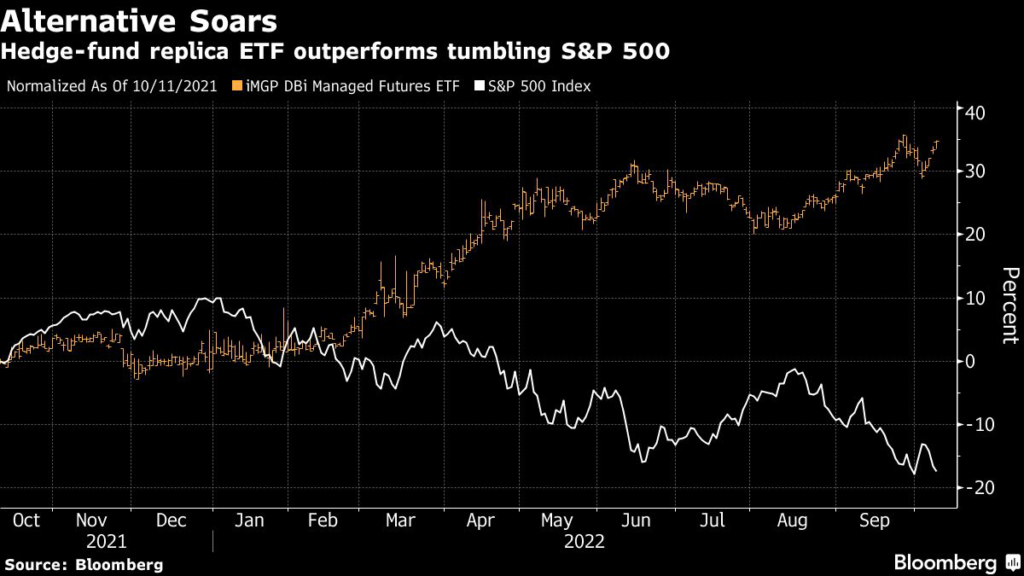
The S&P 500 Index has tumbled more than 20% this year, while 10-year Treasury yields hover near 3.9%. 

At the same time, the $953 million iM DBi Managed Futures Strategy ETF (DBMF), which also deploys machine-learning methods, has seen its shares jump 33% this year, making it the fastest-growing ETF above $50 million in assets in 2022, according to Bloomberg Intelligence. The Global X Guru Index ETF (GURU), which tracks 13F filings, is down about 31%.

The new fund “should give you uncorrelated or at least less-correlated returns assuming the strategy does what it says,” said James Seyffart, ETF analyst at Bloomberg Intelligence. “We know this has worked. DBMF has almost $1 billion in assets and provided meaningfully different and uncorrelated returns particularly over the last year.”

Read More: Quant-Inspired ETFs Rake In Billions With 70% Beating the Market

Elliott and Bridgewater parted ways in 2019 after his relationship with a colleague was not properly disclosed, Bloomberg reported at the time. He founded Unlimited Funds with economist Bruce McNevin this year.

HFND will boast an expense ratio of 0.95% — higher than the average fee for all US-based ETFs, but lower than the typical cost of putting money in a traditional hedge fund, Elliott said.

“The vast majority of traditional hedge funds are a bad deal for investors,” said Elliott, citing the industry’s capital requirements and high fees. “But hedge funds returns — the returns of the most sophisticated asset managers in the world — are actually quite good if you don’t have to pay those fees and those taxes.”

Unlimited also plans to launch a suite of ETFs tracking private equity, venture capital and private credit.

More stories like this are available on bloomberg.com

©2022 Bloomberg L.P.

Portugal to Tax Crypto Gains in Next Year’s Budget Plan

(Bloomberg) — Portugal is planning to start taxing digital-currency gains on purchases held for less than a year in a major policy shift for one of Europe’s most crypto-friendly nations.

Portugal currently does not tax crypto gains unless they come from professional or business activities. But that’s about to change. A provision in the country’s proposed 2023 budget would tax gains on crypto holdings held for less than one year at a rate of 28%, according to the plan submitted to parliament on Monday. Crypto assets held for longer than 365 days will continue to be exempt from taxes, it said.

The draft budget, which still needs to be approved in parliament, would also consider the issuance of new cryptocurrencies and mining operations as taxable income. The government also will introduce a 10% tax on the free transfer of cryptocurrencies and a 4% rate on commissions charged by brokers on cryptocurrency operations, according to the draft budget.

Portugal said the new rules are in line with crypto legislation in other European countries, including Germany, where investors pay no taxes if they hold cryptocurrencies for more than a year.

“It’s a regime that fits into our tax system and also to what is being done in the rest of Europe,” Secretary of State for Tax Affairs António Mendonça Mendes said at a press conference in Lisbon.

The country’s lack of legislation, combined with affordable living costs and mild temperatures has attracted a growing number of digital nomads and cryptocurrency companies in recent years. 

The number of foreign residents living in Portugal rose 40% over the past decade to 555,299 people in 2021, according to Portugal’s National Statistics Institute. Some of these residents also benefit from a flat 20% tax on their income or a 10% tax on their pensions, according to the country’s so-called non-habitual resident program. 

Related: Portuguese Crypto Exchanges Dealt Blow as Bank Accounts Closed

(Adds government official comment in fourth and fifth paragraphs)

More stories like this are available on bloomberg.com

©2022 Bloomberg L.P.
Hedge Fund Investor Who Called Housing Crash Eyes Venezuela Debt

(Bloomberg) — A hedge fund manager who correctly timed the crash of the US housing market and a crypto currency rally eight years ago thinks he’s found his next overlooked investment: Venezuelan debt. 

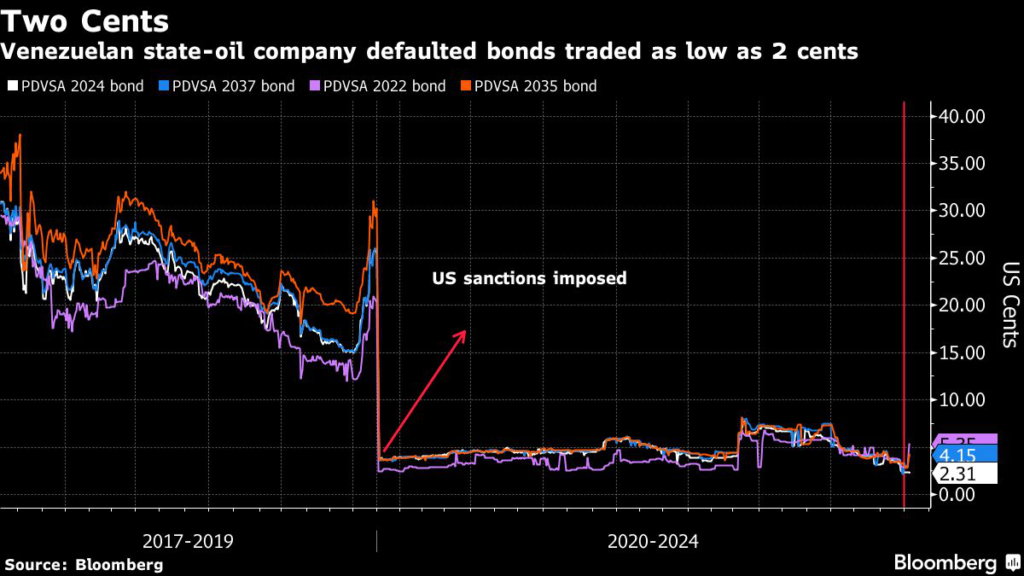
Bonds the country defaulted on nearly five years ago are trading around record lows, with some oil debt available for 2 cents on the dollar. Adding to the risks, the government is under sanctions that prohibit US investors from buying the notes. 

Yet, Lee Robinson said recent engagement between Washington and Venezuela President Nicolas Maduro signals an eventual easing of sanctions, which would open the door for the government to restructure the $60 billion, plus interest, it owes bondholders. His London-based company, Altana Wealth, has been loading up on the paper ever since it launched a dedicated Venezuela debt fund in 2020, recently doubling its investment to about $40 million.

“Ultimately this is a binary event. It doesn’t really matter whether you’re buying this at 7, 8, 9, or 10. At the end of the day, you’re gonna get multiples of that back in almost any scenario of sanctions being lifted,” he said in an interview. 

The US and Venezuela carried out a rare prisoner swap this month and Secretary of State Antony Blinken said the US is willing to reconsider sanctions if Maduro takes “constructive steps” to restore democracy. President Joe Biden sent a high-level delegation to visit Maduro in March when oil prices surged at the onset of the war in Ukraine. The governments have been in talks ever since. 

Robinson, who previously worked for Paul Tudor Jones, shorted the housing market in 2008 and launched a digital currency fund in 2014 to ride bitcoin to four-digit returns. Altana, which he launched in 2011, manages about $500 million in assets. 

He predicts the US will ease some sanctions following the midterm elections in November, when the political stakes of taking such a decision are seen as lower for Democrats. Since it’s based outside of the US, his fund is not subject to the sanctions, which restrict US individuals from buying the debt. 

“If you’d asked me this time last year, I would’ve said, ‘maybe something happens before 2024 because the elections, but I can’t tell you,” he said. “Things have changed. Matters have accelerated.”

Robinson is not alone in his forecast. Medley Advisors analyst Pilar Navarro sees relief coming before the end of the first quarter of 2023.

Robinson’s Cayman Island-based Altana Credit Opportunities Fund was up 27% as of August this year, according to a newsletter sent to investors and seen by Bloomberg. That compares to average losses of more than 20% in a Bloomberg index of developing-world bonds. If he’s right about Venezuela, he said, it will result in a major payout. 

“It’s a fantastic opportunity,” he said. “You may never want to invest in Venezuela, but if you do want to invest in Venezuela, you need to be doing it soon because anything could happen after November the eighth.”

More stories like this are available on bloomberg.com

©2022 Bloomberg L.P.

Stocks Trade Off Session Lows; Dollar Pares Gain: Markets Wrap

(Bloomberg) — US stocks fell as investors assessed the potential for policy tightening and geopolitical risks taking their toll on corporate earnings and economic growth. The dollar trimmed gains.

The S&P 500 pulled back from session lows along with the Nasdaq 100. Still, semiconductors remained among the worst performers after Washington’s move to further restrict China’s access to US technology added to signs of slowing chip demand worldwide.

Among Fed speakers weighing in on the policy outlook Monday, Vice Chair Lael Brainard laid out a case for exercising caution, noting that previous rate increases are still working through the economy. Chicago Fed President Charles Evans said the Fed needs to quickly get to a level where policymakers can feel comfortable pausing in order to reduce the risk of overshooting.

Turbulence gripped the UK gilt market, with the selloff accelerating despite the Bank of England extending its emergency backstop measures. The US cash Treasury market is closed for Columbus Day.  The dollar rose as signs of a new escalation in the Russia-Ukraine war also weighed on risk sentiment.

The mood remains fragile ahead of Thursday’s US inflation data and a raft of bank earnings that will kick off the third-quarter season in earnest. A hotter-than-expected inflation reading, coming on top of last week’s strong labor print, will heap pressure on the Federal Reserve to extend 75 basis-point rate hikes beyond this year.

“The market right now is trying to digest all this data coming in and then put it alongside some sort of Fed rate-hike path,” Shawn Cruz, head trading strategist at TD Ameritrade, said in an interview at Bloomberg’s New York headquarters. “And every time you get something that comes in not in the absolute rosy potential outcome for that data point, the market has some pretty big jitters. With the opening salvo from the earnings season coming from the banks, that’s going to drive a lot of volatility.”

Relentlessly hawkish central banks are making investors gloomy about the upcoming earnings season. JPMorgan Chase & Co. and Citigroup Inc. are among the big banks that will unveil earnings later this week.

On the corporate front, automakers Ford Motor Co. and General Motors Co. tumbled as outlook for the industry darkened further with at least two Wall Street analysts predicting earnings will fall steeply next year.  Macau casino operators including Wynn Resorts Ltd. and Las Vegas Sands Corp. tumbled in US trading after data showed that tourism revenue fell sharply over China’s week-long National Day break. 

Even after this year’s brutal selloff, markets have not priced all the risks stemming from higher interest rates and stubbornly high inflation. More than 60% of the 724 respondents to Bloomberg’s latest MLIV Pulse survey predicted the earnings season would push the S&P 500 Index lower. Strategists at Goldman Sachs Group Inc. and Morgan Stanley warned it would be a difficult reporting season, given risks such as slowing demand and soaring costs

“The bear market will not be over until the deteriorating fundamental picture is more fully discounted,” Morgan Stanley strategists told clients. 

On corporate front:

  • Automakers Ford Motor Co. and General Motors Co. tumbled as the industry outlook darkened further with at least two Wall Street analysts predicting earnings will fall steeply next year
  • Macau casino operators including Wynn Resorts Ltd. and Las Vegas Sands Corp. tumbled in US trading after data showed that tourism revenue fell sharply over China’s week-long National Day break
  • Rivian Automotive Inc. declined after the electric-vehicle maker said it will recall about 13,000 vehicles it delivered to customers after discovering a minor structural defect.

Meanwhile, Britain stepped up efforts to support market functioning. The BOE extended emergency measures backing the bond market through early next month while Chancellor of the Exchequer Kwasi Kwarteng brought forward the date at which he will deliver his much-awaited fiscal strategy.

Despite the measures, 30-year borrowing costs rose above 4.5%. The pound slipped to trade at a 12-day low.

Key events this week:

  • Earnings this week include: JPMorgan Chase & Co., Citigroup Inc., Morgan Stanley, BlackRock Inc., Delta Air Lines Inc., UnitedHealth Group Inc, U.S. Bancorp, Wells Fargo & Co.
  • IMF’s World Economic Outlook and Global Financial Stability Report, Tuesday
  • Fed’s Loretta Mester speaks, Tuesday
  • BOE’s Andrew Bailey speaks, Tuesday
  • FOMC minutes for September meeting, Wednesday
  • US PPI, mortgage applications, Wednesday
  • OPEC Monthly Oil Market Report, Wednesday
  • Fed’s Michelle Bowman and Neel Kashkari speak
  • ECB’s Christine Lagarde speaks
  • US CPI, initial jobless claims, Thursday
  • G-20 finance ministers and central bankers meet, Thursday
  • China CPI, PPI, trade, Friday
  • US retail sales, business inventories, University of Michigan consumer sentiment, Friday
  • BOE emergency bond buying is set to end, Friday

Some of the main moves in markets:

Stocks

  • The S&P 500 fell 0.3% as of 1:52 p.m. New York time
  • The Nasdaq 100 fell 0.4%
  • The MSCI World index fell 0.6%

Currencies

  • The Bloomberg Dollar Spot Index rose 0.2%
  • The euro fell 0.3% to $0.9711
  • The British pound fell 0.1% to $1.1070
  • The Japanese yen fell 0.3% to 145.68 per dollar

Cryptocurrencies

  • Bitcoin fell 0.8% to $19,338.72
  • Ether fell 0.5% to $1,313.8

Bonds

  • Germany’s 10-year yield advanced 15 basis points to 2.34%
  • Britain’s 10-year yield advanced 23 basis points to 4.47%

Commodities

  • West Texas Intermediate crude fell 0.3% to $92.36 a barrel
  • Gold futures fell 1.9% to $1,677.20 an ounce

More stories like this are available on bloomberg.com

©2022 Bloomberg L.P.

US Chipmakers Stocks Join Global Rout as Biden Expands Curbs

(Bloomberg) — Shares of semiconductor companies fell Monday, with the industry selling off globally after fresh US curbs on China’s access to American technology added to a disappointing start to the earnings season, stoking concern that the industry’s downturn is far from over.

The Philadelphia Stock Exchange Semiconductor Index fell as much as 4.6%, building on Friday’s decline of 6.1%. The index is down more than 40% thus far this year and is trading at its lowest level since November 2020. Semiconductor capital equipment companies led the day’s declines, with Applied Materials Inc. tumbling as much as 6.4%, Lam Research Corp. off 9.2% and KLA Corp. down 5.7%. Advance Micro Devices Inc. dropped 3.7%, while Marvell Technology Inc. shed as much as 7.4%.

US-listed shares of chip-equipment maker ASML Holding NV sank 4.1% and Chinese bellwether Semiconductor Manufacturing International Corp. fell 4% in Hong Kong, the most in five weeks. Declines were steeper in smaller stocks. 

The US measures include restrictions on the export of some types of chips used in artificial intelligence and supercomputing, and also tighter rules on the sale of semiconductor equipment to any Chinese company. Separately, the US also added more Chinese firms to a list of companies that it regards as “unverified,” which means US suppliers will face new hurdles in selling technologies to those entities. 

“The changes represent a further escalation, and we do not know what China might do in response,” wrote Stacy Rasgon, an analyst at Bernstein. “Potential retaliation remains a risk.”

The new strategy suggests that Washington aims to “freeze in” China at its current level, enabling the US to increase its lead, said Gabriel Wildau, an analyst at advisory firm Teneo Holdings LLC.

Chinese Foreign Ministry spokesperson Mao Ning said Saturday that the measures, which are set to enter into force this month, are unfair and will “also hurt the interests of US companies.” They “deal a blow to global industrial and supply chains and world economic recovery,” she said.

What Bloomberg Intelligence Says

“SMIC’s revenue could grow at a 50% slower pace vs. our expectations in 2023 on the US’s stricter equipment export license requirements, as 48% of its new capacity to be installed by next year is in 28- or smaller nanometer node advanced chip manufacturing.”

— Charles Shum, analyst

Click here for the full research

The new US rules come at a time when the chip industry is already grappling with an ominous start to the earnings season and has gone from a worldwide shortage of chips to a glut in a matter of months due to the boom-and-bust nature of semiconductor demand. 

Samsung Electronics Co., the world’s largest memory-chip maker, and PC-processor maker AMD reported results last week that suggested a deeper-than-feared slowdown ahead. 

Among smaller chip-related companies, equipment maker ACM Research Inc. plunged as much as 31% in New York trading Monday, while its Shanghai-listed subsidiary, ACM Research Shanghai Inc., sank 20%. In Hong Kong, Hua Hong Semiconductor Ltd. fell 9.4% and Shanghai Fudan Microelectronics Group Co. plummeted 20%, the most since July 2020. China’s Will Semiconductor Co. and Maxscend Microelectronics Co. dropped more than 6% each.

The curbs are a “big setback to China” and “bad news” for global semiconductors, Nomura Holdings Inc. analyst David Wong wrote in a note. China’s localization efforts may also be “at risk as it may not be able to use advanced foundries in Taiwan and Korea,” he wrote.

The US Commerce Department has added Beijing Naura Magnetoelectric Technology Co., a subsidiary of Naura Technology Group Co., to its Unverified List, Naura Technology said in a filing. Naura Technology plunged by the daily limit of 10% in China.

To be sure, the intensifying Sino-American tensions could spur Beijing to step up support for homegrown firms in a bid to achieve its goal of becoming an independent chip powerhouse.

The fall in Chinese chip stocks may cast a pall over the sector globally. Markets in Japan, South Korea, Taiwan and Malaysia will get a chance to react on Tuesday as they were closed on Monday. 

“This will not only be negative to the Chinese semiconductor industry but also indirectly impact global semiconductor makers’ business opportunities longer term,” Citigroup analysts including Laura Chen wrote in a note.

Broader Chinese equity market also saw declines on Monday after returning from the Golden Week holiday, hurt by a global equities selloff and bleak holiday-spending data that deepened concerns about an economic recovery.

(Updates share price moves throughout.)

More stories like this are available on bloomberg.com

©2022 Bloomberg L.P.

Tech Leads Stocks Lower as Growth Fears in Focus: Markets Wrap

(Bloomberg) — US stocks fell as investors grappled with the potential toll policy tightening and geopolitical risks will take on company earnings and economic growth. The dollar rose.

Tech and energy sectors led the S&P 500 lower as the equity slump extended into a fourth consecutive day. The Nasdaq 100 dropped the most among major benchmarks, pressured by the semiconductor sector after Washington’s move to further restrict China’s access to US technology and signs of slowing chip demand worldwide.

Turbulence gripped the UK gilt market, with the selloff accelerating despite the Bank of England extending its emergency backstop measures. The US cash Treasury market is closed for Columbus Day.  The dollar rose as signs of a new escalation in the Russia-Ukraine war also weighed on risk sentiment.

The mood remains fragile ahead of Thursday’s US inflation data and a raft of bank earnings that will kick off the third-quarter season in earnest. A hotter-than-expected inflation reading, coming on top of last week’s strong labor print, will heap pressure on policy makers to extend 75 basis-point rate hikes beyond this year.

“The market right now is trying to digest all this data coming in and then put it alongside some sort of Fed rate-hike path,” Shawn Cruz, head trading strategist at TD Ameritrade, said in an interview at Bloomberg’s New York headquarters. “And every time you get something that comes in not in the absolute rosy potential outcome for that data point, the market has some pretty big jitters. With the opening salvo from the earnings season coming from the banks, that’s going to drive a lot of volatility.”

Relentlessly hawkish central banks are making investors gloomy about the upcoming earnings season. JPMorgan Chase & Co. and Citigroup Inc. are among the big banks that will unveil earnings later this week.

Even after this year’s brutal selloff, markets have not priced all the risks stemming from higher interest rates and stubbornly high inflation. More than 60% of the 724 respondents to Bloomberg’s latest MLIV Pulse survey predicted the earnings season would push the S&P 500 Index lower. Strategists at Goldman Sachs Group Inc. and Morgan Stanley warned it would be a difficult reporting season, given risks such as slowing demand and soaring costs

“The bear market will not be over until the deteriorating fundamental picture is more fully discounted,” Morgan Stanley strategists told clients. 

Meanwhile, Britain stepped up efforts to support market functioning. The BOE extended emergency measures backing the bond market through early next month while Chancellor of the Exchequer Kwasi Kwarteng brought forward the date at which he will deliver his much-awaited fiscal strategy.

Despite the measures, 30-year borrowing costs rose above 4.5%. The pound slipped to trade at a 12-day low.

Key events this week:

  • Earnings this week include: JPMorgan Chase & Co., Citigroup Inc., Morgan Stanley, BlackRock Inc., Delta Air Lines Inc., UnitedHealth Group Inc, U.S. Bancorp, Wells Fargo & Co.
  • IMF’s World Economic Outlook and Global Financial Stability Report, Tuesday
  • Fed’s Loretta Mester speaks, Tuesday
  • BOE’s Andrew Bailey speaks, Tuesday
  • FOMC minutes for September meeting, Wednesday
  • US PPI, mortgage applications, Wednesday
  • OPEC Monthly Oil Market Report, Wednesday
  • Fed’s Michelle Bowman and Neel Kashkari speak
  • ECB’s Christine Lagarde speaks
  • US CPI, initial jobless claims, Thursday
  • G-20 finance ministers and central bankers meet, Thursday
  • China CPI, PPI, trade, Friday
  • US retail sales, business inventories, University of Michigan consumer sentiment, Friday
  • BOE emergency bond buying is set to end, Friday


Some of the main moves in markets:

Stocks

  • The S&P 500 fell 0.6 as of 11:50 a.m. New York time
  • The Nasdaq 100 fell 1%
  • The MSCI World index fell 0.9%

Currencies

  • The Bloomberg Dollar Spot Index rose 0.3%
  • The euro fell 0.5% to $0.9697
  • The British pound fell 0.4% to $1.1045
  • The Japanese yen fell 0.3% to 145.72 per dollar

Cryptocurrencies

  • Bitcoin fell 1.2% to $19,251.19
  • Ether fell 1.1% to $1,306.93

Bonds

  • Germany’s 10-year yield advanced 14 basis points to 2.34%
  • Britain’s 10-year yield advanced 24 basis points to 4.48%

Commodities

  • West Texas Intermediate crude fell 0.5% to $92.15 a barrel
  • Gold futures fell 2% to $1,674.60 an ounce

More stories like this are available on bloomberg.com

©2022 Bloomberg L.P.

Close Bitnami banner
Bitnami