Bloomberg

Musk Plans to Skip Deposition in Twitter-Buyout Lawsuit

(Bloomberg) — Elon Musk won’t be showing up Thursday for a long-awaited deposition in Twitter Inc.’s lawsuit aimed at forcing him to go through with a $44 billion buyout of the company, according to people familiar with the matter. 

The billionaire reversed course earlier this week and committed himself to consummating the $54.20-per-share offer for the popular social-media platform on its original terms. Even though the deal still may take months to close, a trial set for Oct. 17 is almost certain to be put on hold. 

That means there’s no pressure for Musk to submit for pre-trial questioning about his complaints that Twitter executives hid the number of robot and spam accounts among the platform’s more than 230 million users. The deposition was scheduled to start at 9:30 a.m. at a law firm’s offices in Austin, Texas.

The people declined to be identified discussing a confidential matter.

The Wall Street Journal reported earlier that the deposition has been delayed, citing unidentified sources. 

The New York Times reported, also citing unidentified sources, that Musk’s representatives had unsuccessful talks with Twitter in recent weeks about reducing the price of the deal before he renewed his original proposal. 

Musk sought a discount of as much as 30%, which would have valued the company at roughly $31 billion, but Twitter rebuffed the proposal, the newspaper said. Discussions in the last week concerning a discount of about 10% ultimately did not move forward, the Times reported.

Delaware Chancery Judge Kathaleen St. J. McCormick said Wednesday that since neither side has yet asked to pause the case, she’s pressing ahead with the upcoming trial. In a securities filing earlier this week, Musk offered to go forward with the deal if Twitter’s suit was put on hold. 

Lawyers for both sides are still hammering out details on a final resolution of the suit as banks and other investors dust off the deal’s original $12.5 billion debt-financing package. The lenders are led by Morgan Stanley. Other investors include Oracle Corp. Chief Executive Officer Larry Ellison. 

Twitter didn’t immediately respond to a request for comment late Wednesday on Musk’s decision to skip the deposition.

The case is Twitter v. Musk, 22-0613, Delaware Chancery Court (Wilmington). 

(Updates with New York Times report)

More stories like this are available on bloomberg.com

©2022 Bloomberg L.P.

Battery Maker CALB Opens Flat After $1.3 Billion Hong Kong IPO

(Bloomberg) — CALB Co., a Chinese battery supplier for electric vehicle makers, was unchanged in its trading debut in Hong Kong on Thursday as it tests appetite for the sector one week after an EV producer’s disastrous debut in the city.

Shares opened at HK$38 each, the price they were sold at in the offering. The Jiangsu-based company raised about HK$10.1 billion ($1.3 billion) after selling shares at the bottom of a marketed range that went as high as $51. The IPO drew 15 cornerstone investors who agreed to purchase around $735.5 million worth of stock.

The listing is the third-largest in the Asian financial hub this year. Its first session is certain to be watched closely by investors after electric-vehicle maker Zhejiang Leapmotor Technology Co. slumped 34% in its first day of trade on Sept. 29 following a $800 million offering. It capped the biggest first-day decline on record for a listing of that size or bigger in the city.

IPO proceeds in Hong Kong are down nearly 75% for the year, and half of the 18 companies that listed since January after raising more than $100 million ended their initial session below water, Bloomberg data show. CALB shares slipped in gray-market trading in Hong Kong on Wednesday.

Only about 20% of CALB shares that were available to retail investors ended up being subscribed in the IPO, according to a statement this week, while the tranche for international funds was “moderately oversubscribed.”

Huatai International Ltd. is the sole sponsor of CALB’s Hong Kong IPO.

More stories like this are available on bloomberg.com

©2022 Bloomberg L.P.

Mizuho in Talks to Buy 20% Stake in Rakuten Securities, Sources Say

(Bloomberg) — Rakuten Group Inc. shares jumped the most in more than four months on news that Mizuho Financial Group Inc. is in talks to acquire a stake in the e-commerce giant’s securities unit. 

Mizuho’s brokerage unit may buy a 20% stake in Rakuten Securities Inc. for about 80 billion yen ($554 million), people with knowledge of the matter said. An agreement could come by the end of the week, the Nikkei newspaper reported late Wednesday.  

Shares of Rakuten jumped as much as 9.5% on Thursday morning in Tokyo, the biggest intraday gain since May 13, paring this year’s decline to 39%. Mizuho, Japan’s third-largest bank, rose 0.2%.  

Billionaire Hiroshi Mikitani’s Rakuten has struggled since it made a big push into Japan’s saturated mobile market to compete with NTT Docomo Inc., KDDI Corp. and SoftBank Corp. The group’s quarterly operating loss widened from a year ago, and S&P Global Ratings last month gave it a negative credit outlook, citing cash pressures.

A stake purchase of the size and price reported could boost Rakuten Securities’ sum-of-the-parts value by 8% to about 4.2 trillion yen, according to Bloomberg Intelligence analysts including Marvin Lo and Shin Tamura. The price implies a “hefty” price-to-book ratio of almost three times, versus 1.2 times for rival Monex Group Inc., they wrote in a note. 

Rakuten said in May that it’s preparing a listing for its securities unit as the e-commerce giant diversifies its business. It’s not clear what Mizuho’s stake purchase would mean for the initial public offering, which hasn’t been scheduled. 

Conditions for IPOs have deteriorated this year as investors get spooked by a global stock market slump. Rakuten is also planning to list its banking unit, and chose Goldman Sachs Group Inc. and Daiwa Securities Group Inc. as lead managers for the offering last month. 

Going Online 

Japan’s biggest banks have been struggling to build scale in their online securities businesses and compete with industry leaders like SBI Holdings Inc. and Rakuten. Sumitomo Mitsui Financial Group Inc. in June agreed to take a 10% stake in SBI, the country’s largest online brokerage. 

“Mizuho Securities is likely to be attracted by the growth in Rakuten’s online accounts (40%) and assets under management (54%), the highest pace of all Japanese brokers in fiscal 2022,” the BI analysts said. 

Mizuho and Rakuten are in talks for various alliance opportunities, including investment in Rakuten Securities, but nothing has been decided, the bank said in a statement. Rakuten Group issued a similar statement. 

For Japanese banks, digital channels are seen as critical to attract retail clients, especially younger generations. Sumitomo Mitsui’s alliance with SBI will focus on providing online financial services for individuals including younger and mass-affluent customers, Tokyo-based SBI said in June. 

More stories like this are available on bloomberg.com

©2022 Bloomberg L.P.

Communication Emerges as Key Monetary Policy Tool for Thailand

(Bloomberg) — Analysts disappointed with the gradual pace of Thailand’s monetary policy tightening may be missing the point if they’re only looking at interest-rate actions, according to a central banker.

Going by Bank of Thailand Assistant Governor Piti Disyatat’s suggestion, they should also take note of the authority’s open-mouth operations — the spoken or written words communicated by the central bank to direct market expectations.

“Monetary policy is 90% communication and 10% action,” Piti, 49, said in an interview. More than a year ago, he took the job of relaying policy decisions as secretary of the Monetary Policy Committee and has since revamped the BOT’s communications strategy as it aspires to be more transparent, accessible and forward looking.

Among Asian central banks, BOT has one of the most visible communication strategies. While its officials give policy speeches as often as their peers in the Philippines and Indonesia, Thai authorities have been especially active on social media, using it to manage expectations in the wake of global policy events such as a Federal Reserve meeting.

Monetary Policy Via Facebook Is Southeast Asia Tool in Turmoil

The BOT, which has nearly 750,000 followers on Facebook, has grown its online presence to platforms including Line, Twitter and Instagram to better explain itself to the public. A day before the Fed’s meeting in September, the Thai central bank used a niche local social media app, Blockdit, to say why a gradual normalization of policy was worth the wait. 

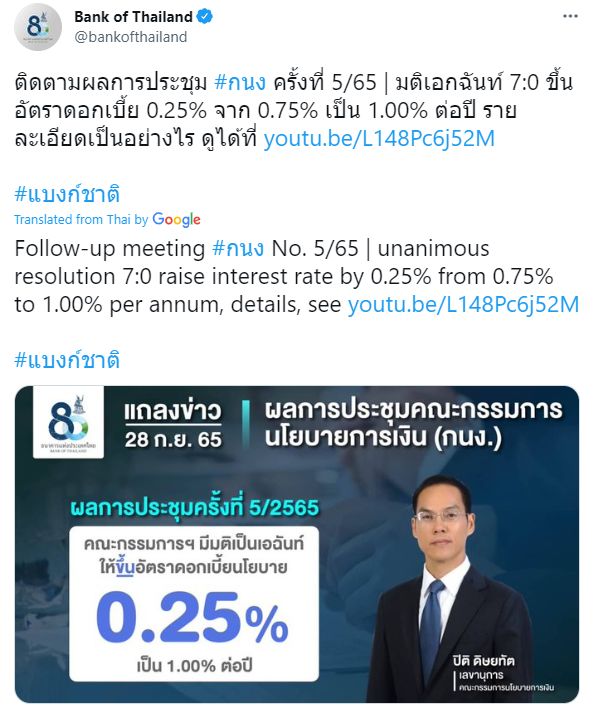
A day after the Fed’s move, the BOT followed up with a post to argue why a large hike was not appropriate for Thailand, even as the Philippines and Indonesia delivered half-point hikes and Vietnam moved by 100 basis points. Nearly a week later, the BOT increased borrowing costs by 25 basis points in a scheduled meeting, in line with its forward guidance for gradual and measured moves.

The quarter-point hike last month surprised some economists, with Skandinaviska Enskilda Banken AB’s Eugenia Fabon Victorino calling it a “lost opportunity,” and Maybank Investment Banking Group describing the BOT as the least hawkish central bank in the region.

The BOT will “not deliberately surprise the market,” Piti said, referring to the bank’s guidance for gradual moves. At the same time it won’t be a factor to stop it from “doing what we think is needed.”

Piti, who previously worked at the Bank for International Settlements and the International Monetary Fund, steered the communications strategy of the 80-year-old BOT to align it with the Fed and the European Central Bank’s approach of announcing the decision 30 minutes before it holds a media briefing. The BOT also started broadcasting the post-policy question and answer session via Facebook Live instead of only reading out the decision statement earlier.

The policy rate statement is now tailored to be more forward-looking rather than explanatory, and spells out a clear pathway for the economy and inflation and the likely course of monetary policy. The central bank is trying to lay out “its preferences,” so the market and the public can understand how it would react to different economic situations, Piti said.

It’s a model also followed by monetary authorities in Sweden, Czech Republic and New Zealand, he said, adding that Thailand doesn’t plan to give interest-rate forecast like other countries on concerns about miscommunication.

“At the end of the day, the central bank doesn’t want to be the one adding noise to the market,” Piti said. “You want to be the stabilizing force.”

More stories like this are available on bloomberg.com

©2022 Bloomberg L.P.

Uber’s Former Security Chief Convicted of Data Hack Coverup

(Bloomberg) — Uber Technologies Inc.’s former security chief was convicted of concealing a massive data breach in a case that prosecutors tied to the company’s troubled past under its original leadership.

Joe Sullivan was found guilty in San Francisco federal court Wednesday by a jury which rejected his claim that other executives at the ride-hailing giant were aware of the 2016 hack and were responsible for it not being disclosed to regulators for more than a year. 

The trial featured almost four weeks of testimony that explored cyber security management as well as a shakeup at Uber in 2017 when a series of scandals drove co-founder Travis Kalanick out as chief executive officer. 

Sullivan was convicted of both charges against him, obstructing a government investigation and concealing the theft of personal data of 50 million customers and 7 million drivers.

Sullivan, a former federal prosecutor who previously headed security for Facebook, is well-known for his expertise in the field in Silicon Valley. He faces as long as eight years in prison, though his sentence will likely be far less.

“While we obviously disagree with the jury’s verdict, we appreciate their dedication and effort in this case. Mr. Sullivan’s sole focus — in this incident and throughout his distinguished career — has been ensuring the safety of people’s personal data on the internet,” said David Angeli, a lawyer for Sullivan. “We will evaluate next steps in the coming days.“

Read More: Uber to Pay $148 Million in Settlement Over 2016 Data Breach

Companies are required under state and federal laws to promptly disclose data breaches. Uber’s mishandling of the 2016 attack on its servers resulted in the company paying $148 million in a settlement with all 50 states, which at the time was the biggest data-breach payout in US history. Uber had previously been reprimanded by the Federal Trade Commission over a similar data breach from 2014.

“Sullivan affirmatively worked to hide the data breach from the Federal Trade Commission and took steps to prevent the hackers from being caught,” Stephanie Hinds, US attorney for San Francisco, said in an emailed statement. “We will not tolerate concealment of important information from the public by corporate executives more interested in protecting their reputation and that of their employers than in protecting users.”

Sullivan was accused of quietly arranging for Uber to pay the hackers $100,000 in Bitcoin to delete the stolen data under the guise of a program used to reward security researchers for identifying vulnerabilities, known as a “bug bounty.” In return, the two hackers agreed not to disclose that they had stolen the data. The hackers later pleaded guilty for their role in the incident.

The October 2016 hack stayed secret until the following November when it was disclosed by the new CEO, Dara Khosrowshahi, about three months into his tenure. At the same time, he fired Sullivan.

Khosrowshahi testified that after discovering inconsistencies in Sullivan’s account of what happened, he decided it was time to replace his security chief. “I couldn’t trust his judgment anymore,” he said.

Sullivan’s defense was that Uber’s legal department and other managers were aware of the incident before it blew up publicly.

Angeli challenged the notion of a coverup by pointing to Sullivan’s sharing of information with numerous employees, before Khosrowshahi arrived at the company. Jurors were shown a 1:24 a.m. text that Sullivan sent to Kalanick describing the breach less than 12 hours after it happened.

“Remember, Mr. Kalanick is the top person at Uber,” Angeli said at closing arguments. “Mr. Sullivan could not have reported this to someone higher up at the company.”

Prosecutors argued that Sullivan, who joined Uber in 2015, was well aware of the requirements to disclose the breach, especially after the company’s dealings with the FTC over the 2014 hack.

Sullivan, who was supposed to have improved security after the earlier breach, didn’t want the details of the new hack to get out because it would have hurt his reputation, prosecutor Ben Kingsley told jurors.

Rather than disclose it, Sullivan “prioritized his reputation, and the company’s reputation, over his obligations,” he said. 

Sullivan didn’t testify, nor did Kalanick.

The case is U.S. v. Sullivan, 20-cr-00337, U.S. District Court, Northern District of California (San Francisco).


(Updates with comment by US attorney in San Francisco)

More stories like this are available on bloomberg.com

©2022 Bloomberg L.P.

DeSantis and Biden Play Nice at Ian’s Epicenter, Previewing Possible 2024 Showdown

(Bloomberg) — Joe Biden and Florida Governor Ron DeSantis have only met twice since the president took office, and both encounters were forced upon them by a disaster.

In normal circumstances the two men avoid each other. DeSantis, 44, represents a Republican alternative to Donald Trump come the next presidential election, and perhaps an even more dangerous challenger to Biden’s pursuit of a second term.

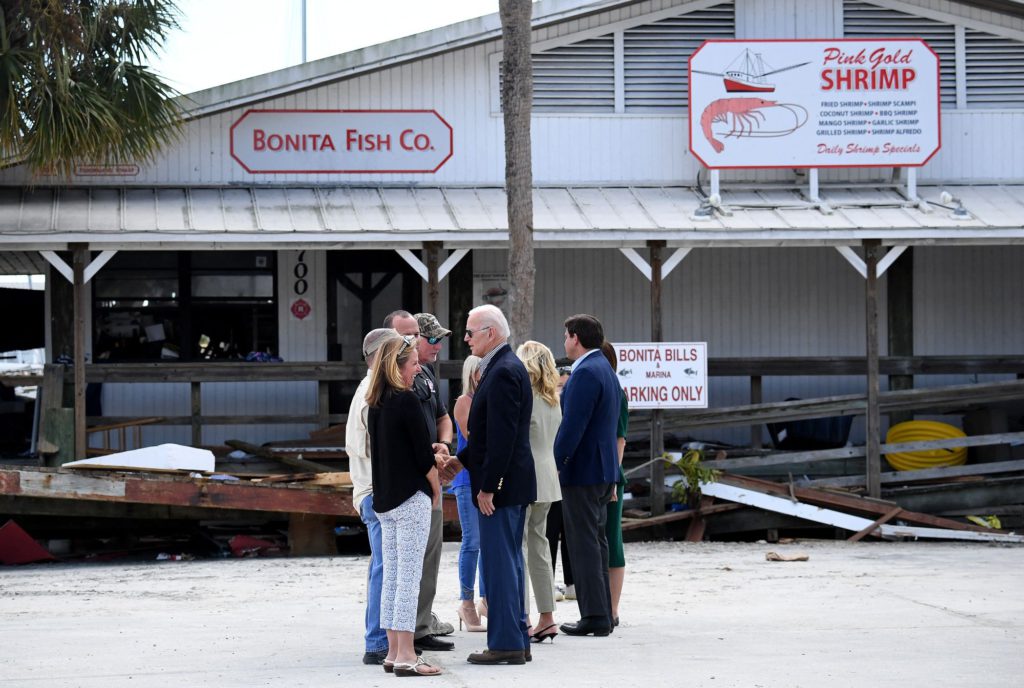
But on Wednesday the two put on a show of solidarity for the victims of Hurricane Ian on a storm-ravaged street near Fort Myers. Accompanied by their wives, they shook hands and complimented each other. DeSantis has “done a good job” with the storm, Biden said, while the governor thanked the president and said his administration was “cutting through the red tape.” 

Nonetheless, the gathering had the unmistakable feel of a pre-fight weigh-in between a pair of political brawlers whose next meeting might come on a debate stage. While they were largely careful to skirt politics, some tension surfaced.

There was a subtle jab from DeSantis, for example, after Biden surveyed storm damage from his helicopter: “I will tell you that I was in Sanibel today — you can go over it in a helicopter and you see damage, but it does not do it justice until you are actually on the ground.”

Minutes later, came the riposte from Biden: “I’m sure it’s much worse from the ground. But you can see a whole hell of a lot of damage from the air.”

The afternoon largely entailed niceties. 

“We have very different political philosophies,” Biden told reporters accompanying him. “But we’ve worked hand-and-glove.”

Christie ‘Hug’

Both men avoided the kind of intimacy that has led to controversy after past meetings between presidents and governors of opposite parties. Former New Jersey Governor Chris Christie had to repeatedly deny that he had hugged President Barack Obama while the two men surveyed damage from storms that hit his state in 2011 and 2012.

While their greetings were better described as warm handshakes, the moments damaged the Republican politically.

DeSantis thanked the president and the first lady for visiting, praised the administration’s response, and credited Biden for extending federal assistance to remove debris and pay for emergency services. Biden pledged assistance would continue as long as it was needed.

The two leaders largely maintained separate orbits, with spouses and aides serving as human buffers. But neither completely shed their political instincts. As DeSantis met with constituents, he showered praise on political ally – and frequent Biden critic — Elon Musk for providing emergency stations with internet connectivity through his Starlink satellite system.

And he highlighted a new charitable organization launched in recent days by his wife, saying it was a way to reach people who might not be eligible for assistance from the federal government. That effort has been particularly important as DeSantis has faced tough coverage over welcoming federal dollars to help Florida despite voting, as a congressman, against funding to assist the victims of Sandy.

Their joint appearance –  announced only Tuesday, days after Biden had indicated he planned to visit the state – amounted to just enough time together that both could avoid criticism that pettiness alone had driven them apart.

Biden seemed largely content to let the event illustrate the thesis of his presidency: that he’s a rare figure able to bridge partisan divides and unite the country in times of crisis.

Praise for DeSantis

He praised DeSantis for a “remarkable” job, and did not criticize the governor when asked about the state’s struggles with its property insurance market. Still, the president also appeared to relish the opportunity to contradict the doddering, passive depiction that critics – including DeSantis – often paint of him.

Biden caused a small maelstrom on social media when microphones caught him deploying salty language in conversation with a heavily sunburned Floridian, who responded with hearty guffaws.

The president made sure to plug the assistance the state had already received through his signature infrastructure law. And he opened his formal remarks with a sharp rebuke of those skeptical about climate change.

“I think the one thing this is finally ended is a discussion about whether or not there’s climate change and we should do something about it,” Biden said.

It’s a point Biden has made before as he’s toured drought, fire, and storm damage across the country. But the moment had particular resonance as he stood in front of DeSantis, who has sought to prohibit his state from investing in environmental, social and governance funds that claim to take into account the impact of climate change.

This isn’t the first display of forced bonhomie between Biden and DeSantis. The pair traded praise for each other last year after the collapse of a condo building in Surfside, Florida.

But both seemed to recognize – particularly with the 2024 election fast approaching – the practical and political benefits of once again burying the hatchet for an afternoon.

“On things relating to dealing with this crisis, we’ve been completely lockstep,” Biden said.

More stories like this are available on bloomberg.com

©2022 Bloomberg L.P.

Apollo, Sixth Street Abandoned Twitter Funding Talks Months Ago

(Bloomberg) — Investment firms that had expressed an interest in helping Elon Musk finance his acquisition of Twitter Inc. abandoned the talks several months ago, around the time that the mercurial billionaire backtracked from the deal, according to people with knowledge of the matter.

Firms including Apollo Global Management Inc. and Sixth Street Partners had been in discussions to contribute billions of dollars via a preferred equity stake — before Musk declared the deal dead, said the people, who asked not to be identified because they weren’t authorized to speak publicly.

Musk had been looking to raise as much as $6 billion from preferred equity investors as a way to reduce the amount of cash he had to provide himself in the $44 billion acquisition. Financing for the transaction also includes $13 billion of debt, which a group of banks led by Morgan Stanley agreed to provide.

Read more: Twitter LBO Revives $12.5 Billion Headache for Wall Street

Representatives for Apollo and Sixth Street declined to comment. A representative for Morgan Stanley didn’t immediately respond to a request for comment.

Reuters earlier reported that Apollo and Sixth Street are no longer in talks with Musk to provide financing for the deal.

Musk’s attempt to back out of the deal set off a months-long legal drama that appeared to have ended on Tuesday after the billionaire said he was now willing to buy the social-media giant for the $54.20-a-share price tag he had agreed to in April.

Apollo and Sixth Street both have large credit investing arms and it’s always possible that they could reemerge as investors later if banks syndicate Twitter buyout debt to investors.

More stories like this are available on bloomberg.com

©2022 Bloomberg L.P.

AT&T CEO Says His Satellite Phone Service Has Lead Over Musk’s

(Bloomberg) — AT&T Inc. Chief Executive Officer John Stankey said his company is way ahead of T-Mobile US Inc. and Elon Musk in efforts to provide mobile phone service to remote areas via satellites.

They each have announced plans to offer wireless phone and internet connectivity to remote regions through a series of low-Earth orbit satellites still being launched.

T-Mobile and Musk, operating through his company SpaceX, announced with great fanfare in August a service they said would save lives by beaming signals to and from areas like remote mountain tops and seas where hikers or sailors may be stranded.

“I would say we probably have an 18 month lead on this,” Stankey said in an interview Wednesday. “SpaceX is going to have to go through the same process. And they’re not going to have their satellite up for testing until the middle of next year.”

Spokespeople for T-Mobile and SpaceX didn’t immediately respond to requests for comment. 

Amazon.com Inc. founder Jeff Bezos and Verizon Communications Inc. are pursuing similar plans.

AT&T has been working with AST SpaceMobile Inc., its satellite partner. The companies will need further approval from the Federal Communications Commission for satellites to serve as cell sites in space. The airwaves they plan to use are currently approved for satellite transmissions at specific power levels. 

“We are comfortable with our test data,” Stankey said. “The next step is to present our findings to the FCC, to support changing the license parameters.”

The initial uses for satellite communications will be for emergency services including connectivity for FirstNet, a government-run network. A consumer application would follow later, according to Stankey.

“It’s inevitable that satellite communications will be a supplement to mobile service,” he said.

More stories like this are available on bloomberg.com

©2022 Bloomberg L.P.

Secretive Chip Startup May Help Huawei Circumvent US Sanctions

(Bloomberg) — When the US government blacklisted Huawei Technologies Co. as a national security threat, it cut the Chinese company off from buying American semiconductors and other critical technologies. Now Huawei may have a path around those restrictions. 

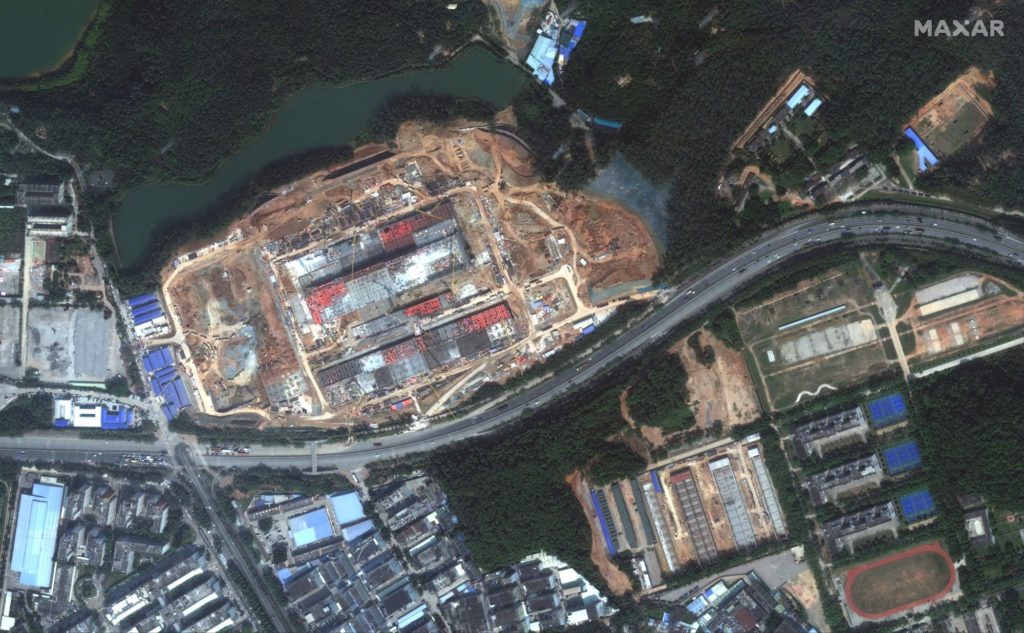
The Chinese technology giant is providing support to a startup in its hometown of Shenzhen that has ordered chipmaking equipment — including from foreign suppliers — for a semiconductor manufacturing plant, according to people familiar with the matter. The fledgling firm, Pengxinwei IC Manufacturing Co., is run by a former Huawei executive and is constructing facilities close to Huawei headquarters, according to public records and satellite photos. 

Huawei is expected to buy most, if not all, of its output, said the people, who asked not to be identified discussing private information. PXW, as the company is known, plans to take delivery of the gear as early as the first half of 2023, one of the people said.

If it succeeds in getting off the ground, the startup could effectively enable Huawei to sidestep Washington’s efforts to choke off the flow of chips to a company it views as a military and economic threat. Huawei representatives declined to comment. 

The low-profile PXW has already drawn the attention of the US Commerce Department’s Bureau of Industry and Security, which helps oversee American trade restrictions. 

The department is aware of the startup and “allegations of relationships with Huawei,” BIS said in response to a Bloomberg News query. “BIS is constantly on the lookout for efforts to evade export controls, including those related to parties on the Entity List like Huawei, and uses open-source, proprietary and classified information to substantiate and then, when appropriate, apply our administrative or criminal law enforcement as well as regulatory tools to address violations.”

It’s not clear whether PXW’s strategic plans explicitly violate US trade sanctions. If the firm intends to supply Huawei, it would be severely restricted in what chipmaking equipment it can buy from American suppliers. It has more latitude to buy machines from foreign suppliers such as ASML Holding NV and Tokyo Electron Ltd., though they too may need to seek US approval depending on the amount of American technology infused into any products sold.

PXW said in a statement it’s inked agreements with suppliers and aims to begin production in 2025, without mentioning clients. The company plans to start working on its 28-nanometer technology — six generations behind the most advanced manufacturing — next year, said one person familiar with its strategy.

Huawei, perhaps more than any other company, has been at the heart of US-China tensions. The Trump administration blacklisted the company in 2019 and pressed allied nations like the UK and Japan to remove its telecommunications equipment out of concern it could be used for spying and espionage. The conflict escalated with efforts to prosecute Huawei’s chief financial officer, the daughter of founder Ren Zhengfei, on fraud charges. (Meng Wanzhou, who denied wrongdoing, was allowed to leave Canada for China last year under a deferred prosecution agreement.)

Huawei has paid a heavy price. Before the blacklisting, the company was the world’s largest supplier of mobile communications equipment and competed with Apple Inc. and Samsung Electronics Co. in the smartphone business. Its chip design unit, HiSilicon, was a cornerstone of China’s attempts to establish a vibrant domestic semiconductor industry. The US actions drove Huawei out of many overseas markets, forced it to sell off its mass-market phone business and cut off its access to chips vital to its success. Ren said this year in an internal employee memo the company is finding it increasingly difficult to grow in the face of American sanctions.

PXW won’t be able to build a chip-making business to match capabilities of Taiwan Semiconductor Manufacturing Co., the industry leader that once supplied Huawei. But the startup could help Huawei regain ground in several critical areas, such as smartphones and servers. It’s not clear whether the company is using any assets, intellectual property or people from HiSilicon. 

President Joe Biden’s administration is preparing new restrictions on China’s access to chip technology that could affect PXW and similar cases. The Commerce Department plans to roll out a package of rules as soon as this week tightening curbs on semiconductor technologies that can be exported to China, people familiar with the matter have said. 

The US government is moving beyond blacklisting individual companies like Huawei and Semiconductor Manufacturing International Corp. in favor of broad restrictions on all Chinese companies, including a ban on purchases of artificial-intelligence chips. The White House is also considering an executive order to place curbs on US investment in Chinese tech companies. 

“We previously maintained a ‘sliding scale’ approach that said we need to stay only a couple of generations ahead. That is not the strategic environment we are in today,” Jake Sullivan, the US National Security Advisor, said last month. “Given the foundational nature of certain technologies, such as advanced logic and memory chips, we must maintain as large of a lead as possible.”

In China, the Huawei episode galvanized Communist Party efforts to build a domestic semiconductor industry, a long-standing goal to better compete with the US in cutting-edge technologies. The government has poured tens of billions of dollars into the sector. Huawei itself has invested in more than 40 chip-related companies, according to a research report from Berenberg Bank.

“Although Huawei does not own any manufacturing facilities for now, it is going to be one of the most important companies in driving China’s semi industry due to its products in end-markets such as networking, artificial intelligence computation, cloud, smartphones, IoT and auto,” Tammy Qiu, an analyst at Berenberg, wrote in the report in September. 

PXW is backed by the same Shenzhen city government that helped take over Huawei’s Honor smartphone division in 2020. The startup acquired enough land in the city to cover more than 30 soccer fields in December, and paid 158 million yuan ($23 million), according to land purchase information and its own website. Satellite photographs show buildings on the site are nearing completion, but what’s not clear is what gear will be installed inside them and where the machinery will come from.

The market for chipmaking equipment is dominated by five companies — the Netherlands’ ASML and Japan’s Tokyo Electron, as well as the US’s Applied Materials Inc., KLA Corp. and Lam Research Corp. All of them are subject to complicated regulations that restrict what they can sell to Huawei and other Chinese customers. In general, the American companies are barred from selling gear to Chinese customers more advanced than 14 nanometers — four generations behind the latest technology. US companies can’t sell anything to Huawei without a special license.

Applied Materials isn’t supplying the Chinese startup, according to a person familiar with the matter. Representatives for Applied and Lam Research declined to comment on PXW. KLA said in a statement that it complies with US trade regulations, including restrictions on individual companies and their affiliates.

ASML, which dominates the market for lithography equipment, declined to say if it is working with PXW and said it’s up to chipmakers to disclose their suppliers. A Tokyo Electron representative said the company has not heard of PXW.

PXW is targeting 14- and 7-nanometer manufacturing, less advanced than the capabilities of companies such as TSMC and Samsung, but still a challenge for Chinese chipmakers, according to one person familiar with its plans. It’s unclear how PXW could secure such technologies.  

Non-American companies like ASML and Tokyo Electron are in murky territory when it comes to companies blacklisted by the US, like Huawei. If their chip-making equipment contains US technology beyond a certain amount, they are restricted from selling to a customer they know works with a blacklisted company, according to Judith Alison Lee, a partner at the law firm Gibson Dunn & Crutcher. 

“Foreign-made items may incorporate a de minimis amount of US-origin content” — typically 25% — without falling under the restrictions, she said.

Kevin Wolf, a former senior official at BIS and now a partner at Akin Gump Strauss Hauer & Feld, said that, under today’s regulations, companies like ASML and Tokyo Electron can probably produce most of their chip-making equipment without crossing that threshold. 

“It’s unlikely that the non-US companies would get caught in any of the Huawei-specific rules,” he said. 

The Biden administration’s new restrictions could change that however. They may decide to block foreign companies from selling chip-making equipment to Huawei suppliers if those companies use any American components or software.

PXW has hired a number of senior engineers from chip giants including China’s Hua Hong Semiconductor Ltd. and Taiwan’s United Microelectronics Corp., according to a recruitment video posted on jobs site Liepin. It has also recruited engineers from Hongxin Semiconductor Manufacturing Co., a $20 billion chip project that collapsed in late 2020, according to a person familiar with the matter. The young company aims to hit capacity of 20,000 wafers by 2025, the company said on its website, without elaborating on the timeframe. 

A Chinese foundry capable of making 14-nm chips might be good enough for Huawei. Many components of networking gear — transceivers, application-specific integrated circuits and switch chips — are made with that technology. 

Read more: Xi Renews Call for China Tech Push After US Escalates Curbs

While Huawei’s smartphone business has been kneecapped by U.S. sanctions, it is still able to grow its telecom infrastructure business. TSMC dropped Huawei as a customer in 2020, cutting off access to a key manufacturing partner for the chips that go into phones and servers. 

PXW could reopen supply channels, the people said, if Washington doesn’t take further action. The US Bureau of Industry and Security declined to say whether it has approved or rejected licenses for any equipment makers to supply PXW.

Taiwan’s Ministry of Economic Affairs said while PXW has not been placed on its entity list for high-tech exports, no Taiwanese company has declared any shipments to the Chinese chipmaker over the past three years. The ministry added that Taiwan is stepping up efforts to clamp down on Chinese companies poaching Taiwanese talent. 

PXW describes itself as an emerging contract chip manufacturer. Its first plant — named by local authorities as a strategic construction project — aims to make chips used in cars, Internet of Things devices and phones, according to the company’s website. 

The company intends to develop its own technologies because of the “US hegemony” that forced China to come up with its own alternatives, a PXW employee said in a recruitment video. The goal is to make PXW a contract chip-making giant comparable to TSMC or SMIC, China’s biggest producer of chips, another employee said in the video.

Huawei will collaborate with domestic chip manufacturers including ones in Qingdao, Shenzhen, Beijing and Shanghai to get components it needs, Berenberg’s Qiu said in the September research note. 

“Over the next three to five years, Huawei should be able to set up manufacturing facilities and start streamlining the whole semi ecosystem,” Qiu wrote. “It is aiming to become a tier one component integrator for the auto industry, leveraging its semi, design and manufacturing capabilities.”

More stories like this are available on bloomberg.com

©2022 Bloomberg L.P.

Stocks Take Breather After Furious Rally From Low: Markets Wrap

(Bloomberg) — For many stock traders, it felt just about right that the market would take a breather after the dramatic rally of the past couple of days.

After a bounce that started around noon in New York and was attributed to a big options trade, the S&P 500 came back lower again. For a market plagued by fears about a recession and the Federal Reserve’s struggles to tame high inflation, the rebound from this year’s bottom has maybe gone too far, too fast.

Fundamentally speaking, nothing has changed that much to make the US central bank tilt toward a more moderate bias to prevent a hard landing. In fact, what Wall Street got on Wednesday was a renewal of the unflinching resolve from Fed officials to crush inflation. 

Fed Bank of Atlanta President Raphael Bostic said he favors lifting rates to between 4% and 4.5% by the end of this year, and then keeping the tightening in place. He also echoed comments from his San Francisco counterpart Mary Daly, who downplayed speculation about rate cuts in 2023.

To Win Thin at Brown Brothers Harriman, the notion of any Fed pivot is just “wishful thinking” as Fed officials remain hawkish. He says another 75-basis-point hike next month is a “done deal.” 

“Over the last few sessions, the market was too quick price in the ‘peak rate’ story in markets,” said Bipan Rai, head of North America currency strategy at CIBC. “Price pressures are set to remain sticky for some time and while the Fed might be closer to smaller incremental hikes than not, playing this via a ‘peak rate’ view is fairly dicey.”

Matt Maley at Miller Tabak, says the extreme positive breadth of the recent rebound in stocks is likely something that tells us the rally will take a “breather” for a day or two — but it might not mean that the bounce is over.

“Yes, ‘bear-market rallies’ can see sharp advances that reverse almost immediately, so what we’ve seen over the last two days could be the ultimate head fake,” Maley added. “However, if the stock market can digest its gains of the last two days without a major reversal over the next few days, it’s likely that we’ll see a bit more upside follow-through to this week’s bounce before long.”

Volcker Lesson to Generation QE: Stock Recoveries Can Take Years

If history is any guide, “markets will need to experience more stress” before a pivot in monetary policy and an equity bottom, Wells Fargo & Co. strategists led by Christopher Harvey wrote. The Cboe Volatility Index is still trading below 40 — a threshold that in the past signaled a shift to monetary easing.

US stocks just posted a rare streak of quarterly declines and are in a bear market, but Citigroup Inc. quantitative strategists say they’re only just starting to reflect the risks of a recession. 

A team led by Hong Li said equities could come under further pressure as they continue to be “heavily driven” by heightened bond market volatility as well as concerns around persistent inflation and hawkish Fed. 

There’s “more downside risk for the market and the earnings season,” they wrote.

Retail investors, who helped push stocks to all-time highs, are now trying a different tactic: Betting against the market. 

From January to August this year, even before the most recent slump in stocks, the number of newly opened short positions on trading platform eToro was 61% higher than in 2021 and 41% higher than in 2020. Meanwhile, some of the biggest US exchange-traded funds that bet against popular indexes are raking in record amounts of cash. 

Investors’ uncertainty toward the health of US companies is rising — and their leaders haven’t done much to help. The lack of an accurate road map for the crucial earnings season is setting the stage for a slew of potential surprises when the reporting season kicks off in coming weeks.

Aside from those few providing cold, hard numbers, executives at the 1,000 largest US firms have spent the past three months voicing a similar message in their public remarks: They’re unsure about what’s ahead. They’ve mentioned “uncertainty” or its synonyms when describing the outlook 484 times during that time, the highest tally since the quarter ending March 2021, data compiled by Bloomberg show.

BofA Strategist Says US Stock Rally Has Set Off a Bullish Signal

Key events this week:

  • Eurozone retail sales, Thursday
  • US initial jobless claims, Thursday
  • Fed’s Charles Evans, Lisa Cook, Loretta Mester speak at events, Thursday
  • US unemployment, wholesale inventories, nonfarm payrolls, Friday
  • BOE Deputy Governor Dave Ramsden speaks at event, Friday
  • Fed’s John Williams speaks at event, Friday

Will earnings disappoint and push equities to new lows? This week’s MLIV Pulse survey asks about corporate earnings. It’s brief and we don’t collect your name or any contact information. Please click here to share your views.

Some of the main moves in markets:

Stocks

  • The S&P 500 fell 0.2% as of 4 p.m. New York time
  • The Nasdaq 100 was little changed
  • The Dow Jones Industrial Average fell 0.1%
  • The MSCI World index fell 0.1%

Currencies

  • The Bloomberg Dollar Spot Index rose 0.6%
  • The euro fell 1% to $0.9884
  • The British pound fell 1.3% to $1.1327
  • The Japanese yen fell 0.3% to 144.56 per dollar

Cryptocurrencies

  • Bitcoin fell 1% to $20,130.68
  • Ether fell 0.8% to $1,350.92

Bonds

  • The yield on 10-year Treasuries advanced 11 basis points to 3.75%
  • Germany’s 10-year yield advanced 16 basis points to 2.03%
  • Britain’s 10-year yield advanced 16 basis points to 4.04%

Commodities

  • West Texas Intermediate crude rose 1.6% to $87.87 a barrel
  • Gold futures fell 0.3% to $1,725.30 an ounce

More stories like this are available on bloomberg.com

©2022 Bloomberg L.P.
Close Bitnami banner
Bitnami