Bloomberg

NATO Struggles With How to Protect Vital Undersea Links After Nord Stream Blasts

(Bloomberg) — NATO allies are struggling to work out how to better safeguard undersea critical infrastructure after the Nord Stream pipelines blasts laid bare the difficulty of monitoring facilities and identifying any attackers.

The sheer scale and underwater depth of assets such as pipelines — or data cables that allow the internet to function — heighten the challenge for governments. With most systems owned by private companies, proving which government may have sponsored an attack is even more complex.

“We’ve had a theoretical concern that it could be vulnerable but until these Nord Stream explosions, we have not seen an incident like this on that infrastructure,” said Kristine Berzina, a senior fellow for security and defense policy at the German Marshall Fund in Washington, D.C. “Now this sets off lots of worries about what other kind of infrastructure can be targeted.”

Russia’s bellicose rhetoric and steps to throttle Europe’s energy supplies have sparked concern that Moscow might target crucial underwater infrastructure like the pipelines from Norway that supply more than a fifth of the continent’s natural gas, or some of the 400 undersea data cables that carry about 98% of international internet data and telephone traffic around the world.

The cause of the damage to the Nord Stream pipelines so far remains unknown. European Union leaders have widely condemned it as sabotage but only Poland has directly blamed Russia. President Vladimir Putin said last week the pipelines had been attacked by “Anglo-Saxons.”

Danish, Swedish and German officials are still investigating the causes, a process that can take weeks. Researchers have previously warned that Russia has both the military capabilities and knowledge of where undersea cables and infrastructure is located. Russian military ships have also often been sighted near cables or pipelines, for instance, when they’ve been laid down. 

Lacking Tools

Allies of the North Atlantic Treaty Organization have rushed to deploy military vessels and planes to monitor the Baltic and North Seas to prevent another such attack. Norway has stepped up patrols of its energy facilities after an abnormally high number of drones were sighted. The Italian Navy is reinforcing protection of strategic trans-Mediterranean pipelines.

Norway’s security service, however, lacks tools to prevent sabotage against the country’s energy facilities while such risks have increased, public broadcaster NRK cited the agency’s Deputy Chief Hedvig Moe as saying. While the service can prevent and investigate terrorist threats using so-called invasive methods, such as wiretapping and data mining, it can’t use such means to prevent sabotage, Moe was quoted as saying.

At a meeting of NATO defense ministers in 2020, the military alliance produced a report underscoring the vulnerabilities related to undersea cables and the importance of protecting undersea infrastructure.


Hybrid Warfare

“It is important to understand that most of these cables are privately owned and it’s publicly known where they are,” NATO Secretary General Jens Stoltenberg said at the time. “And that makes them potentially vulnerable.”

Wojciech Lorenz, an analyst at the Polish Institute of International Affairs, said the Nord Stream pipeline damage displayed the typical hallmarks of hybrid warfare, combining plausible deniability and falling under the threshold of open conflict. 

“Even if we don’t know who’s behind the attacks, Russia can use it for its own purposes,” Lorenz said, adding Moscow could exert pressure on some countries not to support sanctions as well as divert attention from Russia’s annexation of Ukrainian territories.  

The Nord Stream damage also comes as the Ukrainian military continues to drive Russian forces out of large parts of its country, which Berzina said could be yet another factor that points the blame toward Russia as Moscow may seek to distract from its failures.  

NATO’s response to last month’s explosions is likely to be  somewhat limited, since Swedish and Danish officials have noted the pipeline damage took place in their economic zones, not directly in their territorial waters

Alliance members could instead take other action including sanctions or more military aid for Ukraine in the event that Russia is behind the attack, according to a European diplomat.   

NATO’s reaction might look different if Russia strikes a facility in territorial waters of one of the allies, which would potentially trigger the collective defense provisions in Article 5 of its treaty, according to Berzina. 

“We should be concerned this could be a test run for a future situation that would meet those criteria,” she said.

More stories like this are available on bloomberg.com

©2022 Bloomberg L.P.

Bulls Storm Into Stocks, Bonds Amid Peak-Rate Bets: Markets Wrap

(Bloomberg) — A bullish start to the fourth quarter deepened in global markets, lifting US index futures and Treasuries, as investors wagered the end of monetary tightening is mere months away. The dollar slid for a second day.

Futures on the Nasdaq 100 jumped more than 2.1%, while those on the S&P 500 rose 1.7%, signaling a second-day rally in New York markets. Europe’s equity benchmark headed for the best day since June. The two-year Treasury yield briefly plunged below the 4% mark. Oil advanced on expectations the OPEC+ alliance will deliver a substantial supply cut.

Investors see weaker-than-estimated US manufacturing data supporting a dovish tilt at the Federal Reserve after 3 percentage points of hikes began to tell on the economy. Money markets are now pricing the Fed Funds Rate peaking below 4.5% by March. Speculation is growing that the global wave of disruptive monetary tightening is nearing its end, especially after the Reserve Bank of Australia raised rates by half as much as expected. 

“While the more rational approach outlined by the RBA does not bring forward rate cuts, it offers the possibility of stepping back from the more extreme hawkishness of recent weeks,” Stephen Innes, managing partner at SPI Asset Management, wrote in a note. “That implies bull steepening in bond markets and should provide some support for equity markets if other central banks follow suit.”

Money markets signal the Fed will hike rates a further 125 basis points at most by March compared with as much as 165 basis points seen following the third three-quarter point increase last month. This paring-back of expectations spurred a rally in Treasuries across the curve on Tuesday. The 10-year rate shed 5 basis points, while the two-year yield slid as many as 12 basis points to trade at 3.99%.

The dollar headed for the lowest level since Sept. 22, with a rebounding British pound acting as the biggest drag. The UK’s withdrawal of a tax-cut plan soothed nerves about the government’s fiscal health, though doubts remained about the outlook for the currency.

Europe’s Stoxx 600 rallied 2.6%, lifted by gains on travel, technology and retail companies. Credit Suisse Group AG climbed as much a 6% as investors returned to the stock that hit all-time lows amid concern over the bank’s futur3e.

Electric-vehicle makers rose in New York premarket trading. Rivian Automotive Inc. soared more than 9% after reaffirming its goal to build 25,000 EVs this year, while Tesla Inc. advanced 3.8% on a report that Cathie Wood’s Ark Investment Management LLC had bought the shares.

West Texas Intermediate rose above $84 a barrel, having rallied more than 5% on Monday for its biggest one-day gain since May. The Organization of Petroleum Exporting Countries and its allies including Russia will consider reducing output by more than 1 million barrels a day when they meet on Wednesday, according to delegates.


Key events this week:

  • US factory orders, durable goods, Tuesday
  • Fed’s John Williams, Lorie Logan, Loretta Mester, Mary Daly speak at events, Tuesday
  • Eurozone services PMIs, Wednesday
  • OPEC+ meeting begins, Wednesday
  • Fed’s Raphael Bostic speaks, Wednesday
  • The Reserve Bank of New Zealand meets, Wednesday
  • Eurozone retail sales, Thursday
  • US initial jobless claims, Thursday
  • Fed’s Charles Evans, Lisa Cook, Loretta Mester speak at events, Thursday
  • US unemployment, wholesale inventories, nonfarm payrolls, Friday
  • BOE Deputy Governor Dave Ramsden speaks at event, Friday
  • Fed’s John Williams speaks at event, Friday

Will earnings disappoint and push equities to new lows? This week’s MLIV Pulse survey asks about corporate earnings. It’s brief and we don’t collect your name or any contact information. Please click here to share your views.

Some of the main moves in markets:

Stocks

  • Futures on the S&P 500 rose 1.7% as of 8:07 a.m. New York time
  • Futures on the Nasdaq 100 rose 2.1%
  • Futures on the Dow Jones Industrial Average rose 1.5%
  • The Stoxx Europe 600 rose 2.6%
  • The MSCI World index rose 0.9%

Currencies

  • The Bloomberg Dollar Spot Index fell 0.3%
  • The euro rose 0.7% to $0.9895
  • The British pound rose 0.2% to $1.1340
  • The Japanese yen fell 0.2% to 144.84 per dollar

Cryptocurrencies

  • Bitcoin rose 1.9% to $19,962.08
  • Ether rose 2.1% to $1,351.99

Bonds

  • The yield on 10-year Treasuries declined five basis points to 3.59%
  • Germany’s 10-year yield declined eight basis points to 1.83%
  • Britain’s 10-year yield declined 15 basis points to 3.82%

Commodities

  • West Texas Intermediate crude rose 1.3% to $84.75 a barrel
  • Gold futures rose 0.7% to $1,714.40 an ounce

More stories like this are available on bloomberg.com

©2022 Bloomberg L.P.

Dubai IT Firm Starlink Scraps IPO Plans For Infinigate Merger

(Bloomberg) — Sign up for our Middle East newsletter and follow us @middleeast for news on the region.

Dubai-based StarLink has ditched plans for a local listing to merge with Infinigate Group AG, a deal that will create a cybersecurity and cloud services firm with about $2.2 billion in revenue.

After the merger, Infinigate — which is by backed by buyout specialist Bridgepoint Advisers Ltd. — will serve more than 50 markets with 1,100 employees, according to a statement. The combined entity is expected to have a total revenue of EUR2.2 billion ($2.2 billion) in 2023. Financial terms of the deal were not disclosed.

StarLink had been working with Egyptian investment bank EFG Hermes to list on the Nasdaq Dubai bourse in the first quarter of this year in what would have been the first initial public offering of an IT firm on the exchange, its chief executive officer said in a 2021 interview. 

Although StarLink’s founders will remain invested in the combined entity, the deal marks a rare exit for a homegrown tech-focused firm in Dubai. Instead of pursuing a local listing with only domestic investors, the company now hopes to expand internationally with the merger, according to StarLink Chief Executive Officer Nidal Othman.

Bridgepoint, a private equity firm focusing on mid-market deals with EUR37 billion in assets under management, acquired Switzerland-based Infinigate from H.I.G. Capital for an undisclosed sum in 2021. Infinigate in recent months expanded through two acquisitions.

More stories like this are available on bloomberg.com

©2022 Bloomberg L.P.

Cathie Wood Scoops Up Tesla as Stock Tumbles on Deliveries Miss

(Bloomberg) — Cathie Wood bought Tesla Inc. shares as they plunged the most in four months after the electric carmaker’s third-quarter deliveries missed expectations.

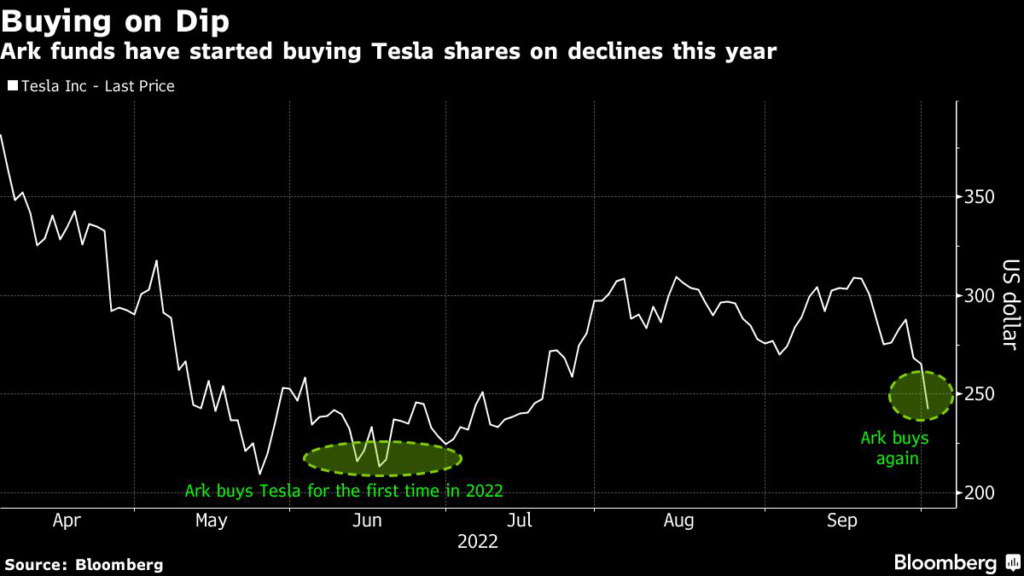
Funds backed by Wood’s Ark Investment Management LLC bought 132,213 shares in Elon Musk’s company on Monday, marking the firm’s first purchase of Tesla since mid-June, according to data compiled by Bloomberg. 

Tesla fell 8.6% on Monday, the most since June 3, as shipment issues and chip shortages weighed on deliveries. It was also the worst performer in the S&P 500 Index, which notched its best day since July 27. The stock rose 3% in premarket trading on Tuesday but it’s still down 31% this year, underperforming the US benchmark.

This is Wood’s second purchase in Tesla in 2022 after a year of selling down her stake. The first was in June, days after Tesla lost its crown jewel status in her main fund, a position it had held for about four-and-a-half years.

The latest purchases add to evidence that Cathie Wood is on a dip-buying binge again.

Ark had sold Tesla shares for at least five quarters in a row as of end-June, Bloomberg data show.  

The purchases on Monday were made by the flagship Ark Innovation ETF and Ark Next Generation Internet ETF.

Ark’s main ETF has plunged 60% in 2022 as historical tightening by the Federal Reserve and global recession fears batter growth stocks. 

(Updates with Tesla share prices in premarket in second paragraph)

More stories like this are available on bloomberg.com

©2022 Bloomberg L.P.

GM Tops Rival Automakers in Car Sales as Supply Crunch Eases

(Bloomberg) — General Motors Co. made big sales gains in the third quarter in a sign the semiconductor shortage is easing, but the relief may arrive for automakers just as consumers get squeezed by rising interest rates and concerns about the economy.

The Federal Reserve’s recent actions have pushed up rates on car loans while inflation is already hurting consumer confidence, according to Edmunds.com, which projects a 0.9% decrease in third-quarter sales from a year ago and a 2.7% drop from the previous quarter. Edmunds said auto-loan rates hit a three-year high of 5.7% in the three months ended Sept. 30.

That could put carmakers in a tough spot even if they can find more chips. The used-vehicles market is already softening and there are signs that the new-car market could follow. Some automakers are starting to dangle interest-rate incentives and sales to corporate fleets are starting to come back.

“There’s a lot of negative consumer sentiment in the marketplace, we’re obviously concerned about that,” said Randy Parker, chief executive officer of Hyundai Motor America, in a roundtable with reporters. “We’ve noticed that inventory levels from a lot of brands have started to pick up.”

While sticker prices remain elevated, price gains are decelerating — which spells potential trouble for automakers’ ability to maintain high profit margins. New-car prices rose 6.3% in September to record an average of more than $45,000, J.D. Power projected, a slowdown from the 10% growth rate that has prevailed for the year to date. Power forecasts seasonally adjusted annual sales for the month rose to 13.6 million units, up 1.5 million units from 2021. 

Inventory levels are also rising. Dealers had 39 days of vehicle supply on hand last month, up 51% from a year ago, according to Cox Automotive. Stellantis NV, owner of the Ram pickup brand, said commercial sales to fleet owners jumped 57% from a year ago. Ram and Jeep are among a handful of brands that have increased the use of incentives since the start of the year, according to Cox Automotive.

“We have long predicted that if retail demand softened, the automakers had the fleet lever to pull, and it appears they have done so,” Michelle Krebs, executive analyst at Cox Automotive, said in an email.

GM posted a double-digit gain in third-quarter sales on improved supplies of hard-to-find computer chips, allowing it to best Toyota Motor Corp. by some 30,000 vehicles. Toyota and Stellantis both reported lower sales for the three months ended Sept. 30. 

September sales will likely rise 7.7%, a reflection of improved inventories compared to a year ago, according to Cox Automotive.

Many major automakers, including GM, Toyota and Stellantis reported US sales Monday for the most recent quarter. Ford Motor Co. is expected to provide its US sales data Tuesday and Tesla Inc., which provides global numbers, reported its results on Sunday.  

Read More: Tesla Deliveries Miss Estimates, Slowed by Logistic Snarls 

GM Semi-Fueled Surge

GM’s sales soared 24% in the most recent three-month period to 555,560 units, allowing it to stay ahead of Toyota for a second consecutive quarter. It was aided by its ability to secure more semiconductor chips and boost production, the company said in a statement. 

Its mainstream Chevrolet brand boosted sales 30% and Cadillac saw a 50% increase in the most recent three-month period. GM said it plans to boost global production of its Chevy Bolt and Bolt EUV by nearly 30,000 vehicles to more than 70,000 units thanks to stronger demand. It cut the compact EV’s price by $6,000 earlier this year.

Despite gasoline prices remaining elevated, GM’s thirstiest vehicles made big gains. The automaker saw sales of its Chevy Suburban large SUV rise more than 40% and the heavy-duty version of its Silverado pickup was up almost 60%. Hummer EV production is still at a trickle, with just 411 sold in the quarter.

Toyota’s Tumble

Japan’s largest carmaker saw third-quarter sales tumble 7.1% from a year ago to 526,017 vehicles. Toyota’s deliveries rose 17.1% in September, but remain off by more than 15% for the year. Sales of its top-selling RAV4 crossover utility vehicle soared nearly 51% last month, driving up overall numbers for the Toyota brand. 

Toyota’s Lexus luxury line saw sales fall 4.3% in September and they are down 16.8% for the year. Deliveries of its best-selling model, the RX SUV, were up less than 1% last month and are down 5.1% so far this year.

Honda Plunges

Honda Motor Co. saw third-quarter sales plunge 36%, with a 44% drop-off in deliveries of its Acura luxury line. Still, the automaker says it is seeing signs of inventory improvement, as sales of its top-selling CR-V crossover utility vehicle rose 27% last month and its Ridgeline pickup had its best September ever, with deliveries up 53%.

“The pipeline is getting stronger with the expectation that increased production in the fourth quarter will support important upcoming all-new model introductions, like the CR-V, CR-V Hybrid and Pilot,” Mamadou Diallo, vice president of auto sales for American Honda Motor Co., said in a statement.

Stellantis Slips 

Stellantis NV sold 385,665 vehicles in the third quarter, a 6% drop from last year and slightly less than the 388,481 forecast by researcher Cox. The Ram pickup was its top seller overall, followed by the Jeep Wrangler.

The company’s other gas guzzlers, the Dodge Challenger and Charger muscle cars, jumped 17% and 25% respectively after the brand released limited-edition models as a swan song before the gasoline-powered versions of those cars are discontinued next year to make way for electrified versions.

Commercial sales to businesses and governments rose in a sign of heightened reliance on fleet sales. With gas prices still elevated, the hybrid Jeep Wrangler 4xe made up 28% of total Wrangler sales in the quarter, the automaker said.

Nissan Falls

Nissan Motor Co. said its third-quarter US Sales fell 23% with its namesake brand down 24% amid chip shortage woes. The company’s premium Infiniti brand posted a 5.4% increase, the company said in a statement.

The Japanese automaker said sales of its Altima sedan doubled, but its top-selling Rogue crossover SUV was hit hard. Sales of the popular model fell 19% in the quarter to 42,460.

Hyundai’s Hot Hand

Hyundai sold 184,431 vehicles in the third quarter, up 3% from a year ago, led by the Tucson crossover and budget-friendly Elantra sedan. Hybrids and fully electric models like the Elantra HEV and Ioniq5 set records, the Korean automaker said. September sales were up 11% year-over-year.

Hyundai has benefited from an onslaught of new models and effective inventory management amid the chip shortage. The automaker has “plenty of cars in the pipeline for the remainder of the year,” Parker, the head of Hyundai Motor America, said in statement.

(Corrects quarter reference in the first paragraph)

More stories like this are available on bloomberg.com

©2022 Bloomberg L.P.

Blockchain Gaming Startup Horizon Raises $40 Million Round Led by Brevan Howard, Morgan Creek

(Bloomberg) — Crypto winter has helped chill demand for nonfungible tokens, but that hasn’t stopped startups that use them from raising money. Horizon Blockchain Games said it secured $40 million as it continues to build out the Sequence developer platform, Niftyswap digital-asset marketplace and Skyweaver virtual trading card game.Brevan Howard Digital and Morgan Creek Digital led the Series A funding round for Toronto-based Horizon, which was founded in 2017. Chief Financial Officer Deborah Marfurt declined to disclose the company’s valuation, but said in an interview that it was higher than in the company’s previous funding round last year. Traditional video gaming companies Ubisoft Entertainment SA and Take-Two Interactive Software, Inc. also participated in the round. Horizon was valued at $89.5 million after last year’s funding round, according to PitchBook data.

Horizon’s funding round shows that investors are still drawn to NFT-gaming startups, despite declines in overall crypto venture capital investing and slumping sales for digital art and collectibles. Global monthly NFT sales tumbled 85% to $507 million in September compared with a year ago, according to blockchain data tracker CryptoSlam. 

In Horizon’s Skyweaver game, users own and battle fantasy trading cards represented by NFTs in a format similar to Magic: The Gathering, according to Horizon co-founder and Chief Executive Officer Peter Kieltyka.

“It’s something that anyone can use and that anyone can participate in,” Kieltyka said in an interview. 

The use of blockchain in gaming hasn’t been without controversy—Kieltyka pointed to environmental concerns over crypto’s electricity usage as a factor in generating backlash, but said Ethereum’s transition to a more eco-friendly way of validating blockchain transactions in a move known as “the Merge” should help mitigate that criticism. He also said that frequent NFT launches through sales known as “drops” have created the negative impression that many are in the industry to get rich quick. 

“There’s definitely a gold rush and not all actors are really building for long-term intention,” he said.

Kieltyka said Horizon is committed to making blockchain more accessible to mainstream consumers and developers. At a time when other crypto companies are slashing their workforces, Horizon hopes to increase its team by the end of the year to 80 people from 60. 

More stories like this are available on bloomberg.com

©2022 Bloomberg L.P.

EVs Add to Electricity Demand, But Not as Much as You Might Think

(Bloomberg) —

California recently asked homeowners to reduce electricity consumption to help avoid blackouts as temperatures soared and the power system struggled to keep up. The plea was effective, with consumers temporarily dialing back demand enough to keep the lights on across the state. But these sorts of close calls are the stuff of nightmares for system operators, and this specific brush with near-disaster had a new element that caught a lot of attention: a call to electric vehicle owners to avoid charging during peak demand hours.

Invariably, this was pounced on by critics as proof that California’s just-announced plan to phase out sales of new combustion vehicles by 2035 was doomed to fail. “How can the state electrify the vehicle fleet if it can barely keep the lights on?” went the refrain.

These types of discussions get emotional quickly, so it’s worth stepping back a bit to look at the data on how much electricity consumption EVs really add.

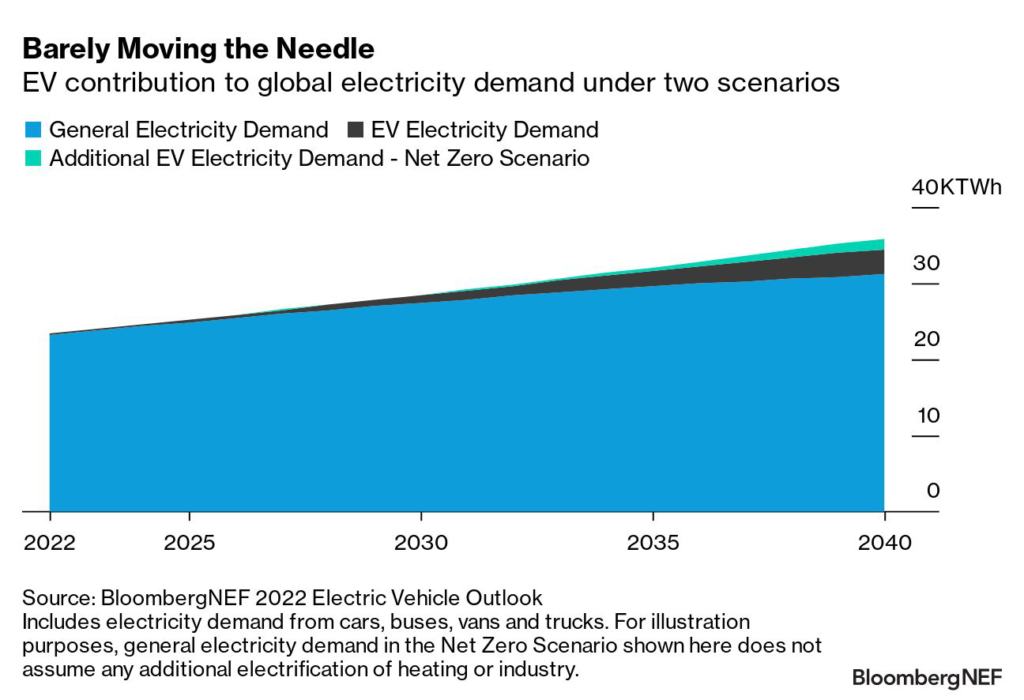
By the end this year, there will be about 27 million plug-in passenger vehicles on the road globally. Based on average driving distances, vehicle efficiencies in different countries, segment sales, the split between full electrics and plug-in hybrids and a few of other factors, BNEF estimates that global electricity demand from these EVs will be around 60 terawatt-hours this year.(1)

How should we best think about that number? One way is to compare it to global electricity demand, which will be somewhere around 28,000 TWh this year, so EVs will add around 0.2% to the total. Looking at this another way, the global passenger EV fleet consumes a similar amount of electricity as Singapore.

EV adoption in large parts of the world is still just getting started, so this comparison with global generation today isn’t totally fair. What about Norway, where EVs are already over 20% of all cars on the road and are covering more distance than their combustion counterparts?

There, EVs are adding around 1.4% to total electricity demand. That’s still small, but Norway is a special case. It has very high per capita electricity consumption because it’s cold, there’s a lot of electric heating and a lot of electrified industrial processes, so the denominator is big.

At BNEF, we’re expecting rapid EV adoption in the next two decades, so this picture will change. Our annual EV Outlook has two main scenarios: one that assumes market forces are the main driver of adoption and that no new policies get implemented, and another that assumes every country in the world gets on track for net-zero CO2 emissions by 2050.

In the first case, which we dubbed the Economic Transition Scenario, battery-electric vehicles represent three quarters of global passenger vehicle sales by 2040. In the Net Zero Scenario, they’ve almost completely taken over the market in the early 2030s.

People may quibble with the specific sales penetration rates in those scenarios, and that’s fine — there’s plenty of room for healthy debate. But if we use those two points as a reference, there will be around 730 million passenger EVs in 2040 — about half the total fleet — and increase global electricity demand by about 7% in the first scenario. In the Net Zero Scenario, there are over a billion EVs on the road then, adding around 9%.

Not all EVs are cars. Adding electric buses, trucks and other vehicles into the mix boosts the numbers a bit further, adding somewhere in the range of 11% and 15% to global electricity demand in 2040 under the two scenarios.(2)

It gets more interesting if we break this down to a country level. In China, where overall electricity demand is still growing quickly, EVs of all types add about 11% to demand in 2040 in the Economic Transition Scenario. For Europe, it’s closer to 22%, while for India they’re adding just a tiny sliver.

In some wealthy countries, EVs are what’s keeping electricity demand from falling, while in emerging economies they make a modest addition to steady expected increases in overall electricity demand. Playing it out even further, electrifying almost all of road transport by 2050 in the Net Zero Scenario would add around 27% to global electricity demand.

One final way to think about this: In 2021, China generated 983 TWh of electricity from wind and solar, 25 times more than the global passenger EV fleet used. China added around 255 TWh of new wind and solar generation to its energy mix in 2021, meaning its newly installed renewable generation produced more than six times what the entire global passenger EV fleet — built up over many years — consumed.

Integrating EVs into the power system will still require careful planning, incentives for off-peak charging to reduce peak demand, and localized grid reinforcement in many places. As a share of global electricity demand, though, the contribution will still be very modest for quite a few years.

(1) This is probably an overestimate, because China’s urban EVs are covering less distance than expected and doing so more efficiently. Estimates will be updated with the latest China Electricity Council data early next year.

(2) For illustration purposes, this Net Zero Scenario assumes no addition electrification of cooking, heating or industrial processes.

More stories like this are available on bloomberg.com

©2022 Bloomberg L.P.

Trump-Tied SPAC, Rumble Show Power of Hardcore Followers

(Bloomberg) — Legions of followers betting on conservative social-media platforms have helped stocks like Rumble Inc. and the blank-check firm taking Donald Trump’s media company public to outperform peers, a sign that speculative fervor in the market is still high.

The pair are, respectively, one of the best performers this year among firms that merged with a special-purpose acquisition company and the top-gaining SPAC since listing that hasn’t yet completed a combination. That outperformance — at a time when shares of established social-media companies mostly are in free fall — has been fueled in part by retail traders. 

Rumble, the video-sharing platform that says it’s “designed to be immune to cancel culture,” has yet to report earnings as a public company. Digital World Acquisition Corp. is a pile of cash that’s still months from clearing hurdles to complete its merger with Trump Media & Technology Group, if it ever does.

“Both of these have sort of generated meme-stock status,” said Julian Klymochko, CEO and chief investment officer at Accelerate Financial Technologies. “It’s not reflective of fundamental business value, but more so an underlying movement just given what these platforms represent.”

That loyal following has lifted Rumble shares by 26% from its IPO price, while Digital World stock is trading 75% above the roughly $10.30 investors would get if its deal with Trump Media collapses. 

At the same time, the broader bubble in SPAC stocks has burst, wiping out billions and forcing experienced blank-check sponsors to admit defeat and return the cash they raised to investors. The collapse is part of a broader selloff in the more speculative areas of the market, triggered by the Federal Reserve’s interest rate increases to try to curb inflation. 

Rumble generated just $9.5 million in revenue last year. Some Digital World investors have pulled the plug on their commitments for key financing as concerns about the deal mount. The SPAC’s shareholders are scheduled to vote Monday on an extension to the deadline for the firm to complete a deal. Sponsors paid for a three-month extension in September after failing to get enough votes to push back the deadline.

Representatives of Rumble and Digital World didn’t reply to emails seeking comment on their stocks’ performances.

Social media and streaming stocks broadly have been hit over the past year. Snap Inc., Netflix Inc., and Meta Platforms Inc. have each slumped more than 55% as investors shun technology stocks with the Fed hiking rates. 

Digital World and Rumble regularly feature on the list of the most-mentioned companies on message board Stocktwits, like retail trader favorites GameStop Corp. and AMC Entertainment Holdings Inc.

“It reminds me of GameStop and AMC, where those securities aren’t driven by fundamentals either,” Klymochko said. 


Tech Chart of the Day

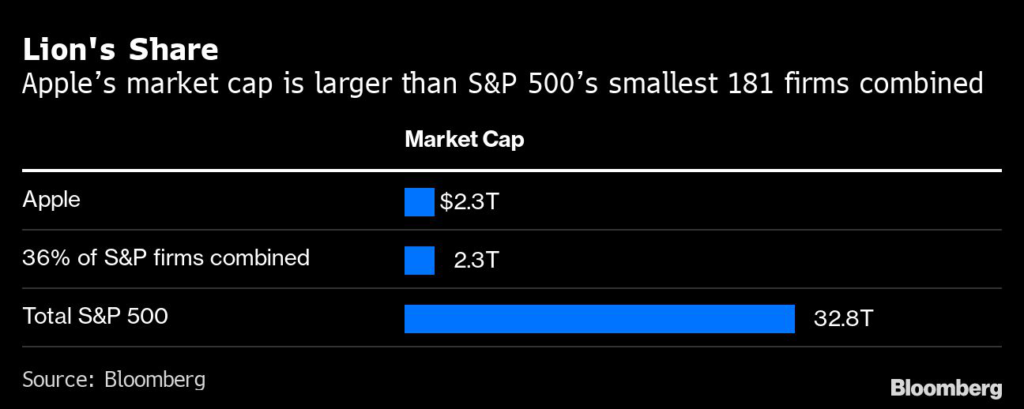
Apple Inc.’s years of outperforming the S&P 500 means that its market value is now larger than the 181 smallest index members combined, which represent more than a third of the overall number of stocks in the benchmark. The index’s members are weighted according to their equity capitalization, so Apple now accounts for almost 7% of the S&P 500. The top 5 companies — Apple, Microsoft Corp., Alphabet Inc., Amazon.com Inc. and Tesla Inc. — have a 22% weighting. 

Top Tech Stories

  • Meta Platforms Inc. is planning to close one of its offices in New York after scaling down its expansion plans in the city, according to people familiar with the matter.
  • Samsung Electronics Co. announced an aggressive five-year plan to lure US chip buyers with more advanced technology, aiming to produce transistors that are just 1.4 nanometers wide by 2027.
  • Apple Inc.’s iPhone exports from India crossed $1 billion in the five months since April, according to people familiar with the matter, signaling the South Asian nation is making progress with its bid to become a force in electronics manufacturing.
  • Cathie Wood bought Tesla Inc. shares as they plunged the most in four months after the electric-car maker’s third-quarter deliveries missed expectations.
  • Tesla Chief Executive Officer Elon Musk drew the wrath of Ukrainians from the president on down for Twitter posts urging Ukraine to seek a negotiated solution to the invasion by Russia and to cede Crimea for good.
    • SpaceX’s out-of-pocket costs for providing Ukraine with Starlink dishes stands at around $80 million so far, Elon Musk said in a tweet late Monday, adding that the company is “obviously” pro-Ukraine as it defends itself against the Russian invasion.
  • Shares of South Korean internet giant Naver Corp. logged their biggest intraday drop in over a year after the company announced it had agreed to buy online second-hand fashion marketplace Poshmark Inc. in a deal worth about $1.2 billion.
  • Nvidia Corp., the most valuable US chipmaker, is closing up operations in Russia after that country’s invasion of Ukraine entered its eighth month and President Vladimir Putin mobilized hundreds of thousands of reservists.
  • Private equity firm GTCR said that it won’t make an offer for UK software firm GB Group Plc after previously disclosing it was weighing a cash bid. GB Group makes fraud-prevention software.

Will this earnings season be a boom or a bust for stocks? This week’s MLIV Pulse survey focuses on corporate earnings. It’s brief and we don’t collect your name or any contact information. Please click here to share your views.

More stories like this are available on bloomberg.com

©2022 Bloomberg L.P.

GTCR Says it Won’t Bid for UK Software Company GB Group

(Bloomberg) — Private equity firm GTCR said that it won’t make an offer for UK software firm GB Group Plc after previously disclosing it was weighing a cash bid. 

GB Group confirmed that early stage talks with its board had ended after the two companies couldn’t agree on terms in a separate statement on Tuesday. 

GB Group shares dropped 19% to 497.20 pence in London trading at 11:47 a.m. giving the company a market value of about £1.3 billion ($1.5 billion). The stock had earlier dropped as much as 20%, the biggest intraday decline since 2016. 

UK-based tech companies, which generally fetch lower valuations than peers in the US, are attractive to foreign buyers, with the number of deals nearly doubling in the last five years through 2021, according to data compiled by Bloomberg. In the last year, Canada’s Open Text Corp. made an offer for Micro Focus International Plc and France’s Schneider Electric SE bid for the rest of Aveva Group Plc it didn’t own. 

Read More: GBG Jumps Most in 4 Years as Analysts Predict More Suitors 

Still, GTCR’s decision follows another reversal from a US investor. In early September, private equity firm Thoma Bravo said it did not intend to make a takeover offer for cybersecurity firm Darktrace, after failing to agree on a price for a final offer.

GB Group, which makes fraud-prevention software, is in a sweet-spot in an industry that’s been attractive to buyout firms, analysts from Liberum and Canaccord Genuity said after GTCR disclosed the talks last month. Other private equity bidders may emerge, analysts said at the time. 

(Updates with additional statement from GBG in second paragraph)

More stories like this are available on bloomberg.com

©2022 Bloomberg L.P.

Ian Latest: Florida Toll From Storm Rises; Biden Visit Planned

(Bloomberg) — Five days after Hurricane Ian slammed into Florida, bringing with it a deadly storm surge, catastrophic flooding and powerful winds, the destruction it caused is becoming clearer.

Florida’s death toll from Ian has climbed to at least 68, according to officials, while the Associated Press put the number at 71, adding to fatalities in Cuba and North Carolina. Insured losses have risen to as much as $57 billion, according to modeler Verisk. President Joe Biden is scheduled to come to Florida on Wednesday to survey the damage from what he described as one of the worst storms to ever hit the US. Biden is currently in Puerto Rico, where the US government has pledged more than $60 million in funding to help the island rebuild after Hurricane Fiona.

The National Hurricane Service discontinued its updates on Ian over the weekend after it weakened to a post-tropical cyclone. By Saturday, the system had “fully dissipated,” according to the agency.

Death Toll Rises, Electricity Supplies Down (1:58 a.m. NY)

At least 78 people have been confirmed dead from the storm, including 71 in Florida, four in North Carolina and three in Cuba, the Associated Press said. Search and rescue efforts continue in the state, where more than 1,600 people have been rescued statewide.

About 520,000 homes and businesses in Florida were still without electricity Monday evening, the AP said. Ian knocked out power to millions of customers across Florida and crews have been working to restore electricity infrastructure. State officials said they expect power to be restored by Sunday to customers whose power lines and other electric infrastructure is still intact, according to the AP.

Rental Home Provider Sees Limited Damage (9:30 p.m. NY)

American Homes 4 Rent, a single-family landlord with more than 52,500 rental houses in multiple states, said preliminary assessments show properties in Florida, Georgia, South Carolina and North Carolina suffered limited damage from Ian. 

The firm has “begun processing related repair and maintenance work orders to return impacted houses to full operation as quickly as possible,” Chief Executive Officer David Singelyn said in a statement. 

Fertilizer Firm Sees Lower Output, Sales due to Storm (4:40 p.m. NY)

Fertilizer firm Mosaic Co. said storm damage to its Florida facilities will result in lower phosphate output for the rest of the year.

Significant flooding and high winds from Ian caused “modest” damage to its facilities and infrastructure, Mosaic said Monday in a statement. Early assessments indicate phosphate production will be down by about 200,000 to 250,000 metric tons, split over its third and fourth quarters. Repairs are expected to be completed in the next one to two weeks.

Timing of shipments was also affected by the storm. Phosphates sales volumes in the third quarter are now expected to total 1.6 million to 1.65 million tons as port and rail closures delayed late third-quarter shipments to October, the company said.

Mosaic resumed loading fertilizer in Tampa, Florida, days after Ian interrupted operations, according to a person familiar with the matter. The ship Basic Challenger has returned to Mosaic’s terminal in Gibsonton, Florida, on the east side of Tampa Bay and is loading fertilizer.

Big-Box Stores Are Back in Business (3:54 p.m. NY)

Most of Florida’s retail stores have resumed operations following Ian’s aftermath. As of Monday, Target had only one store in the state closed while a Walmart Inc. Supercenter in the Fort Myers area was the retail giant’s only Florida location still shut. Winn-Dixie is down to less than 10 closures including in Bradenton and Port Charlotte, according to its website, although some outlets are closing early at 6 p.m.

Publix, which only had 11 stores shut down as of last Friday, didn’t immediately provide an update.

Rebuilding Cities Comes at a Costly Time (2:20 p.m. NY)

Florida cities looking to rebuild from the devastation of Hurricane Ian will be financing their efforts during the worst environment for municipal borrowing in more than a decade. 

Washed-out roads and bridges are only the most glaring examples of urgent infrastructure repairs that the state and its localities are grappling with after the storm. Debt to fund the recovery will probably start hitting the municipal market as soon as this quarter, according to Barclays Plc.

Federal and state aid will likely ease much of the financial blow, but officials looking to issue debt to rebuild and also bolster infrastructure against the risk of increasingly severe weather will be doing so during a brutal juncture for the bond market: Ten-year benchmark municipal yields are near the highest since 2011, and the Federal Reserve is signaling further interest-rate hikes to combat rampant inflation.

Berry Supplier Had Submerged Strawberry Fields (1:44 p.m. NY)

Florida-based berry supplier Wish Farms suffered from some submerged fields and a loss of power due to Ian. The storm also ripped up as much as 15% of the plastic ground cover used to prepare fields for strawberry planting, according to spokesman Nick Wishnatzki.

“We consider ourselves very lucky to only experience that minimal damage,” he said Monday in a phone interview.

Meanwhile, International Fresh Produce Association Chief Executive Officer Cathy Burns said she expects some short-term impacts on price and availability of some fresh produce grown in the state. Florida ranks No. 1 for production of whole cucumbers and tomatoes, according to the association.

Fuel Woes Ease Though Lines Linger (12:04 p.m. NY)

Florida’s fuel supplies are improving after Hurricane Ian disrupted deliveries. Places are now getting consistent deliveries and while there are still some long lines, all communities have supplies, according to Ned Bowman, executive director of the Florida Petroleum Marketers Association. He said it may take another 5 to 7 days to fully return to normal. Challenges remain for Sanibel Island and Pine Island, since bridge access has been disrupted, he said.

Insurer of Last Resort Can Absorb Ian Claims Costs (11:40 a.m. NY)

Citizens Property Insurance Corp., Florida’s state-backed insurer of last resort, said it won’t need to charge its policyholders or taxpayers to cover claims brought on by Hurricane Ian.

The insurer is facing more than 225,000 claims and $1.9 billion to $3.7 billion in losses, Citizens spokesman Michael Peltier said Monday in an email. State law requires the company to levy assessments when it experiences deficits in the wake of a major storm or disaster.

Florida Utility Aims to Restore Power by Friday (11:15 a.m. NY)

Florida Power & Light, the state’s largest utility, said it plans to have power restored to almost all of its customers by late Friday if all goes well, Chief Executive Officer Eric Silagy said in a Monday briefing with reporters.

The utility, a subsidiary of NextEra Energy Inc., still has several thousand customers without power, Silagy said. FPL initially focused on restoring power to critical infrastructure such as water treatment centers and emergency responders, the CEO said.

“It’s been 76 hours since Ian, which was a monster storm, left Florida,” Silagy said. Since then the utility has restored power to 1.8 million customers, which is 83% of all those affected, he said. “We’re going to be able to get this done faster than I thought.”

Flooded Groves Are Putting Citrus Crop at Risk (10:51 a.m. NY) 

Initial damage estimates to Florida groves from Hurricane Ian are pointing to a significant crop loss from high winds, pushing orange juice futures to the highest in almost six years in New York. The contracts soared 4.8% to edge past $2 a pound, the highest since mid-December 2016.

Mixon Fruit Farms, a family operated coastal citrus producer based just south of Tampa, is still without power days after the hurricane.

“It looks like about 30% of the fruit was knocked off the tree,” Janet Mixon said, referring to orchards located in the hard-hit Manatee County. “The oranges are now laying under the tree.”

Climate Change Made Ian’s Rainfall Worse (8:21 a.m. NY)

Climate change made Hurricane Ian’s most extreme rainfall about 10% worse than it would have been without two centuries of greenhouse gas pollution, according to a first-take analysis of the storm by two US climate researchers. The rapid analysis by Michael Wehner of the Lawrence Berkeley National Laboratory and Kevin Reed of Stony Brook University was shared on Twitter.

About 613,000 in Florida Are Still Without Power (7:45 a.m. NY)

Just over 613,000 customers in Florida still have no electricity as of early Monday morning, according to PowerOutage.us. Crews have already restored power to some 1.8 million customers across the state, figures from the Florida Division of Emergency Management show. In Puerto Rico, more than 120,000 are without power.

Insured Losses Mount From Ian’s Devastation (6:05 a.m. NY)

Verisk estimated that insured losses to onshore property from Ian will range from $42 billion to $57 billion. That includes wind, storm surge and inland flood losses resulting from both of Ian’s landfalls in Florida and South Carolina. 

Wind damage accounts for the majority of the loss estimate, totaling anywhere from $38 billion to $51 billion. Ian’s storm surge likely racked up $3 billion to $5.5 billion in insured losses and inland flooding less than $1 billion.

Florida Cell Service Returning With Gaps in Hard-Hit Areas (3:51 p.m. NY)

Cell-service has been restored across most of Florida, though the hardest-hit counties are still experiencing significant zones without signal, according to a report from the Federal Communications Commission Sunday. 

The report listed the top counties by percentage with cell sites still not operational: DeSoto 38.5%; Hardee 33.3%; Charlotte 20.2%; and Lee 19.5%.

Governor Ron DeSantis announced Saturday that Elon Musk’s SpaceX will deploy 120 units of its Starlink satellites to southwest Florida to provide Internet service for those affected.


More stories like this are available on bloomberg.com

©2022 Bloomberg L.P.

Close Bitnami banner
Bitnami