Bloomberg

Executives Are Backing Away From ESG as Recession Risks Mount

(Bloomberg) — Chief executive officers are putting a number of ESG goals on hold as they try to prepare their businesses for fallout from a possible recession, according to a study conducted by KPMG.

About half of CEOs surveyed “are pausing or reconsidering their existing or planned ESG efforts in the next six months,” KMPG said. Roughly a third “have already done so,” it added.

“As CEOs take steps to insulate their businesses from an upcoming recession, ESG efforts are coming under increasing financial pressure,” said Jane Lawrie, global head of corporate affairs at KPMG. 

Most executives surveyed said they generally consider environmental, social and governance issues to be an integral part of their success. But with the challenges posed by a shrinking economy, businesses are now struggling to balance “mid-term environmental issues while hunkering down to protect short-term economic and social stability,” Lawrie said.

More than eight of 10 global CEOs anticipate a recession within the next 12 months, the KPMG survey found. Against that backdrop, spending resources on ESG goals that aren’t fully defined within regulatory frameworks are slipping down the list of priorities, the KPMG data indicate. What’s more, there are some signs of investor skepticism toward ESG.

The KPMG CEO Outlook is based on responses from 1,325 chief executives across sectors and countries, and was conducted between July 12 and Aug. 24. All those participating have annual revenue of at least $500 million — and a third have revenue exceeding $10 billion.

Separately, a recent survey by Capital.com, a London-based online broker with a large retail client base, showed that traders and investors aren’t prioritizing ESG. Of more than 1,800 customers asked, 52% of traders and investors said they never selected a stock or made a trade based on ESG factors. Almost half — or 46% — said they didn’t know how to do so, and 12% said ESG investments were too expensive.

The findings expose some of the key weaknesses that ESG has faced, as the investing form draws criticism from all sides. In the US, more than a dozen traditionally Republican states are trying to stop the finance industry from taking ESG factors into account as they try to protect industries such as oil and firearms. Several ESG insiders, meanwhile, have criticized the investing model for being riddled with inconsistencies and too focused on profits. 

That said, a wave of new regulations is about to change the business and investing landscape in a way that will make it hard for CEOs to downplay ESG. In the EU, investors need to comply with the Sustainable Finance Disclosure Regulation, while corporations face stricter requirements in the form of the Corporate Sustainability Reporting Directive.

In the US, the Securities and Exchange Commission has proposed strict climate disclosure requirements, and globally, the International Sustainability Standards Board is setting guidelines that have the potential to affect companies across all jurisdictions.

KPMG noted that 72% of survey respondents said they “believe that stakeholder scrutiny of ESG issues,” such as gender equality and climate impacts, “will continue to accelerate.” There’s also pressure on companies to step up ESG reporting, the survey found.

More stories like this are available on bloomberg.com

©2022 Bloomberg L.P.

Stocks, US Futures Extend Gains on Fed Bets: Markets Wrap

(Bloomberg) — Stocks in Asia and US equity futures extended their gains as weak US manufacturing data eased bets on the Federal Reserve’s hawkishness. The Australian dollar dropped after the nation’s central bank delivered a smaller-than-expected rate hike. 

An Asia Pacific equity benchmark rose by more than 1.6% and is on course for the highest in a week, sparked by a broad rebound in the region, with investors appearing to shrug off news that North Korea fired a missile over Japan for the first time since 2017.

Treasuries consolidated following a rally on Monday after a US manufacturing gauge declined more than expected, tamping down fears of more aggressive Fed’s moves. The Bloomberg Dollar Spot Index turned flat after a 0.5% decline on Monday.  

The Reserve Bank of Australia raised its benchmark interest rate by 25 basis points, less than expected. Australian three-year yields dropped as much as 58 basis points after the decision, while the currency tumbled as much as 1%.

Read more: Wall Street Capitulation Calls Get Ever Harder as Stocks Bounce

Traders pared bets on Fed hikes, with swaps tied to Fed policy meeting dates falling sharply for early 2023. The May meeting contract’s rate dropped, suggesting a peak policy rate of 4.48% next year, down from recent highs above 4.69%.

In the latest sign the Fed’s five rate hikes totaling 3 percentage points may be taking their toll, the Institute for Supply Management’s gauge of factory activity fell to a more than two-year low. The Fed should consider stopping its tightening campaign after one more interest-rate hike in November, according to Ed Yardeni, a market veteran who coined terms like “Fed Model” and “bond vigilante.”

Fed speakers continued the drumbeat over rate hikes. New York Fed President John Williams said the US central bank has yet to raise interest rates to levels that are restricting economic growth, and tightening still has “significant” ways to go.

“I think we’ve underestimated the pain of the stall out,” Nicole Webb, SVP and financial advisor at Wealth Enhancement Group, said on Bloomberg Television. “At some point the Fed does stop raising but however how long they hold us or suspend us there is still in question.”

China’s onshore markets will remain shut this week for holidays, while the Hong Kong exchange will be closed Tuesday for the Chung Yeung Festival.

Elsewhere, oil steadied after posting the biggest one-day gain since May as the market looked to OPEC+ to deliver a substantial cut in supply.

Brazilian assets soared after President Jair Bolsonaro secured his way to a runoff election against Luiz Inacio Lula da Silva as investors cheered on the incumbent’s better-than-expected showing and bet his leftist challenger will be forced to moderate his stances in the second stretch of the race. The real was the best-performing among the world’s major currencies Monday.

Key events this week:

  • Eurozone PPI, Tuesday
  • US factory orders, durable goods, Tuesday
  • Fed’s John Williams, Lorie Logan, Loretta Mester, Mary Daly speak at events, Tuesday
  • Eurozone services PMIs, Wednesday
  • OPEC+ meeting begins, Wednesday
  • Fed’s Raphael Bostic speaks, Wednesday
  • The Reserve Bank of New Zealand meets, Wednesday
  • Eurozone retail sales, Thursday
  • US initial jobless claims, Thursday
  • Fed’s Charles Evans, Lisa Cook, Loretta Mester speak at events, Thursday
  • US unemployment, wholesale inventories, nonfarm payrolls, Friday
  • BOE Deputy Governor Dave Ramsden speaks at event, Friday
  • Fed’s John Williams speaks at event, Friday

Will earnings disappoint and push equities to new lows? This week’s MLIV Pulse survey asks about corporate earnings. It’s brief and we don’t collect your name or any contact information. Please click here to share your views.

Some of the main moves in markets:

Stocks

  • S&P 500 futures added 0.7% as of 12:33 p.m. Tokyo time. S&P 500 Index rose 2.6%
  • Nasdaq 100 futures climbed 0.8%. Nasdaq 100 Index rose 2.4%
  • Japan’s Topix index rose 2.9%
  • South Korea’s Kospi index surged 2.2%
  • Australia’s S&P/ASX 200 Index gained 3.3%

Currencies

  • The Bloomberg Dollar Spot Index was steady
  • The euro was up 0.1% to 0.9834 per dollar
  • The Japanese yen slid 0.2% to 144.85 per dollar
  • The offshore yuan was at 7.1089 per dollar
  • The British pound weakened 0.1% to 1.1313 per dollar

Bonds

  • The yield on 10-year Treasuries fell nearly two basis points to 3.62%
  • Australia’s 10-year yield dropped almost 25 basis points to 3.65%

Cryptocurrencies

  • Bitcoin was at $19,586
  • Ether climbed 0.2% to $1,326

Commodities

  • West Texas Intermediate crude surged 0.2% to $83.80 a barrel
  • Gold fell 0.1% to $1,697.82 per ounce

More stories like this are available on bloomberg.com

©2022 Bloomberg L.P.

Bankrupt Crypto Firm Celsius Sets Dates for Auction of Assets

(Bloomberg) — Bankrupt cryptocurrency lender Celsius Network Ltd. has set dates for the auction of its assets.

Celsius will have a final bid deadline of Oct. 17 at 4 p.m., with an auction if necessary on Oct. 20 at 10 a.m., according to a filing with the US Bankruptcy Court for the Southern District of New York dated Monday. 

A sale hearing will be held on Nov. 1 at 11 a.m. before Chief US Bankruptcy Judge Martin Glenn via Zoom, the filing said, adding that a large number of participants is expected.

Celsius has been one of the most high-profile casualties of this year’s crypto-market meltdown that claimed the likes of the TerraUSD stablecoin, hedge fund Three Arrows Capital and lender Voyager Digital Ltd. Founder Alex Mashinsky recently resigned the chief executive officer role, ceding it to Chief Financial Officer Chris Ferraro, a JPMorgan Chase & Co. alum.

Read more: Celsius CEO Resigns as Bankrupt Crypto Firm Works to Survive

Sam Bankman-Fried, the crypto billionaire who has been bailing out distressed industry players in recent months, is considering bidding for Celsius assets, Bloomberg News reported last week, citing a person familiar with his deal-making.

More stories like this are available on bloomberg.com

©2022 Bloomberg L.P.

LA School District Says Hackers Accessed Massive Database

(Bloomberg) — The Los Angeles public school system, the second-largest in the US, said an extortionist group had accessed a massive database but had not leaked as much sensitive information from it as initially feared.

Student and staff data of the Los Angeles Unified School District began appearing on the web on Sunday after it refused to pay a ransom to a group called Vice Society. The school system suffered a cyber attack on Labor day, and had been told that its data would be leaked if it didn’t pay to retrieve it. 

Alberto M. Carvalho, the district’s superintendent, denied reports that psychiatric evaluations of students showed up on the web, adding that no health records were available online.

Carvalho said the hackers, who he said were possibly operating out of Russia, “touched” a massive database which included social security numbers, health records and academic scores. Only a “very, very small percentage” of the data within the school’s IT systems was downloaded, he said, when his staff discovered the attack and acted quickly. 

LA School District Says Criminal Group Threatens to Leak Info

Most of the data released on the web came from an archived database of student information from 2013-2016, he said. Some personal data of private contractors and temporary workers had also been leaked. 

Carvalho didn’t believe that the group would release any more data and was confident “that the experience specific to this bad actor has reached its conclusion,” he told a press conference on Monday after reiterating the district would stand by its decision to not pay a ransom. 

Vice Society, which said it hacked numerous school districts across the US, is a so-called hack-and-leak group that first appeared in the summer of 2021, according to the US Cybersecurity and Infrastructure Security Agency.

On the choice of targets, the group said it hacked schools “because we can.” While it had previously bought the malicious software to target victims, it now uses its own new software, a Vice Society spokesperson said in an emailed response to questions.

CISA recently warned that the group had turned its focus from health care to education, and believed the attacks may accelerate as students return to class.

More stories like this are available on bloomberg.com

©2022 Bloomberg L.P.

Naver Sinks 8% on Announcing $1.2 Billion Poshmark Acquisition

(Bloomberg) — Shares of South Korean internet giant Naver Corp. logged their biggest intraday drop in over a year after the company announced it had agreed to buy online second-hand fashion marketplace Poshmark Inc. in a deal worth about $1.2 billion. 

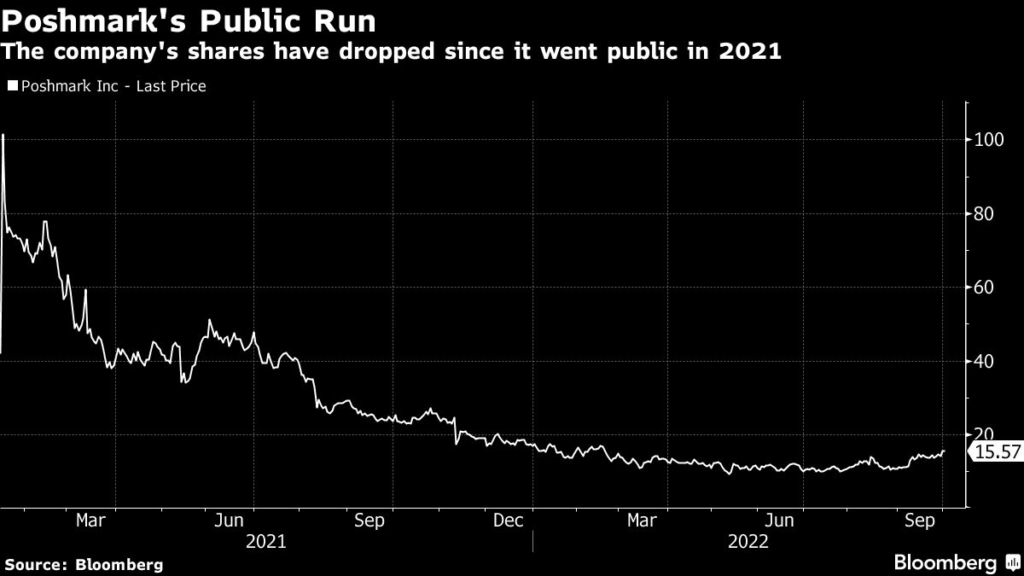
Naver will buy all of Poshmark’s shares for $17.90 each, a 15% premium to Monday’s closing price of $15.57. Trading of Poshmark shares, which fell 0.6% on Monday, was halted on the news. After the deal is completed, Poshmark would become a standalone US subsidiary of Naver, and would continue to be led by Chief Executive Officer Manish Chandra and his management team, the companies said.

Naver shares were down as much as 7.8% in Seoul Tuesday, hitting their lowest point since April 2020. Citi analysts had earlier downgraded the stock to a sell rating, saying its price-to-earnings ratio was hard to justify when compared to other internet firms.

“I think the market was surprised at the size of the deal,” Naver Chief Executive Officer Choi Soo-Yeon said in an interview, noting that this is the company’s biggest acquisition to date and first foray into Silicon Valley. “We will explain to investors about how we can maximize synergy through strengthening the combination of commerce businesses and communities.”

With the transaction, Poshmark, which has sought to expand internationally even as its stock steadily declined over the past year and a half, will get access to Naver’s extensive e-commerce experience. Naver obtains a US brand that has grown rapidly in recent years. 

Naver is one of the leading internet players in South Korea, combining search and cloud services with online shopping. The Poshmark deal is aimed at creating a global player in online fashion, using the target’s social shopping technology.

“Poshmark will become a foothold in the North America market to expand our business in the region,” Choi said. “We will try out our technology through Poshmark’s services popular among the younger generation.”

Poshmark has a community of more than 80 million registered users, across 90% of zip codes in the US, the companies said. 

The boards of both companies have approved the deal, which is expected to close by the first quarter of 2023, according to the statement.

Poshmark, which Chandra founded in 2011, is an online marketplace where users post photos of items they are selling and set their own prices, then ship goods once they are purchased. The company, which doesn’t hold any inventory, gets paid when users make a sale.

Share Drop

Poshmark’s closing price Monday is barely a third of that in its January 2021 initial public offering, in which it raised $319 million, including so-called greenshoe shares. The shares soared 142% from their $42 offer price in their first day of trading to $101.50, briefly giving the company a market value of more than $7 billion.

Other online resellers have experienced even sharper share drops since going public. Shares of RealReal Inc. are down 93% from its 2019 IPO, while ThredUp Inc., which went public two months after Poshmark, has fallen 87%.

LionTree Partners is working as Naver’s financial adviser, while Kirkland & Ellis is acting as Naver’s legal counsel. Goldman Sachs Group Inc. is serving as financial adviser to Poshmark, and Goodwin Procter is legal counsel.

(Updates with share reaction and Naver CEO comment)

More stories like this are available on bloomberg.com

©2022 Bloomberg L.P.

Emerging Stocks Haven’t Had Such a Long Stretch of Bear Market

(Bloomberg) — Emerging market stocks have been in a record stretch of bear market, surpassing their rough patch during the dot-com era thanks to a surging dollar and China’s growth uncertainties.  

It has been 594 days since the MSCI Emerging Markets Index closed at its peak in February 2021, according to Bloomberg-compiled data. The previous record was 589 days that ended in September 2001, according to an analysis by Morgan Stanley on peak-to-trough spans.

The MSCI EM benchmark has fallen about 39% from last year’s high versus a drawdown of 66% during the global financial crisis. There are plenty of reasons to suggest that the weakness may last for a while, given an unapologetically hawkish Federal Reserve that will continue to boost the dollar and draw funds away from emerging markets. 

Uncertainties also linger over the outlook of Chinese companies, which carry the biggest weighting in the index, due to the country’s rigid Covid policy and escalating tensions with the West. 

“EM equities will continue to face pressure from dollar appreciation and weak US equity markets,” Jon Harrison, managing director for emerging-market macro strategy at TS Lombard in London, wrote in a note Monday. “EM outflows are set to accelerate as external conditions deteriorate.”

An analysis of global EM equity exchange-traded funds by TS Lombard shows that the cluster of stocks last month suffered their largest net outflows since the onset of the pandemic.

Still, Morgan Stanley’s strategists including Jonathan Garner believe a so-called classic capitulation trough could likely be forming as EM stocks have moved close to his bear-case targets and due to seasonal factors, they wrote in a note dated Sept. 20. 

Garner warned on May 10 that Asia and emerging-market equities are entering the late stages of a bear market. Since that day’s close, the MSCI EM Index and has dropped about 13%, underperforming the MSCI World benchmark.

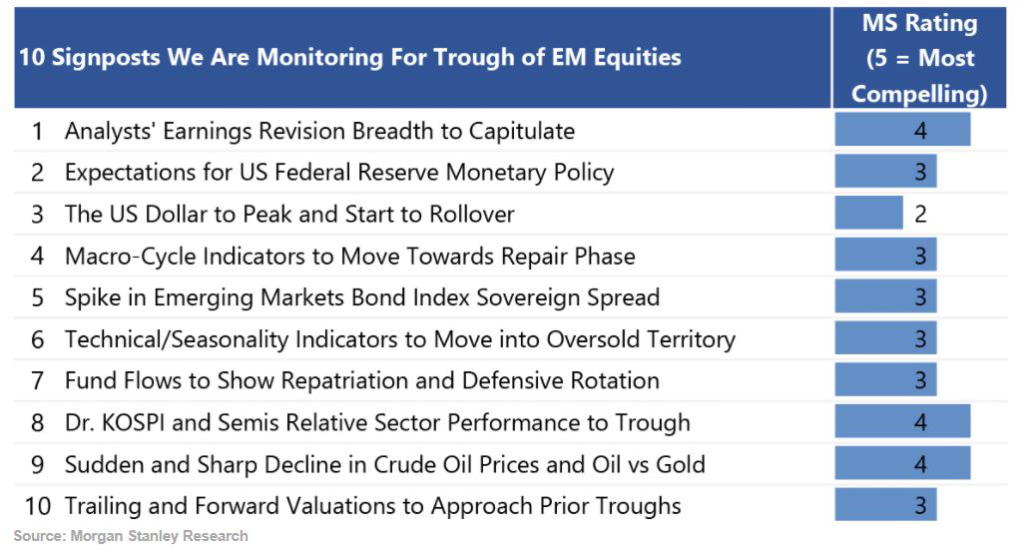
Six of the previous 10 bear markets in Asia and EM equities bottomed in September or October, Garner and his colleagues wrote in a note last month. They are monitoring 10 signals including the dollar’s strength, the semiconductor sector’s performance and the breadth of earnings revisions to call the current cycle’s low. 

More stories like this are available on bloomberg.com

©2022 Bloomberg L.P.

Emerging Stocks Have Never Spent So Many Days Since a Cycle High

(Bloomberg) — Emerging market stocks have been in a record stretch of bear market, surpassing their rough patch during the dot-com era thanks to a surging dollar and China’s growth uncertainties.  

It has been 594 days since the MSCI Emerging Markets Index closed at its peak in February 2021, according to Bloomberg-compiled data. The previous record was 589 days that ended in September 2001, according to an analysis by Morgan Stanley on peak-to-trough spans.

The MSCI EM benchmark has fallen about 39% from last year’s high versus a drawdown of 66% during the global financial crisis. There are plenty of reasons to suggest that the weakness may last for a while, given an unapologetically hawkish Federal Reserve that will continue to boost the dollar and draw funds away from emerging markets. 

Uncertainties also linger over the outlook of Chinese companies, which carry the biggest weighting in the index, due to the country’s rigid Covid policy and escalating tensions with the West. 

“EM equities will continue to face pressure from dollar appreciation and weak US equity markets,” Jon Harrison, managing director for emerging-market macro strategy at TS Lombard in London, wrote in a note Monday. “EM outflows are set to accelerate as external conditions deteriorate.”

An analysis of global EM equity exchange-traded funds by TS Lombard shows that the cluster of stocks last month suffered their largest net outflows since the onset of the pandemic.

Still, Morgan Stanley’s strategists including Jonathan Garner believe a so-called classic capitulation trough could likely be forming as EM stocks have moved close to his bear-case targets and due to seasonal factors, they wrote in a note dated Sept. 20. 

Garner warned on May 10 that Asia and emerging-market equities are entering the late stages of a bear market. Since that day’s close, the MSCI EM Index and has dropped about 13%, underperforming the MSCI World benchmark.

Six of the previous 10 bear markets in Asia and EM equities bottomed in September or October, Garner and his colleagues wrote in a note last month. They are monitoring 10 signals including the dollar’s strength, the semiconductor sector’s performance and the breadth of earnings revisions to call the current cycle’s low. 

More stories like this are available on bloomberg.com

©2022 Bloomberg L.P.

Ian Latest: Florida’s Death Toll From Storm Rises to 68 People

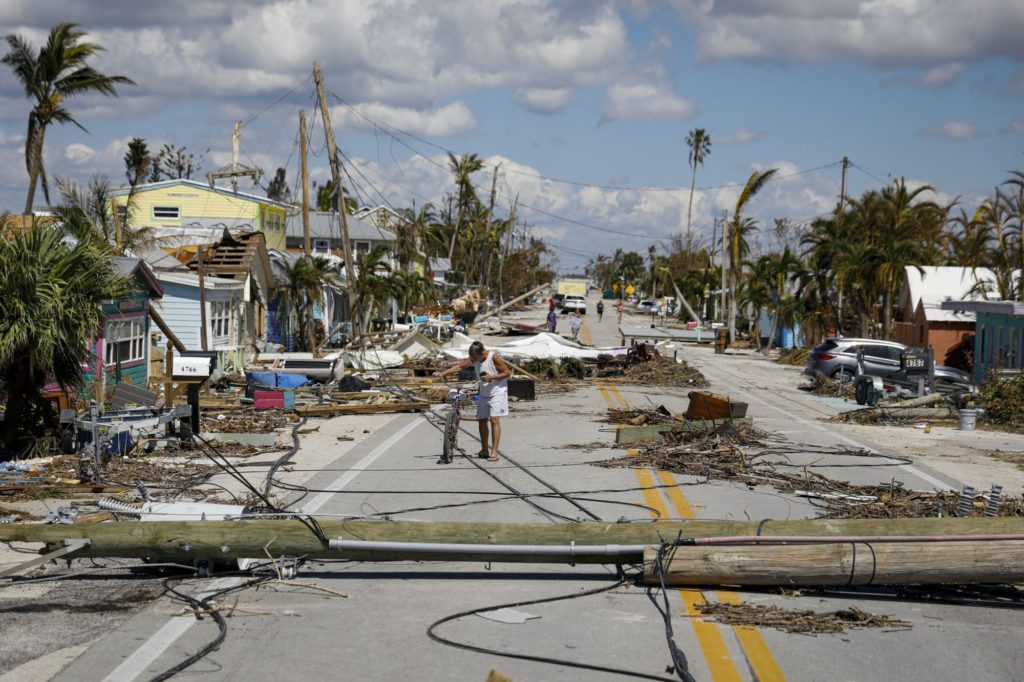
(Bloomberg) — Five days after Hurricane Ian slammed into Florida, bringing with it a deadly storm surge, catastrophic flooding and powerful winds, the destruction it caused is becoming clearer.

Florida’s death toll from Ian is at 68, according to officials, adding to fatalities in Cuba and North Carolina. Insured losses have risen to as much as $57 billion, according to modeler Verisk. President Joe Biden is scheduled to come to Florida on Wednesday to survey the damage from what he described as one of the worst storms to ever hit the US. Biden is currently in Puerto Rico, where the US government has pledged more than $60 million in funding to help the island rebuild after Hurricane Fiona.

The National Hurricane Service discontinued its updates on Ian over the weekend after it weakened to a post-tropical cyclone. By Saturday, the system had “fully dissipated,” according to the agency.

Rental Home Provider Sees Limited Damage (9:30 p.m. NY)

American Homes 4 Rent, a single-family landlord with more than 52,500 rental houses in multiple states, said preliminary assessments show properties in Florida, Georgia, South Carolina and North Carolina suffered limited damage from Ian. 

The firm has “begun processing related repair and maintenance work orders to return impacted houses to full operation as quickly as possible,” Chief Executive Officer David Singelyn said in a statement. 

Fertilizer Firm Sees Lower Output, Sales due to Storm (4:40 p.m. NY)

Fertilizer firm Mosaic Co. said storm damage to its Florida facilities will result in lower phosphate output for the rest of the year.

Significant flooding and high winds from Ian caused “modest” damage to its facilities and infrastructure, Mosaic said Monday in a statement. Early assessments indicate phosphate production will be down by about 200,000 to 250,000 metric tons, split over its third and fourth quarters. Repairs are expected to be completed in the next one to two weeks.

Timing of shipments was also affected by the storm. Phosphates sales volumes in the third quarter are now expected to total 1.6 million to 1.65 million tons as port and rail closures delayed late third-quarter shipments to October, the company said.

Mosaic resumed loading fertilizer in Tampa, Florida, days after Ian interrupted operations, according to a person familiar with the matter. The ship Basic Challenger has returned to Mosaic’s terminal in Gibsonton, Florida, on the east side of Tampa Bay and is loading fertilizer.

Big-Box Stores Are Back in Business (3:54 p.m. NY)

Most of Florida’s retail stores have resumed operations following Ian’s aftermath. As of Monday, Target had only one store in the state closed while a Walmart Inc. Supercenter in the Fort Myers area was the retail giant’s only Florida location still shut. Winn-Dixie is down to less than 10 closures including in Bradenton and Port Charlotte, according to its website, although some outlets are closing early at 6 p.m.

Publix, which only had 11 stores shut down as of last Friday, didn’t immediately provide an update.

Rebuilding Cities Comes at a Costly Time (2:20 p.m. NY)

Florida cities looking to rebuild from the devastation of Hurricane Ian will be financing their efforts during the worst environment for municipal borrowing in more than a decade. 

Washed-out roads and bridges are only the most glaring examples of urgent infrastructure repairs that the state and its localities are grappling with after the storm. Debt to fund the recovery will probably start hitting the municipal market as soon as this quarter, according to Barclays Plc.

Federal and state aid will likely ease much of the financial blow, but officials looking to issue debt to rebuild and also bolster infrastructure against the risk of increasingly severe weather will be doing so during a brutal juncture for the bond market: Ten-year benchmark municipal yields are near the highest since 2011, and the Federal Reserve is signaling further interest-rate hikes to combat rampant inflation.

Berry Supplier Had Submerged Strawberry Fields (1:44 p.m. NY)

Florida-based berry supplier Wish Farms suffered from some submerged fields and a loss of power due to Ian. The storm also ripped up as much as 15% of the plastic ground cover used to prepare fields for strawberry planting, according to spokesman Nick Wishnatzki.

“We consider ourselves very lucky to only experience that minimal damage,” he said Monday in a phone interview.

Electricity has since been restored and the plastic ground covering is expected to be fixed as soon as Monday. The farm typically would have planted in late September, but they held off because of Ian.

Meanwhile, International Fresh Produce Association Chief Executive Officer Cathy Burns said she expects some short-term impacts on price and availability of some fresh produce grown in the state. Florida ranks No. 1 for production of whole cucumbers and tomatoes, according to the association.

Lee County Bears Brunt of Florida Storm Fatalities (12:22 p.m. NY)

The number of confirmed deaths in Florida tied to Hurricane Ian reached 58 as of Monday morning, according to the latest count by the Florida Medical Examiners Commission. A majority of those deaths — 42 — occurred in Lee County, home to Fort Myers, which bore the brunt of the damage from the storm.

The Florida Department of Law Enforcement, which staffs the medical commission, said the next death count will be released either Monday evening or Tuesday by noon if new confirmed data is received from authorities.

Fuel Woes Ease Though Lines Linger (12:04 p.m. NY)

Florida’s fuel supplies are improving after Hurricane Ian disrupted deliveries. Places are now getting consistent deliveries and while there are still some long lines, all communities have supplies, according to Ned Bowman, executive director of the Florida Petroleum Marketers Association. He said it may take another 5 to 7 days to fully return to normal. Challenges remain for Sanibel Island and Pine Island, since bridge access has been disrupted, he said.

Insurer of Last Resort Can Absorb Ian Claims Costs (11:40 a.m. NY)

Citizens Property Insurance Corp., Florida’s state-backed insurer of last resort, said it won’t need to charge its policyholders or taxpayers to cover claims brought on by Hurricane Ian.

The insurer is facing more than 225,000 claims and $1.9 billion to $3.7 billion in losses, Citizens spokesman Michael Peltier said Monday in an email. State law requires the company to levy assessments when it experiences deficits in the wake of a major storm or disaster.

Florida’s homeowners insurance market is in disarray, with companies entering insolvency or halting policy issuance, and Citizens has been forced to pick up the slack. The company accounts for slightly more than 10% of the market by premiums written.

Florida Utility Aims to Restore Power by Friday (11:15 a.m. NY)

Florida Power & Light, the state’s largest utility, said it plans to have power restored to almost all of its customers by late Friday if all goes well, Chief Executive Officer Eric Silagy said in a Monday briefing with reporters.

The utility, a subsidiary of NextEra Energy Inc., still has several thousand customers without power, Silagy said. FPL initially focused on restoring power to critical infrastructure such as water treatment centers and emergency responders, the CEO said.

“It’s been 76 hours since Ian, which was a monster storm, left Florida,” Silagy said. Since then the utility has restored power to 1.8 million customers, which is 83% of all those affected, he said. “We’re going to be able to get this done faster than I thought.”

As utilities across Florida work to restore power, about 600,000 homes and businesses remain in the dark, according to PowerOutage.us.

Flooded Groves Are Putting Citrus Crop at Risk (10:51 a.m. NY) 

Initial damage estimates to Florida groves from Hurricane Ian are pointing to a significant crop loss from high winds, pushing orange juice futures to the highest in almost six years in New York. The contracts soared 4.8% to edge past $2 a pound, the highest since mid-December 2016.

Mixon Fruit Farms, a family operated coastal citrus producer based just south of Tampa, is still without power days after the hurricane.

“It looks like about 30% of the fruit was knocked off the tree,” Janet Mixon said, referring to orchards located in the hard-hit Manatee County. “The oranges are now laying under the tree.”

Flooding from the storm is also threatening the long-term health of citrus trees, Ray Royce, executive director at Highlands County Citrus Growers Association, said in a Monday interview.

“There is so much water standing for so many days, it can kill roots and trees,” he said by phone, adding that uprooting and broken trees are also being reported in producing areas.

Climate Change Made Ian’s Rainfall Worse (8:21 a.m. NY)

Climate change made Hurricane Ian’s most extreme rainfall about 10% worse than it would have been without two centuries of greenhouse gas pollution, according to a first-take analysis of the storm by two US climate researchers. The rapid analysis by Michael Wehner of the Lawrence Berkeley National Laboratory and Kevin Reed of Stony Brook University was shared on Twitter.

Wehner said the quick look at Hurricane Ian turned out to be “a little more interesting” scientifically than he had expected.

About 613,000 in Florida Are Still Without Power (7:45 a.m. NY)

Just over 613,000 customers in Florida still have no electricity as of early Monday morning, according to PowerOutage.us. Crews have already restored power to some 1.8 million customers across the state, figures from the Florida Division of Emergency Management show. In Puerto Rico, more than 120,000 are without power.

Insured Losses Mount From Ian’s Devastation (6:05 a.m. NY)

Verisk estimated that insured losses to onshore property from Ian will range from $42 billion to $57 billion. That includes wind, storm surge and inland flood losses resulting from both of Ian’s landfalls in Florida and South Carolina. 

Wind damage accounts for the majority of the loss estimate, totaling anywhere from $38 billion to $51 billion. Ian’s storm surge likely racked up $3 billion to $5.5 billion in insured losses and inland flooding less than $1 billion.

Death Toll From Ian Rises to At least 68 (4:44 a.m. NY)

At least 68 people have been confirmed dead: 61 in Florida, four in North Carolina and three in Cuba, the Associated Press reported. Deanne Criswell, administrator of the Federal Emergency Management Agency, told the news wire that the federal government was ready to help in a “huge way,” focusing first on victims in Florida, which took the brunt of one of the strongest storms to make landfall in the United States.

More than 640,000 in Florida Still Without Power (11:34 p.m. NY)

More than 640,000 customers in Florida are still without power, according to PowerOutage.us. Electricity has been restored to more than 1.8 million user accounts across the state, figures from the Florida Division of Emergency Management showed on Sunday.

Governor Ron DeSantis visited the cities of North Port and Arcadia over the weekend, where flooding hasn’t subsided, according to local media reports.

Lee County Reports 42 Deaths Amid Rising Florida Toll (6:32 p.m. NY)

The death toll in Florida is rising, though the numbers remained uncertain and incomplete amid ongoing searches through masses of wreckage.   

In Lee County, on the state’s southwest coast, Sheriff Carmine Marceno said on Sunday that 42 people had died there.

“We have buildings, multiple-floor buildings that have been washed out, OK? It is incomprehensible what we’re looking at,” Marceno said. “Those numbers could go up. I don’t know. I pray and hope that they don’t.”

On Saturday night, the Florida Medical Examiners Commission released a count of 44 dead across the state, including 30 in Lee County. The commission had not updated the toll on Sunday. 

Florida Cell Service Returning With Gaps in Hard-Hit Areas (3:51 p.m. NY)

Cell-service has been restored across most of Florida, though the hardest-hit counties are still experiencing significant zones without signal, according to a report from the Federal Communications Commission Sunday. 

The report listed the top counties by percentage with cell sites still not operational: DeSoto 38.5%; Hardee 33.3%; Charlotte 20.2%; and Lee 19.5%.

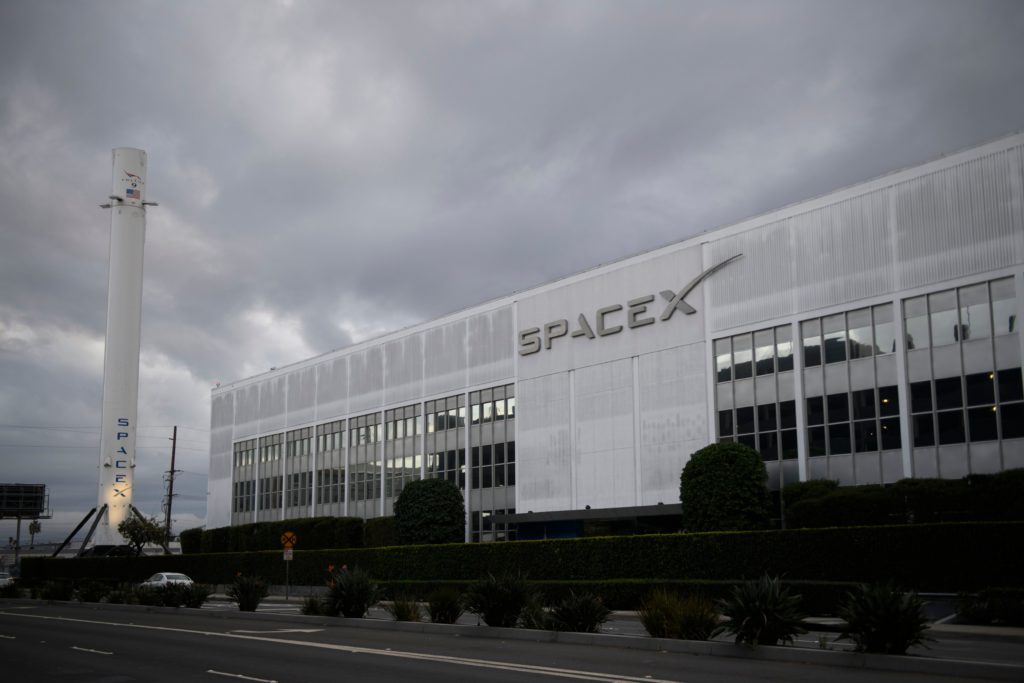
Governor Ron DeSantis announced Saturday that Elon Musk’s SpaceX will deploy 120 units of its Starlink satellites to southwest Florida to provide Internet service for those affected.

More Than 820,000 in Florida Remain Without Power (1:12 p.m. NY)

About 822,000 customers remain without power in Florida, according to PowerOutage.us. That’s a recovery from the peak of 2.7 million customers without power after Hurricane Ian made landfall in southwest Florida on Wednesday. 

In North Carolina, where the storm hit on Friday, there are close to 21,000 customers without power.

More stories like this are available on bloomberg.com

©2022 Bloomberg L.P.

Musk Says SpaceX Has Spent $80 Million Out of Pocket to Support Ukraine

(Bloomberg) — SpaceX’s out-of-pocket costs for providing Ukraine with Starlink dishes stands at around $80 million so far, Elon Musk said in a tweet late Monday, adding that the company is “obviously” pro-Ukraine as it defends itself against the Russian invasion.

The Tesla chief has drawn the ire of Ukrainians for suggesting that the country seek a negotiated solution to the invasion by Russia and cede Crimea for good. 

To view the source of this information click here

More stories like this are available on bloomberg.com

©2022 Bloomberg L.P.
Chip Firm Prices Japan IPO at Top of Range in Rare Feat for 2022

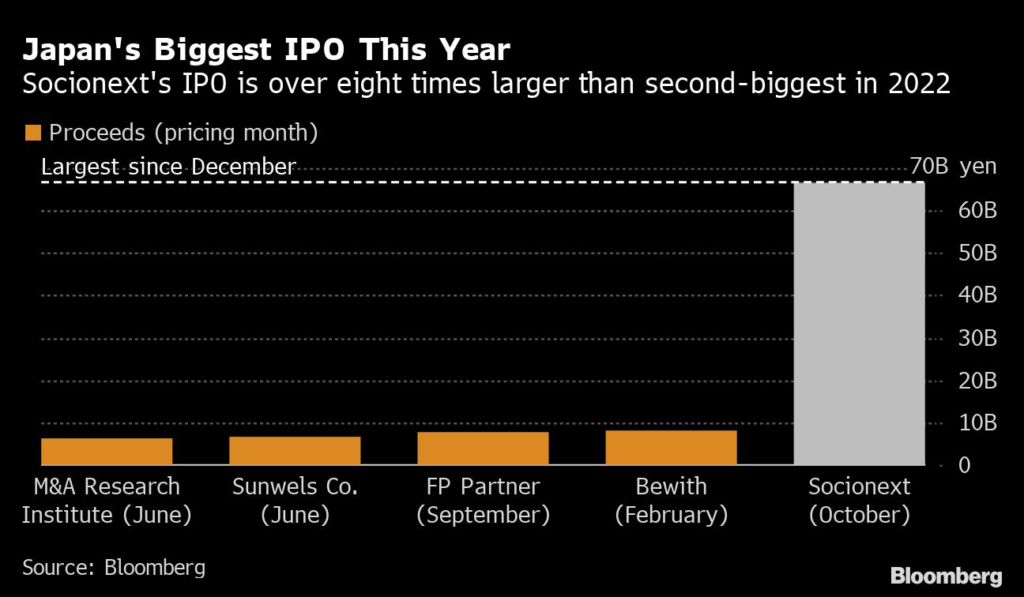
(Bloomberg) — A Japanese chip design firm executed Japan’s largest initial public offering this year after scaling up the deal and pricing shares at the top of the offered range, a rare feat in a tough year for IPOs globally. 

Shares of Socionext Inc. — which counts Panasonic Holdings Corp., Fujitsu Ltd. and the Development Bank of Japan Inc. among its holders — were sold at 3,650 yen each in an upsized offering that amounted to 66.8 billion yen ($461 million), according to a statement on Monday. It’s the largest IPO in Tokyo since December. 

Holders increased the number of shares on sale by about 55% last month after strong demand from investors, IFR reported. Appetite for the Yokohama-based firm contrasts with several recent listings across Asia that were either delayed, cut in size or that priced at the bottom of the range amid expectations for a mismatch between issuers and investors.

Socionext is a company that designs, develops and delivers systems-on-chips, according to its website. Its solutions are used in consumer, automotive and industrial fields. 

While the company’s business is not easy to understand given its “quite unique” segment within the logic semiconductor industry, it has “solid cashflow and a mature business model,” said Hiroaki Tomori, chief fund manager at Mitsubishi UFJ Kokusai Asset. “So I don’t see much downside,” he added.

About 60% of the offering was snapped up by domestic investors, while the remaining 40% ended up with foreigners, according to a statement. The tranche reserved for international investors was oversubscribed by more than 15 times, IFR reported. 

Socionext’s expected debut in Tokyo on Oct. 12 could open the door for more divestments by Fujitsu as it seeks to consolidate its holdings in the core IT solutions business, according to Ian Ma, a technology analyst at Bloomberg Intelligence. Fujitsu could sell stakes in Shinko Electric Industries Co., FDK Corp. and Fujitsu General Ltd., he added.

“Moving these assets that have less synergy with the core IT solutions business would be a step in the right direction to overcoming delays in Fujitsu’s targeted 10% profit margin expansion in fiscal 2023 ending March,” Ma wrote in a note last month. 

More stories like this are available on bloomberg.com

©2022 Bloomberg L.P.
Close Bitnami banner
Bitnami