Bloomberg

UK Energy Supplier Ovo Expects Homes to Delay Winter Heating

(Bloomberg) — The boss of Ovo Energy Ltd., the UK’s third-largest household energy supplier, is expecting British people to start heating their homes later this winter, recommending smart home tech as a way to help use energy more efficiently and lower bills. 

“People will be more mindful” about energy use, Ovo Chief Executive Officer Raman Bhatia said at the Bloomberg Technology Summit in London on Wednesday. On the sidelines of the event he said he expects people to hold off switching their heating on until later in October, delaying the most common start of the UK heating season later than Oct. 1.

An informal poll of audience members conducted during the interview showed a majority plan to respond to soaring energy tariffs simply by minimizing their energy use whenever they can. A smaller number said they would do nothing differently, while a tiny minority said their smart home would optimize everything. 

While governments are releasing billions of euros to support consumers struggling with surging energy costs, the hope is that many people will keep their thermostats turned down even in colder months. 

The most effective way to minimize energy use during colder months is improving insulation, Bhatia said, noting the average UK home loses heat three times faster than in Germany or Sweden. Ovo is training customer service agents to offer more advice and even audit homes, he said. 

Read More: Europe’s First Cold Snap Is Early Test for Continent in Crisis

Beyond that, though, Ovo wants to help customers hook up smart meters to smart variable tariffs to draw on the grid in a more efficient way, saving them money while smoothing out peaks in grid demand during the day, Bhatia said. 

“The opportunity presented by smart meters, smart thermostats, linking all of this data together, is the opportunity to go after right away,” Bhatia said, meaning users can pick their moments to use the most demanding applications. “The grid is pretty dirty and expensive between 4pm and 7pm, for instance. So maybe do not use your tumble drier if you have one at that point.” 

More stories like this are available on bloomberg.com

©2022 Bloomberg L.P.

RBC Names Jason Gurandiano Head of US Technology Banking

(Bloomberg) — Royal Bank of Canada has named Jason Gurandiano head of US technology banking at RBC Capital Markets, elevating one of the firm’s top financial technology bankers. 

Gurandiano will help grow the technology business at the Toronto-based firm’s investment banking unit, according to an internal memo. He will continue reporting to Kirk Kaludis, global head of technology banking.  

Gurandiano is currently global head of fintech and a member of RBC’s crypto committee, the memo shows. He has worked on transactions for clients including SS&C Technologies Holdings Inc., Virtu Financial Inc. and Broadridge Financial Solutions Inc. 

Prior to joining RBC in 2015, he was head of fintech at Deutsche Bank AG and also worked at Credit Suisse Group AG and Citigroup Inc. 

A representative for RBC confirmed the contents of the memo. 

More stories like this are available on bloomberg.com

©2022 Bloomberg L.P.

Green Search Engine Ecosia Invests in Wind Farms Via Ripple

(Bloomberg) — Ecosia GmbH, a search engine that donates its profits toward planting trees, said it would spend 250,000 euros ($239,110) in renewable infrastructure with Ripple Energy, a UK startup that lets people and companies buy shares in green energy projects like wind-farms.

“We’re looking to invest about a quarter of a million euros in the renewable sector in the UK,” Sophie Dembinski, Ecosia’s head of policy and UK, said at the Bloomberg Technology Summit in London on Wednesday. “We would love to work with other organizations who also want to invest in renewable energy.” 

This follows Berlin-based Ecosia’s investments in Germany’s energy transition away from fossil fuels. The startup had put another 20 million euros into the country’s solar energy industry after Russia invaded Ukraine, she said.

Ripple was one of the companies partly underwritten by the UK government in 2020 when the state launched a startup rescue fund in response to the Covid-19 pandemic, injecting £1.14 billion ($1.2 billion) into more than a thousand companies via convertible loans. 

Read more: German Search Engine Ecosia Plants Trees Every Time you Browse

Ecosia was founded in 2009 by Chief Executive Officer Christian Kroll. Kroll said in a 2019 interview with Bloomberg that he started trading stocks at age 16 and studied business administration, before he decided to shift course after extended trips to India, Nepal and Latin America, where he was exposed to poverty and mass extinction. He used his earnings from trading to launch Ecosia.

Ellen Moeller, head of Europe at software company Watershed, also pointed to companies’ increasing interest in commitments to protect the climate. 

“It doesn’t stop at doing things internally,” said Moeller, who also spoke at the Bloomberg Technology Summit on Wednesday. Businesses are keeping track of their climate impact to engage with their investors and employees as well. 

Watershed’s product allows companies to measure their greenhouse gas emissions, and is backed by investors including Sequoia and Kleiner Perkins.

Moeller said she expects more standardization of emissions-tracking software like Watershed’s. 

“We are optimistic that a sum of these disclosure schemes are starting to unify around certain standards,” Moeller says, “That’s going to be very helpful for comparing apples to apples across companies.”


More stories like this are available on bloomberg.com

©2022 Bloomberg L.P.

Amazon Will Rebrand Its Newly Acquired Epix Channel as MGM+

(Bloomberg) — Amazon.com Inc. will rebrand the Epix TV streaming service and related channels as MGM+, in its first big change to the business after acquiring it earlier this year with the purchase of Metro-Goldwyn-Mayer Inc.

The new name will go into effect in January, the company said in statement Wednesday. MGM will continue to invest in original programming for the channels, including shows such as “Hotel Cocaine” and “Belgravia: The Next Chapter.” It will also offer a library of films produced by MGM and other studios, such as “No Time to Die,” “House of Gucci,” and “Licorice Pizza.”

Amazon acquired the famed Hollywood studio for $8.5 billion in a deal that closed in March. The online retailing giant already operates the Prime Video service as well as Freevee, an ad-supported streaming service. 

Epix was founded in 2008 by MGM, Paramount Global and Lions Gate Entertainment Corp. as way to get recurring revenue for their films from cable TV subscribers. MGM bought out its partners five years ago.

More stories like this are available on bloomberg.com

©2022 Bloomberg L.P.

Norway Boosts Defense of Oil and Gas Industry: Energy Update

(Bloomberg) — European governments and companies moved to bolster security around their energy assets after the Nord Stream blasts, as the German Navy was deployed to investigate the suspected sabotage. 

European nations and LNG carriers heading for the region must be on high alert in the wake of the “apparent sabotage,” US Secretary of Energy Jennifer Granholm said. 

The situation in the Baltic Sea between Russia and NATO remains “tense,” said Danish Defense Minister Morten Bodskov, who expects Moscow’s forces in the region to continue their “saber-rattling.” The blasts, which European leaders said were sabotage, coincided with the opening of a new pipeline taking Norwegian gas to Poland.

Gas prices jumped on supply concerns, after Gazprom PJSC warned late Tuesday that flows via Ukraine are also at risk. 

Key Developments:

  • EU announces new sanctions proposal after Russia annexation move
  • Norwegian companies strengthen security
  • Nord Stream leaks could be ‘unprecedented’ climate disaster
  • EU, Denmark, Sweden say Nord Stream leaks caused deliberately
  • German navy deployed to investigate
  • NATO addressing security on critical infrastructure
  • Kremlin dismisses accusations Russian was to blame for damage
  • Ukraine gas flows are at risk, says Gazprom
  • Gas prices rise
  • EU considers ban on shipping Russian oil as part of price cap

Try Your Hand at the Policy Levers: How Would You Manage the Crisis?

(All times are UK.)

Germany Preparing for Months for Threats (3:30 p.m.)

German Interior Minister Nancy Faeser said the government in Berlin has for months been preparing to counter threats to the country’s energy infrastructure and called for the “alleged acts of sabotage” on the Nord Stream pipelines to be cleared up “quickly and comprehensively.”

“We have to prepare for scenarios that were unthinkable until recently,” Faeser said in an emailed statement. “Federal and state security authorities are very vigilant and always act in accordance with the current situation,” she said, adding that police are constantly on patrol in the North and Baltic Seas.

Norway Boosts Defense of Oil and Gas Industry (3:25 p.m.)

Norway’s prime minister said that while there’s no indication of a threat, defense forces will be “more visible” around oil and gas facilities after the suspected Nord Stream sabotage.

There has been “abnormally high” drone activity near oil and gas installations on the Norwegian continental shelf, Jonas Gahr Store told reporters in Oslo. The government has designated oil extraction and pipeline gas transport to Europe as “fundamental national functions” to allow more measures to protect the industries, the prime minister said.

US Urges High Alert After Pipeline Sabotage (2:35 p.m.)

Everybody should be on high alert and nations must build their energy security in the wake of the “apparent sabotage” of the Nord Stream pipelines, US Secretary of Energy Jennifer Granholm said in an interview. That includes a heightened alert for LNG carriers on their way to Europe.

The US hopes its European allies will undertake an “expedited investigation” and identify who was responsible for the pipeline attacks, Granholm said. Vladimir Putin’s move to weaponize gas underscores the urgency with which all nations have to “evaluate the risks of relying on another entity for their energy,” she said.

German Infrastructure Faces Security Threat (1 p.m.)

German energy infrastructure faces a general security threat, according to a spokesman for the Interior Ministry.

There is no indication that the Nord Stream leaks were the result of a natural phenomenon, a government spokesman said, adding that the pipelines will have to be empty before the cause can be investigated.

Naftogaz Says Gazprom Has Paid Oct. Transit (12:30 p.m.)

Ukrainian energy company Naftogaz said Gazprom has paid transit fees for October already.

That may ease some concerns about an immediate cut to flows to Europe via Ukraine. Gazprom said late Tuesday that there’s a risk Russia will sanction Naftogaz in retaliation for a legal dispute, and if that happens Gazprom won’t be able to pay Ukraine’s transit fees. 

Equinor, Var Energi Tighten Security (12 p.m.)

Equinor ASA and Var Energi ASA are tightening security at their facilities in Norway.

“Var Energi has operated with an increased level of security since Russia’s invasion of Ukraine in February and is now introducing even more measures on the basis of the incident in the Baltic Sea,” spokesman Andreas Wulff said in an email.

Gassco, whose network of pipes supplies Norwegian gas to continental Europe, said it has also boosted both cyber and physical security measures.

Ministers to Discuss Nord Stream on Friday (12 p.m)

Energy ministers will discuss the pipeline damage when they meet on Friday in Brussels, according to EU Justice Commissioner Didier Reynders. 

“Before the summer, the council and the commission reached an agreement on security measures for infrastructure which are being implemented,” he said. “And it may be that we need to go even further to secure infrastructure in the light of the recent events.”

German Navy Deployed in Pipeline Probe (11:15 a.m.)

Germany has deployed naval vessels to help in the investigation into the pipeline breaches, the defense ministry said, adding that the “alleged act of sabotage” highlights the vulnerability of critical infrastructure.

“The circumstances of this disturbing event must now be quickly clarified and those responsible identified,” Defense Minister Christine Lambrecht said. “I have already exchanged views on this with my Danish counterpart,” she added. “We have agreed to share information and our navy will contribute its expertise to the investigation.”

Kremlin Dismisses Blame For Sabotage (10:48 a.m.)

Western accusations that Russia sabotaged the Nord Stream pipeline system are “stupid” and “absurd,” Kremlin spokesman Dmitry Peskov said.

The results of an investigation are needed to show the nature of the damage, Peskov said, pointing to the benefit for the US from the Nord Stream pipelines being halted. 

Russia has been taking steps in recent weeks to cut off gas supplies to Europe, including shutting down Nord Stream for maintenance on turbines that the manufacturer said wasn’t necessary.

Equinor Raises Vigilance on Energy Assets (10:35 a.m.)

Equinor decided to raise the level of preparedness last night for all its energy-related facilities in Norway, national broadcaster NRK reported. 

The decision covers offices, installations, supply locations, helicopter bases, land facilities and vessels. A separate contingency team consisting of local management and stewards has been established for the Kollsnes gas processing plant, the broadcaster said.

Explosions Equivalent to 100 kg of TNT (10:07 a.m.)

In Sweden, seismologists said the bigger of the two explosions detected in the area of the Nord Stream gas leak on Monday corresponded to a blast of about 100 kilograms of TNT.

The calculation is based on a comparison with other detonations, for example naval mines where the size of the charge is known. But this is “very much an estimate as it depends on local conditions,” Peter Schmidt of the Swedish National Seismic Network said in an interview.

On Wednesday, the Swedish Prosecution Authority confirmed that the police has opened a case into the Nord Stream incident but would not provide further comment.

‘Unprecedented’ Climate Disaster (10:03 a.m.)

Scientists are scrambling to work out just how much methane, one of the most powerful greenhouse gases, has escaped into the atmosphere. The fear is that it could be one of the worst releases ever.

Many so-called super-emitting events — large continuous discharges of methane — are captured by satellite imagery over land-based pipelines or fossil-fuel production sites. But capturing accurate data over water, is far more challenging given the light that reflects of the surface.

Pipeline Probe Won’t Start for at Least a Week (9:55 a.m.)

It may take as long as two weeks before an investigation of the Nord Stream leaks can begin, Danish Defense Minister Morten Bodskov told local media.

“It can take a week or 14 days before the pressure in the pipelines has fallen enough for there to be enough calm to see anything,” he said.

NATO Chief Looking at Protecting Infrastructure (9:20 a.m.)

NATO chief Jens Stoltenberg discussed the sabotage on the Nord Stream pipelines with the Danish Defence Minister addressing the need to protect critical infrastructure.

15 EU Countries Back Price Cap on Gas (8:40 a.m.)

A cap on the price of natural gas should be applied to all transactions, and not limited to imports from specific jurisdictions, 15 EU Energy Ministers said in a letter to the European Commission. The cap is a priority and can be combined with proposals to strengthen the financial oversight of the gas market and develop alternative benchmarks for gas pricing in Europe, energy ministers of Belgium, Bulgaria, Croatia, France, Greece, Italy, Latvia, Lithuania, Malta, Poland, Portugal, Romania, Slovakia, Slovenia and Spain said in the letter.

The European Union’s executive arm plans to discuss the feasibility of imposing a price cap on gas in a document to be presented to member states Wednesday.

Ukraine to Press Ahead With Arbitration (8:10 a.m.) 

Ukraine’s NJSC Naftogaz Ukrainy intends to continue with arbitration against Gazprom PJSC, its chief executive officer said on Twitter. The legal dispute could lead to Russia sanctioning the country and cutting supplies of gas.

Gas Prices Jump (7:23 a.m.)

Natural gas prices in Europe jumped 11%, after Russia’s Gazprom warned supplies via Ukraine are at risk if the country pursues a dispute over transit payments. The warning came after leaks were reported on Nord Stream pipelines to Germany, which authorities suspect are caused by sabotage. 

Sweden Calls Foul Play (7:15 a.m.)

Sweden’s government maintained its stance that the leaks were a result of foul play on Wednesday. “We can say that it likely is sabotage,” Foreign Minister Ann Linde told state broadcaster SVT.

EU Warns of Strong Response (9:20 p.m. Tuesday)

President of the European Commission, Ursula von der Leyen warned that Europe will carry out “the strongest possible response” if the damage on the Nord Stream 1 and 2 pipelines proves to be deliberate. She said any deliberate damage to Europe’s energy infrastructure is “unacceptable.”

More stories like this are available on bloomberg.com

©2022 Bloomberg L.P.

Ford Unveils Gas-Fueled Pickup That’s Funding Its EV Future

(Bloomberg) — Ford Motor Co.’s redesigned F-Series Super Duty pickup may lack the sex appeal of the Mustang introduced earlier this month, but this hulking warhorse is critical to funding the automaker’s electric future.

The new Super Duty introduced Tuesday is the antithesis of an electric vehicle. According to Ford, it received a thorough overhaul that includes a new 6.8-liter V8 gasoline engine and a new 6.7-liter diesel engine to go along with a massive 7.3-liter gas engine the media have dubbed Godzilla. In its largest configuration, the truck stands over 6 and 1/2 feet tall and stretches more than 22 feet.

To Ford, this truck isn’t so much about saving the planet as it is about keeping it turning. According to the automaker, the Super Duty generates more in annual revenue than Southwest Airlines Co., which last year booked $15.8 billion in sales. It dominates commercial sales to construction crews, utilities, mining companies and emergency-response teams, and has twice the market share of rivals, Ford said.

Chief Executive Officer Jim Farley, who unveiled the redesigned truck at Churchill Downs in Louisville, Kentucky, close to where it’s built, has said Ford’s traditional gas-powered vehicles will be “a profit and cash engine” that finances the company’s electric-car ambitions. That includes spending $50 billion electrifying Ford’s lineup and building 2 million EVs a year by the end of 2026.

“The Super Duty is clearly a big revenue driver which is extremely important to Ford as they move toward this new future,” said Jessica Caldwell, executive director of insights for automotive researcher Edmunds.com. “Having the Super Duty contribute so much to the bottom line certainly makes that challenge much easier.”

Ford shares rose less than 1% to $11.99 at 9:58 a.m. in New York. The stock is down about 42% this year.

Read more: Ford invests $700 million in Kentucky plant

To keep revenue rolling in, Ford updated the Super Duty with plenty of tech to go with all that brawn.

It’s the first model in Ford’s lineup — and the first pickup on the market — with a superfast 5G modem. This enables over-the-air software updates while driving and creates a Wi-Fi hot spot capable of supporting 10 devices. 

Ford plans to capitalize on that data flow by selling software to fleet managers to keep track of their trucks every move and monitor maintenance needs in real time. 

Ford says the Super Duty’s beefy engines will allow it to tow and haul more cargo. The vehicle goes on sale in late 2022 or early next year. The current version of the Super Duty starts at just under $40,000, but can climb above $100,000.

“We really see a lot of opportunity to grow in internal combustion,” Ted Cannis, head of the Ford Pro commercial unit, said in an interview. “The Super Duty is a critical product for us.”

Just don’t look for Ford to electrify the Super Duty in the near future. A battery big enough to power the truck and meet its towing needs would be so heavy it would reduce the cargo capacity and the distance the truck could travel on a charge, Farley said.

“You wind up sacrificing range a lot — like cut your range in half with towing,” Farley said in an interview on Bloomberg TV. “So this is not the kind of vehicle we would use for electric. We don’t think this segment is going electric any time soon.”

(Updates with CEO comment in the last paragraph.)

More stories like this are available on bloomberg.com

©2022 Bloomberg L.P.

CALB Raises $1.3 Billion in Hong Kong IPO Priced at Bottom

(Bloomberg) — CALB Co., a Chinese battery supplier for electric vehicle makers, has raised about HK$10.1 billion ($1.3 billion) after pricing its Hong Kong initial public offering at the bottom of its marketed range, according to terms of the deal seen by Bloomberg News.

The Jiangsu-based company has priced the offering at HK$38 per share, according to the terms. The firm marketed about 265.8 million shares at HK$38 to HK$51 each. An external representative for CALB declined to comment.

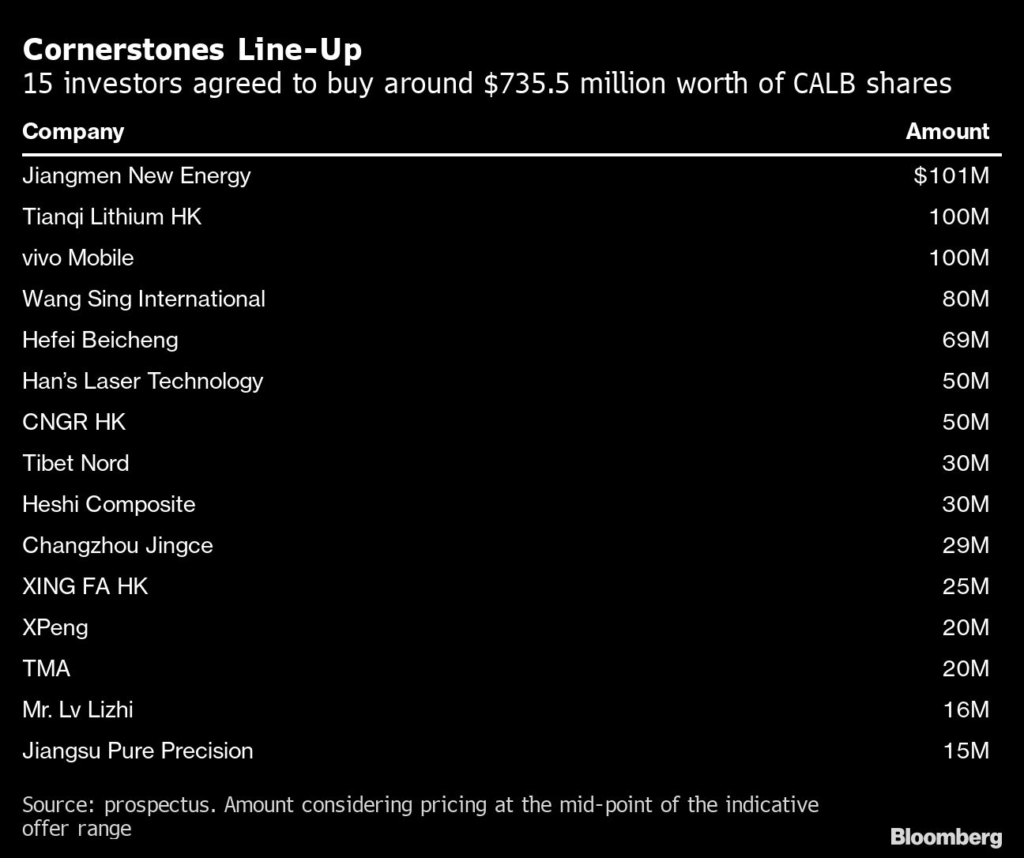
The offering drew 15 cornerstone investors who agreed to purchase around $735.5 million worth of stock in the offering. They include Tianqi Lithium Corp., which began trading in Hong Kong in July, electric carmaker XPeng Inc. and phone manufacturer Vivo Mobile Communication Co.

CALB is the third company to raise over $1 billion through a first-time share sale in Hong Kong this year, as mid-to-large sized deals return to the Asian financial hub after a slow first half. Still, funds raised in the city are down about 78% since the start of January as rising interest rates drove volatility in equities and kept issuers on the sidelines.

Established in 2007, CALB makes lithium batteries for electric vehicles and other products. It operates major production bases in China, including Changzhou, Xiamen and Wuhan, according to its website. 

The company supplies batteries to the EV brands of carmakers including Guangzhou Automobile Group, Chongqing Changan Automobile Co. and Zhejiang Leapmotor Technology Co., which raised about $800 million in its Hong Kong IPO and is slated to debut in the city on Thursday.

CALB ranked sixth by sales in the global EV battery market in July, overtaking South Korea’s Samsung SDI Co., according to data from Seoul-based SNE Research. The Chinese firm will use part of the proceeds for the construction of production lines of EV batteries and to invest in new production facilities in different parts of China.

Huatai International Ltd. is the sole sponsor of CALB’s Hong Kong IPO. The shares are scheduled to start trading Oct. 6.

(Updates throughout with terms of the deal.)

More stories like this are available on bloomberg.com

©2022 Bloomberg L.P.
Globant Bets on Spanish Football With LaLiga Tech Joint Venture

(Bloomberg) — Software firm Globant SA picked Spain to expand its football business, reaching an agreement with top-flight competition LaLiga to create a tech-based joint venture.

The new entity, in which Globant will hold a 51% stake, will leverage the technology developed by LaLiga Tech, the arm of LaLiga that’s specialized in providing fan engagement solutions, according to a statement. The financial terms of the deal weren’t disclosed.

Data analysis and real-time statistics have been gaining weight in different sports leagues globally to build up predictive models that support the decision-making process on tactics and players’ training. Data is also analyzed to enhance fan engagement and boost merchandising revenue.

Globant, whose clients include Google and Disney, will work on expanding LaLiga Tech’s products and services such as anti-piracy tools and data analysis.

The venture will also try to leverage new technologies such as web3, which will bring fans “a new form of interacting with their teams, including blockchain-based collectibles,” Globant Chief Executive Officer Martín Migoya said in an interview. “We’ll also use artificial intelligence to better identify users and develop more sophisticated experiences,” he said, adding that the company also aims to expand to “many other leagues in many other countries, as well as many other sports globally.”

LaLiga aims to improve the interaction with fans, “being able to take decisions leveraging data-based predictions,” said Óscar Mayo, executive director of LaLiga, adding that one of the main targets is being able to offer metaverse-linked services as soon as possible.

Globant’s Alejandro Scannapieco will be the CEO of the new company, while current LaLiga Tech CEO Miguel Ángel Leal Góngora will become director of technology and innovation at LaLiga Group.

More stories like this are available on bloomberg.com

©2022 Bloomberg L.P.
Apple Ditches iPhone Production Increase After Demand Falters

(Bloomberg) — Apple Inc. is backing off plans to increase production of its new iPhones this year after an anticipated surge in demand failed to materialize, according to people familiar with the matter.

The Cupertino, California-based electronics maker has told suppliers to pull back from efforts to increase assembly of the iPhone 14 product family by as many as 6 million units in the second half of this year, said the people, asking not to be named as the plans are not public. Instead, the company will aim to produce 90 million handsets for the period, roughly the same level as the prior year and in line with Apple’s original forecast this summer, the people said.

Demand for higher-priced iPhone 14 Pro models is stronger than for the entry-level versions, according to some of the people. In at least one case, an Apple supplier is shifting production capacity from lower-priced iPhones to premium models, they added.

Apple shares fell 3.9% in New York Wednesday morning to $145.90. The shares are down 18% this year, compared with a 23% drop in the S&P 500 Index.

Analysts at Morgan Stanley and Oddo said the news didn’t imply any downside to their volumes forecasts. Bloomberg Intelligence analyst Anurag Rana said he “was not surprised” by the report and continues to “believe that weak demand from Europe and China could hurt overall iPhone sales in fiscal 2023.”

In Taipei, key chipmaker Taiwan Semiconductor Manufacturing Co. fell 2.2% and Apple’s biggest iPhone assembler Hon Hai Precision Industry Co. was down 2.9%, amid a wide selloff of electronics suppliers. ASML Holding NV, maker of advanced chipmaking gear, dropped as much as 3.2% in Amsterdam.

Apple Suppliers Drop as Firm Said to Ditch IPhone Output Boost

Apple had upgraded its sales projections in the weeks leading up to the iPhone 14 release and some of its suppliers had started making preparations for a 7% boost in orders.

An Apple spokesperson declined to comment.

China, the world’s biggest smartphone market, is in an economic slump that’s hit its domestic mobile device makers and also affected the iPhone’s sales. Purchases of the iPhone 14 series over its first three days of availability in China were 11% down on its predecessor the previous year, according to a Jefferies note on Monday.

Global demand for personal electronics has also been suppressed by surging inflation, recession fears and disruption from the war in Ukraine. The smartphone market is expected to shrink by 6.5% this year to 1.27 billion units, according to data from market tracker IDC.

“The supply constraints pulling down on the market since last year have eased and the industry has shifted to a demand-constrained market,” said Nabila Popal, research director at IDC. “High inventory in channels and low demand with no signs of immediate recovery has OEMs panicking and cutting their orders drastically for 2022.”

(Updates with US trading and analyst comments in fifth paragraph.)

More stories like this are available on bloomberg.com

©2022 Bloomberg L.P.

Micron Earnings Are Key as Apple News Points to Slowdown

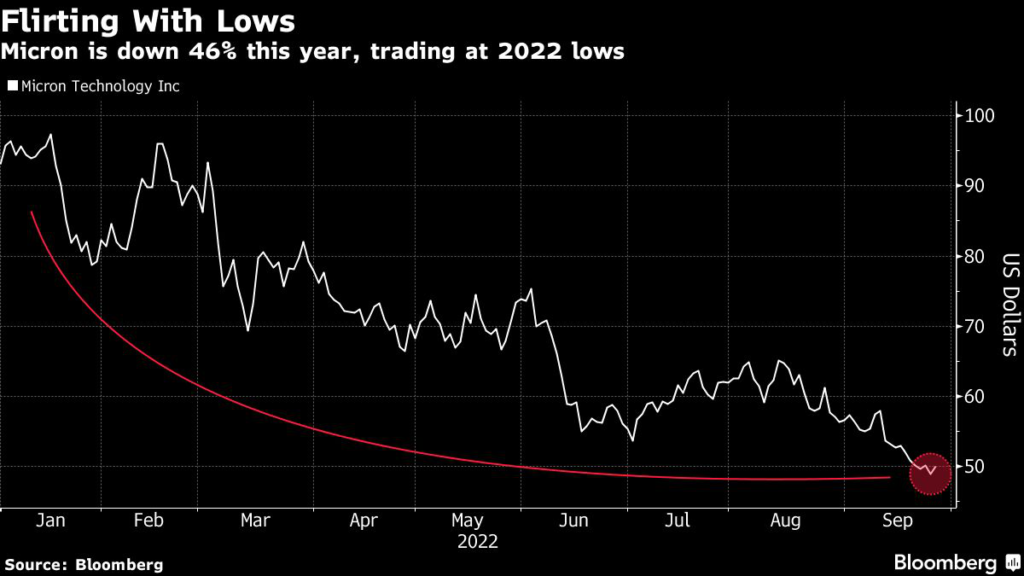
(Bloomberg) — Micron Technology Inc. shocked investors last month by warning that rapidly slipping demand for computers would curb sales of its memory chips. On the eve of the holiday shopping season, analysts fear that business has only worsened.

Thursday’s earnings from Micron will show how bad the damage is from inflation eating into consumer budgets and cooling sales of consumer gadgets as the year’s biggest quarter kicks off. The signs aren’t good: Apple Inc. is backing off plans to increase output of its new iPhones after an anticipated surge in demand failed to materialize, people familiar with the matter said.

In a sign of how pessimistic investors are, Micron’s stock closed Monday at the lowest in almost two years and fell at the open. Over the past three months, analysts have cut estimates for sales this year by 6.9% and for earnings by 12%, Bloomberg data shows. They now expect revenue for the fourth quarter ended Aug. 31 to fall by 18%, which would be the first decline in 10 quarters.  

“It appeared as if management was assuming a worst-case scenario” in its August earnings guidance, Matt Bryson, a Wedbush Securities analyst, wrote in a note. “In retrospect, their guide likely did not prove conservative enough.” 

Micron’s woes are likely to have ripple effects. The Boise, Idaho-based company already plans to reduce spending on new plants and equipment this year, saying last month that capital expenditures will be “down meaningfully” from a year earlier. Comments on further cuts could affect makers of the equipment used to produce semiconductors, such as Applied Materials Inc. and Lam Research Corp.

With fears of a recession looming, chip stocks have seen a deeper selloff than the rest of tech. The Philadelphia semiconductor index hit a fresh low for the year on Monday. It’s down 41% from its record close in December, with all of the benchmark’s 30 components falling in that time and Micron slumping 46%.

The declines have left chip stocks looking like bargains relative, and Micron is no exception, selling for 11 times estimated earnings for the next year and 1.1 times book value. The problem is, profit forecasts still look too high to many investors.

“The stock is definitely undervalued from a historical perspective,” said Daniel Morgan, a senior portfolio manager at Synovus Trust Co. “Can it go lower? Yes.”


Tech Chart of the Day

It’s been a nightmare of a year for Meta Platforms Inc. in the stock market. The shares are down 65% from their peak a little more than a year ago and now trade at 10 times estimated earnings, their cheapest level since the Facebook owner went public in 2012. Meta is among the cheapest 25% stocks in the S&P 500 Index. The selloff this year has wiped about $574 billion in value, an amount larger than all but the six largest companies in the S&P 500.

Top Tech Stories

  • The UK has “no chance in hell” of becoming technologically sovereign, Hermann Hauser, the co-founder of Amadeus Capital Partners and founder of Arm, said at Bloomberg’s Tech Summit in London.
  • Apple is backing off plans to increase production of its new iPhones this year after an anticipated surge in demand failed to materialize, according to people familiar with the matter.
    • Shares in Apple’s Asian suppliers extended losses Wednesday after Bloomberg reported the Californian company is backing off plans to increase production of its new iPhones.
  • Elon Musk asked a federal appeals court to throw out the deal he made with the US Securities and Exchange Commission in 2018 requiring a Tesla Inc. lawyer to screen all his company-related tweets, calling it an illegal effort to muzzle him.
  • Intel Corp., looking to regain its footing in the chip industry, introduced new personal-computer processors and graphics semiconductors, as well as software that makes it easier to use the company’s technology.
  • Supporters of a landmark US antitrust bill gathered over beer and soft pretzels at Cafe Berlin on Capitol Hill last week to muster energy for one last push to rein in the dominance of giant technology companies. Recognizing that the measure won’t come up for a vote before the Nov. 8 midterms, the group considered  on how to jam the legislation through the brief “lame duck” period after the elections.
  • A hacker who infiltrated Fast Company, a publication owned by Morningstar Inc.’s billionaire founder Joe Mansueto, sent obscene push notifications to Apple News users’ home screens on Tuesday night, sparking a shutdown of the magazine’s website.

(Updates with market open)

More stories like this are available on bloomberg.com

©2022 Bloomberg L.P.

Close Bitnami banner
Bitnami