Bloomberg

Biden’s Privacy Revamp Gets EU Blessing in Boost for Data Flows

(Bloomberg) — European Union regulators took a big step toward ending the legal limbo that imperiled transatlantic data flows worth billions of dollars and sparked threats of an EU withdrawal from social network giant Meta Platforms Inc.

The US now ensures an “adequate level” of data protection, the European Commission said as it unveiled proposals to replace a previous accord that was torpedoed by the EU’s top court on privacy concerns.  

The step follows months of negotiations with the US, which yielded an executive order by President Joe Biden and US pledges to ensure that EU citizens’ data is safe once it’s shipped across the Atlantic. The new pact still needs the approval by EU lawmakers and a panel of EU privacy watchdogs.

“US companies will be able to join the EU-U.S. Data Privacy Framework by committing to comply with a detailed set of privacy obligations,” such as to delete data that’s no longer needed, the commission said in a statement. US promises will ensure EU citizens’ defense rights, but will also limit access to data by US security agencies or other public authorities, the commission said.

The EU’s top court in 2020 toppled the bloc’s previous deal, over concerns that citizens’ data wasn’t safe from the prying eyes of US agencies when it was transfered from Europe. The so-called Privacy Shield had widely been hailed as providing the necessary protections, after EU judges stuck down the first such accord. The court ruling plunged whole swathes of the EU-US economy into a legal limbo, with firms clamoring to find legally watertight alternatives. 

EU-US negotiators were forced back to the drawing board and the prospect of no deal led Meta, Facebook’s owner, to say it may have no choice but to pull its Facebook and Instagram services from the EU.

Biden Order Brings New Transatlantic Data Pact Ever Closer 

A breakthrough was reached earlier this year and the legal changes the US committed to this time represent a “fundamental shift” from what was in place before and “really target” concerns laid out by the EU court, a US government official said last month.

Privacy campaigner Max Schrems has been behind two EU court cases that ended up striking down the bloc’s previous data flow decisions. Schrems said in a statement through his group Noyb on Monday that “the changes in US law seem rather minimal.” 

“We will analyze the draft decision in detail the next days,” said Schrems. “As the draft decision is based on the known executive order, I can’t see how this would survive a challenge” and “it seems that the European Commission just issues similar decisions over and over again — in flagrant breach of our fundamental rights.”

It’s widely expected the new pact will also face a court challenge.

“Of course we will have a challenge before the Court of Justice, I’m sure of that,” EU Justice Commissioner Didier Reynders said at an event on Monday. “I’m quite confident” that the new decision will be upheld in court, because “we’re very far, in a very robust system.”

The EU’s decision will now be analyzed by the European Data Protection Board, the body consisting of the bloc’s national privacy watchdogs and enforcers, and by the European Parliament. The commission has said that if all goes smoothly, the new EU-US Data Privacy Framework could be finalized in the first half of next year. 


More stories like this are available on bloomberg.com

©2022 Bloomberg L.P.

Honest Co. Names Former Amazon Executive as New CEO

(Bloomberg) — Honest Co., the personal-care company founded by actress Jessica Alba, appointed former Amazon.com Inc. and General Mills Inc. executive Carla Vernón as its new chief executive officer.

Vernón assumes the role starting Jan. 9 and will replace Nick Vlahos, who has led the company since 2017 and took it public last year. Vlahos will remain on Honest’s board, according to a statement.

The new CEO was previously vice president of consumables at Amazon, where she oversaw categories such as baby care, household products and beauty, Honest said, adding that she was “instrumental in invigorating Amazon.com’s beauty experience” by introducing virtual lipstick try-on and creating a seasonal beauty sales event. Vernón becomes one of the only Afro-Latina CEOs at a publicly traded company, according to Honest. 

She takes the reins at a company that has struggled to meet the expectations set at its IPO. Honest, which sells diapers, shampoo and makeup that it markets as environmentally sustainable and free of harmful ingredients, has seen its shares steadily decline and took a hit earlier this year when sales of its cleaning products slumped more than expected as the pandemic eased. Consumers also returned to stores faster than foreseen, but the digitally-native brand didn’t have enough presence in retail — a misstep it’s trying to fix.

In November, the company posted third-quarter results earnings that missed investor expectations. Management said it expects sales to rise 7% to 10% in the first half of 2023 as its products become more widely available and price increases kick in.

Honest shares jumped 5.6% at 9:34 a.m. in New York trading. The stock has declined about 65% this year and 82% since the IPO, bringing the company’s market capitalization to $264 million.

More stories like this are available on bloomberg.com

©2022 Bloomberg L.P.

Read the Charges Against Bankman-Fried Filed by SEC, DOJ, CFTC

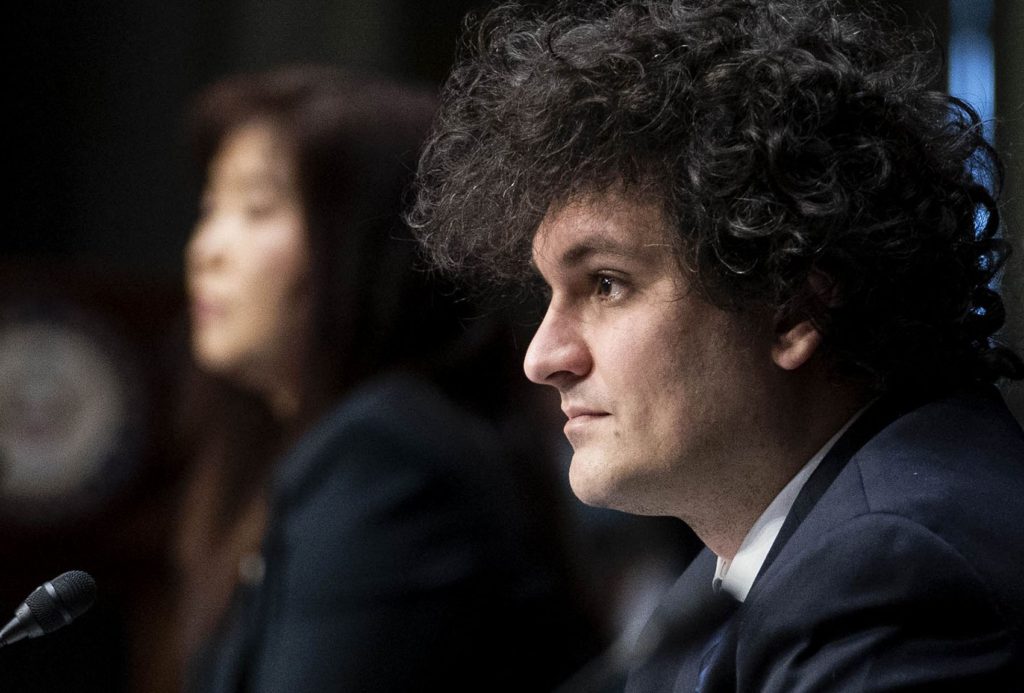
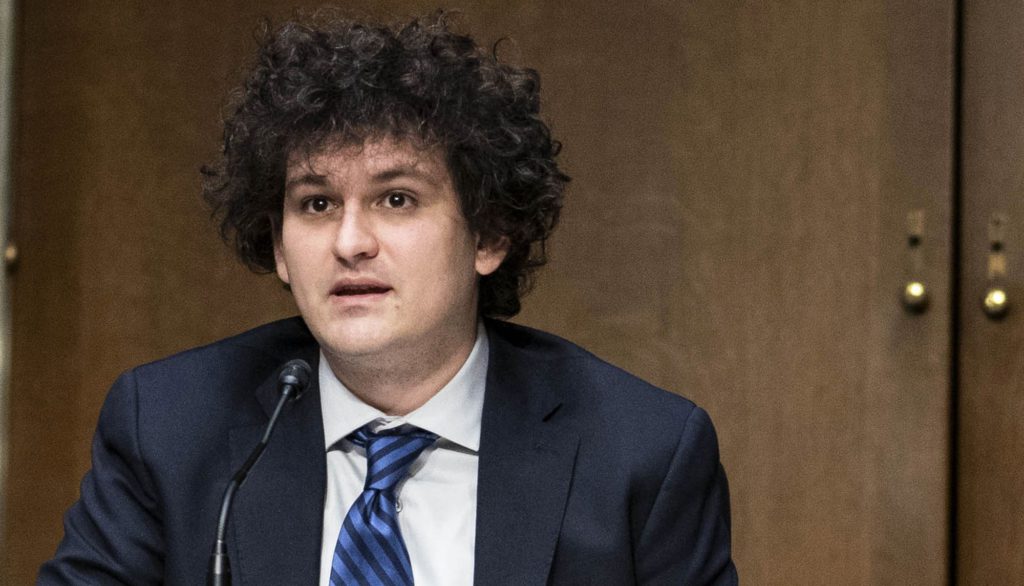
(Bloomberg) — The US Justice Department, Securities and Exchange Commission and Commodity Futures Trading Commission went after Sam Bankman-Fried for his role in the collapse of FTX, in three separate court filings. The SEC alleges he was “orchestrating a massive, years-long fraud, diverting billions of dollars of the trading platform’s customer funds for his own personal benefit and to help grow his crypto empire.”

Read the full SEC complaint here. 


Read the DOJ indictment here. 


Read the CFTC’s allegations here. 


More stories like this are available on bloomberg.com

©2022 Bloomberg L.P.

Shorts Eye More Gains After Reaping $50 Billion From Big Tech in 2022

(Bloomberg) — Short sellers have reaped almost $50 billion of gains this year from betting against some of the biggest technology companies, and some bears see further profits in 2023. 

Even after this year’s 26% slump in the Nasdaq 100 Index, many of the stocks are still expensive relative to their estimated sales or earnings, skeptics say, a sign that some of the froth from a multiyear bull market still remains to be blown away.  

The 10 most-shorted companies have delivered $49.2 billion in combined mark-to-market gains for bears through Friday, according to data-analytics firm S3 Partners. Tesla Inc. leads with almost $12 billion in paper profits for shorts, followed by Amazon.com Inc. and Meta Platforms Inc. The top 10 also includes Apple Inc. and Microsoft Corp. 

“The reason we are so attracted to the technology sector is because there are still a ridiculous amount of companies out there that are trading at 10, 15, 20 times price to sales,” said Brad Lamensdorf, a manager of the AdvisorShares Ranger Equity Bear ETF. Such multiples are “absurd,” he said, adding that “the odds of that position being profitable over time for an investor is so low that they are a great pool to fish from.”

Short sellers — who borrow shares and sell them, hoping to buy them back at a lower price to profit from the difference — struggled during the years-long bull market, when high valuations didn’t seem to matter. 

That changed this year: Soaring inflation prompted a series of interest rate increases by the Federal Reserve, causing investors to flee once-popular growth and tech stocks. 

Tesla is a prime example: The electric-car company was the most shorted stock in 2020 and 2021, but by the end of those years short sellers were sitting on about $35 billion and $10 billion of paper losses, respectively, as the shares rallied. 

The stock topped out late in 2021 at about 18 times sales, and it’s lost half its value this year, when it was again the most shorted stock and the most profitable one for the bears. 

Another favorite of the shorts, used-car retailer Carvana Co., has tumbled 98% this year. Short sellers have $4.3 billion in mark-to-market profits on bets against the stock, according to S3.

Representatives of Apple and Carvana didn’t have any immediate comment on the short interest in their shares, while Microsoft declined to comment. Tesla, Meta and Amazon weren’t immediately available to comment.  

Many of the most-shorted stocks also were among the most-owned stocks by individual investors, meaning the mom-and-pop set took a big hit in the bear market.

Investment portfolios belonging to retail traders suffered a $350 billion blow this year, according to data compiled by Vanda Research. The list is topped by Tesla, which accounts for about 10% of the average self-directed global retail trader’s portfolio, according to the firm. 

Even after this year’s selloff, the Nasdaq 100 trades at 21 times forward earnings, slightly above its 10-year average. 

It’s likely “that investors will make money shorting tech again in 2023,” said Matt Maley, chief market strategist at Miller Tabak + Co. “History tells us that bear markets for the tech group do not end until the biggest names become at least somewhat cheap.”

Tech Chart of the Day

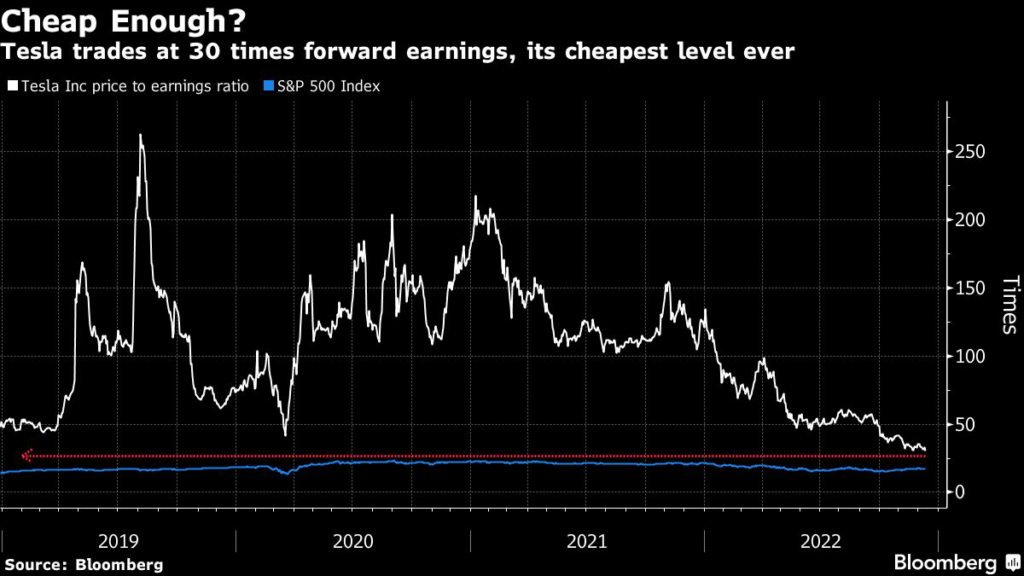
This year’s selloff has pushed Tesla’s valuation to its lowest ever level. Tesla’s stock is down 51% this year, trading at about 30 times projected earnings. Yet skeptics say the valuation may not be low enough, given that the electric-car maker is grappling with slowing in sales in China, the world’s largest car market, at a time when Chief Executive Officer Elon Musk is spending much of his time working on his new acquisition, Twitter Inc. However, the stock rallied along with the broader market on Tuesday after data on consumer prices rose less than expected in November.

Top Tech Stories

  • Oracle Corp. reported quarterly sales that exceeded analysts’ estimates on a strong effort from its Cerner digital health records unit, overcoming softer demand for information technology services in a choppy economy.
  • Japan and the Netherlands have agreed in principle to join the US in tightening controls over the export of advanced chipmaking machinery to China, according to people familiar with the matter, a potentially debilitating blow to Beijing’s technology ambitions.
  • Japan’s newly formed chip foundry venture Rapidus Corp. said it is seeking to invest several trillion yen to help reboot the country’s semiconductor industry.
  • Twitter resumed selling its Twitter Blue premium offering, which gives users a blue verification badge by their names, following a weeks-long pause because some subscribers were using the paid service to impersonate well-known accounts.
  • Sony Group Corp. led a big jump in video-game hardware sales in the US last month, in the latest sign of improving PlayStation 5 supply.
  • Elon Musk’s SpaceX is offering to sell insider shares at a price that would raise the closely held company’s valuation to about $140 billion, according to people familiar with the matter.
  • The $5.7 billion of Tesla shares that Musk donated to an unnamed organization at the end of 2021 went to his own charitable arm, instantly making it one of the largest foundations in the US.
  • Uber Technologies Inc. said it’s investigating the hack of a third-party vendor that reportedly resulted in the leak of data from the ride-hailing company, including employee email addresses.
  • GoTo Group jumped Tuesday by the most since May as some brokers upgraded the battered stock following weeks of sharp selloff. The Indonesian ride-hailing and e-commerce provider surged 15%, snapping 16 straight sessions of losses.

(Updates to market open.)

More stories like this are available on bloomberg.com

©2022 Bloomberg L.P.

CFTC Sues Bankman-Fried, FTX and Alameda for Law Violations

(Bloomberg) — The Commodity Futures Trading Commission sued Sam Bankman-Fried, FTX and Alameda Research for violations of federal commodities laws.

The top US derivatives regulator claims Bankman-Fried and other FTX executives took hundreds of millions of dollars in loans from Alameda they used to buy real estate and make donations to politicians. 

“At Bankman-Fried’s direction, FTX executives created features in the underlying code for FTX that allowed Alameda to maintain an essentially unlimited line of credit on FTX,” the CFTC said in a complaint filed Tuesday in Manhattan federal court.

Bankman-Fried was the only individual defendant listed in the complaint. 

The CFTC’s case would add to the significant legal troubles already facing Bankman-Fried. The Securities and Exchange Commission on Tuesday accused him of carrying out a multi-year scheme to defraud investors. He’s also facing US criminal charges and was arrested Monday in the Bahamas.

More stories like this are available on bloomberg.com

©2022 Bloomberg L.P.

Here Are The Wildest Parts From Bankman-Fried’s SEC Allegations

(Bloomberg) — US authorities have alleged that fallen crypto maven Sam Bankman-Fried defrauded investors in his FTX empire, stealing billions of dollars as part of a “massive, years-long fraud” for his own benefit.

Civil charges, filed by the Securities and Exchange Commission on Tuesday, claimed that Bankman-Fried had been engaged in a scheme to deceive investors in FTX and his companies since at least May 2019, and that the process only ended last month when he lost his position as chief executive officer as part of FTX filing for bankruptcy.

Bankman-Fried had raised more than $1.8 billion from equity investors over that time, including from the likes of SoftBank Group, Temasek, Tiger Global Management and Insight Partners. Upon engaging bankruptcy lawyers, the equity stakes of all who had backed FTX effectively fell to zero.

The SEC alleged in a 28-page filing detailing its claims against SBF (emphasis ours):

Unbeknownst to those investors (and to FTX’s trading customers), Bankman-Fried was orchestrating a massive, years-long fraud, diverting billions of dollars of the trading platform’s customer funds for his own personal benefit and to help grow his crypto empire.

Throughout this period, Bankman-Fried portrayed himself as a responsible leader of the crypto community. He touted the importance of regulation and accountability. He told the public, including investors, that FTX was both innovative and responsible. Customers around the world believed his lies, and sent billions of dollars to FTX, believing their assets were secure on the FTX trading platform. But from the start, Bankman-Fried improperly diverted customer assets to his privately-held crypto hedge fund, Alameda Research LLC (“Alameda”), and then used those customer funds to make undisclosed venture investments, lavish real estate purchases, and large political donations.

Here’s more:

He told investors and prospective investors that FTX had top-notch, sophisticated automated risk measures in place to protect customer assets, that those assets were safe and secure, and that Alameda was just another platform customer with no special privileges. These statements were false and misleading. In truth, Bankman-Fried had exempted Alameda from the risk mitigation measures and had provided Alameda with significant special treatment on the FTX platform, including a virtually unlimited “line of credit” funded by the platform’s customers.

While he spent lavishly on office space and condominiums in The Bahamas, and sank billions of dollars of customer funds into speculative venture investments, Bankman-Fried’s house of cards began to crumble.

As the broader crypto market declined in value throughout 2022, Alameda’s lenders began to seek repayment. Even though FTX had allegedly already given Alameda billions of dollars in customer funds, Bankman-Fried began to give Alameda even more money to cover those positions, the SEC said. Over the summer, he also began to divert FTX customer funds for venture investments and to make loans to himself and other executives, the SEC added.

The filing described FTX’s origin story: From SBF setting up Alameda with co-founder Gary Wang in 2017, to setting up FTX in 2019 and bringing on board others that would form the exchange’s internal cabal of senior executives — Alameda co-CEOs Caroline Ellison and Sam Trabucco, and Nishad Singh as a co-founder of FTX. Approximately $1.1 billion of the funds raised were from US investors, the SEC said.

It alleged that all statements made by Bankman-Fried to investors during this time were misleading because he chose to omit information about Alameda’s special treatment, including its unique ability to carry a negative balance on FTX, and its exemption from a crucial part of FTX’s risk management system, its auto-liquidation feature.  

From page 10 of the filing:

Bankman-Fried diverted FTX customer funds to Alameda in essentially two ways: (1) by directing FTX customers to deposit fiat currency (e.g., U.S. Dollars) into bank accounts controlled by Alameda; and (2) by enabling Alameda to draw down from a virtually limitless “line of credit” at FTX, which was funded by FTX customer assets.

As a result, there was no meaningful distinction between FTX customer funds and Alameda’s own funds. Bankman-Fried thus gave Alameda carte blanche to use FTX customer assets for its own trading operations and for whatever other purposes Bankman-Fried saw fit.

Moreover, for a period of time after its founding, Bankman-Fried claimed FTX was unable to secure its own bank accounts and so was forced to use Alameda’s accounts to store assets. A balance sheet touted by Bankman-Fried to potential investors in the week when he was trying to avoid bankruptcy described a “hidden, poorly internally labeled ‘fiat@’ account” with a negative $8 billion balance.

Having uncovered bank accounts operated by a secretive Alameda subsidiary called North Dimension Inc., the SEC said it found out exactly what that fiat@ account was up to:

Bankman-Fried directed FTX to have customers send funds to North Dimension in an effort to hide the fact that the funds were being sent to an account controlled by Alameda.

Alameda did not segregate these customer funds, but instead commingled them with its other assets, and used them indiscriminately to fund its trading operations and Bankman-Fried’s other ventures.

This multi-billion-dollar liability was reflected in an internal account in the FTX database that was not tied to Alameda but was instead called “fiat@ftx.com.” Characterizing the amount of customer funds sent to Alameda as an internal FTX account had the effect of concealing Alameda’s liability in FTX’s internal systems.

And how the account got lost:

In 2022, FTX began trying to separate Alameda’s portion of the liability in the “fiat@ftx.com” account from the portion that was attributable to FTX (i.e., to separate out customer deposits sent to Alameda-controlled bank accounts from deposits sent to FTX-controlled bank accounts). Alameda’s portion — which amounted to more than $8 billion in FTX customer assets that had been deposited into Alameda-controlled bank accounts — was initially moved to a different account in the FTX database. 

However, because this change caused FTX’s internal systems to automatically charge Alameda interest on the more than $8 billion liability, Bankman-Fried directed that the Alameda liability be moved to an account that would not be charged interest. This account was associated with an individual that had no apparent connection to Alameda. As a result, this change had the effect of further concealing Alameda’s liability in FTX’s internal systems.

When falling crypto prices meant the time came to start actually liquidating Alameda’s positions on FTX, Bankman-Fried said in interviews with media that he wasn’t aware of just how illiquid Alameda’s collateral had become. This was despite FTX’s supposed state-of-the-art risk engine, which Bankman-Fried promoted to regulators as an example of how crypto could avoid a 2008-style crisis if implemented at large. Now, the SEC:

Bankman-Fried was well aware of the impact of Alameda’s positions on FTX’s risk profile. On or about October 12, 2022, for example, Bankman-Fried, in a series of tweets, analyzed the manipulation of a digital asset on an unrelated crypto platform. In explaining what occurred, Bankman-Fried distinguished between an asset’s “current price” and its “fair price,” and recognized that “large positions – especially in illiquid tokens – can have a lot of impact.”

Bankman-Fried asserted that FTX’s risk engine required customers to “fully collateralize a position” when the customer’s position is “large and illiquid enough.” But Bankman-Fried knew, or was reckless in not knowing, that by not mitigating for the impact of large and illiquid tokens posted as collateral by Alameda, FTX was engaging in precisely the same conduct, and creating the same risk, that he was warning against.

The SEC also alleged Bankman-Fried told one investor in late 2021 that FTX had no exposure to its own FTT token at all, and that investor subsequently put $30 million into the company. 

Between March 2020 and September 2022, the SEC claimed Bankman-Fried executed more than $1 billion in loans from Alameda, sometimes to himself as the borrower and from himself as Alameda’s CEO. Singh and Wang also borrowed hundreds of millions of dollars each, with these loans being “poorly documented, and at times not documented at all.”

As time went on, the authorities alleged that Bankman-Fried continued to lie to the public, stating multiple times on Twitter that customer assets were safe on FTX and that FTX would always be able to meet withdrawal requests. The former FTX CEO was arrested in the Bahamas on Monday. 

–With assistance from Annie Massa.

More stories like this are available on bloomberg.com

©2022 Bloomberg L.P.

Microsoft, Salesforce Join Startups With Products to Track Emissions

(Bloomberg) — A rush of regulation and investor pressure is forcing companies to do a better job of tallying up the environmental impact of their operations and the products they sell. That’s stirring demand for software that helps businesses measure carbon emissions.

Salesforce Inc. and Microsoft Corp. have joined at least a dozen startups providing products to help companies calculate their impact on the environment. Their customers are facing US Securities and Exchange Commission rules expected next year that will mandate disclosure on carbon emissions, as well as increasing demands from other governments around the world and environmental, social, and corporate governance investors.

There’s significant money at stake. Spending on new software services is part of the $18 billion Bloomberg Intelligence’s Nathan Dean estimates companies will have to shell out on climate accounting services over the next six years to keep up with disclosure requirements. The SEC sees an average company paying about $500,000 a year to comply with the new rules. 

“A lot of our customers recognize the time is now to get their systems up and running for more-detailed reporting,” said Ari Alexander, general manager of Salesforce’s Net Zero Cloud platform, which helps companies forecast and account for emissions and was rolled out globally this year. “You can’t switch on a system like this overnight.”

Microsoft launched its emissions tracking platform in June. Elisabeth Brinton, Microsoft corporate vice president of sustainability, said there will be a “constant drumbeat of new products” including a recently-announced carbon offset tracing service. 

The flurry of reporting activity is an opportunity not just for new enterprises — it’s also fertile ground for consolidation. Microsoft would “absolutely” consider acquisitions and venture investment in the space, Brinton said. Salesforce’s Alexander said “there has already been a lot of activity on the partnership and on the acquisition front in the industry, I think it’s going to continue to heat up.”

The tech giants are joining the dozen or more startups that have popped up in recent years, offering software that helps companies calculate and reduce the emissions created in the course of doing business. Venture capital and private equity firms have channeled more than $5 billion to startups that offer software, satellite imagery and other tech to tackle climate problems since the start of last year, according to data from BloombergNEF, a clean energy research group.

“We always get these sales pitches by these companies who promise a lot,” said Ralf Pfitzner, global head of sustainability at carmaker Volkswagen AG, which has been reporting detailed emissions for over a decade. Still, “these vendors are helpful. A database is good and always better than spreadsheets,” he said. “It would be a nightmare if it was a bunch of spreadsheets.”

Read More: How Measuring and Reducing Emissions Has Become Its Own Business 

The activity comes despite protests from big American companies and some Republican lawmakers against proposed Securities and Exchange Commission regulations to force them to account for their carbon emissions. They argue the rules due to be decided next year will be too onerous and should be weakened or eliminated entirely. 

The SEC reporting rules will require publicly-traded companies to disclose emissions and whether any lines of revenue are threatened by climate change. But still in question is exactly which kind of emissions will have to be detailed. The regulator has proposed companies report not only those known as Scope 1, which they produce directly, and Scope 2, which are produced from energy they use, but in some cases Scope 3, emissions generated by customers or a potentially vast network of suppliers.

Among the companies pushing back on the rules was General Motors Co., which  said in public comments the requirements were “exceedingly onerous.” Bank of America Corp. said the rules should be delayed in part because of difficulties related to reporting Scope 3, while Fidelity Investments argued Scope 3 emissions shouldn’t have to be reported as the data is “speculative.”

Those three companies are already reporting emissions to CDP, formerly known as the Carbon Disclosure Project, a nonprofit that operates the world’s largest inventory of emissions data and accepts submissions to help firms meet a range of demands for disclosure. A World Resources Institute analysis showed about 13,000 companies reported 2021 emissions, a 38% increase from the prior year. However, more than half them are submitting this data in a way viewable only to some institutional investors or supply chain customers. The SEC rules would make this kind information publicly accessible, subjecting the companies to increased scrutiny.

The US rules are expected to be finalized in the first half of next year. They could be watered down to exclude Scope 3, and a legal challenge is possible. Regardless, multinationals will likely still have to contend with planned European Union rules that will mandate emissions disclosure by most companies – public or private – including Scope 3. Many firms listed on Singapore stock exchanges will have to begin reporting emissions next year, something that’s already a requirement in the UK and New Zealand. 

This constellation of emerging regulations plus investor pressure means that the trend toward disclosure is clear, said Kristina Wyatt, who used to work on climate rulemaking at the SEC and is now deputy general counsel at Persefoni, an Arizona-based climate accounting startup that has raised $114 million. “A lot of companies are already reporting their greenhouse gas emissions because they’re under pressure from a whole host of different parties.”

Philip Morris International Inc., which has a market capitalization of $155 billion and sells over half a trillion cigarettes a year, started accounting for emissions in 2010, and it took about six years to get its detailed reporting system up and running, said Claudia Berardi, director of environmental sustainability. The company uses bespoke software that links internal records with third-party data to produce climate reports for operations in 89 countries. However, Philip Morris is considering working with traditional software giants for a more-complete platform experience. Berardi sees a need to be prepared as worldwide regulations increase.

“We are exploring more of these platforms, especially because when you start to seriously tackle your Scope 3 emissions, the level of complexity multiplies,” she said. “It’s critical for each company to be equipped with a digital solution that can account for your emissions properly and simulate what will happen based on your forecast of how your business will develop.”

The situation echoes the aftermath of the 2002 passage of the Sarbanes–Oxley Act, said Lee Ballin, managing director of ESG services at Deloitte. That legislation tightened accounting standards after a string of financial scandals, including the collapse of energy giant Enron. It also accelerated demand for accounting software and consultants as financial reports had to be more detailed and reviewed by outside auditors. The economic impacts of new SEC environmental rules may duplicate that experience for carbon accounting, and getting prepared will be key, Ballin said.

“There’s a clear direction of travel toward regulation, not just here, but internationally,” he said. “The companies that are going to get this right are the ones that are getting started now. Delaying is not going to be a great strategy.”

(Corrects product description in fifth paragraph.)

More stories like this are available on bloomberg.com

©2022 Bloomberg L.P.

Twitter Disbands Independent Trust and Safety Council

(Bloomberg) — Twitter Inc. has disbanded its Trust and Safety Council, a group of independent experts who provided guidance on content moderation issues, days after several members quit.

The company, recently bought by Elon Musk, created the advisory group in 2016 to help tackle child sexual exploitation, hate speech, harassment, self-harm and other problems on the platform.

Late Monday, members of the council received an email from Twitter with the subject line “Thank you,” informing them the group was being disbanded.

“As Twitter moves into a new phase, we are reevaluating how best to bring external insights into our product and policy development work,” the letter read, according to a copy seen by Bloomberg News. “As part of this process, we have decided that the Trust and Safety Council is not the best structure to do this.”

Twitter added that work to make the app a “safe, informative place will be moving faster and more aggressively than ever before” and that it would “continue to welcome your ideas going forward about how to achieve this goal.”

Since taking over Twitter in October, Musk has made sweeping cuts to Twitter’s workforce, including those responsible for trust and safety. The team dedicated to identifying and removing child sexual exploitation was decimated by the changes, Bloomberg reported last month. Musk has also been making his own content decisions, including reinstating the accounts of people who had previously been suspended. 

Last week, three members of the council announced their resignation over concerns about the company’s ability to police the platform for harmful content.

“It is clear from research evidence that, contrary to claims by Elon Musk, the safety and wellbeing of Twitter’s users are on the decline,” the former members wrote in a statement shared on Twitter.

Denton Howard, executive director of INHOPE, a nonprofit focused on combating child sexual abuse material online and a member of the council, said he was concerned about what the move will mean for the safety of the platform.

“I’m saddened by it,” he said in an interview. “It says to me that trust and safety isn’t a priority for them.”

Howard said that many of the “very committed individuals” he had worked with over the years have already been fired or quit and that he hasn’t seen any signs of progress at addressing child sexual exploitation on the platform, in spite of Musk’s assertions that it is a priority.

“It’s a bit like saying there’s something behind the curtain and I’m not going to tell you what it is or show you what it is,” he said. “I would love it if he had come up with some magic formula that’s been evading everyone else but I have a feeling the emperor has no clothes.”

Twitter didn’t immediately respond to a request for comment. 

More stories like this are available on bloomberg.com

©2022 Bloomberg L.P.

Rivian’s Quick Use of Cash Proves Costly for EV Maker’s Global Ambitions

(Bloomberg) —

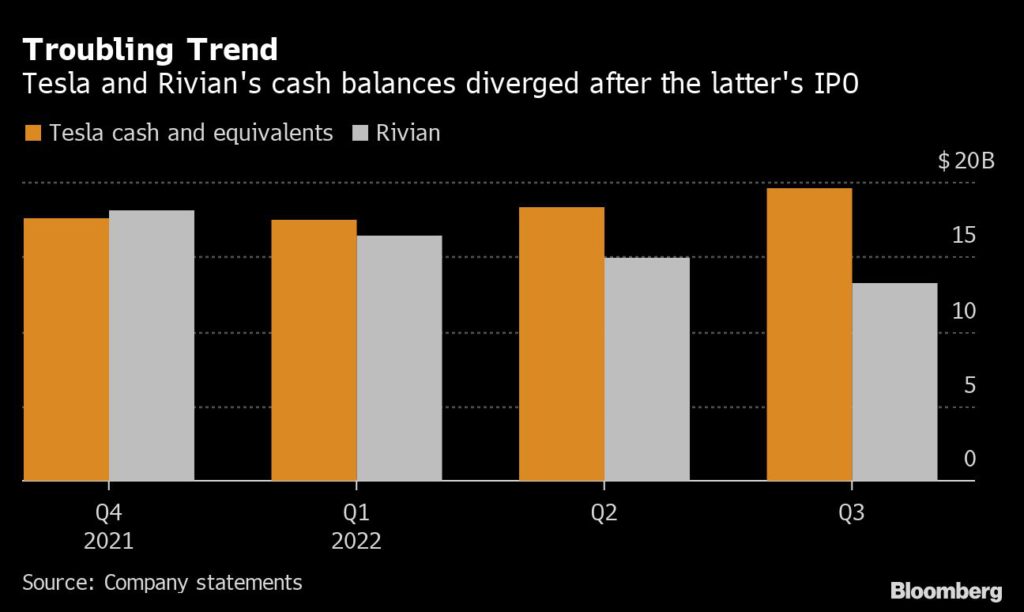
Rivian went public just over a year ago with big plans to take on Tesla and more cash to work with than Elon Musk’s car company.

The fact that the former already has gone through about a quarter of the money it debuted with helps explain why the company abruptly called off plans for a joint venture with Mercedes-Benz announced only three months ago.

Rivian has its hands full trying to make R1T pickups and R1S sport utility vehicles for consumers, plus electric delivery vans for Amazon. It’s burning through about $1.5 billion a quarter by operating its lone assembly plant in Illinois at roughly half capacity, yet plans to spend $5 billion on a new factory near Atlanta. CEO RJ Scaringe apparently concluded that, in partnering with Mercedes to jointly produce electric vans in Europe, Rivian would be biting off more than it can chew.

“As we evaluate growth opportunities, we pursue the best risk-adjusted returns on our capital investments,” Scaringe said Monday. “At this point in time, we believe focusing on our consumer business, as well as our existing commercial business, represent the most attractive near-term opportunities to maximize value for Rivian.”

The comments contrast with how Rivian pitched itself as it was going public. The company told investors it planned to enter Western Europe “in the near term,” followed by markets in Asia, and would localize production and supply chains in those regions.

A lot has changed since then. The capital markets that were wide open to EV makers — via a blockbuster IPO in Rivian’s case, or deals with special purpose acquisition companies for the likes of Lucid and Fisker — are now much less welcoming. When Rivian announced in October that it was dismissing 6% of its employees, Scaringe cited the need “to continue to grow and scale without additional financing in this macro environment.”

Rivian ended last year with around $18.4 billion in cash and equivalents. That’s dropped to $13.3 billion at the end of the third quarter. The company never disclosed how much it might invest in the Mercedes partnership, and the German company didn’t release details Monday on how much it will spend to expand its engine and battery plant in Poland to produce medium and large vans that will hit the market in 2025.

Analysts at Robert W. Baird praised Rivian’s decision to shelve the project with Mercedes, writing in a note that management was “keeping both eyes on the ball.”

For its jilted German partner, Rivian’s about-face was an unwelcome surprise. Mercedes saw teaming with the startup as a chance to share tech and investment as it electrifies its van lineup. While the company will still invest in making vans at its Polish plant, further expansion to make room for Rivian is now on hold.

“They will need to think about and might consider finding an industrial partner,” Bernstein analyst Daniel Roeska said of Mercedes.

Rivian’s cancellation of a preliminary agreement with Mercedes adds to setbacks for Europe’s auto sector, which has been struggling with tepid demand, surging energy costs and the generous incentives the US is now offering for battery production and electric vehicle purchases.

Volkswagen may abandon plans for a new €2 billion ($2.1 billion) EV factory in Germany, with new CEO Oliver Blume starting to rethink some of the costly projects announced by his predecessor, Herbert Diess. Battery maker Northvolt said last month it may delay building a factory in Germany, citing Europe’s steep energy bills and US President Joe Biden’s efforts to woo investment.

The allure of the Inflation Reduction Act might also be coming into play in Rivian’s case.

“We believe the IRA bill may be causing the company to re-evaluate the attractiveness of domestic manufacturing relative to commercial van production in Europe,” Joe Spak, an analyst at RBC Capital Markets, wrote in a report.

–With assistance from Edward Ludlow.

More stories like this are available on bloomberg.com

©2022 Bloomberg L.P.
Rogers’ $15 Billion Shaw Deal Crawls Toward the Finish Line

(Bloomberg) — A court case over one of Canada’s biggest-ever takeovers is near its end, after weeks of testimony that came to focus on a single question: Is Shaw Communications Inc. a great company or a broken one? 

The nation’s antitrust watchdog is fighting to block Shaw’s sale to Rogers Communications Inc., arguing that to consumers, Shaw is an irreplaceable force for good — a “disruptive” and “maverick” firm that has helped drive down prices in a country known for expensive cell-phone bills. 

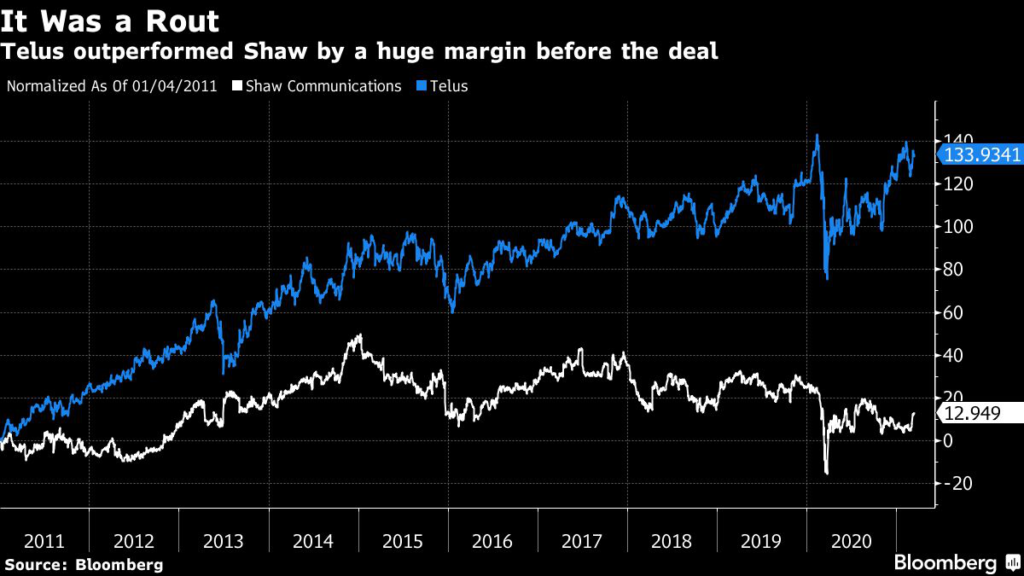
Shaw executives, one after another, testified that their company was, in fact, about to hit a wall. It’s been cornered by larger competitors and its share price had flatlined for eight years before the Rogers family offered a way out. On the witness stand, Shaw’s chief financial officer said bluntly: “We just didn’t see a viable path forward as a standalone company.”

The legal battle over the C$20 billion ($14.7 billion) deal will be settled within weeks, possibly days. Merger-arbitrage traders who’ve been watching the case for months may be in line for rich gains if the Competition Tribunal, Canada’s merger court, allows it to proceed. Shaw closed Monday almost 10% below the Rogers offer of C$40.50 per share; the discount has narrowed since the trial began, as it became apparent that lawyers for the companies were getting some traction. 

Power shift

At stake is a massive reshuffling of power within Canada’s communications industry. If the deal goes ahead, Toronto-based Rogers will assume control of one of largest networks providing home internet and cable television in the western provinces, becoming a national firm to rival the sector’s no. 1 player, BCE Inc. Most of Shaw’s wireless business would be sold off to Montreal-based Quebecor Inc., turning it into a fourth player to challenge Rogers, BCE and Telus Corp.

The parties are set to square off one more time for final arguments Tuesday and Wednesday. A ruling may come before Christmas, though that timeline is not guaranteed. 

“My base case is the deal will be approved. I think a closing before year-end is possible, but seems a bit aggressive to me,” Jerome Dubreuil, an analyst at Desjardins Securities, said by phone. 

The trial has drawn some of the biggest names in Canadian corporate law. Overseeing it is Chief Justice Paul Crampton, the top judge in the Federal Court of Canada and head of a three-person panel that has to decide whether the deal is so harmful to competition that it needs to be blocked. 

Many experts say legal precedent runs in Rogers and Shaw’s favor. 

The heart of the Competition Bureau’s case is that the deal represents such a dramatic, anti-competitive change that it warrants a rare court intervention to stop the deal. The billionaire Rogers and Shaw families are the beneficiaries, the antitrust body argued, at the expense of low-income earners who rely on affordable wireless services that Shaw’s Freedom Mobile division offers in three of Canada’s four largest provinces.  

The companies, on the other hand, have built a case that the merger is “pro-competitive.” If Shaw was failing — and the numbers say it has lost significant market share in Western Canada to its larger rival, Telus — then allowing the Shaw family to sell out to stronger players like Rogers and Quebecor will improve competition and choice. 

At times, the weekslong trial has descended into a university economics lecture, as expert witnesses fought about price elasticity, competitive effects, taxes and income distribution. “There’s a theater of math element here,” said Keldon Bester, a fellow at the Center for International Governance Innovation and a former special adviser to the Competition Bureau.

Read More: Rogers Lawyer Rips ‘Waste’ as Antitrust Czar Digs In for a Fight

“The general consensus among experts seems to be that the Competition Bureau is fighting a losing battle, but they’ve made good arguments,” said Ben Klass, an Ottawa-based researcher in telecommunications policy. “They’ve brought a substantial amount of evidence. They’ve levied substantial criticisms against the evidence brought by the companies. They didn’t just go in there with their pants around their ankles.”

Final hurdles

If the tribunal allows the merger to go ahead, the companies would need only need one final level of approval from Industry Minister Francois-Philippe Champagne, who appeared to signal support in October by publicly spelling out the conditions under which he would agree to allow Quebecor to buy up Shaw’s wireless licenses. 

Before it gets to that, however, there’s another possibility. The Competition Bureau, if it loses its case, could try to appeal, bringing another delay to a deal that was announced in March 2021.  

“We don’t think it serves the companies, the industry or consumers/businesses out west to have the CB potentially extend the regulatory review process further into the future,” National Bank of Canada analyst Adam Shine said in a note to clients. 

More stories like this are available on bloomberg.com

©2022 Bloomberg L.P.
Close Bitnami banner
Bitnami