

Bloomberg

Musk and Twitter CEO Seek to Reschedule Questioning on $44 Billion Buyout

(Bloomberg) — Elon Musk and Twitter Inc. Chief Executive Officer Parag Agrawal are seeking to reschedule their depositions in the company’s lawsuit over Musk’s $44 billion buyout, according to people familiar with the matter.

Musk and Agrawal were scheduled to sit down for questioning Monday. The billionaire’s deposition was supposed to start at 9:30 a.m. at a law office in Wilmington, Delaware, while Agrawal was due to appear at one in San Francisco, court filings show. 

Instead, Agrawal wants to reschedule his session for later this week, while Musk wants his to take place somewhere other than Delaware, according to the people, who asked not to be identified discussing a private subject. Depositions often are rescheduled for the convenience of the parties to a legal dispute and their lawyers.

A representative for Twitter declined to comment on the matter. A spokesman for Musk’s lawyers also declined to comment.

Read More: Elon Musk Will Sit for Deposition in Twitter Case

The lawsuit is set for a five-day trial starting Oct. 17. Delaware Chancery Judge Kathaleen St. J. McCormick must decide whether the world’s richest person had legitimate grounds for walking away from the $54.20-per-share deal. 

Each side has fired an intense volley of subpoeanas at the other to elicit testimony and other evidence about the number of bot and spam accounts on the social media platform, among other subjects. Musk claims Twitter deceived him about the quality of the platform’s user base, while the company alleges that is only a pretext for abandoning the deal.

McCormick will hold a hearing Tuesday on several fights over pretrial information exchanges, such as whether Bruce Falck, who oversaw product revenue at Twitter, must sit for a deposition. 

The case is Twitter v. Musk, 22-0613, Delaware Chancery Court (Wilmington).

Read More

  • Musk Can Use Twitter Whistle-Blower Payment in Buyout Fight 
  • Musk Gets Potential Boost From Twitter Whistle-Blower Claims 

More stories like this are available on bloomberg.com

©2022 Bloomberg L.P.

Stock Trade Ban for Congress Is Being Readied for Release in US House

(Bloomberg) — Senior House Democrats are poised to introduce long-promised legislation to restrict stock ownership and trading by members of Congress, senior government officials and Supreme Court justices.

The bill would apply to the spouses and dependent children of those officials, according to an outline sent to lawmaker offices last week by House Administration Chair Zoe Lofgren. The restrictions also cover “commodities, futures, cryptocurrency, and other similar investments,” according to the outline.

The legislation would require public officials to either divest current holdings or put them in a blind trust. Investments in mutual funds or other widely held investment funds and government bonds would be allowed. 

The bill may be released as soon as Monday, according to a person familiar with the matter. It hasn’t been scheduled for a vote, though House Majority Leader Steny Hoyer has said it’s possible it could come to the floor this week in the middle of an already jam-packed schedule before lawmakers go on break ahead of the November midterm election.

While conservative Republicans and progressive Democrats alike have been clamoring for restrictions on stock trades by members of Congress to avoid conflicts of interest, legislation has been hung up by questions about how broad to make the ban and whether to include family members. A group of senators is working on their own version of the legislation and there’s little chance of Congress taking any final action before the midterms.

“I believe that a meaningful and effective plan to combat financial conflicts of interest could help restore the public’s faith and trust that our public servants act in the public interest,” Lofgren, a California Democrat, wrote in the notice to lawmakers, which was obtained by Bloomberg.

The current law doesn’t prohibit lawmakers from owning or trading individual securities, but it bans members of Congress from using nonpublic information available to them for personal benefit. It requires any transaction be disclosed within 45 days.

A New York Times analysis of disclosure forms published earlier this month found that from 2019 to 2021 almost 100 senators or representatives reported that they or an immediate family member traded a stock or other financial assets that had some overlap with issues before congressional committees on which they served.

Lofgren’s framework also would tighten disclosure requirements and increase penalties for violations.

One of the key points of debate has been whether to include family members in any ban on trading. House Speaker Nancy Pelosi’s husband, Paul Pelosi, made his fortune in real estate and venture capital and frequently draws attention for his stock trades. Pelosi in February gave her support to banning lawmakers from trading equities, a reversal of her earlier stance on the subject.

Another potential point of contention is applying the requirements to the Supreme Court. The Congressional Research Service in an April report said that Congress imposing a code of conduct on the judiciary would “raise an array of legal questions,” including whether it would violate the constitutional separation of powers.

Justices and lower court judges already file annual financial disclosures and are barred from participating in cases where there’s a direct conflict of interest. Despite that, the CRS report says that the Supreme Court has never directly addressed “whether Congress may subject Supreme Court Justices to financial reporting requirements or limitations upon the receipt of gifts.”

More stories like this are available on bloomberg.com

©2022 Bloomberg L.P.
Scotiabank’s CEO Pick Spurs Debate Over Whether Changes Loom

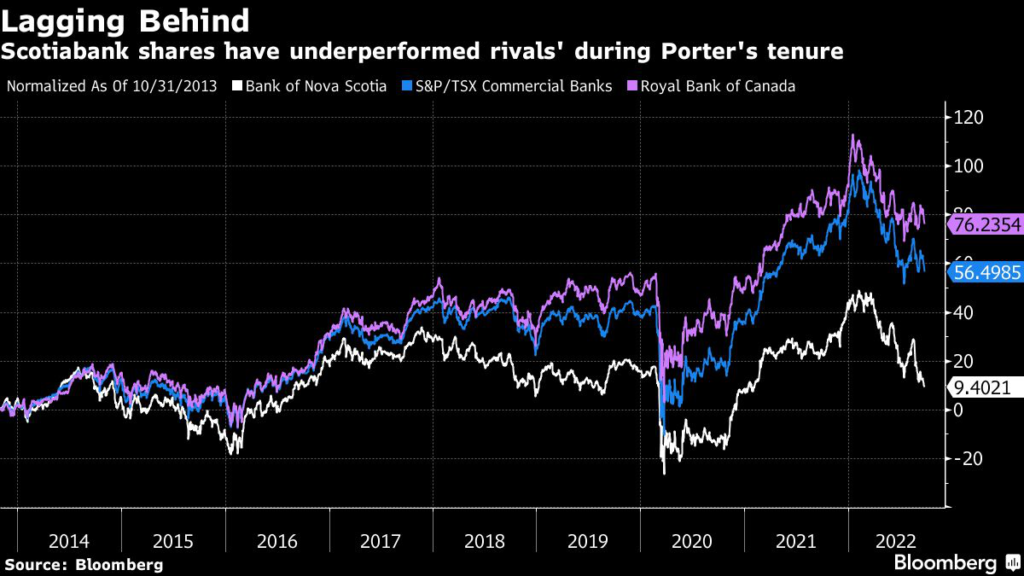
(Bloomberg) — Bank of Nova Scotia’s surprise pick of a CEO from outside its executive ranks is sparking a debate over whether major changes will result at Canada’s third-largest lender, whose shares have underperformed those of rivals for a decade.

Scotiabank said on Monday that its next chief executive officer will be Scott Thomson, head of Finning International Inc., a Vancouver-based company that sells, finances and services Caterpillar Inc. equipment. 

While Thomson isn’t a total stranger to the bank or its industry — he spent time as a vice president at Goldman Sachs Group Inc. and has been on Scotiabank’s board since 2016 — his selection for the top job is a rarity among Canadian lenders, who typically groom executives internally for decades before handing them the reins. The current heads of Canada’s five other largest banks had spent much of their careers at their firms before taking the helm.

That unconventional pick has analysts questioning whether Thomson’s ascension portends a broad shakeup at Scotiabank. The lender’s presence in Latin America sets Scotiabank apart from its Canadian peers, but is often blamed for its shares’ underperformance.

“We have to assume that change will be coming,” Paul Holden, an analyst at Canadian Imperial Bank of Commerce, said in a note to clients. “Thomson was an agent for change when he joined Finning as CEO, and we assume the same will be true when he becomes Scotia’s CEO.”

Thomson, 52, will step down from Finning on Nov. 15, become Scotiabank’s president on Dec. 1 and take over as CEO on Feb. 1.

“It is not obvious what changes will be made,” Holden wrote, adding that because Thomson won’t become CEO for several months, there will be “some uncertainty in the near term.” 

That potential uncertainty is weighing on Scotiabank’s shares, which were down 2.9% as of 2:24 p.m. in Toronto, the worst performance in the eight-company S&P/TSX Commercial Banks Index. Over the past decade, Scotiabank is up 24%, the smallest gain among Canada’s six largest banks.

Thomson’s career has run the gamut of important-to-Canada industries, including executive positions with BCE Inc.’s Bell Canada, one of the country’s big telecommunications firms, and a stint as chief financial officer of oil-and-gas producer Talisman Energy Inc.

He became CEO of Finning, which services the country’s sizable mining industry, in 2013, and was credited with improving earnings by cutting costs, speeding up the supply chain and improving the company’s technology. Finning generates almost a third of its revenue in South America, while Scotiabank reaps about 20% of its earnings from its Latin America-focused international division.

That familiarity with one of Scotiabank’s key markets suggests that the transition from current CEO Brian Porter, 64, will be smooth, according to Barclays Plc analyst John Aiken said. Revamping Scotiabank’s Latin America unit was a centerpiece of Porter’s tenure as CEO and it’s a division he has repeatedly said the bank is committed to.

“The move leads us to believe that there should not be an immediate shift in Scotia’s strategy as Mr. Thomson has been involved in developing it at the board level,” Aiken said in a note to clients. “Further, we believe that his experience in Latin America is a positive and was likely a component that attracted the search committee.”

There’s also a possibility that Scotiabank was looking for someone in the middle — an executive who combines familiarity and a fresh perspective, said Anish Chopra, a partner at Toronto-based Portfolio Management Corp. While Thomson’s presence on the board gives him some experience with Scotiabank’s issues, he hasn’t previously run a financial institution, Chopra said in an interview with BNN Bloomberg Television. 

“The Bank of Nova Scotia may have wanted an outside view of their operations,” Chopra said. “And when you’re looking for an outside view, you need to go to an outsider who’s got some level of knowledge and interest in the bank.”

(Updates with share performance in first, fourth paragraphs, stock price in eighth.)

More stories like this are available on bloomberg.com

©2022 Bloomberg L.P.
US Stocks Fall, Yields Surge Amid UK Turmoil: Markets Wrap

(Bloomberg) — US stocks extended declines, cutting short a brief, cautious rebound led by technology shares earlier in the session, as hawkish central banks across the globe continued to subdue sentiment. The pound dropped after the Bank of England said it may not act before November to stem a rout that took the sterling to a record low. 

The S&P 500 fell as much as 1.3% and the Nasdaq 100 dropped, after both equity gauges plunged last week. US Treasury yields continued to rise, with the 10-year rate near 3.90%, the highest since April 2010. The pound was near $1.07. The dollar climbed to yet another record high.

Markets are on the edge after a selloff of risk assets deepened last week as the UK’s plan to lift its economy fueled fears that heightened inflation would push rates higher and ignite a global recession. UK markets were in focus on Monday as the pound remained volatile after crashing to an all-time low, with the Bank of England’s comments doing little to reassure traders. 

Federal Reserve officials also added to the hawkish rhetoric. On Monday, Boston Fed President Susan Collins said additional tightening is needed to rein in stubbornly high inflation and cautioned the process will require some job losses. Atlanta Fed President Raphael Bostic also said the central bank still has a ways to go to control inflation.

“On the macro front, it feels like a remake of West Side Story, with a gang of central bankers going after the job market, which refuses to let go,” said Mike Bailey, director of research at FBB Capital Partners. “Powell and now Andrew Bailey at the BOE are trying to slow the economy down, but my sense is employers are keeping as many workers as they can to avoid being left out in the cold when we recover from the next recession. So we almost have an arms race with central bankers raising rates and employers holding on to workers.”

US markets will continue to remain challenged by uncertainty until companies start to report their third-quarter earnings next month, which will provide greater detail on the health of corporate revenues and profit, wrote John Stoltzfus, chief investment strategist at Oppenheimer. Any company or industry that needs lower rates could be in trouble, FBB’s Bailey says. 

Investors will also be keeping an eye on the economic data stream for hints of prices cooling, Art Hogan, chief market strategist at B. Riley, wrote in a note. 

“What the market will need to see now to get out of the current conundrum is for inflation inputs to start coming down noticeably,” said Hogan. “We will get a read on the Fed’s preferred inflation indicator this Thursday when the second quarter core PCE is reported. Along with that investors will keep a close eye on the economic data stream for hints of prices paid coming down.”

Trading this week will be punctuated by a number of economic reports including US initial jobless claims and gross-domestic-product data, along with PMI figures from China. Choppiness in price moves is likely with a steady stream of Federal Reserve officials speaking through the week.

UK Gilts

The plunge in UK gilts sent 10-year yields above 4% for the first time since 2010. Traders ramped up wagers on the scale of interest-rate hikes in the short term, with money markets pricing in more than 200 basis points of increases by the central bank’s next meeting in November. 

Meanwhile, Christine Lagarde said the European Central Bank will consider shrinking its balance sheet only once it has completed the “normalization” of interest rates. Raising borrowing costs is the most appropriate and effective tool for now to combat record-high euro-area inflation, the ECB President said on Monday. 

Geopolitical risks from the war in Ukraine to escalating tensions over Taiwan and unrest in Iran also continue to weigh on market sentiment. The OECD cut almost all growth forecasts for the Group of 20 next year while anticipating further interest-rate hikes. And a gauge of German business confidence deteriorated. 

Key events this week:

  • Fed official Loretta Mester speak at events, Monday
  • China industrial profits, Tuesday
  • US new home sales, Conference Board consumer confidence, durable goods, Tuesday
  • Fed Chair Jerome Powell and Charles Evans speak at events, Tuesday
  • Fed’s Mary Daly, Rafael Bostic, Charles Evans and ECB President Christine Lagarde speak at events, Wednesday
  • Euro zone economic confidence, consumer confidence, Germany CPI, Thursday
  • US initial jobless claims, GDP, Thursday
  • Fed’s Loretta Mester, Mary Daly speak at events, Thursday
  • China PMI, Friday
  • Euro zone CPI, unemployment, Friday
  • US consumer income , University of Michigan consumer sentiment, Friday
  • Fed’s Lael Brainard and John Williams speak, Friday

Some of the main moves in markets:

Stocks

  • The S&P 500 fell 1.3% as of 2 p.m. New York time
  • The Nasdaq 100 fell 0.7%
  • The Dow Jones Industrial Average fell 1.4%
  • The MSCI World index fell 2%

Currencies

  • The Bloomberg Dollar Spot Index rose 1.1%
  • The euro fell 0.9% to $0.9601
  • The British pound fell 1.7% to $1.0670
  • The Japanese yen fell 1% to 144.72 per dollar

Cryptocurrencies

  • Bitcoin rose 1.1% to $19,109.14
  • Ether rose 2.3% to $1,322.81

Bonds

  • The yield on 10-year Treasuries advanced 21 basis points to 3.89%
  • Germany’s 10-year yield advanced nine basis points to 2.11%
  • Britain’s 10-year yield advanced 42 basis points to 4.24%

Commodities

  • West Texas Intermediate crude fell 2.1% to $77.06 a barrel
  • Gold futures fell 1.4% to $1,631.80 an ounce

More stories like this are available on bloomberg.com

©2022 Bloomberg L.P.

Richemont’s Watchfinder Reports Customer Data Breach

(Bloomberg) — Watchfinder, the dealer in pre-owned luxury watches that’s owned by Richemont, said it suffered a data breach that may have disclosed customer information.

The UK-based company, which sells watches online and in retail outlets, “recently discovered unauthorised access to a user account belonging to one of our employees,” its chief executive officer, Arjen van de Vall, said in an email to clients and customers.

The Richemont unit is one of the biggest pre-owned watch dealers and competes against rival platforms like Watchbox and Chrono24. The popularity of buying and selling second-hand watches online surged during the pandemic as homebound consumers flush with cash discovered a new hobby. Prices for the most desirable Rolex, Audemars Piguet and Patek Philippe models soared before pulling back in April amid the selloff in equities and cryptocurrencies. 

The data breach “resulted in lists of our prospective customers being compromised,” van de Vall said in the email. The records may include email addresses, telephone numbers and any watches that customers and clients expressed an interest in, he said.

The data breach did not include postal addresses, passwords, credit card details or other banking information, the Watchfinder CEO said.

The company said customers should be alert to any “suspicious correspondence,” adding that Watchfinder has “informed the relevant authorities and are conducting a further review of our security measures and policies.”

More stories like this are available on bloomberg.com

©2022 Bloomberg L.P.

Stocks Fall; Pound Drops as BOE Fails to Reassure: Markets Wrap

(Bloomberg) — US stocks dropped, cutting short a cautious rebound led by technology shares, as hawkish central banks across the globe continued to subdue sentiment. The pound extended its drop after the Bank of England says it may not act before November to stem a rout that took the sterling to a record low. 

The S&P 500 fell and the Nasdaq 100 pared gains after both equity gauges plunged last week. US Treasury yields continued to rise, with the 10-year rate hovering around 3.77%. The pound was near $1.07. 

Markets are on the edge after a selloff of risk assets deepened last week as the UK’s plan to lift its economy fueled fears that heightened inflation would push rates higher and ignite a global recession. UK markets were in focus on Monday as the pound remained volatile after crashing to an all-time low, with the Bank of England’s hawkish comments doing little to reassure traders. 

“From a contrarian perspective, such widespread pessimism is creating buying opportunities,” Ed Yardeni, president of Yardeni Research, wrote in a note. “Admittedly, though, it is getting harder to be optimistic about the economy. It is also getting harder to be bullish on stocks when the Fed is turning more hawkish on monetary policy.”

On Monday, Federal Reserve Bank of Boston President Susan Collins said additional tightening is needed to rein in stubbornly high inflation and cautioned the process will require some job losses.

US markets will continue to remain challenged by uncertainty until companies start to report their third-quarter earnings next month, which will provide greater detail on the health of corporate revenues and profit, wrote John Stoltzfus, chief investment strategist at Oppenheimer. 

Investors will also be keeping an eye on the economic data stream for hints of prices cooling, Art Hogan, chief market strategist at B. Riley, wrote in a note. 

“What the market will need to see now to get out of the current conundrum is for inflation inputs to start coming down noticeably,” said Hogan. “We will get a read on the Fed’s preferred inflation indicator this Thursday when the second quarter core PCE is reported. Along with that investors will keep a close eye on the economic data stream for hints of prices paid coming down.”

Trading this week will be punctuated by a number of economic reports including US initial jobless claims and gross-domestic-product data, along with PMI figures from China. Choppiness in price moves is likely with a steady stream of Federal Reserve officials speaking through the week.

UK Gilts

The plunge in UK gilts sent 10-year yields above 4% for the first time since 2010. Traders ramped up wagers on the scale of interest-rate hikes in the short term, with money markets pricing in more than 200 basis points of increases by the central bank’s next meeting in November. 

Geopolitical risks from the war in Ukraine to escalating tensions over Taiwan and unrest in Iran also weighed on sentiment. Meanwhile, the OECD cut almost all growth forecasts for the Group of 20 next year while anticipating further interest-rate hikes. A gauge of German business confidence deteriorated. 

Key events this week:

  • Fed officials Raphael Bostic, Loretta Mester speak at events, Monday
  • ECB President Christine Lagarde at the European Parliament, Monday
  • China industrial profits, Tuesday
  • US new home sales, Conference Board consumer confidence, durable goods, Tuesday
  • Fed Chair Jerome Powell and Charles Evans speak at events, Tuesday
  • Fed’s Mary Daly, Rafael Bostic, Charles Evans and ECB President Christine Lagarde speak at events, Wednesday
  • Euro zone economic confidence, consumer confidence, Germany CPI, Thursday
  • US initial jobless claims, GDP, Thursday
  • Fed’s Loretta Mester, Mary Daly speak at events, Thursday
  • China PMI, Friday
  • Euro zone CPI, unemployment, Friday
  • US consumer income , University of Michigan consumer sentiment, Friday
  • Fed’s Lael Brainard and John Williams speak, Friday

Some of the main moves in markets:

Stocks

  • The S&P 500 fell 0.7% as of 11:45 a.m. New York time
  • The Nasdaq 100 fell 0.1%
  • The Dow Jones Industrial Average fell 0.8%
  • The Stoxx Europe 600 fell 0.4%
  • The MSCI World index fell 2%

Currencies

  • The Bloomberg Dollar Spot Index rose 1%
  • The euro fell 0.7% to $0.9615
  • The British pound fell 2% to $1.0646
  • The Japanese yen fell 0.8% to 144.49 per dollar

Cryptocurrencies

  • Bitcoin rose 0.5% to $19,001.47
  • Ether rose 1.8% to $1,316.27

Bonds

  • The yield on 10-year Treasuries advanced 10 basis points to 3.79%
  • Germany’s 10-year yield advanced seven basis points to 2.09%
  • Britain’s 10-year yield advanced 37 basis points to 4.20%

Commodities

  • West Texas Intermediate crude fell 0.6% to $78.25 a barrel
  • Gold futures fell 0.5% to $1,646.50 an ounce

More stories like this are available on bloomberg.com

©2022 Bloomberg L.P.

EasyJet Drops Carbon Offsets for Technology in Net-Zero Plan

(Bloomberg) — EasyJet Plc said it would drop carbon offsetting from the start of next year as it targets net zero carbon emissions by 2050, focusing instead on new technologies including an Airbus SE system that reduces fuel burn as aircraft land, and concluding a deal for the supply of sustainable aviation fuel.

The Luton, England-based carrier confirmed a goal of cutting emissions 35% by 2035 in a briefing Monday and said a roadmap including newer jets, operational efficiencies, airspace modernization and the increased use of SAF has been backed by the Science-Based Targets initiative.

The Airbus landing technology, to be retrofitted across EasyJet’s A320-series fleet by the end of 2023 at a cost of several million pounds, allows planes to cruise for longer at higher altitude before descending. Airbus says EasyJet’s annual fuel use will be cut by 98 metric tons per aircraft, or 1%, and carbon emissions by 88,600 tons.

Net zero will be achieved in 2050 through a 78% reduction in CO2 output and the deployment of carbon-removal technology to address residual emissions, EasyJet said.

New initiatives in what EasyJet says is the airline industry’s most ambitious decarbonization plan include a five-year agreement on the supply of SAF with Q8Aviation. It said collaboration with Rolls-Royce Holdings Plc on hydrogen propulsion is progressing well.

EasyJet’s roadmap includes:

  • Fleet renewal: 160 more efficient Airbus A320neo jets on order
  • Operational efficiencies including single engine taxiing and engine washing, as well as Airbus’s Descent Profile Optimisation system
  • Increased use of SAF in line with European Union-proposed mandates
  • Airspace modernization including a 10% CO2 reduction by 2035 through implementation of Single European Sky
  • Early adoption of zero carbon emission aircraft once viable
  • Carbon removal technology to tackle residual emissions

(Adds plan to drop carbon offsets from first paragraph)

More stories like this are available on bloomberg.com

©2022 Bloomberg L.P.

Volkswagen Warns of Production Shift From Germany Over Gas Shortage

(Bloomberg) — Volkswagen AG is exploring ways to help its broad supplier network in Europe counter a shortage in natural gas, including making more parts locally and shifting manufacturing capacity. 

Volkswagen, Europe’s biggest carmaker, said Thursday that relocation of production capacity for some component makers is among options in the medium term if gas shortages last much beyond this winter. Suppliers in central and eastern Europe are most reliant on Russia gas, while VW has major factories in Germany, Czech Republic and Slovakia as well as facilities in southern Europe.  

“As mid-term alternatives, we are focusing on greater localization, relocation of manufacturing capacity, or technical alternatives, similar to what is already common practice in the context of challenges related to semiconductor shortages and other recent supply chain disruptions,” Geng Wu, Volkswagen’s head of purchasing, said in a statement. 

Russia’s decision to throttle gas supplies to Europe has raised concerns that Germany might be forced to ration its fuel. Recent news that gas storage levels hit 90% ahead of schedule has soothed fears of acute shortages this winter, but Germany faces a challenge in replenishing depleted reserves next summer without contributions from Russia. 

Southwestern Europe or coastal zones of northern Europe, both of which have better access to seaborne liquefied natural gas cargoes, could be the beneficiaries of any production shift, a Volkswagen spokesman said by phone. Suppliers relocating to those areas would gravitate toward existing Volkswagen group car factories in Portugal, Spain and Belgium.

Labor Hurdles

VW’s comments echo concerns among other carmakers about the ability of their suppliers to keep making parts as energy prices surge. Mercedes-Benz AG said it has been working to identify Germany-based suppliers that would be at risk in a gas-rationing scenario and is in talks with them about shifting production to locations outside of Germany. 

“Politicians must also curb the currently uncontrolled explosion in gas and electricity prices,” said Thomas Steg, the company’s head of external relations. “Otherwise small and medium-sized energy-intensive companies in particular will have major problems in the supply chain and will have to reduce or stop production.”

READ: Covestro CEO: Investments in Europe Unlikely Due to Energy Costs

While gas supplies for VW’s plants are currently secured, the company has identified potential savings at its European sites to cut gas consumption by a “mid-double-digit percentage,” said Michael Heinemann, managing director of VW’s power-plant unit.

(Corrects story from Sept. 23 to say that VW is weighing options to help suppliers affected by Europe’s energy crisis. A previous version said VW was exploring reallocation of vehicle production within its European network.)

More stories like this are available on bloomberg.com

©2022 Bloomberg L.P.

EV Startup Faraday Overhauls Board to Resolve Investor Fight

(Bloomberg) — Faraday Future Intelligent Electric Inc. will overhaul its board under an agreement with a large shareholder group, sending shares soaring as it ends a highly contentious battle that had brought litigation and allegations of death threats.

Susan Swenson, the electric-vehicle maker’s executive chair, will step down from all non-director positions and board committees when Faraday receives $13.5 million in funding, according to a regulatory filing Monday. She and another director, Brian Krolicki, will resign from the board entirely after the company secures another $85 million of financing commitments and receives $35 million.

Faraday will also add a 10th seat to its board until its annual meeting, at which point the size will be reduced to seven members — with three of the new nominees selected by shareholder FF Top Holding LLC. As part of the agreement, which was reached Sept. 23, the investor group that collectively controls about 36% of shares will end its litigation against Faraday.

Its shares jumped 37% to $1.05 at 9:42 a.m. in New York. Faraday hasn’t announced a date for the annual meeting.

The shareholder group last week sued Faraday as part of its ongoing campaign to reshape the company and force Swenson and Krolicki off the board, saying in the lawsuit that the startup was “suffering from a crisis of leadership.” Faraday responded Sept. 22 with a statement detailing a “misinformation campaign” that had disrupted capital-raising efforts and claimed its leaders had received death threats.

Read more: EV Startup Faraday Cites Death Threats in Campaign Against Board

The automaker has said it believes FF Top and its parent are under the influence of co-founder Jia Yueting. He was sidelined in April after an internal probe led by Swenson concluded that managers misled investors on Jia’s day-to-day control and influence.

Faraday also announced Monday that it’s again pushing off the launch of its first electric vehicle until at least next year. The startup pledged when it went public in 2021 that it would begin production by July 2022, but has had to delay the debut because it needs more cash. As part of the plan to trim costs and conserve cash, it’s cutting staff and delaying payments. 

The Los Angeles-based startup has also faced a number of other obstacles, including the delayed the launch of its first electric SUV in July, and the resignation of its auditor. The SEC has opened a probe into Faraday’s financial statements.

(Updates with share trading beginning in first paragraph)

More stories like this are available on bloomberg.com

©2022 Bloomberg L.P.

Twitter CEO Agrawal Will Be Deposed Today in Musk Court Fight

(Bloomberg) — Twitter Inc. Chief Executive Officer Parag Agrawal is scheduled to answer questions from Elon Musk’s lawyers on the billionaire’s effort to pull the plug on his $44 billion purchase of the company.

The deposition will take place behind closed doors Monday at a law office in San Francisco starting at 9 a.m. local time, according to a court filing. “The deposition will be videotaped and will continue from day to day until completed,” according to the filing in Delaware Chancery Court.

Agrawal is being asked questions on the same day that Musk’s deposition is due to start. His deposition is being held in a law office in Wilmington, Delaware. A five-day trial on the case is scheduled to begin Oct. 17.

More stories like this are available on bloomberg.com

©2022 Bloomberg L.P.

Close Bitnami banner
Bitnami