
Bloomberg

Tesla’s Stock Emerges as Unlikely Megacap Rival to Apple

(Bloomberg) — In a year that has seen high-flying technology stocks with lofty valuations battered, Tesla Inc. shares have emerged as an unlikely rival to Apple Inc.

Of the five biggest US companies by market value, Tesla’s shares are by far the most expensive, yet they’re the only ones whose performance comes close to Apple’s, which has been a rare bright spot for investors in the sector this year. Tesla is down 22% this year while Apple has fallen 15%. By contrast, Microsoft Corp., Alphabet Inc. and Amazon.com Inc. have all declined 29% or more, roughly the same as the Nasdaq 100 Index.

On the surface, Tesla appears to be the polar opposite of Apple. The electric-vehicle maker is big on revenue growth but shorter on profits, and several years ago it was burning so much cash it was on the brink of bankruptcy. Apple’s expansion, by contrast, has slowed to a crawl, yet it has become a profit juggernaut with an expected $100 billion in net income this fiscal year.

“The correlation between the two is surprising, but when you consider that Tesla is the only game in town for electric vehicles, that makes it unique,” said Eric Clark, portfolio manager at Accuvest Global Advisors. “Other big tech names are in software or cloud, which are more competitive markets, and I think people underestimate the appeal of a pure play in a particular thematic.”

Apple and Tesla are similar in that they have huge market values — $2.4 trillion and $862 billion, respectively — which means they benefit from flows into funds that track major indexes. They’re also less tied to the business cycle than other tech-related stocks, according to Wiley Angell, chief market strategist at Ziegler Capital Management. 

“It means there’s a little less recession fear and a little less fear about what the Fed is doing,” said Angell, whose firm holds shares of both Apple and Tesla. “The electric-vehicle story is still in the early innings and Apple gets a huge amount of its revenue from subscriptions or a recurring base, which means it’s more stable.”

Those attributes — and the cult followings that their products enjoy — have made both stocks among the most popular for retail traders. Apple and Tesla were by far the most purchased stocks by mom-and-pop investors over the past five days, Vanda Research said on Sept. 21. 

Apple’s immense cash flows and commitment to return money to shareholders via dividends and buybacks have made it a favorite for investors seeking to play defense amid concerns that the Federal Reserve’s efforts to tame inflation will push the US economy into recession. Meanwhile, some of the volatility in Tesla this year is related to CEO Elon Musk’s decision to buy Twitter Inc., a deal he is trying to get out of.

Apple has been rewarded with a premium valuation relative to the Nasdaq 100 that sits well above the iPhone maker’s average over the past decade, according to data compiled by Bloomberg. Yet at 23 times profit projected over the next 12 months, it’s still less than half the price of Tesla. 

In a market where investors are avoiding risk, being relatively insulated from economic cycles thanks to a loyal customer base makes Apple and Tesla particularly attractive right now, according to Ziegler Capital’s Angell.

“The reason they’ve outperformed is the reason we want to continue to own them,” he said.


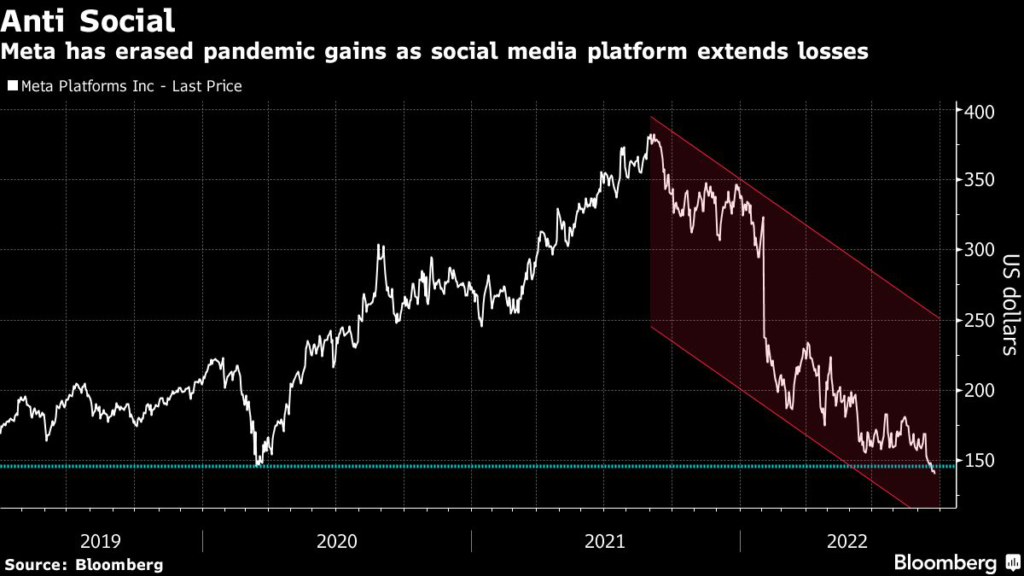
Tech Chart of the Day

The pain for investors in Facebook owner Meta Platforms is getting worse, with the social-media company erasing all of the gains made during the pandemic. Meta shares are down 58% this year, heading for only their second annual decline in its time as a public company, the other being a 26% drop in 2018. The company’s market value has shriveled by $558 billion since the beginning of the year. Shares of the social media giant were up 0.6% on Monday. 

Top Tech Stories

  • Apple Inc. began making its new iPhone 14 in India sooner than anticipated, after a surprisingly smooth production rollout that slashed the lag between Chinese and Indian output from months to mere weeks.
    • Chinese consumers bought fewer iPhone 14 handsets in the early days of its availability than the product’s predecessor a year ago, Jefferies said in a note on Monday.
  • ByteDance Ltd.’s TikTok faces a possible fine of 27 million pounds ($28.9 million) after the UK’s privacy watchdog found the company may have breached data protection rules by failing to sufficiently protect children’s data.
  • South Korea said Interpol requested law enforcement worldwide to locate and arrest Terraform Labs co-founder Do Kwon, who faces charges related to the $60 billion wipeout of cryptocurrencies he created.
  • Chinese electric-vehicle maker Zhejiang Leapmotor Technology Co. raised about HK$6.3 billion ($800 million) in its Hong Kong initial public offering, according to people familiar with the matter.
  • Binance, the world’s biggest cryptocurrency exchange, is seeking a license to operate in Japan, four years after retreating from the country as it didn’t have a permit, according to people familiar with the matter.

(Updates with market open.)

More stories like this are available on bloomberg.com

©2022 Bloomberg L.P.
BMW Expects EV Sales to Jump 70% Next Year on Strong Demand

(Bloomberg) — BMW AG expects global deliveries of its fully-electric vehicles to jump more than 70% next year as demand remains strong, the automaker’s chief financial officer said.

EV deliveries are expected to climb to 400,000 in 2023 from an expected 240,000 to 245,000 this year, CFO Nicolas Peter said Monday on a call with reporters.

Like other carmakers, BMW has had to contend with shortages of semiconductors and supply chain disruptions related to the pandemic that have slowed the production of EVs. 

Compared to last year, global sales this year will be slightly lower due to losses in the first half, according to Peter. Next year, however, the company aims to make “another big leap” in purely electric vehicles, he added. 

More stories like this are available on bloomberg.com

©2022 Bloomberg L.P.
Russian E-Commerce Platform Ozon to Buy Back Bonds at 35% Discount in Restructuring

(Bloomberg) — Ozon Holdings Plc, the Russian e-commerce platform, is offering to buy back its convertible dollar bonds at a 35% discount as part of a restructuring agreement forced by the halt of the trade of its stock from a US exchange. 

The firm’s $750 million of convertible bonds due in 2026 became repayable earlier this year after the trading of its shares on the Nasdaq was suspended after Russia’s invasion of Ukraine. Since then, it’s been negotiating with bondholders a solution, as the company had most of the funds stuck in Russia. 

On Friday, Ozon announced an agreement to pay 83% of the face value in rubles to those outside the US who choose the redemption in that currency, or 65% of face value in dollars for US bondholders or those who haven’t chosen the ruble option. The company intends to fund the deal with funds from its Russian subsidiaries and has secured the approval of the Russian government, according to the filing. 

The restructuring is conditioned on its being in compliance with sanctions imposed by the European Union, UK, US, as well as with Russian law and regulations. Houlihan Lokey EMEA, LLP is the financial adviser for an ad hoc group of bondholders, while law firm Cleary Gottlieb Steen & Hamilton LLP is advising the company. A vote will take place in late October to amend the terms of the notes.

Ozon was one of the three Russian technology firms forced to restructure their convertible bonds after their shares stopped trading in the US and Europe. Search engine Yandex NV agreed with bondholders in June on a buyback of its notes paid in cash and shares. Social media platform VK Co Ltd is still negotiating with bondholders. 

(Corrects to clarify in lede the shares were not delisted but the trading was halted.)

More stories like this are available on bloomberg.com

©2022 Bloomberg L.P.
Hurricane Ian Gains Strength as It Roars Toward Cuba and Florida

(Bloomberg) — Hurricane Ian is expected to build power as it nears western Cuba later Monday and menace Florida’s west coast, where a close call could be as bad as a direct hit. 

Ian was about 275 miles (442 kilometers) southeast of the western tip of Cuba, the US National Hurricane Center said in an advisory at 8 a.m. New York time. The storm had maximum sustained winds of 75 miles per hour and is expected to rapidly intensify as it moves north. A hurricane watch is in effect along Florida’s west coast, including Tampa Bay, and hurricane warnings have been issued for Grand Cayman and parts of Cuba. 

“Ian is forecast to become a major hurricane tonight when it is near western Cuba,” Brad Reinhart, a hurricane specialist at the center, wrote in his outlook.

Ian is the second destructive hurricane to rip across the Atlantic in less than a week, following Hurricane Fiona. Fiona struck Atlantic Canada over the weekend, causing extensive damage, power outages and flooding across Nova Scotia and Prince Edward Island.

Ian’s center is set to pass near the Cayman Islands Monday and then overnight near western Cuba, where the storm surge could raise water levels by as much as 14 feet (4 meters) above normal, the hurricane center said. Rains could produce flash flooding and mudslides in parts of Cuba.

Track Ian’s latest path

The hurricane will likely move west of the Florida Keys late Tuesday and approach the state’s west coast Wednesday. Some tornadoes are possible late Monday and Tuesday across the Florida Keys and into the southern part of the state. Heavy rain is expected to hit the north, including parts of the Florida Panhandle toward the weekend. 

“It is going to be a very dangerous storm,” said Paul Walker, a meteorologist with commercial forecaster AccuWeather Inc.

This will likely be the first major storm to hit the US this year. AccuWeather expects Ian will make landfall Friday on the Panhandle and ride up the western coast. Hurricanes spin counterclockwise in the Northern Hemisphere, so in Ian’s case its strongest side would be pointed directly at the Florida coastline.

The path of the storm could cause travel delays, with some airlines warning that flights could be canceled as the system moves across the Gulf of Mexico into the southern US.

Emergency Declaration

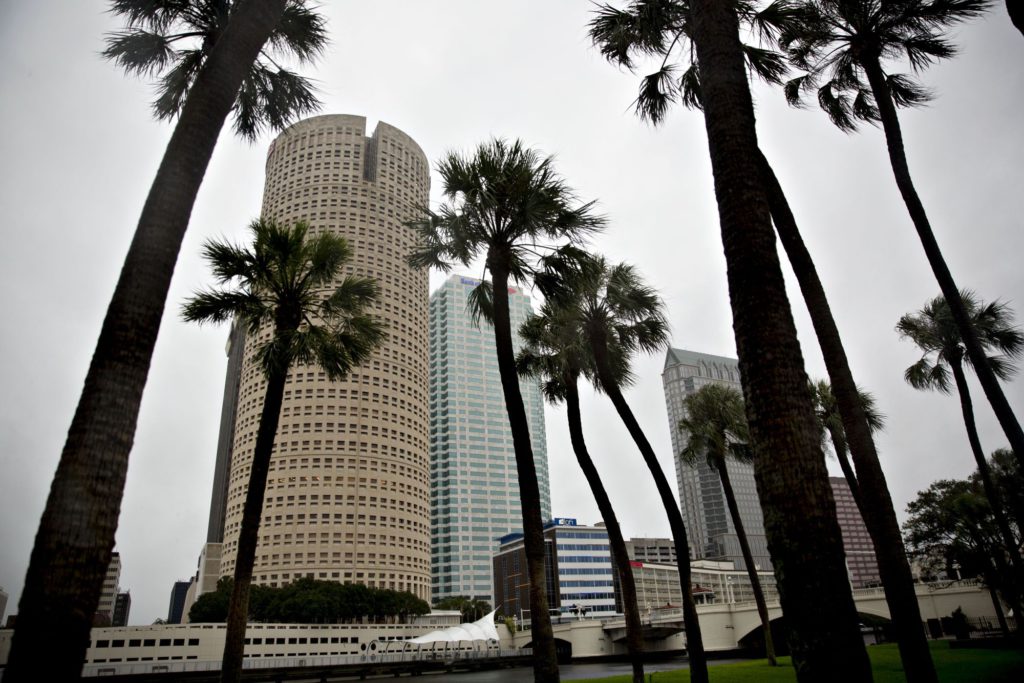
The storm could cause $25 billion to $50 billion in damage to the Tampa-St. Petersburg area, said Chuck Watson, a disaster modeler with Enki Research.

A near miss could be worse than a direct strike, Watson said. If the hurricane’s eye wall were to graze Tampa Bay it would send more storm surge into the waterway than if Ian came into the city directly. A near miss could cause water to rise by about 20 feet in the Tampa Bay, bringing widespread flooding and driving economic losses and damage higher.

President Joe Biden approved an emergency declaration for Florida on Saturday, freeing federal disaster aid to the state. He also postponed a scheduled trip on Tuesday to the state that included a Democratic National Committee rally in Orlando. Governor Ron DeSantis declared a state of emergency across Florida and warned residents to prepare.

Forecasters are also watching a second system that has a 70% chance of becoming the Atlantic’s next storm later Monday.

(Updates throughout with latest advisory)

More stories like this are available on bloomberg.com

©2022 Bloomberg L.P.

Walmart Is Making Its First Move Into the Metaverse With Virtual Worlds on Roblox 

(Bloomberg) — Walmart Inc. is making its first move into the metaverse. 

Starting Monday, the retailer will unveil two immersive experiences on Roblox Corp.’s virtual platform. Walmart Land will feature fashion, beauty and entertainment items, while Walmart’s Universe of Play will showcase toys, the company announced. 

Walmart follows companies from Nike Inc. to VF Corp. in a bid to get consumers’ attention via virtual universes, where elements of video conferencing, gaming, social media and e-commerce blend together. Roblox has a community of more than 52 million daily users, and many of them are younger people, who are particularly valuable targets for corporate powerhouses. 

See also: Walmart filings reveal plans to create cryptocurrency, NFTs

“This is the first major initiative that we have in the metaverse,” William White, Walmart’s chief marketing officer, said in an interview. “This is another step for us in reaching our customers in unexpected ways.”

Walmart Land will offer a virtual store where Roblox users can use badges and coins earned on the platform to buy merchandise for their avatars. There will also be a “physics-defying Ferris wheel” that provides a bird’s-eye view of the virtual world, plus unlockable tokens and badges that can be earned in games and competitions. 

Walmart Land will initially feature an experience similar to a music festival along with a fashion-oriented “House of Style” that includes a virtual dressing room and an oversized cosmetics obstacle course. In October, it will add a motion-capture concert with performances from singers such as Madison Beer and Kane Brown. 

Universe of Play is designed to let Roblox users explore toy worlds and earn coins for virtual goods. It will offer games featuring products and characters from Jurassic World, Paw Patrol and other entertainment brands. 

Since debuting last year, Nikeland has gotten about 21 million visits while VF’s Vans World has had around 81 million. White will be watching the results in Walmart’s virtual worlds as the company hones its strategy in the metaverse and tries to entice users to move beyond avatars and shop at Walmart’s stores and website. 

“It will be a great opportunity for us to build relevance, build cultural conversation, and to develop a community with Gen Z and our younger audiences,” he said. “All these things lend themselves to more brand equity.”

More stories like this are available on bloomberg.com

©2022 Bloomberg L.P.

Vietnam’s Tesla Hopeful Has Lofty Goals. Here’s an Inside Look

(Bloomberg) —

Vingroup just hosted Elite Vietnam Tour — a four-day, multicity extravaganza aimed at convincing attendees that the company’s electric car division, VinFast, can make good on its lofty goals.

Considering VinFast hadn’t made a car before 2017, it’s moving at light speed. Its factory in Haiphong, to Hanoi’s north, spans 9 million square feet. Another one costing $4 billion in phases is planned for North Carolina. Its goal is to make and sell around 1 million electric cars within five to six years, an extraordinary target considering the company produced about 35,000 last year.

VinFast isn’t just targeting domestic customers, either. It plans to sell EVs to customers in the US, Canada and Europe, going up against legacy automakers led by Toyota, Volkswagen and General Motors, as well as Tesla and the raft of aggressive Chinese upstarts such as Nio and Xpeng.

It’s a tall order for a company barely known outside Vietnam. But as the 180 or so assembled media, influencers, customers and business partners were often reminded last week, seeing is believing.

This much was clear from the immersive Vingroup experience: Founder and Chairman Pham Nhat Vuong, who didn’t make an appearance, has very deep pockets. The factory visit, which stretched for the better part of a morning and included an elaborate champagne and lobster lunch, was eye-opening. From the body shop to the press shop, to the battery pack facility and general assembly line, the cavernous complex was stocked with state-of-the-art German machines and gleaming robots. VinFast also makes its own chips and is starting to make its own EV batteries “just next door,” attendees were told.

Very little equipment was operating during the visit, however, and most places were devoid of workers, except a handful who looked as interested in the gawping guests being ferried around in golf carts as visitors were in them.

A spokesman said after the tour that VinFast had stopped making gasoline vehicles and only has one model in production for the time being, with a second on the way. Output is only running in range of tens of thousands, so lines are operating in moderation for the moment. The factory has been designed to eventually reach 250,000 units annually and will operate at high capacity when the VF 8 and VF 9 vehicles are ready to be sold in Vietnam and international markets.

The factory tours were strange for other reasons. As several seasoned trade journalists pointed out, it’s exceedingly rare for a collection of YouTubers, TikTokers and reporters to be given this level of access to something as proprietary as a cutting-edge car assembly plant. Once the golf carts stopped, guests were free to mill about, take pictures and wander around, passing under heavy-duty overhead conveyors and, at one stage, brushing off sparks flying out of a welding area.

There was always a ready reason for where everyone else was. Press shop workers were at lunch, despite it being 10 in the morning (that was also the case in July, when another batch of reporters were taken on a similar tour). General assembly line employees hadn’t started their shift yet. The machines were running slow or not at all so influencers could take video more easily.

The oddities only compounded as the days progressed. Guests were driven around in a convoy of buses to tour some of Vingroup’s sprawling real estate empire on the outskirts of Hanoi. Vinhomes Ocean Park 1 was all rice paddies three years ago. Now, there are man-made lakes, running tracks, high-rise condos, a shopping center and row upon row of French-influenced villas.

Outside the residential towers, though, the area is largely deserted. Weeds have taken over the gated front yards of the villas, windows are boarded up and the buildings have started to crumble. A spokesman said the company sold out all the houses that are part of the project, and that some customers are completing interiors of their properties. Others haven’t been able to complete construction because of the pandemic and have postponed their move-in.

Vinhomes Ocean Park 2, which will be even bigger, is already under construction a few kilometers down the road. There, a huge waterpark and wave pool has been built first, surrounded by cranes and dust. Lifeguards stood on duty even though not a single visitor was present. The park was very popular with Hanoi residents, attendees were told, just not on a weekday.

At VinUniversity, the library was devoid of books (most are electronic, visitors were told) and the campus was nearly devoid of students. Some were on autumn break, and others had compulsory military obligations, according to the company. Two young people introduced as students — one from Ukraine and another from New Zealand — were vague about what they were studying and didn’t have a convincing answer for why they’d come to a university that didn’t exist a few years ago. Both said separately their mothers had made the decision for them. A Vingroup ambulance also cruised by at convenient moments, offering tour guides a neat segue to talk about the company’s hospital business and VinUniversity’s medical degree.

Before tour participants departed — via chartered jets, Emirates business class or first class for those traveling onward from San Francisco — there was an opportunity while staying at the coastal Vinpearl Nha Trang resort to test-drive one of the company’s EVs. The VF 8, which starts from $42,000 with monthly battery subscription or $57,000 with battery included, is a good-looking SUV. It handles magnificently, is whisper quiet and boasts an impressive array of bells and whistles, including a touch-screen console, voice-activated features and stylish leather interior. The Netherlands embassy in Vietnam bought one in orange.

VinFast’s aggressive direct marketing approach may well work. Social media posts by folks flown in from Europe and the US will sway some consumers, and executives working on the VF 8 said US President Joe Biden’s tweet about the planned factory in North Carolina did wonders for the company’s profile in North America.

But whether VinFast can fulfil the 65,000 pre-orders it says it has globally — some of those buyers got the same tour to Vietnam, thrown in for free — and go on to sell 750,000 EVs annually by 2026 is unclear. It took Tesla 18 years to cross that threshold for the first time.

The notion that Vuong — Vietnam’s richest person, with a net worth of $5 billion — will easily manage to sidestep the production hell Elon Musk has referred to seems unlikely. Last week’s tightly choreographed tour was impressive, but more will need to be seen before believing what would be some astonishing feats.

More stories like this are available on bloomberg.com

©2022 Bloomberg L.P.

EU Countries Plan to Delay Russian Oil Price Cap Amid Divisions

(Bloomberg) — European Union nations are struggling to reach an accord on imposing a price cap on Russian oil and will likely push back a deal on the issue until after a broader sanctions package has been agreed. 

Cyprus and Hungary are among the countries that have expressed opposition to the oil cap proposal, according to people familiar with the ongoing talks. Sanctions in the EU require unanimity, giving each nation an effective veto.

The European Commission, the bloc’s executive arm, met with member states over the weekend to try to find a compromise on the package of restrictive measures, according to the people. Countries may push to have a preliminary deal ahead of an informal gathering of EU leaders in Prague on Oct. 6. 

The EU is scrambling to put tougher sanctions in place after Russian President Vladimir Putin announced a “partial mobilization” of troops last week and started holding UN-condemned “referendums” on annexation in areas of Ukraine it is still occupying. There have also been recent reports that Ukrainian forces had uncovered a mass grave in the city of Izyum, which had been controlled by Russia. Other measures being discussed include import controls on diamonds and banning certain steel products. 

Electronics Ban

Separately, the 27 member states were also closer to backing a proposal to restrict the export to Russia of electronic components used in weapons, said the people. 

Member states contend that further limiting access to the electronic components used in weapons against Ukraine is one of the most efficient tools to hit Russia’s military, particularly as Moscow needs more arms for the up to 300,000 additional soldiers it’s seeking to mobilize.

The EU push to impose a price cap on Russian oil would align the bloc with a US effort to keep the cost of crude from soaring and to eat into Moscow’s revenue from energy sales. The Group of Seven reached a political agreement on a cap earlier this month and the commission said it would work to implement the proposal. 

Many details still need to be ironed out, including at what price the allies would set the cap, the people said. Any measures would need to take effect before Dec. 5, when previously adopted EU measures take force that ban the import of seaborne oil as well as the services needed to ship it. 

European Solidarity

In June, the bloc’s 27 nations spent weeks haggling over the terms of the current oil measures, which include an embargo on Russian seaborne oil and petroleum products, an exemption on pipeline deliveries and a ban on providing services, such as insurance, to Russian oil shipments anywhere in the world. The US has been pushing to loosen those prohibitions over fears that they could lead to a spike in global oil prices. 

It remains unclear how effective a price-cap regime would be, particularly since some of Russia’s biggest buyers, including China and India, haven’t agreed to join. US officials have argued that the price cap could work even if many buyers don’t officially join the coalition, since they could still use the system for leverage in contract negotiations with Moscow to negotiate lower prices.

Adoption of the cap would also require member states to put national interests aside in favor of European solidarity. 

EU countries that won exemptions for oil received through their pipelines want to ensure that those remain intact, while nations that import via sea could seek to link the price cap to the currently envisioned full embargo on seaborne deliveries in order to level the playing field, one of the people said. Shipping nations, such as Greece, Cyprus and Malta, could also try to protect their respective industries from the measures, the person added. 

More stories like this are available on bloomberg.com

©2022 Bloomberg L.P.

Global Risk Assets Tumble as Pressure on UK Mounts: Markets Wrap

(Bloomberg) — Global risk assets extended their selloff on Monday as fears of faster inflation and global recession continued to rise. 

UK markets were in focus as the pound crashed to an all-time low and bond yields surged to the highest in more than a decade, sparking talk of emergency action by the Bank of England. The market mayhem unleashed by the government’s fiscal plan on Friday went into overdrive after the government pledged further tax cuts.  

An index of global stocks traded at the lowest since 2020, while US futures dropped on fears that Federal Reserve rate hikes to combat persistently elevated inflation will hurt the economy and a measure of volatility jumped. European equities extended declines after sliding into a bear market on Friday, with mining and energy stocks underperforming as metals and oil fell.

“We’re in a period of global gloom, with pessimism blanketing different countries for different reasons,” said Ed Yardeni, president of his eponymous research firm, who warned of growing storm clouds for the US economy. “The latest data jibe with our growth recession scenario, but the risks of a full-blown recession are obviously increasing,” he wrote in a note Monday.

Sterling dropped to as low as $1.0350, taking it closer to parity with the dollar, though it pared losses to about $1.08 after Sky News reported that the BOE is expected to make a statement. Britain’s central bank is watching the market closely and has yet to decide whether to comment, according to someone with knowledge of the situation. 

The plunge in UK gilts sent 10-year yields above 4% for the first time since 2010. Traders ramped up wagers on the scale of interest-rate hikes in the short term, with money markets pricing in more than 200 basis points of increases by the central bank’s next meeting in November. 

Currency traders are finding developed markets trickier to navigate than their emerging counterparts. The euro fell as investors weighed the prospects of Italy under the most right-wing government since World War II, though Giorgia Meloni struck a conciliatory tone after her election win. 

Geopolitical risks from the war in Ukraine to escalating tensions over Taiwan and unrest in Iran also weighed on sentiment. Meanwhile, the OECD cut almost all growth forecasts for the Group of 20 next year while anticipating further interest-rate hikes. A gauge of German business confidence deteriorated. 

Treasuries extended their worst bond slide in decades as a dollar gauge rose to yet another record. The currency’s rally is “untenable” for risk assets including stocks, and in the past this kind of dollar strength has led to some kind of financial or economic crisis, according to Morgan Stanley strategists led by Michael Wilson.

In Asia, the yen weakened through 144 to the greenback, while remaining short of the point last week that drew intervention from Japanese authorities. The yuan fell for a sixth day in the longest losing streak in three years, even as China said it would raise the risk-reserve requirement to increase the cost for shorting the currency. 

“It’s a king US dollar,” Sian Fenner, senior Asia economist for Oxford Economics, said on Bloomberg TV. “It’s adding to inflationary pressures and more central banks raising rates more than we have historically seen.”

Trading this week will be punctuated by a number of economic reports including US initial jobless claims and gross-domestic-product data, along with PMI figures from China. Choppiness in price moves is likely with a steady stream of Federal Reserve officials speaking through the week.


Key events this week:

  • Fed officials Susan Collins, Raphael Bostic, Loretta Mester speak at events, Monday
  • ECB President Christine Lagarde at the European Parliament, Monday
  • China industrial profits, Tuesday
  • US new home sales, Conference Board consumer confidence, durable goods, Tuesday
  • Fed Chair Jerome Powell and Charles Evans speak at events, Tuesday
  • Fed’s Mary Daly, Rafael Bostic, Charles Evans and ECB President Christine Lagarde speak at events, Wednesday
  • Euro zone economic confidence, consumer confidence, Germany CPI, Thursday
  • US initial jobless claims, GDP, Thursday
  • Fed’s Loretta Mester, Mary Daly speak at events, Thursday
  • China PMI, Friday
  • Euro zone CPI, unemployment, Friday
  • US consumer income , University of Michigan consumer sentiment, Friday
  • Fed’s Lael Brainard and John Williams speak, Friday

Some of the main moves in markets:

Stocks

  • Futures on the S&P 500 fell 0.5% as of 8:30 a.m. New York time
  • Futures on the Nasdaq 100 fell 0.4%
  • Futures on the Dow Jones Industrial Average fell 0.4%
  • The Stoxx Europe 600 fell 0.3%
  • The MSCI World index fell 2%

Currencies

  • The Bloomberg Dollar Spot Index rose 0.5%
  • The euro fell 0.3% to $0.9654
  • The British pound fell 0.5% to $1.0805
  • The Japanese yen fell 0.5% to 143.99 per dollar

Cryptocurrencies

  • Bitcoin rose 0.1% to $18,928.13
  • Ether rose 0.9% to $1,304.26

Bonds

  • The yield on 10-year Treasuries advanced seven basis points to 3.76%
  • Germany’s 10-year yield advanced eight basis points to 2.10%
  • Britain’s 10-year yield advanced 27 basis points to 4.10%

Commodities

  • West Texas Intermediate crude fell 1.1% to $77.89 a barrel
  • Gold futures fell 0.4% to $1,649.50 an ounce

More stories like this are available on bloomberg.com

©2022 Bloomberg L.P.
Tech Stocks Face Another 10% Drop or More as Strong Dollar Hits Profits

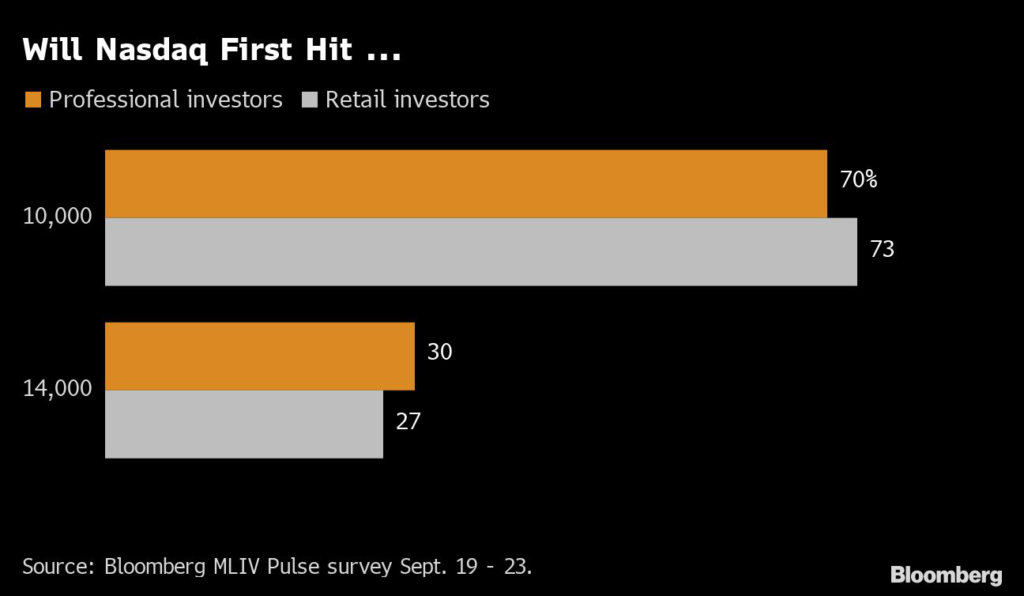
(Bloomberg) — The great tech selloff of 2022 is far from over as investors brace for earnings misses that may spur a more than 10% plunge in the Nasdaq 100.

More than two-thirds of 914 respondents in the MLIV Pulse survey think profits of the technology companies will disappoint the market throughout 2022. Firms including Alphabet Inc.’s Google are at risk of advertisers cutting spending as the global economy struggles, while streaming services including Netflix Inc. face an exodus of price-sensitive subscribers with consumers tightening their belts. 

The Nasdaq 100 is down about 31% so far this year, wiping trillions of dollars in market value, as investors reassess the post-pandemic value of many business models. Interest-rate hikes are hitting stocks and diminishing the value of their future earnings. Inflation is driving up costs, while a stronger dollar is weighing on profits and the threat of recession is growing. Retailers such as Amazon.com Inc. are finding some their direct responses to the Covid-19 pandemic — such as massive investments in warehouses and workers to pack products in them — are coming back to bite them. Futures on the Nasdaq 100 fell 0.5% in Monday trading as global risk assets extended their selloff.

Apple Inc. said it will raise the price of its App Store purchases across Asia and countries that use the euro, as the value of foreign currencies collapses relative to the dollar. Microsoft Corp. lowered its forecast because of the currency’s strength in June. And in July, Sony Group Corp. warned investors about the impact of the global economic slowdown, especially in Europe, and the adverse effects of the strong dollar on its financial results. The Bloomberg dollar index, which tracks greenback’s performance against 10 leading global currencies, has set new record since those announcements were made. 

Tech’s earnings are projected to lag the S&P 500 in the third and fourth quarters. Info tech’s earnings per share are estimated to fall 6.6% year-over-year in the third quarter, compared to a 3.2% gain for the overall S&P 500, according to Bloomberg Intelligence data. The Nasdaq 100’s 12-month forward EPS has dropped about 2.9% since June 1, compared to a 0.8% drop for the S&P 500. 

Meanwhile, retail and professional investors are also bearish on the metaverse. More than 70% of MLIV Pulse respondents said they knew what the metaverse was but that it won’t change the way they interact with people and businesses over the next two years. The sentiment sits awkwardly with how Mark Zuckerberg described the metaverse’s potential. It’s “the next frontier,” he said when the billionaire changed his company’s name from Facebook to Meta Platforms Inc.

His company said that investments in Reality Labs, the Meta division that makes hardware such as virtual-reality headsets, reduced operating profit by $10 billion in 2021. Computer-graphics chipmaker Nvidia Corp. wants its Omniverse platform to power some of the underlying framework for the metaverse, as does software-maker Unity Software Inc. Innumerable technology companies, both massive and minuscule, have big ambitions for the metaverse. Yet despite the grand promise from industry leaders, MLIV respondents are muted in their enthusiasm for its potential.

On the bright side, technology companies that focus on sustainable and power-efficient products are likely to benefit from the unprecedented energy crisis in the wake of Russia’s invasion of Ukraine. After Russia restricted natural gas supplies to heavily-reliant neighbors, electricity prices surged to record levels, and governments are fighting off a potential economic collapse.

Investors see high power bills and scarcity of fuels boosting the development of green solutions. Retail players were the most optimistic, with 63% of respondents saying they believed a gas-and-oil crisis would encourage the development of sustainable electronics. Sixty percent of professional respondents agreed.

“If we had invested more in energy efficiency, and invested more in renewable energy, then we would be in a better position,” Rachel Kyte, the dean of the Fletcher School at Tufts University, said in a Bloomberg TV interview.

“The nearly 5x surge in European gas prices over the past 12 months is providing a nice tailwind for clean energy equipment suppliers with companies like SolarEdge or Enphase on track to boost sales by more than 50% this year,” said Bloomberg Intelligence Senior Clean Energy Analyst Rob Barnett. 

Respondents are somewhat more sanguine when it comes to their positioning. About a third said they planned to increase their exposure to tech stocks, just under a third said they’d reduce it, and the rest said they’d hold steady over the next six months. Tech remains attractive on some metrics, such as the current price-to-earnings ratio compared to its 10-year average, while companies like Apple are still big cash generators. More generally, it’s hard to avoid tech — the S&P 500’s biggest sector by far at almost 27%.

To subscribe to MLIV Pulse stories, click here. For more markets analysis, see the MLIV blog.

(Updates with TV clip under the fifth paragraph.)

More stories like this are available on bloomberg.com

©2022 Bloomberg L.P.
Morgan Stanley Dealmaker Joins Tencent-Backed Airwallex, Sources Say

(Bloomberg) — Airwallex, a payment platform startup, is hiring Morgan Stanley’s head of Southeast Asia technology investment banking, according to people with knowledge of the matter.  

Justin Yek, an executive director who has been with the US firm for more than four years, will join the Tencent Holdings Ltd.-backed company, said the people, who asked not to be identified as the information is private. He will be based in Singapore, one of the people said. 

Yek’s departure comes amid Airwallex’s rapid fundraising over the past year and its expansion in the region after securing permits in Singapore and Malaysia. The firm is valued at $5.5 billion and also counts DST Global and Mastercard Inc. among its backers, according to its website. It is considering an initial public offering as soon as 2024, people with knowledge of the matter have said.

Before joining Morgan Stanley, Yek was a co-founder of Altitude Labs, an app design and development agency, according to his LinkedIn profile. He also previously worked at Citigroup Inc., the profile shows.

Separately, Yuen Dezhao, an executive director at Morgan Stanley focused on power, utilities and infrastructure deals in Asia, is joining private equity firm Actis LLP, according to people familiar with the matter. Based in Hong Kong, he spent more than 10 years at the bank, his LinkedIn profile shows. 

Representatives for Airwallex, Actis and Morgan Stanley declined to comment, while Yek and Yuen didn’t immediately respond to requests for comment.

(Updates with Actis hire in second last paragraph.)

More stories like this are available on bloomberg.com

©2022 Bloomberg L.P.

Close Bitnami banner
Bitnami
