Bloomberg

TikTok Faces Hefty Privacy Fine in UK Children’s Data Probe

(Bloomberg) — ByteDance Ltd.’s TikTok faces a possible fine of 27 million pounds ($28.9 million) after the UK’s privacy watchdog found the company may have breached data protection rules by failing to sufficiently protect children’s data. 

The Information Commissioner’s Office said Monday it issued TikTok with a notice of intent, laying out its plans for a potential fine and its findings. The authority’s provisional findings include that TikTok probably failed to get the necessary parental consent from minors that use its platform, and processed some data without legal grounds. 

“We will carefully consider any representations from TikTok before taking a final decision,” the ICO said in a statement.

TikTok has faced intense scrutiny in Europe over concerns that children’s data isn’t safe on the social media platform. A separate probe in Ireland, the EU base of TikTok, which is looking into alleged misuse of child data by the company, is also in the final stages.

“We all want children to be able to learn and experience the digital world, but with proper data privacy protections,” John Edwards, the Information Commissioner, said. 

A spokesperson for TikTok didn’t immediately respond to an email requesting comment.

More stories like this are available on bloomberg.com

©2022 Bloomberg L.P.

Hurricane Ian to Strengthen as It Churns Through Caribbean

(Bloomberg) — Storm Ian became a hurricane early Monday as it churned through the Caribbean, bringing the threat of flooding to parts of Cuba and tornadoes to southern Florida in the coming days.  

The hurricane was about 315 miles (507 kilometers) southeast of the western tip of Cuba, the US National Hurricane Center said in an advisory at 5 a.m. Eastern time. It had maximum sustained winds of 75 miles per hour. 

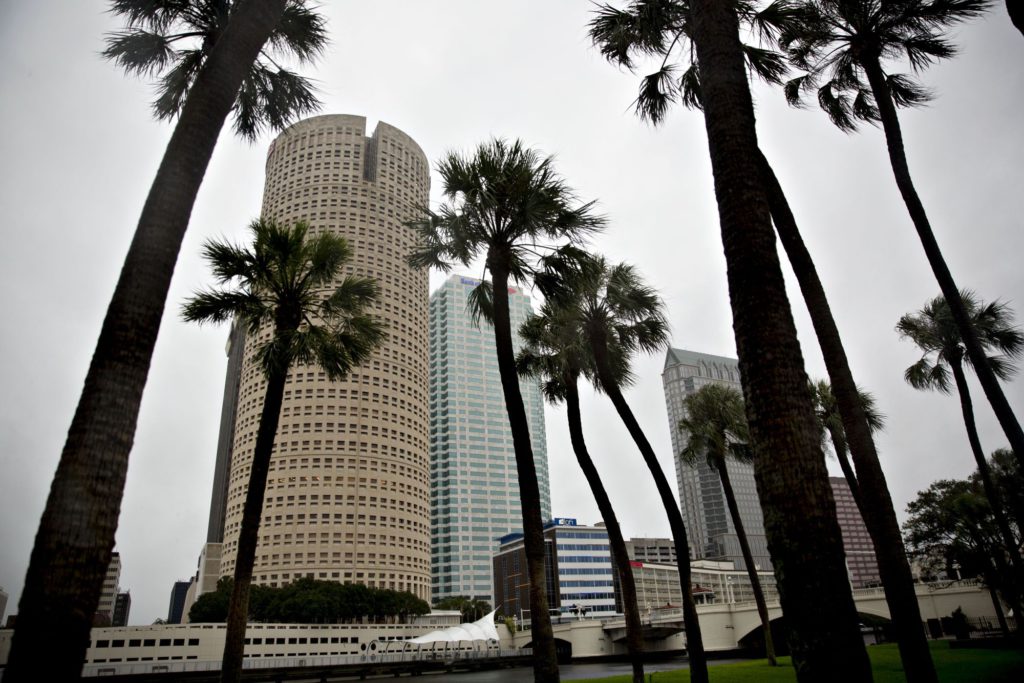
A hurricane watch is now in effect along the west coast of Florida, including Tampa Bay. Hurricane warnings are in effect for Grand Cayman and parts of Cuba.

Ian’s center is set to pass near the Cayman Islands on Monday and then overnight near western Cuba, where the storm surge could raise water levels by as much as 14 feet above normal, the NHC said. Rains could produce flash flooding and mudslides in parts of Cuba.

The hurricane will likely move west of the Florida Keys late Tuesday and approach the west coast of the state on Wednesday. Some tornadoes are possible late Monday and Tuesday across the Keys and into southern Florida. Heavy rain is expected to hit the north, including parts of the Panhandle, toward the weekend. 

The path of the storm could cause travel delays, with some airlines warning customers flights could be canceled as the system moves across the Gulf of Mexico into the southern US. A direct strike on Tampa from a major hurricane would push a wall of water into Tampa Bay, flooding the city and its suburbs and causing as much as $30 billion in losses and damage, said Chuck Watson, a disaster modeler with Enki Research. 

Track Ian’s latest path

President Joe Biden approved an emergency declaration for Florida on Saturday, freeing federal disaster aid to the state. He also postponed a trip to Florida scheduled for Tuesday that included a Democratic National Committee rally in Orlando. Governor Ron DeSantis declared a state of emergency across all of Florida and warned residents to prepare.

(Updates throughout with latest advisory.)

More stories like this are available on bloomberg.com

©2022 Bloomberg L.P.

Crypto Is Dueling With the Dollar to Be This Quarter’s Top Performer

(Bloomberg) — Wild gyrations in markets have left cryptocurrencies dueling with the dollar for the title of top-performing asset this quarter.

The MVIS CryptoCompare Digital Assets 100 Index has added 7.3% since the end of June, whereas stocks, bonds, commodities and gold suffered losses. The Bloomberg Dollar Spot Index is up by a similar magnitude over the period, reaching a record high.

The slide in conventional assets reflects the turmoil caused by a global wave of aggressive monetary tightening to fight inflation. More attractive interest rates and the need for a haven from the maelstrom have in turn buoyed the dollar.

Why volatile digital tokens have so far bucked the wider third-quarter selloff is an open question. One factor is a 27% jump in Ether on optimism about an energy-saving revamp of its Ethereum blockchain. 

Others speculate crypto may have hit its nadir in June after big blowups catalyzed by the $60 billion wipeout in the Terraform Labs ecosystem, which saw the TerraUSD stablecoin and linked token Luna unravel.

“This recent performance is perhaps an early indicator that we are past the contagious volatility following the Luna and crypto-lender collateral damage of the last quarter,” said Jonathon Miller, managing director for Kraken Australia.

Miller added that the Ethereum software upgrade, known as the Merge, also “moved the needle” on the attention falling on the crypto industry.

Bitcoin and Ether both advanced on Monday. Bitcoin gained about 2.1% to $19,300 at 10 a.m in London, mirroring gains in some European stock markets, even amid a mini-crash in the British pound.

It could be that crypto is merely delaying the inevitable — Bitcoin is only a 6% swoon away from breaching its June low of about $17,600 and many prognosticators reckon the chances of such a slide are high. 

“Bearish macro sentiment is dominating all risky assets,” said Cici Lu, chief executive officer of Venn Link Partners Pte. “We can see Bitcoin going much lower than $17,500.” 

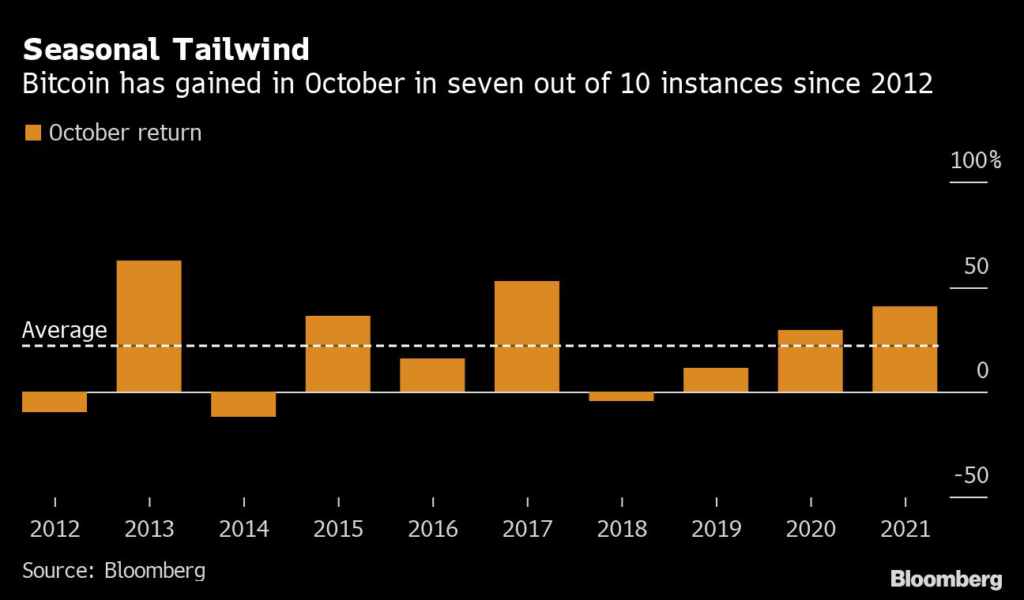
Those of a more optimistic bent can take succor from seasonal trends. Bitcoin has posted an average return of just over 22% in October over the past decade, the most after the month of November, according to data compiled by Bloomberg.

(Updates with Bitcoin trading higher in eighth paragraph.)

More stories like this are available on bloomberg.com

©2022 Bloomberg L.P.

The Inside Story on Crypto ETFs

  • Listen to Bloomberg Crypto on the iHeartRadio App
  • Listen to Bloomberg Crypto on Apple Podcasts
  • Listen to Bloomberg Crypto on Spotify  

(Bloomberg) — For investors trying to get exposure to crypto, there are many different options available these days. Crypto ETFs, or exchange-traded funds, are some of the most popular alternatives to owning tokens directly. 

What are crypto ETFs and how do they work? And what does it mean that many of the products pitched as ways to diversify your crypto portfolio are actually pretty similar to each other? Katie Greifeld joins this episode to tackle these questions

Follow us on Twitter @crypto, and subscribe to the Bloomberg Crypto Newsletter at https://bloom.bg/cryptonewsletter 

More stories like this are available on bloomberg.com

©2022 Bloomberg L.P.

Binance Seeks Permit to Return to Japan Market After 4 Years

(Bloomberg) — Binance, the world’s biggest cryptocurrency exchange, is seeking a license to operate in Japan, four years after retreating from the country as it didn’t have a permit, according to people familiar with the matter.

The nation’s easing approach to crypto and substantial potential for user growth are the key reasons for Binance’s renewed interest in the world’s third-largest economy, one of the people said.

Japanese Prime Minister Fumio Kishida’s agenda for reinvigorating the economy under the rubric of “New Capitalism” includes support the growth of so-called Web3 firms. The term “Web3” refers to a vision of a decentralized internet built around blockchains, crypto’s underlying technology.

“It would be inappropriate to comment on any conversations with regulators,” a Binance spokesperson said in response to request for comments. Binance is “committed to working with regulators and policymakers to shape policies that protect consumers, encourage innovation, and move our industry forward,” the spokesperson added. An official at the Financial Services Agency declined to comment.

Last month, Japan’s financial regulator proposed relaxing corporate tax rules for crypto assets. Lobbying groups have been calling for changes, saying high corporate taxes cause some firms to relocate to Singapore and elsewhere. 

Binance isn’t the only foreign firm looking to push into Japan’s cryptocurrency market. Temasek-backed Amber Group this year acquired DeCurret Inc., a crypto exchange that has operated in the country since 2018. 

Japan’s steps are somewhat of a contrast to the tougher regulatory oversight emerging in a range of countries after a $2 trillion wipeout in digital assets from last year’s peak led to blowups at crypto hedge funds and lenders.

Binance’s billionaire co-founder Changpeng “CZ” Zhao in 2018 ditched a plan to build a base in Japan, following inquiries from the securities regulator that led to an official notice to stop operating in the country without a license. It got a similar warning three years later for not complying with registration rules. 

In Asia, Binance is present in countries including Thailand, Malaysia, Indonesia and India through partnerships.  

Binance has been the target of regulatory probes in a variety of jurisdictions, including the US. In response, the firm has said it works with authorities and will continue to meet requirements set by officials.

(Updates with Amber acquisition in sixth paragraph.)

More stories like this are available on bloomberg.com

©2022 Bloomberg L.P.

Interpol Issues Red Notice for Terra’s Do Kwon, Korea Says

(Bloomberg) — South Korea said Interpol requested law enforcement worldwide to locate and arrest Terraform Labs co-founder Do Kwon, who faces charges related to the $60 billion wipeout of cryptocurrencies he created.

Prosecutors in Seoul said Monday in a text message that the international police organization has issued a Red Notice for Kwon, the latest inglorious chapter of a $2 trillion rout in digital assets that exposed hugely risky practices. Neither Interpol, Kwon nor Terraform Labs immediately replied to emails seeking comment.

South Korean officials have accused Kwon and five others of crimes including breaches of capital-markets law. Kwon earlier this year moved from South Korea to Singapore, where his now collapsed Terraform Labs project had a base, but his location became unclear after the city-state on Sept. 17 said he’s no longer there. Prosecutors subsequently stepped up their efforts to find him.

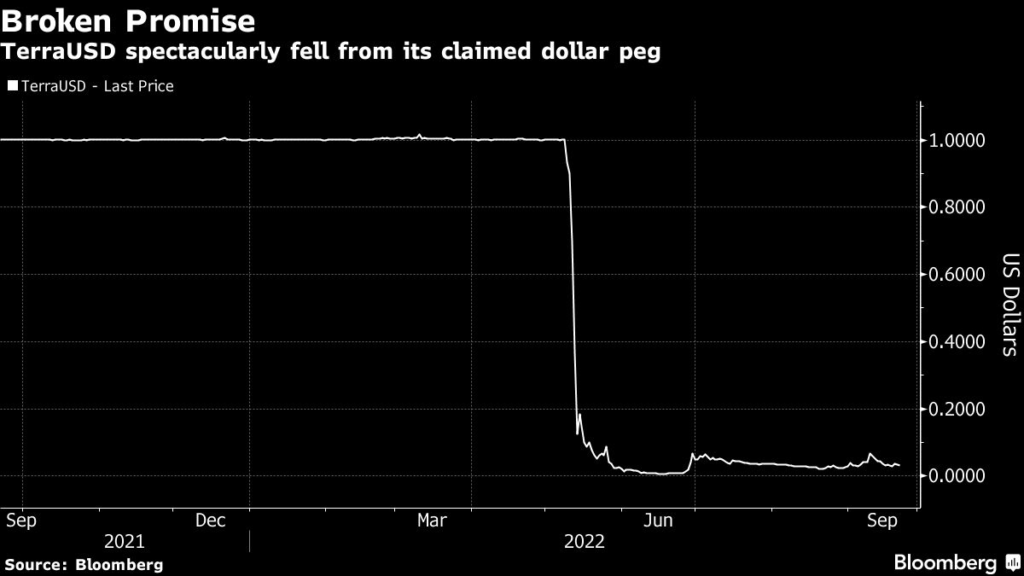
Terraform Labs was behind the TerraUSD algorithmic stablecoin and its sister token Luna. Both coins imploded in May and sparked huge losses in crypto markets, which were already reeling from tightening monetary policy. 

Digital assets have yet to recover and regulators globally are pouring over the wreckage to see how to avoid a repeat. In South Korea, earlier ardor for crypto is being usurped by growing disdain.

Terra’s collapse and the broader market rout led to the unraveling of Three Arrows Capital, a once high-flying crypto hedge fund. Contagion also buffeted lenders and brokers such as Voyager Digital Ltd. and Celsius Network Ltd. 

TerraUSD, also known as UST, was meant to keep a constant value of $1 in a complex arrangement involving Luna. But the system depended on confidence in the ecosystem created by Kwon, a 31-year-old who studied computer science at Stanford. Once the trust disappeared, the arrangement collapsed.

South Korean prosecutors have said they issued an arrest warrant for Kwon in part because there was “circumstantial evidence of escape” ever since he left for Singapore. They also took issue with his claim that he was cooperating.

“We are in the process of defending ourselves in multiple jurisdictions — we have held ourselves to an extremely high bar of integrity, and look forward to clarifying the truth over the next few months,” Kwon has previously said on Twitter.

The Terra community split after the collapse of TerraUSD. The original tokens were rebranded as Terra Luna Classic and TerraClassic USD.  Kwon, meanwhile, started a new Terra blockchain with a new Luna as its only token. 

The new Luna token is down 7% in the last 24 hours, data from CoinGecko show. Luna Classic shed almost 13%. TerraUSD never recovered its dollar peg but still trades on some venues and was nearly 10% lower.

(Updates the performance of Luna coins from the penultimate paragraph.)

More stories like this are available on bloomberg.com

©2022 Bloomberg L.P.

Apple Begins Making iPhone 14 in India Weeks Ahead of Schedule

(Bloomberg) — Apple Inc. began making its new iPhone 14 in India sooner than anticipated, after a surprisingly smooth production rollout that slashed the lag between Chinese and Indian output from months to mere weeks.

The US tech giant made the announcement on Monday, weeks after the marquee device’s Sept. 7 unveiling. It had worked with Foxconn Technology Group, its most important production partner, with the original goal of assembling iPhones in Chennai about two months after global launch, Bloomberg News reported in August.

The partners quickened the process after resolving supply chain issues, which helped production go smoother than expected, people familiar with the matter said, asking to remain anonymous discussing internal procedures.

Apple, which long made most of its iPhones in China, is seeking alternatives as Xi Jinping’s administration clashes with the US government and imposes lockdowns across the country that have disrupted economic activity. At the same time, Narendra Modi’s administration is keen to make the country into a viable competitor to China in technology and production capability, especially as Western investors and corporations begin to sour on Beijing’s track record.

“India is now an attractive location for manufacturing as it offers better labor cost structure while Apple is looking to reduce geopolitical risks,” said Jeff Pu, an analyst with Haitong International Securities. “To turn India into a major manufacturing site, Apple will help India accelerate its production timeline.”

Read more: Apple’s New IPhone to Show India Closing Tech Gap With China

“We’re excited to be manufacturing iPhone 14 in India,” Apple said in an emailed statement Monday without discussing production timelines. A Foxconn representative declined to comment.

Apple-partners such as Foxconn, which makes the majority of the world’s iPhones, typically begin assembling the device in India about six to nine months after Chinese factories. That’s partly because more time is needed to secure and ship critical components to a supply chain less accustomed to the process. 

Assembling iPhones often entails coordination between hundreds of suppliers and meeting Apple’s infamously tight deadlines and quality controls.

Still, analysts such as Ming-Chi Kuo of TF International Securities Group have said they anticipate Apple will eventually ship new iPhones from both countries at roughly the same time, a milestone in Apple’s efforts to diversify its supply chain and build redundancy.

Matching China’s pace of iPhone production would also mark a major achievement for India, which has been touting its attractiveness as an alternative at a time when rolling Covid lockdowns and US sanctions jeopardize the larger country’s position as factory to the world. Industry executives are exploring a so-called China-plus-one strategy of migrating some production to countries such as India or Vietnam.

Apple’s partners began making iPhones in India in 2017, the start of a yearslong effort to build manufacturing capabilities in the country. Besides offering backup to existing operations, the country of 1.4 billion is a promising consumer market and the Modi administration has offered financial incentives under its Make in India program.

“All major companies are now looking at India as part of their ‘China-plus one’ or ‘China-plus two’ strategy,” said Aruna Sundararajan, who served as a secretary to the federal government in 2017 when Apple first began assembling iPhones in India. “For the long run, we need to strengthen our logistics and infrastructure, boost the human capital and focus more on building an export hub to make India a viable alternative to China.”

More stories like this are available on bloomberg.com

©2022 Bloomberg L.P.

Dollar Rallies, Stocks Drop in Rocky Start to Week: Markets Wrap

(Bloomberg) — The dollar rallied, bond yields climbed and shares slid amid unrelenting pressure on risk-sensitive assets as fears of faster inflation and global recession continued to rise. 

The pound led declines among major currencies Monday, slumping as much as 4.7% to a record low as the UK vowed to press on with tax cuts that threaten to stoke inflation. The euro fell as investors weighed the prospects of Italy under the most right-wing government since World War II. 

Shares dropped in Japan, Australia and  Hong Kong while an index of global stocks traded near the lowest since 2020. US and European stock futures fell. Oil slumped on concern that demand will ebb as economies slow.

“We’re in a period of global gloom, with pessimism blanketing different countries for different reasons,” said Ed Yardeni, president of his eponymous research firm, who warned of growing storm clouds for the US economy. “The latest data jibe with our growth recession scenario, but the risks of a full-blown recession are obviously increasing,” he wrote in a note Monday.

A dollar gauge rose to a record high. The yen weakened through 144 to the greenback while remaining short of the point last week that drew intervention from Japanese authorities. 

The Korean won traded at the weakest level since 2009 as its depreciation continued, prompting the central bank to warn of its impact in exacerbating inflationary pressures. 

The yuan edged close to the weak end of its trading band even as China brought back a tool to make it more expensive to bet against the currency via onshore derivatives.

“It’s a king US dollar — we’ve been seeing currencies across Asia come under pressure,” Sian Fenner, senior Asia economist for Oxford Economics, said on Bloomberg TV. “It’s adding to inflationary pressures and more central banks raising rates more than we have historically seen.”

Treasuries sold off, extending the worst bond slide in decades, with the two-year yield rising 10 basis points to 4.30%. Australia’s sovereign debt dropped, led by the policy-sensitive three-year note. German bund futures declined.

The Bank of Japan boosted amounts at its regular bond-buying operation as the benchmark 10-year yield rebounded toward the upper end of the central bank’s tolerated trading range. 

Trading this week will be punctuated by a number of economic reports including US initial jobless claims and gross-domestic-product data, along with PMI figures from China. Choppiness in price moves is likely with a steady stream of Federal Reserve officials speaking through the week.

Underscoring the concern in markets, the Cboe Volatility Index, which serves as a “fear gauge” for Wall Street, jumped to a three-month high on Friday. Adding to the bleak outlook, Goldman Sachs Group Inc. slashed its target for US stocks at the end of last week, warning a dramatic upward shift in the outlook for rates will weigh on valuations.

Oil fell again as mounting recessionary concerns threatened global demand. West Texas Intermediate sank through $78 a barrel, adding to a 7% slump last week. Brent slipped below $85 a barrel for the first time since January. 

Gold plumbed its lowest since 2020 while copper and iron ore slumped. Bitcoin stayed below $19,000. 

Key events this week:

  • Fed officials Susan Collins, Raphael Bostic, Loretta Mester speak at events, Monday
  • ECB President Christine Lagarde at the European Parliament, Monday
  • China industrial profits, Tuesday
  • US new home sales, Conference Board consumer confidence, durable goods, Tuesday
  • Fed Chair Jerome Powell and Charles Evans speak at events, Tuesday
  • Fed’s Mary Daly, Rafael Bostic, Charles Evans and ECB President Christine Lagarde speak at events, Wednesday
  • Euro zone economic confidence, consumer confidence, Germany CPI, Thursday
  • US initial jobless claims, GDP, Thursday
  • Fed’s Loretta Mester, Mary Daly speak at events, Thursday
  • China PMI, Friday
  • Euro zone CPI, unemployment, Friday
  • US consumer income , University of Michigan consumer sentiment, Friday
  • Fed’s Lael Brainard and John Williams speak, Friday

Some of the main moves in markets:

Stocks

  • S&P 500 futures dropped 0.9% as of 7:22 a.m. in London. The S&P 500 fell 1.7% on Friday
  • Nasdaq 100 futures fell 0.9%. The Nasdaq 100 dropped 1.7%
  • Euro Stoxx 50 futures decreased 0.5%
  • The Topix index dropped 2.7%
  • Australia’s S&P/ASX 200 Index slipped 1.4%
  • South Korea’s Kospi declined 3%
  • The Hang Seng Index dropped 0.8%

Currencies

  • The Bloomberg Dollar Spot Index rose 0.6%
  • The euro dropped 0.4% to $0.9653
  • The yen slid 0.3% to 143.80 per dollar
  • The pound fell 2.1% to $1.0630
  • The offshore yuan weakened 0.4% to 7.1663 per dollar

Cryptocurrencies

  • Bitcoin fell 0.9% to $18,730.88
  • Ether slid 0.5% to $1,286.13

Bonds

  • The yield on 10-year Treasuries rose seven basis points to 3.76%
  • Australia’s 10-year yield increased five basis points to 3.96%

Commodities

  • West Texas Intermediate crude slipped 1.8% to $77.33 a barrel
  • Gold traded 0.3% lower at $1,639.20 an ounce

More stories like this are available on bloomberg.com

©2022 Bloomberg L.P.

New iPhone’s Initial China Sales Lag Predecessor, Jefferies Says

(Bloomberg) — Chinese consumers bought fewer iPhone 14 handsets in the early days of its availability than the product’s predecessor a year ago, Jefferies said in a note on Monday. 

Sales of Apple Inc.’s latest smartphone series in the first three days of delivery came to 987,000 units, 11% lower than comparable sales of the iPhone 13 family last year, analysts including Edison Lee wrote in the note. It’s a rare double-digit decline for the iPhone, whose sales had been the most resilient in a Chinese smartphone market that’s seen its domestic leaders slump all year.

“These initial data suggested iPhone 14’s sales may not be as strong as the pre-order levels indicated, since pre-order does not come with any payment obligations,” it said.

Smartphone shipments in China fell by almost a third to 19.1 million in July, national data showed earlier this month, adding to a year of dwindling sales in the world’s largest mobile market. The Chinese consumer economy has had a stuttering year affected by stringent Covid containment policies and weak economic performance.

Apple’s effort to diversify its supply chain got a boost Monday with the announcement that it’s begun assembling iPhone 14 devices in India. It’s the fastest turnaround yet from release to India manufacturing by the Cupertino, California-based company.

Read more: Apple Begins Making iPhone 14 in India Three Weeks After Launch

More stories like this are available on bloomberg.com

©2022 Bloomberg L.P.
Apple Begins Making iPhone 14 in India Three Weeks After Launch

(Bloomberg) — Apple Inc. has begun manufacturing its new iPhone 14 in India, narrowing a technology gap with the device’s main manufacturing base of China.

Apple made the announcement on Monday, less than three weeks after the iPhone 14’s unveiling. The company had worked with suppliers to ramp up manufacturing in India and shorten the lag with China in production from the typical six to nine months for previous launches, Bloomberg News reported in August.

“We’re excited to be manufacturing iPhone 14 in India,” Apple said in an emailed statement Monday, confirming the move.

Apple, which long made most of its iPhones in China, is seeking alternatives as Xi Jinping’s administration clashes with the US government and imposes lockdowns across the country that have disrupted economic activity.

Foxconn Technology Group, its primary manufacturer of iPhones, studied the process of shipping components from China and assembling the iPhone 14 at its plant outside the southern Indian city of Chennai, Bloomberg News has reported. That included looking at ways to maintain Apple’s high standards for confidentiality.

Read more: Apple’s New IPhone to Show India Closing Tech Gap With China

More stories like this are available on bloomberg.com

©2022 Bloomberg L.P.
Close Bitnami banner
Bitnami