Bloomberg

DoorDash Fails in Bid to Toss Lawsuit Over Speeding Driver

(Bloomberg) — DoorDash Inc. failed to persuade a judge to dismiss a lawsuit over the death of a Wisconsin man who was killed last year by a speeding delivery driver working for the company.

In a tentative ruling Friday, Superior Court Judge Richard Ulmer rejected the San Francisco-based company’s request to dismiss the wrongful death lawsuit, which Doordash said shouldn’t have been brought in California.

The suit was filed by the family of Ashley Taylor, 37, who died in April 2021 after he was struck by an SUV going 75 miles per hour in a 40-mph zone. The DoorDash driver behind the wheel was later charged with reckless homicide. DoorDash operates an app-based meal delivery business that, as its name suggests, counts on its “dasher” delivery people to be “speedy,” the judge noted.

“The loss of Mr. Taylor is a tragedy but it does not change the fact there is no evidence DoorDash was the cause of the accident and there is plenty of evidence other factors were,” the company said in an emailed statement. “This tentative ruling is not about the merits of the case; it is only about where the appropriate venue is. Even though we feel deeply for the family, we are compelled to vigorously defend ourselves in court.”

Taylor’s family sued the company in San Francisco, accusing it of “flooding the street” with drivers and distracting them with text messages while failing to ensure that they complied with speed and safety laws.

DoorDash said the suit should have been filed in Wisconsin, where the accident happened.

In a one-paragraph ruling, the judge rejected the company’s request, pointing out that the family’s suit was based on the DoorDash business model, making it convenient to conduct exchanges of information in the company’s hometown.

The case is Taylor v. DoorDash Inc., CGC22600500, California Superior Court (San Francisco).

(Updates with DoorDash comment in fourth paragraph.)

More stories like this are available on bloomberg.com

©2022 Bloomberg L.P.

China’s Digital Nomads Trade Mega-Cities for Backpacker Havens

(Bloomberg) — After a hard day’s work, programmer Richard Hao powers down his laptop in a cafe overlooking Dali’s picturesque lake and drinks in the view. Like a growing number of digital nomads in China, he’s turned his back on big-city living and moved to the tourist hub in Yunnan province, famed for its snowcapped mountains, ancient temples and pagodas. 

“I’m working on a normal job with relatively fixed hours,” said Hao, who’s employed by a technology firm in Shenzhen, a city of more than 17 million people about 1,800 kilometers (1,100 miles) to the southeast. “It’s just that I don’t have to go to an office and I have some flexibility to do my own thing.”

China is catching up with the global trend of tech-savvy workers choosing cheaper and prettier locations to base themselves — a lifestyle that’s gained traction since the Covid-19 pandemic prompted a rethink of work-life balance.

The backdrop to digital nomadism in China, however, is unique. It offers a middle path between two quite extreme attitudes to work — the “996” culture prevalent in some tech firms of toiling 9am to 9pm, 6 days a week, and the protest culture of doing as little work as possible, known as “tang ping” or lying flat.

Proponents like Daniel Ng, who runs a co-working space in Dali, believes a happy medium can help reduce a youth jobless rate that’s hovering around 20% as the economy slows. An influx of creative, entrepreneurial people that typically include livestreamers, vloggers, online teachers and tech support workers can also help local authorities revitalize towns depleted of tourists by the pandemic.

Read More: From the Great Resignation to Lying Flat, Workers Are Opting Out

But the future looks far from certain. As big tech firms such as Alibaba Group Holding Ltd. and Tencent Holdings Ltd. lay off thousands of staff, companies can be choosier about who they wish to keep and what perks they will offer. And then there’s government policies such as the household registration system that have limited mobility for some migrant workers.

Digital nomadism will take on a “bigger part of the future of work,” said Rachael Woldoff, a professor of sociology at West Virginia University and co-author of “Digital Nomads: In Search of Freedom, Community and Meaningful Work in the New Economy.” 

“What is less clear to us is whether Chinese work culture is ready to adapt to this and how much Chinese workers would want to engage in it,” she said.

Dali, a city of just over half a million, has long been known as a backpackers’ paradise, with a touristy Old Town where travelers can find cheap lodging, Western-style bars and southeast Asian cuisine. The area is famous for its natural beauty, with Erhai Lake to the east and the Cangshan Mountains to the west.

About a 10-minute walk from Old Town is Dali Hub, a three-story white stucco building located in a quiet street that literally translates as “reclusive immortals.” Like many co-working places, it has a cafe, desks and space for events. The building, which has a rooftop with mountain views, offers accommodation for nomads and serves as a haven for like-minded people who want to work on their own terms.

“People are really sick of the company culture in China like 996,” said co-founder Ng, who is originally from southeastern Fujian province and lived for several years in Malaysia.

“Because of Covid, everyone is struggling, stuck in the cities” and people need the freedom to choose where they work and live, said Ng. “If you work in a cube, you don’t really have that kind of creativity.”

While remote working has grown rapidly in countries such as the US, and seen nations including Argentina offer special visas to attract remote workers, it remains relatively unconventional in the world’s second-largest economy.

Gartner Inc. predicts 31% of the global workforce will be remote this year, either fully or partly working away from their employers. It says the US will lead with 53%, while 28% of workers in China will be remote.

There are several obstacles to being a digital nomad in China. Many workers still prefer the security of government employment, especially during times of economic distress. With an ongoing crackdown on private enterprise and the nation’s big tech companies, fresh college graduates are increasingly seeking jobs in the state sector despite the lower pay. 

There are practical considerations as well. While China’s household registration system, known as hukou, isn’t as much a restraint on mobility for nomads as it is for migrant workers, their itinerant status and self-employment could make it difficult to access the social welfare system that covers healthcare insurance and pensions.

Still, co-working ventures are emerging in regional areas, partly due to improved internet access. About 28% of China’s web users were living in rural regions as of June, according to the China Internet Network Information Center, a government-backed body that provides research on the sector.

In Anji, a town in eastern China’s Zhejiang province made famous by the bamboo forests featured in Ang Lee’s “Crouching Tiger, Hidden Dragon” film, a government-backed hub offers co-working spaces and creative labs for nomads willing to live in harmony with the local tea growers.

Jingdezhen, a city in China’s southeast Jiangxi province known for its porcelain making, also hosts a digital nomad hub. The local government there has worked with Tsinghua University’s institute for culture and creativity to develop village economies based on tourism. It’s part of a broader effort to make rural development a growth engine for the economy, in turn reducing the urban-rural divide and increasing self-reliance.

The remote working culture benefits “location-independent professionals” and also companies, which can save on office rents and the higher salaries demanded by employees in big cities, according to Olga Hannonen, a postdoctoral researcher at the University of Eastern Finland who studies the trend. 

It’s particularly well-suited to virtual influencers and livestreamers, she said. China’s livestreaming e-commerce market grew to 1.2 trillion yuan ($170 billion) in 2020, with influencers hawking wares from lipstick to smartphones in a Gen-Z version of the Home Shopping Network.

Back in Dali, the sense of community among the nomads is all important. A co-working venture called DAO Space that opened in August in an old bed-sheet factory charges customers just 480 yuan a month.

“Ideally we hope to build an self-sustained economy here,” said a former English tutor who identified himself as Glitch Boy, as he’s known in the local group of digital nomads. The space provides “an arena for people to exchange their resources and skills so that we can grow our little community.”

More stories like this are available on bloomberg.com

©2022 Bloomberg L.P.

Twitch Creator Chief Exits With Controversy Over Streamer Pay Swirling

(Bloomberg) — The senior vice president of global creators at Twitch told employees she is leaving the company on the same day it announced changes to how the video game streaming platform will pay top talent. 

In a letter to employees Wednesday obtained by Bloomberg, Constance Knight said she is embarking on a “new adventure that provides exciting growth opportunities for me both professionally and personally” that is also “in the creator space.” Knight previously held similar positions at Instagram and YouTube.

Knight resigned after Amazon.com Inc.-owned Twitch announced that it’s reducing the amount of money its biggest streamers can earn from subscriptions. Online celebrities, like Tyler “Ninja” Blevins, have been able to earn sometimes millions of dollars playing games and chatting with fans with an agreement that had offered them as much as 70% of revenue from fan’s subscriptions to their channels.

But in a move to boost profitability, Twitch President Dan Clancy said in a blog post that, starting next June, these top streamers will receive 70% of the revenue up to $100,000 earned, and then drop down to the standard 50/50 split. Bloomberg News reported on the planned changes to revenue sharing in April.

“We can’t run this service unless you make money,” Clancy said. “That’s not a drawback; it’s by design. This innate partnership is why we support all streamers’ careers and ambitions like they’re our own.” Clancy said the “vast majority” of Twitch streamers operate with the 50/50 revenue split. A lack of transparency and inconsistency in who gets what deals–and on what terms–prompted the need for a revamp of the policy, he said.

Twitch declined to comment on Knight’s resignation or sentiment at the company, and it isn’t clear if Knight’s departure is tied to the pay issue.

The changes have exacerbated concerns among current and former employees that Twitch and Clancy are falling out of touch with the content creators who draw, at any time, 2.5 million concurrent viewers to the platform. Although only a small number of livestreamers benefit from the premium subscription model that allowed them to earn more, Clancy noted that more than 22,000 streamers were hoping Twitch would opt to move them all to a 70/30 split. Twitch deviates from rivals in the industry, as YouTube Gaming skims 30% off its premium subscription product while other platforms like OnlyFans or Patreon take 20% or less.

Clancy said Twitch is expensive to run. Unlike TikTok and YouTube Gaming, Twitch broadcasts 2.5 million hours of live content every day, across the world. The technology, provided by Amazon Web Services, necessary to support long-form live video on this scale is costly, he said. Amazon acquired Twitch in 2014.

Twitch is focusing its efforts on incentivizing streamers to run ads, Bloomberg has reported–a strategy that can be lucrative, but also disruptive to the live experience.

Twitch lost both its chief content officer and chief operating officer earlier this year. Neither have been replaced. Remaining top Twitch executives, including Clancy and Emmett Shear, co-founder and chief executive officer, are more product-focused than creator-focused, people familiar with the matter said. A Silicon Valley fixture, Clancy has held top engineering positions at Nextdoor and Google. There are few voices representing Twitch’s community of creators at the executive table, according to two former managers. 

“Dan is the ultimate embodiment of a tenured business technology professional coming from a non-creator-first company trying to right-side a ship that seemed to be veering off into unprofitability,” said Zachary Diaz, Twitch’s former director of emerging content, who also spent eight months as TikTok’s US head for creator management for its Live platform. “He is this embodiment of ‘Creator sentiment is secondary to everything.’ There’s no leader to push back against that, so it’s now the direction of Twitch.”

Some employees shared their objections to the revenue sharing changes with colleagues, according to one former manager and a current employee who asked not to be named discussing private information. Twitch recently loosened its exclusivity agreements with top creators, generating concerns that some will feel less loyal to Amazon’s livestreaming platform.

(Updates with more on Twitch’s history in eighth paragraph.)

More stories like this are available on bloomberg.com

©2022 Bloomberg L.P.
Risk Assets Crushed With Few Signs Drama Is Over: Markets Wrap

(Bloomberg) — A selloff in the riskier corners of the market deepened as the UK’s plan to lift its economy fueled concerns about heightened inflation that could lead to higher rates, adding to fears of a global recession.

It was a sea of red across equity trading desks, with the S&P 500 briefly breaching its June closing trough — and failing to pierce its intraday low for the year. Chartists looking for signs of where the rout might ease had identified that as a potential area for support. Yet the lack of full-blown capitulation may be an indication the drawdown isn’t over. Goldman Sachs Group Inc. slashed its target for US stocks, warning that a dramatic upward shift in the outlook for rates will weigh on valuations.

As risk-off sentiment took hold, Wall Street’s “fear gauge” soared to a three-month high, with the Cboe Volatility Index momentarily topping 30. Throughout the year, the US equity benchmark has hit near-term lows when the VIX was above that level, according to DataTrek Research.

A surge in the greenback to a fresh record swept aside global currencies. The euro slid to its weakest since 2002, while sterling hit a 37-year low — with former US Treasury Secretary Lawrence Summers saying that “naive” UK policies may create the circumstances for the pound to sink past parity with the dollar. 

Treasury 10-year yields fell after earlier topping 3.8%. Meanwhile, two-year US rates climbed for 12 straight days — an up streak not seen since at least 1976. 

“It appears that traders and investors are going to throw in the towel on this week in what feels like ‘the sky is falling’ type of event,” said Kenny Polcari, chief strategist at SlateStone Wealth. “Once everyone stops saying that they ‘think a recession is coming’ and accepts the fact that it is here already – then the psyche will change.”

Liz Truss’s new UK government delivered the most sweeping tax cuts since 1972 at a time when the Bank of England is struggling to rein in inflation, which is running at almost five times its target. The plunge in gilts means that investors are now betting the central bank boosts its benchmark lending rate by a full point to 3.25% in November, which would be the sharpest increase since 1989.

Read: Powell Says Economy May Be Entering ‘New Normal’ After Pandemic

Amid heightened fears over a hard economic landing, commodities got hammered across the board. West Texas Intermediate settled below $79 a barrel for the first time since January, posting its longest stretch of weekly losses this year. Not even gold — a haven asset — was able to gain due to a surging dollar, and sank to the lowest level in two years.

The greenback’s strength has been unrelenting and will also exert a “meaningful drag” on corporate earnings — serving as a key headwind for stocks, said David Rosenberg, founder of his namesake research firm.

KKR & Co. sees potential trouble ahead, including a mild recession next year, with the Fed narrowly focused on driving up unemployment to tame inflation. The US labor shortage is so severe that it’s possible the Fed’s tightening doesn’t work, wrote Henry McVey, chief investment officer of the firm’s balance sheet.

“This is a more draconian outcome than corporate profits falling,” he noted, “because it will encourage the Fed to tighten even further.”

Investors are flocking to cash and shunning almost every other asset class as they turn the most pessimistic since the global financial crisis, according to Bank of America Corp. Investor sentiment is “unquestionably” the worst it’s been since the turmoil of 2008, strategists led by Michael Hartnett wrote in a note.

“It’s a realization that interest rates are going to continue to rise here and that that’s going to put pressure on earnings,” said Chris Gaffney, president of world markets at TIAA Bank. “Valuations are still a little high even though they’ve come down, interest rates still have a lot further to go up and what impact that will have on the global economy — are we headed for a sharper recession than the recession everybody expected? I think it’s a combination of all of that, it’s not good news.”

Extreme Pessimism

Stocks are indeed still far from being obvious bargains. At the low in June, the S&P 500 was trading at 18 times earnings, a multiple that surpassed trough valuations seen in all previous 11 bear cycles, data compiled by Bloomberg show. In other words, should equities recover from here, this bear-market bottom will have been the most expensive since the 1950s. 

Bleak sentiment is often considered a contrarian indicator for the US stock market, under the belief that extreme pessimism may signal brighter times ahead. But history suggests that equity losses may accelerate even further from here before the current bear market ends, according to Ned Davis Research.

In another threat to stocks, different iterations of the so-called Fed model, which compares bond yields to stock earnings’ yields, show equities are least appealing relative to corporate bonds and Treasuries since 2009 and early 2010, respectively. This signal is getting attention among investors, who can now know look to other markets for similar or better returns.

The idea that companies with rock-solid balance sheets will at least offer robust payouts, is buckling. The pool of the S&P 500 firms whose dividends yield more than cash has plunged 70% this year.

“The next question is when and how far do earnings estimates decline for 2023,” said Ellen Hazen, chief market strategist and portfolio manager at F.L. Putnam Investment Management. “Earnings estimates for next year are too high, they really have not come down, and as that happens you’re going to have further equity pain because in addition to the multiple coming down via the yield mechanism, the earnings you’re applying that multiple to are going to come down as well.”

As slower growth and tighter financial conditions start catching up to companies, a wave of downgrades will come for the US investment-grade corporate bond market.

That’s according to strategists at Barclays Plc, who say companies are facing margin pressure thanks to high inventories, supply chain issues, and a strong dollar. The firm expects the average monthly volume of downgrades to increase to $180 billion of bonds over the next half year. The current monthly average is closer to $40 billion.

Read: Private Equity Writedowns Spur Mounting Scrutiny From the SEC

Some of the main moves in markets:

Stocks

  • The S&P 500 fell 1.7% as of 4 p.m. New York time
  • The Nasdaq 100 fell 1.7%
  • The Dow Jones Industrial Average fell 1.6%
  • The MSCI World index fell 2.1%

Currencies

  • The Bloomberg Dollar Spot Index rose 1.3%
  • The euro fell 1.5% to $0.9693
  • The British pound fell 3.5% to $1.0868
  • The Japanese yen fell 0.6% to 143.30 per dollar

Cryptocurrencies

  • Bitcoin fell 2.2% to $18,823.63
  • Ether fell 2.4% to $1,292.77

Bonds

  • The yield on 10-year Treasuries declined four basis points to 3.68%
  • Germany’s 10-year yield advanced six basis points to 2.02%
  • Britain’s 10-year yield advanced 33 basis points to 3.83%

Commodities

  • West Texas Intermediate crude fell 5.3% to $79.06 a barrel
  • Gold futures fell 1.7% to $1,651.80 an ounce

More stories like this are available on bloomberg.com

©2022 Bloomberg L.P.

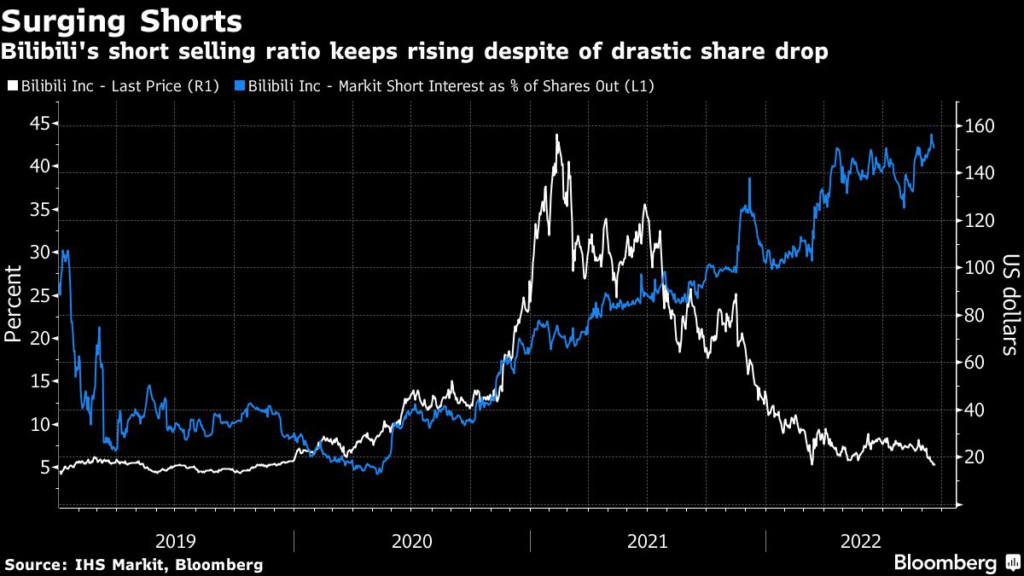
Record Bearish Bets Hit Bilibili Even After 90% Dive

(Bloomberg) — A Chinese technology company has emerged as a prime target for short sellers in the US even after the stock tumbled almost 90% over the past 18 months, a sign of how pessimistic some investors are about the economic outlook. 

Short interest in Bilibili Inc. jumped to a record last week, with bearish positions accounting for almost half of shares outstanding, IHS Markit Ltd. data show. That makes the live-streaming platform operator among the most shorted US stocks among companies with market values of $2 billion or more.

The bets show just how wary — and selective — investors have become as it relates to putting money into the Chinese tech sector as the Nasdaq Golden Dragon China Index sinks about 30% this year. The stock is under pressure even after Beijing’s yearlong regulatory clampdown eased, in part because investors are concerned that Bilibili won’t become profitable any time soon given that advertising spending is weakening along with the slowing economy. Bilibili closed 1.6% lower on Friday.

“This market reaction makes sense in the current environment where cost of capital is rising and investors are no longer willing to assume these companies turn profitable and grow profits in the distant future, especially with regulatory tightening and difficult economic conditions in China,” said Louis Lau, a portfolio manager at Brandes Investment Partners LP. 

Bilibili stands out when it comes to Chinese firms traded in the US. In 2021, it reported the biggest net loss among the 65 members of the Nasdaq Golden Dragon China Index. During the second quarter, it was one of the few Chinese internet companies that missed analyst expectations. That prompted brokerages including Citigroup Inc., Morgan Stanley and Deutsche Bank AG to slash target price forecasts, citing the impact of a slowing economy on the bottom line.

The firm is among a slew of unprofitable Chinese companies in the social media and entertainment sectors. These high cash burners have expanded aggressively thank to years of cheap capital. Now, the weakening economy isn’t just hurting the ability to raise cash, it’s also slowing consumer spending and hurting online advertising, which contributed one-quarter of Bilibili’s revenues last year. 

“The pace of profitability could be slower than the market expects, with weaker cost discipline and slower growth for ads and games,” Morgan Stanley analysts including Alex Poon wrote in a Sept. 9 note on Bilibili. The brokerage also slashed its price target by 12%, citing high cash burn. 

Beyond Bilibili, investors are also counting some other Chinese firms as good short bets. Short bets on online property agent platform Ke Holdings Inc. and social media platform Zhihu Inc. spiked this month. Both firms have been unprofitable for the last two years, and fund managers are now turning to companies that are stronger financially.

“During a market downturn, we would prefer companies that have high-quality, good cash flow and earnings certainty, because they have some buffer to offer dividends and share buybacks to support shares,” said William Fong, head of Hong Kong China equities at Barings.

Tech Chart of the Day

Chip stocks fell for a second week in the wake of the Federal Reserve’s third straight 75-basis-point interest rate increase and amid mounting concerns of a global recession. The Philadelphia semiconductor index sank 6% this week and closed at the lowest level since 2020. The benchmark has now fallen 39% in 2022.

Top Tech Stories

  • Ericsson, still reeling from a cash-for-access probe in Iraq, has been plunged into a fresh governance scandal over applications to provide services and software in Russia. The Swedish 5G network maker was granted seven out of 12 applications to circumvent export sanctions against Russia since the start of the war in Ukraine through mid-August, Radio Sweden reported.
  • Apple Music will become the title sponsor of the Super Bowl halftime show, taking over from PepsiCo Inc., which has had its name on the star-studded intermission program since 2013.
  • Charlie Collier, head of the Fox broadcast network, is leaving to become the president of Roku Inc.’s media division, where he’ll oversee programming of the streaming TV company’s channels.
  • A former Twitter Inc. employee who was convicted of spying for Saudi Arabia by turning over personal information of platform users said he deserves a new trial because prosecutors didn’t tell him about a whistle-blower’s report on security lapses at the company.
  • Salesforce Inc. Co-Chief Executive Officer Marc Benioff said the company will continue to make acquisitions, while focusing more immediately on integrating companies it already bought.

(Updates with closing share price moves throughout.)

More stories like this are available on bloomberg.com

©2022 Bloomberg L.P.

US Gives Lift to Iran Protesters, Easing Internet Curbs

(Bloomberg) — The Treasury Department is easing restrictions on internet services to Iran as protests roil the country, widening access to social media and other tools in a move that officials said is meant to increase the flow of information for ordinary people.

Guidance released Friday expands the list of services US companies can provide in Iran despite broad sanctions that prohibit most foreign business. The guidance was released a week after demonstrations began over the fate of 22-year-old Mahsa Amini, who died in custody after she was arrested for allegedly flouting Islamic dress codes.

Iran cut off internet access to 80 million people on Wednesday. Elon Musk, the world’s richest man, had drawn attention to the drama earlier in the week when he raised the possibility that his satellite internet service Starlink would seek an exemption to operate in Iran.

The Treasury Department says satellite Internet services such as Starlink are allowed but some types of equipment, including certain types of satellite receivers, still require a specific license before they can be exported to Iran.

“We took action today to advance Internet freedom and the free flow of information for the Iranian people, issuing a General License to provide them greater access to digital communications to counter the Iranian government’s censorship,” Secretary of State Antony Blinken said in a tweet.

In a Twitter response to Blinken’s comment, Musk wrote: “Activating Starlink…”

Musk Should Get Starlink Waiver for Iran, Lawmakers Say (1)

It wasn’t clear whether Starlink had actually applied for a license and the company didn’t immediately return a request for comment on Friday. In a briefing with reporters on Friday, a Treasury Department official, speaking to reporters on condition of anonymity, said Starlink was welcome to apply for an exemption.

The Treasury Department is adding social media, video-conferencing and cloud-based computing to its list of cleared activities and is removing a condition that communications be “personal.” That condition made it too hard for companies to verify the purpose of communications. It’s also adding online maps, automated translation, web maps and user authentication services to the list.

The department is also expanding its case-by-case licensing policy, which it says is meant to allow Iranian developers to create the anti-surveillance and anti-censorship apps used by many people there to circumvent government controls on the Internet. The new guidelines are contained in General License D-2.

(Updates with Elon Musk tweet about activating Starlink in 7th paragraph.)

More stories like this are available on bloomberg.com

©2022 Bloomberg L.P.

Crypto DAOs and Their Token Holders Aren’t Safe From the CFTC

(Bloomberg) — A recent enforcement action by the Commodity Futures Trading Commission signals that the community-run projects popular in crypto known as decentralized autonomous organizations, or DAOs, are within the purview of the agency’s oversight — as are the millions of people who hold DAO governance tokens that are used to make decisions.

The CFTC on Thursday filed and settled charges against bZeroX LLC and its founders Tom Bean and Kyle Kistner for illegally offering “leveraged and margined retail commodity transactions in digital assets,” among other charges. Simultaneously, the CFTC filed a federal civil enforcement action in the U.S. District Court for the Northern District of California charging the Ooki DAO — a decentralized effort that bZeroX converted into last year — with violating the same laws, holding it liable as an “unincorporated association.”

The action may have big implications for the nearly 5,000 DAOs in existence, about 2,300 of which have assets of more than $1 million, according to tracker DeepDAO. Many crypto projects have transformed themselves into DAOs — organizations governed by holders of special tokens — over the past year, partly in hopes to avoid regulatory scrutiny. Some of these crypto apps don’t check their customers’ identities, or otherwise comply with many existing financial-industry laws. 

“I think this is an important action, because it highlights that regulators need not be dissuaded by claims of decentralization,” said Hilary Allen, a law professor at American University. “Ultimately, there are always people who establish and run crypto services, even if they seek to hide from regulators by using a DAO. The CFTC has set a precedent for seeing through the decentralization rhetoric and looking at the economic realities of how DAOs operate.”

The CFTC’s action holds accountable for the DAO’s violations those individuals who participated in decision-making for the Ooki protocol by exercising their governance tokens. This is significant, experts and market watchers say. 

“This is a really sweeping claim by the CFTC that everybody who exercises governance tokens is somehow responsible for the DAO,” said Gary DeWaal, chair of Katten Muchin Rosenman’s financial markets and regulation practice. “It’s quite significant and from the industry’s perspective, quite scary.” 

There are 3.9 million holders of governance tokens,  according to DeepDAO, and they include many venture-capital firms like Andreessen Horowitz.  

“It is clear that the CFTC believes that anyone who participates in governance of a protocol, even on one occasion, should be held liable for activity on the protocol that violates laws the CFTC enforces,” said Marc Boiron, chief legal officer at Polygon Companies, which builds blockchain infrastructure.

Spokespeople at the CFTC didn’t immediately return a request for comment.

Boiron believes the CFTC’s action doesn’t set a precedent, as no independent party, such as a court, has agreed with the agency. But, he added, “it is possible that a court will agree because nobody who holds tokens will defend Ooki DAO.” 

Because the Ooki protocol is distributed around the world and can’t be shut down, a court action in favor of the CFTC could result in “holders of tokens who the CFTC believes have done nothing wrong (if they have not participated in governance) losing significant value in their tokens while the protocol continues to exist and be available to be used by US and non-US people in a way the CFTC claims violates the law,” Boiron said. 

The message for investors? Involvement in a DAO may now mean more risks, and potential liability. 

More stories like this are available on bloomberg.com

©2022 Bloomberg L.P.
Aaron Judge Could Make History Tonight. You’ll Need Apple TV+ to Watch.

(Bloomberg) — Apple Inc., which aired its first baseball game only a few months ago, could be a part of MLB history Friday — and that’s creating headaches for Yankees fans.

Slugger Aaron Judge is one home run away from tying Roger Maris’s American League record of 61 home runs in a season, set in 1961. Judge could tie or break the mark during Apple’s online broadcast of the Yankees game against the Boston Red Sox.

While most Yankees games are carried locally on the YES Network or broadcast by national TV networks, this game will be on Apple TV+. It’s free for anyone who downloads the app. But some viewers may not have Web-enabled TVs or watch TV on computers and phones.

In a tweet Friday, New York Attorney General Letitia James called on Major League Baseball and Apple to “open up tonight’s game” to the YES Network.

“Millions of New Yorkers paid their cable bills expecting to see live sports programming,” she said. 

Potentially, it’s a big moment for Apple, which is trying to become a major player in sports broadcasting. This season, the company began streaming two Friday night baseball games on its Apple TV+ service. In June, it bought the rights to stream Major League Soccer. And it’s in the running to acquire rights to the NFL Sunday Ticket, an out-of-market package now held by DirecTV. Friday’s game will likely give Apple its biggest baseball audience yet.

Some fans have complained about finding games in the fragmented media landscape. This season, Yankees followers in New York who wanted to watch every game needed to have multiple streaming services — Peacock, Apple TV+ and Amazon Prime Video — as well as YES and other cable channels. If you live outside the New York area, you also need MLB.TV.

Friday’s game also presents an awkward scenario for the MLB, which wants its historic moments to be seen by the largest audience possible.

Apple doesn’t disclose how many people use its TV service, but it’s believed to be far less than the roughly 70 million US cable and satellite TV customers. Unlike cable, however, Apple’s baseball games are free and available in 12 countries, creating a global audience that could see Judge break a baseball record. The team tweeted instructions on how to access the broadcast.

In a video posted Thursday on his Twitter account, comedian Jon Stewart, who has a show on Apple TV+, promoted Apple’s Yankees broadcast on Friday night.

“See Aaron Judge chase history!” Stewart said. “All you need is the app!”

As Judge has inched closer to 61 home runs, sports broadcasters have jockeyed for a piece of the action. This week Walt Disney Co.’s ESPN cut into its regular programming to show his at-bats. ESPN won’t have the rights to do that during Friday’s game on Apple TV+, according to Front Office Sports.

TBS, owned by Warner Bros. Discovery Inc., said Thursday it will air the Sept. 27 Yankees game, when Judge may still be vying for the home-run record as well as the American League Triple Crown, a rare feat that occurs when a player leads the league in home runs, batting average and runs batted in. The network picks which late-season games to show about a week ahead of time in order to get the most compelling matchups.

Thanks in part to Judge’s prolific season, the YES Network is on pace to have its best year for viewership in 11 years, with an audience that’s up 24% from last year, according to a spokesperson for the network.

(Updates with New York Attorney General’s comments in fourth and fifth paragraphs. An earlier version corrected the number of countries where Apple’s baseball games are available.)

More stories like this are available on bloomberg.com

©2022 Bloomberg L.P.
Risk Assets Swept Up in Rout as ‘Fear Gauge’ Soars: Markets Wrap

(Bloomberg) — A selloff in the riskier corners of the market deepened as the UK’s plan to lift the economy fueled concerns about heightened inflation that could lead to higher rates, adding to fears of a global recession.

It was a sea of red across equity trading desks, with the S&P 500 breaching its June closing low. Chartists looking for signs of where the rout might ease had identified the level as a potential area for support. Yet the lack of full-blown capitulation may be a sign the drawdown isn’t over. Goldman Sachs Group Inc. slashed its target for stocks, warning that a dramatic upward shift in the outlook for rates will weigh on valuations.

Read: Powell Says Economy May Be Entering ‘New Normal’ After Pandemic

As risk-off sentiment took hold, Wall Street’s “fear gauge” soared toward a three-month high, with the Cboe Volatility Index topping 30. Throughout the year, the US equity benchmark has hit near-nerm lows when the VIX was above that mark, according to DataTrek Research.

A surge in the greenback to a fresh record swept aside global currencies. The euro slid to its weakest since 2002, while sterling hit its lowest in 37 years — with former US Treasury Secretary Lawrence Summers saying that “naive” UK policies may create the circumstances for the pound to sink past parity with the dollar. Treasury 10-year yields fell after earlier topping 3.8%.

“It appears that traders and investors are going to throw in the towel on this week in what feels like ‘the sky is falling’ type of event,” said Kenny Polcari, chief strategist at SlateStone Wealth. “Once everyone stops saying that they ‘think a recession is coming’ and accepts the fact that it is here already – then the psyche will change.”

Liz Truss’s new UK government delivered the most sweeping tax cuts since 1972 at a time when the Bank of England is struggling to rein in inflation, which is running at almost five times its target. The plunge in gilts means that investors are now betting the central bank boosts its benchmark lending rate by a full point to 3.25% in November, which would be the sharpest increase since 1989.

‘Meaningful Drag’

Amid heightened fears over a hard economic landing, commodities got hammered across the board. West Texas Intermediate tumbled below $80 a barrel for the first time since January and was set for a fourth week of declines. Not even gold — a haven asset — was able to gain due to a surging dollar.

China’s yuan extended losses to a level closest to the weak end of its allowed trading band since a shock currency devaluation in 2015. With a hawkish Federal Reserve set to sustain the dollar at high levels, analysts say there’s only so much Beijing could do to shore up its currency at a time of economic difficulties.   

The greenback’s strength has been unrelenting and will also exert a “meaningful drag” on corporate earnings — serving as a key headwind for stocks, said David Rosenberg, founder of his namesake research firm.

KKR & Co. sees potential trouble ahead, including a mild recession next year, with the Fed narrowly focused on driving up unemployment to tame inflation. The US labor shortage is so severe that it’s possible the Fed’s tightening doesn’t work, wrote Henry McVey, chief investment officer of the firm’s balance sheet.

“This is a more draconian outcome than corporate profits falling,” he noted, “because it will encourage the Fed to tighten even further.”

Investors are flocking to cash and shunning almost every other asset class as they turn the most pessimistic since the global financial crisis, according to Bank of America Corp. Investor sentiment is “unquestionably” the worst it’s been since the crisis of 2008, with losses in government bonds being the highest since 1920, strategists led by Michael Hartnett wrote in a note.

“It’s a realization that interest rates are going to continue to rise here and that that’s going to put pressure on earnings,” said Chris Gaffney, president of world markets at TIAA Bank. “Valuations are still a little high even though they’ve come down, interest rates still have a lot further to go up and what impact that will have on the global economy — are we headed for a sharper recession than the recession everybody expected? I think it’s a combination of all of that, it’s not good news.”

Extreme Pessimism

Stocks are indeed still far from being obvious bargains. At the low in June, the S&P 500 was trading at 18 times earnings, a multiple that surpassed trough valuations seen in all previous 11 bear cycles, data compiled by Bloomberg show. In other words, should equities recover from here, this bear-market bottom will have been the most expensive since the 1950s. 

Bleak sentiment is often considered a contrarian indicator for the US stock market, under the belief that extreme pessimism may signal brighter times ahead. But history suggests that equity losses may accelerate even further from here before the current bear market ends, according to Ned Davis Research.

The firm’s Crowd Sentiment Poll has been in an extreme pessimism zone since April 11, or 112 consecutive trading days that mark the third-longest streak of gloom since the data began in 1995. Over the subsequent few months following those periods of extreme pessimistic sentiment, equity gains were fleeting, with negative median returns three and six months after the 100-day mark.

In another threat to stocks, different iterations of the so-called Fed model, which compares bond yields to stock earnings’ yields, show equities are least appealing relative to corporate bonds and Treasuries since 2009 and early 2010, respectively. This signal is getting attention among investors, who can now know look to other markets for similar or better returns.

“The next question is when and how far do earnings estimates decline for 2023,” said Ellen Hazen, chief market strategist and portfolio manager at F.L. Putnam Investment Management. “Earnings estimates for next year are too high, they really have not come down, and as that happens you’re going to have further equity pain because in addition to the multiple coming down via the yield mechanism, the earnings you’re applying that multiple to are going to come down as well.”

As slower growth and tighter financial conditions start catching up to companies, a wave of downgrades will come for the US investment-grade corporate bond market.

That’s according to strategists at Barclays Plc, who say companies are facing margin pressure thanks to high inventories, supply chain issues, and a strong dollar. The firm expects the average monthly volume of downgrades to increase to $180 billion of bonds over the next half year. The current monthly average is closer to $40 billion.

Read: Private Equity Writedowns Spur Mounting Scrutiny From the SEC

Some of the main moves in markets:

Stocks

  • The S&P 500 fell 2.6% as of 2:13 p.m. New York time
  • The Nasdaq 100 fell 2.5%
  • The Dow Jones Industrial Average fell 2.4%
  • The MSCI World index fell 2.6%

Currencies

  • The Bloomberg Dollar Spot Index rose 1.3%
  • The euro fell 1.5% to $0.9688
  • The British pound fell 3.4% to $1.0876
  • The Japanese yen fell 0.7% to 143.36 per dollar

Cryptocurrencies

  • Bitcoin fell 3% to $18,667.08
  • Ether fell 3.2% to $1,282.35

Bonds

  • The yield on 10-year Treasuries declined three basis points to 3.68%
  • Germany’s 10-year yield advanced six basis points to 2.02%
  • Britain’s 10-year yield advanced 33 basis points to 3.83%

Commodities

  • West Texas Intermediate crude fell 5.9% to $78.54 a barrel
  • Gold futures fell 1.8% to $1,651.50 an ounce

More stories like this are available on bloomberg.com

©2022 Bloomberg L.P.

Motley Fool Stock-Pick Hacker Pleads Guilty to $3 Million Fraud

(Bloomberg) — An Idaho man who worked as an information technology professional admitted to making at least $3.5 million by illegally accessing the stock picks of the personal finance website Motley Fool before they were released.

David Stone, a freelance web developer from Nampa, Idaho, pleaded guilty Friday to securities fraud in New York before US District Judge Mary Kay Vyskocil as part of an agreement with federal prosecutors and is scheduled to be sentenced on Feb. 14. Prosecutors said Stone provides IT support for small businesses via remote access to their computing systems.

Stone, 37, was charged in May with gaining unauthorized access to Motley Fool’s computer system and viewing the group’s recommendations before they were announced to paying subscribers. He then traded on them, sometimes using options contracts that paid out only if shares gained within a week, and also shared the information on multiple occasions between January 2021 and March 2022 with another person who made more than $2.7 million, prosecutors said in a statement.

While prosecutors didn’t identify the investment advisor or the tippee, the US Securities and Exchange Commission filed a tandem civil complaint against Stone that also named a friend, John D. Robson, as complicit in the scheme. Robson was not criminally charged. The SEC said the two engaged in a scheme that generated more than $12 million in illicit profits since at least November 2020.

Among the dozens of recommended companies whose shares Stone and Robson traded based on the hacks were Amazon.com Inc., Lululemon Athletica Inc., Peloton Interactive Inc., Airbnb Inc. and Coinbase Global Inc., according to the SEC.

Prosecutors agreed that Stone faces 46 to 57 months in prison under federal sentencing guidelines and a fine of $20,000 to $5 million.

The case is US v Stone, 22-cr-510, US District Court, Southern District of New York (Manhattan.)

More stories like this are available on bloomberg.com

©2022 Bloomberg L.P.

Close Bitnami banner
Bitnami