Bloomberg

Fox Entertainment Chief Jumps to Roku to Lead Streaming Channel

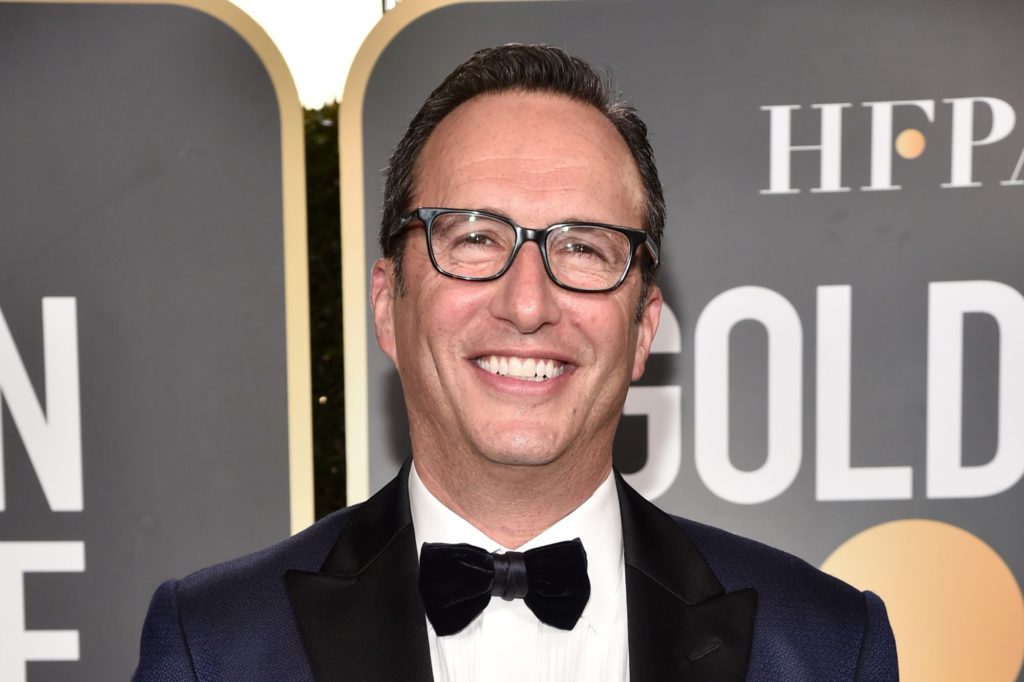
(Bloomberg) — Charlie Collier, head of the Fox broadcast network, is leaving to become the president of Roku Inc.’s media division, where he’ll oversee programming of the streaming TV company’s channels.

The executive, who’ll start working in the New York office in late October, will supervise ad sales and programming for products like the Roku Channel. He’ll report to Chief Executive Officer Anthony Wood, the company said in statement Thursday. Two other Roku executives, Mustafa Ozgen and Gidon Katz, are being elevated to lead devices and the consumer experience, respectively. 

Roku, based in San Jose, California, is best known for devices that connect TV sets with streaming services such as Netflix and Hulu. The company has been branching out in recent years to make its own programming for its customers.

Collier, a former executive at AMC Networks, had been helping Fox Corp. rebuild its entertainment offerings after the controlling Murdoch family sold much of their empire to the Walt Disney Co. In that role, Collier made acquisitions, such as the celebrity gossip site TMZ, and launched shows, such as “Monarch,” a family drama.

“He and his team have executed a creative strategy in entrepreneurial and profitable ways that leveraged our broadcast leadership to build and support businesses to position us for future growth,” Fox CEO Lachlan Murdoch said in a statement. “We wish Charlie all the best in his new role.”

More stories like this are available on bloomberg.com

©2022 Bloomberg L.P.

Cost of Watching Premier League On Rise For Viewers

(Bloomberg) —

The cost for streaming every available game for the current Premier League season matches will cost UK users more than a third by the end of 2022, after a rise in competition and costs. 

Amazon.com Inc. joined Sky and BT Group Plc at the end of 2019 in broadcasting UK Premier League games, adding one of the world’s largest companies into an already highly competitive auction process.  

Prior to Amazon’s entry, the cost to stream all live Premier League football matches for a season was just under £540 — using the best available deals without signing up to extra services. By the end of 2022 that price will be more than £700 a year, according to a Bloomberg calculation of membership fees.

An Amazon subscription — which comes with its Prime delivery service — will cost consumers an extra £17.98 for the two months it is streaming Premier League football, while the cost to stream Sky Sports on Now TV is £33.99 a month, up 78% from the cheapest deal three years ago. The lowest cost to stream BT Sports is still £25 a month. 

While the cost to watch matches via Amazon Prime in October and November is marginal, Pivotal Research Group Chief Executive Officer Jeffrey Wlodarczak said the increase in competition is driving up costs for the consumer and broadcasters alike. “It’s difficult to compete with the money and model that Amazon has,” he said.

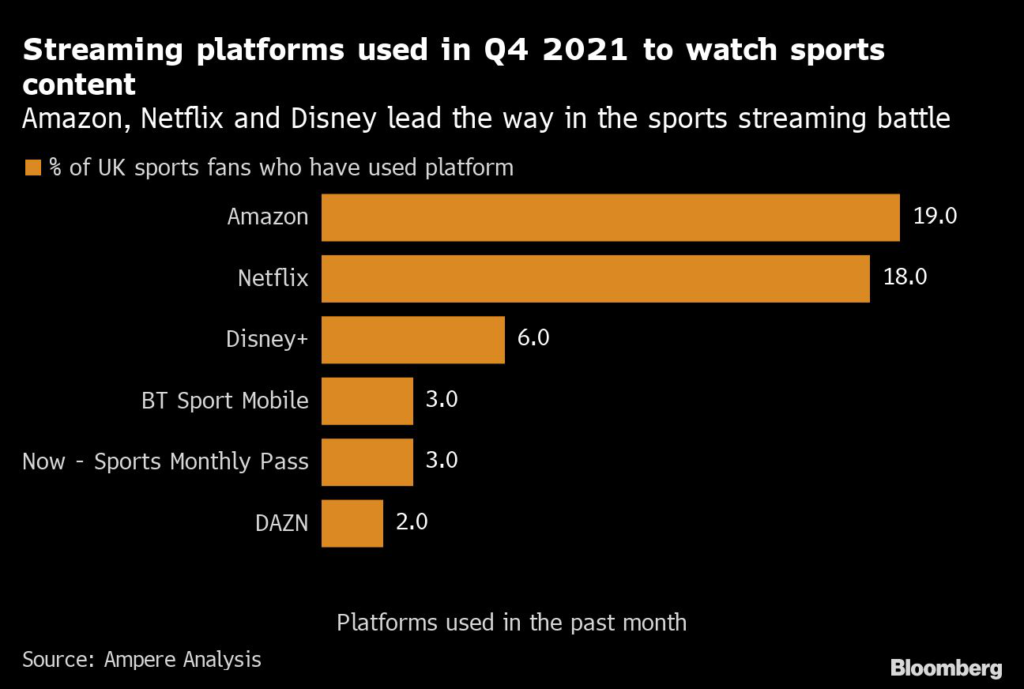
Amazon has agreed to spend £30 million a year on Premier League rights from 2019 through at least 2025, according to the Ben McMurray, an analyst at Ampere Analysis. As a percent of the population, the UK is No. 2 in Europe for customers who have at least one streaming sports subscription, after Italy, McMurray said. 

The streaming companies have big budgets. Amazon has invested more than £1 billion in TV, movies and live sports since 2018. 

However, subscribers are facing rising costs of living. The UK could see an exodus of subscribers after autumn gas bills come in, according to Minal Modha from Ampere. Netflix has already been losing customers after increased competition combined with users facing less disposable income. Last quarter, it shed 1.3 million customers in the US and Canada, its biggest region.

Some streaming services will begin selling advertising to offset the cost and keep subscribers. Charging customers a premium for ad-free viewing hasn’t appealed to Netflix or Disney+ in the past, which have both thrived offering products without commercial interruptions. 

About two thirds of streaming users would agree to watch as much as 10 minutes of ads per hour, according to Deloitte’s latest Digital Consumer Trends report. Disney+ and Netflix are also developing ad-supported plans. 

DAZN is incorporating gambling to supplement subscriptions. The service launched DAZN Bet in August with the aim of “creating a more recreational, sociable, and relevant experience for today’s sports fan,” it said in a statement.

OneFootball, a Germany-based football media company, announced in August this year that UK customers will be able to watch one free live game of Italian football league, Serie A, every match day of the season through its app. Traditional broadcasters are promising similar as a bid to win loyalty. Free-to-air channel, ITV Plc has said it will broadcast 10 La Liga games throughout the season. 

Streaming companies are also creating other sports content to build exclusive libraries and entice viewers. Amazon has its “All or Nothing” documentary series about NFL teams, and took on Bath Rugby Club player Beno Obano to produce a behind-the-scenes documentary on Harlequins Rugby Club. 

Netflix’s Formula 1 “Drive to Survive” series has been a ratings hit in its own right, something Disney executives are hoping to replicate with “Welcome to Wrexham,” a series following Wrexham Football Club and its celebrity owners, Rob McElhenney and Ryan Reynolds.

(Corrects price using the monthly price of Amazon Prime. The original story based the cost on a yearly subscription.)

More stories like this are available on bloomberg.com

©2022 Bloomberg L.P.

How AI Is Being Used to Save the Whales

(Bloomberg) — Is your iPhone whale-safe? Smartphones, like many consumer products, arrive in the US on giant container ships, vessels that are leading killers of endangered whales that play crucial roles in the climate and ocean health. Now a high-tech initiative called Whale Safe is detecting the huge marine mammals off the coast of San Francisco and alerting ship captains to slow down to avoid deadly collisions. Launched on Wednesday, Whale Safe aims to create “school zones” for imperiled blue whales, fin whales and humpback whales in busy shipping lanes, according to the project’s managers at the Benioff Ocean Science Laboratory at the University of California at Santa Barbara and at the Bay Area’s Marine Mammal Center. Speeders are caught by satellite surveillance and cited online. That gives consumers the opportunity to see, for instance, if that cruise they’re contemplating is operated by a company with a history of ignoring sea speed limits. In the future, Whale Safe might award a label to retailers who sell products transported on ships that brake for cetaceans. “No one wins when a ship comes into a port with an endangered whale wrapped around its bow right below the brand name of the company,” says Douglas McCauley, director of the Benioff Ocean Science Laboratory. “The phone that I’m talking to you on now has a connection to cargo ships that I think is underappreciated. There is a consumer connection to whale conservation here.” Weighing 160 tons, blue whales are the largest animals that have ever lived, but they’re no match for a 200,000-ton cargo ship. California is home to three of the nation’s busiest ports and a hotspot for ship-related whale deaths. Scientists estimate that more than 80 endangered whales are killed annually by ship strikes off the West Coast, though only 5% to 17% of carcasses are recovered as most sink to the ocean floor. That death toll has implications for climate change. Researchers have discovered that whales sequester large volumes of carbon dioxide in their bodies, while their excrement spawns blooms of phytoplankton that produce half of the world’s oxygen and are the foundation of the marine food web. 

How Whale Safe works

With the rapidly warming ocean reducing whales’ prey populations and altering their migratory routes, curtailing ship strikes is critical to the animals’ survival, according to scientists. A federal assessment of blue whale stocks in 2019 found that losing more than 1.2 individuals that year from accidents like ship collisions would threaten the sustainability of the population. That year there were two confirmed incidents of blue whales killed by ship strikes off California, with more deaths likely undetected.

After a record number of whales died from ship collisions in California waters in 2018 and 2019, the Benioff Ocean Science Laboratory led efforts to start the Whale Safe pilot program in the Santa Barbara Channel. The area is a shipping superhighway for freight bound to the ports of Los Angeles and Long Beach, and an ecologically rich smorgasbord of prey for endangered whales that migrate up and down the California coast. In 2020, scientists deployed a technology-packed buoy developed by the Woods Hole Oceanographic Institution. A microphone called a hydrophone sits on the ocean floor and listens for the sounds of whale vocalizations. If the hydrophone detects whale chatter, it sends the data to a computer housed in a buoy. An AI program identifies the species in near real-time by comparing its vocalizations with a library of thousands of whale recordings. The detection is beamed by satellite to scientists who confirm the finding before posting it on the Whale Safe website and automatically sending it  to shipping companies that subscribe to the whale feed. The alert system also includes physical sightings of the marine mammals as well as a feature that McCauley likens to a whale weather forecast. An algorithm analyzes real-time data on ocean conditions and information from 104 satellite-tagged blue whales to predict their likely presence.

In the Bay Area, scientists placed the buoy offshore of San Francisco, where there were six confirmed ship strikes of endangered whales last year. When McCauley inspected that buoy on Monday, he spotted nine humpbacks feeding in south-bound shipping lanes. “There’s just a huge amount of ship traffic that comes through this constrained space, which unfortunately also happens to be a really important buffet area for whales,” McCauley said.

On Thursday morning, Whale Safe reported a “very high presence” of whales off San Francisco: 12 humpback sightings as well as acoustic detections, plus blue whales vocalizing in the area. The forecast for whales in the Santa Barbara Channel was “high,” with sightings of 41 humpbacks and detection of their songs. McCauley says there were five documented ship strikes of endangered whales in Southern California and four deaths in 2019, including a blue whale found wrapped around the bow of a cruise ship as it entered the Port of Long Beach. Incidents declined to two strikes and one death in 2020, the first year of the buoy’s operation, and last year there were no reports of whale collisions or deaths in the Santa Barbara Channel. “I want to see that stay at zero for a decade before I claim that there’s an important contribution that has been made here, but this is happy news,” he says.

Stopping speeding ships

As whales come closer to shore in search of prey that is disappearing from warming oceans, scientists say climate change is increasing the threat of collisions with ships in San Francisco Bay. “They’re following the fish,” Kathi George, director of field operations and response at the Sausalito, California-based Marine Mammal Center, said at a press conference Wednesday. 

The National Oceanic and Atmospheric Administration asks large ships to slow to 10 knots (11.5 miles per hour) when they travel through the Santa Barbara Channel and the Greater Farallones National Marine Sanctuary off San Francisco during the whales’ summer feeding season. A 2021 study published in the journal Frontiers in Marine Science estimated that whale deaths in the Santa Barbara Channel could fall by up to a third if 95% of ships complied with the speed limits.  Whale Safe analyzes location data broadcast by ship transponders to determine if vessels are slowing down and assigns a letter grade that rates companies’ compliance. About 61% of ships adhere to the recommended speed limit in the Santa Barbara Channel and 62% in the Farallones marine sanctuary, according to George. France’s CMA CGM SA, the world’s third largest container shipping company, receives data directly from Whale Safe and alerts captains when they need to reduce their speed. Claire Martin, the company’s vice president of sustainability, said that 80% of ships comply with the alerts; when they don’t, it’s usually related to weather conditions. McCauley said deploying additional buoys would allow for more precise detection of endangered whales. The buoys, however, cost about $250,000 to build and $200,000 annually to operate. Funding an expansion of Whale Safe got easier on Wednesday when the Benioff Ocean Science Laboratory’s benefactors, Salesforce Inc. founder Marc Benioff and his wife Lynne Benioff, announced a $60 million gift to UC Santa Barbara to support the laboratory’s work.

More stories like this are available on bloomberg.com

©2022 Bloomberg L.P.

Alex Jones Renews ‘Deep State’ Claim at Defamation Trial

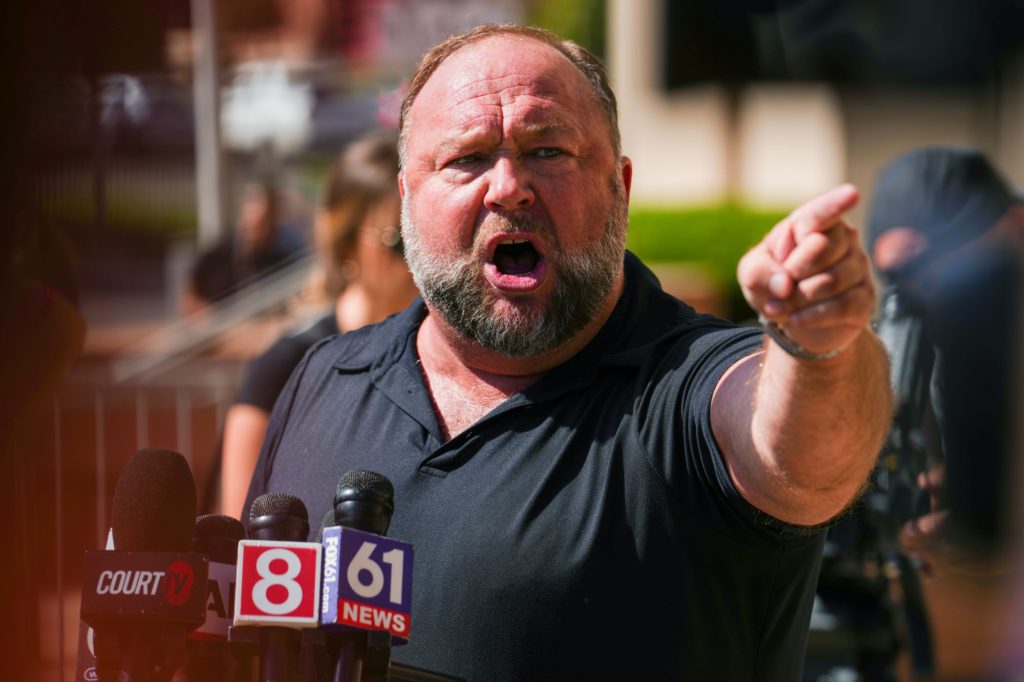
(Bloomberg) — Combative conspiracy theorist Alex Jones doubled down on his claim that defamation lawsuits filed by the families of 26 children and educators gunned down at Sandy Hook Elementary School are part of a liberal plot to destroy him.

“I think this is a Deep State situation,” Jones told jurors Thursday during the second week of a civil trial in Connecticut. When asked if his credibility is the most important thing to him, the Infowars host replied: “No, crushing the globalists.”

Jurors are hearing testimony to determine how much the Internet host must pay in damages for defaming eight families and an FBI agent who responded to the scene of the 2012 school shooting by repeatedly calling the massacre a hoax. Jones already was found liable for defamation against the victims, who say his false claims encouraged his fans to harass and pursue them, turning their lives into living nightmares.

Connecticut State Judge Barbara Bellis, who ruled Jones was liable in a separate non-jury proceeding, is overseeing the case in New Haven, about 25 miles from Sandy Hook. Bellis and judges in two similar Sandy Hook lawsuits ruled against Jones for failing to turn over financial records.

Jones has repeatedly insisted his First Amendment free speech rights protect his statements, even if they were false. He claims he should be able to speak freely on topics of national importance like any other journalist. Having already been found liable, Jones isn’t legally allowed to make that argument to jurors in any of these trials, which are strictly to determine damages.

Texas Case

In the first of the three Sandy Hook defamation trials last month, a jury in Austin, Texas, ordered Jones to pay almost $50 million to the parents of one of the slain first graders.

On the stand Thursday, Jones admitted he’s blasted Bellis as a “tyrant” and mocked the Connecticut proceeding as a “kangaroo court.” He said his Infowars.com staff has added a “kangaroocourt” page so fans can follow the trial.

After a heated exchange with one of the families’ lawyers, Jones proclaimed loudly, “I’m done saying I’m sorry. I legitimately thought it might’ve been staged. I’ve apologized to the parents. I’m not apologizing to you.”

The judge then interrupted Jones, saying, “You’re in a court of law. You have to follow the rules. There is media in the room, but this is not a press conference. This is clearly not your show.”

After sending the jury home for the day, Bellis warned Jones and the lawyers on both sides that she’d hold in contempt anyone who “steps out of line” or engages in “outbursts.”

Outside the courthouse on Wednesday, Jones called the trial a “travesty of justice, and this judge is a tyrant.” He added that he was merely questioning whether government agents staged the school shooting — with the help of “crisis actors” portraying grieving parents — as part of a liberal plot to confiscate citizens’ guns.

“There have been a lot of staged events in history, like WMDs in Iraq, and I question every major event that we see,” Jones told reporters Wednesday.

Jurors have heard family members of the murdered children describe how Jones’s fans stalked them in person and online, threatening violence and denying their loved ones ever existed. The jury was also shown video clips of Jones telling millions of viewers the massacre never happened and was a “false flag” operation by the government.

The Law & Crime Network, which is livestreaming the Connecticut trial, disabled its comments section Wednesday, after Jones’s fans swarmed the webcast with violent threats to the families.

The case is Lafferty v. Jones, 22-05019, US Bankruptcy Court, District of Connecticut (Bridgeport).

(Updates with comments from Jones, judge.)

More stories like this are available on bloomberg.com

©2022 Bloomberg L.P.

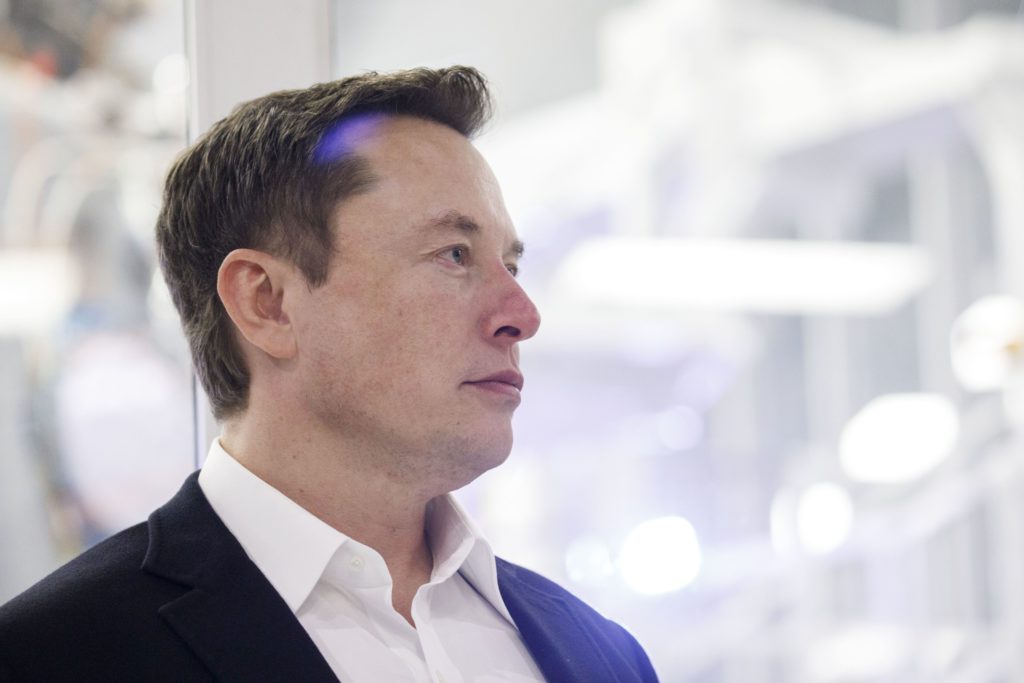
Elon Musk Should Provide Internet in Iran, Lawmakers Urge Yellen

(Bloomberg) — Treasury Secretary Janet Yellen should give Elon Musk’s satellite Internet service Starlink clearance to operate in heavily sanctioned Iran as the country faces widespread protests, a bipartisan group of lawmakers said.

Musk “recently stated that SpaceX would seek a license to provide its satellite based Starlink Internet service to Iran,” the lawmakers wrote in a letter to Yellen. “If such a license request is submitted, we urge you to approve it immediately.” Musk called for the exemption in a tweet on Monday.

The letter was led by Representatives Claudia Tenney, a New York Republican, and Tom Malinowski, a New Jersey Democrat, and signed by a number of other lawmakers. They also asked Treasury to clarify its policies for fostering communications access in sanctioned countries and urge the department to issue any necessary “comfort letters” to entities that may seek to provide communications services under previously issued general licenses.

“Congress is calling on the Treasury Department to do everything in its power to help the Iranian people stay connected to the Internet,” Tenney said in a statement. “We need to cut through any bureaucratic red tape and get this done.”

Demonstrations in Iran started last Friday following the death of 22-year-old Mahsa Amini, a young woman who fell into a coma after Tehran’s so-called morality police arrested her for allegedly flouting Islamic dress codes. Protests have since been reported in scores of towns and cities including the capital Tehran as well as Karaj, Shiraz, Tabriz, Kerman, Kish Island, Yazd, Neyshapur, Esfahan and Mashhad.

Iran Protests’ Death Toll Rises to 17 as the Unrest Deepens 

“Iranians are taking to the street demanding justice for Mahsa,” Malinowski said. “We need to do our part to ensure that Iranians remain connected to the outside world.”

Representative Michael McCaul, the top Republican on the House Foreign Affairs Committee, said in a statement that the US must do “everything in our power” to help “the brave Iranians protesting against injustice.”

A Treasury spokesperson said the department already allows some services related to Internet communications, including those that use satellite terminals as Starlink does, and that it welcomes applications for specific licenses related to Internet freedom in Iran.

Daniel Tannebaum, a partner at Oliver Wyman, said companies are sometimes wary of exposing themselves to the risk of running afoul of US sanctions even when the service they provide is expressly authorized by Treasury. This is especially true in the case of heavily sanctioned jurisdictions such as Iran.

“It becomes a business decision based on risk appetite in the space,” Tannebaum said in an interview. “You need to trust that you have the right controls in place to stay on the right side of the exemption.”

Treasury has begun advertising for a “chief sanctions economist” who officials say will help mitigate these types of concerns.

(Updates with comments from Rep. McCaul in the seventh paragraph)

More stories like this are available on bloomberg.com

©2022 Bloomberg L.P.

Bond Yields Surge as Post-Fed Hangover Hits Stocks: Markets Wrap

(Bloomberg) — Treasury yields surged to multiyear highs and stocks fell after a parade of central banks joined the Federal Reserve in boosting rates to curb scorching levels of inflation at the expense of economic growth.

The superlatives kept piling across Wall Street as a selloff in the world’s biggest bond market sent the 10-year yield to 3.7%, its highest since 2011. The two-year rate climbed for an 11th straight session — the longest up streak in over three decades. The moves weighed on the tech space, with the S&P 500 failing to sustain a late-day rebound and moving closer to its June bottom.

The dollar remained at record levels, fueled by hawkish Fed policy and investors in search of haven. The Swiss franc slumped as a central bank hike proved not enough to satisfy expectations, while the yen gained as Japan propped up the currency for the first time since 1998.

The Fed gave its clearest signal yet that it’s willing to tolerate a recession as the necessary trade-off for regaining control of inflation, with officials forecasting a further 1.25 percentage points of tightening before year-end. Norway, Britain and South Africa also followed with hikes of their own as officials rush to get to grips with rampant price increases.

“We see this new even-higher-for-longer rate path as associated with a substantially greater higher likelihood of a hard landing, and so not just unambiguously hawkish but unambiguously bad for risk,” said Krishna Guha, vice chairman of Evercore ISI.

Read: Fed Repo Facility Use Surges to Record High as Rates Rise

Read: Mortgage Investors Jump In After Fed Says MBS Sales Aren’t Near

The S&P 500 could be poised for more downside after breaking through a rare technical indicator, according to Berenberg strategists including Jonathan Stubbs. 

It has traded below its 200-day moving average for over 100 sessions — a streak that was previously breached only during the tech bubble and the global financial crisis in the past 30 years. In both of those instances, the gauge posted most of its losses after surpassing that level, with the index declining by a further 50% in 2000-2003 and 40% in 2008-2009 before troughing, they said. 

Evercore’s chief equity and quantitative strategist Julian Emanuel cut his S&P 500 year-end projection to 3,975 from 4,200 and expects a “full retest” of the June low in the weeks ahead. The target cut accounts for a rising probability of a recession following Fed Chair Jerome Powell’s warning that the rate-hike process won’t be “painless” for the labor and housing markets.

Its June bottom stands nearly 2.5% below current levels.

“The bad news is we are still in one of the weakest seasonal windows of the year, especially in a mid-term year,” said Jonathan Krinsky, chief market technician at BTIG. “The good news is that it quickly reverses by mid-October. We think we test or break the June lows before then, which should set up a better entry point for a year-end rally.”

Dennis DeBusschere at 22V Research expects markets to remain volatile while maintaining his neutral, range-bound stance for stocks.

“It’s tough to get long until we get signs of slower underlying demand growth, but tail risk is limited by already tighter financial conditions, lower PEs, and higher implied vol,” he wrote.

The environment isn’t suitable for strong directional positioning on overall indexes, according to Mark Haefele at UBS Global Wealth Management. However, he advises against retreating to the sidelines, “especially given the drag on cash from high inflation and the challenge of timing a return to markets without missing out on rebounds.”

“Instead, we stay invested but also selective, and focus our preferences on the themes of defensives, income, value, diversification, and security,” he added.

Among notable corporate news, FedEx Corp. is cutting flights, deferring projects and closing offices as it seeks as much as $2.7 billion in savings to tackle challenges including slowing demand and a tight labor market. Boeing Co. agreed to pay $200 million to settle US Securities and Exchange Commission allegations that the company failed to properly disclose to investors safety issues tied to its 737 Max jetliner.

Will the Nasdaq 100 Stock Index hit 10,000 or 14,000 first? This week’s MLIV Pulse survey focuses on technology. It’s brief and we don’t collect your name or any contact information. Please click here to share your views.

Here are some of the main moves in markets:

Stocks

  • The S&P 500 fell 0.8% as of 4 p.m. New York time
  • The Nasdaq 100 fell 1.2%
  • The Dow Jones Industrial Average fell 0.4%
  • The MSCI World index fell 1%

Currencies

  • The Bloomberg Dollar Spot Index was little changed
  • The euro was little changed at $0.9839
  • The British pound fell 0.1% to $1.1257
  • The Japanese yen rose 1.2% to 142.35 per dollar

Bonds

  • The yield on 10-year Treasuries advanced 17 basis points to 3.70%
  • Germany’s 10-year yield advanced seven basis points to 1.96%
  • Britain’s 10-year yield advanced 18 basis points to 3.50%

Commodities

  • West Texas Intermediate crude rose 0.7% to $83.49 a barrel
  • Gold futures rose 0.3% to $1,680.60 an ounce

More stories like this are available on bloomberg.com

©2022 Bloomberg L.P.

Crypto Outperforms Stocks for a Change as Correlation Breaks

(Bloomberg) — Cryptocurrencies outperformed US equities for a change, with Bitcoin and Ether gaining for the first time in five days.

Bitcoin, the largest virtual currency by market value, rose about 2% to $19,2912 as of 4:26 p.m. in New York. Earlier, it slid as much as 4% toward a three-month low. Ether rose about 1.5%. It had dropped as much as 20% since a much-touted network upgrade last week. 

Markets are shuddering at the Federal Reserve’s determination to fight inflation by constricting financial conditions. Treasury yields hit multiyear highs and stocks fell as a parade of central banks joined the Federal Reserve in boosting rates to curb scorching levels of inflation at the expense of economic growth.  

The Fed “was heavily frontrun in crypto, and we’re hence seeing a correction before stocks have even fully moved,” said Wilfred Daye, chief executive officer of Securitize Capital, a digital asset management firm. “This has been a pattern we’ve seen repeatedly with event-driven moves recently due to the relative immaturity of crypto markets and their participants. Volatility is higher in crypto than equity trading.” 

The backdrop has offered little respite for crypto markets. The sector was already reeling from a $2 trillion plunge from a 2021 record high, an unraveling pockmarked with blowups such as the Three Arrows Capital hedge fund and the Terraform Labs project — whose co-founder Do Kwon is wanted by authorities.

“Last night BTC/USD revisited multi-year lows around $18,200,” said Joshua Lim, former head of derivatives at Genesis Trading. “There were some shorts that got trapped at the lows getting liquidated now.”

The MVIS CryptoCompare Digital Assets 100 Index is down this week, taking its losses for 2022 to about 60% compared with 23% for global stocks. The correlation between equities and Bitcoin is elevated and close to a record, a sign of how assets are being tossed around by common macro factors.  

XRP continued to rally. A crypto industry lobbying group wants the judge in a high-profile digital assets case to consider Congressional efforts to establish a new legal framework for the nascent industry before moving ahead.

The Chamber of Digital Commerce filed an amicus brief Wednesday in the Securities and Exchange Commission’s lawsuit against Ripple Labs, which is being heard before the US District Court for the Southern District of New York.

XRP, the native currency of the Ripple network, rose about 8 cents to 49 cents, or 20%, on Thursday — the biggest one-day increase since August 2021. It has rallied about 40% this week, cutting its loss for the year to about 40%.  

More stories like this are available on bloomberg.com

©2022 Bloomberg L.P.

Nikola Investor Lost $160,000 on Milton’s Hype, He Tells Jury

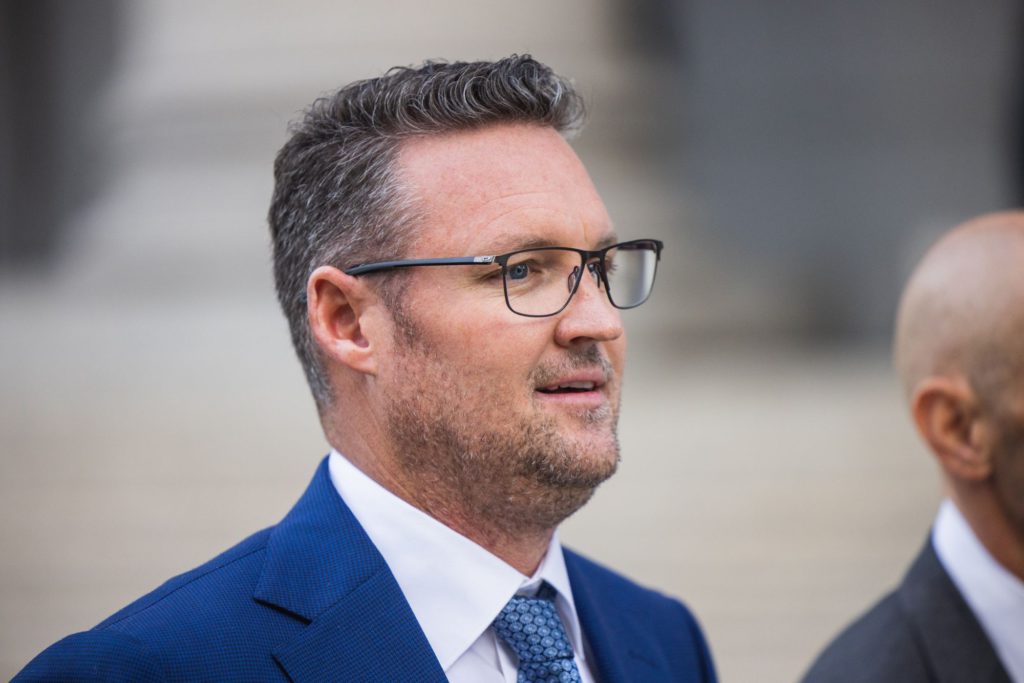
(Bloomberg) — Nikola Corp.’s founder cost a San Diego man about $160,000 trading the company’s hyped shares, he told the jury in Trevor Milton’s criminal fraud trial.

Joseph Ryan was called to the witness stand Thursday by federal prosecutors, who allege that Milton misled investors by exaggerating the electric truck maker’s progress toward introducing vehicles for sale and by lying about Nikola’s technology and partnerships. 

Ryan told the jurors he bought shares based on public statements by Milton that the company had succeeded in slashing the cost of hydrogen fuel from $16 a kilogram to less than $4. He told the panel it would have affected his investment decisions if he had known Nikola was actually buying hydrogen at $14 a kilogram rather than producing it.

He testified that he also invested based on Milton’s claims that Nikola was moving toward commercial production of the Badger pickup, and that he was misled by a video that appeared to show a Nikola semi truck prototype traveling under its own power, when in fact it was rolling downhill thanks to gravity.

Risky Trading

Ryan, who said he had done some day trading, told the jurors Milton’s interviews and videos convinced him to hold Nikola stock for the long term.

“It sounded like they were making great progress in every aspect of what they were targeting, whether it be hydrogen production, the truck or the consumer truck, the Badger,” he said.

Read More: Nikola CEO Says He Learned Truck Had No Power After His Hire 

On cross-examination, Ryan agreed that Securities and Exchange Commission filings are a more reliable source of company information than press interviews, as Milton lawyer Marc Mukasey suggested that day trading is risky. The defense argues Milton was just following the company’s marketing plan and never said anything he didn’t believe to be true.

The trial comes two years after Milton abruptly resigned from the company’s board, following scrutiny once Nikola listed its shares in June 2020. The stock’s initial surge turned small investments by hedge funds and others into stakes worth billions of dollars at the time, reflecting optimism that Nikola could become a Tesla-like disruptor. 

All GM

Individual investors, too, piled into the stock, which collapsed in the wake of a short-seller’s report and which is down 24.3% from its close before opening arguments began on Sept. 13.

Milton, 40, is charged with securities and wire fraud and faces a maximum prison term of 25 years if convicted of the most serious charge. The defense has cited “a distortion of Trevor Milton’s words, a distortion of Trevor Milton’s meanings, a distortion of Trevor Milton’s intentions.”

Read More: Nikola Founder Milton Went Rogue on Social Media, Jury Is Told

The prosecution witness before Ryan was Scott Damman, a senior manager at General Motors Co. whom GM sent to work with Nikola. Damman testified that Milton had falsely claimed Nikola was responsible for most of the parts in the planned Badger pickup truck GM was to build for the EV maker.

“There were no components coming from Nikola,” Damman told the jury in federal court in Manhattan. “They owned the creative design, what the vehicle looked like and felt like, but all of the parts were to come from General Motors.”

‘70% Nikola’

Damman’s testimony came in response to questioning about a video interview Milton gave in 2020. 

“It’s probably 70% Nikola, 30% GM, when it comes to the parts that are really important to us,” Milton said in the interview that September, the same month the Detroit car maker announced it would build and provide technology for the Badger in return for payments and an 11% equity stake. 

Read More: Nikola Saw ‘Massive’ Badger Losses But Backed Milton Anyway 

The relationship between Nikola and GM was to be brief. The short-seller’s report came just days after the partnership was announced that month, accusing Milton and Nikola of deception. By November, GM had scaled back its commitment and dropped its plans for the stake. The Badger was scrapped. 

Nikola took $5,000 down payments for Badger reservations in June 2020, when it had no prototype or plan to manufacture the pickup. Public discussion of the truck bolstered the stock, with promises a prototype would be revealed at an event later that year. That unveiling, too, was canceled.

Ryan told the court he continues to hold his Nikola shares. He said he may offset the gains he’s made on other investments with his Nikola losses, or just hope to profit if the company is acquired.

The case is US v. Milton, 21-cr-478, US District Court, Southern District of New York (Manhattan).

Read More

  • Nikola Cannibalized a Ford for Electric Pickup, Jury Told 
  • Nikola Founder Milton Faces Jury in His Toughest Sales Job 

More stories like this are available on bloomberg.com

©2022 Bloomberg L.P.

Salesforce Will Continue to Make Acquisitions, CEO Benioff Says

(Bloomberg) — Salesforce Inc. Co-Chief Executive Officer Marc Benioff said the company will continue to make acquisitions, while focusing more immediately on integrating companies it already bought.

“We’ve bought 60 companies — we’ll always buy companies,” Benioff said Thursday in an interview with Bloomberg Television from the software giant’s annual Dreamforce conference. Meanwhile, Salesforce is still integrating employees of recently acquired firms like Tableau, he said.

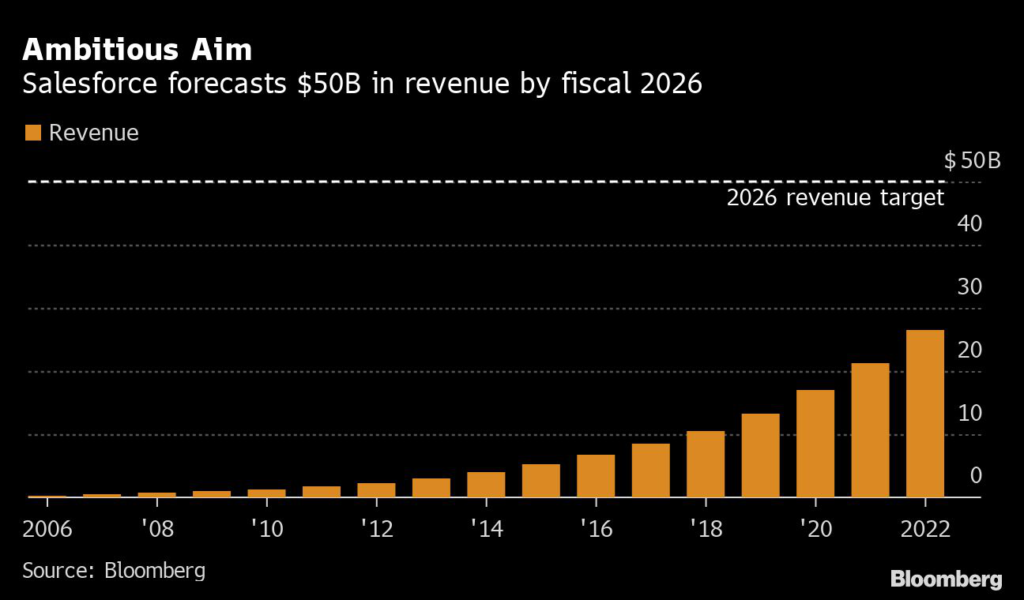
The customer-relations software giant is aiming to improve its margins as economic sentiment has soured. The company reaffirmed its target of $50 billion revenue by fiscal year 2026 — nearly double its current annual sales — while adding a new profit margin target of 25% during an investor event Wednesday. “Now we want to have very strong margins,” Benioff said.

Like many of its tech peers, the company has tightened its spending on hiring and travel after growing its workforce through the pandemic. “We all invested aggressively in the last two years, and we are absorbing those investments into our business,” Benioff said. Further reductions of investment in the workforce are “certainty not our intention,” he said

The co-founder and board chair has shared chief executive officer duties with Bret Taylor for nearly a year since the product leader was promoted to share the top job in November 2021. Benioff called Taylor a “fantastic leader of the company.”

For more on Co-CEO Bret Taylor

Benioff said he will stick to his joint CEO duties “as long as everybody wants me to do it,” he said. “So far it seems to be working.”

More stories like this are available on bloomberg.com

©2022 Bloomberg L.P.
Apple Fixes iPhone 14 Pro Camera-Shake and Copy-and-Paste Bugs

(Bloomberg) — Apple Inc. released a software update aimed at fixing bugs found in early iPhone 14 units, including a problem that made the device’s camera shake when used with some apps. 

The update, known as iOS 16.0.2, resolves an issue that made the camera vibrate and take blurry photos when users were in third-party apps like TikTok and Instagram. Customers took to social media after the new iPhones launched last Friday to complain about the bug, which affected Pro and Pro Max models.

The software update also fixes a problem that made some displays turn black during device setup, an issue that presented a copy-and-paste approval prompt more frequently than necessary, and glitches that caused the VoiceOver feature and displays on older iPhones to become unresponsive. 

The software update marks the second so far for the iPhone 14, which had a fix last week related to FaceTime. The company is planning another update, iOS 16.1, for next month — to accompany the initial iPadOS 16 release and to enable the launch of iPhone 14 satellite connectivity for emergency texting in November.

More stories like this are available on bloomberg.com

©2022 Bloomberg L.P.
Close Bitnami banner
Bitnami