Bloomberg

Japan’s Rapidus Seeks Billions of Dollars to Reboot Chip Sector

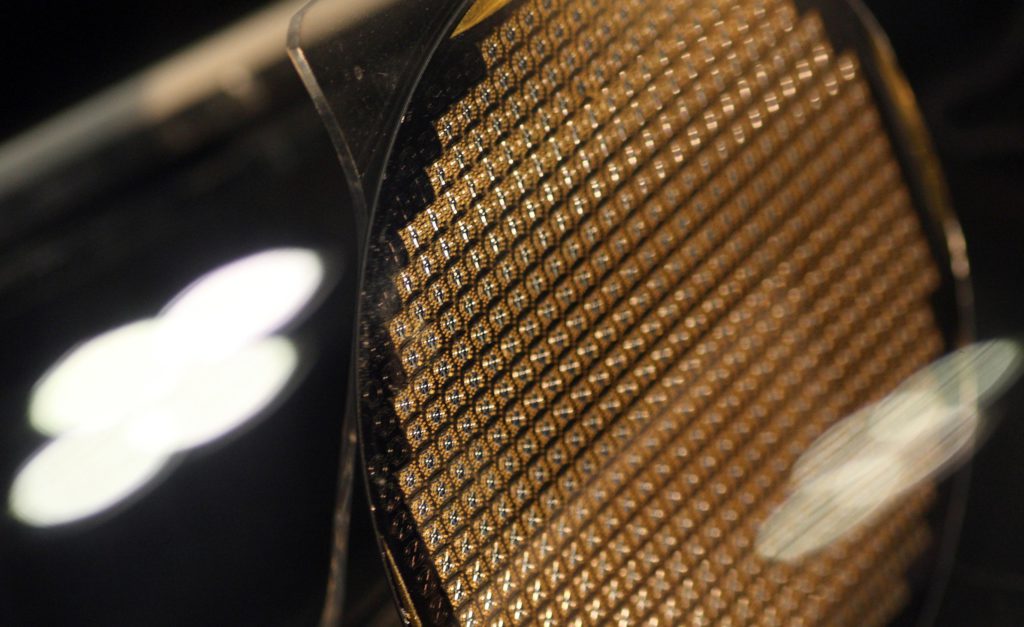
(Bloomberg) — Japan’s newly formed chip foundry venture Rapidus Corp. said it is seeking to invest several trillion yen to help reboot the country’s semiconductor industry.  

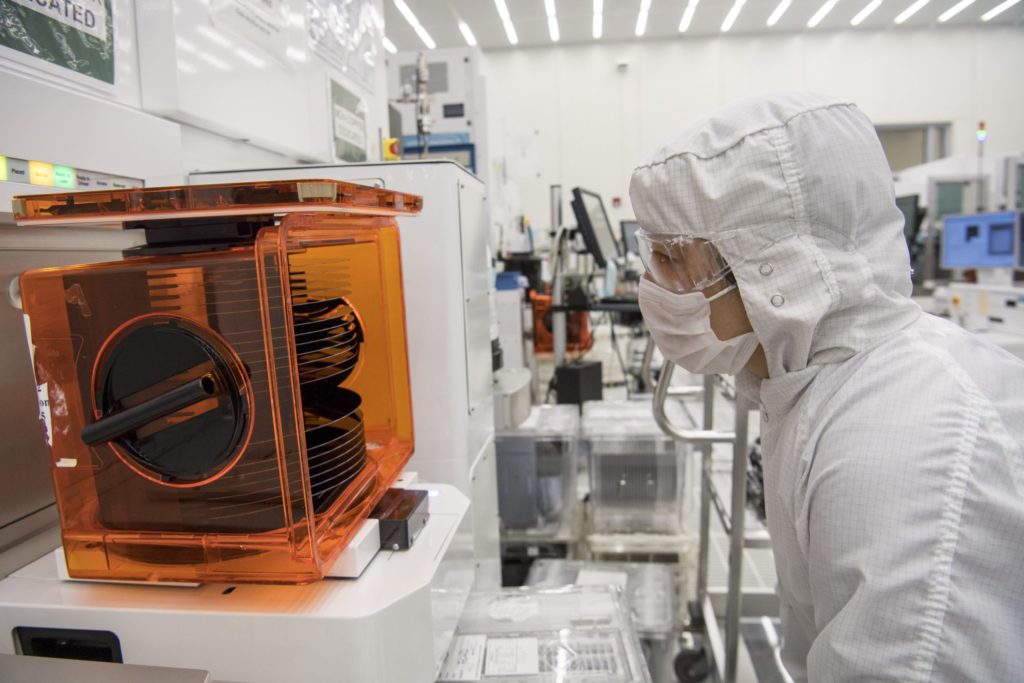
Backed by Toyota Motor Corp., Sony Group Corp. and six other Japanese companies, the Tokyo-based venture signed a partnership with International Business Machines Corp. to develop the US firm’s leading-edge 2-nanometer technologies. Rapidus said it will begin mass production of the chips in 2027 at a plant it plans to build in Japan.

The company secured an allocation of 70 billion yen ($510 million) in subsidies from the country’s Ministry of Economy, Trade and Industry last month. For comparison, the US government is spending more than $50 billion to rebuild its chip production capabilities.

“This is a start,” Rapidus President Atsuyoshi Koike said at a news conference Tuesday, adding that the company will seek continued government support. “We will need to invest several trillion yen.” 

Sector leader Taiwan Semiconductor Manufacturing Co. plans to mass produce 2nm chips in 2025, while Samsung Electronics Co. began mass production of 3nm chips in June. While home to some of the world’s leading suppliers of semiconductor-making equipment, Japan’s domestic factories are generations behind.

Rapidus is also backed by auto parts maker Denso Corp., memory chipmaker Kioxia Corp., MUFG Bank, NEC Corp. and telecom firms Nippon Telegraph & Telephone Corp. and SoftBank Corp. The chip venture previously announced a partnership with Belgium-based microelectronics research hub IMEC on advanced semiconductor technologies.

“We are confident that we will be able to secure the support of the Japanese government and that of the trade ministry,” Koike said. “The ramifications will be huge if we cannot achieve 2nm capabilities.”

More stories like this are available on bloomberg.com

©2022 Bloomberg L.P.

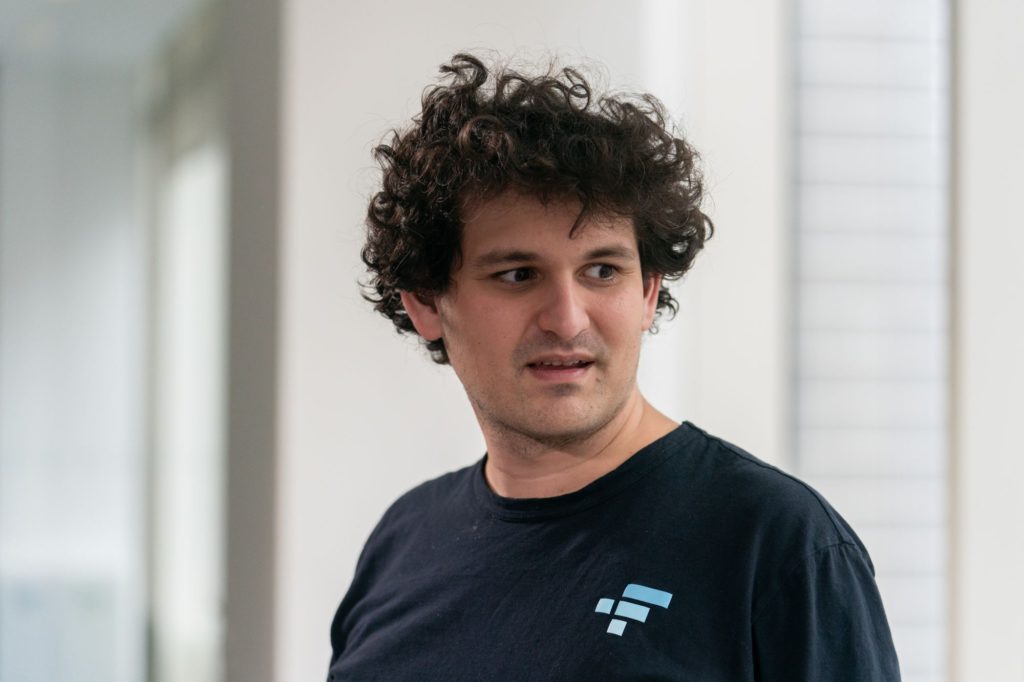
Sam Bankman-Fried Arrested in Bahamas as US Files FTX Charges

(Bloomberg) — Sam Bankman-Fried, the disgraced co-founder of digital-asset exchange FTX, was arrested in the Bahamas after the US government filed a criminal indictment, following weeks of speculation that client funds were misused before his empire’s collapse.

Bankman-Fried is being held in custody pending an extradition process, the island nation’s attorney general, Ryan Pinder, said in a statement Monday. 

Federal prosecutors in Manhattan plan to unseal the case against him Tuesday morning, “and will have more to say at that time,” Damian Williams, US attorney for the Southern District of New York, said in a separate statement. He didn’t elaborate on the allegations.

The Securities and Exchange Commission separately authorized civil charges relating to Bankman-Fried’s violations of securities laws, Enforcement Director Gurbir Grewal said in a statement. Those civil charges are expected to be filed publicly in Manhattan Tuesday, according to the statement. 

Bankman-Fried has been facing investigations in the US and the Bahamas, where FTX was headquartered, into a range of possible misconduct. One key inquiry has been whether customer funds were lent out to trading firm Alameda Research, which Bankman-Fried also founded. More than 100 FTX-related entities filed for US bankruptcy protections on Nov. 11. 

‘Powerful Evidence’

“To indict this early, when they didn’t have to, tells me that they have incredibly powerful evidence,” said Gene Rossi, a former federal prosecutor. Rossi added that prosecutors were probably “gravely concerned” that Bankman-Fried would flee to a jurisdiction where he could not be extradited.

The White House declined to comment on the arrest and charges.

House Financial Services Committee Chairwoman Maxine Waters told reporters the panel still plans to hold its hearing on FTX’s collapse. “It’s important for the American public to understand FTX and what was going on,” she said.


Bankman-Fried, 30, is being held at the Cable Beach police station in Nassau, according to an officer working at the facility. The person, who declined to give a name when reached by phone, said that all the cells there are comfortable, but didn’t provide details.

The facility is about 13 miles from the Albany Bahamas luxury community where Bankman-Fried lives and is located close to a main tourist zone.

Bankman-Fried’s arraignment is scheduled for Tuesday, according to a person familiar with the matter.

In media interviews since FTX’s collapse, Bankman-Fried has admitted major managerial missteps, but has also claimed that he never tried to commit fraud or break the law.

In his remarks prepared for the US House hearing that Bankman-Fried was scheduled to appear at on Tuesday, he offered a blunt assessment of his plight. 

“I would like to start by formally stating under oath: I f—-ked up,” Bankman-Fried said in draft copy of his remarks obtained by Bloomberg News. 

He added that the company’s new managers, led by restructuring expert John J. Ray III, have repeatedly rebuffed his offers to help sift through the wreckage of the collapsed crypto empire. Ray, who’s now leading the company, hasn’t responded to five of his emails, he said. 

Crypto Exchanges

Prior to the arrest and long before his empire collapsed into bankruptcy, federal prosecutors in Manhattan had already been looking into FTX as part of broader sweep of exchanges and potential anti-money laundering violations under the Bank Secrecy Act.

The investigation, led by the Complex Frauds and Cybercrime Unit, took a different trajectory after FTX’s catastrophic implosion.

Prosecutors were closely examining whether hundreds of millions of dollars were improperly transferred to the Bahamas around the time of FTX’s Nov. 11 bankruptcy filing in Delaware, according to a person familiar with the matter.

They were also digging into whether FTX broke the law by transferring funds to Alameda Research, the bankrupt investment firm also founded by Bankman-Fried, Bloomberg reported previously.

Last week, prosecutors, the FBI, Department of Justice officials and FTX’s new CEO and restructuring expert Ray met at SDNY’s headquarters in downtown Manhattan. Potential charges were not discussed at that meeting, according to a person familiar with the conversation.

–With assistance from Allyson Versprille, Max Chafkin, Emily Wilkins, Akayla Gardner and David Voreacos.

(Updates with former federal prosecutor’s comments in the sixth paragraph.)

More stories like this are available on bloomberg.com

©2022 Bloomberg L.P.

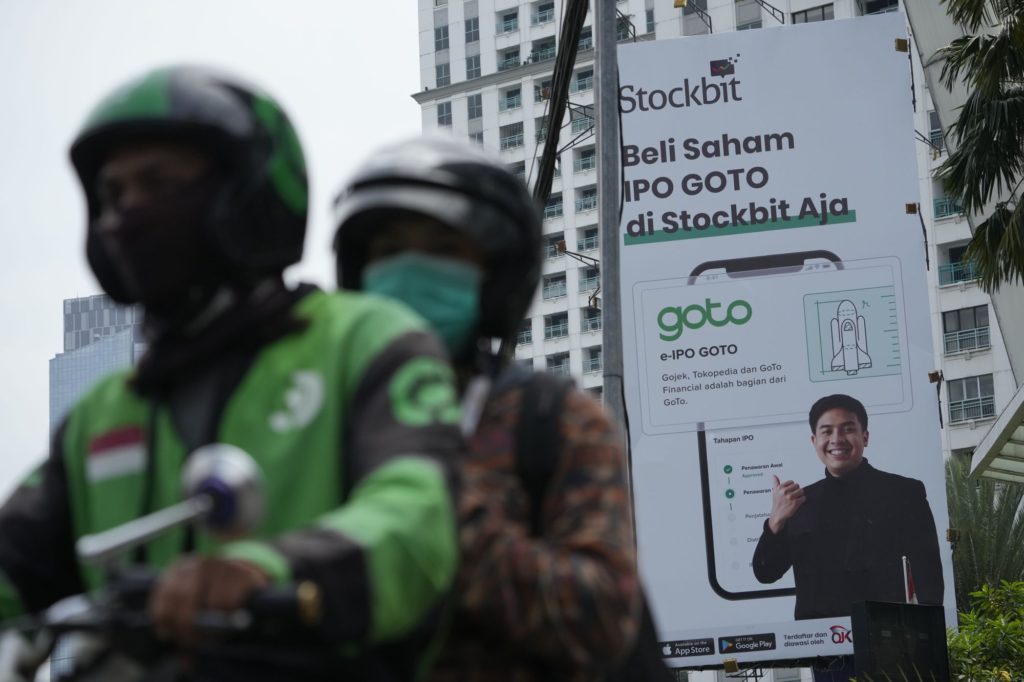
Goto Jumps to Snap 16-Session Loss Amid Valuation Focus

(Bloomberg) — GoTo Group jumped Tuesday as investors focused on valuation after recent sharp declines and Indonesia’s bourse said it’s monitoring the stock’s movements.    

The Indonesian tech startup fell as much as 6.9% before rebounding 24% to 108 rupiah, snapping a 16 straight session of losses. The nation’s stock exchange said it will closely monitor the stock after unusual sharp declines. 

UBS Group AG and PT BNI Sekuritas said the stock is a buy after a recent expiry of a lockup triggered a sharp selloff, taking a slide since its April debut to more than 70%.  

GoTo is still trading at higher valuations compared to regional peers, but its “premium vs. peers has narrowed, making valuations attractive,” UBS AG analysts including Navin Killa wrote in a note. 


(Updates with analyst comments)

More stories like this are available on bloomberg.com

©2022 Bloomberg L.P.

Stocks Eke Out Gains, Dollar Eases Before CPI Data: Markets Wrap

(Bloomberg) — Stocks climbed while the dollar edged down amid cautious trading ahead of US inflation data that may shape the outlook for interest-rate hikes into next year.

Hong Kong scrapping its three-day Covid monitoring period for arriving travelers bolstered sentiment during Asian trading, sending shares in the city higher. US futures remained slightly lower. 

The dollar saw marginal declines against most of its major counterparts. Treasury yields inched lower after gains on Monday that sent the 10-year rate to above 3.6%. Yields for Australian and New Zealand government bonds ticked higher.

Investors will be closely watching the consumer price figures, which are expected to remain elevated even as the rate of increase slows. A subdued CPI print would justify the Federal Reserve’s projected half-point move on Wednesday and shed light on whether markets can expect rate cuts in late 2023. 

The release of the inflation data will be more critical than the Fed’s decision, according to Xi Qiao, managing director for global wealth management at UBS Group AG. “It’s all going to depend on CPI numbers, whether the Fed is going to pivot or not,” she said on Bloomberg Television. “With the current inflation situation, a lot of the fundamental challenges that we have right now are going to go into 2023.”

Other central banks are also set to announce their final rate decisions of the year this week. The European Central Bank will announce its rate decision Thursday, and may also opt for a half-point hike. Markets will also contend with decisions from the Bank of England and monetary authorities in Mexico, Norway, the Philippines, Switzerland and Taiwan.

A potential fillip for markets is oil trading around the lowest price this year after prices plunged 11% last week. After gaining 3% on Monday, West Texas Intermediate edged higher to remain above $73 a barrel on Tuesday.

Still, investors will continue to monitor for market risks from Covid infections in China. They are also weighing the impact of Japan and the Netherlands agreeing in principle to at least partially join the US in increasing controls over the export to China of advanced machinery to make semiconductors. Trading of Asian semiconductor stocks was mixed on the news.

Key events this week:

  • US CPI, Tuesday
  • FOMC rate decision and Fed Chair news conference, Wednesday
  • China medium-term lending, property investment, retail sales, industrial production, surveyed jobless, Thursday
  • ECB rate decision and ECB President Lagarde briefing, Thursday
  • Rate decisions for UK BOE, Mexico, Norway, Philippines, Switzerland, Taiwan, Thursday
  • US cross-border investment, business inventories, empire manufacturing, retail sales, initial jobless claims, industrial production, Thursday
  • Eurozone S&P Global PMI, CPI, Friday

Some of the main moves in markets:

Stocks

  • S&P 500 futures fell 0.1% as of 11:45 a.m. Tokyo time. The S&P 500 rose 1.4%
  • Nasdaq 100 futures fell 0.1%. The Nasdaq 100 gained 1.2%
  • Japan’s Topix index rose 0.5%
  • South Korea’s Kospi index rose 0.2%
  • Hong Kong’s Hang Seng Index rose 1.1%
  • China’s Shanghai Composite Index was little changed
  • Australia’s S&P/ASX 200 Index rose 0.3%

Currencies

  • The Bloomberg Dollar Spot Index fell 0.1%
  • The euro rose 0.1% to $1.0550
  • The Japanese yen was little changed at 137.64 per dollar
  • The offshore yuan rose 0.1% to 6.9807 per dollar

Cryptocurrencies

  • Bitcoin fell 0.2% to $17,140.32
  • Ether fell 0.5% to $1,268.77

Bonds

  • The yield on 10-year Treasuries declined one basis point to 3.60%
  • Australia’s 10-year yield advanced three basis points to 3.41%

Commodities

  • West Texas Intermediate crude rose 1.4% to $74.16 a barrel
  • Spot gold rose 0.2% to $1,785.61 an ounce

This story was produced with the assistance of Bloomberg Automation.

–With assistance from Jason Scott.

More stories like this are available on bloomberg.com

©2022 Bloomberg L.P.

Uber Conducting Probe After Vendor Hit With Cyberattack

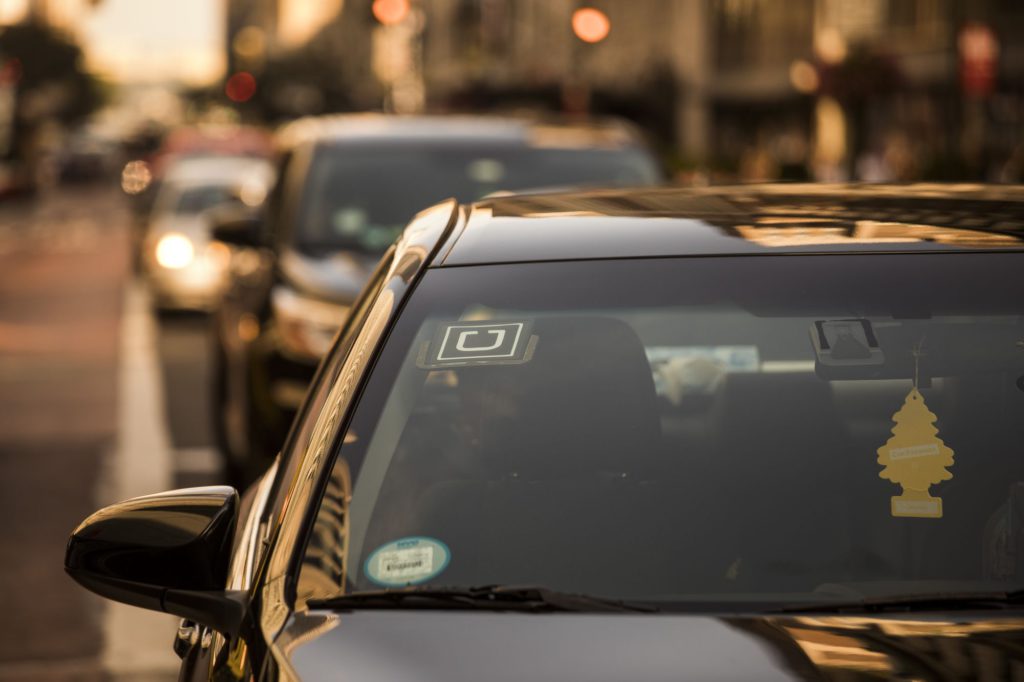
(Bloomberg) — Uber Technologies Inc. said it’s investigating the hack of a third-party vendor that reportedly resulted in the leak of data from the ride-hailing company, including employee email addresses.

The vendor, Teqtivity, which helps manage and track information technology equipment such as phones and computers, on Monday confirmed the cyberattack. 

More than 77,000 Uber employees’ email addresses and other data, including alleged source code associated with mobile device management platforms used by Uber and Uber Eats, have been leaked as part of the recent hack, according to a report from Bleeping Computer, which covers information security and technology news. 

“We believe these files are related to an incident at a third-party vendor and are unrelated to our security incident in September,” said Carissa Simons, the Uber spokesperson. “Based on our initial review of the information available, the code is not owned by Uber; however, we are continuing to look into this matter.”

Teqtivity said in a statement it doesn’t collect or store sensitive information such as bank account details or government identification numbers. The exposed data includes device information such as serial number, make and model as well as user information such as full name, work email address and location.

Teqtivity said customer data was compromised due to unauthorized access to its systems by a malicious third party. The hacker was was able to gain access to the Teqtivity AWS backup server that houses the company’s code and data files related to its customers, according to the company.

Teqtivity has notified law enforcement officials and hired a forensics firm to investigate all logs and server configuration.

The leak is the latest breach to affect Uber. Uber said the attackers (or attacker) responsible for a September breach were affiliated with the notorious extortion group called Lapsus$ and had likely infected a contractor’s personal device with malware and then bought that person’s password on the dark web.

In that instance, the intruders were able to get into several employee accounts and had security permissions for Uber’s G-Suite and Slack, among other internal tools.

In October, former Uber security chief Joe Sullivan was found guilty of hiding a massive 2016 data breach from federal regulators.

–With assistance from William Turton.

(Updates with additional details in the third paragraph)

More stories like this are available on bloomberg.com

©2022 Bloomberg L.P.

Japan to Join US Effort to Tighten Chip Exports to China

(Bloomberg) — Japan and the Netherlands have agreed in principle to join the US in tightening controls over the export of advanced chipmaking machinery to China, according to people familiar with the matter, a potentially debilitating blow to Beijing’s technology ambitions.

The two countries are likely to announce in the coming weeks that they’ll adopt at least some of the sweeping measures the US rolled out in October to restrict the sale of advanced semiconductor manufacturing equipment, according to the people, who asked not to be named because they are not authorized to speak publicly on the matter. The Biden administration has said the measures are aimed at preventing Beijing’s military from obtaining advanced semiconductors. 

The three-country alliance would represent a near-total blockade of China’s ability to buy the equipment necessary to make leading-edge chips. The US rules restricted the supply from American gear suppliers Applied Materials Inc., Lam Research Corp. and KLA Corp. Japan’s Tokyo Electron Ltd. and Dutch lithography specialist ASML Holding NV are the two other critical suppliers that the US needed to make the sanctions effective, making their governments’ adoption of the export curbs a significant milestone.

“There’s no way China can build a leading-edge industry on their own. No chance,” said Sanford C. Bernstein analyst Stacy Rasgon.

On Monday, China filed a dispute over the US export controls with the World Trade Organization, the country’s Ministry of Commerce said in a statement. Beijing said the restrictions threaten the stability of the global supply chain and that America’s national-security justification is dubious.

But the global opposition to China’s chipmaking ambitions is mounting. Bloomberg News reported last week that Dutch officials were planning new export controls on China. The Japanese government agreed to similar restrictions in recent weeks since the two countries wanted to act in concert, the people said. Japan had to overcome opposition from domestic companies that would prefer not to lose sales into China, one of the people said. Beside Tokyo Electron, Nikon Corp. and Canon Inc. are minor players in the market.

Japan is in discussion with the US and other countries regarding the matter, Japanese trade minister Yasutoshi Nishimura said on Tuesday at a press conference, declining to comment on the status of ongoing talks. “We are conducting hearings of domestic firms and studying the impact of the US restrictions.”

The three countries are the world’s top sources of machinery and expertise needed to make advanced semiconductors. ASML shares closed down 1.4%, paring an earlier decline of as much as 2.8%. 

Senior US National Security Council official Tarun Chhabra and Under Secretary of Commerce for Industry and Security Alan Estevez were in the Netherlands late November to discuss export controls, Bloomberg reported, while Commerce Secretary Gina Raimondo talked about the same issues with METI chief Yasutoshi Nishimura via teleconference last week.

With the move, Dutch and Japanese officials will essentially codify and expand their existing export control measures to further restrict China’s access to cutting-edge chip technologies.

The two governments are planning to impose a ban on the sale of machinery capable of fabricating 14-nanometer or more advanced chips to China, the people said. The measures align with some rules Washington set out in October.

The 14nm technology is at least three generations behind the latest advances available on the market, but it is already the second-best technology that China’s chipmaking champion Semiconductor Manufacturing International Corp. owns. 

Asked at a briefing Monday in Washington about a potential agreement with Japan and the Netherlands, US National Security Advisor Jake Sullivan said “I’m not going to get ahead of any announcements.”

“We are very pleased with the candor, the substance and the intensity of the discussions that are taking place across a broad range of countries who share our concerns and would like to see broad alignment as we go forward,” he said. “Alignment is a priority for us. We’re working towards that.”

–With assistance from Debby Wu, Jenny Leonard, Jordan Fabian, Ian King and Yuki Furukawa.

(Updates with Japan trade minister comments in seventh paragraph)

More stories like this are available on bloomberg.com

©2022 Bloomberg L.P.

SpaceX Tender Offer Is Said to Value Company at $140 Billion

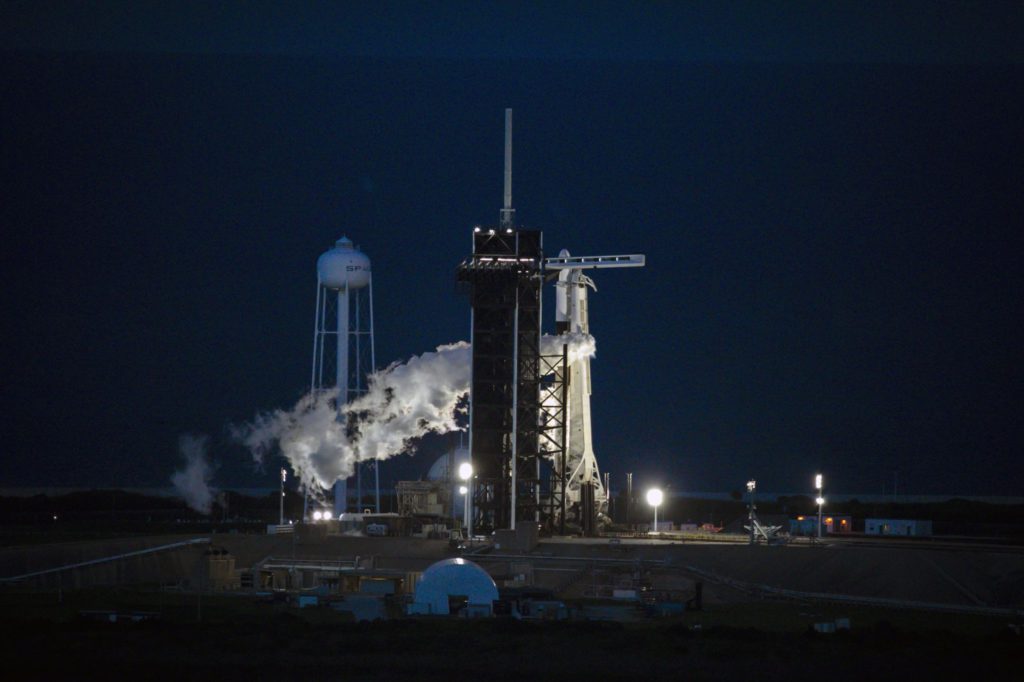
(Bloomberg) — Elon Musk’s SpaceX is offering to sell insider shares at a price that would raise the closely held company’s valuation to about $140 billion, according to people familiar with the matter.

Space Exploration Technologies Corp., as the company is formally called, is offering the shares for $77 apiece, said the people, who asked not to be identified because the information wasn’t public. The $140 billion figure compares with a $127 billion valuation in July, according to data provider PitchBook.

In recent weeks, SpaceX had held conversations for a range of prices but ultimately settled on $140 billion for the valuation in a tender offer, the people said. It couldn’t be immediately learned whether the company will seek to raise capital in a primary funding round at that valuation.

A representative for SpaceX, the most valuable private company in the US, didn’t immediately respond to a request for comment.

SpaceX, based in Hawthorne, California, dominates the market for commercial space launch. The company sends payload to orbit for private sector customers, the National Aeronautics and Space Administration and other government agencies. It also ferries astronauts to and from the International Space Station for NASA, and has run the first private space tourism mission for civilians to orbit the earth for several days.

The closely held company, led by Musk, the world’s richest man, is also building a constellation of thousands of Starlink satellites to beam broadband internet coverage to the Earth below. Musk has previously said Starlink could be spun off in a public listing once cash flow is more predictable. In June 2021, Musk said the company would need to invest $20 billion to $30 billion to maintain Starlink’s competitive position.

Musk, the world’s richest man, has a net worth of almost $168 billion, according to the Bloomberg Billionaires Index. His stake in SpaceX was valued at around $47 billion, according to the index.

–With assistance from Ed Ludlow.

(Updates with details in third paragraph.)

More stories like this are available on bloomberg.com

©2022 Bloomberg L.P.

Google Defeats One Suit Over Chrome Data Privacy Practices

(Bloomberg) — Alphabet Inc.’s Google defeated a privacy lawsuit by consumers who accused the company of snooping on them even after they opted out of sharing their web activity.

US District Judge Yvonne Gonzalez Rogers on Monday dismissed claims that Google tracked users’ personal information, including IP addresses and browsing history, if they chose not to “Sync” their Google accounts with Chrome — and even if they didn’t have an account.

“Google adequately disclosed, and plaintiffs consented to, the collection of the at-issue data,” Rogers wrote in dismissing the suit.

Rogers also ruled on another Chrome privacy case involving the “Incognito Mode” feature that lets people surf the web privately. She let tens of millions of Google users to join the suit launched by a handful of consumers claiming that the search giant scoops up data even when “Incognito Mode” is turned on. The users can’t seek monetary compensation though, only relief that would block the company from further collecting private browsing information and to push it to delete previously gathered data.

A spokesperson for Google didn’t immediately respond to a request for comment.

Google faces a raft of privacy suits brought by states including Arizona and consumers as well as intense scrutiny by lawmakers over its data-gathering practices. The technology giant has said that in 2024 it will eliminate third-party cookies that help advertisers keep tabs on consumers’ web activity and won’t employ alternative methods to track individuals.

In a bid to keep the Incognito case from expanding, Google had argued in a court filing that many potential class members knew about the company’s data collection and consented to it. 

Court filings revealed a paper trail highlighting frustration among Google’s employees over Incognito Mode’s branding, including a 2021 email from the company’s marketing head telling Chief Executive Officer Sundar Pichai that the feature “isn’t truly private.”

Google has fended off two attempts by plaintiffs to force Pichai to submit to questioning under oath. 

The cases are Calhoun v. Google, 20-cv-05146, and Brown v. Google LLC, 20-3664, U.S. District Court, Northern District of California (Oakland).

(Adds Google response, comments)

More stories like this are available on bloomberg.com

©2022 Bloomberg L.P.

Twitter Blue Service Is Back, Including ‘Verified’ Badges

(Bloomberg) — Twitter Inc. resumed selling its Twitter Blue premium offering, which gives users a blue verification badge by their names, following a weeks-long pause because some subscribers were using the paid service to impersonate well-known accounts.

After several postponements, the social network said in a blog post that Twitter Blue is available now. Users who pay $8 a month will received a check mark in a blue badge next to their profile pictures and will be able to edit tweets, among other perks. 

Twitter said it will take “a number of other steps to detect and prevent impersonation,” including a requirement that users have a valid phone number attached to their account. Users who change their user name or photo will also lose their check mark “until those changes are reviewed by Twitter.”

“Accounts found to be breaking our rules may be suspended without a refund,” the blog reads.

Before billionaire Elon Musk took the company private in late October, Twitter verified accounts with a blue badge as a way to distinguish prominent users, or those at risk of being impersonated, including celebrities, musicians and journalists. But the process of getting verified was also unclear, and Musk has criticized it as a “lords & peasants system.” 

The San Francisco-based company said it will also start offering different colored check marks, including a gold one for businesses and a gray one for political accounts. In a tweet later Monday, Musk said Twitter Blue subscribers will also see half as many advertisements as regular users, and added that the company is planning to sell subscriptions for an ad-free version of the service later next year.

An earlier attempt at the pay-for-verification system led to widespread impersonation when users who bought check marks changed their user names to those of prominent brands and people, including Musk. The verification process was temporarily suspended as the company tried to figure out how to fix the issue.

Read more: Twitter Staff Grapple With Brand Impostors Like Nintendo, Lilly

Musk is also taking a subtle shot at Apple Inc. as part of Twitter Blue’s relaunch. The company will charge users $11 per month if they subscribe through the Twitter app for Apple’s iOS, an effort to recoup fees collected by Apple for in-app purchases. Musk has repeatedly complained about those fees, calling them a “de facto global tax on the internet.”

Users who don’t pay for Twitter Blue will lose their verification badges “in a few months,” Musk tweeted Monday, though he has made similar statements before.

(Updates to add details about tiers of service in sixth paragraph.)

More stories like this are available on bloomberg.com

©2022 Bloomberg L.P.

I Test Drove the Mercedes Avatar Concept Vehicle of the Future

(Bloomberg) — Despite its name and the Avatar-related marketing campaign behind it, the Mercedes-Benz Vision AVTR is not actually in Avatar: The Way of Water. (That’s James Cameron’s Avatar sequel set underwater, which opens in theaters on Dec. 16.) 

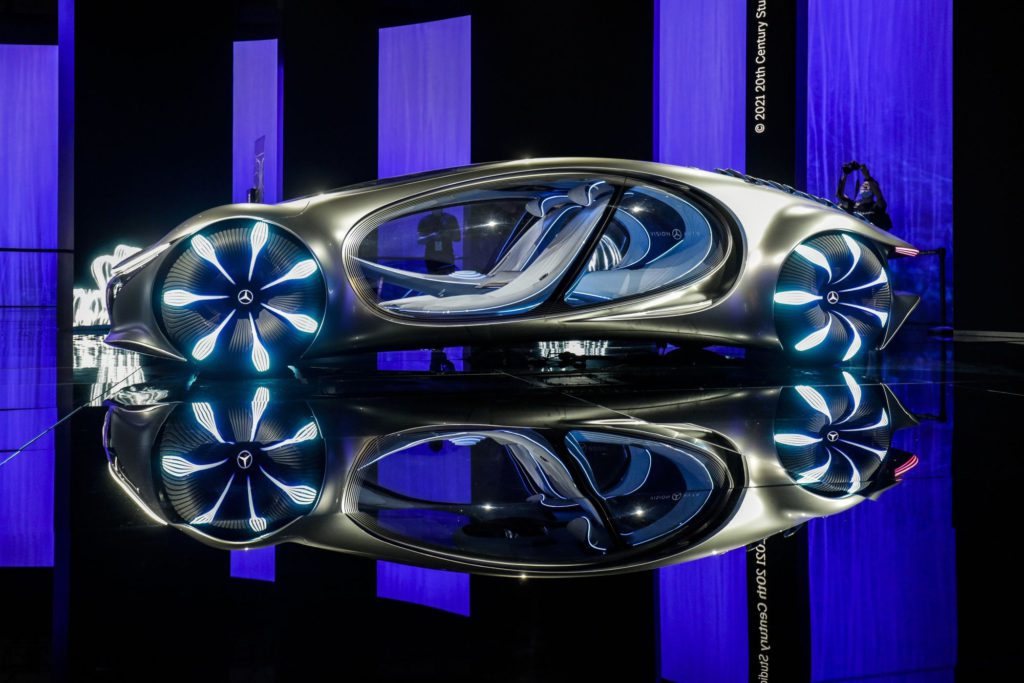
First released as a thought experiment at the Consumer Electronics Show in 2020, Vision AVTR rolls on four oversized wheels that look like cartoon donuts. Its dual ovoid doors, which double as large side windows, are not what you’d call “seaworthy.”

The vehicle is, however, an example of what Mercedes thinks cars should be decades from now: electric, efficient, and made from sustainable materials. It is seamless inside between front and rear, and morphs between drive modes and appearance based on the mood of the driver. Gorden Wagener, Mercedes-Benz’s design chief, says the car of the future should be like a living organism—able to engender the same feelings about it that we might feel toward animals or even pets. 

“We designed it as a holistic system,” he says. “Everything can be changed, and at the same time has an impact on the whole organism, or the car. The user experience as a central element is comparable to a symbiotic organism.”

When it was introduced two years ago in Las Vegas, Vision AVTR was heralded as part of Mercedes-Benz’s big plan to sell only electric vehicles by 2030—a design exercise to show the path forward, so to speak. Now trotted out a second time to coincide with the film’s release, it is also a huge marketing play: The car was created in partnership between Mercedes-Benz and Lightstorm Entertainment, the production company Cameron founded in 1990. Avatar is the top-grossing film of all time, raking in more than $2.9 billion since it was released in 2009. Hitching a ride on that juggernaut is a no-brainer. 

So, I was curious. When I was invited recently to have a drive, I got myself down to Manhattan Beach, California, to hop into the greenhouse cockpit as soon as I could.

I use the term “drive” loosely. It was really a few laps around a large production studio near the ocean. And I soon found out that operating the thing is more like guiding a large beast than steering a normal car. But I was happy for the chance to get into something so usable compared to a lot of the other concept cars brands promote, most of which don’t run at all. 

As I walked toward the AVTR (shorthand for the film but also for “Advanced Vehicle Transformation,” says Mercedes), it sensed my presence. Lights outlining its doors and seats and wheels begin to illuminate, and its curvaceous doors opened. Thirty-three “bionic flaps” on the back moved and changed colors from red, purple and blue to greet me. It was like having a giant pet–say, a dragon–excited to finally have me home.

Once inside, I placed my hand on a mound between the two front seats; the top of it was shaped kind of like a computer mouse. It vibrated and rose up a little bit to show it had come “alive,” and that we were now connected. Mercedes says the effect was made to mimic when the Na’vi people in Avatar movies place their hands on each other and say, “I see you.” 

Okay, I’ll go with it.

I partially reclined to settle into my seat and admired the interior, which was done in a mix of sustainable materials like rattan and vegan leather. The entire dashboard had became a giant infotainment screen controlled by waving my hand in front of it. I raised my palm, and the system projected a menu onto it, which I controlled by flicking my hand back and forth. It was a little difficult to read—had the cues been on a touchscreen they would have been crisper.

I toggled through different scenes projected onto the front of the car, choosing one that placed me in a world like Pandora, which is the fictitious land where the Avatar characters called the Na’vi live. Three real-life places—the Huangshan Mountains of China, California’s Redwood forest and its 380-feet-high Hyperion tree and the pink salt Lake Hillier in Australia—will also project onto the screen; it will show magnetic and ultraviolet light fields, too. They have no practical purpose at the moment but do set a futuristic mood in the car. 

After orienting myself inside and clearing the videos from the screen, the only thing to do was go. Vision AVTR boasts a combined motor power of more than 350 kW (469.3 horsepower) and all-wheel drive with torque vectoring. The battery system is especially unique. It uses graphene-based organic cell chemistry rather than the toxic and rare metals normally used for EVs. It will recharge in fewer than 15 minutes and boasts a range of 434 miles, according to Mercedes.

I did not come close to verifying those numbers, since the battery was hardly drained by my outing, but I can vouch for the car’s drivability. Operating the Vision AVTR is like playing golf or ping-pong: simple to learn, difficult to master. It would have helped had I been good at playing video games, because that’s what it felt like to pilot the car. (I should note that I was sitting on the right side of the car using my left hand to “drive”; Vision AVTR can be operated from either the right or left side.) To go forward, I pressed the top of the mound forward; to turn, I twisted it to the right or the left. I crab-walked it on diagonals by holding the controller in a 45-degree position and pressing forward. Look out Hummer EV!

Braking was easy, like regenerative brakes in existing EVs. I simply stopped pushing the controller forward and the car slowed. For quicker brakes, I pulled all the way back on it. The German engineer in the car with me said the scale-flap things stood more erect and grew brighter or laid lower with calmer colors depending on my driving style and speed, which sounded cool. I found myself thinking, Could this be the new robot pet I didn’t know I needed?

As I crossed the parking lot, the car felt smooth, more like gliding than driving as I gazed out of the glass roof and casually guided the car forward. I am not ready to trade in my good old-fashioned steering-wheel cars yet—they’re much more engaging, precise and nimble to drive. But this at least wasn’t annoying for an afternoon jaunt, and more fun than just another appliance on four wheels. I felt like I’d caught a glimpse of what a computerized automotive companion could be in the future.  

Sometime later, on my way to dinner one evening, I saw the Vision AVTR driving down Hollywood Boulevard with a police escort on its way to the Chinese Theater, where it would be for the movie’s premiere. I couldn’t help but think how cool it looked, and how proud I was to have driven it, even though it will never make it to production and lacks simple real-life necessities like side-mirrors, cup holders, storage space and proper bumpers. I’m not even convinced its cabin would be comfortable on summer days, since all the glass on the windshield and doors would seem to make it bake in the heat. But it still made me excited to think about the future of driving. As a thought experiment, Vision AVTR puts us one step closer to a point where car and human can be combined in some kind of friendly existence. I can’t wait to see it happen. 


More stories like this are available on bloomberg.com

©2022 Bloomberg L.P.

Close Bitnami banner
Bitnami