
Bloomberg

Stocks, US Futures Advance as Traders Await CPI: Markets Wrap

(Bloomberg) — US index futures and European equities rose amid forecasts inflation in the world’s largest economy will post the lowest figure this year, warranting a less hawkish Federal Reserve. 

Contracts on the S&P 500 and Nasdaq 100 advanced at least 0.1% each after the underlying indexes climbed on Monday by the most in December. The Stoxx 600 gauge was buoyed by energy and technology stocks. Treasuries gained marginally. Oil traded higher on signs of further easing in China’s Covid rules. Oracle Corp. jumped in premarket New York trading after posting results above expectations.

US stocks advanced Monday as traders took comfort from economists’ projection for a 7.3% expansion in the US consumer price index for November. If that expectation comes true, it would be the lowest reading in 11 months and the fifth consecutive drop. While that would still leave inflation much higher than the Fed’s target of 2%, it could justify a slowdown in the pace of monetary tightening, with a projected half-point move on Wednesday. However, it also leaves the bar low for disappointment and a selloff. 

“Today’s US CPI data will give us an idea on how the market pricing for the Fed’s terminal rate will clash with the dot plot projections that will come out tomorrow, and that will, in all cases, hammer any potentially optimistic market sentiment,” Ipek Ozkardeskaya, a senior analyst at Swissquote Bank, wrote in a note. “Therefore, even if we see a great CPI print and a nice market rally today, it may not extend past the Fed decision on Wednesday.”


The European equity benchmark recovered from Monday’s losses as traders awaited the US release but were also mindful of the European Central Bank’s rate decision due Thursday. The continent’s policymakers are expected to follow the Fed with their own half-point hike. Meanwhile, data showed that UK wages are rising at close to a record pace, maintaining pressure on the Bank of England to keep hiking interest rates despite a worsening economic outlook.

Treasuries advanced marginally with the 10-year rate shedding 1 basis point. The Bloomberg Dollar Spot Index traded below its 200-day moving average, having fallen below it earlier this month. An Asian equity benchmark rose after Hong Kong’s decision to scrap its three-day Covid monitoring period for arriving travelers. 

Crude oil rallied, with West Texas Intermediate futures climbing above $74 a barrel. China’s ambassador to the US said the nation will continue relaxing its curbs and will welcome more international travelers soon.


Oracle rose 2.4% in premarket trading.The software company reported quarterly sales that exceeded analysts’ estimates on a strong effort from its Cerner digital health records unit.


Key events this week:

  • US CPI, Tuesday
  • FOMC rate decision and Fed Chair news conference, Wednesday
  • China medium-term lending, property investment, retail sales, industrial production, surveyed jobless, Thursday
  • ECB rate decision and ECB President Lagarde briefing, Thursday
  • Rate decisions for UK BOE, Mexico, Norway, Philippines, Switzerland, Taiwan, Thursday
  • US cross-border investment, business inventories, empire manufacturing, retail sales, initial jobless claims, industrial production, Thursday
  • Eurozone S&P Global PMI, CPI, Friday

Some of the main moves in markets:

Stocks

  • The Stoxx Europe 600 rose 0.1% as of 9:45 a.m. London time
  • Futures on the S&P 500 rose 0.1%
  • Futures on the Nasdaq 100 rose 0.2%
  • Futures on the Dow Jones Industrial Average rose 0.1%
  • The MSCI Asia Pacific Index rose 0.2%
  • The MSCI Emerging Markets Index was little changed

Currencies

  • The Bloomberg Dollar Spot Index was little changed
  • The euro was little changed at $1.0540
  • The Japanese yen was little changed at 137.68 per dollar
  • The offshore yuan was little changed at 6.9896 per dollar
  • The British pound was little changed at $1.2277

Cryptocurrencies

  • Bitcoin rose 0.1% to $17,199.73
  • Ether fell 0.6% to $1,267.04

Bonds

  • The yield on 10-year Treasuries declined one basis point to 3.60%
  • Germany’s 10-year yield was little changed at 1.94%
  • Britain’s 10-year yield advanced five basis points to 3.25%

Commodities

  • Brent crude rose 1.1% to $78.88 a barrel
  • Spot gold rose 0.1% to $1,783.36 an ounce

This story was produced with the assistance of Bloomberg Automation.

–With assistance from Tassia Sipahutar and Jason Scott.

More stories like this are available on bloomberg.com

©2022 Bloomberg L.P.

Sam Bankman-Fried Arrested in Bahamas After US Files Charges

(Bloomberg) — Sam Bankman-Fried, the disgraced co-founder of digital-asset exchange FTX, was arrested in the Bahamas after the US government filed a criminal indictment, following weeks of speculation that client funds were misused before his empire’s collapse.

Bankman-Fried is being held in custody pending an extradition process, the island nation’s attorney general, Ryan Pinder, said in a statement Monday. 

Federal prosecutors in Manhattan plan to unseal the case against him Tuesday morning, “and will have more to say at that time,” Damian Williams, US attorney for the Southern District of New York, said in a separate statement. He didn’t elaborate on the allegations.

The Securities and Exchange Commission separately authorized civil charges relating to Bankman-Fried’s violations of securities laws, Enforcement Director Gurbir Grewal said in a statement. Those civil charges are expected to be filed publicly in Manhattan Tuesday, according to the statement. 

Bankman-Fried has been facing investigations in the US and the Bahamas, where FTX was headquartered, into a range of possible misconduct. One key inquiry has been whether customer funds were lent out to trading firm Alameda Research, which Bankman-Fried also founded. More than 100 FTX-related entities filed for US bankruptcy protections on Nov. 11. 

‘Powerful Evidence’

“To indict this early, when they didn’t have to, tells me that they have incredibly powerful evidence,” said Gene Rossi, a former federal prosecutor. Rossi added that prosecutors were probably “gravely concerned” that Bankman-Fried would flee to a jurisdiction where he could not be extradited.

The White House declined to comment on the arrest and charges.

House Financial Services Committee Chairwoman Maxine Waters told reporters the panel still plans to hold its hearing on FTX’s collapse. “It’s important for the American public to understand FTX and what was going on,” she said.

Bankman-Fried, 30, is being held at the Cable Beach police station in Nassau, according to an officer working at the facility. The person, who declined to give a name when reached by phone, said that all the cells there are comfortable, but didn’t provide details.

The facility is about 13 miles from the Albany Bahamas luxury community where Bankman-Fried lives and is located close to a main tourist zone.

Bankman-Fried’s arraignment is scheduled for Tuesday, according to a person familiar with the matter. His attorney, Mark Cohen of Cohen & Gresser, didn’t immediately respond to a request for comment outside normal business hours.

In media interviews since FTX’s collapse, Bankman-Fried has admitted major managerial missteps, but has also claimed that he never tried to commit fraud or break the law.

In his remarks prepared for the US House hearing that Bankman-Fried was scheduled to appear at on Tuesday, he offered a blunt assessment of his plight. 

“I would like to start by formally stating under oath: I f—-ked up,” Bankman-Fried said in draft copy of his remarks obtained by Bloomberg News. 

He added that the company’s new managers, led by restructuring expert John J. Ray III, have repeatedly rebuffed his offers to help sift through the wreckage of the collapsed crypto empire. Ray, who’s now leading the company, hasn’t responded to five of his emails, he said. 

Crypto Exchanges

Prior to the arrest and long before his empire collapsed into bankruptcy, federal prosecutors in Manhattan had already been looking into FTX as part of broader sweep of exchanges and potential anti-money laundering violations under the Bank Secrecy Act.

The investigation, led by the Complex Frauds and Cybercrime Unit, took a different trajectory after FTX’s catastrophic implosion.

Prosecutors were closely examining whether hundreds of millions of dollars were improperly transferred to the Bahamas around the time of FTX’s Nov. 11 bankruptcy filing in Delaware, according to a person familiar with the matter.

They were also digging into whether FTX broke the law by transferring funds to Alameda Research, the bankrupt investment firm also founded by Bankman-Fried, Bloomberg reported previously.

Last week, prosecutors, the FBI, Department of Justice officials and FTX’s new CEO and restructuring expert Ray met at SDNY’s headquarters in downtown Manhattan. Potential charges were not discussed at that meeting, according to a person familiar with the conversation.

–With assistance from Joanna Ossinger.

More stories like this are available on bloomberg.com

©2022 Bloomberg L.P.
Indonesia’s GoTo Jumps 24% After Relentless Selloff

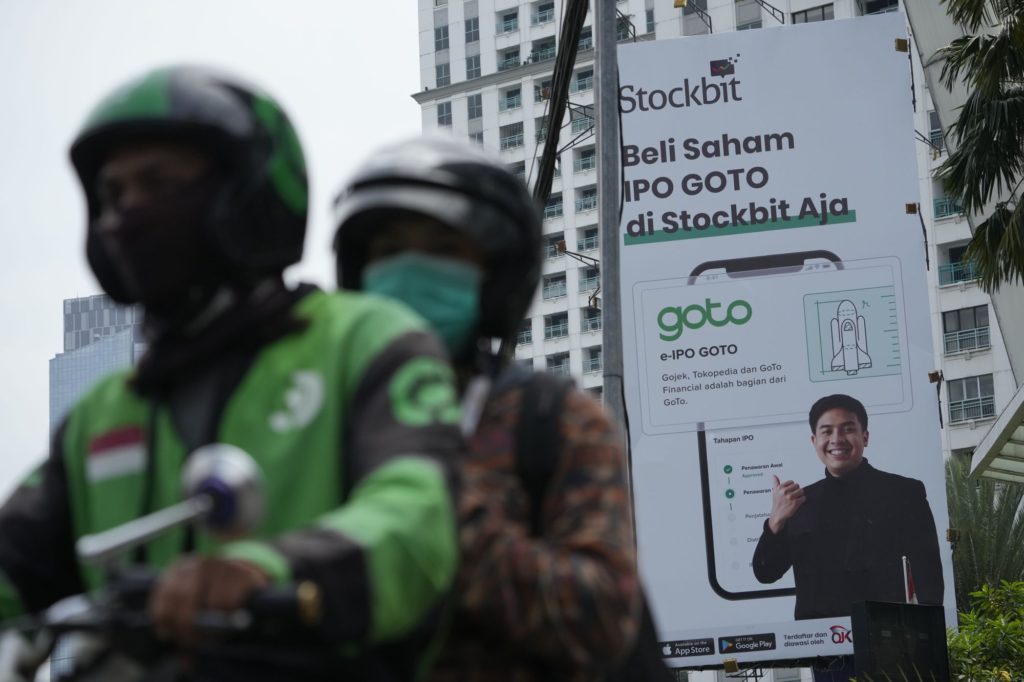
(Bloomberg) — GoTo Group jumped Tuesday by the most since May as some brokers upgraded the battered stock following weeks of sharp selloff.  

The Indonesian ride-hailing and e-commerce provider surged 15% to 100 rupiah, snapping 16 straight sessions of losses. Trading volume also soared to about 30 times its three-month average.

Even with today’s gain, the stock has plunged more than 70% since its April debut, which has prompted the Indonesia stock exchange to put GoTo in its watchlist for any unusual trading activity. The bourse can suspend trading in the stock if it detects anything suspicious. Shares touched as low as 81 earlier in the day, approaching the 50 rupiah-threshold set by the exchange that would reject any bid or offer below that level.

A number of analysts are turning more positive on the stock as valuations become more attractive. UBS AG and BNI securities upgraded their rating this week to buy from sell. That comes after Aletheia Capital said last week that GoTo is about six quarters away from a cash crunch and recommended investors sell the stock. 

GoTo is still trading at higher valuations compared to regional peers, but its “premium vs. peers has narrowed, making valuations attractive,” UBS analysts including Navin Killa wrote in a note dated Monday. “Steady progress toward profitability in should help the stock re-rate.”    

Like many technology companies worldwide, GoTo is confronting the effects of stiffer competition, economic slowdown and heightened investor focus on the bottom line. Selloff gathered pace following a Nov. 30 expiry of a lockup on its major shareholders’ stakes that freed them to reduce their holdings. It’s the worst performer among 11 tech and internet companies that raised more than $500 million in inaugural share sales this year. 

Efforts by the company’s executives last week to assuage investors that it has enough funds to last until reaching profitability have failed to turn around the bearish sentiment. GoTo said last month it’s cutting about 12% of its workforce, or 1,300 positions, after its losses mounted. 

“As for the latest bounce, the volumes that are traded are much higher than the daily average. It could be speculation that a white knight could be entering the fray,” said Nirgunan Tiruchelvam, an analyst at Aletheia Capital. “Alternatively, the core holders may be bolstering their position.”

–With assistance from Abhishek Vishnoi.

More stories like this are available on bloomberg.com

©2022 Bloomberg L.P.

Austrian Fund With Fresh Cash Wants to Be BlackRock of Startups

(Bloomberg) — An Austrian investor specializing in early-stage startups wants to model itself after the world’s largest money manager, BlackRock Inc., after raising one of Europe’s largest dedicated funds.

Vienna-based Speedinvest GmbH closed a fourth funding round with €500 million ($528 million) for so-called seed and pre-seed investments. The cash haul is the sixth largest this year among its peer group of European venture capitalists, that typically target later-stage investments, according to PitchBook data. It raises the company’s managed assets to more than €1 billion.

The fresh cash inflow comes amid strong headwinds for the industry, which is sliding toward its worst dealmaking year in more than two decades. That’s prompting Speedinvest — an early shareholder in companies including Bitpanda and GoStudent — to transform operations by allowing sector-focused teams to handle larger volumes of investment decisions.

Venture Capital Deals Set for Worst Drop in Over Two Decades

“It’s a shift from a boutique mom and pop investment style to a proper platform for seed-stage investing,” Speedinvest’s founder and managing partner Oliver Holle said in an interview. “You can call it the BlackRock of early-stage venture.”

The ambitions are bold in an environment where rising interest rates are ending a years-long boom in venture capital, and several high-profile corporate melt-downs have made investors wary of the asset class. BlackRock itself has come under fire recently for its focus on environmental, social and governance investing.  

Holle says US investors were reluctant to participate in the most recent round of funding due to the market volatility, and in part due to the stigma on European investments from Russia’s war on Ukraine. 

About two-thirds of the new cash came from existing investors, including New Enterprise Associates, the European Investment Fund and Bpifrance, as well as insurers and family offices. The fund is more than double the size of its previous investment vehicle raised in early 2020.

Holle plans to allocate €300 million to new startups and has earmarked €200 million for follow-up investments. Its teams focus on six sectors, giving a structure for allocations: deep tech, finance, health, consumers, industrial tech and software as a service.

“We think 2021 and to some degree 2020 was more the outlier than the norm, with both tourist money and tourist founders,” Holle said. “We do do things differently: there is method to the madness.”

More stories like this are available on bloomberg.com

©2022 Bloomberg L.P.

Equinix to Invest $160 Million in South Africa Data Center Entry

(Bloomberg) — Equinix Inc. plans to invest $160 million to build its first data center in South Africa, as part of the firm’s African expansion push. 

The US data center company will build its first facility in Africa’s richest city, Johannesburg, and expects to be operational by mid 2024, said Equinix EMEA president Eugene Bergen in an interview. The deal follows its acquisition of Nigeria’s MainOne, that valued the west African data center business at $320 million. 

“South Africa was a big target for Equinix as it is the most developed economy in sub-Saharan Africa,” said Bergen. “We are focusing to get into Africa, and we are looking at another five or six countries to enter.”

California-based Equinix is looking to take advantage of a predominantly young African population with increasing access to the internet that is providing a boon for the industry, albeit from a low base. 

With the South African deal, the global data center investor plans to serve large enterprises such as banks, content and media companies, and hyper-scalers operating in the country and on the continent, said Bergen. The company is seeking anchor customers that it could potentially follow to other African countries, said Bergen. “We expect the customer ramp-up in South Africa to go quite quickly,” he said.

Tech giants such as Amazon.com Inc. and Microsoft Corp. have also invested in data centers in African countries in recent years as demand for storage grows. The continent accounts for just 1% of global data center capacity, creating a large opportunity for investors that want to tap into the region’s growth potential, while taking on certain operating risks such as an unreliable power supply. 

While South Africa is home to the largest electricity supplier on the continent through its utility Eskom, there have been significant power interruptions as it struggles to replace its aging plants and meet growing power demand. Equinix’s Bergen said energy reliability was a strong focus for the business across its operations, and it takes various steps to ensure a stable supply including building its own power capacity, installing multiple back-up generators and making deals with local grids. 

Nasdaq-listed Equinix owns 249 data centers and operates in 32 countries. The South African deal comes soon after the company announced plans to expand into Indonesia and Malaysia. 

More stories like this are available on bloomberg.com

©2022 Bloomberg L.P.
GIC-Backed Unicorn in Talks to Acquire Foodpanda in Thailand

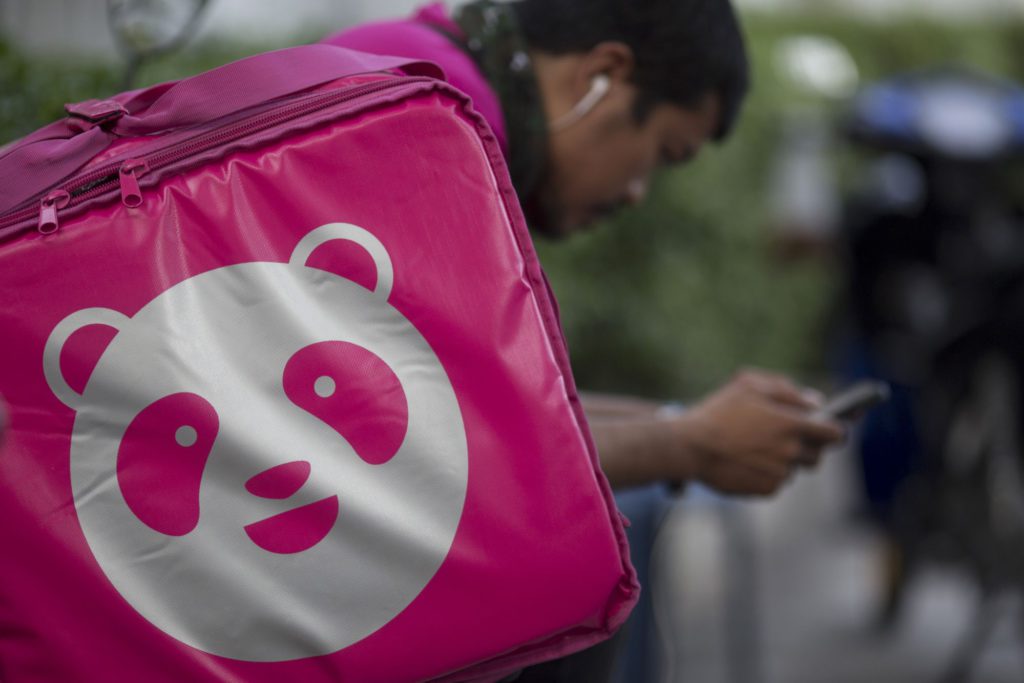
(Bloomberg) — Food delivery unicorn Line Man Wongnai is in talks to acquire Delivery Hero SE’s Foodpanda in Thailand as it plans for a stock-market debut in the next few years, according to people familiar with the discussions. 

Bangkok-based Line Man Wongnai considered a deal at around $100 million at one point, but the value is likely to have changed with the deterioration of the wider market and internal views toward loss-making businesses, said one of the people, who asked not to be named as the matter is private. The company is backed by Line Corp. and Singapore sovereign wealth fund GIC Pte.

No final decision has been made and talks could still fall through, the people said. Representatives for Line Man Wongnai and Line declined to comment. Representatives for Delivery Hero and Foodpanda didn’t immediately respond to requests for comment.

The potential takeover would bolster Line Man Wongnai’s pursuit of a spot among Thailand’s top online shopping platforms. Southeast Asia’s second-largest economy counts Line as its most popular messenger app. Tokyo-based Line merged with SoftBank Group Corp.’s Z Holdings Corp. in 2021 and is a major shareholder of Line Man Wongnai.  

Singapore’s GIC Leads $265 Million Round for Newest Thai Unicorn

Line Man Wongnai was formed in 2020 from the merger of delivery service Line Man and Thai restaurant review platform Wongnai. Its valuation topped $1 billion when it raised $265 million this year. Grab Holdings Ltd. and Foodpanda are its biggest competitors in Thailand.

The move comes as Berlin-based Delivery Hero is seeking to accelerate a plan to reach profitability by 2023. Chief Executive Officer Niklas Oestberg suggested during a conference call a month ago that while his company has a strong position in countries such as Malaysia and the Philippines, it may exit in some markets where it’s not No. 1. “We are not looking to sell our Southeast Asia business, but there may be markets in Southeast Asia, or in other regions, where we are in discussions,” he said. 

That has triggered speculations whether ride-hailing and food delivery giant Grab may consider acquiring some assets. Grab’s chief financial officer, Peter Oey, said during an earnings call last month that Grab is focused on “organic growth” instead. “Cash preservation is critical for us,” he said in response to questions from analysts. “Our bar on M&A is extremely high.”

The biggest recent consolidation move in the sector came last week when Turkey’s Getir acquired Berlin-based Gorillas Technologies GmbH for $1.2 billion.

–With assistance from Olivia Poh.

More stories like this are available on bloomberg.com

©2022 Bloomberg L.P.

Stocks Pare Gains; Dollar Steady Before CPI Data: Markets Wrap

(Bloomberg) — Stocks in Asia came off their session highs as investors redirected their focus toward US inflation data that may shape the outlook for interest-rate hikes into next year.

An Asian equity benchmark pared gains, after an earlier advance that was spurred by Hong Kong’s decision to scrap its three-day Covid monitoring period for arriving travelers. US and European futures rose. 

The dollar was little changed. Treasury yields inched lower after gains on Monday that sent the 10-year rate to above 3.6%. Yields for benchmark government bonds in Australia, New Zealand and Japan ticked higher.

Investors will be closely watching the consumer price figures later Tuesday, which are expected to remain elevated even as the rate of increase slows. A subdued CPI print would justify the Federal Reserve’s projected half-point move on Wednesday and shed light on whether markets can expect rate cuts in late 2023. 

IG Australia said it saw potential for a 2%-3% initial rally in the S&P 500 and a dollar sell-off in the event that headline inflation comes in a range of 7%-7.2%. 

“If headline came in lower, say high 6s, we could see an initial 5% rally in the S&P 500, with scope for similar gains again into year-end, amplified by low liquidity and bullish seasonals,” said Tony Sycamore, a market analyst at IG Australia.

Other central banks are also set to announce their final rate decisions of the year this week. The European Central Bank will announce its rate decision Thursday, and may also opt for a half-point hike. Markets will also contend with decisions from the Bank of England and monetary authorities in Mexico, Norway, the Philippines, Switzerland and Taiwan.

Still, BlackRock Investment Institute thinks markets are “wrong” to expect central banks to come to the rescue with rate cuts in light of recessions. 

“The US equity rally and yield curve inversion show that markets are clinging to central banks’ old recession playbook,” a team of BlackRock analysts wrote in a note. “We think stocks could fall again if markets stop expecting policy easing. The gap between market expectations and the Fed’s intentions will start to close over time, in our view.”

Investors are also weighing the impact of Japan and the Netherlands agreeing in principle to at least partially join the US in increasing controls over the export to China of advanced machinery to make semiconductors. Trading of Asian semiconductor stocks was mixed on the news.

Elsewhere, oil advanced for a second day on signs of further easing of China’s Covid restrictions and as a key North American pipeline remained shut. Gold rose.

Key events this week:

  • US CPI, Tuesday
  • FOMC rate decision and Fed Chair news conference, Wednesday
  • China medium-term lending, property investment, retail sales, industrial production, surveyed jobless, Thursday
  • ECB rate decision and ECB President Lagarde briefing, Thursday
  • Rate decisions for UK BOE, Mexico, Norway, Philippines, Switzerland, Taiwan, Thursday
  • US cross-border investment, business inventories, empire manufacturing, retail sales, initial jobless claims, industrial production, Thursday
  • Eurozone S&P Global PMI, CPI, Friday

Some of the main moves in markets:

Stocks

  • S&P 500 futures rose 0.1% as of 2:57 p.m. Tokyo time. The S&P 500 rose 1.4%
  • Nasdaq 100 futures rose 0.1%. The Nasdaq 100 gained 1.2%
  • Japan’s Topix index rose 0.5%
  • Hong Kong’s Hang Seng Index rose 0.8%
  • China’s Shanghai Composite Index rose 0.2%
  • Australia’s S&P/ASX 200 Index rose 0.3%

Currencies

  • The Bloomberg Dollar Spot Index fell 0.1%
  • The euro rose 0.1% to $1.0551
  • The Japanese yen was little changed at 137.57 per dollar
  • The offshore yuan rose 0.1% to 6.9817 per dollar

Cryptocurrencies

  • Bitcoin was little changed at $17,184.44
  • Ether fell 0.2% to $1,272.34

Bonds

  • The yield on 10-year Treasuries declined one basis point to 3.60%
  • Japan’s 10-year yield rose 0.5 basis point to 0.25%
  • Australia’s 10-year yield advanced two basis points to 3.40%

Commodities

  • West Texas Intermediate crude rose 1.3% to $74.15 a barrel
  • Spot gold rose 0.2% to $1,785.60 an ounce

This story was produced with the assistance of Bloomberg Automation.

–With assistance from Jason Scott.

More stories like this are available on bloomberg.com

©2022 Bloomberg L.P.

Italy’s Government Wants More Pull in the Business World: Here’s What to Watch

(Bloomberg) — A string of long-festering corporate crises in Italy could offer the rightwing administration of Prime Minister Giorgia Meloni a chance to make its mark on the business world and expand state influence over the economy.

Government officials say Rome is now seeking greater control over a number of strategic sectors, signaling a readiness to deploy billions of euros in state money to shore up ailing companies in areas from telecommunications, to energy, to aviation. 

While the approach meshes with Meloni’s pledge to protect national production and favor domestic firms, it also risks imposing a high cost on a country that already suffers from a mammoth debt load and sluggish growth.

Here are the companies to watch:

Telecom Italia

Rome is scrambling to find a way to shore up debt-ridden Telecom Italia SpA, and it’s called the ex-phone monopolist’s multi-billion-euro landline grid a strategic asset. Cabinet Undersecretary for Telecommunications Alessio Butti says the government wants “a state-controlled, wholesale-only, national network.”

The project could include an eventual merger between Telecom Italia and smaller state-backed rival Open Fiber SpA, though the grid’s valuation has been a sticking point, with Telecom Italia advisers assessing it at around €20 billion ($21 billion) and top shareholder Vivendi SE at about €31 billion, people familiar with the matter said earlier this year. 

That’s forced Rome to put a bid by state lender Cassa Depositi e Prestiti SpA — the carrier’s biggest shareholder and the top investor in Open Fiber — on hold. KKR & Co. could also bid for the network in partnership with the government, people familiar with the matter have said.

ITA Airways

The Meloni government is looking to retain an oversight role at ITA Airways, which is hemorrhaging cash and risks running out of funds, as part of a possible deal with Deutsche Lufthansa AG.

That would signal a change of approach from the previous administration’s willingness to cede control of the carrier. 

One option under review is seeking special powers to influence or veto governance or strategy at ITA — the successor to troubled flagship Alitalia — following the sale of a stake to Lufthansa. 

Ilva

The Ilva steel works has been a headache for a series of governments since being placed under administration almost a decade ago. Ilva is now operated by a company majority-owned by ArcelorMittal, with a state-led firm as a minority shareholder. 

The Meloni government isn’t planning an outright nationalization of Ilva, Industry Minister Adolfo Urso said last week, preferring to raise fresh funds with ArcelorMittal’s help. Italy had previously agreed to raise its stake to 60% by May 2024.

Ilva, which this year expects to produce about 3 million tons of steel — only about half of its original target — employs around 10,000 people. 

ISAB Lukoil Refinery

The government has paved the way for putting the ISAB refinery, owned by Russia’s Lukoil PJSC, under temporary administration, citing its strategic importance for oil and gas supply. Industry Minister Urso, however, denies that the refinery is destined for nationalization.

The Sicily-based refinery is one of Europe’s biggest oil-processing complexes, with a combined capacity of well over 300,000 barrels a day, according to data compiled by Bloomberg. Talks to sell it to non-Russian investors have been going on for months. 

Negotiations with US-based Crossbridge Energy Partners LLC could be completed soon, according to a Reuters report, while an investor group led by Qatar’s Ghanim Bin Saad Al Saad could also make an offer, daily la Repubblica reported. The government says it will set conditions and could veto any deal because the refinery is deemed to be strategic. 

Monte dei Paschi 

Finance Minister Giancarlo Giorgetti recently confirmed to lawmakers that Italy is committed “to managing the exit of the state” from lender Banca Monte dei Paschi di Siena SpA “in an orderly way.” 

Italy has repeatedly bailed out Paschi, and the state now owns over 64% of the lender. An attempt by the country’s last government to sell Paschi to UniCredit SpA collapsed. 

Last month the state injected about €1.6 billion in fresh funds into the troubled lender, part of a €2.5 billion share sale needed to replenish capital buffers and finance more than 4,000 job cuts.

Ansaldo Energia

The government has called energy-plant turbine maker Ansaldo Energia SpA an “extremely important technological asset,” signaling support for a rescue package led by Cassa Depositi after the company ran into trouble amid the recent gas market downturn.

Workers at the company made headlines earlier this autumn by shutting down traffic in Genoa — where the company is based — while management worked on a turnaround plan, its second in two years. 

Under that proposal, now being reviewed by creditors, Cassa Depositi will need to write off more than €200 million in loans and inject €300 million into the business, while bank debt will be restructured. Cassa Depositi already led a €400 million recapitalization in 2020.


–With assistance from Daniele Lepido and Sonia Sirletti.

More stories like this are available on bloomberg.com

©2022 Bloomberg L.P.

China Courts South Korea as US Chips Campaign Gains Steam

(Bloomberg) — China said it was ready to build better ties with South Korea, courting a key US ally and microchip producer amid Washington’s campaign to curb Beijing’s access to advanced semiconductor technology.

China was “willing to work with South Korea to adhere to the general direction of good-neighborliness and friendship,” while also strengthening “strategic communication,” Foreign Minister Wang Yi said in a video meeting with counterpart Park Jin on Monday. He said the two nations should “ensure safe and smooth production and supply chains, maintain the international free trade system, and strengthen cooperation on regional and global issues,” according to the Chinese Foreign Ministry.

While the Chinese readout didn’t mentioned partnership with South Korea on chips, Wang criticized the US’s CHIPS and Science Act and the Inflation Reduction Act, which have sought to secure American access to key technologies in Washington’s strategic competition with Beijing. The laws hurt both China and South Korea, Wang said, describing the US as “saboteurs rather than builders” of international rules.

The remarks hint at Chinese worries about the Biden administration’s campaign to curb the tech ambitions of the world’s No. 2 economy. Japan and the Netherlands have agreed in principle to join Washington in tightening controls over the export of key chipmaking machinery to China, Bloomberg News reported Tuesday. 

Japan Said to Join US Effort to Tighten China Chip Exports

The US has also been pressuring South Korea to comply with the export controls. A US delegation that includes Assistant Secretary of State for East Asian and Pacific Affairs Daniel Kritenbrink is visiting South Korea and Japan this week. The group met Chinese officials in Langfang, near Beijing, on Sunday and Monday.

South Korea has increasingly found itself caught between its top security ally and biggest trader partner as competition intensifies between the world’s largest economies. South Korean Trade Minister Ahn Duk-geun said in October that key chip producers Samsung Electronics Co. and SK Hynix Inc. had won approval from the US to keep operating in China, but that concerns remain over the impact of Washington’s sweeping restrictions.  

Why Making Computer Chips Has Become a New Arms Race: QuickTake

On Monday, China challenged the US’s chip curbs at the World Trade Organization, saying the restrictions threaten the stability of the global supply chain. Matt Murray, the US’s senior official for Asia-Pacific Economic Cooperation, sought to play down the dispute during an interview Tuesday with Bloomberg News.

“The WTO is the kind of place to have those sorts of conversations about disputes,” Murray said. “We have disputes in the WTO with some of our closest friends such as Canada. There’s going to be trade disputes that are brought to the WTO. That’s what it’s for.”

–With assistance from Philip J. Heijmans and Jing Li.

More stories like this are available on bloomberg.com

©2022 Bloomberg L.P.
Byju’s Lenders Seek Quicker Part-Payment of $1.2 Billion Loan

(Bloomberg) — A group of creditors to Byju’s, India’s most valuable startup, has asked the company to immediately repay part of a $1.2 billion loan they recently bought into as they renegotiate terms of the debt, according to people familiar with the matter.

The lenders have hired Houlihan Lokey Inc. to advise them on amending covenants after the edtech titan breached terms, including a September deadline for filing its results for the year ended March 31, 2022, the people said, asking not to be identified as the information isn’t public. Rothschild & Co. is representing Byju’s in the talks, they said.

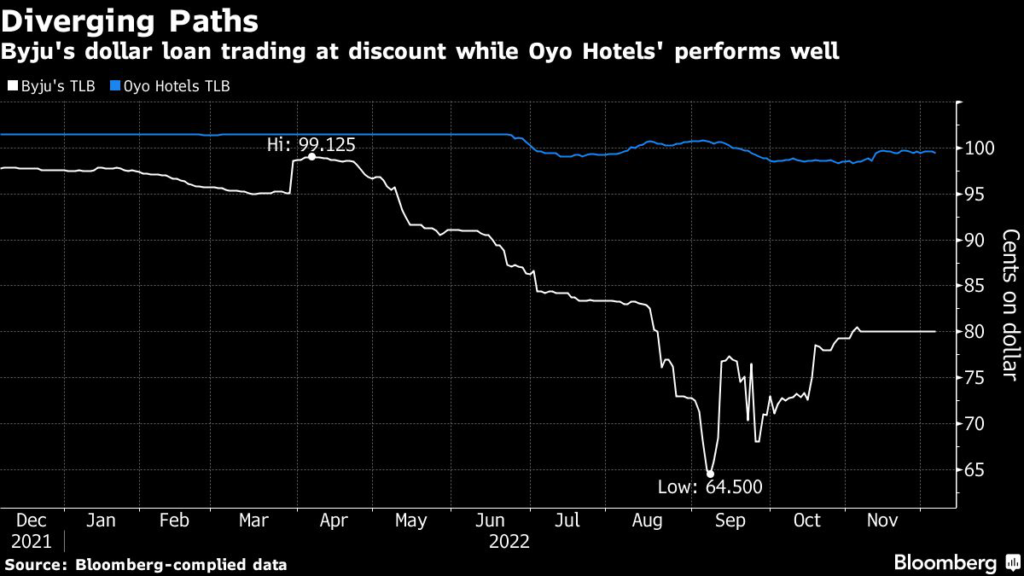
Most of the lenders in this group bought the debt from primary holders in September, when the loan slumped to a record 64.5 cents, and are seeking to profit from accelerated repayment, two of the people said. Spokespersons for Byju’s, Houlihan Lokey and Rothschild declined to comment.


The loan was trading at 80 cents on the dollar on Monday, while similar debt from another Indian startup Oyo Hotels is holding close to the issue price, according to data compiled by Bloomberg. 

The renegotiated terms that Byju’s has already agreed with a majority of the lenders include providing monthly business updates, hiring a chief financial officer, and increasing the interest rate on the loan, the people said. The company is seeking to restructure the loan as it struggles with steep losses and meeting its cost reduction targets, Bloomberg News reported earlier this month.

However, a small group of creditors are still holding out asking the company, valued at $22 billion, to use its US unit’s cash reserves of about $850 million to prepay part of the year-old loan, the people said. The loan, priced at 550 points over Libor in November 2021, is one of the largest unrated term loan B offerings ever from a new-age company worldwide, according to JPMorgan Chase & Co., one of the deal’s bookrunners.


–With assistance from Divya Patil.

More stories like this are available on bloomberg.com

©2022 Bloomberg L.P.

Close Bitnami banner
Bitnami
