

Bloomberg

Peloton Debuts Long-Awaited $3,195 Rowing Machine as Part of Comeback Bid

(Bloomberg) — Peloton Interactive Inc. is launching its long-awaited rowing machine, a $3,195 product aimed at expanding the fitness company’s appeal and helping reverse a sales slide.

The company will start taking orders for the Peloton Row on Tuesday and begin initial deliveries to US customers in December. Peloton has been working on the new machine for several years, with Bloomberg News first reporting on the project in 2019. The shares climbed as much as 2.9% in premarket trading Tuesday.

The device marks Peloton’s first major new piece of exercise equipment since 2020, when it debuted a cheaper version of its treadmill. Like the company’s other products, the Row has a dark exterior design with a touch screen for viewing workout content and classes. The Row’s 23-inch (58-centimeter) display is designed to swivel, and customers can store the machine vertically on a wall when they’re not using it.

Peloton could use another hit product. Its exercise bikes were a hot item during the early days of the pandemic, but demand fell off steeply once people returned to offices and gyms. The hope is to lure new users with the rowing machine and get them hooked on Peloton’s subscription services.

The Row will use Peloton’s delivery and installation service, which is included in the overall price. The company has begun to wind down its in-house logistics teams, relying instead on third-party providers. Peloton also is switching to bikes that users can assemble themselves and has started selling products via Amazon.com Inc. But those options aren’t available for the new device.

The Peloton Row’s screen has three main modes: Form Assist, Form Rating and Insights, and Personal Pace Targets. The first feature shows users how to adjust their form while rowing, while the second one rates their form. The last mode allows users to set custom pace targets for working out during classes.

Peloton shook up its management in February, bringing in Chief Executive Officer Barry McCarthy to turn around the fitness company. But the comeback has been slow to take hold, and the shares remain down more than 90% in the past year.

McCarthy is trying to streamline the company by pulling several levers, including layoffs, parting ways with longtime executives, a shift away from in-house manufacturing, entering new sales channels and shuttering the majority of its retail stores.

At $3,195, the Peloton Row becomes one of the priciest rowing machines on the market. NordicTrack’s highest-end rower is $1,799, while competitors like Aviron and Ergatta have machines that top out under $2,500. Peloton argues that its device is superior because of its design, software and content integration, as well as the equipment’s near-silent row movements. 

The Row requires Peloton’s $44-per-month subscription to access any rower content, a slight shift from its bikes, which include three basic classes without the service. Users who already have subscriptions can expand them to include the Row without paying extra.

The Row becomes Peloton’s second-most-expensive device, behind its $3,495 Tread. McCarthy said in August that the company needs to generate more cash, and pricier products like the Row could help bolster revenue. The New York-based company also has been steering customers toward a new leasing program, which combines the hardware and content costs into a single monthly price, but that offering isn’t available for the Row. 

The company said last month that revenue will come in between $625 million and $650 million in its first fiscal quarter, missing Wall Street estimates by over $100 million. The Row will launch in the second quarter, and the company hasn’t said how it may affect sales. Peloton also didn’t say when it would be available outside the US.

McCarthy is aiming to make the company cash flow positive in the second half of the coming fiscal year. “We continue to make steady progress, but we still have work to do,” he said in August.

(Updates with early trading.)

More stories like this are available on bloomberg.com

©2022 Bloomberg L.P.
Nasdaq Makes First Big Crypto Push to Lure Institutional Clients

(Bloomberg) — Nasdaq Inc. is making its first major push into crypto, as the second-largest stock exchange prepares to capitalize on increasing appetite for digital currencies among big-money investors. 

A new group dedicated to digital assets will initially offer custody services for Bitcoin and Ether to institutional investors, according to Tal Cohen, the company’s executive vice president and head of North American markets. Nasdaq hired Ira Auerbach, who ran prime broker services at crypto exchange Gemini, to head up the new Nasdaq Digital Assets unit.  

Wall Street’s biggest firms are deepening their involvement as institutional investor interest persists despite a downturn that cost jobs and depressed prices. BlackRock Inc. partnered with Coinbase Global Inc. to make it easier for investors to trade Bitcoin and shortly after offered its first investment product directly in the token. EDX Markets, a new exchange backed by Charles Schwab Corp., Fidelity Digital Assets, Citadel Securities and Virtu Financial among others, will start trading some tokens this year.

“We believe this next wave of the revolution is going to be driven by mass institutional adoption,” Auerbach said in an interview. “I can think of no better place to bring that trust and brand to the market than Nasdaq.”

As a custodian of digital assets — a step which is pending approval from the New York Department of Financial Services — Nasdaq would be competing with crypto firms such as Coinbase, Anchorage Digital and BitGo. A small number of financial firms, including BNY Mellon and State Street, also provide crypto custody for institutions, although a recent Securities and Exchange Commission accounting guideline has made holding tokens on behalf of clients more capital intensive.

“Custody is foundational,” Cohen said in an interview. “Off the back of custody, we can start to develop other solutions, offer execution services, liquidity services, and think about how we support new markets.” 

While Nasdaq has no immediate plans to launch a crypto exchange, it will evaluate the opportunity based on the regulatory environment and competitive landscape, Cohen said. 

Nasdaq has been focused on diversifying its revenue sources beyond the exchange business where shares in public companies trade. It’s made investments in software, data and other offerings. The company also outsources its own software to crypto players, including surveillance and trading tools. It already provides matching engine technology to crypto exchanges such as Bitstamp. 

Rules of the Road

Still, Nasdaq’s overall approach to the space has been more cautious because of questions around regulation, Chief Executive Officer Adena Friedman said in a May Bloomberg interview. But regulation can also provide opportunity, according to Cohen. 

“We know how to operate under regulatory regimes, and we continue to innovate under the rules of the road,” Cohen said. “Embracing regulation as it comes is something we do. And institutions want us to operate under that framework.”

Nasdaq is also open to exploring partnerships and deal opportunities with crypto-native firms, though has no plans in the short-term to make an acquisition, said Auerbach, who will be senior vice president and head of digital assets, reporting to Cohen. The team is looking to build internally and hire externally, reaching 40 people by year-end, he said. 

Nasdaq also expanded the technology it offers crypto companies tied to protection and anti-crime software including through the company’s Verafin and Surveillance product, which can help investigate and report instances of money laundering, fraud and manipulation for banks and trading firms. 

More stories like this are available on bloomberg.com

©2022 Bloomberg L.P.
Tencent Denies Report It Will Sell Down Didi, Meituan Stakes

(Bloomberg) — Tencent Holdings Ltd. denied a report it was considering selling down investments in companies from Meituan to KE Holdings Inc. to bankroll share buybacks and new businesses.

The company has no need to raise funds nor a timeline for such divestments, a spokesperson said. Dow Jones had reported earlier on Tuesday that the WeChat operator recently completed a review of its worldwide portfolio, and identified companies such as Didi Global Inc. that it may sell down. Shares in real estate firm KE slid as much as 3.9% in pre-market trading in New York. 

Tencent Chief Strategy Officer James Mitchell said last month that a Reuters report it intends to sell all or much of its stake in food delivery giant Meituan was incorrect.

But speculation that Tencent would unwind some of its vast portfolio has persisted. The company has long been expected to reduce some of its vast investments in companies around the globe over time, responding in part to political pressure.

Since last year, the Chinese giant has disclosed plans to sell shares in investees such as e-commerce giant JD.com Inc. and Sea Ltd., as Beijing punishes the country’s tech giants for anti-competitive behavior, including maintaining closed ecosystems that favor certain firms at the expense of others. The trend has weighed on the stocks of companies with Tencent ownership.

“We don’t have any target amounts for divestments. We have always invested with the goal of generating strong returns for our company and shareholders, not according to any arbitrary timeline or target,” a Tencent spokesperson said in a statement. The company hasn’t reached out to any investment banks regarding divestments, the spokesperson added.

(Updates with share action from the second paragraph)

More stories like this are available on bloomberg.com

©2022 Bloomberg L.P.

DeFi Lender Maple Debuts Bitcoin Mining Fund Charging Up to 20%

(Bloomberg) — Crypto lending platform Maple has set up a $300 million credit fund for Bitcoin miners, charging as much as 20% interest on their loans. 

The new fund launches just as more mining firms come under stress. Bitcoin’s low prices, soaring energy costs and network competition have compressed miners’ revenues to a two-year low. Fundraising opportunities from traditional capital market and other crypto-native financiers have also dried up. 

Maple, which previously did business as Maple Finance, was founded in Sydney in 2019 and launched its first lending pool in May 2021. Most of the team has relocated to Miami, Florida, since its inception. Through its newly established fund, the lender will offer secured debt financing to large-scale Bitcoin miners and mining infrastructure providers in North America. 

Icebreaker Finance, which is a financial services firm based in Sydney, will manage and administer the loans on Maple’s platform, according to Sidney Powell, CEO of Maple. 


The fund plans to secure the loans with a mix of Bitcoin mining rigs, power assets and tokens, while digital assets will form a relatively small portion of the collateral, said Icebreaker’s CEO, Glyn Jones. The loans will have a tenor of 12 to 18 months with interest rates ranging between 15% to 20%. Borrowers’ credit quality will be determined based on financial performance, balance sheet strength, treasury and energy risk management expertise and operational efficiency, Jones added.

Although there is typically little insight into crypto lenders’ loan books with miners, capital allocators for the new fund will be able to use the platform’s on-chain lending vehicle where loan terms are visible for better price discovery, said Powell.

Maple is considered one of the major crypto lending marketplaces within the DeFi space. The company says it has issued close to $1.8 billion of loans so far and holds 50% of the market, as measured by total loans outstanding across institutional DeFi lending platforms.

More stories like this are available on bloomberg.com

©2022 Bloomberg L.P.
Hong Kong Arrests Man Mourning Queen Under Colonial Sedition Law

(Bloomberg) — Hong Kong police used a colonial-era law intended to protect the British monarchy to arrest a man near a memorial for Queen Elizabeth II.

A 43-year-old man was detained late Monday “on suspicion of committing an act with seditious intent” on a road near Britain’s consulate, police said in a statement on Tuesday.

Police didn’t offer details on why he was arrested. Videos posted online Monday night showed people attending the memorial singing “Glory to Hong Kong,” the unofficial anthem of protesters during the historic and sometimes violent unrest that shook the financial hub in 2019.

Hong Kongers have been lining up for hours in recent days to sign a condolence book for the Queen at the consulate and leave flowers on the sidewalk. Some have waved British flags and posted signs reading “I love Hong Kong.”

The consulate said earlier on Twitter that it was extending its opening hours because wait times could be more than three hours. It warned people to wear clothing appropriate for the hot weather.

The consulate did not immediately respond to a request for comment about the arrest.

Elizabeth II’s Funeral Draws Leaders Amid Pageantry, Hymns

The 1938 Crimes Ordinance the man was arrested under defines sedition as speech or publications bringing hate or contempt to “Her Majesty, her heirs or successors” or the government.

Authorities in Hong Kong — which once guaranteed free speech — have arrested at least 60 people under the law since September 2020 as part of a crackdown on dissent that has sent scores of journalists, politicians and civil society figures to prison.

The sedition law was ignored for decades but the city has been using it in tandem with national security legislation Beijing imposed on the city in 2020. Beijing defends the changes it has made in Hong Kong, including a revamp of the electoral system to ensure only loyalists can govern, as necessary to restore order and economic progress.

Internet users in China have been critical of expressions of sympathy for the Queen, whose state funeral was held Monday. One target of their ire was Hong Kong actress Carina Lau, who posted messages of condolences on social media platforms.

One person asked on the Twitter-like Weibo service whether it was Chinese to be sad about the Queen’s death.

Hong Kong Cantonese opera star Law Kar-ying apologized on Weibo and declared himself a patriot after he was attacked on Weibo for praising the Queen.

More stories like this are available on bloomberg.com

©2022 Bloomberg L.P.
Australian Lithium Auction Sees Record Bid as World Prices Surge

(Bloomberg) — An auction of lithium from an Australian miner just attracted its highest-ever winning bid.

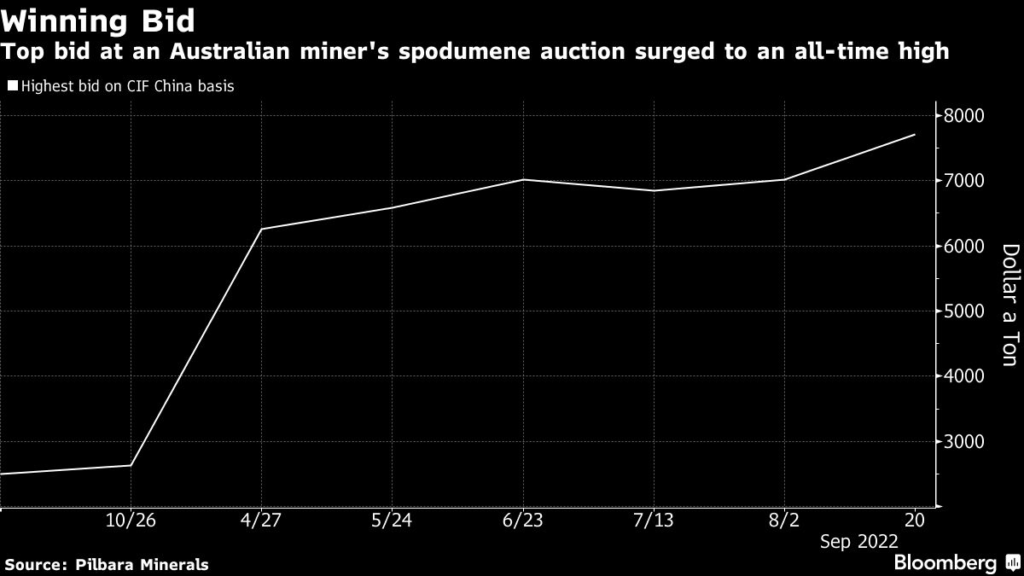
Pilbara Minerals Ltd. said a buyer will pay the equivalent of $7,708 a ton for spodumene concentrate — a partly-processed form of lithium — delivered to China. The sale of the 5,000-ton cargo on Tuesday compares with a top bid of $7,012 at the last auction on the miner’s Battery Material Exchange in early August.

The jump is roughly in line with gains for refined lithium in China, where prices of the battery material have been racking up new records since last week as robust demand from electric vehicles meets tightening supply. Rocketing costs threaten to worsen pressure in the supply chain that’s already eroding profits and prompting battery producers to hike their own selling prices.

Soaring prices are already worrying authorities in China. Officials last week asked major lithium firms to ensure that prices don’t deviate too much from production costs, and urged consumers to strike long-term agreements.

More stories like this are available on bloomberg.com

©2022 Bloomberg L.P.
Stocks Decline as Traders Eye Supersized Fed Hike: Markets Wrap

(Bloomberg) — Stocks fell, giving up early gains, as traders braced for another supersized US rate hike amid rising anxiety the Federal Reserve could overtighten and raise the odds of a hard landing.

The Stoxx 600 Index dropped 0.4%, paced by losses on real estate and miners. US equity futures also declined, with those on the tech-heavy and rate-sensitive Nasdaq 100 underperforming S&P 500 peers.

The US central bank kicks off its meeting today and is expected to again hike rates by 75 basis points Wednesday, signal rates are heading above 4% and will then pause. The long hold strategy is rooted in the idea the central bank would avoid the disastrous stop-go policy of the 1970s that allowed inflation to get out of hand. Market participants have dialed back expectations of an even larger increase and only two of 96 economists in a Bloomberg survey now predict a full-point move.

“The Federal Reserve is likely tightening policy straight into the teeth of a recession,” Danielle DiMartino Booth, CEO and chief strategist of Quill Intelligence, wrote in an email.  “The stock market’s addiction to Fed easing when stocks decline may be what Jerome Powell is aiming to quash by aggressively hiking rates, in addition to inflation.”


Treasury 10-year yields hovered near 3.5% while yields on the more policy-sensitive two-year rate hit the highest since 2007 and are poised to crack above 4%, reflecting hard-landing fears.

Swap contracts that forecast rates over the next two years now peak around 4.5% in March 2023 — a full point higher than was expected after the last meeting in July.

Markets have fairly priced in yield on the two-year Treasury inching closer to 4% and “it might scratch a bit higher, but not an awful lot at this point,” Peter Kinsella, head of foreign exchange strategy at Union Bancaire Privee Ubp SA, said on Bloomberg Television. It would still be reasonable for the 10-year Treasury yield to go towards 3.5% or 3.7%, “but there’s probably not a lot more juice in that trade,” he said.

In China, banks kept their main lending rates unchanged after the central bank paused its monetary easing and defended a weakening yuan.

Elsewhere, Bitcoin struggled to return to the $20,000 level. Oil slipped below $86 per barrel and gold fell.

Will the Nasdaq 100 Stock Index hit 10,000 or 14,000 first? This week’s MLIV Pulse survey focuses on technology. It’s brief and we don’t collect your name or any contact information. Please click here to share your views.

Key events this week:

  • US housing starts, Tuesday
  • EIA crude oil inventory report, Wednesday
  • US existing home sales, Wednesday
  • Federal Reserve decision, followed by a news conference with Chair Jerome Powell, Wednesday
  • Bank of Japan monetary policy decision, Thursday
  • The Bank of England interest rate decision, Thursday
  • US Conference Board leading index, initial jobless claims, Thursday

Some of the main moves in markets:

Stocks

  • The Stoxx Europe 600 fell 0.4% as of 10:19 a.m. London time
  • Futures on the S&P 500 fell 0.3%
  • Futures on the Nasdaq 100 fell 0.5%
  • Futures on the Dow Jones Industrial Average fell 0.2%
  • The MSCI Asia Pacific Index rose 0.7%
  • The MSCI Emerging Markets Index rose 0.9%

Currencies

  • The Bloomberg Dollar Spot Index rose 0.2%
  • The euro fell 0.2% to $1.0007
  • The Japanese yen fell 0.4% to 143.76 per dollar
  • The offshore yuan fell 0.3% to 7.0227 per dollar
  • The British pound was little changed at $1.1427

Bonds

  • The yield on 10-year Treasuries advanced four basis points to 3.53%
  • Germany’s 10-year yield advanced nine basis points to 1.90%
  • Britain’s 10-year yield advanced 10 basis points to 3.23%

Commodities

  • Brent crude rose 0.7% to $92.60 a barrel
  • Spot gold fell 0.5% to $1,667.80 an ounce

More stories like this are available on bloomberg.com

©2022 Bloomberg L.P.

The Quest for Cheaper Bitcoin Mining Power Continues North

  • Listen to Bloomberg Crypto on the iHeartRadio App
  • Listen to Bloomberg Crypto on Apple Podcasts
  • Listen to Bloomberg Crypto on Spotify  

(Bloomberg) — Sweden and Norway are home to some of the most abundant energy sources in the world — including geothermal, wind and hydro electricity. 

Which helps explain why these countries have been becoming so attractive to Bitcoin miners. Unfortunately for those miners, the combination of Russia’s invasion of Ukraine along with rising inflation and environmental factors like drought, are curbing the availability of cheap electricity in these Nordic regions. Miners in some of these areas could even be regulated out of the market. 

So miners are on the move again, forever chasing that combination of abundant electricity for relatively low prices. This time, they’re heading north of the Arctic Circle. Bloomberg Editor Lars Paulsson joins this episode to discuss what’s happening in the region.

Follow us on Twitter @crypto, and subscribe to the Bloomberg Crypto Newsletter at https://bloom.bg/cryptonewsletter

More stories like this are available on bloomberg.com

©2022 Bloomberg L.P.

SEC Suit Hints at Case for US Jurisdiction Over Ethereum Network

(Bloomberg) — The saga over cryptocurrency regulation took another twist courtesy of a comment buried in a Securities and Exchange Commission lawsuit that hints at a case for US jurisdiction over the Ethereum blockchain.

The suit lodged Monday is against the founder of a crypto investment research firm over allegedly undisclosed incentives linked to an initial coin offering. It also detailed the movement of Ether tokens in relation to the case.

Those Ether transactions originated in America and “were validated by a network of nodes on the Ethereum blockchain which are clustered more densely in the US than in any other country,” the SEC said. “As a result, those transactions took place in the US.”

The comment appears in the 69th paragraph of the 23-page filing, a lowly position which perhaps cautions against reading too much into it. Still, it winks at the possibility of a case for US jurisdiction over the most commercially important blockchain based on where the bulk of its computing happens.

The SEC didn’t immediately reply to an email outside of regular business hours seeking comment.

“The bigger issue here is the problems over jurisdiction of blockchain activities more generally,” said Elizabeth Morton, research fellow at Australia’s RMIT Blockchain Innovation Hub. “Multiple jurisdictions with their own regulatory frameworks can make independent claims.”

Over $40 billion is sitting in decentralized-finance applications on Ethereum, which lets users trade, lend and borrow coins, DeFi Llama data shows.

The digital ledger is used by people in many countries. According to Etherscan, about 46% of all Ether nodes — computers helping to operate and secure the network — are in the US, followed by nearly 19% in Germany.

The SEC was already circling Ether, the blockchain’s native token, after the digital ledger’s upgrade last week to a much more energy-efficient system. 

SEC Chair Gary Gensler signaled a feature of this revised approach, whereby Ether holders can earn financial rewards by allowing the network to use some of their assets, could fall under securities rules. 

Decentralized blockchains sprawling across computer networks around the globe, and tokens that can make or lose billions of dollars in the blink of an eye, are giving regulators headaches. They are also stirring a contest among agencies for the right to manage oversight.

More stories like this are available on bloomberg.com

©2022 Bloomberg L.P.

Asia Stocks Extend Gains Ahead of FOMC Meeting: Markets Wrap

(Bloomberg) — Stocks extended gains in Asia after a rebound in the final hour of New York trading as investors shifted positions ahead of a flurry of central bank decisions this week led by the Federal Reserve.

MSCI Inc.’s Asia-Pacific equity index advanced for the first time in six days. Hong Kong stocks rallied amid a report that Hong Kong plans to relax Covid curbs for travelers. Japan’s Nikkei 225 earlier jumped by as much as 1.2% after traders returned from a holiday. S&P 500 and Nasdaq 100 futures edged higher.

Treasury 10-year yields hovered near 3.5% while yields on the more policy-sensitive two-year rate hit the highest since 2007 and are poised to crack above 4%, amid fears that an overtightening of monetary settings raises the odds of a hard landing.

Investors are on tenterhooks as they await policy decisions that are expected to bring hefty rate hikes from the US, UK and Sweden. Decisions are also due in Japan, Switzerland, Indonesia, Norway and the Philippines, among others.

The dollar was little changed below recent highs, while the yen was held comfortably under the key 145 level. The yuan was on the weak side of 7 versus the dollar.

Traders are betting the Fed will hike by 75 basis points Wednesday, signal rates are heading above 4% and will then pause. The long hold strategy is rooted in the idea the central bank would avoid the disastrous stop-go policy of the 1970s that allowed inflation to get out of hand. 

“We recognize that after this week’s hike the funds rate will be placed comfortably into  ‘restrictive’ territory,” Kevin Cummins, the chief US economist at NatWest Markets, wrote in a note. “It seems reasonable that officials will continue to err on the side of doing too much rather than too little and keep front-loading.”

Swap contracts that forecast rates over the next two years now peak around 4.5% in March 2023 — a full point higher than was expected after the last meeting in July.

Markets have fairly priced in yield on the two-year Treasury inching closer to 4% and “it might scratch a bit higher, but not an awful lot at this point,” Peter Kinsella, head of foreign exchange strategy at Union Bancaire Privee Ubp SA, said on Bloomberg Television. It would still be reasonable for the 10-year Treasury yield to go towards 3.5% or 3.7%, “but there’s probably not a lot more juice in that trade,” he said.

In China, banks kept their main lending rates unchanged after the central bank paused its monetary easing and defended a weakening yuan.

Elsewhere, Bitcoin struggled to return to the $20,000 level. Oil slipped below $86 per barrel and gold fell.

Will the Nasdaq 100 Stock Index hit 10,000 or 14,000 first? This week’s MLIV Pulse survey focuses on technology. It’s brief and we don’t collect your name or any contact information. Please click here to share your views.

Key events this week:

  • US housing starts, Tuesday
  • EIA crude oil inventory report, Wednesday
  • US existing home sales, Wednesday
  • Federal Reserve decision, followed by a news conference with Chair Jerome Powell, Wednesday
  • Bank of Japan monetary policy decision, Thursday
  • The Bank of England interest rate decision, Thursday
  • US Conference Board leading index, initial jobless claims, Thursday

Some of the main moves in markets:

Stocks

  • S&P 500 futures increased 0.2% as of 7:06 a.m. in London. The S&P 500 rose 0.7%
  • Nasdaq 100 futures gained 0.2%. The Nasdaq 100 climbed 0.8%
  • Japan’s Topix index climbed 0.5%
  • South Korea’s Kospi index added 0.5%
  • Hong Kong’s Hang Seng Index rose 1.1%
  • China’s Shanghai Composite Index increased 0.1%
  • Australia’s S&P/ASX 200 Index surged 1.2%
  • Euro Stoxx 50 futures gained 0.4%

Currencies

  • The Bloomberg Dollar Spot Index rose 0.1%
  • The euro fell 0.1% to $1.0017
  • The Japanese yen dropped 0.2% to 143.42 per dollar
  • The offshore yuan was at 7.0177 per dollar, down 0.2%

Bonds

  • The yield on 10-year Treasuries was steady at 3.49%
  • Australia’s 10-year yield fell four basis points to 3.64%

Commodities

  • West Texas Intermediate crude climbed was steady at $85.76 a barrel
  • Gold fell 0.3% to $1,671.02 an ounce

More stories like this are available on bloomberg.com

©2022 Bloomberg L.P.

Close Bitnami banner
Bitnami