Bloomberg

Uber Blames Notorious Extortion Gang Lapsus$ for Hack

(Bloomberg) — Uber Technologies Inc. said the hacker responsible for a data breach reported last week is affiliated with a notorious extortion group named Lapsus$, which also targeted technology companies including Microsoft Corp., Cisco Systems Inc., Okta Inc. and Samsung Corp. this year. 

Uber shut down some of its internal software and messaging systems on Thursday, after an attacker infiltrated its network and sent employees messages warning that Uber had been hacked. 

“We believe that this attacker (or attackers) are affiliated with a hacking group called Lapsus$, which has been increasingly active over the last year or so,” a company spokesperson said in an announcement Monday. 

Uber also acknowledged unconfirmed reports over the weekend that the same perpetrator had breached video game publisher Rockstar Games, and said it was working with the FBI and the US Department of Justice to investigate its breach. 

Uber said it did not believe the attacker had gotten into its public-facing systems, such as user accounts or databases that store sensitive or financial information. They did not access any customer data stored by its cloud providers including Alphabet Inc.’s Google and Amazon Web Services, it added. 

Uber said it was “likely” that the attacker bought an Uber contractor’s password on the dark web, after that contractor’s personal device had been infected with malware. The attacker managed to hijack the two-factor login approval by inundating the contractor with requests, which they eventually accepted. From there, the intruder was able to get into several employee accounts and had security permissions for Uber’s G-Suite and Slack, among other internal tools. 

Uber also discovered that the attacker downloaded internal Slack messages and an internal tool the finance team uses to manage some invoices.

All software vulnerability reports the attacker accessed through Uber’s HackerOne dashboard had already been remediated, alleviating concerns that the hacker had access to vulnerabilities in Uber’s code. HackerOne assists with Uber’s bug bounty program, which allows ethical hackers to search for flaws which could lead to breaches in return for payment, or bounty.

More stories like this are available on bloomberg.com

©2022 Bloomberg L.P.

Analyst Had $5 Million Deal to Push ICO, SEC Says

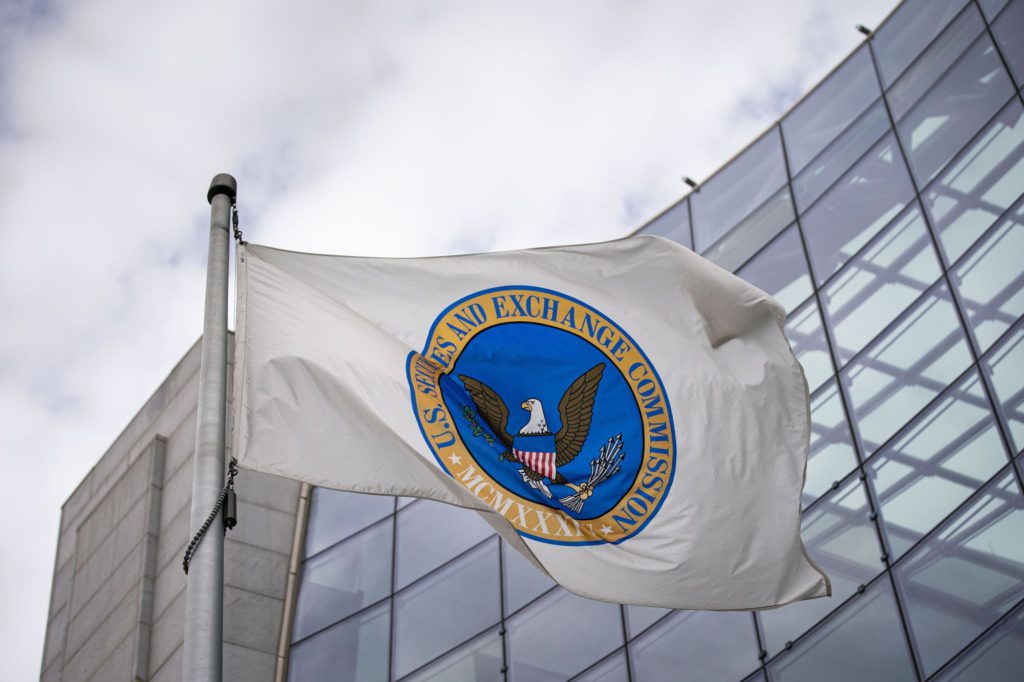
(Bloomberg) — The founder of a cryptocurrency investment research firm was accused by the SEC of promoting an initial coin offering without disclosing that he had been given a $5 million allocation in the coin to do so.

Ian Balina, 33, promoted the SPRK token on social media platforms including YouTube and Telegram without revealing that he had been compensated by the company that offered it, the Securities and Exchange Commission said in a suit filed Monday in federal court in Austin, Texas. 

While the SEC didn’t identify Balina’s firm, the description matches that of Token Metrics, an Austin-based firm that provides “AI-based cryptocurrency ratings and price predictions.” Balina’s bio on the site describes him as a “former IBM Watson Analytics evangelist” who has “built million-dollar businesses from the ground up.”

Balina, a self-described crypto asset investor, promoter and influencer, documented his investment process and research on YouTube and other social media outlets through an online diary called “Diary of a Made Man.”

The SEC said the company behind SPRK, Sparkster Ltd., a software development company incorporated in the Cayman Islands, raised about $30 million from almost 4,000 investors in an unregistered offering that took place between April and July 2018. 

According to the SEC, Balina asked Sparkster for an allocation of the coin before he began promoting it on social media. The company agreed to let him purchase approximately $5 million worth. It also gave him a 30% bonus in tokens.

The SEC further accused Balina of organizing an investing pool of about 50 people and offered them the chance to buy tokens from him upon their release without registering. 

Balina’s lawyer, Stephen Galebach, didn’t immediately respond to an email seeking comment. Token Metrics also didn’t immediately respond to a request for comment.

The case is US v Balina, 22-cv-950, US District Court, Western District of Texas (Austin.)

(Corrects description of benefit to Balina throughout.)

More stories like this are available on bloomberg.com

©2022 Bloomberg L.P.

NYC to Offer Free Broadband to 300,000 Public Housing Residents

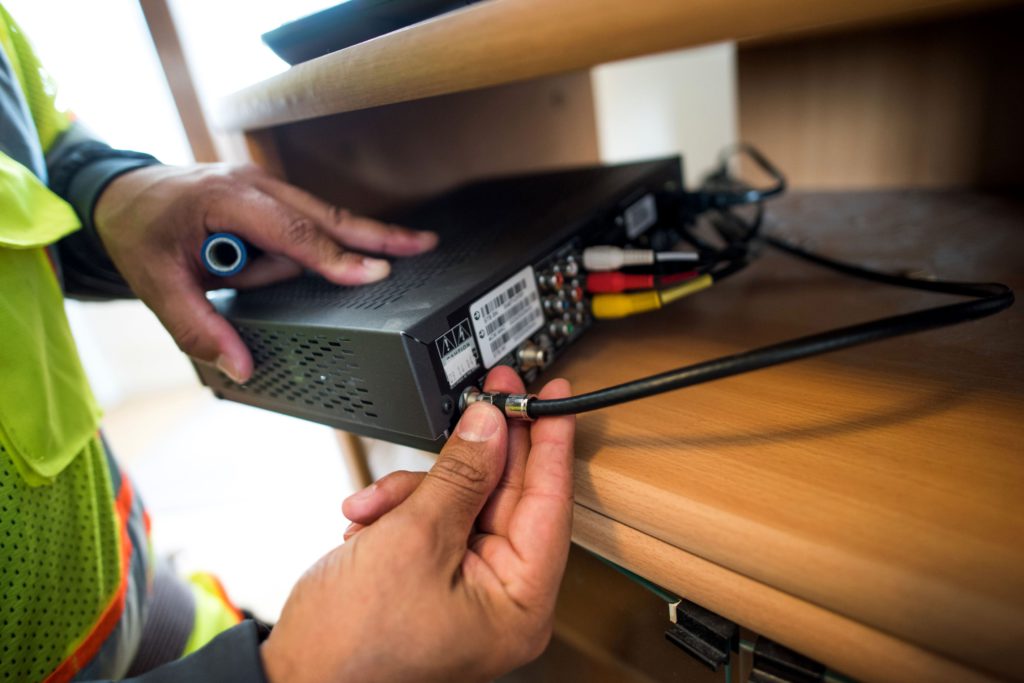
(Bloomberg) — New York City is partnering with Charter Communications Inc. and Altice USA Inc. to provide free high-speed internet and basic cable TV service to about 300,000 residents of public housing. 

Called “Big Apple Connect,” the program aims to bridge the digital divide between wealthier residents and lower-income people who lack the tools necessary for remote learning, access to health care and job opportunities, city officials said. An estimated 30% to 40% of people who live in buildings run by the New York City Housing Authority lack broadband, according to the cable providers.

“In 2022, in the wealthiest city in the country, no one should go without access to the internet,” Chief Housing Officer Jessica Katz said in a statement. “It is vital to our daily lives, to succeeding in school and in work, and is how we stay connected as a society.”

The city plans to have the service available in more than 200 NYCHA buildings by the end of 2023.

The program differs from a previous short-term promotion by Altice’s Optimum and Charter’s Spectrum that gave New York City students free internet service after the pandemic hit. Some parents said they were duped into signing up for paid subscriptions after the promotion ended.

Under a three-year agreement with the providers, New York will pick up the cost at about $30 per household. The city is in talks with a third major cable TV carrier in the city, Verizon Communications Inc., to join the program.

NYCHA residents enrolled in Big Apple Connect will still be able to use the federal Affordable Connectivity Program benefit to save money on their cell phone bills and provide discount of up to $30 per month toward internet and cellular data service, city officials said.

More stories like this are available on bloomberg.com

©2022 Bloomberg L.P.

Stocks Churn With Wall Street on Hold Before Fed: Markets Wrap

(Bloomberg) — Stocks whipsawed as traders geared for another super-sized US rate hike amid mounting fears on whether the Federal Reserve could overtighten and raise the odds of a hard landing.

The equity market had a tough time finding direction, with Treasury 10-year yields hovering near 3.5%. The two-year rate, which is more sensitive to imminent Fed moves, hit the highest since 2007. The dollar fluctuated.

Traders are pricing in the Fed will hike by 75 basis points Wednesday, signal rates are heading above 4% and will then pause. The long hold strategy is rooted in the idea the central bank would avoid the disastrous stop-go policy of the 1970s that allowed inflation to get out of hand. While a case can be made for going bigger, a shock full-point hike could add to recession jitters. 

“This Fed meeting is going to have global markets at the edge of their seats,” wrote Matt Miskin, co-chief investment strategist at John Hancock Investment Management. “Speculating on the market’s reaction to short-term Fed moves is nearly impossible to predict on several levels. For example, markets may deem it dovish for them to do just a 0.75% rate hike as the whisper is that it could be 1.00%.”

Ed Yardeni, president of his namesake research firm who nailed the market bottom in 1982 and 2009, sees the Fed boosting rates by 100 basis points this month, with Chair Jerome Powell and the central bank’s economic projections looking hawkish. He noted that could cause the S&P 500 to retest its June 16 low of 3,666.77, roughly 5% below current levels.

To Sam Stovall, chief investment strategist at CFRA Research, a full-point hike would “unnerve Wall Street” as it would imply a central bank “overreacting to the data rather than sticking to its game plan.” Following the previous seven rate increases of that magnitude, the US equity benchmark fell four times each over one-, three-, and six-month periods, he added.

Read: Morgan Stanley, Goldman Warn of Valuation Risk as Earnings Wilt

While a policy surprise could certainly move markets, the Fed’s revised forecasts for where the policy rate will ultimately come to rest and how long it’s likely to stay at that level will be equally important. Swap contracts that forecast rates over the next two years now peak at 4.5% in March 2023 — a full point higher than was expected after the last meeting in July.

“Due to current negative indicators including high inflation and the Fed’s upcoming rate announcement, global economic growth concerns and earnings expectations, we expect to see a continued negative pattern in the near-term,” said Mark Hackett, chief of investment research at Nationwide. “It will not take much good news to light a fire under the market, but we don’t expect that good news to come in the next few weeks.”

In a sign of how severe the equity beatdown has been, the S&P 500 has been trading below a key technical level for the longest stretch since the global financial crisis. Its long-term trend has turned “sharply lower recently,” and the index has closed below its 200-day moving average for 110 trading sessions, the longest streak since the bear markets of 2008-2009 and 2000-2002, according to Bespoke Investment Group.

In the five-week period that started in mid-August and ended Sept. 7, long-only institutional investors sold $51.2 billion worth of US-traded stocks — roughly a quarter of what they dumped in the prior 31 weeks of this year, according to an S&P Global Market Intelligence analysis. The data don’t include last week, when a surprising inflation print stoked concerns of a Fed tightening that’s more aggressive than expected.

“Volatility is expected to remain heightened through the remainder of this year at a minimum,” said Megan Horneman, chief investment officer at Verdence Capital Advisors. “Until there is consistent improvement from inflation, timing the peak in Fed rate hikes is challenging. We do not suggest selling into the volatility. While we do not rule out a testing of the June S&P 500 low, we would look at it as a potential buying opportunity and focus on areas that are reflecting the potential downside in economic growth and earnings.”

Every major bottom in the last 15 years hasn’t culminated until the Cboe VIX Index started trading 10 volatility points higher than the VIX futures two months from now, signaling a front-month inversion of the volatility curve, data compiled by BTIG LLC show. That’s yet to happen in this year’s rout. Even as the VIX curve shifted higher and became flatter, it’s still in its usual upward-sloping shape, meaning the here-and-now cost for protection is lower than several months out.

Read: US CLO Loan Downgrades Near 10% as Bankruptcies Rise, BofA Says

Bond issuers also seem cautious about the market now. Four potential high-grade borrowers looked at selling bonds Monday, but ultimately opted to stand down amid a volatile start to trading. Supply is now running well below forecasts for September, with rapidly rising yields derailing some issuers’ plans.

In a time-tested harbinger of an economic downturn, short-term US rates have exceeded yields on longer maturities for months. The MLIV Pulse survey, which drew 737 responses, showed that the bulk of contributors expect a deeper inversion. Some see it reaching levels last seen in the early 1980s, when Paul Volcker ratcheted up borrowing costs to break the back of hyperinflation.

The majority of the MLIV survey’s contributors say it’s best to bet on dollar gains, and 44% prefer to sell stocks.

Key events this week:

  • US housing starts, Tuesday
  • EIA crude oil inventory report, Wednesday
  • US existing home sales, Wednesday
  • Federal Reserve decision, followed by a news conference with Chair Jerome Powell, Wednesday
  • Bank of Japan monetary policy decision, Thursday
  • The Bank of England interest rate decision, Thursday
  • US Conference Board leading index, initial jobless claims, Thursday

Some of the main moves in markets:

Stocks

  • The S&P 500 was little changed as of 2:31 p.m. New York time
  • The Nasdaq 100 was little changed
  • The Dow Jones Industrial Average was little changed
  • The MSCI World index fell 0.2%

Currencies

  • The Bloomberg Dollar Spot Index was little changed
  • The euro was little changed at $1.0010
  • The British pound was little changed at $1.1412
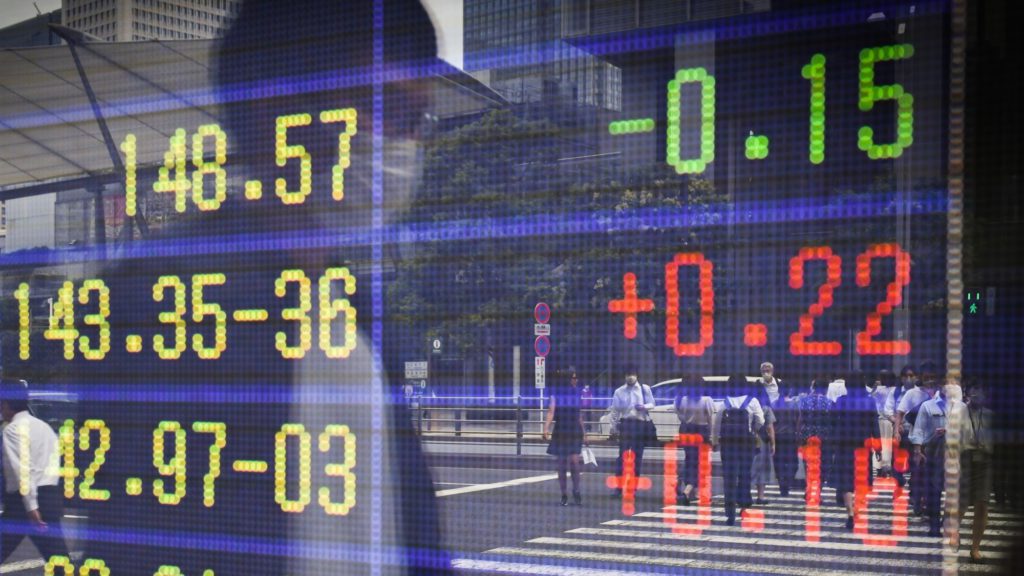
  • The Japanese yen fell 0.3% to 143.36 per dollar

Bonds

  • The yield on 10-year Treasuries advanced three basis points to 3.48%
  • Germany’s 10-year yield advanced five basis points to 1.80%

Commodities

  • West Texas Intermediate crude rose 0.6% to $85.63 a barrel
  • Gold futures fell 0.2% to $1,679.40 an ounce

More stories like this are available on bloomberg.com

©2022 Bloomberg L.P.

Banks Push Ahead to Offload Risky LBO Debt Ahead of Fed Meeting

(Bloomberg) — A group of banks led by Barclays Plc and Bank of America Corp. is moving forward with a risky leveraged buyout financing despite the volatility gripping the market ahead of the Federal Reserve’s rate decision Wednesday.

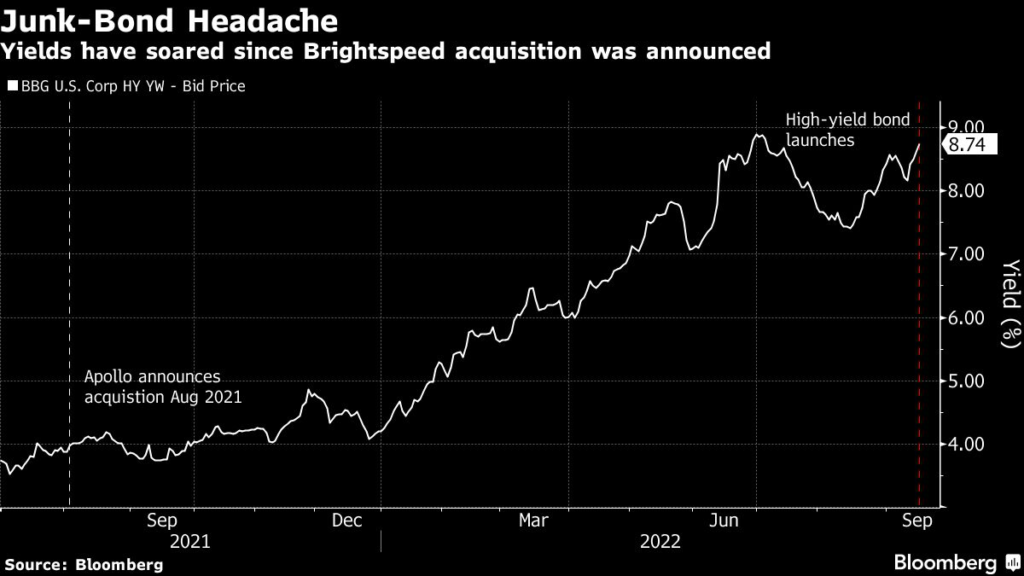
An $1.87 billion secured high-yield bond was launched Monday, led by Barclays, to help finance Brightspeed’s acquisition by Apollo Global Management Inc. Early pricing discussions call for an 8% coupon with a discount that will bring the all-in yield to 10%, according to people familiar with the matter. 

A $2 billion leveraged loan sale, led by Bank of America, was also kicked off. That loan was launched at a discount of 92 cents on the dollar, Bloomberg reported on Friday. 

Debt tied to leveraged buyouts has been more difficult to sell to investors as the outlook for the global economy darkens. Banks are offering bonds and loans to money managers at steep discounts to entice them to buy. Pricing discussions for the $4 billion secured bond tied to Citrix Systems Inc.’s leveraged buyout widened Monday to a yield of 9.5% to 9.75%, up from the 9.5% maximum Bloomberg previously reported. The cloud computing company’s bonds are being offered at a discount as low as 84.6 cents. 

In an effort to reduce the amount they need to sell in the institutional leverage loan market, banks are converting a portion of the financing into a term loan A. The $1 billion term loan A for Brightspeed will be held by the banks themselves for now, according to people familiar with the matter.

Apollo said in August of last year that it would buy part of Lumen Technologies Inc.’s business for $7.5 billion, carving out a new company called Brightspeed, which will provide broadband and telecommunications services for homes and businesses. 

The timing suggests that the debt was likely underwritten in a stronger market. The average leveraged loan price traded around 98 cents on the dollar last August compared to the approximately 94 cents currently. The average yield for junk bonds, meanwhile, was around 4% when the deal was announced.

There is an investor call for Brightspeed’s seven-year notes at 11 a.m. New York time on Tuesday. Small group calls are scheduled through Sept. 28 with bond pricing expected next week. 

Barclays, Apollo, Brightspeed and Lumen declined to comment. Bank of America did not immediately respond to requests for comment. 

(Updates with term loan A details and additional details throughout.)

More stories like this are available on bloomberg.com

©2022 Bloomberg L.P.

Crypto Firm Fights SEC by Claiming Its Investors Have No Rights

(Bloomberg) — Cryptocurrency firm Ripple Labs Inc. sought to defeat a Securities and Exchange Commission suit by claiming that its XRP token isn’t a security subject to the regulator’s authority.

Ripple over the weekend filed a motion seeking dismissal of the suit before trial in federal court in Manhattan. The company argued that XRP can’t be considered a security because there was no “investment contract” granting investors rights or requiring the issuer to act in their interests.

In a 2020 suit, the SEC accused Ripple and its top executives of misleading XRP investors. The case is expected to help define the commission’s ability to regulate cryptocurrency assets and could impact dozens of other digital coins.

The regulator is attempting to assert jurisdiction over any asset transfer that it “think may benefit from the registration and disclosure requirements of the securities laws,” Ripple said in its weekend filing.

“The SEC’s untethered position would convert the sale of all types of ordinary assets – diamonds, gold, soybeans, cars, and even works of art – into sales of securities. Congress has given the agency no such authority,” Ripple said. 

The regulator also asked for a ruling in its favor without trial, saying a purchase of the token is an “investment in a common enterprise with other XRP holders and with Ripple” and and that investors expected to earn a profit from buying the token.

“Defendants cannot dispute the content of their many public statements about Ripple and XRP,” the SEC said. “Nor can Defendants dispute either the vast record of the efforts they made consistent with those representations or the economic reality: Ripple funded its business by touting XRP’s profit potential, selling and distributing XRP to public investors while keeping a large amount of XRP for itself.”

The case is SEC v Ripple Labs Inc., 20-cv-10832, US District Court, Southern District of New York (Manhattan).

More stories like this are available on bloomberg.com

©2022 Bloomberg L.P.

San Francisco’s Biggest Conference Is Back But a Full Recovery Remains Elusive

(Bloomberg) — Tens of thousands of techies will frolic through kitschy national park-themed decorations in San Francisco’s downtown this week as Salesforce Inc.’s annual Dreamforce conference returns in full after two pandemic years.

It will easily be the largest conference the city has seen since early 2020, said Joe D’Alessandro of the San Francisco Travel Association. Company and city leaders are touting the event as a symbol of pandemic recovery, with the estimated $40 million of revenue that Dreamforce will generate for the city and a new $25 million donation to city schools.

But, the downtown that conference attendees will be coming back to is still marked by the pandemic. Office vacancy rates are higher now than after the great recession, population has slipped more than any other major US city, companies have left the region for cheaper tech hubs and persistent work-from-home leaves the streets a bit emptier.

Read more about San Francisco’s struggles

Even Salesforce, which is the namesake tenant of San Francisco’s tallest building, has cut office space in the city where it’s headquartered, fully embracing a hybrid work model without any mandatory return-to-office minimums. And just like many of its employees, the largest San Francisco employer is increasingly splitting its time between the city and suburbs — the company opened a new retreat called Trailblazer Ranch about 70 miles south of the city for bringing aboard new workers and other events. 

“We’re known for our towers, we’re known for our events,” said co-Chief Executive Officer Bret Taylor in an interview with Greylock Partners last year. “I joke that half the people who aren’t in tech have no idea what Salesforce does.”

For just $1,999-a-ticket beginning Tuesday, you can listen to speakers like retired basketball star Magic Johnson or actress Jennifer Hudson, catch a Red Hot Chili Peppers benefit concert and even grab a free copy of Bono’s memoir. There are also hundreds of those technical panels that are the point of the conference.

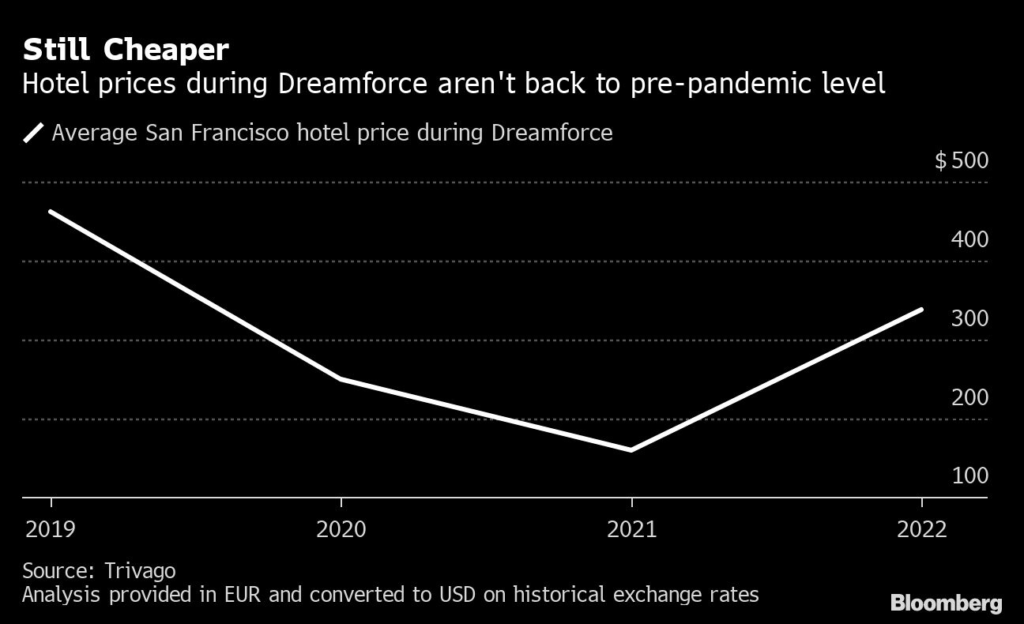
Hotel prices reflect the influx of visitors — the average price for a double room is about 46% more expensive during this Dreamforce than last year’s scaled-down event, according to data from travel website Trivago shared with Bloomberg. Still, average hotel prices are below the average cost during Dreamforce 2019.

For the Bay Area Rapid Transit commuter rail, where weekday commuter ridership is less than half of pre-pandemic levels, the conference stands to bring a big, albeit temporary, boost. Dreamforce has traditionally marked some of BART’s top ridership days, the agency said. Wednesday has the potential to exceed the highest ridership day since the pandemic, Robert M. Powers, the system’s general manager, said in an interview. The conference aligns that day with an Oakland Athletics baseball game and Gorillaz concert in the city.

San Francisco’s other big annual software conference run by Oracle Corp., which had been held in the city for more than a decade, announced in 2019 that it would move to Las Vegas, citing high hotel prices and poor street conditions. The San Francisco Travel Association estimated that would cost $64 million a year.

City residents express the same frustrations. Over the past few days, the San Francisco Chronicle has published results of a poll taken in June that showed more than half of San Franciscans feel life today in the city is worse than when they first moved to the city. Homelessness, crime and the cost of housing were named as the top three problems plaguing San Francisco.

Still, Salesforce counts San Francisco as an essential part of its corporate identity — and this will be the 20th year of its annual conference in the city. “We could go to Vegas, we could go to New York. We choose to do Dreamforce in San Francisco,” Chief Business Officer Ebony Beckwith said in an interview.

Convention’s Mass Appeal

Co-founder Marc Benioff has long touted the importance of mass-appeal events to drum up interest in the company. In his 2009 book, Benioff gleefully details stunts like bringing a George W. Bush impersonator to one of his keynote speeches or hiring fake protesters to disrupt a rival company’s conference. 

Dreamforce speakers have included Sheryl Sandberg, Melinda Gates, and both Obamas. Metallica, Fleetwood Mac, Stevie Wonder, and Alicia Keyes have been musical guests.

Years into the company, Benioff worried that Salesforce’s branding was getting too “boring,” said Chief Marketing Officer Sarah Franklin in an interview. “He pivoted our whole company from being just a blue cloud to being immersed in a national park and having, you know, trees and characters.” 

Now, attendees to Salesforce events can expect to see outdoor-styled environments; past company events have taken visual queues from Yosemite and Zion national parks, she said. This year’s event is focused on Sequoia National Park, which recently re-opened after a fire. In recent years, the company has moved away from its use of Hawaiian motifs after some saw the corporate obsession as cultural appropriation.

Critics of Salesforce have taken some cues from Benioff’s showmanship. His 2019 Dreamforce keynote speech was interrupted by protesters upset at Salesforce supplying the US Customs and Border Protection with productivity software. The year before, protesters set up a giant cage outside Moscone Center, the site of many of the conference events, in reference to the US government’s treatment of immigrants.

Elaborate themes, guests, and protests can distract from the fact that it’s all for business-to-business software. Most panels are about wonky operational topics like marketing strategies, data analytics, or ESG reporting. 

Still, Salesforce sees it as an opportunity to brand itself to the wider public as a fun company aligned with the future of San Francisco as its largest employer. “This is our way of continuing to support the city and to continue to show our love to the city,” Beckwith said.

More stories like this are available on bloomberg.com

©2022 Bloomberg L.P.

Apple Flexes Muscle as Quiet Power Behind App Group

(Bloomberg) — The App Association brands itself as the leading voice for thousands of app developers around the world. In reality, the vast majority of its funding comes from Apple Inc.

The tech giant isn’t a member of the association. But it plays a dominant behind-the-scenes role shaping the group’s policy positions, according to four former App Association employees who asked not to be named discussing internal matters.

In fact, critics note, the association’s lobbying agenda tracks closely with Apple’s — even when it’s at odds with app developers, the companies that make the individual games and programs that run on Apple’s iPhone and other devices. 

The group, known as ACT, says it’s not beholden to Apple, but confirmed that it derives more than half its funding from the company. The former employees say the actual percentage is much higher.

The relationship between Apple and ACT illustrates how big companies quietly pour money into outside groups that promote their agenda in Washington. ACT representatives regularly testify in Congress, file court briefs in defense of Apple’s positions and host annual “fly-in” meetings for developers with lawmakers. 

Rick VanMeter, a former congressional aide who is the head of rival developer group Coalition for App Fairness, said ACT’s purported representation of app developers is deceptive, given its relationship with Apple. “When you pretend to be something that you’re not in order to make a point, that’s bad for the lawmaking process,” said VanMeter. 

Cupertino, California-based Apple declined to comment for this story, but ACT executives defended the role of the company. ACT President Morgan Reed said in an interview that it “doesn’t pass the laugh test” to say the association is fronting for Apple.

“Our job is to make sure we’re paying attention to the way that government can have an impact, unintended or otherwise, on all of those small businesses making cool software products,” Reed said.

Reed and other ACT executives said that they determine policy positions based on the preferences of their members and don’t take direction from Apple, though they take Apple’s positions into account.

ACT spokesperson Karen Groppe declined to say how much of the group’s funding comes from Apple other than to say it’s more than half. Contributions from all donors topped $9 million in 2020, according to the most recently available data from disclosure filings, suggesting Apple makes a multimillion-dollar contribution.

Apple is a major force in the industry. Its App Store is a virtual marketplace for apps, a lucrative business for both the developers and Apple. The company takes a 15% to 30% cut of sales of paid apps and subscriptions — representing billions of dollars a year.

But many app developers object to the fees and restrictions, which Apple insists it needs so it can vet the systems to ensure the safety of its users.

Proposed antitrust legislation advancing in Congress would loosen Apple’s grip over the App Store and enable developers to circumvent the company’s cut. The measure, known as the Open App Markets Act, is backed by the Coalition for App Fairness. 

But ACT opposes the bill, arguing it would threaten the privacy and security of the App Store, echoing Apple’s talking points against the bill.

ACT’s executive director, Chelsea Thomas, is a former lobbyist on Apple’s government affairs team. 

“Understanding what bigger players in the ecosystem are thinking on policy issues is important to us to understand where the conversations are going,” Thomas said.  

ACT’s work has also drawn scrutiny from some of the developer world’s biggest players. Tim Sweeney, chief executive officer of Epic Games Inc., called the association “Apple’s fake ‘small app developer’ lobby” in a June tweet. 

Epic Games, a member of VanMeter’s Coalition for App Fairness, lost an antitrust case against Apple involving the App Store last year, but did win on an unfair competition claim and some counterclaims. 

Both sides are appealing. ACT supported Apple in the case.

ACT’s website says it represents 5,000 developers and device companies around the world, though Reed said the number of active members is smaller. In addition to Apple, other corporate sponsors listed on its website are Verisign Inc., AT&T Inc., Intel Corp. and Verizon Communications Inc.

The group’s annual congressional fly-ins feature policy presentations to the developers by Apple representatives and tech industry experts. People who have attended them said ACT often shared talking points that mirrored Apple’s agenda before they met with lawmakers and staff.

Several ACT members said they appreciate the sessions with lawmakers arranged by ACT, even if they don’t always agree on the group’s positions.

“Is it unreasonable that there is a major donor whose position also aligns and supports all the small contributors in this space?” said Thomas Gorczynski, an ACT member and founder of software development agency DevScale. 

But VanMeter, whose coalition’s members also include Apple antagonist Spotify Technology SA, said he assumed ACT was “the unified voice of app developers” when he received materials from them during his time in Congress.

“They have sown a lot of confusion,” said VanMeter.

(Updates with details of App Store commission fees in 11th paragraph)

More stories like this are available on bloomberg.com

©2022 Bloomberg L.P.

UK Regulator Issues Warning on Crypto’s FTX to Consumers

(Bloomberg) —

The UK’s Financial Conduct Authority published a warning to consumers about Sam Bankman-Fried’s crypto exchange FTX, saying it isn’t authorized by the regulator to offer financial services or products in the country.

The regulator said on Friday on its website that Bahamas-based FTX “is targeting people in the UK,” adding that investors are “unlikely to get your money back if things go wrong” since they won’t be protected by the country’s ombudsman service and compensation scheme.

The FCA previously issued a similar warning about Binance, another major global crypto exchange, and its activities in the UK. Dozens of regulators around the world later put out similar statements about Binance.

A spokesperson for FTX said the firm is aware of the notice, but added that the FCA had listed an incorrect phone number for the exchange. 

“We’re looking into it and communicating with regulators; we believe that a scammer is impersonating FTX,” the spokesperson said by email. “The phone numbers listed by the FCA are not from FTX and are listed as a crypto scam.”  

Following FTX’s statement, an FCA spokesperson said: “Given the risks to consumers from unregistered or scam firms it’s important we issue warnings as quickly as possible and will issue updates if further information comes to light.”

The UK made permanent its cryptoasset register in April this year, a program that requires firms conducting crypto activity in the country to meet the FCA’s anti-money laundering standards. While some firms like Gemini, Kraken and Crypto.com are on the register, others such as FTX, Coinbase and Binance are not. All are still accessible by UK consumers.

(Updates with comment from FCA in the sixth paragraph.)

More stories like this are available on bloomberg.com

©2022 Bloomberg L.P.
Italy’s Salvini Wants $30 Billion to Aid Companies Hit by Energy Prices

(Bloomberg) — Matteo Salvini, a leader of the right-wing coalition expected to win Italy’s elections, wants a 30 billion-euro ($30 billion) state subsidy to cap the cost of energy for businesses in the run-up to winter.

“My problem is how to ensure Italian industries survive the next months with surging energy bills,” Salvini said in an interview at the Milan exhibition center Monday, citing companies which have started to furlough workers because of the price spikes. “If the avalanche starts, when we get into government we would only be able to handle the consequences.”

Salvini, who fostered political ties with Vladimir Putin’s party before his invasion of Ukraine, said that he had changed his mind about the Russian president and doesn’t see any chance of new gas deals with Moscow for Italy. 

Countries across the European Union are struggling to ease the financial pain of an energy crisis that has jolted the continent. The European Commission, the EU’s executive arm, has proposed a mandatory cut on energy use in the bloc, as well as steps to ease the crunch in markets caused by ballooning collateral demands.

The coalition led by Giorgia Meloni of the far-right Brothers of Italy party, and which includes Salvini’s anti-migrant League, is expected to win Sunday’s general elections in a context closely-watched by investors because of Italy’s precarious finances. Meloni herself is likely to succeed Mario Draghi as prime minister.

Salvini is urging Draghi to expand the budget deficit to fund the new measures, before he exits the premiership. Salvini pledged that if his request is met, he would refrain from seeking a further increase in Italy’s mammoth debt — an option worrying investors. Draghi has ruled out such a measure.

French Model

Salvini’s proposal would also be financed by additional tax revenue collected by the state due to higher inflation. “France recently designed a price cap for energy prices domestically,” Salvini said. “We aim for the same program, to allow industrial production to reach the summer.”

France will budget 16 billion euros to limit power and gas price increases to 15% for households and small companies next year to ease the burden of the energy crisis on consumers. Prices would have risen by 120% without the limits, French Prime Minister Elisabeth Borne said on Sept. 14.

Salvini had long been cultivating ties with Russia, and said in 2018 that he felt at home in Russia and not in some EU countries.

Change on Putin

“My opinion about Putin has indeed changed amid the war, because when someone starts invading, bombing, sending tanks into another country, well, everything changes,” Salvini said. He added that the League had voted in favor of all sanctions against Russia, but questioned whether such measures actually work. 

Salvini also backed Italy’s commitment to the NATO military alliance, saying that international relations “don’t change for us.” In May, Salvini opposed enlargement of the alliance, saying this would not favor peace.

The League leader warned against China as a business rival. “For the near future China is our main competitor, we need to fear it because it’s not a democracy and they are ready to invade the European market with their own products and goods, starting with the automotive industry with the new electrification trend,” he said.

Salvini sought to reassure investors about a possible right wing government, saying it will be stable and united regardless of which party prevails inside the coalition.

More stories like this are available on bloomberg.com

©2022 Bloomberg L.P.
Close Bitnami banner
Bitnami