Bloomberg

Hard-Hit NFTs See Surge in Sales After Ethereum Merge

(Bloomberg) — The price of the world’s second-largest cryptocurrency by market value, Ether, and other digital assets are down, but it’s a different story for nonfungible tokens following the long-awaited upgrade of the Ethereum blockchain.

Sales and prices of NFTs have surged, according to crypto data tracker DappRadar. The upgrade, known as the Merge, also seems to have benefited marketplaces that sell NFTs based on Ethereum, which is the most popular blockchain for this type of token. 

One of the top NFT collections, Bored Ape Yacht Club, recorded $1.3 million in sales as of 4 p.m. New York time Thursday, a 187% increase from 24 hours ago, according to DappRadar. Among the most recognizable NFTs, Bored Apes are colorful cartoon primates owned by celebrities like Snoop Dogg and Eminem.

CryptoPunks, another popular NFT collection, saw trading volume rise 56% to $1.4 million for the same period, according to DappRadar. These NFTs depict pixelated images of 10,000 unique characters stored on the Ethereum blockchain. 

The top NFT marketplace by all-time sales, OpenSea, saw trading volume increase 77% to $10 million as of 4 p.m. New York time Thursday, but its volume has since steadied in the past 24 hours, according to DappRadar. The average price of an NFT on the platform soared 227% to $114 early Thursday, but has settled at $105, a 74% increase from the day before. Even Magic Eden, which mostly sells Solana-based NFTs, experienced a boost, with volume rising 36% to $4.6 million, DappRadar found. The startup began supporting Ethereum NFTs in August. Magic Eden currently has $4.4 million in sales, a 19% increase from the day before. 

For now, increases in trading volume and asset price represent a bright spot amid overall declining sales for NFTs, which have been hit hard amid crypto winter. Global NFT sales declined 675% in August compared to the same month last year when it totaled $4 billion, according to NFT data tracker CryptoSlam.  

The Merge, which saw Ethereum switch to a more energy-efficient way to verify and order transactions on the blockchain, is expected to pave the way for more upgrades that will make transactions on the network faster and cheaper. These improvements would be a boon for NFT collectors who have faced delays and sky-high transaction costs when trying to use the network. When Otherdeed NFTs were released in April, for example, buyers paid as much as $6,000 in transaction fees amid major congestion on the Ethereum blockchain. Each Otherdeed is a plot of virtual land in an online game connected to Bored Ape Yacht Club.

More stories like this are available on bloomberg.com

©2022 Bloomberg L.P.

Elon Musk Demands Ex-Twitter Product Chief Testify in Takeover Fight

(Bloomberg) — Elon Musk is demanding Twitter Inc. make the former head of its consumer division answer questions about spam or robot accounts on the social-media platform that are central to the billionaire’s legal fight to back out of a $44 billion buyout of the company. 

Kayvon Beykpour, who oversaw more than 230 million Twitter accounts, has so far evaded efforts to make him turn over documents or provide testimony, according to a court filing unsealed Wednesday. Musk’s legal team says Beykpour is a key figure in their case because he was intimately involved with measuring how many accounts were revenue generating.

Beykpour’s lawyers told Twitter earlier this month he currently is outside the US and “therefore beyond the subpoena power of the US courts during the pendency” of information exchanges before next month’s trial to determine if Musk will be forced to consummate his $54.20-per-share deal. 

Musk’s attorneys contend Twitter can force its former employee to accept the subpoena and answer questions because the company is probably paying for Beykpour’s defense. “Mr. Beykpour is within Twitter’s control and Twitter must produce Mr. Beykpour for deposition,” Musk’s team said in the filing.

The dispute is the latest in the burgeoning legal battle over the stalled transaction. Musk and Twitter have issued subpoenas to banks, investors and lawyers involved in the deal as they seek ammunition for an Oct. 17 trial before Delaware Chancery Court Judge Kathaleen St. J. McCormick in Wilmington. Last month, she ordered Twitter to turn over Beykpour’s internal files to Musk’s attorneys.

Twitter representatives didn’t immediately return an email seeking comment on Musk’s allegations that Beykpour isn’t cooperating.

Musk’s attorneys have accused Twitter of trying to hide witnesses in the case to frustrate the billionaire’s efforts to show he had legitimate grounds for walking away from the deal. Twitter denies dragging its feet in turning over files and witnesses to its would-be buyer.

The case is Twitter v. Musk, 22-0613, Delaware Chancery Court (Wilmington). 


More stories like this are available on bloomberg.com

©2022 Bloomberg L.P.

Texas Instruments Plans $15 Billion in Share Buybacks, Boosts Dividend

(Bloomberg) — Texas Instruments Inc. authorized $15 billion in share repurchases and boosted its quarterly dividend by 8% to $1.24 a share, rewarding investors after a difficult year for chip stocks.

The buyback plans come in addition to the $8.2 billion of previously authorized repurchases that remained at the end of June, Texas Instruments said in a statement Thursday. The higher dividend, meanwhile, will be payable Nov. 15 to shareholders of record on Oct. 31.

The chipmaker’s leadership has remained committed to steering its free cash flow toward investor returns, attracting long-term shareholders who might otherwise shy away from the volatile semiconductor industry. Other companies have begun to follow its lead by devoting more money to dividends and buybacks.

The latest move marks 19 straight years of dividend increases, the chipmaker said. Texas Instruments has also reduced its outstanding shares by 47% through stock repurchases since the end of 2004.

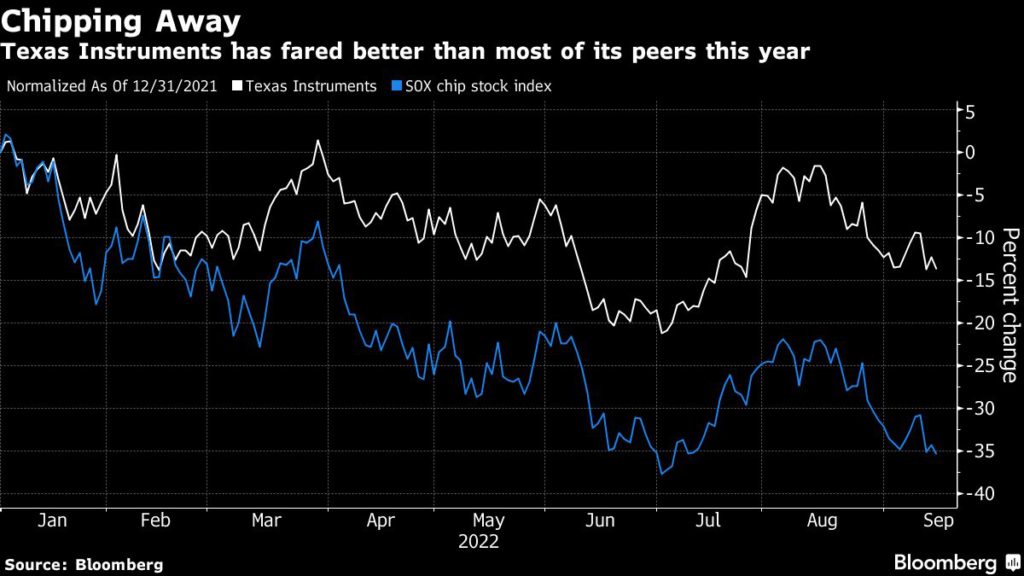
Investors battered Texas Instruments shares this year, though the stock hasn’t suffered as much as many in the chip industry. It’s down 18% in the past year, compared with a 26% decline by the Philadelphia Stock Exchange Semiconductor Index. 

Sluggish sales of smartphones and personal computers have slowed demand for related chips. But Texas Instruments’ components go into a wide range of products and equipment, helping it weather the downturn. The company gave an upbeat forecast for the current quarter in July, with sales and profit projections coming in ahead of Wall Street estimates. 

(Updates with historical data in third paragraph.)

More stories like this are available on bloomberg.com

©2022 Bloomberg L.P.

Adobe’s Bargain Share Price Isn’t Enough for the Bulls

(Bloomberg) — Adobe Inc. seems like just the kind of technology stock that would provide shelter in a market storm — a huge, profitable, decades-old company with strong brands and double-digit revenue growth, selling at the cheapest valuation in almost a decade.

Turns out the price is still high even for some one-time Adobe bulls, while news it’s about shell out $20 billion to buy software company Figma Inc. is not helping either, with analysts opining that the deal seems “extremely expensive.”

Two firms, Mizuho Securities and BMO Capital Markets, downgraded the stock earlier this week, with Oppenheimer following them on Thursday after the company announced what may mark the biggest ever takeover of a private software company. 

The news sent Adobe shares down 17% on heavy volume, their biggest one-day drop since September 2010, in a rout that erased $29 billion from its market capitalization.

Adobe, the maker of Photoshop photo-editing software and the Acrobat document-creation program, has this year been hampered by the US dollar index near a 20-year high and surging interest rates, representing headwinds to overseas sales and stock multiples. The Federal Reserve’s rate increases to fight inflation threaten to push the economy into a recession, weighing on demand and resulting in longer times for clients to sign deals.

For Mizuho, this is a more difficult environment than it expected, with large deals potentially becoming less prevalent. There’s a risk that the company cuts its guidance for the current quarter, analyst Gregg Moskowitz wrote this week. 

“If we see earnings growth explode, which we haven’t yet seen in Adobe, then that bullish catalyst would help lift the stock,” said Adam Sarhan, chief executive officer of 50 Park Investments. “But in the meantime, valuations are getting compressed because the Fed is in a tightening mode and yields are going through the roof.”

Even before Thursday’s drop, the stock has struggled this year, with a 45% decline that outpaces the 27% drop in the Nasdaq 100 Index. 

Adobe, with a market value of nearly $145 billion, has a long history of enriching shareholders: Over the past two decades, the stock has returned 20% a year, about double the return of the S&P 500 Index. And analysts broadly still see Adobe as a reliable grower, with double-digit revenue increases anticipated for the next several years. 

BMO Capital Markets is less sure on that front. The firm moved to the equivalent of a neutral view on the shares, citing “uncertainty about the durability of growth” for the Creative Cloud business, which includes graphic design and video editing software products. Creative Cloud accounted for more than 60% of Adobe’s 2021 revenue.

The tempering of bullishness follows Adobe’s previous report, from mid-June, when it cut its revenue forecast. Morgan Stanley downgraded the stock in the wake of those results, warning a slowing growth profile.

Nevertheless, the weakness in Adobe’s stock has it looking like a bargain on some metrics. The stock trades around 20 times forward earnings, its cheapest since late 2012, and below its 10-year average of 33. 

Sarhan sees more volatility ahead for Adobe and other software stocks, but said they were starting to jump onto his radar.

“It’s starting to look very attractive, and while we’re not quite there yet, I think the stars are beginning to align for value investors,” he said.

Tech Chart of the Day

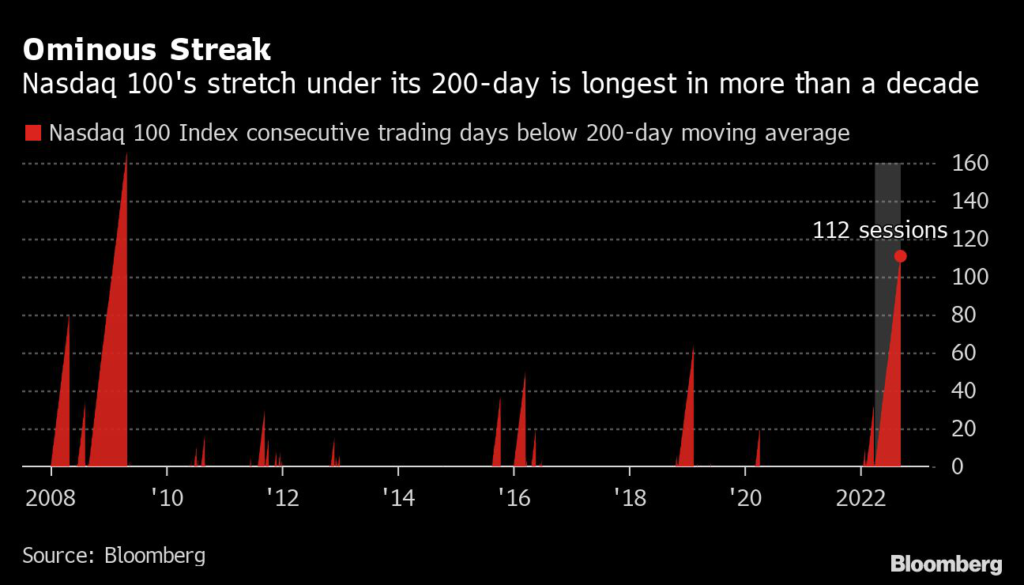
While the market has recently offered some positive technical signals, a key measure for long-term momentum remains decidedly negative. The Nasdaq 100 hasn’t closed above its 200-day moving average since early April, and that multimonth stretch represents its longest such streak since one that ended in 2009. “Although the Nasdaq 100 has been beneath the 200-day for several months, we’ve seen periods that have lasted much longer,” said Ryan Detrick, chief market strategist at Carson Group. “As long as it is down here, caution is warranted.” The index would have to rise more than 10% to reach the closely watched level.

Top Tech Stories

  • Hundreds of workers at an Amazon.com Inc. warehouse in Coventry, England, began voting Thursday on whether to strike, adding to a season of widespread industrial action in Britain.
  • THG Plc warned that sales will miss guidance this year as consumer appetite drops on the higher cost of living in the UK. Shares of the embattled British online shopping emporium dropped.
  • Crypto’s most important commercial highway, Ethereum, completed the industry’s biggest software upgrade to date. Called the Merge, it replaced power-hungry computers that were used to order transactions on the network with a more energy-efficient setup using piles of the network’s native token, Ether, placed in special, so-called staking wallets.
  • Samsung Electronics Co. will invest 7 trillion won ($5 billion) in green initiatives and call on South Korea to tackle high costs of clean energy as the electronics giant looks to reverse a rise in emissions and zero out direct pollution by mid-century.
  • Hewlett Packard Enterprise Co. is exploring the viability of making servers in India at a time the South Asian nation is making a big push to become the electronics factory of the world.
  • Sea Ltd.’s top management will forgo their salaries and tighten company expense policies, as the Singapore gaming and e-commerce giant tries to shield itself from the economic slowdown threatening tech companies.
  • Walt Disney Co. Chief Executive Officer Bob Chapek is considering merging the Hulu streaming service with Disney+, creating a single online option for viewing the company’s movies and TV shows in the US.
  • A top executive for the video app TikTok Inc., which is owned by Chinese tech giant ByteDance Ltd., told a US Senate panel that it’s negotiating with federal regulators on restricting access to user data for employees in China, but declined to commit to a total cutoff.

(Updates with market close)

More stories like this are available on bloomberg.com

©2022 Bloomberg L.P.

BMO Capital Markets Is Cutting Jobs After Downturn in Business

(Bloomberg) — Bank of Montreal’s capital-markets division is cutting jobs across its businesses and locations in response to weakening market conditions, according to people familiar with the matter.

The cuts account for a small percentage of the firm’s personnel, said one of the people, who didn’t provide a specific figure.

BMO Capital Markets is managing its resources “dynamically,” which “means making difficult choices to optimize its workforce,” spokeswoman Kelly Hechler said in response to a Bloomberg News query. Hechler declined to comment on job losses or individual departures.

Banks are cutting staff amid a drop in debt and equity issuances, along with weakness in some areas of the trading business. Goldman Sachs Group Inc. plans to eliminate several hundred roles starting this month, marking its biggest round of cuts since the start of the coronavirus pandemic.

Bank of Montreal, Canada’s fourth-largest lender, said capital markets revenue fell 20% from a year earlier in its most recent quarter, and the bank booked a C$37 million ($28 million) severance charge for the business related to the cuts.

Canada’s six largest banks have bulked up in the last few years and may cut jobs, including in investment banking, which accounts for a large portion of their compensation expenses, said Adam Dean, president and founding partner of Dean Executive Search. 

“Some of those businesses, including investment banking and M&A, are likely to be operating in a less-frothy environment going forward,” Dean said. “Layer in the fact that, as public companies, our banks have to answer to analysts, and that means that we can expect them to manage earnings, so cuts could be in the offing.”

The situation is a stark reversal from less than a year ago, when the job market for capital-markets talent was booming, and the banks increased bonuses by the most in at least nine years. 

“We have heard from various senior investment-banking leaders that they are concerned about activity levels going forward,” Dean said. “As such, they’re less confident about making major hiring decisions than they were just six or 12 months ago, especially when it comes to committing to candidates with high compensation expectations.”

Technology banker Jason Hutchinson is among those who have left BMO, according to people familiar with the matter who, like the others, asked not to be identified because the information is private. Hutchinson was co-head of global technology and business services investment banking, according to the bank’s website.

Hutchinson had been at BMO since August 2021 and worked in the San Francisco area, according to his LinkedIn profile. Before joining BMO, he was a managing director of telecommunications, media and technology banking at Lazard Ltd. and global head of tech investment banking at Houlihan Lokey Inc.

Hutchinson couldn’t be reached for comment.

(Updates with executive recruiter’s comments starting in sixth paragraph.)

More stories like this are available on bloomberg.com

©2022 Bloomberg L.P.

Adobe Tumbles After Deal to Buy Figma for About $20 Billion

(Bloomberg) — Adobe Inc. agreed to buy software design startup Figma Inc. in a deal valued at about $20 billion in a bid to expand its suite of creative tools for professionals.

The deal announced by Adobe, which is a mix of half cash and half stock, confirms an earlier Bloomberg report and would mark the biggest ever takeover of a private software company, according to data compiled by Bloomberg. It’s also Adobe’s biggest acquisition and the market found the deal expensive, sending shares to their steepest single-day decline since 2010.

Figma, which allows customers to collaborate on software as they build it, saw demand jump during the pandemic while more people worked remotely. The company expanded its customer base in recent years from software designers at big companies like Airbnb Inc., Google, Herman Miller and Kimberly-Clark Corp. — to also include individuals building lightweight games, maps and presentations. It has also attracted a loyal student following. 

The combination benefits “literally anybody who is a knowledge worker,” said Adobe Chief Executive Officer Shantanu Narayen, in an interview.

Adobe, which had been a Wall Street favorite for more than a decade, has been pummeled in the tech downturn, seeing its stock lose 45% of its value since the start of the year. Investors have become increasingly skeptical about the dominance of Adobe’s line of software for design professionals, which makes up about 60% of its revenue. The company has targeted more accessible web-based offerings such as Adobe Express to sell its creative software to consumers, small businesses, and social media influencers. But the initiative ran into friction from upstarts including Figma, Lightricks Ltd. and Canva Inc. 

San Francisco-based Figma was co-founded about a decade ago by Dylan Field and Evan Wallace. The startup introduced browser-based software design tools that allow software designers to work together in real-time, bypassing the sometimes clumsy process of saving and sending their work to collaborators using a collection of disparate apps. 

The company was valued at $10 billion in its last funding round a year ago. Figma’s backers include venture capital firms Kleiner Perkins, Index Ventures and Greylock Partners.

“Figma was at the scale that it was a serious standalone company — the path was to go public,” said Figma board member Mamoon Hamid, a partner at Kleiner Perkins. “The right company made us an offer we couldn’t refuse.”

The deal’s “very high” valuation is likely weighing on Adobe’s stock, said Bloomberg Intelligence’s Anurag Rana. He added that Figma may add less than 2% to Adobe’s sales growth rate, and will likely decrease margins.

Analysts questioned Adobe executives on their valuation of Figma during the company’s earnings call Thursday. But Adobe defended its business strategy. “I understand that there’ll be some sentiment associated with the price, and the ball’s in our court to go demonstrate,” Narayen said on the call.

The shares plunged 17% to $309.13 at the close Thursday in New York, making it the worst performer on the S&P 500. 

The transaction is expected to close in 2023, pending regulatory and other approvals, Adobe said. After closing, Field will continue to lead the Figma team, reporting to David Wadhwani, president of Adobe’s digital media business. Figma will continue to exist as a standalone product. “We’re confident that if you look at this in the long run, it’s going to be a big value for their shareholders and our shareholders as well,” Narayen said. 

This isn’t Adobe’s first acquisition focused on collaborative software. It bought Frame.io, a video feedback platform, for $1.3 billion last year and Workfront, a project management service, for $1.5 billion in 2020. Frame.io annual recurring revenue grew more than 50% in the second quarter, and Workfront sales more than 35%, Adobe said.

Adobe also announced third-quarter results on Thursday, showing revenue jumped 13% to $4.43 billion. That was in line with analysts’ estimates but marked the third consecutive quarter of growth of less than 15%, as Adobe has been buffeted by economic uncertainty and by the strong dollar overseas. Adjusted earnings per share were $3.40, better than Wall Street expected. It provided a revenue forecast for the current period of $4.52 billion, in line with estimates.

Figma will have a total addressable market of $16.5 billion by 2025, according to the statement. The company is expected to add about $200 million in net new annual recurring revenue this year, surpassing $400 million in total annual recurring revenue by the end of 2022, with a net dollar retention rate, which measures revenue growth from existing customers, of greater than 150%, Adobe said in an investor presentation. Figma has gross margins of about 90%, and about 850 employees, Adobe said. The transaction is expected to be accretive to Adobe’s adjusted earnings per share at the end of the third year.

According to terms of the deal, about 6 million additional restricted stock units will be granted to Figma’s CEO and employees that will vest over four years after closing. Adobe expects the cash consideration to be financed through cash on hand and, if necessary, a term loan.

Qatalyst Partners advised Figma along with the law firm Fenwick & West while Allen & Co. was Adobe’s adviser along with Wachtell, Lipton, Rosen & Katz. The deal includes a termination fee of $1 billion in cash.

(Updates with closing shares in the second and 11th paragraphs.)

More stories like this are available on bloomberg.com

©2022 Bloomberg L.P.

Almost 80% of Remote Workers Think They’d Be Fired for Saying No to the Office

(Bloomberg) — Almost 80% of remote workers believe their employers would fire them if they said “no” to a return-to-office mandate.

However, nearly 60% of employers say they’d be content with employees resigning rather than returning to the office. That’s according to a survey of 800 workers and 200 business leaders by OSlash, a productivity software company.

Big-name companies like Apple Inc. and Peloton Interactive Inc. are leading the charge, setting Labor Day as their latest deadline for corporate employees to be in the office at least three days a week. The push has driven a wedge between workers and their bosses, with many rank-and-file employees reluctant to give up the flexibility and autonomy they enjoyed during the pandemic.

Stories of employee resistance are circulating on social media: One of the most popular posts on the subreddit r/antiwork this month described a worker replying all to a company-wide message with,  simply, “no.” On Monday, New York Times offered employees branded lunchboxes to welcome them back to the office. The gesture fell flat as more than 1,200 pledged to work from home to protest the mandated return and to pressure the company to negotiate with the union over returning to the building.

Hard pass from
antiwork

Read More: ‘We’d Rather Have Raises’: New York Times’ Lunchbox Perk Backfires Amid Work-From-Home Protest

For employers who want to sweeten the deal, more money, flexible scheduling and free food were some of the most popular incentives workers said would lure them back, OSlash found. Alternatively, four out of five of employees would be happy to take a pay cut to continue working from home, with Gen Z workers the most willing to do so.

Read More: World’s Workers Cling to WFH as Bosses Push RTO

Employers polled say they’re prepared to offer flexible scheduling, with 60% saying they would offer hybrid options to employees disinclined to return to in-person work. While 20% said they would continue to let their employees work remotely if challenged, almost the same portion said they would fire workers who refused to return to their desks, making outright refusal a risky proposition. At the same time, over 10% of business leaders admitted using a return-to-the-office mandate to terminate employees without having to lay them off.

For those still resisting: the survey found that more than one-third of employers see remote workers as more expendable than those on site. 

More stories like this are available on bloomberg.com

©2022 Bloomberg L.P.

Amazon Isn’t Interested in LIV Golf Media Rights as League Pursues Deal

(Bloomberg) — Amazon.com Inc. isn’t interested in streaming LIV Golf, according to a person familiar with the matter, leaving the Saudi-backed league with fewer options as it searches for a media partner.

LIV Golf held its first tournaments this year and has quickly established itself as a threat to the PGA Tour. It has poached some of the sport’s biggest names, including Dustin Johnson, Phil Mickelson and Cameron Smith, luring them away with massive sums of money.

Amazon’s lack of interest in LIV Golf was reported earlier by the Wall Street Journal, which also said that Apple Inc. had passed on the rights. Apple didn’t reply to a request for comment from Bloomberg News.

LIV’s tournaments are free to watch online but they’re not available on TV in the US, making it tougher to reach the typical weekend golf viewer.

Most of the major US sports broadcasters — CBS, NBC and ESPN — have long-term contracts with the PGA Tour. It’s unlikely that they would air a rival league and jeopardize that relationship. Warner Bros. Discovery Inc., which owns TNT, also has a deal to show the PGA Tour outside the US. 

Fox Corp. isn’t encumbered by a relationship with the PGA Tour, but the company has struggled with golf broadcasting in the past. In 2020, it walked away from a TV deal with US Golf Association, which runs the US Open, one of golf’s four majors.

At the same time, former Fox Sports executive David Hill has been working as a consultant for the new league, and LIV Golf Chief Executive Officer Greg Norman has a longtime relationship with Fox’s Rupert Murdoch.

In an interview Thursday, Will Staeger, LIV Golf’s chief media officer, said the league is still in the “early stages” of trying to secure its first US TV deal, which would take effect in 2023. Fourteen tournaments are planned for next year, up from eight this season.

LIV could find other ways to get on American screens, such as buying airtime on another network or pursuing a deal with Sinclair Broadcast Group Inc., the largest owner of local sports channels in the US.

“We are highly optimistic that we will find a TV partner in the US who will grow LIV Golf in the way the English Premier League was grown on NBC and Formula One will grow on ESPN,” said Staeger, a former ESPN producer and former executive at World Wrestling Entertainment Inc.

(Updates with attempt to reach Apple in third paragraph.)

More stories like this are available on bloomberg.com

©2022 Bloomberg L.P.
Ether Slumps as ‘Merge’ Turns Into a ‘Sell-the-News’ Event

(Bloomberg) — Ether led digital assets lower after the groundbreaking software upgrade of the token’s underlying network turned into what some market observers labeled a “sell-the-news” event. 

The second-largest cryptocurrency by market value after Bitcoin dropped as much as 8.9% to $1,460. Ether, already down more that 50% this year, had rallied more than fivefold last year in part on optimism about the revision.  

“Now the excitement around the Merge is done, and we don’t have a catalyst for Ethereum in the short term,” said Martha Reyes, head of research at BeQuant, crypto exchange and prime broker. “It would be natural to expect a bit of rotation back into BTC.”

Bitcoin dropped about 1% to $19,746. Cardano fell around 2.8%, Polygon slumped 1.9%, while Solana was little changed.    

Ethereum’s revamp makes it vastly more energy efficient and paves the way for it to scale up and become quicker, according to the network’s developers. The update was years in the making and appears to have gone smoothly, though hiccups remain possible.

“That was unbelievably smooth,” said David Fauchier, a portfolio manager at Nickel Digital. 

Exchanges and lending platforms temporarily disabled Ethereum-related services before the Merge. They later began bringing them back online.

The funding rate of Ether perpetual futures contracts on crypto exchange including Binance and FTX have started to recover, according to crypto data firm Kaiko Research. Ahead of the Merge, some investors were hedging their long spot positions of Ether by shorting Ether. Exchanges use the funding rate — or the cost to trade –to tether the contracts to their underlying spot price.

“The successful completion of the Merge has alleviated risk hedging for a possible worst case scenario,” said Clara Medalie, strategic initiatives and research director at Kaiko.

Other market participants pointed out that some investors were using the futures market to hedge against losses while they held onto Ether tokens through the Merge. Ether holders are receiving a new token called EthereumPOW.  

“The main driver of negative funding rates now is linked to the upcoming Ethereum Proof of Work hard fork,” Medalie said. “Traders are holding onto their ETH until the airdrop, and hedging using perpetual futures.”

More stories like this are available on bloomberg.com

©2022 Bloomberg L.P.
Ether Miners Are Piling Up Losses As ‘Merge’ Shifts Them to Altcoins

(Bloomberg) — Ether miners are piling up losses after shifting to lower value cryptocurrencies such as Ethereum Classic and Ravencoin, in the wake of an Ethereum network upgrade that rendered much of their operations obsolete. 

The upgrade, known as the ‘Merge’, replaced powerful graphic cards used by Ether miners with investors who stake Ether, in order to secure the Ethereum network and validate transaction data encrypted by the blockchain. 

The tokens that the miners are now seeking to mine still operate under Ethereum’s old consensus mechanism, called proof of work. This means that miners can still use their graphic processing units (GPUs) to earn these coins. However, miners must compete to be the first to solve a mathematical puzzle to win a limited amount of coins as rewards. The more miners there are, the smaller the reward. Subsequently, an influx of computing power from Ether miners has driven mining revenue to below zero for the other major alternative coins. 

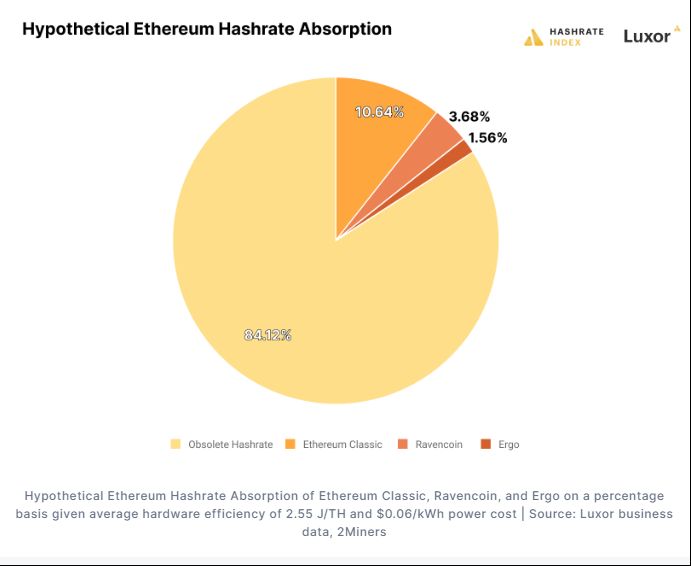
Those mining Ethereum Classic for a profit “are operating at negative 30% to 40% of gross profit margins, even the best operators,” estimates Ethan Vera, chief operations officer at crypto-mining firm Luxor Technologies, which used to provide Ethereum mining services. Around 25% of computing power is flowing from Ether miners to other coins, Vera calculates, using data from MiningPoolStats, a website tracking computing power as reported by major crypto-mining companies.  

It will be easy enough for miners to switch to Ethash alternatives and other GPU-mineable coins after the Merge. The problem is, there’s a limit to how much computing power these other networks can absorb before the average miner becomes unprofitable — and it isn’t much, writes Colin Harper, head of content and research at Luxor. 

“As it currently stands, I expect some of that computing power for Ethereum Classic will drop off the network because it is unprofitable to mine for even people with good gear and low-cost power,” said Vera. 

As many as one million people were mining Ether with over $10 billion dollars worth of mining equipment before the Merge, which was completed early on Thursday morning, New York Time. 

Post-Merge, some large-scale Ether miners such as HIVE Blockchain Technologies Ltd. and Hut 8 Mining Corp. are planning to use their facilities for other purposes, such as high-performance computing. However, the majority of Ether miners lack the same ability to scale up or the business setup to pursue this, according to Vera. 

More stories like this are available on bloomberg.com

©2022 Bloomberg L.P.
Close Bitnami banner
Bitnami