

Bloomberg

UK’s New Chancellor Courts Bankers With Controversial Plan to Lift Bonus Cap

(Bloomberg) —

The UK’s new chancellor has dived head first into one of the most contentious political issues in UK finance.

Kwasi Kwarteng has chosen scrapping the cap on banker bonuses as one of his first proposals to sharpen London’s competitive edge against Paris and Frankfurt, according to people familiar with the matter. It comes after years of bankers seeing little government action to improve the industry’s fortunes in the wake of the financial crisis and Brexit negotiations. 

It’s unclear how much difference such a change would make, given banks have already raised fixed pay and use workarounds such as allowances to skirt the cap, which limits bonuses to twice the salary of staff defined as “material risk takers.” Still, scrapping the limit that was set by the European Union in 2014 could help send a clear message from the new government to the world of finance: we are here to help.

“It is a welcome move aimed at enhancing the competitiveness of the City of London versus other global centers like New York,” said Gerard Lyons, chief economic strategist at online wealth manager Netwealth and supporter of Prime Minister Liz Truss. “It is another indicator of a significant shift away from benign neglect of the City and financial services.”

The Treasury has made no official announcement on the idea, and political response has been muted during a period of mourning following the death of Queen Elizabeth II. In June, an attempt by Boris Johnson’s government to broach the issue of banker pay led to fierce criticism from the opposition Labour Party, as British households face the steepest rise in living costs for four decades. 

“Removing the cap would be a pro-rich ideological measure that sends a depressing message about who policymakers listen to and think about when making economic policy,” said Luke Hildyard, executive director of the High Pay Centre, a think-tank focused on economic inequality.

After eight years of dealing with the rules, banks have found ways to align pay with that of other regions. That means the bonus cap hasn’t been a top lobbying priority for many firms and removing it is unlikely to lead to any significant pay changes, according to executives at multiple global banks.

Roger McCormick, honorary senior visiting fellow at Bayes Business School in London, said the end of the cap would still be a welcome break from the crisis management that followed the global financial crisis. “We are now some way past the events of 2008 and the need for the cap is no longer obvious, so it should be removed. There are other ways of curbing recklessness and there have been regulatory changes directed at this,” he said. 

Other Ways

Others pointed to alternative ways to enhance London’s prospects, such as reducing taxes on bank earnings. A surcharge on profit was introduced in 2015, which the former chancellor Rishi Sunak had planned to scale back from next year to offset an overall rise in corporation tax — an increase that Truss’s administration now plans to cancel. 

Banks pay £18.7 billion in annual taxes, according to analysis last year by PricewaterhouseCoopers for UK Finance, an industry lobby group. Including national insurance and other levies on employees, the sector accounts for £37.1 billion, or 5.5% of the government’s total receipts.

“Ensuring the industry is globally competitive is essential for future economic growth and we are keen to see the steps the government plans on taking to make the UK an attractive place to do business,” UK Finance said on Thursday.

The PwC research estimated that a bank in London would have an overall tax burden of 44.9% last year, compared to an equivalent 45.7% in Amsterdam and 44.9% in Frankfurt. By 2024, London would be at 50.5%, Amsterdam 37.5% and Frankfurt 38.6%, PwC projected. Its estimate was calculated before the new government’s plans to reduce national insurance and scrap a corporation tax rise, which would lower the rate in London.

Pay Changes

While global firms have had to tweak the mix of remuneration to comply with the cap, it hasn’t led to pay cuts. At the UK’s five largest banks, fixed pay as a percentage of total remuneration rose to 54% from 28% between 2013 and 2014 as firms adjusted to the rules, a Treasury official said in parliament. 

JPMorgan Chase & Co. is one example of how pay packages have been adapted. President Daniel Pinto was awarded $28.5 million for 2021, when he was based in the UK. That made him the highest paid of Jamie Dimon’s top deputies, and while other senior executives got cash bonuses, he instead received a $8.4 million fixed allowance. Still, he faced a seven-year wait for his stock bonuses to fully vest, while his US colleagues received their awards after three to five years.

British banks have topped up the pay of senior executives with fixed awards, often given in a mixture of cash and shares. HSBC Holdings Plc Chief Executive Officer Noel Quinn received a base salary of £1.29 million ($1.48 million) last year, but also earned £1.7 million in a fixed pay allowance. Similarly, Lloyds Banking Group Plc CEO Charlie Nunn was paid a base salary of £426,000 after starting as the lender’s boss in August 2021, topped up with a £402,000 in a fixed share award that’s released over three years.

Even so, lifting the limit could help banks in the UK compete globally for staff, said Jordan Galhardo-Burnett, head of publications and insight at BCG Expand. “Banks have lost huge numbers of talent to hedge funds, fintechs and digital asset firms, which are not as heavily scrutinized so they are able to sometimes able to be more generous,” he said, though he added that it may prove too contentious for some. “There could be plenty of firms out there that might keep things consistent with how they’ve done things previously and not have any disruptive PR.”

Senior bankers are jointly regulated by the Bank of England, where Governor Andrew Bailey has long thought the pay rules should be overhauled. “The Bank did not support the bonus cap when it was introduced,” a spokesperson said in an emailed statement. “The Senior Managers Regime and remuneration rules requiring deferral of bonus payments are more effective tools for ensuring bankers take proper account of risks.”

Less than a month into the new government, it’s unclear what form any changes will take. Earlier discussions of loosening any banking regulation have met with political backlash. 

“Gifting bankers uncapped bonuses at a time when millions of households are choosing between eating and heating is beyond tone deaf — it’s shameful,” said Fran Boait, executive director at Positive Money, a campaign group.

(Adds comments, details on HSBC and Lloyds, updated BOE statement from seventh paragraph.)

More stories like this are available on bloomberg.com

©2022 Bloomberg L.P.

US Manufacturing Output Increases for a Second-Straight Month

(Bloomberg) — US factory production rose slightly in August as resilient business investment more than offset a pullback in the output of consumer goods, consistent with steady manufacturing activity.

The 0.1% increase in manufacturing output last month followed an auto-fueled 0.6% July increase, Federal Reserve data showed Thursday. Including mining and utilities, total industrial production fell 0.2% in August.

The median forecast in a Bloomberg survey of economists called for a 0.1% decline in factory output and no change in total industrial production.

While domestic demand is generally holding up, manufacturers face a number of headwinds including a shift in consumer behavior toward services and away from goods. That change in preferences caught some retailers flat-footed, leading to an inventory overhang and canceled orders that are further weighing on production. 

Foreign demand is at risk of softening at well, as an energy crisis grips Europe, China’s economy cools and a surge in the value of dollar raises the costs of US goods for overseas customers.

What Bloomberg Economics Says…

“The August industrial production figures showed factories making progress rebalancing supply to demand. With a freight-rail strike apparently off the table and delivery delays felt less broadly this year, the industrial production reading is promising news for disinflation in core goods prices.”

–Andrew Husby, economist

To read the full note, click here

A pair of regional Fed bank surveys on Thursday showed mixed results. A gauge of manufacturing in New York state snapped back in September on firmer orders and shipments after plunging in the prior month. At the same time, the Philadelphia Fed’s gauge contracted for the third time in four months.

Among industry groups, factory production for machinery, aerospace equipment, and computers and electronic products increased. Meantime, motor vehicles output fell after a robust advance in the prior month. Consumer goods production also fell, reflecting a drop in food, clothing and energy. 

Excluding autos, factory production increased 0.2%. The Fed’s report also showed capacity utilization at factories held at 79.6%. 

Outside of manufacturing, utility output fell 2.3% on a decline in electricity. Mining was unchanged after five straight months of gains. Oil and gas well drilling rose 2.7%.

This week, Bloomberg’s MLIV Pulse survey focuses on the best trades ahead of next week’s Fed policy meeting. It’s brief and we do not collect your name or any contact information. Please click here if you would like to share your views.

(Adds Bloomberg Economics comment)

More stories like this are available on bloomberg.com

©2022 Bloomberg L.P.
Ethereum Finishes Long-Awaited Energy-Saving ‘Merge’ Upgrade

(Bloomberg) — Ethereum has completed a key revamp of its network, marking the crypto world’s most-ambitious software upgrade to date and paving the way for changes that could fuel more usage of the commercial blockchain.

Called the Merge, the upgrade completed in the early hours of Thursday, according to a Twitter post by Ethereum co-founder Vitalik Buterin. 

The change replaced power-hungry computers that were used to order transactions on the network with a more energy-efficient setup using piles of the network’s native token, Ether, placed in special, so-called staking wallets. As a result, Ethereum’s energy consumption will decline by an estimated 99%.


Such an upheaval had never been attempted in crypto before, let alone on Ethereum, home to about 3,500 active decentralized apps, ranging from exchanges to games and handling billions of dollars worth of crypto. In the works for years, the Merge doesn’t change the end-user experience on Ethereum, but it’s a key stepping stone to more upgrades that will make the network faster and cheaper, and should further increase its stature and usage.

“This is the first step in Ethereum’s big journey toward being a very mature system,” Buterin said during an online Merge viewing party– essentially a public video call where developers tracked live progress on the switch. “And there’s steps left to go. We still have to scale, we have to fix privacy. To me the Merge symbolizes the difference between an early stage Ethereum and the Ethereum we’ve always wanted.”

As it became clear the transition had worked, developers who had worked on the the project for months started congratulating each other on the call. Watched by more than 41,000 people at peak, the viewing party featured content ranging from dry technical explanations of what the Merge would entail, to the performance of a Merge-themed song. Lyrics included: “Carbon footprint is all gone. That’s why we are singing the Merge song.”

Carrying out major upgrades to the software without any downtime is a brilliant engineering feat, said Harsh Rajat, co-founder of Ethereum Push Notification Service or EPNS. “Akin to changing the foundation of a skyscraper while it still remains standing!” he added.

The Merge also changed properties of Ether, making it more akin to yield-bearing securities. Staked Ether will generate a return, expected to be around 5.2% after the Merge, according to tracker Staking Rewards. Coupled with an expected net decrease in Ether token supply soon after the update, that should make the coin more attractive to investors.

The Ether token is down more than 50% so far this year, after surging fivefold in 2021. Its performance has grown more closely aligned to that of Bitcoin, the world’s largest cryptocurrency, over the last month.

The software upgrade is called the Merge because the existing Ethereum blockchain will combine with a parallel network that’s been running for almost two years to test the proof-of-stake concept. Overall, the upgrade has been under consideration for over seven years. 

Even though completed, the Merge could be followed by days or even weeks of hiccups, based on what happened after some prior Ethereum software updates. Worried about bugs and hacks, crypto exchanges like Coinbase Global Inc. paused Ethereum-related withdrawals and deposits around the time of the software upgrade. Crypto lender Aave had suspended Ether borrowing in advance of the Merge.

Adding to the concern is the likely creation of copies of Ethereum that still use power-hungry computers called miners. These forks, such as EthereumPOW, create their own copies of Ether coins given to all holders of mainstream Ether. The tokens may have some value. But the existence of several versions of Ether — each running on a different chain — could create confusion and give rise to attacks and scams. So can copies of other tokens running on forked chains.

While all apps and wallets currently on Ethereum have been replicated on the forked chains, most apps are likely to be broken, as key players — USDC stablecoin issuer Circle and oracle provider Chainlink among them  — have said they won’t support the forked versions. Whether the forked chains can stay viable in the long run remains to be seen.

Large teams of Ethereum developers from all over the world have worked on the Merge for years. In late 2020, they debuted Beacon Chain, a parallel network that was testing the ordering transactions via staked coins, or a system called proof of stake. In the Merge, Beacon was merged with the main Ethereum network, using miners, and made Beacon Ethereum’s way of testing the ordering of network transactions.   

(Updates first paragraph, prices, chart and adds comment in seventh paragraph on significance of upgrade)

More stories like this are available on bloomberg.com

©2022 Bloomberg L.P.
Buyout Firms Are Finding It Harder to Hang Onto a Key Source of Fees

(Bloomberg) — It’s getting harder for the private equity industry to hang on to long-term assets while still raking in the fees they throw off.

Institutional investors are souring on so-called continuation funds, which private equity firms deploy when they want to keep managing assets in traditional buyout funds that are about to mature — often to avoid taking portfolio companies public prematurely or being forced to sell them at unfavorable prices. 

Demand for such vehicles, which soared during the pandemic, tumbled in the first half of this year after hitting a record $60 billion in 2021, according to a report by Campbell Lutyens & Co., a private markets advisory business. In addition to providing an off-ramp for investors who want to cash out, continuation funds allow buyout firms — also known as general partners — to keep raking in management fees from existing or new clients. 

While the number of proposed continuation funds coming to the secondaries market isn’t necessarily declining, “the percentage of those deals that are closing is certainly down,” Campbell Lutyens partner Gerald Cooper said in an interview.

“Valuation is much more of a concern today than it was 12 months ago,” said Eric Albertson, senior investment director at Abrdn Plc. “No one wants to invest in a deal and then 6 or 9 months later have a writedown.” 

That helps to explain the recent rut. 

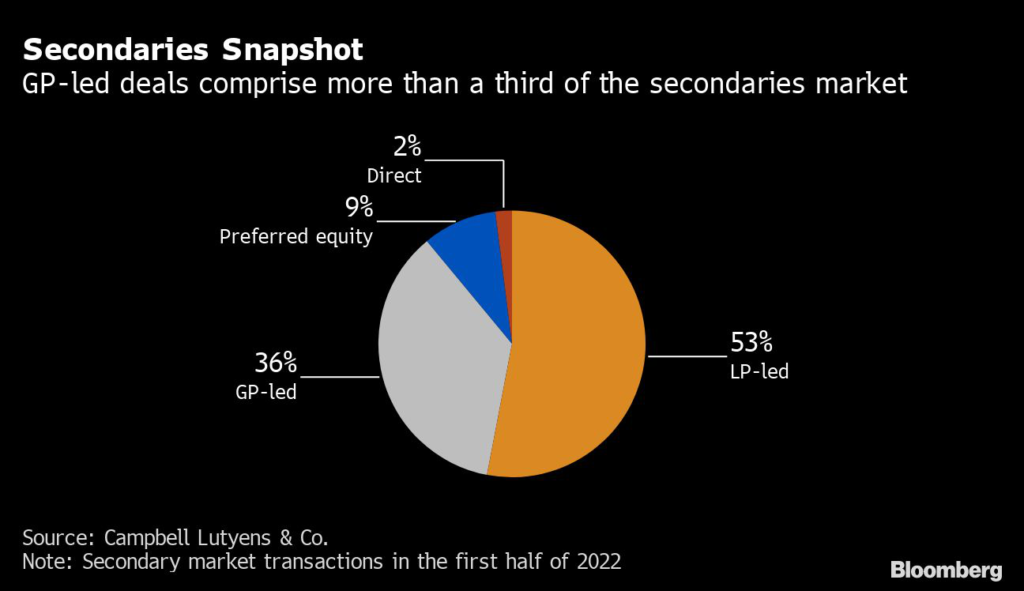
The value of GP-led deals that closed during the first half — the vast majority of them were continuation funds — totaled $19 billion, a 32% drop from the same period a year earlier, Campbell Lutyens said in a report last month.


Private-market pricing lags behind public markets by several quarters, and valuations didn’t dip as much as investors expected in the second quarter, creating a “pause” in the secondary market, said Cooper, adding that there isn’t enough demand to absorb all of the supply.  

Because of that lag, the slowdown is expected to continue until the end of the year or early 2023, said Samer Ghaddar, deputy chief investment officer at the Arizona State Retirement System. 

“A contraction in valuations is still in its early phase,” he said in an emailed statement.

More broadly, institutional investors including pension funds and university endowments are pulling back from committing fresh capital to private equity because their portfolios are now over-invested in the asset class following a sharp decline in public equities. 

Read more: Ivy League Endowments Brace for Losses With PE Values Tumbling

While the Campbell Lutyens report shows that more than three-fifths of GP-led deals were sold between par and a 5% discount, Albertson said he’s aware of transactions in which limited partners sought haircuts of as much as 20% compared with year-end prices. And several deals put forth last year had to be renegotiated as investors sought better pricing, according to secondaries brokers who asked not to be identified.

Valuations Slide

In January, for example, Banneker Partners sold a minority stake in education-software business LINQ to Welsh Carson Anderson & Stowe. Banneker recently arranged a continuation fund for the rest of its holding, though the new investors wanted a lower valuation than the one secured months earlier with Welsh Carson. 

A Banneker representative declined to comment.

Resilience Capital Partners had planned a $326.1 million continuation fund that included as many as 18 companies from two existing vehicles, according to a presentation seen by Bloomberg. But the firm recently shelved the offering, according to a person familiar with the matter. 

First Ascent Ventures GP, a Toronto-based firm that sought C$120 million ($80 million) for three portfolio companies, paused plans to roll them into a continuation fund because of unfavorable pricing conditions, a person familiar with the matter said. 

“I would be surprised if most of the deals that were in market in the first quarter didn’t have some level of renegotiation,” Cooper said. 

One of the largest proposed continuation funds so far in 2022 is being arranged by Madison Dearborn Partners, which is seeking as much as $3 billion to extend its ownership of three insurance firms. 

Read more: Madison Dearborn Partners Seeks $3 Billion in Secondary Deal

Continuation funds can be controversial because the general partner is on both sides of the deal, raising questions about how it determines the valuation, which sets the basis for the fees it charges. The Securities and Exchange Commission has proposed rules that would enhance transparency, including that each deal get an outside fairness opinion.

“To attract new investors, GPs tend to offer assets at higher discounts, which is naturally a conflict to existing LPs as they see a markdown in their valuations,” said Ghaddar, of the Arizona retirement system. Lower management fees and a new carry structure help to ease such conflicts, and “some GPs do address that,” he said.

High Bar

John Beil, the head of private equity and real estate investments at Partners Capital, said his firm evaluates continuation funds on a series of criteria, including whether a fairness opinion accompanies the transaction and if the general partner is re-investing most of its earnings from the “sale” of the asset into the new fund.

“The bar is high to elect to roll our capital,” said Beil, whose firm advises on more than $48 billion for endowments, foundations and pensions. In most cases, it opts to take a cash payment because higher returns can be found elsewhere, he said.

Limited partners may also demur because of the amount of work required to evaluate continuation funds, which are treated like entirely new investments even though the underlying assets were in previous funds, Beil said.

In some instances, GPs give clients as little as two weeks to decide whether they want in or out, according to investors and advisers. Hiring external consultants for due diligence on the quality of an asset and its valuation takes time, forcing investors to cash out, they said.

But with about $110 billion of dry powder in the market, according to Prequin data, the slowdown may only to be temporary. 

“It’s going to be a tool for years to come,” Kate Ashton, leader of alternative assets transactions at Debevoise & Plimpton. “Private equity GPs are going to look at some form of continuation fund structure as an alternative exit in many different circumstances to a traditional sale or IPO.”

More stories like this are available on bloomberg.com

©2022 Bloomberg L.P.

Adobe Tumbles After Agreeing to Buy Figma for About $20 Billion

(Bloomberg) — Adobe Inc. agreed to buy software design startup Figma Inc. in a deal valued at about $20 billion to help it expand tools for creative professionals.

The deal announced by Adobe, which is a mix of half cash and half stock, confirms an earlier Bloomberg report and would mark the biggest ever takeover of a private software company, according to data compiled by Bloomberg. Adobe shares fell 13% as the market opened in New York, the biggest decline in more than two years.

Figma, which allows customers to collaborate on software as they build it, saw demand jump during the pandemic while more people worked remotely. The company expanded its customer base in recent years from software designers at big companies like Airbnb Inc., Google, Herman Miller and Kimberly-Clark Corp. — to also include individuals building lightweight games, maps and presentations. It has also attracted a loyal student following. 

The combination benefits “literally anybody who is a knowledge worker,” said Adobe Chief Executive Officer Shantanu Narayen, in an interview.

Adobe, which had been a Wall Street favorite for more than a decade, has been pummeled in the tech downturn, seeing its shares lose more than a third of their value since the start of the year. Investors have become increasingly skeptical about the dominance of Adobe’s line of software for design professionals, which makes up about 60% of its revenue. The company has targeted more accessible web-based offerings such as Photoshop Express to sell its creative software to consumers, small businesses, and social media influencers. The initiative ran into friction from upstarts including Figma, Lightricks Ltd. and Canva Inc.

San Francisco-based Figma was co-founded about a decade ago by Dylan Field and Evan Wallace. The startup introduced browser-based software design tools that allow software designers to work together in real-time, bypassing the sometimes clumsy process of saving and sending their work to collaborators using a collection of disparate apps. The company was valued at $10 billion in its last funding round a year ago. Figma’s backers include venture capital firms Kleiner Perkins, Index Ventures and Greylock Partners.

The deal’s “very high” valuation is likely weighing on Adobe’s stock, said Bloomberg Intelligence’s Anurag Rana. But Adobe defended its business strategy.

“We’re confident that if you look at this in the long run, it’s going to be a big value for their shareholders and our shareholders as well,” Narayen said. The transaction is expected to close in 2023, pending regulatory and other approvals, Adobe said. After closing, Field will continue to lead the Figma team, reporting to David Wadhwani, president of Adobe’s digital media business. Figma will continue to exist as a standalone product.

Adobe also announced third-quarter results, with revenue jumping 13% to $4.43 billion. That was in line with analysts’ estimates but marked the third consecutive quarter of growth of less than 15%, as Adobe has been buffeted by economic uncertainty and by the strong dollar overseas. Adjusted earnings per share were $3.40, better than Wall Street expected. 

Figma will have a total addressable market of $16.5 billion by 2025, according to the statement. The company is expected to add about $200 million in net new annual recurring revenue this year, surpassing $400 million in total annual recurring revenue by the end of 2022, with a net dollar retention of greater than 150%, Adobe said in an investor presentation. Figma has gross margins of about 90%, and about 850 employees, Adobe said. The transaction is expected to be accretive to Adobe’s adjusted earnings per share at the end of the third year.

According to terms of the deal, about 6 million additional restricted stock units will be granted to Figma’s CEO and employees that will vest over four years after closing. Adobe expects the cash consideration to be financed through cash on hand and, if necessary, a term loan.

Qatalyst Partners advised Figma along with the law firm Fenwick & West while Allen & Co. was Adobe’s adviser along with Wachtell, Lipton, Rosen & Katz.

The deal includes a termination fee of $1 billion in cash.

More stories like this are available on bloomberg.com

©2022 Bloomberg L.P.
Biden Team Beefs Up Security Reviews of Foreign Investments

(Bloomberg) — The Biden administration will intensify national security reviews of foreign investments in the US by adding criteria for regulators to scrutinize in deals, including potential risks to sensitive data, senior administration officials said.

An executive order that President Joe Biden plans to sign Thursday will add five new factors for reviews of transactions by the Committee on Foreign Investment in the United States, or CFIUS, an interagency panel that reviews acquisitions of US businesses by foreign buyers.

The new criteria include a deal’s impact on the resilience of critical supply chains, risks to sensitive data of US citizens, cybersecurity threats, as well as the effect on national security and US technological leadership, according to a White House fact sheet.

The new criteria will apply to sectors including semiconductors, artificial intelligence, biotechnology and clean energy technologies. The move reflects growing concern in the White House and among both Democrats and Republicans about China, in particular, which seeks to rapidly match and eventually surpass the US in a variety of high-tech industries, including through investments in American companies.

The officials spoke on condition of anonymity to preview the order in a call with reporters.

TikTok Review Unresolved

One high-profile case involving Americans’ data that continues to be unresolved is a national security review of TikTok Inc., which is owned by Chinese company ByteDance Inc.

The review, which started in 2019 under former President Donald Trump, stems from ByteDance’s 2017 purchase of Musical.ly, an app that did business in the U.S and was later folded into TikTok. 

The administration is working to resolve concerns about Chinese government access to US user data that have fueled the years-long review of the popular video-sharing app. 

Previous reviews of certain transactions have brought out some of the concerns targeted in the order, one of the officials said in response to a question on what prompted the new criteria.

In addition to more closely scrutinizing inbound investments, the Biden administration also continues to examine potential limits on certain US investments in rival countries like China. 

White House officials have signaled that any restrictions would likely be narrow and would not occur without giving affected industries sufficient time to comment. That process is ongoing and not related to Thursday’s order, one official said.

While Biden’s order, as well as CFIUS reviews in general, isn’t country-specific, a significant number of transactions reviewed by the committee have involved Chinese buyers.

More stories like this are available on bloomberg.com

©2022 Bloomberg L.P.
Ford Rolls Out What May Be the Classic Mustang’s Last Stand

(Bloomberg) — Ford Motor Co.’s glitzy introduction of a redesigned Mustang sports car powered by fossil fuels runs counter to the industry narrative of ditching gas-burning cars to make way for electrified models.

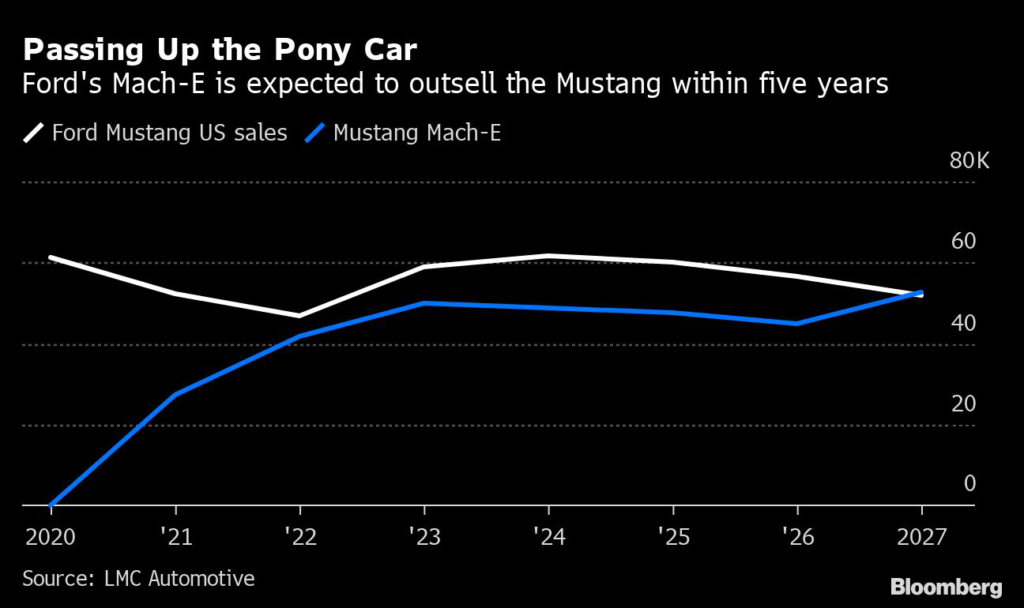
Ford is betting there’s enough life left in the 58-year-old Mustang to help pay for the company’s electric-powered future, in which Chief Executive Officer Jim Farley is investing $50 billion to build 2 million EVs annually by 2026. With the Mustang, Ford is also offering a plug-in version, the Mach-E, which has seen sales soar 49% this year.

Even so, gas-fueled Mustangs still outsell those powered by electrons. That helps explain why Ford invested in a new version to give the low-slung deuce coupe what it calls “sexy and edgy” styling and its most powerful V-8 engine ever.

“We definitely see a marketplace there and that’s why we’ve invested in this product,” Kumar Galhotra, president of the newly created Ford Blue unit that focuses on traditional internal combustion engine vehicles, said in an interview. “The entire Ford Blue portfolio is the profit engine and will continue to fund future needs for the company.”

Despite the splashy introduction of the seventh-generation Mustang along the banks of the Detroit River at the North American International Auto Show Wednesday, sales of the classic Mustang this year are expected to be less than half what they were six years ago. By 2027, it will be outsold by the Mach-E, according to a forecast from researcher LMC Automotive.

Analysts see this as the beginning of the end for the storied car with a roaring engine under the hood. Ford is already preparing for the day when it puts the old warhorse out to pasture to make way for plug-in ponies.

“People have asked me if this will be your last internal combustion Mustang? And the answer is, ‘we’ll see,’” Bill Ford, the company’s executive chair and great-grandson of the founder, told reporters at the car’s introduction. “The customers will let us know when that day will come. Personally, that day will come with a tear in my eye.”

Farley has said he expects more than half of Ford’s overall sales worldwide to be electric vehicles by 2030.

See also: Biden takes Detroit victory lap surrounded by EVs with no rebate

“Ford is walking a tightrope,” Jeff Schuster, LMC’s president of the Americas said in an interview. “They’ve got a competitive and successful Mach-E and that allows them to slow the transition of the regular Mustang to an electrified version. And they can get some near-term benefit from that.”

That’s because by mid-decade, it appears Ford will have the gas-fired muscle car market to itself. Stellantis NV, maker of the Dodge Charger and Challenger, announced last month it is doing away with its gas-fueled hot rods at the end of next year to make way for electric muscle cars. And General Motors Co. has no plans to build its Chevrolet Camaro past 2025 as it switches to an electric lineup.

“We would expect a certain number of those customers, the ones who truly want that type of a product, to consider Mustang,” Galhotra said of current buyers of the Charger, Challenger and Camaro.

While muscle cars only accounted for 1.4% of the US market last year — down from 2.1% in 2015 — they remain a lucrative proposition, selling primarily to wealthy Baby Boomers willing to spend big to feel the rumble of an open throttle. With this Mustang, they can get that feeling before they even get behind the wheel: Its key fob features a button that will rev the engine as they approach the car.

Ford has also carried over the Mustang’s most expensive components — its two engine options and its mechanical platform — from the previous version. The automaker’s engineers enhanced, but did not replace, the 2.3-liter 4 cylinder and 5.0-liter V8 engines that have powered the Mustang for years. Ford said the V8 has been souped up to generate more power than ever.

It also introduced a new line of Mustangs it dubbed “Dark Horse” that features a 500-horsepower V8 and can be equipped as a track-ready race car. Bill Ford announced the company will race that car at the 24 hours of Le Mans, the race it won in 1966 that was featured in the 2019 film “Ford v. Ferrari.”

Related: VW software issues point to iOS and Android-like future for cars

Most of the Mustang’s exterior sheet metal is new, with the exception of its roof and door openings, giving the car a more athletic look. But it’s built on the same chassis that underpins the car’s previous generation.

“Why would we continue to make drastic changes when we can take this existing platform and really further refine it?” said Eddie Khan, the new Mustang’s chief engineer.

Boosting Margins

The frugal approach to redesigning the Mustang is emblematic of how Ford will selectively invest in gas-burners to help Farley realize his goal of transforming the company’s top-selling combustion engine models, such as the F-150 pickup and Bronco sport-utility vehicle, into the “profit and cash engine” of the company.

“We were very thoughtful about where we invest” on the Mustang, Galhotra said. “The investment had to be where the customers are going to appreciate it the most.”

Farley has pledged to boost margins throughout Ford’s lineup in part by cutting $3 billion in costs from its combustion engine side of the business. It cut 3,000 employees earlier this month, primarily from its Ford Blue unit, and may cut thousands more.

In a move that may offend traditionalists, Ford deleted the double brow dashboard design that’s been on the car since the beginning. Instead, it installed an expansive, curved touchscreen that flows from behind the steering wheel to the middle of the dashboard and oriented it toward the driver. It also eliminated every knob except the volume dial to appeal to those used to swiping and pinching on their smartphones.

“We’re trying to bring in a new set of customers, from the later millennials to the Gen Z folks,” said Jim Owens, the Mustang’s brand manager, who identified himself as a Baby Boomer. “Our generation is getting older and maybe not buying as many cars as they once used to.”

(Updates with comment from executive chair in the seventh paragraph)

More stories like this are available on bloomberg.com

©2022 Bloomberg L.P.

Adobe Agrees to Buy Figma in $20 Billion Software Deal

(Bloomberg) — Adobe Inc. agreed to buy software design startup Figma Inc. in a deal valued at about $20 billion to help it expand tools for creative professionals.

The deal announced by Adobe, which is a mix of half cash and half stock, confirms an earlier Bloomberg report and would mark the biggest ever takeover of a private software company. Adobe shares fell about 7% in premarket trading.

Figma, which allows customers to collaborate on software as they build it, saw demand jump during the pandemic while more people worked remotely. The company expanded its customer base in recent years from software designers at big companies like Airbnb Inc., Google, Herman Miller Inc. and Kimberly-Clark Corp. — to also include individuals building lightweight games, maps and presentations. 

Adobe, which had been a Wall Street favorite for more than a decade, has been pummeled in the tech downturn, seeing its shares lose more than a third of their value since the start of the year. Investors have become increasingly skeptical about the dominance of Adobe’s line of software for design professionals, which makes up about 60% of its revenue. 

San Francisco-based Figma was co-founded about a decade ago by Dylan Field and Evan Wallace. The startup introduced browser-based software design tools that allow software designers to work together in real-time, bypassing the sometimes clumsy process of saving and sending their work to collaborators using a collection of disparate apps. The company was valued at $10 billion in its last funding round a year ago. Figma’s backers include venture capital firms Kleiner Perkins, Index Ventures and Greylock Partners. 

Adobe also announced third quarter results, with revenue jumping 13% to $4.43 billion. The results marked the third consecutive quarter of growth of less than 15%, buffeted by economic uncertainty and by the strong dollar overseas. 

More stories like this are available on bloomberg.com

©2022 Bloomberg L.P.

Electric Airliner a Step Closer as Heart Unveils 30-Seat Model

(Bloomberg) — Plans for the first electric airliner took a step forward as Swedish startup Heart Aerospace AB swelled its design to 30 seats, announced a factory site and won investment from Saab AB, maker of the Gripen fighter.

Heart has also secured Air Canada as a shareholder, with the carrier placing an order for 30 of the enlarged ES-30 aircraft. That model replaces the original 19-seat blueprint and is slated to begin deliveries in 2028.

Construction of offices, test facilities and a production line on a campus at Säve airport outside Gothenburg should be completed by mid-2024, with initial flights due in 2026, Heart said Thursday in a briefing at the site. The workforce should swell from 130 people to around 500 over three years.

Anders Forslund, Heart’s founder and chief, said the new shareholders will bolster the push for all-electric flight, with Saab “synonymous with aerospace” and Air Canada “a strategically important partner with one of the world’s largest networks operated by regional turboprops.”

Heart’s is one of a handful of projects competing to bring an electric passenger plane to market by the end of the decade. While proposals for so-called flying taxis, carrying only a few people, are more numerous and aim to be airborne within a few years, Heart is seeking to develop a fully fledged aircraft that would play a role in mainstream air travel.

Range Limit

Performance and weight limitations from battery propulsion impose a limit on range, so the ES-30 will be able to fly only 200 kilometers (124 miles) with a full load, extending to 400 kilometers in hybrid mode, aided by aviation fuel, and 800 kilometers if capacity is capped at 25 passengers.

That makes it well suited to services on routes known in the aviation industry as short and thin, linking smaller settlements which, while not so far apart, have limited surface-transport links, often due to geographical factors such as mountain ranges and sea passages. Scandinavia and Canada are among the biggest markets for the regional planes that ply such routes.

Anders said that Heart’s new facilities, known as Northern Runway, will establish a “whole new industry” in Sweden, a country at the forefront of changing societal attitudes toward air transport as concerns around global warming prompt people to rethink their travel habits.

‘Flight Shame’

“Sweden is the origin of flight shame, an anti-flying movement, but with the Northern Runway we will make electric air travel a reality and preserve flying for future generations.”

Saab, Sweden’s biggest aerospace company and a former maker of regional aircraft, and Air Canada will each invest $5 million for minority stakes in Heart.

The company said prior orders from United Airlines and Mesa Air Group for 200 19-seat ES-19s, now dropped, will be converted to the ES-30. Letters of intent from airlines including Nordic operators SAS AB, Braathens Regional Aviation and Icelandair have also been updated to the bigger planes, while Swedish lessor Rockton has signed an LOI for up to 40 planes.

Nordic States Set Electric-Planes Pace After Green-Cars Push 

More stories like this are available on bloomberg.com

©2022 Bloomberg L.P.

Adobe to Buy Online Design Startup Figma in $20 Billion Deal

(Bloomberg) — Adobe Inc. is nearing a deal to acquire Figma, a startup that makes online design collaboration tools, people with knowledge of the matter said. 

An agreement may be announced as soon as Thursday, the people said, asking not to be identified because the information is private. The parties have been discussing a valuation of more than $15 billion for Figma, one of the people said.

Adobe is set to release its earnings for the fiscal third quarter on Thursday. Deliberations are ongoing, and terms of a deal could still change, the people said. 

Representatives for Adobe and Figma didn’t immediately respond to requests for comment. 

Figma spent several years in stealth mode before introducing browser-based tools that allow software designers to work together in real time. Its products allow collaborators to bypass the sometimes clumsy process of saving and sending their work to colleagues using a collection of disparate apps.

The company, led by co-founder Dylan Field, saw demand jump during the pandemic with the rise of remote working. Customers include Airbnb Inc., Google, Netflix Inc. and Twitter Inc., according to its website. Figma’s backers include venture capital firms Kleiner Perkins, Index Ventures and Greylock Partners. 

Adobe, a Wall Street favorite for more than a decade, has been pummeled in the tech downturn with its shares losing more than a third of their value since the start of the year. Investors have become increasingly skeptical about the dominance of Adobe’s creative software, and the company has been looking to expand into more consumer-friendly offerings.

More stories like this are available on bloomberg.com

©2022 Bloomberg L.P.

Close Bitnami banner
Bitnami