Bloomberg

Adobe Near Deal for Online Design Startup Figma, Sources Say

(Bloomberg) — Adobe Inc. is nearing a deal to acquire Figma, a startup that makes online design collaboration tools, people with knowledge of the matter said. 

An agreement may be announced as soon as Thursday, the people said, asking not to be identified because the information is private. The parties have been discussing a valuation of more than $15 billion for Figma, one of the people said.

Update: Adobe Agrees to Buy Figma in $20 Billion Software Deal

Adobe is set to release its earnings for the fiscal third quarter on Thursday. Deliberations are ongoing, and terms of a deal could still change, the people said. 

Representatives for Adobe and Figma didn’t immediately respond to requests for comment. 

Figma spent several years in stealth mode before introducing browser-based tools that allow software designers to work together in real time. Its products allow collaborators to bypass the sometimes clumsy process of saving and sending their work to colleagues using a collection of disparate apps.

The company, led by co-founder Dylan Field, saw demand jump during the pandemic with the rise of remote working. Customers include Airbnb Inc., Google, Netflix Inc. and Twitter Inc., according to its website. Figma’s backers include venture capital firms Kleiner Perkins, Index Ventures and Greylock Partners. 

Adobe, a Wall Street favorite for more than a decade, has been pummeled in the tech downturn with its shares losing more than a third of their value since the start of the year. Investors have become increasingly skeptical about the dominance of Adobe’s creative software, and the company has been looking to expand into more consumer-friendly offerings.

More stories like this are available on bloomberg.com

©2022 Bloomberg L.P.

Bitcoin, Ether Take Major Revamp of Ethereum Network in Stride

(Bloomberg) — Cryptocurrencies traded in relatively tight ranges Thursday as Ethereum, the most commercially important blockchain in the digital-asset sector, underwent a major software upgrade.

The price of Ether jumped to an intraday high of $1,654 shortly after the Merge completed on Thursday, but was down 0.6% as of 12:34 p.m. in London. Bitcoin was up 1.2%. Fairly calm conditions were also evident for coins such as Cardano and Solana.

Ethereum’s revamp — known as the Merge — makes it vastly more energy efficient and paves the way for it to scale up and become quicker, according to the network’s developers. The update was years in the making and appears to have gone smoothly so far, though hiccups remain possible.

“For institutional investors, ones who are ESG conscious, they will use this as an opportunity to dip their toes into blockchain, into tokens, into Ethereum,” Teong Hng, co-founder at digital-asset platform Satori Research, said on Bloomberg Television.

Exchanges and lending platforms temporarily disabled Ethereum-related services before the Merge. They later began bringing them back online.

There were indications of substantial Ether inflows into exchanges ahead of the Merge. The exact reasons why were unclear.

Inflows

Alex Svanevik, co-founder and chief executive officer of blockchain research portal Nansen, in a Twitter post cited $1.2 billion of inflows into separate exchanges in two transactions.

Ether has climbed about 80% since a mid-June low, far outstripping Bitcoin, partly on Merge hype, though that rally is now cooling.

Both Bitcoin and Ether are down more than 50% in 2022, hurt by rising interest rates that sucked liquidity from global markets.

The medium and longer term Ether outlook is brighter, according to Stefan Rust, chief executive of blockchain development house Laguna Labs.

In a note, he said Ether could top $3,000 by the end of this year and possibly achieve the so-called “flippening” in time, referring to the idea that its market value might overtake Bitcoin’s.

(Updates prices in third paragraph)

More stories like this are available on bloomberg.com

©2022 Bloomberg L.P.

Retailers Struggle to Pass on Soaring Costs as Profits Drop

(Bloomberg) — The global inflation crisis is hitting retailers that can’t pass along higher costs to customers, putting them behind stronger rivals that still have pricing power.

Three sellers of everything from food to apparel to cosmetics revealed Thursday how soaring prices are affecting consumer demand and squeezing sales. 

THG Plc, the online shopping emporium, said earnings would miss guidance, sending its shares down as much as 24% to a record low. John Lewis Partnership Plc, a bellwether for British retail, and Swedish fashion giant Hennes & Mauritz AB also published disappointing results.

H&M posted a 4% drop in revenue in the latest quarter, a performance that stands in contrast to the 25% surge in sales and higher-than-expected profits reported Wednesday by Zara-owner Inditex SA. The latter’s ability to pass on higher costs to shoppers helps explain the difference.

The average price of a Zara clothing item was up about 12% in July compared to last year, according to data compiled by UBS from thousands of websites across 20 regions. That was more than twice the increase at H&M.

Luxury brands have also managed to buck the trend. E-commerce portal MyTheresa posted 18% growth in its gross merchandise value on Thursday. “We serve a customer base where $2,000 more in energy costs is not decreasing their discretionary spend,” CEO Michael Kliger told Bloomberg.

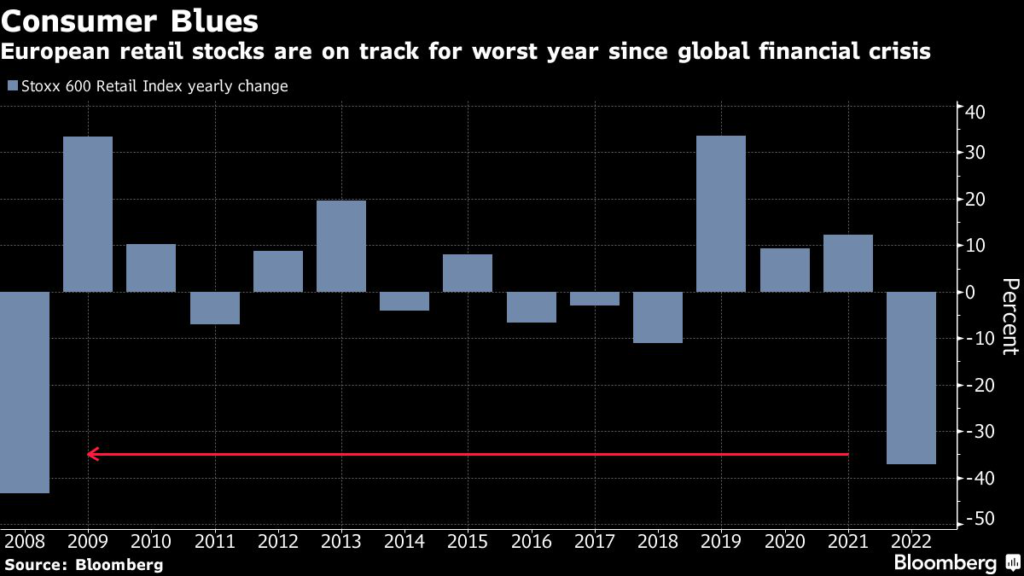
Nevertheless, pessimism over the industry’s prospects has made retail the worst-performing sector in Europe’s benchmark Stoxx 600 Index this year, down 37%.

THG’s co-founder and Chief Executive Officer Matt Moulding said his company has invested heavily “in price protection for consumers currently facing unprecedented cost-of-living challenges.”

THG’s problems aren’t limited to the macro-environment. Shares have tumbled from a high of nearly 800 pence last year to under 40 pence amid concerns over its governance and business model, and two unsuccessful takeover bids. Nonetheless, it is suffering from a spike in costs — for example, in the price of whey that goes into its protein shakes — and the squeeze on consumer spending.

At John Lewis, Chairman Sharon White argued that the company’s employee-ownership model gave it an ethical obligation to protect staff, customers and suppliers from soaring inflation and an impending recession.

“We are forgoing profit by making choices based on the sort of business we are,” White said, adding that it has been “extremely considered” in how it passed on costs. School uniforms are no more expensive than last year, she said, citing a £500 million ($633 million) investment in holding down prices. “We are leaning into value in an even more significant way,” she added during a call with journalists.

Retailers such as Associated British Foods Plc, which owns budget chain Primark, and Macy’s in the US have also said that profits will be squeezed by rising costs. 

With inflation exceptionally high and Christmas on the horizon, the ability to pass on higher costs will prove an increasingly crucial test of companies’ ability to protect their bottom lines.

(Adds MyTheresa sales in sixth paragraph)

More stories like this are available on bloomberg.com

©2022 Bloomberg L.P.

World’s Biggest Ether Mining Firm Turns Off Servers After Merge

(Bloomberg) — Ethermine, the largest Ethereum mining services provider by computing power, shut down its servers for miners after the blockchain network completed its historic technical upgrade. 

The move followed Ethereum’s highly-anticipated software revamp, dubbed the Merge, which shifted the most used blockchain from a proof of work consensus mechanism to proof of stake earlier Thursday. It is no longer possible to mine Ether on the network, since the powerful graphic cards used to validate transaction data are being replaced with investors that stake Ether. The validators will secure the Ethereum blockchain and validate data on the network.    

A few days after the Merge, Ethermine will trigger an automatic payout to its miners for any unpaid balances. The company also launched an Ethereum staking pool in August, where Ether holders will be able to deposit their coins and earn yields.

As many as one million people with over $10 billion worth of computer equipment had mined Ether at one point. 

Ether mining had developed into a multi-billion dollar industry over the last several years. The activity involved miners competing against each other to be the first to solve mathematic puzzles and earn a reward in the token. Mining pools such as Ethermine aggregated computing power from a group of miners to increase the probability of winning Ether before distributing the rewards among miners. The pools usually charged a fee for providing their services. 

More stories like this are available on bloomberg.com

©2022 Bloomberg L.P.

KKR, GIP Pursue Stake in Vodafone’s $13 Billion Towers Arm

(Bloomberg) — KKR & Co. and Global Infrastructure Partners are among private equity firms competing for a stake in Vodafone Group Plc’s wireless towers unit, people familiar with the matter said. 

Swedish investment firm EQT AB has also been exploring a potential investment in Frankfurt-listed Vantage Towers AG, the people said, asking not to be identified discussing confidential information. Vodafone has invited suitors to participate in an auction process, according to the people. 

Shares in Vantage rose as much as 4.2% on Thursday, giving the company a market value of 13.4 billion euros ($13.4 billion).

Vodafone hasn’t made a final decision on the size of the stake it wants to sell, though a number of bidders are keen to get a majority holding, the people said. The UK carrier currently holds around 82% of Vantage, according to data compiled by Bloomberg. 

There’s no certainty the private equity firms will proceed with formal offers, and other bidders could still emerge, the people said. Representatives for EQT, KKR, Vantage and Vodafone declined to comment, while a spokesperson for GIP didn’t immediately provide comment. 

Europe’s phone carriers have started to sell off infrastructure assets to raise money for investments in costly fiber-optic rollouts and wireless network upgrades, as well as to cut their large debt piles. In July, Deutsche Telekom AG agreed to sell a majority stake in its towers unit to Brookfield Asset Management Inc. and DigitalBridge Group Inc. in a deal valuing the business at 17.5 billion euros.

These assets, which carriers once saw as vital to their business models, are attractive to investment firms thanks to their steady, predictable returns. KKR raised $17 billion for its latest global infrastructure fund earlier this year, and Bloomberg News reported in February that GIP was targeting $25 billion for the world’s biggest pool of capital dedicated to infrastructure investments. 

(Updates shares in fourth paragraph.)

More stories like this are available on bloomberg.com

©2022 Bloomberg L.P.

South Korea Tightens Net Around Fallen Crypto Tycoon Do Kwon

(Bloomberg) — Do Kwon, whose collapsed Terraform Labs cryptocurrency ecosystem sparked a meltdown in digital assets, faces being forced to return to South Korea after officials sought to have his passport revoked.

A request has been passed to the nation’s Foreign Ministry to scrap the travel document, the prosecutor’s office said in a text message Thursday. If the ministry accedes, Kwon — who prosecutors have said is in Singapore — in theory would have to return to Seoul within 14 days after receiving the notice of revocation.

The ministry acknowledged receiving the prosecutor’s request, saying in a statement that it “is taking necessary steps in accordance with relevant laws and regulations.”

The ministry earlier said it’s possible Kwon can stay in Singapore without a passport. The latest steps come a day after a court in South Korea issued an arrest warrant for Kwon and five others on allegations that include violations of capital-markets law. Kwon couldn’t be reached for comment.

Kwon found himself at the center of one of crypto’s biggest blowups when TerraUSD, also known as UST, crumbled from its dollar peg and brought down the ecosystem he had built. The $60 billion wipeout also saw the implosion of a related token known as Luna. The collapse in May shook faith in the digital-asset sector, which has yet to recover much of the losses.

Some investors in Luna have filed a complaint with local prosecutors alleging Kwon engaged in fraud and illegal fundraising, according to Han Sang Jun, a lawyer at Daegun. LKB & Partners also filed a complaint with South Korean prosecutors making similar allegations.

An estimated 280,000 South Koreans had invested in Luna, according to the Financial Services Commission, the country’s financial regulator. Kwon said in an interview with crypto media startup Coinage that he plans to cooperate with authorities when the time comes.

(Updates with Foreign Ministry statement in third paragraph.)

More stories like this are available on bloomberg.com

©2022 Bloomberg L.P.

Goldman Sachs, Citigroup Boost Lending to Latin America Startups

(Bloomberg) — Banks including Goldman Sachs Group Inc. and Citigroup Inc. are stepping in with loans as Latin American startups face shrinking public valuations that make equity sales less attractive.

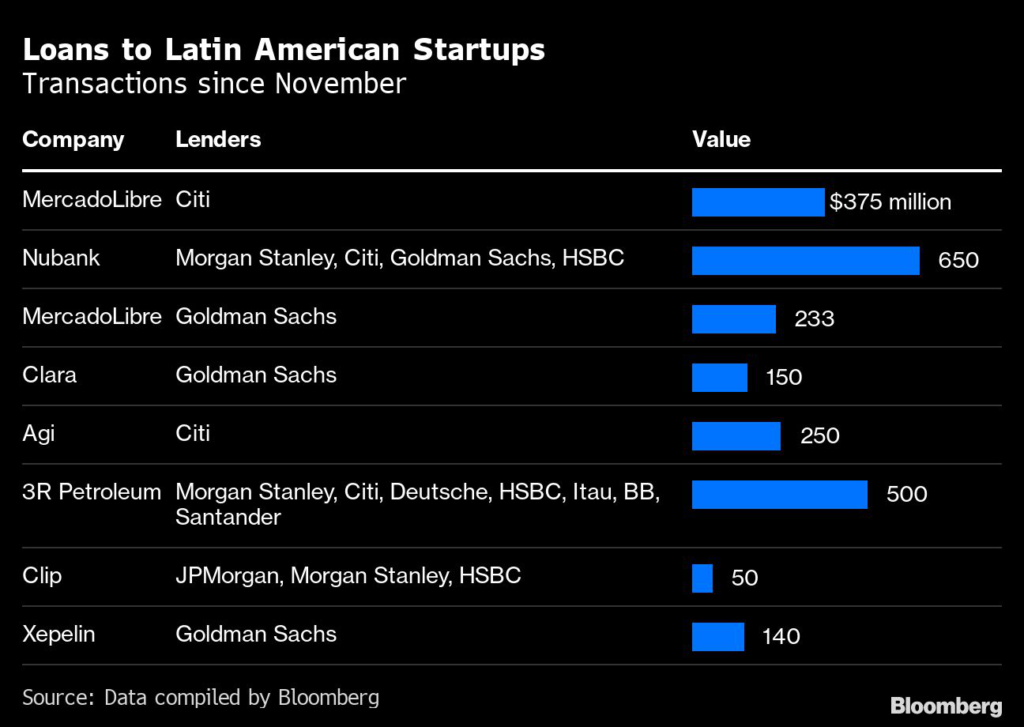
Small startups such as Brazilian fintech Agi, known previously as Banco Agibank SA, and Chile’s Xepelin Holdings SA, as well as bigger firms such as digital retailer MercadoLibre Inc. are among those receiving financing. More than $2.3 billion in loans have been made since November, with banks such as Morgan Stanley and JPMorgan Chase & Co. also participating, according to public data compiled by Bloomberg. Many transactions have been kept private. 

“We’re not here just to take them public,” said Eduardo Cruz, Citigroup’s head of banking, capital markets and advisory for Latin America. “Because of our services and capabilities and our presence in so many countries, we actually can help these companies expand beyond their local markets.”

Latin America startups, which boomed in recent years with huge initial public offerings and record venture-capital investments, are suddenly facing a reckoning as rising interest rates around the world depress valuations and increase the cost of funding. Equity sales by Latin American companies fell 60% this year through Sept. 13, to $10.8 billion, according to data compiled by Bloomberg. 

“It’s a new class of clients that has emerged in the last five years that we’re working closely with,” said Eduardo Miras, head of investment banking at Citigroup in Brazil. “We are helping companies that we believe are going to be the winners, that are going to grow and solidify. We can offer these tech companies not only investment-banking services and funding, but also payments and cash management.” 

After being valued at $45 billion in a much-anticipated initial public offering in December and raising almost $2.8 billion, Nu Holdings Ltd., know as Nubank, has a market value about $25 billion now. In April, it took a $650 million credit line with a three-year maturity from banks including Citigroup, Goldman Sachs, HSBC Holdings Plc and Morgan Stanley for its expansion in Mexico and Colombia. 

Citigroup’s loan book to Latin America corporations rose 12% to $36.2 billion in June from the end of 2021, according to the New York-based bank’s balance sheet.  

Even companies that still received venture capital investments this year are taking the opportunity to get loans. Just four months after having raised $111 million in a private equity sale, Chilean fintech Xepelin got a $140 million loan from Goldman Sachs for its expansion in Mexico. 

After the record of $15.8 billion last year, venture capital investments in startups in Latin America fell this year, according to LAVCA, the association for private equity investment in the region. In the first half of the year, it reached $5.44 billion, 41% less than in the last half of 2021.

Pedro Juliano, head of investment banking at JPMorgan in Brazil, said not all forms of financing are appropriate for startup companies.

“On one side, venture debt is good, because in theory it dilutes the shareholder less up-front,” Juliano said Wednesday at the Bloomberg Línea Summit in Brazil. “But it also usually uses warrants and has characteristics that can make it expensive, with a bigger dilution in the future.” 

Rodrigo Catunda, co-head for Brazil at General Atlantic, said at the event that “venture debt is risky debt, and I would not use it as an aggressive strategy.”

Much of the lending coming to Latin America’s startups from US banks are asset-backed loans, which can reduce the cost of funding for companies and provide financing in local currency. Others are straightforward acquisition-finance deals, such as the $500 million loan taken by Brazil’s 3R Petroleum Oil & Gas SA to pay for the acquisition of the country’s Potiguar oil field.

Goldman Sachs sees value in “developing our relationships early with these companies since our intention is to grow alongside them,” said Samuel Villegas, president of Goldman Sachs Mexico Casa de Bolsa. “We believe some of these companies are changing the landscape of the financial and banking industries in Latin America.” 

More stories like this are available on bloomberg.com

©2022 Bloomberg L.P.

Oman’s OQ Picks BofA for $800 Million Gas Pipeline IPO

(Bloomberg) —

Oman energy firm OQ SAOC has picked Bank of America Corp. and Bank Muscat to advise on the initial public offering of its gas pipelines unit, according to people familiar with the matter, as the sultanate kickstarts its privatization program.

The IPO of OQ Gas Network could raise as much as $800 million, one of the people said, asking not to be identified as the information isn’t public. OQ has also discussed the possibility of a dual listing in Muscat and Saudi Arabia, the people said.

More banks may be added to the deal, while details such as its size and the listing location may change, the people said.

Representatives for OQ and Bank Muscat didn’t immediately respond to requests for comment. A representative for Bank of America declined to comment.

The OQ share sale is part of Oman Investment Authority’s plan to bolster state coffers. Across the energy-rich Gulf, governments are readying plans to sell assets to fund the diversification of their economies, attract international investors and boost trading volumes. 

Saudi Arabia and the United Arab Emirates are in the midst of such programs, which have fueled a boom in IPOs and led to a record start to the year for offerings in the Middle East.

State Sales

In June, Oman said it was considering selling shares in two of OQ’s units, as well as a manufacturing firm, without revealing the names. The country has only had a small number of IPOs in the last decade. The most recent sizable deal was Omani Qatari Telecommunications Co.’s IPO in 2010 that raised $475 million, according to data compiled by Bloomberg.

If OQ opts for a dual listing, it would be one of the Middle East’s first. Americana Group, the operator of KFC and Pizza Hut restaurants across the region, is planning to list in Abu Dhabi and Riyadh.

OQ is an integrated energy firm with oil and gas exploration, production operations, refineries, a retail network and a large petrochemical business.

More stories like this are available on bloomberg.com

©2022 Bloomberg L.P.
John Lewis Sinks to £99 Million Loss as Shoppers Cut Back

(Bloomberg) —

John Lewis Partnership Plc blamed the UK’s “unprecedented cost-of-living crisis” as it posted a loss of £99 million ($114 million) in the first half of the year.

The pretax loss widened from £29 million a year earlier, with the company — which is owned by its employees — saying it had chosen to protect both customers and staff from soaring inflation.

Workers will be given a £500 one-off bonus, while entry-level pay will increase 4%. John Lewis had already said it would provide free food to employees, including hot meals, during winter.

“We are forgoing profit by making choices based on the sort of business we are,” Chairman Sharon White said, “by helping our partners, customers, communities and suppliers.”

“The outlook is uniquely uncertain,” White said, due to the war in Ukraine and high global energy costs.

Excluding exceptional items, John Lewis lost £92 million, compared with a profit of £69 million a year earlier.

Waitrose, its high-end grocery business, suffered a 5% drop in like-for-like sales.

John Lewis is under pressure from consumers cutting back on non-essential spending as they prioritize cash for energy bills and other crucial costs. 

“We have seen customers move their discretionary spending from high margin, big-ticket household items to restaurants and holidays,” White said. “From dining room furniture to dining out.”

Waitrose has lost ground to cheaper competitors with shoppers changing their habits to visit discount supermarkets Aldi and Lidl. The partnership has been shutting stores and cutting costs under the leadership of White, a former telecommunications regulator who joined the employee-owned company in 2020.

In a push for Christmas sales, John Lewis is hiring 10,000 temporary staff in the UK to meet demand, 3,000 more than the chain hired for the same period last year. But with rising energy bills and the threat of a recession on the horizon, consumers are unlikely to splash out.

(Adds details on staff bonus and pay rise in third paragraph)

More stories like this are available on bloomberg.com

©2022 Bloomberg L.P.

Carmakers Play Numbers Game in $53 Billion Self-Driving Splurge

(Bloomberg) —

In BloombergNEF’s latest road transport outlook report, we see autonomous vehicles accounting for roughly 8% of the kilometers that passenger vehicles travel by 2040.

There’s a great deal of uncertainty in the pace of technological development in this industry, so it’s easy to find predictions that this number will be far higher or lower. But this much is certain: charting the share of kilometers driven by self-driving vehicles in the future involves drawing a line going up and to the right.

The general belief in this trend — and perhaps a healthy dose of FOMO — has helped spur more than $53 billion of investment in private autonomous-vehicle technology companies since 2014. Automakers have played an important role in determining how that capital has been allocated. They’ve invested directly through their corporate venture funds and M&A departments and have ascribed credibility to self-driving vehicle startups that need vehicles to develop their technology.

As part of our work tracking self-driving vehicle developments, we maintain a database of external investments, joint ventures, partnerships and other moves by the world’s largest automakers. The most obvious takeaway from mapping out these activities is that, for the majority of major manufacturers, there’s a reluctance to put all their self-driving eggs in one basket.

Spreading out investment and partnerships across multiple companies isn’t a guarantee of success, but many investors will tell you it does improve the odds. In addition to diverse-portfolio theory, there are other reasons automakers would want to hedge their bets.

Many self-driving companies test and develop their technology in cars but also have their eyes on other prizes. Self-driving delivery company Nuro, which last week announced a partnership with Uber, tested early iterations of its software in cars while awaiting federal approval for its custom delivery vehicle to be allowed on public roads.

Diversity in self-driving applications and business models — be it robotaxis, autonomous trucks, delivery robots or more niche vehicles like street sweepers and garbage trucks — could be a way to ensure that even if you as an investor pick a company that doesn’t end up with the best tech, at least they have an early start in a specific revenue-generating activity.

Another reason to spread out wagers on autonomous driving is geography. In some respects, regional differences are becoming less of a hindrance. The General Motors-backed startup Cruise, for example, announced plans this week to quickly expand into new areas, deploying its vehicles in Phoenix and Austin, Texas. The company expects to be able to arrive in a new city, record 3D maps and begin offering driverless rides to passengers, all within 90 days. If Cruise is able to achieve this goal, it’ll be a significant development for the industry and a powerful demonstration of how self-driving technology could scale.

Geography remains a roadblock in other ways. Some regions are increasingly reluctant to allow self-driving companies to share data they capture in one area with developers in another. This trend is prevalent in our automaker corporate strategy database, with many automakers making significant investments in western self-driving companies and separate investment in companies based in China.

As with any developing industry, not every company will be successful and there will likely be a lot of consolidation in the self-driving industry. However, across specific applications, geographies and business models, there will be many winners, and the global automotive giants want a piece of it all.

More stories like this are available on bloomberg.com

©2022 Bloomberg L.P.
Close Bitnami banner
Bitnami