Bloomberg

Growing Popularity of Trucks Dents Fuel-Economy Gains, US Finds

(Bloomberg) — The rising popularity of large trucks and sport utility vehicles is slowing the auto industry’s efforts to reduce greenhouse gas emissions, the US government found.

After reaching a record high in 2020, fuel economy for vehicles from the last model year was unchanged, according to a report released Monday from the Environmental Protection Agency. Carbon dioxide emissions decreased slightly in 2021, the study found.

The figures reflect consumers’ embrace of larger, heavier and more powerful vehicles, which typically have lower fuel economy and higher CO2 emissions than other automobiles. Sedans fell to 26% of the cars produced in 2021, down from more than 80% in 1975, the report found. Meanwhile, the large vehicles that the EPA calls “truck SUVs” reached a record high of 45% of production.

“The overall new vehicle market continues to move away from the sedan/wagon vehicle type,” the agency said in the executive summary of the report. That “has offset some of the fleetwide benefits that otherwise would have been achieved from the improvements within each vehicle type.”

More stories like this are available on bloomberg.com

©2022 Bloomberg L.P.

Microsoft’s Offer to Sony for Call of Duty Includes Subscription Service

(Bloomberg) — In a bid to win regulatory approval for its $69 billion purchase of Activision Blizzard Inc., Microsoft Corp. has offered rival Sony Group Corp. the right to sell Activision blockbuster Call of Duty as part of its gaming subscription service. 

Microsoft has publicly stated that it offered Sony a 10-year deal to make Call of Duty available on the Japanese company’s PlayStation console. The proposal, which Sony hasn’t accepted, also includes rights to sell the title on the PlayStation Plus service, which gives gamers access to a catalog of games for a monthly fee, according to a person familiar with the negotiations who declined to be identified because the talks are confidential.

Microsoft’s Xbox Game Pass is the leader in the video game and cloud gaming subscription market and is a top concern of regulators in the US, UK and European Union. Last week, the US Federal Trade Commission said it’s seeking to block the merger on grounds that it would “enable Microsoft to suppress competitors to its Xbox gaming consoles and its rapidly growing subscription content and cloud-gaming business.”

Cloud gaming, which Microsoft sells as part of the highest tier of Game Pass, is still in its infancy. But some expect the technology, which  allows subscribers to stream certain games onto any device, even tablets and phones, could eventually make consoles less relevant. Subscriptions offer gamers access to a wealth of games for a low price of about $10 to $15 a month, compared with single game titles that cost about $70 each. Sony didn’t immediately reply to a request for comment. Microsoft declined to comment on the specific terms of its offer to Sony. 

Sony has been a staunch opponent to Microsoft’s bid for Activision, accusing the company of seeking to “lock in many consumers to Xbox” and leveraging its other products to “foreclose cloud gaming at a critical point of its evolution.” Analysts question whether Sony’s criticisms come from insecurity that the Japanese tech company lags behind Microsoft in diversifying away from console gaming. Sony typically releases its best first-party games onto PlayStation long before they appear anywhere else. 

Game Pass, which launched in 2017, has grown quickly and now has more than 25 million subscribers, far more than Sony’s similar offering. Microsoft added cloud gaming to Game Pass in 2020 and, according to the FTC, more than 20 million gamers have streamed games from the cloud with the service. Microsoft has said that cloud gaming subscription services are essential to reach its goal of expanding to 3 billion gamers worldwide, and its vision of enabling gamers to play games across Windows, Xbox and smartphones.

Microsoft last week struck a 10-year deal for Call of Duty with Nintendo Co. Microsoft declined to say whether that agreement also included subscription service rights. 


More stories like this are available on bloomberg.com

©2022 Bloomberg L.P.

New FTX Chief John Ray Chides Crypto Firm’s Previous Leadership

(Bloomberg) — The person in charge of restructuring crypto giant FTX told lawmakers that the company’s spectacular collapse was due to failures by its previous leaders.

“The FTX Group’s collapse appears to stem from the absolute concentration of control in the hands of a very small group of grossly inexperienced and unsophisticated individuals,” John J. Ray III said in remarks prepared for a hearing in the House Financial Services Committee on Tuesday. 

More stories like this are available on bloomberg.com

©2022 Bloomberg L.P.

Goldman to Cut Hundreds More Jobs as Consumer Unit Scaled Back

(Bloomberg) — Goldman Sachs Group Inc. aims to cut at least a few hundred more jobs as the Wall Street titan restructures its struggling consumer business and braces for an uncertain economy in the year ahead.

The bank is drafting plans that could eliminate at least 400 positions from its loss-making retail banking operations, according to people familiar with the matter.

Chief Executive Officer David Solomon has said he’s dialing back the firm’s ambitions for consumer banking. The latest cuts show the firm is moving beyond its annual exercise of weeding out underperforming staff, which was the focus just months ago. The CEO has recently also signaled he’s reviewing other business lines to manage headcount and limit costs.

The firm is facing mounting pressure on expenses after spending significantly on technology and integrating operations, and as analysts predict the company’s adjusted annual profit will fall 44%. The consumer unit’s swelling costs, a slowdown in dealmaking and a slump in asset prices were enough to take a big bite out of the firm’s bonus pool this year.

“We continue to see headwinds on our expense lines, particularly in the near term,” Solomon said at a conference last week. “We’ve set in motion certain expense mitigation plans, but it will take some time to realize the benefits. Ultimately, we will remain nimble and we will size the firm to reflect the opportunity set.”

A company spokesperson declined to comment. The plans are still being finalized, one of the people said, asking not to be named discussing internal deliberations.

Under Solomon, the New York-based firm has dabbled in acquisitions to beef up business lines outside its core Wall Street profit engine to build a more diversified company. That contributed to a surge in headcount. The bank’s workforce surpassed 49,000 in this year’s third quarter, up 34% since the end of 2018. The bank doesn’t break out how many people work in consumer operations.

Curtailing Lending

The consumer business will halt loan originations in the coming months. Those unsecured loans were one of the most visible signs of Goldman’s departure from catering to the financial elite. It gave the firm a taste of business on Main Street, like chasing down unpaid debts in local courts across the country.

The bank is still committed to growing its other highly visible product — high-yield savings accounts that have helped attract consumer deposits. It is, however, turning off the beta rollout of a checking-account product that was meant for a mass retail launch before the restructuring. It’s now reviewing whether and how to make that operational again for a narrower target audience.

The bank is also reviewing its installment-lending arm GreenSky — a venture Goldman finished acquiring in March. The space for such lending has gotten crowded at a time of mounting concern about the strength of the economy. Investors were lukewarm about the deal when it was announced and have expressed concern as the business underperformed projections this year, the people familiar with the situation said.

In October, Goldman said it will wrap GreenSky into a new business line dubbed Platform Solutions, which also includes the firm’s nascent credit-card unit and transaction-banking arm. Platform Solutions is expected to post elevated losses when its numbers are disclosed next month.

More stories like this are available on bloomberg.com

©2022 Bloomberg L.P.

Stocks Rise Ahead of Inflation Data, Fed Meeting: Markets Wrap

(Bloomberg) — US stocks advanced at the start of a pivotal week for monetary-policy decisions from the Federal Reserve, European Central Bank and a host of their peers. 

The S&P 500 rose as much as 0.7% after the New York Fed released consumer survey data showing inflation expectations declined. The tech-heavy Nasdaq 100 climbed after fluctuating earlier. Treasury yields rose, with the 10-year rate around 3.63%. The dollar advanced. 

All eyes will be on the US consumer price index reading on Tuesday, which is expected to show prices, while still high, are continuing to decelerate. A subdued CPI print would justify the Fed’s projected half-point move on Wednesday and shed light on whether markets can expect rate cuts in late 2023. While central bank officials have indicted a downshift, they have also emphasized that borrowing costs will need to remain restrictive for some time. 

“We need to keep the optimism in perspective — we’ve just gotten back to the levels that prevailed before the late swoon on Friday,” said Steve Sosnick, chief strategist at Interactive Brokers. “And yet again we bounced off the 100-day on SPX. There hasn’t been enough selling pressure to push us below it. But it does feel like there is some optimism regarding CPI. We shrugged off a bad set of PPI numbers, so I think there are many who think we could do the same regardless of outcome.”

Read: The 24 Hours of Hikes That End Year of Fighting Inflation

The S&P 500 posted its best post-CPI day ever in November after the inflation print came in slower than projected. The US equity benchmark could rise as much as 5.5% on Tuesday — which will tie for the best CPI day ever — should headline inflation come in 0.2 percentage points below estimates on a year-over-year basis, according to an analysis from market maker Optiver. 

Still, disparities in the economic outlook between the world’s regions, from the resurgence of Covid in China to energy volatility in Europe, have kept a lid on risk sentiment. 

Following the Fed, the ECB will announce its rate decision Thursday, and may also opt for a 50 basis-point hike. Markets also have to contend with decisions from the Bank of England and monetary authorities in Mexico, Norway, the Philippines, Switzerland and Taiwan.

Key events this week:

  • US CPI, Tuesday
  • FOMC rate decision and Fed Chair news conference, Wednesday
  • China medium-term lending, property investment, retail sales, industrial production, surveyed jobless, Thursday
  • ECB rate decision and ECB President Lagarde briefing, Thursday
  • Rate decisions for UK BOE, Mexico, Norway, Philippines, Switzerland, Taiwan, Thursday
  • US cross-border investment, business inventories, empire manufacturing, retail sales, initial jobless claims, industrial production, Thursday
  • Eurozone S&P Global PMI, CPI, Friday

Some of the main moves in markets:

Stocks

  • The S&P 500 rose 0.5% as of 1:04 p.m. New York time
  • The Nasdaq 100 rose 0.2%
  • The Dow Jones Industrial Average rose 0.9%
  • The MSCI World index fell 0.1%

Currencies

  • The Bloomberg Dollar Spot Index rose 0.2%
  • The euro fell 0.1% to $1.0529
  • The British pound rose 0.1% to $1.2275
  • The Japanese yen fell 0.8% to 137.65 per dollar

Cryptocurrencies

  • Bitcoin fell 0.6% to $17,015.01
  • Ether fell 0.9% to $1,253.75

Bonds

  • The yield on 10-year Treasuries advanced five basis points to 3.63%
  • Germany’s 10-year yield was little changed at 1.94%
  • Britain’s 10-year yield advanced two basis points to 3.20%

Commodities

  • West Texas Intermediate crude rose 3.6% to $73.58 a barrel
  • Gold futures fell 0.9% to $1,794.60 an ounce

This story was produced with the assistance of Bloomberg Automation.

–With assistance from Srinivasan Sivabalan.

More stories like this are available on bloomberg.com

©2022 Bloomberg L.P.

Bankman-Fried Jolts FTX Hearings With Plan to Skip Senate Panel

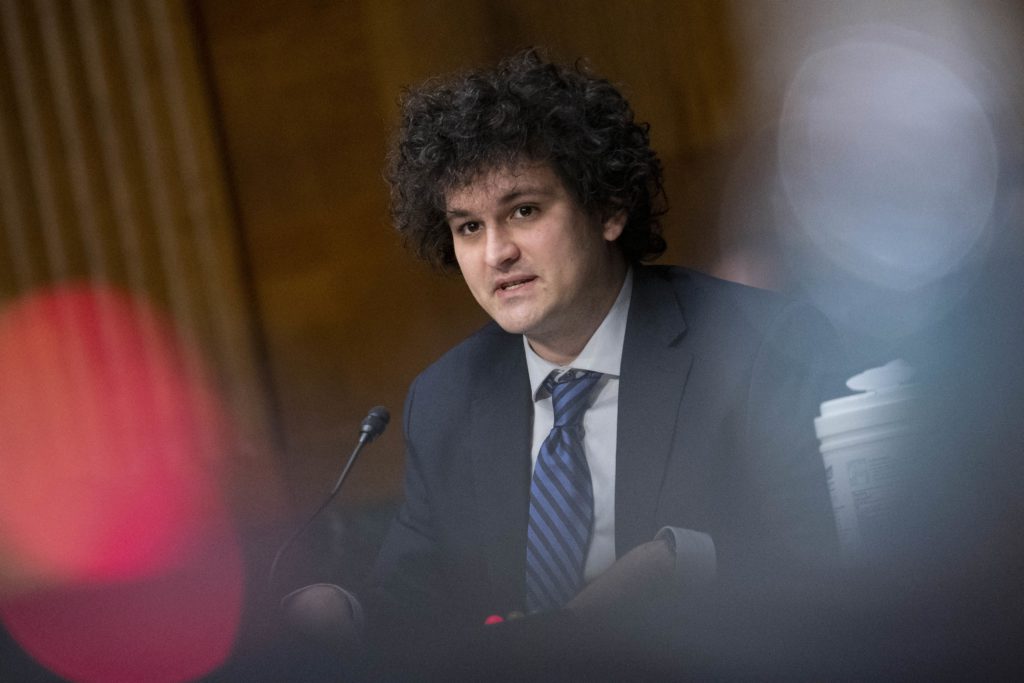
(Bloomberg) — After spending the past two weeks participating in media interviews, former FTX Chief Executive Officer Sam Bankman-Fried is being more selective when it comes to appearing before Congress to discuss the collapse of his cryptocurrency empire. 

Bankman-Fried said Monday that he is “currently not scheduled” to attend the Senate Banking Committee’s hearing on Dec. 14, though he will testify at a separate hearing by a House panel a day earlier. 

I’m “open and willing” to having a conversation with the chair of the Senate committee about the hearing if his attendance is deemed important, Bankman-Fried said during a Twitter Space interview. Bankman-Fried missed a deadline last week set by the Senate committee for a response to a request to testify. 

Bankman-Fried, who is in the Bahamas, confirmed he will attend the Tuesday hearing by the House Financial Services Committee remotely. He is listed as a witness alongside current FTX CEO John J. Ray III, according to a media advisory from the committee. Starting at 10 a.m. in Washington, the House hearing will be split into two parts, each featuring one of the men. 

At the center of civil and criminal investigations into the FTX implosion are questions about whether FTX mishandled customer funds by lending them out to the trading platform’s sister company, Alameda Research, to shore up risky bets.     

Bankman-Fried, who hasn’t been charged with any crimes, has denied trying to perpetrate a fraud, though he has owned up to grievous managerial errors at FTX.   

–With assistance from Allyson Versprille.

(Updates with more details on the hearings beginning in the second paragraph.)

More stories like this are available on bloomberg.com

©2022 Bloomberg L.P.

Elon Musk Gets Booed at Dave Chappelle Show

(Bloomberg) — Elon Musk was booed on stage for several minutes at a comedy show in San Francisco on Sunday after spending the weekend attacking former Twitter Inc. employees and outgoing top US medical adviser Anthony Fauci.

Many in attendance to see Dave Chappelle at Chase Center — which has capacity for more than 18,000 — broke out into jeers as soon as the comedian asked them to “make some noise for the richest man in the world.”

“Cheers and boos, I see,” Chappelle said as Musk, 51, waved and paced around on stage in footage later posted on YouTube. After the two raised their hands in reaction to the reception for the billionaire, the comedian quipped: “It sounds like some of them people you fired are in the audience.”

The billionaire has dismissed thousands of employees from San Francisco-based Twitter since closing his $44 billion acquisition of the company six weeks ago. Over the weekend, he accused his predecessors of running it “as a Democratic Party activist machine” and agreed with a follower who said Twitter’s handling of former president Donald Trump’s tweets amounted to election interference.

In other posts, Musk baselessly suggested that Yoel Roth, the former head of Twitter’s trust and safety division, is an advocate for sexualizing children, and wrote that the company is “both a social media company and a crime scene.” He made fun of gender pronouns and called for Fauci to be prosecuted in a post, and claimed the director of the National Institute of Allergy and Infectious Diseases has lied to Congress. The US has debunked that.

Musk’s tweeting has been turning off some would-be buyers of Tesla Inc.’s electric cars, and his acquisition of Twitter has dragged on the valuation of the company from which he derives most of his $175.2 billion fortune. Tesla shares slumped as much as 5% on Monday and are down about 52% this year.

Musk tweeted hours after his public appearance that the crowd’s reaction was “90% cheers & 10% boos,” but said it was the first time he’s been booed in person. 

More stories like this are available on bloomberg.com

©2022 Bloomberg L.P.

Insight Partners Weighs $2 Billion Community Brands Sale

(Bloomberg) — Insight Partners is exploring the sale of Community Brands, which makes software used for donations, peer-to-peer fundraising, admissions and events, among other purposes, according to people with knowledge of the matter.

The New York-based investment firm is working with FT Partners to solicit interest from potential suitors, which may include larger software vendors or private equity firms, said the people, all of whom requested anonymity discussing private information. Community Brands could fetch as much as $2 billion, including debt, in any transaction, the people said. 

Representatives for Insight Partners and FT Partners declined to comment.

Community Brands, led by Chief Executive Officer Dave Wirta, serves over 100,000 clients in 30 countries including 3M Co., International Business Machines Corp., Habitat for Humanity and Girl Scouts, its website shows. Its software includes brands like Aptify, Configio, GiveSmart, MobileCause, Ravenna and SchoolSpeak.

Formed in 2017 through the combination of YourMembership, Abilta and Aptify, the software maker has acquired firms including BigSIS in August. 

Read more: Insight Partners Holds Talks to Raise New $20 Billion Fund

More stories like this are available on bloomberg.com

©2022 Bloomberg L.P.

China Tries to Push Back on US Chip Sanctions With WTO Case

(Bloomberg) — China filed a dispute with the World Trade Organization trying to overturn US-imposed export controls, which aim to limit the Asian nation’s ability to develop a domestic semiconductor industry and equip its military.

China lodged the compliant with the WTO on Monday, according to a statement from its Ministry of Commerce. With the trade rules threatening its foothold in the $580 billion industry, the country is arguing that the US is unfairly using vague security-related justifications to hold back its rival.

The chip industry has become a major flashpoint for trade tensions between the two economic superpowers. Though China is the biggest maker of phones and computers, US companies still control most of the underlying chip technology. The Biden administration has argued that it needs to limit China’s access to the most advanced equipment to safeguard national security.

In Monday’s statement, China said the US is engaging in economic protectionism that undermines trade rules. The behavior also threatens the global supply chain, according to the complaint. But even if the country is successful with its case, the WTO lacks the ability to force the US to reverse its actions.

Washington is asking its allies to go along with the restrictions, which would put more pressure on China. For US companies, meanwhile, the rules have caused some suffering. China is the largest market for semiconductors, and chipmakers that sell to the country expect to lose billions in revenue.

China’s move marks the first stage of the WTO’s lengthy dispute resolution process. The US now has 60 days to enter into consultations. If that doesn’t resolve the issue, Beijing can request the establishment of a WTO panel.

It could take several years for the case to work its way through the WTO’s backlogged dispute-settlement system. And even if China wins the case, the US could essentially veto the outcome by appealing the decision to the WTO’s slow-moving appellate body.

–With assistance from Foster Wong and Bryce Baschuk.

(Updates with explanation of WTO process from sixth paragraph.)

More stories like this are available on bloomberg.com

©2022 Bloomberg L.P.

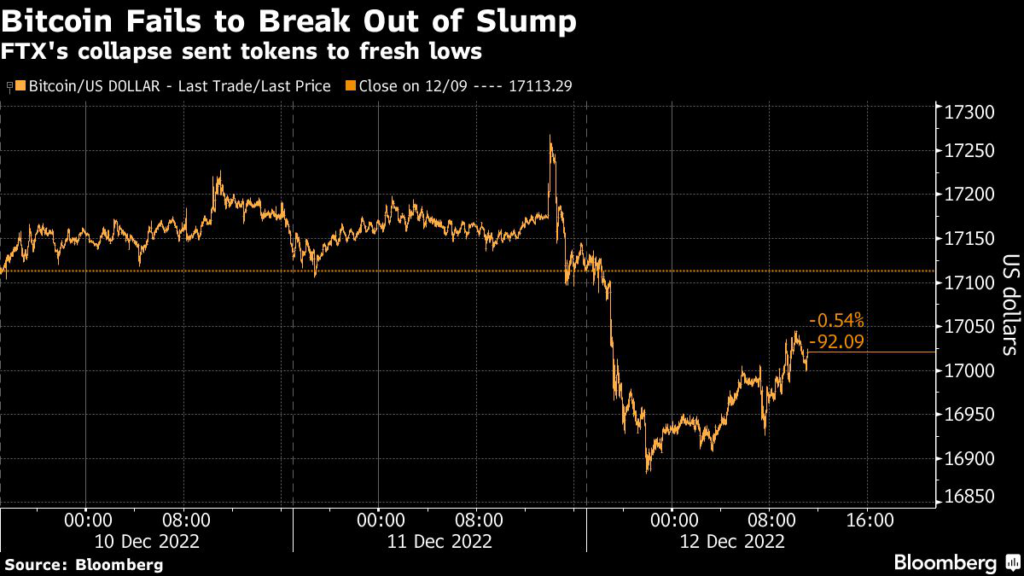
FTX Fiasco Pushes Bitcoin Lower on Continued Fears of Contagion

(Bloomberg) — Cryptocurrencies were mostly lower as the risk of further contagion continues to weigh on investor sentiment a month after Sam Bankman-Fried’s FTX exchange sought bankruptcy protection.

Bitcoin dropped as much as 1.4% to $16,882 on Monday before paring losses. Ether sank modestly as well, while altcoins like Avalanche and Dogecoin posted more significant declines. 

The insolvency of one of crypto’s most established firms pushed down prices, already in a months-long slide. At the start of the fourth quarter, Bitcoin traded close to $20,000, but over the past month, the token has hovered around $16,500, failing to break above $17,400. Bitcoin is down 63% this year. 

“I would expect us to continue to stay range-bound until the new year,” wrote Aya Kantorovich, former head of institutional coverage at FalconX. 

Instead of expanding crypto portfolios, clients have unwound and hedged their crypto exposures, which Kantorovich said has pushed down open interest in Bitcoin and Ethereum. Bitcoin dropped 16% in November, its largest monthly decline since June.

Kantorovich added that she expects funds to “re-deploy into the space in January,” and wrote that crypto markets may be hitting a bottom. 

Crypto trading firm Cumberland also said it does not “expect this paradigm to last,” given consolidating price action.     

More stories like this are available on bloomberg.com

©2022 Bloomberg L.P.
Close Bitnami banner
Bitnami