Bloomberg

Wirecard Trial Should Be Halted, Ex-CEO’s Lawyer Demands

(Bloomberg) — Days into the sprawling trial over the collapse of Wirecard AG, the lawyer for the payment firm’s former boss Markus Braun demanded a halt to proceedings, saying prosecutors must re-examine key parts of their case.

Piles of relevant documents were disclosed to the defense only four weeks before the trial start, robbing attorneys of a fair chance to prepare, Alfred Dierlamm, Braun’s lead attorney, said in his opening statement on Monday. Prosecutors also failed to secure account statements of companies linked to the scandal and instead uncritically believed the “tall stories” of their central witness, he added.

“This is a distortion of a criminal justice,” said Dierlamm, at the trial located in the Stadelheim prison, among Germany’s largest prison complexes. “The case suffers from grave violations of the rule of law because information was withheld from the defense.”

Braun and two other men are on trial over the 2020 demise of Wirecard, the digital payment company that collapsed over allegations it was built on fraud. After numerous denials, Wirecard finally admitted that more than $2 billion in cash it had previously reported as merely missing likely never existed. The company filed for insolvency a few days later in June 2020. The case became Germany’s biggest corporate scandal.

Read More: Wirecard CEO Gets Day in Court After Two Years Behind Bars

A central part of the allegations is linked to so called Third Party Acquirers, or TPA, which allegedly procured payment business for Wirecard. Prosecutors said in their charges that this business didn’t exist and the paperwork surrounding it was forged.

These TPAs had accounts in Germany with assets totally €1 billion making it hard to believe there was no such business, Dierlamm said. About €750 million of that money was then sent to accounts of off-shore companies controlled by Oliver Bellenhaus, who is on trial alongside Braun and is also a key witness the prosecution relies on. Dierlamm said accounts of these companies should have been thoroughly checked instead of claiming that money has nothing to do with Wirecard.

“Only when these accounts have been thoroughly reviewed and when we know who profited here, we can say who the perpetrators were,” said Dierlamm. “Follow the money!”

His client believed in Wirecard and bought shares for millions of euros as late as May 2020, which shows that he had nothing to do with the scam that brought it down, said Dierlamm.

The court said it will rule on Dierlamm’s request later this week or early next week. Braun, who was scheduled to testify on Wednesday, now won’t address the court before the ruling.

Braun vs Bellenhaus

Monday’s hearing demonstrated that the trial is set to become a showdown between Braun and Bellenhaus.

Florian Eder, Bellenhaus’ defense counsel, rejected Dierlamm’s allegation that his client lied. Bellenhaus was the only manager to take responsibility and voluntarily returned from Dubai to help the probe even though he knew that meant going directly to prison, the lawyer said.

“Wirecard was all smoke and mirrors,” Eder said. “It was part of the system to respond to an attack with a counterattack and then quickly adopt a victim attitude.”

A lawyer for the third defendant, Stephan von Erffa, spoke for the first time during the trial on Monday. Prosecutors were wrong to charge von Erffa with being part of a criminal gang at Wirecard. He never received any money other than his regular pay, Sabine Stetter said. 

Separately, Ernst & Young LLP, Wirecard’s auditor, lost a suit in a Stuttgart court which ruled that it must hand over its internal reference files it compiled when auditing the company. EY also has to answer questions about its 2016 audit, the judges said. Wirecard’s insolvency administrator had filed the suit.

(Updates with more lawyer statements throughout)

More stories like this are available on bloomberg.com

©2022 Bloomberg L.P.

Ireland Will Get Less Growth From Multinationals Next Year

(Bloomberg) — Ireland has a “positive pipeline” of foreign investment lined up for the first half of next year, but the outlook for the rest of 2023 is “more uncertain” due to global economic headwinds, according to Ireland’s inward investment agency.

A record 301,475 people were employed by multinationals in Ireland in 2022, equating to 12% of the total labor force, the IDA’s interim CEO Mary Buckley said on Monday. Of the 242 investments won in the year, 103 were from new names. 

Even so, “the now evident severe headwinds facing the global economy in 2023 means we will have to work harder than ever in the year ahead to win new investment,” she said. 

The results come after a wave of job cuts at multinational technology companies with European headquarters in Ireland including Twitter Inc., Meta Platforms Inc. and Stripe Inc.

While the job losses are “regrettable,” the companies involved will continue to operate in Ireland, the agency said. 

“Not withstanding the recent retrenchment in the tech sector, we all know the future is digital,” Deputy Prime Minister Leo Varadkar said at a briefing. “There will be a huge expansion in the tech sector in the medium term, we must ensure that all businesses in Ireland no matter what their size are at the forefront of that expansion.”

Tech sector jobs grew 9% in 2022, though this figure doesn’t account for roles lost since October, which will be included in the agency’s 2023 results, Buckley said. 

“There will be some job losses ahead, but we are very confident of the strong base and the growth that continues year-on-year in the technology sector,” she said. Even so, “our companies are going to be much more cautious next year. Growth is likely to slow in Ireland from all of the headwinds we’re seeing.” 

Ireland last week published a new business strategy in the wake of tech sector job cuts, focusing on growing domestic exporters as well as emphasizing decarbonization and digitalization. Investment in infrastructure, particularly housing, which is being raised as a concern by businesses, will also be a “major priority,” Varadkar said.

While more people are expected to work in multinationals, growth won’t be as strong as in recent years, he said. Where there are “big job expansions to come it’ll be more from life sciences and manufacturing rather than technology.”

More stories like this are available on bloomberg.com

©2022 Bloomberg L.P.

Stocks Rise as Traders Brace for CPI, Fed Decision: Markets Wrap

(Bloomberg) — US stocks rose at the start of a pivotal week for monetary-policy decisions from the Federal Reserve, European Central Bank and a host of their peers. 

The S&P 500 climbed after fluctuating earlier in the session. Gains in shares of Microsoft Corp., which agreed to buy a 4% stake in London Stock Exchange Group Plc. lifted the index. The Nasdaq 100 wavered. US Treasuries pared gains, with the 10-year yield around 3.57%. The dollar rose.

All eyes will be on the US consumer price index reading on Tuesday, which is expected to show prices, while still high, are continuing to decelerate. A subdued CPI print would justify the Fed’s projected half-point move on Wednesday and shed light on whether markets can expect rate cuts in late 2023. While central bank officials have indicted a downshift, they have also emphasized that borrowing costs will need to remain restrictive for some time. 

“It’s obviously a meaningful week from a macro prospective and while we’re tempted to suggest the FOMC events will be the highlight, ultimately the core inflation figures will set the tone for trading in US rates for the balance of 2022,” Ben Jeffery and Ian Lyngen of BMO Capital Markets wrote in a note.

Read: The 24 Hours of Hikes That End Year of Fighting Inflation

The S&P 500 posted its best post-CPI day ever in November after the inflation print came in slower than projected. The US equity benchmark could rise as much as 5.5% on Tuesday — which will tie for the best CPI day ever — should headline inflation come in 0.2 percentage points below estimates on a year-over-year basis, according to an analysis from market maker Optiver. 

Still, disparities in the economic outlook between the world’s regions, from the resurgence of Covid in China to energy volatility in Europe, have kept a lid on risk sentiment. 

Following the Fed, the ECB will announce its rate decision Thursday, and may also opt for a 50 basis-point hike. Markets also have to contend with decisions from the Bank of England and monetary authorities in Mexico, Norway, the Philippines, Switzerland and Taiwan.

While the tumult of this year has a gauge of global stocks headed for its biggest annual loss since 2008, the world’s biggest investors predict that stocks will see low double-digit gains in 2023. As many as 71% of respondents in a Bloomberg News survey expect equities to rise, versus 19% forecasting declines. For those seeing gains, the average response was a 10% return.

Key events this week:

  • US CPI, Tuesday
  • FOMC rate decision and Fed Chair news conference, Wednesday
  • China medium-term lending, property investment, retail sales, industrial production, surveyed jobless, Thursday
  • ECB rate decision and ECB President Lagarde briefing, Thursday
  • Rate decisions for UK BOE, Mexico, Norway, Philippines, Switzerland, Taiwan, Thursday
  • US cross-border investment, business inventories, empire manufacturing, retail sales, initial jobless claims, industrial production, Thursday
  • Eurozone S&P Global PMI, CPI, Friday

Some of the main moves in markets:

Stocks

  • The S&P 500 rose 0.3% as of 10:45 a.m. New York time
  • The Nasdaq 100 fell 0.1%
  • The Dow Jones Industrial Average rose 0.6%
  • The Stoxx Europe 600 fell 0.7%
  • The MSCI World index fell 0.1%

Currencies

  • The Bloomberg Dollar Spot Index rose 0.1%
  • The euro was little changed at $1.0544
  • The British pound rose 0.2% to $1.2282
  • The Japanese yen fell 0.5% to 137.26 per dollar

Cryptocurrencies

  • Bitcoin fell 0.6% to $17,018.98
  • Ether fell 1.1% to $1,251.17

Bonds

  • The yield on 10-year Treasuries declined one basis point to 3.57%
  • Germany’s 10-year yield declined two basis points to 1.92%
  • Britain’s 10-year yield was little changed at 3.19%

Commodities

  • West Texas Intermediate crude rose 3.9% to $73.77 a barrel
  • Gold futures fell 0.7% to $1,797.50 an ounce

This story was produced with the assistance of Bloomberg Automation.

More stories like this are available on bloomberg.com

©2022 Bloomberg L.P.

FTX Bankruptcy Means $73 Million in Political Donations at Risk of Being Clawed Back

(Bloomberg) — At least $73 million of political donations tied to Sam Bankman-Fried’s FTX may be at risk of being clawed back as bankruptcy lawyers sort through the remnants of his crypto empire in search of assets to repay creditors.

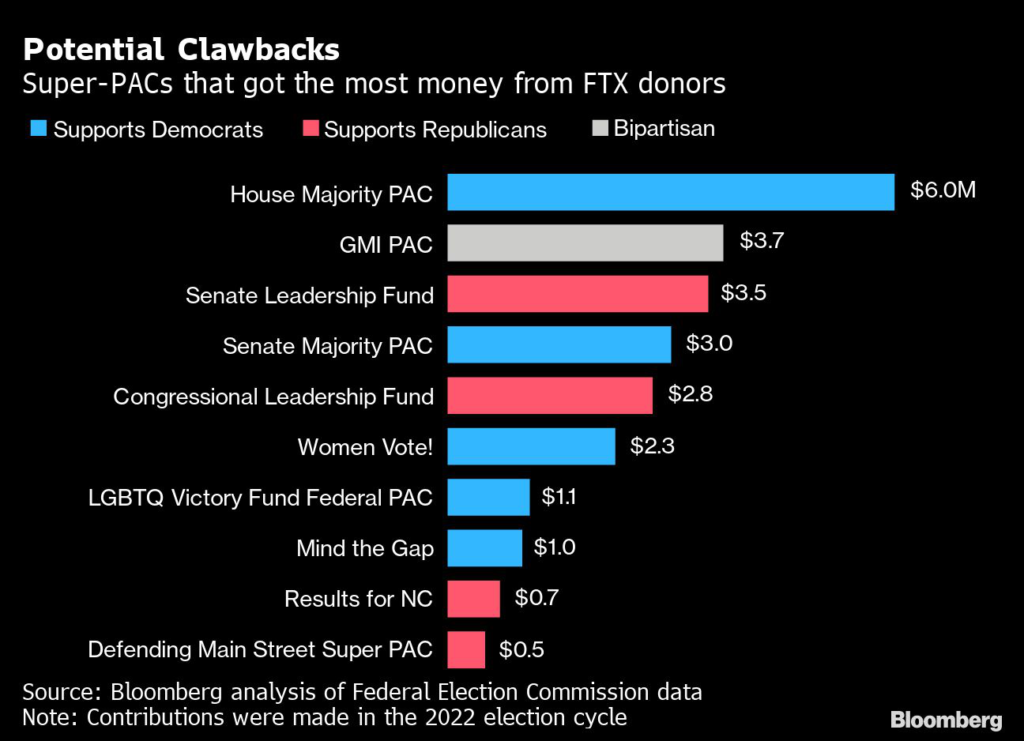
The wide-ranging contributions from Bankman-Fried and two of his top lieutenants, Ryan Salame and Nishad Singh, include more than $6 million to a super political action committee for House Democrats, $3.5 million for the GOP’s Senate Leadership Fund and $3 million for a fund that backs Senate Democrats. 


Washington’s brief but intense flirtation with FTX donors as crypto executives sought to influence industry regulation may end up backfiring spectacularly, damaging the reputations of politicians who benefited from large contributions while some FTX exchange users face losing their life savings. Crypto billionaires — who came with millions in campaign cash — were able to convince many lawmakers that the nascent industry needed a light regulatory framework in order to innovate, but FTX’s implosion has now cast doubt on that.

It’s another layer to the fallout from FTX’s implosion. Just a few months ago, Bankman-Fried, the 30-year-old founder of the crypto exchange, had pledged to give as much as $1 billion in the 2024 presidential election cycle and was touted by his supporters as the next George Soros. Salame had been donating to Republicans at almost the same pace as Steve Schwarzman and Peter Thiel.

“Nobody ends up looking great in this,” said David Primo, a political science professor at the University of Rochester. “FTX was so broad-based in their giving.”

While there’s precedent for forcing political entities to return contributions in cases of fraud, recovery prospects are unclear in FTX’s case. Recouping campaign funds as part of the bankruptcy proceedings is a complicated and lengthy process, and the scope of the total funds eligible for clawback depends on myriad federal and state laws. It is also subject to the bankruptcy lawyers’ judgment on what money, which may be long spent by the time the FTX trustees try to go after it, is worth the effort.

Bankman-Fried is facing additional scrutiny for recently saying he gave equally to Republicans and Democrats, but funded conservatives through  “dark money” groups that don’t identify donors. The claim is almost impossible to verify unless the recipients voluntarily disclose they received money from him. 

What’s clear from public records is that donors tied to FTX gave to Senator Mitch McConnell and Representative Kevin McCarthy, the top Republicans in the House and Senate. They gave to Hakeem Jeffries, now the Democratic Leader in the House, and Dick Durbin, a member of Senate Democratic leadership, in total doling out $73 million in federal races. Jeffries and Durbin have both said they donated the money given to their campaigns by FTX to charity.

Apart from that, Bankman-Fried also gave to state committees. Texas Democrat Beto O’Rourke’s gubernatorial campaign said it returned a $1 million donation Nov. 4, one week before FTX declared bankruptcy. Bankman-Fried also gave $850,000 to the Emily’s List Non-Federal PAC, which helps state and local candidates.

Caroline Ellison, the former chief executive officer of Alameda Research, the Hong Kong-based sister trading company of FTX, didn’t make any donations at the federal level in the 2022 cycle.


One key factor for the scope of any attempt to recoup the donations is whether the court determines there was fraud or fraudulent intent involved in FTX’s collapse, according to Ilan Nieuchowicz, a litigator for law firm Carlton Fields. If so, nearly all the donations tied to FTX could be a target for recovery; if not, then only donations made within 90 days of the company going insolvent — a total of about $8.1 million — might be subject to recapture.

Some recipients of the largesse are trying to get ahead of the issue by moving proactively to give away donations. 

Debbie Stabenow, a Michigan Democrat who received $20,800 from Bankman-Fried, says she plans to donate the money to a charity in her state. Senator John Hoeven, a North Dakota Republican, gave the $11,600 he received from Bankman-Fried and Salame to the Salvation Army. 

Giving donations to charity rather than returning it to FTX is preferable for many lawmakers because it can win them points with their local communities, according to Ann Ravel, a former chair of the Federal Election Commission. “It makes them look better,” she said.

Politicians who donate an equal amount of money to a charity doesn’t extinguish the claims of fraud victims. The bankruptcy trustee could still ask that donations made by FTX donors be returned if courts determine Bankman-Fried and other FTX executives committed fraud.

The money FTX and its top executives gave directly to individual candidates for federal office only totals in the thousands because of contribution limits, amounts too small to be worth suing to recover. But the large donations to established super PACs — mostly the big fundraising operations for congressional Democrats and Republicans — are a more attractive target.

Of the $73 million Bankman-Fried, Salame, Singh and FTX corporate entities donated, $45.5 million, or 63% of that total, went to their own personal super-PACs, including Bankman-Fried’s Protect Our Future and Salame’s American Dream Federal Action. Salame backed Republicans, while Bankman-Fried and Nishad largely supported Democrats. 

Most of the money from those entities has already been spent, paid to a long list of vendors to support various office seekers. Bankman-Fried’s PAC only had $384,588 cash on hand as of late November, the last time the entity was required to publicly report its finances.

But there are $26.6 million of contributions linked to FTX that went directly to other large super PACs, including those aligned with the House and Senate leadership of both parties.

Those groups are the easiest targets and most vulnerable to recovering the funds. They still have lots of money on hand, and will continue to exist, unlike some PACs controlled by single candidates or individuals that can close at any time. These entities will also take in millions in additional dollars ahead of the 2024 races.

Those recipients are unlikely to voluntarily return the funds. Unlike politicians, who could be attacked for keeping contributions from a disgraced donor, super-PACs face little political pressure, according to Charles Spies, who practices political law at Dickinson Wright.

“It’s a lot easier to return a symbolic $1,000 contribution than it is $1 million to a super PAC,” Spies said in an interview.

Representatives for the House Majority PAC, Senate Leadership Fund, GMI PAC, McConnell and McCarthy didn’t respond to requests for comment.

Campaign contributions have been clawed back by bankruptcy trustees before. In 2011, a district court judge ordered five party committees, including the Democratic National Committee and its Republican counterpart, to return donations totaling $1.6 million that they’d received between 2000 and 2008 from Allen Stanford, one of his top lieutenants and his Stanford Financial Group, which was part of a Ponzi scheme he operated until its collapse in 2009.

Though the party committees hadn’t known the money donated was part of the proceeds of a criminal fraud, they were ordered not only to refund the contributions but to also pay interest and the legal fees of the bankruptcy trustee. Dozens of campaign committees and political action committees that received smaller donations received letters requesting the money be returned. Of those, 43 disgorged donations totaling $162,250 while 39 held on to $117,700, according to a disclosure by the trustee.

“With contributions in the millions, the trustee has to pursue it,” said Kevin Sadler, an attorney with BakerBotts LLP. He sued the party committees on behalf of Stanford’s victims.

Going after the political donations is likely to be one of the final stages of FTX’s bankruptcy case, said Joseph Acosta, a bankruptcy partner at law firm Dorsey & Whitney LLP. It could be years away because of how incomplete the books and records for the company are, he said.

More stories like this are available on bloomberg.com

©2022 Bloomberg L.P.

Twitter Axed Its German Comms Team, Fired Boss Tells Labor Court

(Bloomberg) — Twitter Inc.’s communications department in Germany no longer exists after the social media giant’s takeover by Elon Musk, according to the former head of the unit who’s suing for unfair dismissal.

The local communications chief told a tribunal in Hamburg that the closing of the team, which echoes the shuttering of the firm’s entire Brussels office, hampers Twitter’s operations in the European Union’s most-spoken language.

It’s now “very difficult” for the company to do external communications in German and the company’s EMEA headquarters in Dublin will, in his view, find it impossible to fill the gap, he said. The former manager said the department had facilitated communications to business interests, as well as illustrating to current and potential users the benefits of using the platform. 

Read More: Twitter Loses Entire Brussels Office With Regulators Looming

Twitter’s lawyer said his client and team were casualties of the broader restructuring at the company following Tesla CEO Musk’s purchase of the platform.

Regulators across Europe have been quick to demand Twitter keeps up with its regulatory demands. Hours after billionaire Musk closed his $44 billion deal for the company, European Commissioner Thierry Breton sent a warning to the new owner, calling on the company to “fly by our rules.” 

The German government views recent developments at Twitter since the Musk takeover as “definitely problematic” and is still in the process of evaluating its policy on using the platform, Chancellor Olaf Scholz’s chief spokesman, Steffen Hebestreit, said Monday at a regular news conference in Berlin.

Any decision should be coordinated between the various ministries and agencies, he said, adding that it’s perfectly possible the government will decide to maintain a presence on Twitter. 

Germany is also home to some of Europe’s toughest controls on hate speech and fake news online. The NetzDG law requires tech companies to delete such posts and calls for fines as high as 50 million euros ($52.8 million) if they fail to do so.

–With assistance from Iain Rogers.

More stories like this are available on bloomberg.com

©2022 Bloomberg L.P.
Microsoft to Buy 4% of London Stock Exchange on Cloud Deal

(Bloomberg) — Microsoft Corp. agreed to buy a 4% stake in London Stock Exchange Group Plc in a $2.8 billion cloud-computing deal that pushes big tech further into financial markets.

As part of the agreement, LSEG said it will spend at least that amount on cloud services with Microsoft over the next 10 years. The partnership will speed up the migration of its markets to the cloud and allow it to develop new products and services, it said Monday.

The transaction adds to a recent trend of exchanges and tech firms linking up after similar partnerships between Nasdaq Inc. and Amazon.com Inc., as well as Alphabet Inc.’s Google and CME Group. It points to increased demand from investors for information that gives them an edge in increasingly fast electronic markets. 

Global spending on financial market data and news rose 7.4% to a record $35.6 billion in 2021, according to an April report by Burton-Taylor International Consulting.

“We will be generating meaningful revenue growth in the coming years by accessing new products and enhancing our existing product capabilities,” LSEG Chief Executive Officer David Schwimmer said in a phone interview.

At Friday’s closing price, a 4% stake in LSEG was valued at around £1.6 billion ($2 billion).

Microsoft will buy its stake from a consortium made up of Blackstone, Thomson Reuters Corp. and affiliates of the Canada Pension Plan Investment Board and Singapore’s GIC, according to the statement. Thomson Reuters said in a statement it plans to use its proceeds from the transaction “to pursue organic and inorganic opportunities in key growth segments and provide returns to shareholders.”

Microsoft shares gained 1.4% in New York at 9:40 a.m. LSEG’s shares rose as much as 4.9% in London trading.

Minimum Spend

The deal underlines LSEG’s increasing focus on data and analytics. The company completed a $27 billion purchase of Refinitiv last year, kicking off a new era where the majority of its revenues come from data. The parent company of Bloomberg News competes with Refinitiv to provide financial news, data and information.

The Microsoft agreement is expected to cost LSEG between £250 million to £300 million between 2023 and 2025, including about £100 million in capital spending. 

Additional spending beyond the $2.8 billion minimum depends on the “success of the strategic partnership” and demand for LSEG’s data platform and professional services, according to the UK firm. Microsoft estimated in a separate statement that the “partnership, and broader market opportunity, could generate an additional $5 billion in revenue for the company over the next 10 years.”

Scott Guthrie, Microsoft’s executive vice president for cloud and artificial intelligence, will be appointed as a LSEG director.

Data Consolidation

The past few years has seen consolidation among the finance industry’s biggest data providers. Last year, S&P Global Inc. agreed to buy IHS Markit Ltd. while Deutsche Boerse, LSE’s biggest European rival, took a majority stake in Institutional Shareholder Services Inc., the corporate-governance adviser.

Read More: LSE Completes Refinitiv Deal to Kickstart Data-Driven Era

It’s not the first time Microsoft has struck a deal alongside unveiling a sizeable cloud deal. In 2018, it invested in Grab, with the ride-hailing firm agreeing to adopt Azure as its preferred cloud platform.

These cross-selling deals don’t always end in success. In 2012, the US tech firm spent $300 million in a stake in then struggling bookseller Barnes & Noble’s e-book division Nook. 

As part of the deal, Barnes & Noble agreed to make e-reading content for Microsoft. Two years later, Barnes & Noble bought out Microsoft’s stake for about $125 million, after Nook struggled to win over customers.

–With assistance from Chris Reiter.

(Adds Microsoft share price in 8th paragraph.)

More stories like this are available on bloomberg.com

©2022 Bloomberg L.P.
Rivian Scraps Plan to Make Electric Vans in Europe with Mercedes

(Bloomberg) — Rivian Automotive Inc. is shelving plans to jointly build electric vans in Europe with Mercedes-Benz AG, aborting a deal signed just three months ago to share costs and technology.

Rivian will no longer pursue the memorandum of understanding signed with the German automaker in September to invest in and jointly operate an existing Mercedes plant, the US company said in a statement Monday. Mercedes said separately that the factory it was going to share with Rivian in Jawor, Poland, will produce medium and large vans that will hit the market in 2025.

“At this point in time, we believe focusing on our consumer business, as well as our existing commercial business, represent the most attractive near-term opportunities to maximize value for Rivian,” Chief Executive Officer RJ Scaringe said in Rivian’s statement.

Walking away from an agreement that would have eased the path to entering a new market represents another setback to Rivian’s ambitions to challenge Tesla Inc. for electric vehicle leadership. After staging one of the biggest US initial public offerings ever just over a year ago, the company flagged that its factory would only produce half the number of vehicles it has capacity to build this year, due to supply chain issues. It’s also had to cut jobs and recall almost all the EVs it delivered to customers.

Rivian shares fell as much as 4.6% as of 9:35 a.m. Monday in New York, while Mercedes traded down 1% in Frankfurt.

Poland Plans

Mercedes saw partnering with Rivian as a chance to share tech and investment with an upstart as it electrifies its van lineup. While it will still invest in making vans at its Jawor plant that’s been producing combustion engines and batteries, further expansion to make room for Rivian is now on hold.

“Our collaboration with the Rivian team has been based on a common engineering passion and a strong spirit of partnership,” Mathias Geisen, the head of Mercedes-Benz Vans, said in a statement. “That’s why I respect and understand the decision of Rivian to prioritize the delivery of their consumer business and existing commercial business in the near-term.”

Rivian makes two models for consumers — the R1T pickup and R1S sport utility vehicle — and has a deal to build 100,000 electric delivery vans for Amazon.com Inc., one of its biggest shareholders. Its lone factory is in Normal, Illinois, and it’s planning to spend $5 billion on a new plant near Atlanta.

Earlier Breakup

This isn’t the first time Rivian has had a partnership with an established carmaker fall apart. Plans to build EVs with Ford Motor Co. — one of Rivian’s big early financial backers — were abandoned in November 2021, shortly after the IPO. Ford pared back its investment in Rivian in the following months.

When the preliminary deal with Mercedes was first announced in September, it sent Rivian shares up 11%, their biggest gain in four months. The EV maker’s stock was down 74% this year through Friday’s close.

Mercedes and Rivian said they’re keeping the door open to working together at a later date.

“We share the same goal as Mercedes-Benz Vans, to help the world transition to electric vehicles, and we look forward to exploring opportunities with them at a more appropriate time for Rivian,” Scaringe said.

(Updates with share moves in the fifth paragraph.)

More stories like this are available on bloomberg.com

©2022 Bloomberg L.P.

Shopify’s $118 Billion Rout Slows Canada’s Stellar Stock-Market Run

(Bloomberg) — Shopify Inc.’s 70% plunge has almost single-handedly dragged the Canadian stock market into the red this year, taking the shine off what would otherwise be one of the world’s top-performing major equity benchmarks.

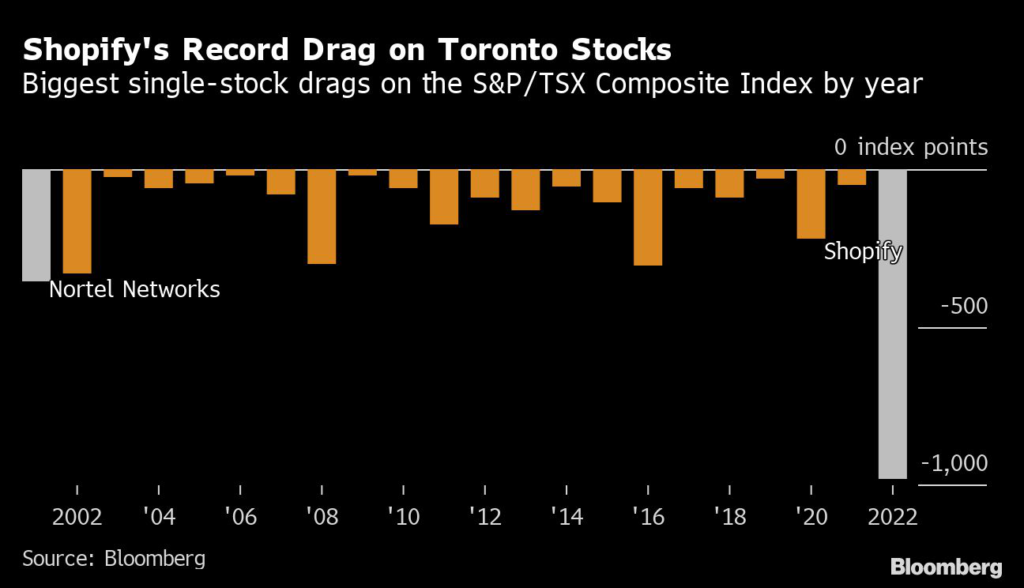
The e-commerce software provider has lost C$161 billion ($118 billion) in market value in 2022, causing a 978-point drag on the S&P/TSX Composite Index. Without it, the index would be down less than 2% in Canadian dollars this year, rather than 6%. 

Shopify was down 0.2% to C$52.52 at 9:35 a.m. in Toronto on Monday. It ended last week on a six-day losing streak. 

It’s not the first time a single tech stock has been a huge anchor on the key Canadian index. Nortel Networks Corp.’s collapse was a 353-point drag in 2001, the index’s inaugural year. BlackBerry Ltd., then called Research In Motion, was the TSX’s biggest negative contributor in 2008, pulling the index down more than 300 points. 

Despite Shopify, Canadian stocks have outperformed the S&P 500 Index by more than 11 percentage points this year. Unlike some European and US equity gauges, the S&P/TSX Composite did not enter an official bear market this year: its peak-to-trough decline was 17.6%. 

Soaring oil and metals prices have lifted energy and mining stocks, which make up about a 30% weighting. At the same time, US megacap tech stocks have been pummeled by the relentless rise in interest rates: seven FANG+ stocks are responsible for about half of the S&P 500’s 17.5% decline in 2022.

“Concentration risk matters in an index,” said Craig Basinger, Purpose Investments Inc.’s chief market strategist. Shopify’s problems “sucked for Canada” but the tech sector makes up a smaller proportion of the index here, he noted. There’s only one other tech company on the TSX with a market capitalization of more than C$40 billion.

For longer-term holders of index funds, Shopify has had a less meaningful impact. In fact, the stock has had almost no influence on the benchmark over a three-year period, as this year’s losses have essentially given back two years of big gains. The TSX Composite is up 17.7% over three years, with banks, commodities and railways having the biggest upside impact.  

Some investors see TSX outpacing the S&P 500 as long as higher rates continue to pressure technology shares. 

“With Shopify being a smaller component, there’ll be more room to continue to outperform as long as we’re in a tightening cycle with rising interest rates,” said Martin Pelletier, senior portfolio manager at TriVest Wealth Counsel.

(Adds Monday’s share move to third paragraph)

More stories like this are available on bloomberg.com

©2022 Bloomberg L.P.
The Best Twitter Account to Follow Is One That Keeps Disappearing

(Bloomberg) — Michael Burry has such a strong following among investors that traders picked his Twitter handle as the best — even after he once again deleted it.

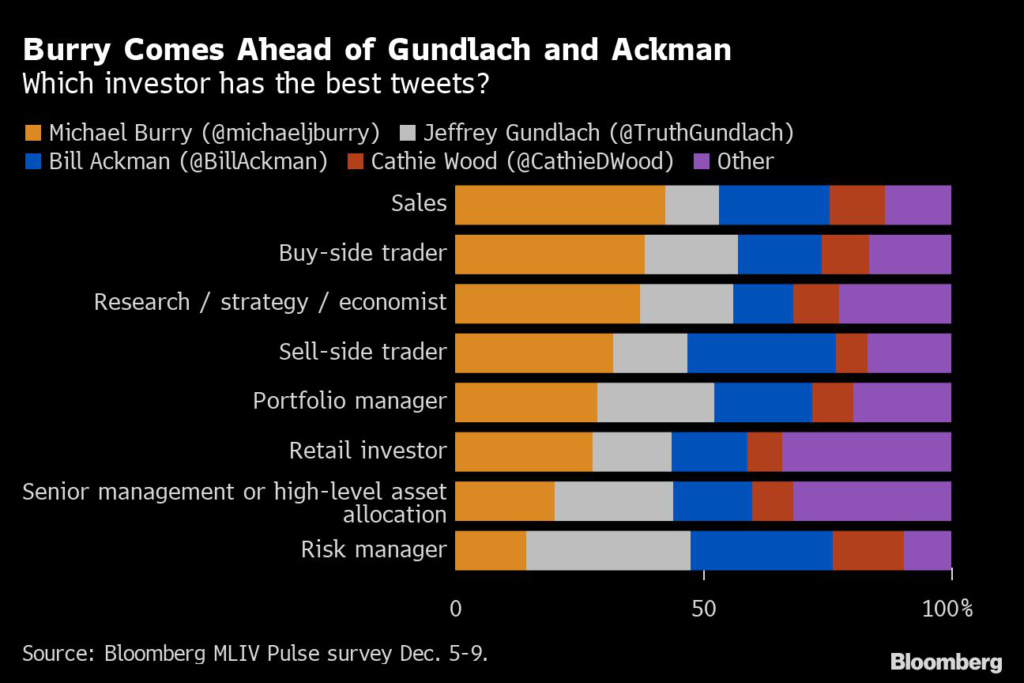
Almost a third of the 515 respondents in the latest MLIV Pulse survey last week voted for @michaeljburry as the best investor handle, with his popularity especially high among professional market participants.

Burry, best known for betting against the housing market ahead of the 2008 crash and immortalized in Michael Lewis’s book “The Big Short,” has deleted and reactivated his Twitter account  several times, including last week. He was also in the habit of deleting most of his tweets. Still, he has about 1.2 million followers, and in the MLIV Pulse survey beat out Bill Ackman, Jeffrey Gundlach and Cathie Wood.

It’s quite telling that at the end of a year that saw significant losses in most financial assets, investors picked Burry’s Twitter account as the best one to follow. 

On the social platform, Burry uses the name Cassandra B.C., which reflects the spirit of his deeply bearish messages. On a May day when markets were sliding, he posted a cryptic tweet saying it was like watching “a plane crash.” He flagged the dangers of “addictive” consumer spending in August, and the following month warned that signs of rising velocity and a declining money supply may be a precursor to higher inflation. 

Burry is also a frequent critic of Elon Musk, Twitter’s new owner.

Since the survey offered “other” as a choice, some investors wrote in Twitter handles, with Benn Eifert, founder and chief investment officer at boutique volatility hedge fund QVR Advisors, and Musk as the top choices.

Tune in this Wednesday for our Instant Pulse survey right after the FOMC decision.

More stories like this are available on bloomberg.com

©2022 Bloomberg L.P.
FTX Collapse Gets Capitol Hill Scrutiny This Week

(Bloomberg) — Lawmakers are set to hold hearings this week on the collapse of cryptocurrency platform FTX, and the leaders of the Senate Banking and House Financial Services committees want to hear from former FTX chief Sam Bankman-Fried.

Bankman-Fried is listed as a witness at the Dec. 13 House hearing along with current FTX CEO John J. Ray III. He said last week he was “willing to testify” but would be limited in what he would be able to say because he didn’t have access to much of his data.

Bankman-Fried missed the Senate Banking Committee’s deadline for a response to a request to testify at its separate hearing, and there is still no word as to whether he will appear. Senate Banking Chair Sherrod Brown has said he and ranking member Pat Toomey are ready to issue a subpoena if Bankman-Fried choses not to appear at the Dec. 14 hearing. 

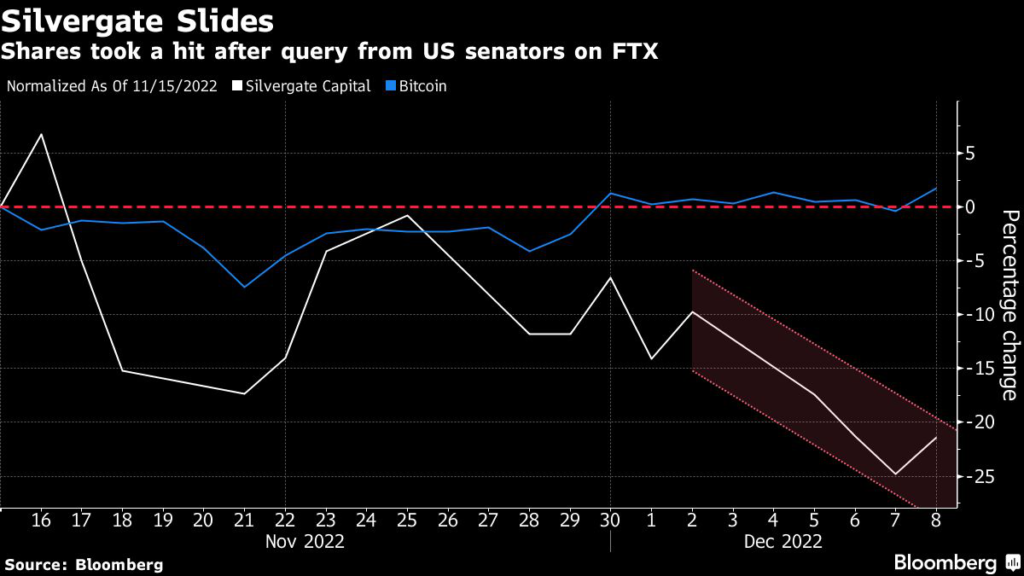
Crypto bank Silvergate Capital Corp. was asked by three US senators to release all records related to transfers of funds for the collapsed FTX empire.

Democrat Elizabeth Warren was joined by Republicans Roger Marshall and John Kennedy in sending a letter a letter dated Dec. 5 to Silvergate. “The public is owed a full accounting of the financial activities that may have led to the loss of billions in customer assets, and any role that Silvergate may have played in these losses,” they wrote.

Silvergate said it received the letter and was reviewing it.

CHARTING CRYPTO


WEEKLY ROUNDUP FROM WASHINGTON

  • A senior Justice Department official warned that prosecutors are closely watching activity in crypto markets with an eye toward taking action over potential illegal conduct.  Principal Associate Deputy Attorney General Marshall Miller appeared to be addressing the controversy surrounding crypto exchange FTX during a speech Dec. 6 at the American Bankers Association conference.
  • The House Ethics Committee directs outgoing Republican Madison Cawthorn to give over $14,000 to charity after he was found to have “improperly” promoted LGB Coin, which he owned but did not disclose, according to a panel’s report
  • US Senator Elizabeth Warren seeks an accounting from Federal Reserve Chair Jerome Powell and other banking watchdogs on the links that major lenders have with the crypto industry
  • Federal prosecutors are investigating whether Sam Bankman-Fried and his hedge fund orchestrated trades in a way that led to the collapse of two cryptocurrencies in May, the New York Times reported, citing two people with knowledge of the matter

MORE READING

JPMorgan CEO Jamie Dimon Calls Crypto Tokens ‘Pet Rocks’

Crash Course — A Glossary for the ‘Crypto Winter’: QuickTake

UK Finalizing Plans for Crypto Regulation After FTX Implosion

EU Aims to Require Crypto Providers to Report Transaction Data

When Crypto Scammers Stole $23 Million, This Victim Found Them

FTX Considered $100 Million Deals With Liverpool, Man United 

Crypto Firm Amber Cuts Staff, Pauses Fundraising in FTX Fallout


More stories like this are available on bloomberg.com

©2022 Bloomberg L.P.
Close Bitnami banner
Bitnami