Bloomberg

Crypto Markets Waver as Key Upgrade of Ethereum Blockchain Nears

(Bloomberg) — Cryptocurrencies traded in tight ranges Thursday as the clock ticked down to a major software upgrade of Ethereum, the most commercially important blockchain in the digital-asset sector.

Bitcoin edged up to about $20,000 while Ether, the native token of Ethereum, dipped under $1,600 as of 7:40 a.m. in London. Coins such as Cardano and Solana also posted modest losses. The MVIS CryptoCompare Digital Assets 100 Index has shed some 6% this week.

Ethereum’s revamp — known as the Merge — will make it vastly more energy efficient and over time pave the way for it to scale up and become quicker, according to the network’s developers. They say an update years in the making will go smoothly, though some investors are wary of possible hiccups.

“The market is pricing in a virtually successful Merge to happen,” Teong Hng, co-founder at digital-asset platform Satori Research, said on Bloomberg TV. “For institutional investors, ones who are ESG conscious, they will use this as an opportunity to dip their toes into blockchain, into tokens, into Ethereum.”

Exchanges and lending platforms began temporarily disabling Ethereum-related services before the Merge, which is due to be completed in less than 30 minutes. If all goes to plan, they will later come back online once the revamp is done.

There were indications of substantial Ether inflows into exchanges ahead of the Merge. The exact reasons why were unclear.

Inflows

Alex Svanevik, co-founder and chief executive officer of blockchain research portal Nansen, in a Twitter post cited $1.2 billion of inflows into separate exchanges in two transactions.

“In the short term we will still continue to have some mis-pricing until after the Merge and if the Merge becomes successful then it will be another opportunity set for traders and investors alike,” Satori’s Hng said.

Ether has climbed about 80% since a mid-June low, far outstripping Bitcoin, partly on Merge hype. That rally is cooling and another market risk is that investors will take profits, judging the narrative has played out for now.

The funding rate for Ether perpetual futures contracts was the most negative since at least the onset of the pandemic, according to data from CryptoQuant. That’s an indication of investors paying a bigger premium to short Ether.

After the Merge there may be “a short-lived rally and short squeeze” but “it is hard to see the end of the bear market with the hawkishness of the central banks to continue rate hikes to combat inflation,” said Cici Lu, chief executive officer of Venn Link Partners Pte.

Both Bitcoin and Ether are down more than 50% in 2022, hurt by rising interest rates that sucked liquidity from global markets.

The medium and longer term Ether outlook is brighter, according to Stefan Rust, chief executive of blockchain development house Laguna Labs.

In a note, he said Ether could top $3,000 by the end of this year and possibly achieve the so-called “flippening” in time, referring to the idea that its market value might overtake Bitcoin’s.

More stories like this are available on bloomberg.com

©2022 Bloomberg L.P.

Ex-Citadel Securities Duo Unveils Crypto High-Speed Trading Firm

(Bloomberg) — A pair of former Citadel Securities employees are making public a market-making firm for cryptocurrencies they founded with the backing of $50 million from venture capitalists.

Leonard Lancia, Citadel Securities’ former head of Europe systematic market making for derivatives, and Alex Casimo, who was with the firm’s business-management team in Europe, founded Portofino Technologies in April 2021. Since then, the company has traded billions of dollars in so-called stealth mode, the executives said in an interview. 

Coatue Management, Valar Ventures and Global Founders Capital are among Portofino’s venture-capital backers. Based in Zug, Switzerland, it has 35 employees, including in London, Singapore and New York, and aims to expand to 50 by the end of the year. The founders declined to disclose valuation or performance figures. 

Portofino provides crypto liquidity to financial institutions and high-net-worth individuals, trading on both centralized and decentralized exchanges and over the counter. It also gives advice and technical support for web3 startups seeking to list their assets on exchanges. 

This year’s crypto winter has created a challenging environment for market makers, which are dealing with lower trading volumes and fewer arbitrage opportunities. The cost of borrowing has also increased, making hedging more expensive. Casimo, Portofino’s chief operating officer, said the firm can compete on pricing with bigger players on the most popular trading pairs using its proprietary algorithms and automated inventory management. 

Longer-term, the company aims to be more than a crypto market-maker by supporting new services and industries entering web3. 

“In five years, 10 years from now, if you believe in the narrative of the tokenized economy, what you will see is that any small business could issue tokens that have some sort of utility or engagement,” said Lancia, who is Portofino’s chief executive officer. 

In those situations, he said, the liquidity provider will have a role in “supporting things that are smaller, connecting potentially local businesses to local people.”

More stories like this are available on bloomberg.com

©2022 Bloomberg L.P.

Chinese Headset-Battery Supplier to Xiaomi, Oppo Hikes Prices

(Bloomberg) — A unit of China’s top lithium producer Ganfeng Lithium Co. is raising prices for small batteries used in consumer electronics like headphones that are produced by companies including Xiaomi Corp. and Oppo.

Xinyu Ganfeng Electronics Co. sent a letter to customers on Friday saying prices for new orders would be evaluated amid a substantial hike in power cell costs. The Chinese lithium producer confirmed the content of the letter seen by Bloomberg News; it didn’t give a size of the price increases for its customers.

The company, which makes small polymer lithium batteries for smart wearable products and Bluetooth headset batteries, cited a “huge increase” in prices of minerals including lithium carbonate, cobalt oxide and graphite. Anode materials had also been impacted by production and electricity curbs in Inner Mongolia, it added. 

See also: Lithium Roars Back to China Record as EV Boom Overwhelms Supply

Demand for battery metals has boomed as their use expands from consumer electronics to electric vehicles, just as the global transition away from fossil fuels gathers pace. Meanwhile, supply has been struggling to catch up amid Covid-related logistical woes and a lack of investment from previous years.

The elevated prices have been unnerving some manufacturers as inflated costs could add pressure to margins and feedstock security. Battery-makers and the automobile industry have been rushing to lock in supply of the raw materials.

Battery-metal prices hit an inflection point in August and are now returning to month-on-month increases, according to a BloombergNEF report Tuesday, adding that global supply chains remain under pressure.

More stories like this are available on bloomberg.com

©2022 Bloomberg L.P.

Chinese Battery Supplier to Xiaomi Hikes Prices as Costs Surge

(Bloomberg) — A unit of China’s top lithium producer Ganfeng Lithium Co. is raising prices for small batteries used in consumer electronics like headphones that are produced by companies including Xiaomi Corp. and Oppo.

Xinyu Ganfeng Electronics Co. sent a letter to customers on Friday saying prices for new orders would be evaluated amid a substantial hike in power cell costs. The Chinese lithium producer confirmed the content of the letter seen by Bloomberg News; it didn’t give a size of the price increases for its customers.

The company, which makes small polymer lithium batteries for smart wearable products and Bluetooth headset batteries, cited a “huge increase” in prices of minerals including lithium carbonate, cobalt oxide and graphite. Anode materials had also been impacted by production and electricity curbs in Inner Mongolia, it added. 

See also: Lithium Roars Back to China Record as EV Boom Overwhelms Supply

Demand for battery metals has boomed as their use expands from consumer electronics to electric vehicles, just as the global transition away from fossil fuels gathers pace. Meanwhile, supply has been struggling to catch up amid Covid-related logistical woes and a lack of investment from previous years.

The elevated prices have been unnerving some manufacturers as inflated costs could add pressure to margins and feedstock security. Battery-makers and the automobile industry have been rushing to lock in supply of the raw materials.

Battery-metal prices hit an inflection point in August and are now returning to month-on-month increases, according to a BloombergNEF report Tuesday, adding that global supply chains remain under pressure.

More stories like this are available on bloomberg.com

©2022 Bloomberg L.P.

Samsung to Invest $5 Billion Under Plan to Tame Emissions

(Bloomberg) — Samsung Electronics Co. will invest 7 trillion won ($5 billion) in green initiatives and call on South Korea to tackle high costs of clean energy as the electronics giant looks to reverse a rise in emissions and zero out direct pollution by mid-century.

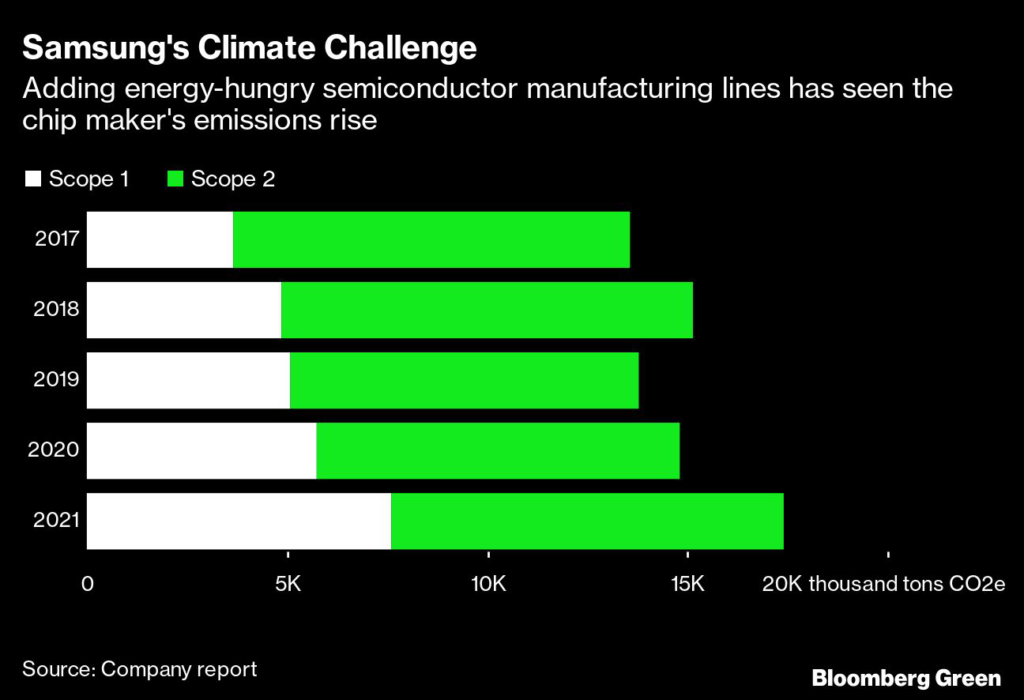
The world’s largest memory-chip maker, which has seen its climate footprint swell in recent years as it has expanded energy-intensive manufacturing lines, plans to eliminate Scope 1 and 2 carbon emissions. Samsung has not developed goals to reduce Scope 3 pollution like some peers, though intends to set targets in the future.

South Korea’s biggest company also aims to switch overseas factories entirely to renewable electricity within five years, though argues it can’t yet pursue a similar target for its most energy-hungry domestic plants — which account for the majority of production — because of constraints on the availability of clean power in the fossil fuel-reliant nation. 

Read more: Samsung Struggles to Go Green in Coal-Addicted South Korea

Samsung has long been criticized by investors and activists over a slower approach to climate action than industry peers such as Apple Inc., which said in October it had cut emissions by 40% over the past five years and is pressing suppliers to use only renewable energy.

“Addressing climate risks has been particularly challenging with our complex business portfolio,” Kim Soojin, head of ESG strategy group at Samsung Electronics, said in an interview. The firm’s status as a manufacturer of a wide range of electronics and its extensive supply chains, mean “the environmental pressure on our shoulders has been extremely heavy,” she said. 

A new strategy announced Thursday includes spending on carbon capture and storage, measures to reduce water consumption and the release of gases during semiconductor manufacturing, work to boost the energy efficiency of its products and improvements to the collection of electronic waste for recycling. While cutting direct emissions is a priority, Samsung will also consider the use of offsets in voluntary carbon markets, Kim said. 

As the biggest electricity user in South Korea, Samsung’s key challenge remains the country’s grid. Fossil fuels accounted for more than 65% of electricity generation in 2021 and plans are being studied to scale back proposals for more renewables as President Yoon Suk Yeol’s government touts a potential longer-term build out of nuclear power.

Samsung’s operations consumed 32,322 gigawatt-hours of energy in 2021, including 25,767 GWh of electric power, the company said in its most recent sustainability report. That compares with South Korea’s wind, solar and hydro power generation of 31,323 GWh in the same year, according to data compiled by BloombergNEF. The company’s emissions have risen in recent years as a direct result of the installation of new semiconductor manufacturing lines, according to its report.

Competition for renewable electricity is also likely to rise with all of South Korea’s key conglomerates now pledging to run their operations using solely clean energy. Coal and gas remain cheaper in the nation than new solar or wind generation, according to BNEF data.

Samsung will ask Yoon’s administration for more help. “We’re planning to voice industry-wide concerns over higher cost of renewable energy, and ask for the government’s policy support for the development of various climate-related innovations,” Kim said.

Under its new climate strategy, the company will also join RE100, a global initiative in which members commit to eventually use 100% renewable energy. 

“Samsung signing up for declarations like this might be a step in the right direction, but a vague 2050 target leaves shareholders with more questions than answers,” said Kiran Aziz, head of responsible investment at KLP, Norway’s largest pension fund, which holds Samsung shares and has about $80 billion of assets under management. “Scope 3 emissions are crucial and having them missing from a target points to another obvious weakness in this announcement.” Samsung declined as much as 1.1% in Thursday trading.

Local plants for consumer electronics will move to 100% renewables by 2027, Samsung said in its statement. The company aims to run its semiconductor operations entirely on clean sources by 2050, according to Kim.

“The Korean government isn’t doing much to support companies, putting the entire economy at risk of losing its industrial competitiveness,” said Hong Jong Ho, a professor at Seoul National University Graduate School of Environmental Studies. “With Samsung’s enormous influence, it should be the one playing an advocacy role in enforcing the government for policy changes.” 

(Updates with investor comment in 12th paragraph.)

More stories like this are available on bloomberg.com

©2022 Bloomberg L.P.

These Are the US Areas Most at Risk of Housing Downturn, According to Attom Report

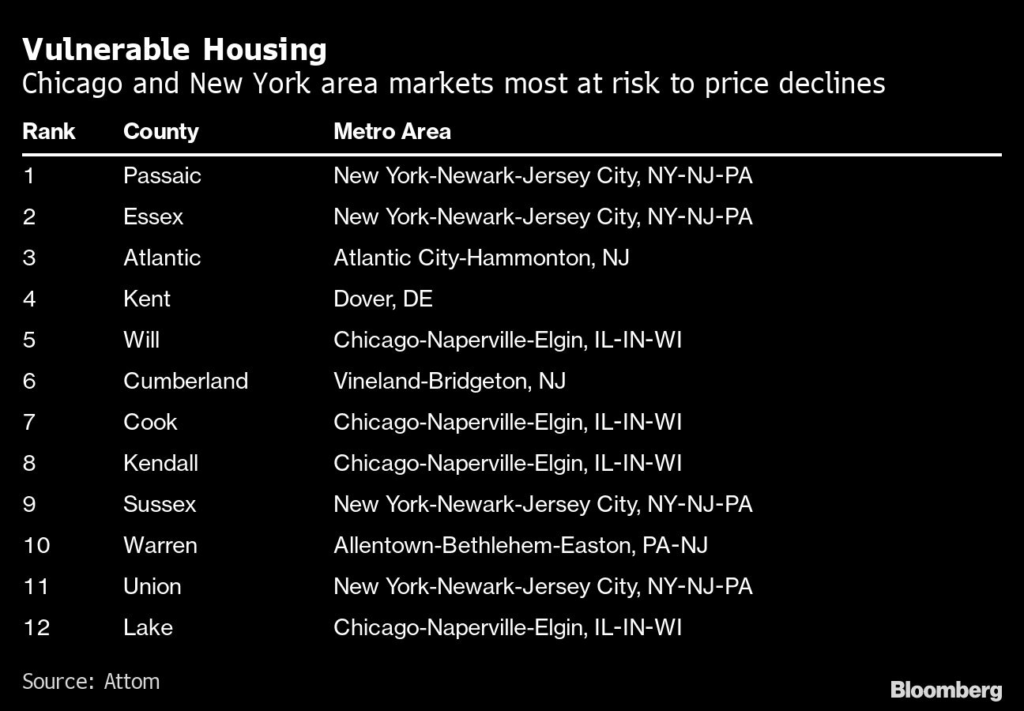
(Bloomberg) — Homes in and around New York City and Chicago are most vulnerable to price declines in a potential economic downturn, according to a report released Thursday by real estate data analytics firm Attom.

Of the 50 counties most at risk, nine are in and around New York City, six are in the Chicago metropolitan area, and 13 are spread through California. These counties have high levels of unaffordable housing, underwater mortgages, foreclosures and unemployment. In contrast, counties least at risk — concentrated in the South and Midwest apart from Chicago — have lower such levels.

After a pandemic-related boom, the Federal Reserve’s aggressive tightening policy and elevated inflation are crimping the once-booming US housing market. Rising mortgage rates have helped to dampen sales and force an increase in income needed to cover a typical home payment.

“Given how little progress has been made reducing inflation so far, the Fed’s actions seem more and more likely to drive the economy into a recession, and some housing markets are going to be more vulnerable than others if that happens,” said Rick Sharga, executive vice president of market intelligence at Attom. 

The most vulnerable New York City counties include Kings and Richmond counties, which cover Brooklyn and Staten Island, and seven counties in the suburbs: Bergen, Essex, Ocean, Passaic, Sussex, Union and Rockland. New York County, or Manhattan, ranks 52 out of the 575 analyzed. Passaic and Essex counties in New Jersey top the list respectively at first and second.

Seventh most at risk is Cook County, which holds Chicago and is the only one with a population of at least 1 million that ranks among the top 25.

Counties with a minimum population of 500,000 that were among the 50 safest include Washington’s King County, which encompasses Seattle; Texas’s Travis County that includes Austin; Utah’s Salt Lake County; Wake County in North Carolina, and Cobb County in Georgia, according to the report. 

The report gauged risks that housing markets face based on the percentage of homes facing possible foreclosure, the portion with mortgage balances that exceeded estimated property values, the percentage of average wages required to pay for major home ownership expenses on median-priced single-family homes, and unemployment rates as of the second quarter this year.

More stories like this are available on bloomberg.com

©2022 Bloomberg L.P.

Record Chinese Cyber Breach Spurs Eruption in Data for Sale

(Bloomberg) — Since the data of about roughly 1 billion Chinese citizens appeared for sale on a popular dark web forum in June, researchers have observed a surge in other kinds of personal records from China appearing on cybercriminal marketplaces.  

In the aftermath of that record leak, an estimated 290 million records about people in China surfaced on an underground bazaar known as Breach Forums in July, according to Group-IB, a cybersecurity firm based in Singapore. In August, one seller hawked personal information belonging to nearly 50 million users of Shanghai’s mandatory health code system, used to enforce quarantine and testing orders. The alleged hoard included names, phone numbers, IDs and their Covid status — for the price of $4,000.

“The forum has never seen such an influx of Chinese users and interest in Chinese data,” said Feixiang He, a researcher at Group-IB. “The number of attacks on Chinese users may grow in the near future.”

Bloomberg was unable to confirm the authenticity of the datasets for sale on Breach Forums. The website, like other markets where illicit goods are sold, has been home to false advertisements meant to generate attention, as well as legitimate data apparently stolen in security incidents, including an instance where users marketed user information taken from Twitter Inc.

The interest in leaked Chinese data has trained a spotlight on the vast amount of information that government officials collect through Beijing’s sprawling surveillance apparatus. In the summer incident, the unknown hackers claimed to have stolen data of about 1 billion Chinese residents after their discovery of an unsecured Shanghai police database, laying bare significant vulnerabilities in how government agencies store citizens’ information. 

Before that episode, there were three China-related databases marketed on Breach Forums, according to Group-IB’s Feixiang He. In July, that number jumped to 17, the firm found. Researchers were unable to confirm the legitimacy of all the information in databases posted that month.  

Chinese-speaking users on Breach Forums expressed surprise that data about the country’s citizens was available for sale, according to a Bloomberg News review. The posts were so frequent that a forum administrator asked website visitors to keep posts in the English language. “Please do not send Chinese characters,” they wrote.

In the 10-day period following the apparent Shanghai leak, researchers from San Francisco-based Reposify Ltd. discovered more than 12,700 exposed assets — including web servers and remote access sites — when scanning for software vulnerabilities in Chinese government websites. This also included 1,436 exposed databases, which “could account for millions of potentially accessible data points representing Chinese citizens,” the company said. 

The uptick in databases for sale comes in spite of Beijing’s increasingly strict cybersecurity and data privacy standards, which President Xi Jinping has tied closely to national security.

Read more: Claim of TikTok Breach Spotlights Viral App’s Lure as Target

Shanghai authorities and China’s internet regulators haven’t publicly addressed leaks of police and health system data, and discussions of the incidents have been scrubbed by censors from local social media. Shanghai’s government and the Cyberspace Administration of China, the main internet regulator, didn’t respond to multiple faxes requesting comment.

“We can see tens of thousands, more than 20,000 servers in China alone that are completely open,” said Stanislav Pratossov, co-founder of the security firm Acronis International GmbH. “This happens everywhere. In China, I guess, the amount is outrageous just because of the size of the Chinese economy, and the number of servers in China is huge.” 

Away from the public view, analysts said, they expect an internal review within the government agencies in question and tighter scrutiny of those involved in data management.

“It doesn’t matter how this plays out, it’s going to shed a bad light on the cybersecurity regime, on institutions that enforce these regulations,” said Michael Frick, a cyber consultant for businesses in China and a published author on the country’s cyber industry.  

In the meantime, hackers are readying themselves for more data dumps. One new user on the underground database forum, who claimed to be selling the Shanghai health system data after joining the site in July, alleged that they had more leaked information to share. “In my humble opinion, no amount of cyber security [or] data protection could stop data leaks from ever happening,” the unnamed user wrote.

As for Breach Forums, its administrators offered a pointed reminder in its welcome message to new Chinese users: “We are not in China and we are not Chinese, so we do not have to obey Chinese laws.”

More stories like this are available on bloomberg.com

©2022 Bloomberg L.P.

Ukraine Latest: Zelenskiy Visits Izyum, City Reclaimed in Push

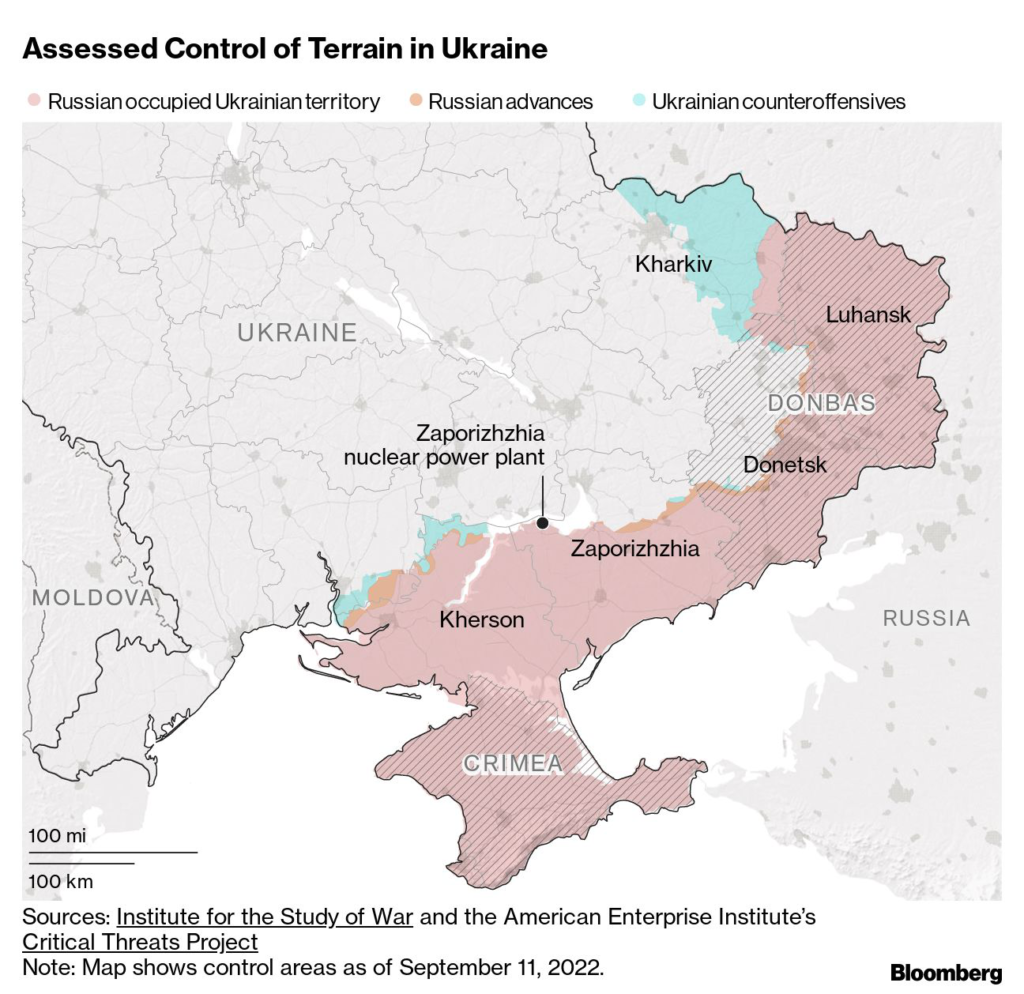
(Bloomberg) — Ukrainian President Volodymyr Zelenskiy visited Izyum, the biggest city recaptured last week during a counteroffensive in the country’s northeast that marked Kyiv’s most significant battlefield victory in months.

A car carrying the president collided with another vehicle on the way back to Kyiv and Zelenskiy did not suffer any serious injuries, a spokesman for the leader said in a social media post, adding the collision is under investigation.

Ursula von der Leyen, the head of the European Union’s executive, pledged in her annual state of the union address to work to guarantee “seamless” access for Ukraine to the bloc’s massive single market to help its economy recover from the war. The US is preparing another package of aid to Ukraine after the government in Kyiv said it recaptured more than 2,300 square miles of occupied territory. 

(See RSAN on the Bloomberg Terminal for the Russian Sanctions Dashboard.)

Key Developments

  • IMF Appoints Ukraine Chief With Experience of War-Torn Iraq
  • Putin’s Options Narrow After Ukraine Delivers Battlefield Rout
  • Ukraine’s Leader Visits Largest City Seized Back From Russians
  • Russia’s Richest Person to Transfer Rosbank Shares to Foundation
  • Russia Quietly Adds Up ‘Direct Losses’ From Financial Sanctions
  • Xi Unlikely to Throw Putin a Lifeline as Ukraine Struggles Mount

On the Ground

Ukraine was consolidating control over retaken territory, Zelenskiy said, following a push that shifted momentum in Kyiv’s favor. Fighting continued in the south, the Ukrainian military said. Russia again targeted civilian infrastructure, according to Ukraine’s General Staff, while local authorities said the cities of Mykolaiv and Nikopol were shelled overnight. Ukraine’s military destroyed several ammunition depots and is targeting Russian troops with artillery fire, military spokeswoman Nataliya Humeniuk told a briefing. The Russian navy has also increased the number of missile carriers in the Black Sea to five with the total number of Kalibr type cruise missiles to 36. Eight Russian cruise missiles hit the city of Kryvyi Rih in central Ukraine, an official said.

(All times CET) 

Zelenskiy in Car Crash (3:05 a.m.)

A passenger car collided with a vehicle carrying the president as his motorcade was returning to Kyiv from the Kharkiv region, Serhiy Nykyforov, a spokesman for Zelenskiy, said in a post on Facebook, without indicating what sort of injuries the president may have received. 

“Doctors who accompany the president checked him, no serious injuries were detected,” Nykyforov wrote, adding “doctors accompanying the head of the state provided emergency aid to the driver of the car and transferred him to an ambulance.”

Read more: Ukrainian President Zelenskiy in Car Crash, No Major Injuries

Pentagon to Replace Javelins Sent to Ukraine (1 a.m.)

The US Army’s assistant secretary for acquisition, Douglas Bush, said the service plans to have $1.2 billion in contracts in place by next September to replace Javelin anti-armor missiles that have been supplied to Ukraine.

As part of that effort, Raytheon Technologies Corp and Lockheed Martin Corp, the joint makers of the Javelin, received a $311 million contract on Tuesday. That was on top of a $309 million order in May, Bush said, adding “There’s more coming.” 

More than 6,500 Javelin anti-armor systems have been committed to Ukraine from Defense Department stocks.

Ukraine Signs Accord on Debt Payment Suspension (8:13 p.m.)

Finance Minister Serhiy Marchenko signed a memorandum of understanding on Ukraine’s debt payment suspension with the Group of Seven and the Paris Club, the Finance Ministry said on its website.

This follows the call by the Paris Club group — which includes the US, the UK, France, Germany, Japan and Canada — to Ukraine’s creditors on July 20 to reach an agreement on debt service suspension until the end of 2023 with a possibility to extend it by another year.

Putin Talks Grain and Nuclear Plant With UN’s Leader (7:41 p.m.)

Russia’s President Vladimir Putin and United Nations Secretary-General Antonio Guterres discussed how the agreement allowing grain shipments from Ukraine is being carried out, the Kremlin press service said in a statement.

They agreed that priority for food supplies should go to the regions most in need, including Africa, the Middle East and Latin America, according to the statement.

They also discussed the Zaporizhzhia nuclear power plant in Ukraine and the International Atomic Energy Agency’s visit to the Russian-seized facility.

Eight Russian Cruise Missiles Hit City in Central Ukraine (6:52 p.m.)

The city of Kryvyi Rih in central Ukraine was hit by eight Russian cruise missiles, Ukrainian official Kyrylo Tymoshenko said on Telegram. The missiles were aimed at a waterworks and “the goal was obviously to cause an emergency,” Tymoshenko said.

Two missiles fell near the city of Zaporizhzhia in the southeast, Interfax reported, citing city council secretary Anatoliy Kukhtyev.

The Ukrainian General Staff reported the intensity of shelling in the Kharkiv region has declined significantly and Ukrainian forces spotted several Russian convoys with S-300 and Buk missiles moving from Lutuhyne near Luhansk toward the Russian border. 

Putin Still Doesn’t See War as a Mistake, Scholz Says (6:23 p.m.)

German Chancellor Olaf Scholz said Putin still hasn’t come to regret the invasion of Ukraine “Unfortunately, I cannot report that the insight has grown that this war is a mistake,” Scholz said of his phone conversation with Putin on Tuesday.

Speaking in Berlin, Scholz made clear he still has no intention of sending heavy tanks to Ukraine, even as he said German weapons have “made the difference, which has now visibly enabled Ukraine to defend its own country.”

Biden Plans to Nominate Lynne Tracy as Ambassador to Russia: CNN (5:14 p.m.) 

President Joe Biden plans to nominate Lynne Tracy, who currently serves as ambassador to Armenia, as the new US envoy to Russia, CNN reported, citing three people familiar with the plan. A State Department spokesperson declined to comment. 

Russia Tallies Billions in Losses From Financial Sanctions (3:37 p.m.)

Russia’s financial sector suffered hundreds of billions of dollars in “direct losses” from the sweeping sanctions imposed by the US and its allies over the invasion of Ukraine, according to an internal Finance Ministry document.

The estimate, which includes significant hits to the stock market, bank capital as well as $300 billion in foreign-exchange reserves frozen by the restrictions, was included in a presentation for a top-level meeting of officials on responding to sanctions held last month. The Finance Ministry declined to comment.

Billions of Ruble Bonds Stuck as Clearstream Blocks Settlement (3:02 p.m.) 

Different approaches to Russia sanction rules taken by Europe’s major clearing houses means some international investors are now stuck with billions of dollars worth of ruble bonds while others are free to unwind. 

Bondholders using Clearstream as their depository can’t settle ruble-denominated government bond trades, according to people with direct knowledge of the matter who spoke on condition of anonymity. Investors estimate that Clearstream has more than $10 billion of sovereign ruble bonds under custody, they said. The other large depositary service provider Euroclear allows for settlement of ruble bonds already in the system, free of payment, the people said.

Ukraine Seeks to Continue Electricity Export Without Zaporizhzhia (2:04 p.m.)

Ukraine expects to continue exporting electricity to European countries over the winter season despite the conflict and the idling of the Zaporizhzhia nuclear power plant, according to Volodymyr Kudrytskyi, chief executive of state-run power company Ukrenergo.

“We’re talking about more than 600 megawatts of export capacity for Poland, Romania, Slovakia and Moldova,” Kudrytskyi said. Ukrenergo plans to increase exports and is now preparing for winter season to ensure consumers have power. 

Zelenskiy Raises Ukrainian Flag in Izyum (12:40 p.m.)

Zelenskiy participated in a flag-raising ceremony in Izyum, which had been a key staging point for Russian troops before they retreated in the face of a lightning Ukrainian counteroffensive last week, according to a statement on the presidential website. 

The Kharkiv region city of Izyum, which was occupied by Russia since March, is one of the most strategically significant areas retaken during the counteroffensive. The speed of the Russian retreat last week was evident in the amount of military vehicles and ammunition left behind.

The Russian military said on Saturday it pulled troops out of two areas in the Kharkiv region to regroup its forces in the Donetsk region.  

More stories like this are available on bloomberg.com

©2022 Bloomberg L.P.

China Braces for a Slowdown That Could Be Even Worse Than 2020

(Bloomberg) — Six months after China’s government set ambitious economic targets for the year, growth has slowed so sharply that several major banks don’t even think 3% is achievable anymore.

Growth projections have come down steadily since March, when the official target of around 5.5% was first disclosed. The consensus in a Bloomberg survey is for the economy to expand 3.5% this year, which would be the second-weakest annual reading in more than four decades. Forecasters at Morgan Stanley and Barclays Plc are among those predicting even slower growth as risks mount into year-end.

It’s not just China’s strict Covid Zero policy of lockdowns and mass testing that’s buffeting the economy. A housing market collapse, drought, and weak demand both at home and overseas have all undercut growth. 

Jian Chang, Barclays’s chief China economist, last week cut her full-year growth forecast to 2.6% from 3.1%, citing the “deeper and longer property contraction, intensified Covid lockdowns, and slowing external demand.” The cash crunch faced by developers will extend into 2023 and weak confidence in the real-estate market and the economy will hold back any meaningful recovery in home sales, she wrote.

Official data for August, due to be published on Friday, will likely show little improvement in industrial output, retail sales and investment. September’s figures don’t look any better either, with early indicators showing further contraction in the housing market and damage to consumer spending because of travel restrictions.

The People’s Bank of China refrained from taking any easing steps on Thursday, holding key policy interest rates steady on Thursday and draining liquidity from the banking system which is overflowing with cash. Further PBOC easing would put more pressure on the depreciating yuan and could increase capital outflows.

State media is striking a positive tone on the economy’s outlook. Growth is expected to rebound markedly in the current quarter compared to the previous three months, the China Securities Journal reported Thursday. The report cited early indicators and economists that pointed to recovering commodities demand and the easing of restrictions on production put in place after extreme temperatures.

However, the International Energy Agency is forecasting that oil demand in China will drop 2.7% this year, the first decline since 1990. 

What Bloomberg Economics Says…

China’s recovery likely stalled in August, hit by heatwaves, power shortages and Covid-19 flare-ups — on top of a property slump. Leading indicators signal weakening momentum from output to consumption. 

Eric Zhu and Chang Shu

For the full report, click here.

With the Communist Party gearing up for its twice-a-decade leadership congress in mid-October, Covid restrictions are being tightened and travel is being discouraged to avoid the spread of infections, throwing a pall over tourism spending during the nine-day National Day holiday break at the start of next month. 

Here’s a look at the main risks the economy is facing and what the latest data and alternative indicators tell us about the outlook for the rest of the year.

Covid Zero

The biggest drag on the economy is the Covid Zero policy, which the government remains committed to despite more infectious virus strains making it harder than ever to control outbreaks. The virus has spread to every province this year and almost 865,000 people have been infected.

Major cities like Shanghai, Shenzhen and more recently Chengdu have locked down their populations and shut businesses to curb outbreaks. Frequent Covid testing is required — as often as every 48 hours in Beijing now — even in places where there are no outbreaks.

The restrictions have taken a toll on consumers, with spending taking months to recover after lockdowns. The official consumer confidence index plunged to its lowest level in nearly 10 years in April and it’s barely recovered since. Tourism has been decimated.

“The overall economic impact of Covid restrictions almost certainly worsened at the margin in August, and likely will again in September,” Ernan Cui, an analyst at Gavekal Dragonomics, wrote in a recent report. “The repeated high-profile lockdowns in major cities such as Shenzhen might remind households of the possibility of more disruptions to come, encouraging them to consume less and save more — as they have since the start of the pandemic.”

While some China watchers have speculated the Covid Zero policy may be eased after the Communist Party’s congress in October, economists at Nomura Holdings Inc. and Goldman Sachs Group Inc. say that’s unlikely. Nomura predicts the policy will remain in place until at least March next year. If it’s gradually eased from then, the economy could be in for a difficult period with people “overwhelmed by a surging Covid infection,” Lu Ting, Nomura’s chief China economist, wrote in a recent report. 

Aside from the direct healthcare costs of a spike in illness and death, a widespread outbreak would also mean extended disruptions to business and consumer activity as people stay home to avoid getting infected and absenteesim from work rises.

Housing Crisis

What started in 2020 as an attempt by the government to cut the amount of risky debt held by property developers has developed into a crisis for the entire property market. Major builders have defaulted and halted construction, home owners have halted mortgage payments because of unbuilt homes, and demand for concrete, steel and everything else needed to build apartments have slumped.

There’s no sign that the contraction in homes sales — which began in July last year — has eased. The almost 900 billion yuan ($129 billion) of homes sold in July this year was about 30% below the amount sold a year earlier. Sales declined at the same speed in every week in August and preliminary data for September showed the trend continuing.

About 660 million square meters of homes were sold this year through the end of July, the lowest amount since 2015.

The crisis has undermined the wealth of Chinese households, who keep much of their wealth in real estate. Prices for new homes have contracted for 11 consecutive months, with the deepest declines happening in the smaller and regional cities where the majority of people live. 

Slowing Factories

The housing crisis is rippling across China’s critical manufacturing sector. Steel output dropped to a four-year low in July, and even though there are some signs of a recovery, demand remains very weak, with inventories 41% higher at the end of August than they were at the start of this year. Meanwhile, cement output over the past year was the lowest it’s been in more than a decade. 

While that has been good for reducing China’s carbon emissions, it’s not good for the manufacturing sector, which contracted for a second month in August, according to purchasing managers surveys. 

Global demand for Chinese-made goods is also slowing after a two-and-a-half year boom in exports, another drag on manufacturing. Even though the value of exports still rose 7.1% in August from a year earlier, volumes are under pressure. Shanghai port, the world’s largest, processed 8.4% less cargo by weight in August compared to a year earlier.


On top of that, China just had its hottest summer on record, with the drought and heat causing power shortages in some areas, curbing output in July and August, and damaging crops. The full extent of the damage will take months to become clear, although autumn harvests will likely be affected and power shortages could persist, especially for heavy users like aluminum smelters. 

Worsening Fiscal Situation

Local governments are spending more on Covid testing and quarantine — with that cost likely to rise for the rest of the year as restrictions are tightened. At the same time, their revenues are plummeting because of a slump in land sales and tax cuts.

Budget shortfalls have soared: the augmented deficit was 5.25 trillion yuan in the year through July, almost the same as for the whole of 2021 and worse than at the same point in 2020. Some governments can’t pay their their bills on time, with Bloomberg calculations showing Covid testing companies are struggling to get paid.

Local governments sold a record amount of so-called special bonds in the first half of the year, but those funds are mainly for infrastructure investment, not general expenditure. Even though infrastructure spending is being ramped up, economists say it won’t be sufficient to compensate for the slump in property investment, and the government may need to boost borrowing in the rest of the year to plug the budget gap. 

(Updates with additional details from sixth paragraph.)

More stories like this are available on bloomberg.com

©2022 Bloomberg L.P.
Crypto Markets Brace for Historic Upgrade of Ethereum Blockchain

(Bloomberg) — Cryptocurrencies traded in tight ranges Thursday as the clock ticked down to a major software upgrade of Ethereum, the most commercially important blockchain in the digital-asset sector.

Bitcoin edged up to about $20,000 while Ether, the native token of Ethereum, also made modest gains to hover around $1,605 as of 11:21 a.m. in Tokyo. The MVIS CryptoCompare Digital Assets 100 Index has shed some 6% this week.

Ethereum’s revamp — known as the Merge — will make it vastly more energy efficient and over time pave the way for it to scale up and become quicker, according to the network’s developers. They say an update years in the making will go smoothly, though some investors are wary of possible hiccups.

“The market is pricing in a virtually successful Merge to happen,” Teong Hng, co-founder at digital-asset platform Satori Research, said on Bloomberg TV. “For institutional investors, ones who are ESG conscious, they will use this as an opportunity to dip their toes into blockchain, into tokens, into Ethereum.”

Exchanges and lending platforms began temporarily disabling Ethereum-related services before the Merge, which is due to be completed in the next few hours. If all goes to plan, they will later come back online once the revamp is done.

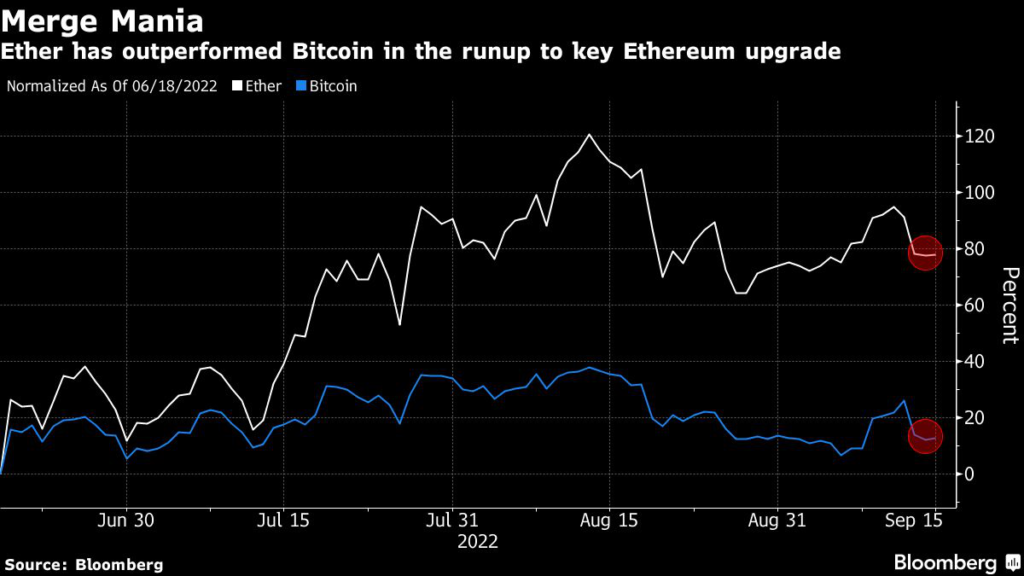
Ether has climbed about 80% since a mid-June low, far outstripping Bitcoin, partly on Merge hype. That rally is cooling and another market risk is that investors will take profits, judging the narrative has played out for now.

But the medium and longer term Ether outlook is brighter, according to Stefan Rust, chief executive of blockchain development house Laguna Labs.

In a note, he said Ether could top $3,000 by the end of this year and possibly achieve the so-called “flippening” in time, referring to the idea that its market value might overtake Bitcoin’s.

Both Bitcoin and Ether are down more than 50% in 2022, hurt by rising interest rates that sucked liquidity from global markets.

More stories like this are available on bloomberg.com

©2022 Bloomberg L.P.

Close Bitnami banner
Bitnami