Bloomberg

US Enlists Mexico to Find Incentives to Attract Chipmakers

(Bloomberg) — The US has asked Mexico to find ways of offering incentives to bring chip-makers to North America, as both nations try to lure companies that are crucial to the world’s electronics.

US Commerce Secretary Gina Raimondo asked Mexico Finance Minister Rogelio Ramirez de la O for a list of proposals to draw semiconductor companies to his nation, a top official from the Mexican government said following the U.S.-Mexico High-Level Economic Dialogue between both nations in Mexico City this week.

“They asked that they see the possibility to complement some help, incentives, etcetera, for semiconductors, in order to close the circle,” Economy Minister Tatiana Clouthier told Bloomberg News in an interview on Tuesday. “Time is a priority.”

Read More: US and Mexico Express Optimism on Resolving Energy Dispute

The CHIPS Act, which includes $52.7 billion to boost domestic semiconductor production and research, triggered interest in Mexico to try to get some of those businesses to relocate to the country. The US and Mexico said in a joint statement on Monday that they will “work together to pursue a pilot project to determine the feasibility of near-shoring semiconductor manufacturing inputs.”

Researchers for the Inter-American Development Bank wrote in a blog post published Tuesday that Mexico already has several companies — including Intel Corp., Skyworks Solutions Inc., Texas Instruments Inc., and Infineon Technologies AG — working on semiconductor design and backend, including assembly and testing, which “presents significant opportunities.” Much of the industry is currently dominated by companies in Asia, the report said.

Mexico is also keeping an eye on the companies setting up shop on the other side of the border, said Clouthier. Intel agreed with Brookfield Asset Management Inc. to invest as much as $30 billion in chip factories in Arizona and Taiwan Semiconductor Manufacturing Co. has been working on a $12 billion plant in the state. 

“How can we make it so that the supply chain stays here, and the product is not finished in another place,” Clouthier said. “That it is not sent to other parts of the world.”

Read More: Chinese Manufacturers Skirt US Tariffs With Help From Mexico

When asked about battery makers, Clouthier said a company was deciding on an investment between the states of Sonora and Chihuahua, on the US border, a boon to the electric vehicle industry. Clouthier declined to name the company. 

Even as the US has sought to attract companies operating in Asia, Chinese companies have been looking for opportunities to take advantage of the near-shoring push to establish themselves in the North American market. Chinese battery giant Contemporary Amperex Technology Co. Ltd. has been considering an investment of as much as $5 billion in a location in Mexico, Bloomberg reported earlier this year.

The US Commerce Department declined to immediately comment on Clouthier’s remarks. Mexico’s Finance Ministry didn’t respond to a request for comment.

Read More: Mexico Considers Incentives to Attract Semiconductor Investment

(Update with research from IADB in fifth, sentence on nearshoring in ninth paragraph.)

More stories like this are available on bloomberg.com

©2022 Bloomberg L.P.

Bitcoin Miner Poolin Issues IOU Tokens During Withdrawal Halt

(Bloomberg) — Poolin, a Beijing-based provider of Bitcoin mining-pool services, is issuing tokens to clients equal to the value of various crypto assets that were frozen last week. 

The firm said earlier that it halted withdrawals to preserve liquidity. Tokens representing six different cryptocurrencies will be issued on a one-to-one ratio, Poolin said in a statement. About $59 million worth of Bitcoin is sitting in Poolin’s digital wallet, according to data from mempool.space. Ether, Litecoin and the stablecoin USDT are among the other tokens being held in the firm wallet. 

Bitcoin miners use powerful computers to validate transaction data encrypted by the blockchain and earn rewards in the token. However, they have to compete to be the first to solve the mathematical puzzles to win such rewards. The more computing power a miner has, the more likely the miner will win. Poolin, which was one of the largest mining-pool services providers, aggregates computing power from miners through its software to increase the probability of winning rewards. It charges miners a fee for providing the services. The firm is now the seventh largest mining pool, according to data from btc.com. 


Mining pools have become an integral part of the crypto-mining industry as the vast majority of miners, including Riot Blockchain Inc. and Core Scientific Inc, use such services. When mining pools win, they put the rewards in their wallets and the miners can withdraw and cash out on the tokens. Miners tend to take out their shares of rewards in a matter of days but some pools like Poolin incentivize miners to leave their coins in the wallets for a longer time with yield-generating products. 

The tokens being issued will be on Ethereum blockchain and can be used to repay loans or purchase new mining rigs. Poolin also mines Bitcoin itself. The total computing power in Pollin’s pool has dropped by about 60% since Sept. 5, when it halted withdrawals. 

More stories like this are available on bloomberg.com

©2022 Bloomberg L.P.

US Charges Three in Iran With Hacking Hundreds of Companies, Computer Networks

(Bloomberg) — The Justice Department filed charges against Iranian nationals accused of conducting hacking attacks against hundreds of companies and organizations internationally, accusing them of encrypting computers associated with critical infrastructure, including electric utilities.

The indictment charges Mansour Ahmadi, Ahmad Khatibi Aghda and Amir Hossein Nickaein Ravari with carrying out attacks since October 2020 that included a municipality in Union County, New Jersey, power companies in Mississippi and Indiana, an accounting firm based in Illinois and a domestic violence shelter in Pennsylvania. Ransomware attacks also allegedly occurred in other countries, including the UK, Israel, Russia and Iran.

The hackers exploited known flaws in commonly used computer network devices and software applications to access and exfiltrate data and information, according to a 20-page indictment unsealed on Wednesday. 

The department said the three defendants are likely still in Iran and haven’t been arrested.

FBI special agent James Dennehy said in a briefing on Wednesday that the US government would be offering a reward of $10 million for information leading to the arrest of the men, who he said were affiliated with companies operating in Iran that were “engaging in cybercrimes on a global scale.” A statement from the US Treasury identified those companies as Najee Technology Hooshmand Fater LLC and Afkar System Yazd Company. 

According to prosecutors, the defendants hacked data in local networks and demanded payment in Bitcoin of as much as $500,000. Several attacks cited in the indictment demanded ransoms for tens of thousands of dollars. In one message to an accounting firm in March 2022, according to the indictment, the hackers said, “Are you ready to pay?”

The hackers were separately named by the Treasury as having links to Iran’s Islamic Revolutionary Guard Corps. However, there was no evidence that the alleged hacking operations featured in the indictment were sponsored by the Iranian government, according to a senior Justice Department official. Rather, the official said, the hacks had been carried out “on the side” for personal gain. The official added that hackers were able to operate with “impunity” in Iran due to “neutral law enforcement” that turned a blind eye.

John Hultquist, vice president of intelligence at the cybersecurity firm Mandiant, said his firm has been tracking the hackers for some time. “We believe these organizations may have been moonlighting as criminals in addition to their status as contractors in the service of the IRGC,” he said in a statement. “The IRGC leans heavily on contractors to carry out their cyber operations.”

At least two of the men featured in the indictment — Aghda and Ahmadi – were in July publicly identified by an anonymous online group named Lab Dookhtegan, which is known for exposing alleged Iranian government hackers. The group alleged that the men were involved with a cyber unit of the IRGC and have used hacking tools in cyberattacks in the US and Europe with the aim of extorting money.

The indictment doesn’t specify how much money the hackers earned. In one case, it states, they received a payment of £13,000 from the domestic violence shelter in Pennsylvania after hacking its computers and encrypting its files.

Philip Sellinger, US attorney for the district of New Jersey, said the men had carried out “a massive global computer hacking and ransomware scheme.”

“Hackers like these three Iranian nationals go to great lengths to keep their identities secret, but they always leave a digital trail, and we will find it,” he said.


(Updates with additional information throughout.)

More stories like this are available on bloomberg.com

©2022 Bloomberg L.P.

Asset Managers Are Facing Hundreds of ESG Fund Downgrades

(Bloomberg) — Asset managers across Europe may have to reclassify hundreds of ESG funds in the coming months.

Reviews by researchers including Morningstar Inc. show that only a small fraction of funds registered as Article 9 — the EU’s strictest ESG category — actually lives up to the level of sustainable investments required under European rules. 

Lawyers advising the industry are now warning that many fund managers may have little choice but to change their official ESG designations. The upshot is that clients who thought they’d signed up for the EU’s cleanest ESG product suddenly are left with something else.

“I can imagine there being lots of reclassifications from Article 9” to a less strict ESG designation known as Article 8, said Rahul Manvatkar, an investment funds partner at Linklaters in London. “As much as they may not want to, that’s probably the trajectory as market participants get to grips with the rules.” 

A number of prominent asset managers have already resorted to downgrades following guidance from the EU. These include Pacific Investment Management Co., which reclassified four funds to Article 8 from 9, and Goldman Sachs Group Inc.’s NN Investment Partners, which downgraded 10 funds. 

Read More: Pimco, NN Investment Downgrade ESG Funds Amid Rule Confusion 

Europe enforced the world’s most ambitious rulebook for environmental, social and governance investing in March 2021. But the full scale of the challenges posed by that framework — the Sustainable Finance Disclosure Regulation — is only now becoming apparent. 

Fund managers say they don’t have anywhere near enough data to comply, and SFDR is continually being fine-tuned as rulemakers acknowledge gaps. The EU Commission has said that an Article 9 fund “may invest in a wide range” of assets “provided these underlying assets qualify as sustainable investments,” while allowing for liquidity and hedging needs. 

In other words, EU authorities have “made it clear that Article 9 funds should commit to invest almost exclusively in sustainable investments,” said Hugo Gallagher, senior policy adviser at the European Sustainable Investment Forum (Eurosif), whose members represent about $20 trillion in assets under management. 

“Clearly, a significant proportion of funds classified as Article 9 are far short of meeting this threshold,” he said. 

Morningstar estimates that Article 9 funds currently represent about 470 billion euros ($470 billion) of assets under management. Article 9 funds worth 25 billion euros have already been downgraded in the past six months, according to an estimate by Barclays Plc analysts led by Charlotte Edwards that’s based on Morningstar data.

More than 300 Article 9 funds have reported a minimum threshold in sustainable investments that is less than 90%, putting them at risk of losing their designation, data provider FE fundinfo told Bloomberg. Many more failed to provide any indication of their sustainability targets, suggesting the figure may be meaningfully higher than 300.

The Articles…

SFDR requires firms to classify their investment products under one of three categories: Article 6, which only looks at potential ESG risks; Article 8, which is supposed to “promote” ESG characteristics; and Article 9, which sets measurable ESG “objectives.” 

Regulators are also struggling to interpret the rules. The EU’s three financial supervisory authorities have asked the European Commission for more guidance on several fundamental issues around how to define a sustainable investment. Meanwhile, national authorities are left to patrol the industry, with the European Securities and Markets Authority saying it will intervene if necessary.

Morningstar, which estimates that there are roughly 950 Article 9 funds in total, said that about 40% of these have a sustainable investment goal that is less than 50%. Just 2.5% target allocations higher than 90% and only a dozen report 100% sustainable investments.

“This begs the question: Was it really what the regulator intended? Probably not,” said Hortense Bioy, global director of sustainable research at Morningstar. 

Either way, “the end result for asset managers will be to either reclassify funds from Article 9 to Article 8, or enhance their Article 9 strategies by tightening up their investment criteria,” she said. 

Concern about the credibility of Article 9 designations follows significant flows into the fund category. Investors poured about $6 billion into such funds during the second quarter and withdrew more than $30 billion from the weaker Article 8 designation, Morningstar reported. 

Bioy said that some fund managers eager to hold on to their Article 9 designations will now try “working backwards,” whereby they look for a methodology that offers a path to meeting EU requirements.

“The reality is even that won’t work for most Article 9 funds,” she said. “So the regulator may need to provide further clarification.”

Gallagher at Eurosif said that even if more Article 9 fund managers were claiming to meet the EU’s sustainability criteria, holes in the way sustainability is defined mean clients would ultimately have limited insight. He said higher fund targets might actually disguise weaker definitions of sustainability.

Behind the scenes, fund managers say EU officials are guiding the industry to have no less than 80% sustainable assets in Article 9 funds.

So setting a threshold below that level is highly risky, according to Eric Pedersen, head of responsible investment at Nordea Asset Management. “How could you think that would pass muster?”

And if a fund with less than 60% sustainable assets tries to call itself Article 9, “then that’s very strange,” he said. “It would be greenwashing where you were almost guaranteed to get caught.” 

Matthias Breier, ESG product manager at FE fundinfo, said he expects regulators will soon weigh in.

As funds start to “inform the market they aren’t 100% aligned with sustainable metrics, then we would expect the local authorities to reach out and tell them you cannot have an Article 9 fund,” he said.

(Adds estimate of downgrades so far in 10th paragraph)

More stories like this are available on bloomberg.com

©2022 Bloomberg L.P.

US Cyber-Defense Agency Urges Companies to Automate Threat Testing

(Bloomberg) — The US government’s cyber defense agency is recommending for the first time that companies embrace automated continuous testing to protect against longstanding online threats.

The guidance, from a cluster of US and international agencies published on Wednesday, urges businesses to shore up their defenses by continually validating their security program against known threat behaviors, rather than a more piecemeal approach. 

“The authoring agencies recommend continually testing your security program, at scale,” according to an alert from the Cybersecurity and Infrastructure Security Agency and several other US and international agencies. The alert warned malicious cyber actors allegedly affiliated with the Iranian Government’s Islamic Revolutionary Guard Corps are exploiting known vulnerabilities for ransom operations.

An official at CISA told Bloomberg ahead of the announcement that emulating adversaries and testing against them is key to defending against cyberattacks.

Central to the effort is a freely available list of cyberattackers’ most common tactics and procedures that was first made public in 2015 by MITRE, a federally funded research and development center, and is now regularly updated. While many organizations and their security contractors already consult that list, too few check if their systems can actually detect and overcome them, the CISA official said.

Automated threat testing is still not very widespread, according to the official, who added that organizations sometimes don’t really follow through after deploying expensive tools on their network and instead just assume they’re doing the job.

Automating security controls will make it easier to stop attackers from relying on established tactics. The top threat actors are still going back and leveraging vulnerabilities that are up to 10 years and older, warned the CISA official.

CISA is making the recommendation in collaboration with the Center for Threat-Informed Defense, a 29-member nonprofit formed in 2019 that draws on MITRE’s framework.

Iman Ghanizada, global head of autonomic security operations at Google Cloud, a research sponsor of the Center, said automated testing is important for creating continuous feedback loops that can steadily improve protection.

“Whether you are a large company or a startup, you have to have visibility, analytics, response and continuous feedback,” he said. It makes a big difference to test cybersecurity protections in the real world, rather than just in lab conditions, Ghanizada said.

A growing number of cybersecurity companies, including AttackIQ, Cymulate, Mandiant, Picus Security and SafeBreach, offer so-called breach and attack simulations and other security validation services. The CISA official said the agency is agnostic about which vendor companies use.

Martin Petersen, chief information security officer at facilities management giant ISS A/S, said he persuaded his company to start automated testing following a 2020 ransomware attack. That breach had left hundreds of thousands of employees without access to email and other systems.

The company’s three-year contract with AttackIQ, a founder member of the Center for Threat-Informed Defense, costs $300,000 a year. ISS calculated that the price was cheaper than employing so-called penetration testers, who do similar work but less regularly and effectively, he said.

Petersen said the company had improved tamper protections around its 60,000 endpoints, making it harder to deactivate malware protection as a result of continuous testing. It also fixed “funny” Windows configurations and local firewall settings that could be vulnerabilities. 

He added the company had also “significantly raised” its cybersecurity budget, which he said now stands at 7.5% of its information technology budget. He declined to say what the number was before the attack but said it would continue climbing into next year.

JetBlue Airways Corp. also relies on AttackIQ, a California-based company founded in 2013. The airline turned to automated continuous testing in part because a government alert about threats is “usually fairly slow and of little value by the time it gets to us,” said Tim Rohrbaugh, its chief information security officer since 2019.

Current protections often aren’t up the task, according to a new study from AttackIQ due out on Wednesday. Cloud-based customers’ common cybersecurity controls — known as endpoint detection and response systems, which are intended to automatically detect and block compromises in real time — stopped what the company assessed are the the seven-biggest attack techniques 39% of the time in 2021, it found. And none of the more than 100 cloud-based companies’ controls in the study prevented all seven of the “deadly” techniques, according to the report.

Jonathan Reiber, AttackIQ’s vice president for cybersecurity strategy and policy and one of the report authors, argues that continuous automated testing can help catch changes in personnel and equipment that undermine cybersecurity protections. He likens the approach to actively seeking out potential threats rather than scouring for fingerprints in the wake of an incident — a retroactive approach known as looking for “indicators of compromise.”

“People just don’t have enough data,” he said. “Often the only feedback mechanism people have is the attacker.”

(Updates with statement from agency)

More stories like this are available on bloomberg.com

©2022 Bloomberg L.P.

Amazon Union Vote Is Set for October at Warehouse Near Albany, New York

(Bloomberg) — A group of Amazon.com Inc. workers seeking to unionize a company facility near Albany, New York, will vote on the matter beginning Oct. 12, the National Labor Relations board said on Wednesday. 

Workers at the ALB1 warehouse in the town of Schodack in August submitted a petition to hold an election. The group, which has affiliated with the upstart Amazon Labor Union, is seeking higher wages and other improvements to working conditions. 

“We are going to win,” Heather Goodall, lead organizer of the effort, said in a text message. Goodall added that she and her coworkers would demand Amazon pay them the amount of money the company spent on its effort to persuade employees to vote against the union. “If Amazon has millions to spend on ‘employee relations,’ AKA union busters,” she said, “they can afford to pay us back for wasting our time.” 

Voting will be conducted over four days in a tent in the facility’s parking lot, NLRB spokesperson Kayla Blado said in an email. Ballot counting will begin Oct. 18 in Albany. The NLRB says the proposed union includes about 400 employees at the facility.  

“We remain skeptical that there are a sufficient number of legitimate signatures to support the union’s petition for an election, but the NLRB is moving forward,” Amazon spokesperson Paul Flaningan said in an emailed statement. “We’ve always said that we want our employees to have their voices heard and we hope and expect this process allows for that.”

Amazon is challenging the successful union drive at a warehouse in New York’s Staten Island. The ALU in April won the right to represent more than 8,000 workers at the JFK8 facility there. An NLRB official recommended rejecting Amazon’s objections to the result, but the company has indicated it will appeal rather than start negotiating a contract with workers. Amazon Chief Executive Officer Andy Jassy said last week that there were “a lot of disturbing irregularities” during the vote. 

The ALU lost a second election at another Staten Island facility but has expanded beyond New York City through affiliations with previously independent organizing efforts in Schodack and Campbellsville, Kentucky.

The Wall Street Journal earlier reported the election timing, citing Amazon. 

(Updated with comment from union organizer in the third paragraph.)

More stories like this are available on bloomberg.com

©2022 Bloomberg L.P.

Ukraine Latest: Zelenskiy in Izyum as Counteroffensive Pushes On

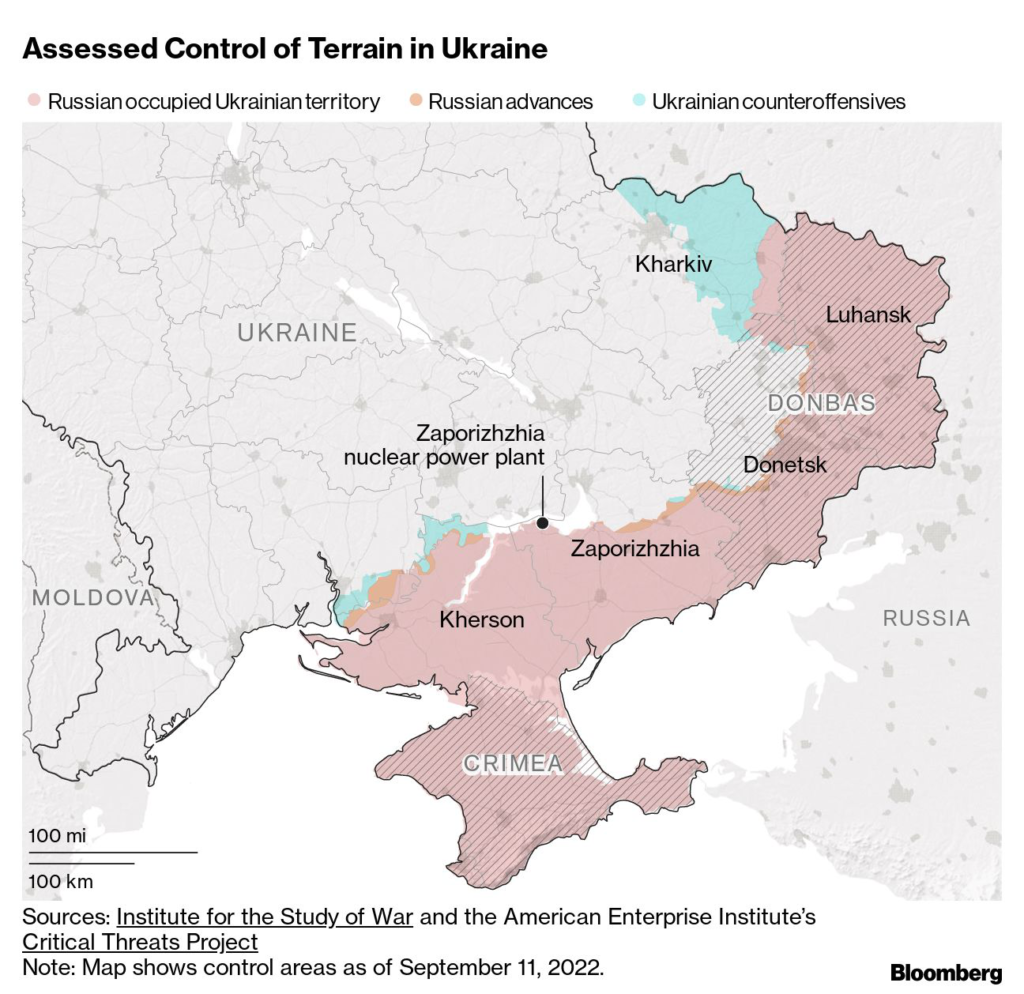
(Bloomberg) — Ukrainian President Volodymyr Zelenskiy visited Izyum, the biggest city recaptured last week during a counteroffensive in the country’s northeast that marked Kyiv’s most significant battlefield victory in months.

Ursula von der Leyen, the head of the European Union’s executive, pledged in her annual state of the union address to work to guarantee “seamless” access for Ukraine to the bloc’s massive single market to help its economy recover from the war. 

The US is preparing another package of aid to Ukraine, according to John Kirby, spokesman for the National Security Council, who cited a “shift in momentum” in the war after the government in Kyiv said it recaptured more than 2,300 square miles of occupied territory. 

(See RSAN on the Bloomberg Terminal for the Russian Sanctions Dashboard.)

Key Developments

  • Ukraine’s Leader Visits Largest City Seized Back From Russians
  • Russia Quietly Adds Up ‘Direct Losses’ From Financial Sanctions
  • Xi Unlikely to Throw Putin a Lifeline as Ukraine Struggles Mount
  • Yuan’s Clout Gets a Boost From Russia Trade as Sanctions Bite
  • Azerbaijan-Armenia Fighting Resumes as US, France Urge Truce 
  • Russia’s Invasion Put Ukraine’s Renewables Gains in Jeopardy

On the Ground

Ukraine was consolidating control over retaken territory, Zelenskiy said, following a push that shifted momentum in Kyiv’s favor. Fighting continued in the south, the Ukrainian military said. Russia again targeted civilian infrastructure, according to Ukraine’s General Staff, while local authorities said the cities of Mykolaiv and Nikopol were shelled overnight. Ukraine’s military destroyed several ammunition depots and is targeting Russian troops with artillery fire, military spokeswoman Nataliya Humeniuk told a briefing Wednesday. The Russian navy has also increased the number of missile carriers in the Black Sea to five with the total number of Kalibr type cruise missiles to 36. 

(All times CET) 

Biden Plans to Nominate Lynne Tracy as Ambassador to Russia: CNN (5:14 p.m.) 

President Joe Biden plans to nominate Lynne Tracy, who currently serves as ambassador to Armenia, as the new US envoy to Russia, CNN reported, citing three people familiar with the plan. A State Department spokesperson declined to comment. 

Russia Tallies Billions in Losses From Financial Sanctions (3:37 p.m.)

Russia’s financial sector suffered hundreds of billions of dollars in “direct losses” from the sweeping sanctions imposed by the US and its allies over the invasion of Ukraine, according to an internal Finance Ministry document.

The estimate, which includes significant hits to the stock market, bank capital as well as $300 billion in foreign-exchange reserves frozen by the restrictions, was included in a presentation for a top-level meeting of officials on responding to sanctions held last month. The Finance Ministry declined to comment.

Billions of Ruble Bonds Stuck as Clearstream Blocks Settlement (3:02 p.m.) 

Different approaches to Russia sanction rules taken by Europe’s major clearing houses means some international investors are now stuck with billions of dollars worth of ruble bonds while others are free to unwind. 

Bondholders using Clearstream as their depository can’t settle ruble-denominated government bond trades, according to people with direct knowledge of the matter who spoke on condition of anonymity. Investors estimate that Clearstream has more than $10 billion of sovereign ruble bonds under custody, they said. The other large depositary service provider Euroclear allows for settlement of ruble bonds already in the system, free of payment, the people said.

Ukraine Seeks to Continue Electricity Export Without Zaporizhzhia (2:04 p.m.)

Ukraine expects to continue exporting electricity to European countries over the winter season despite the conflict and the idling of the Zaporizhzhia nuclear power plant, according to Volodymyr Kudrytskyi, chief executive of state-run power company Ukrenergo.

“We’re talking about more than 600 megawatts of export capacity for Poland, Romania, Slovakia and Moldova,” Kudrytskyi said. Ukrenergo plans to increase exports and is now preparing for winter season to ensure consumers have power. 

Zelenskiy Raises Ukrainian Flag in Izyum (12:40 p.m.)

Zelenskiy participated in a flag-raising ceremony in Izyum, which had been a key staging point for Russian troops before they retreated in the face of a lightning Ukrainian counteroffensive last week, according to a statement on the presidential website. 

The Kharkiv region city of Izyum, which was occupied by Russia since March, is one of the most strategically significant areas retaken during the counteroffensive. The speed of the Russian retreat last week was evident in the amount of military vehicles and ammunition left behind.

The Russian military said on Saturday it pulled troops out of two areas in the Kharkiv region to regroup its forces in the Donetsk region.  

Ukrainian Deputy Prime Minister Says Russia Sought Talks: France 24 (11:05 a.m.)

Russian officials reached out to Ukraine in recent days about negotiations, Ukrainian Deputy Prime Minister Olha Stefanishyna told France 24 in an interview.

Moscow doesn’t reject negotiations with Ukraine, Russian Foreign Minister Sergei Lavrov said on state television Sunday. However, the longer they are delayed, the more difficult the talks will be, he said.

There haven’t been substantial peace talks since the early days of the war, and the prospect of a settlement appears dim following Ukraine’s successful counteroffensive this month. Billionaire Roman Abramovich attempted to revive contacts between the sides in April but failed to achieve a breakthrough.

EU’s von der Leyen to Travel to Kyiv Wednesday (9:40 a.m.)

Von der Leyen, president of the European Commission, said she would make her third trip to Ukraine since the war began later Wednesday to discuss a plan to ensure “seamless access to the single market of the European Union” with President Zelenskiy.

“Europe’s solidarity with Ukraine will remain unshakable,” von der Leyen told European lawmakers in her annual speech in Strasbourg. Sanctions imposed by the EU against Russia following its invasion “are here to stay.”

Von der Leyen said she will travel to Kyiv with Ukraine’s first lady, Olena Zelenska, who attended the speech.

US Says Russia Gave $300 Million to Foreign Political Parties (7:30 a.m.)

Russia has secretly funneled more than $300 million to foreign political parties and candidates in more than two dozen countries since 2014 to influence elections, and may ramp up its efforts in the coming months in a bid to blunt the effect of sanctions, a senior US official said, speaking to reporters on condition of anonymity.

Russia transfers the funds — cash, cryptocurrency and non-monetary contributions — using intermediaries including security services, oligarchs and supposedly independent foundations or think tanks, the State Department said in a note to dozens of US embassies that was shared with reporters.

Biden Cites ‘Significant Progress,’ With Caveat (3:10 a.m.) 

President Biden, asked if Ukraine’s recent battlefield successes marked an inflection point in the war, said Tuesday evening that “the question is unanswerable right now.”

“It’s clear the Ukrainians have made significant progress,” he told reporters after voting in Wilmington, Delaware. “I think it’s gonna be a long haul.”

More stories like this are available on bloomberg.com

©2022 Bloomberg L.P.

Google Must Face States’ Claims in Ad Tech Antitrust Suit

(Bloomberg) — An antitrust suit by state attorneys general accusing Alphabet Inc.’s Google of monopolizing the technology underlying online advertising can move forward, a New York federal judge ruled.

Judge P. Kevin Castel on Tuesday allowed the bulk of the states’ antitrust lawsuit to proceed, while throwing out a key claim that a 2018 advertising pact with Facebook violated antitrust law. 

Attorneys general for 16 states plus Puerto Rico sued Google in 2020 for monopolizing the advertising technology market. Google sought to dismiss the case, arguing that all of the conduct that the states target is legal.

The states, led by Texas, alleged that Google entered into a secret deal, nicknamed Jedi Blue, to give Meta Platforms Inc. advantages on the exchange it runs to buy and sell online ads. In return, the social media company abandoned plans to adopt a new type of technology that would have undercut Google’s online advertising monopoly.

Castel dismissed that claim, saying “there is nothing inexplicable or suspicious” about what led the companies to enter into the agreement.

Google said the judge struck down “large parts” of the Texas attorney general’s case, including the “centerpiece” — the agreement with Meta.

“This has always been a well-publicized, pro-competitive agreement,” the company said in a statement.

Texas Attorney General Ken Paxton called the decision a “major step in the right direction.”

“We look forward to a jury hearing how this Big Tech giant abused its monopoly power by harming consumers to reap billions in monopoly profits,” Paxton said in a statement.

The states also alleged that Google manipulated the auctions held on its exchange in ways designed to ensure its own products nearly always won.

Castel said the states can move forward with a monopolization claim over nationwide markets for publisher ad servers, ad exchanges and ad-buying tools for small advertisers.

Google said it will continue to fight those claims.

“As we’ve long said, advertising technology is a fiercely competitive industry — and our products increase choice for publishers, advertisers and consumers while enabling small businesses to affordably find new customers,” the company said in the statement. “We look forward to setting the record straight.”

Other parts of Castel’s ruling went against the states’ case. He found the states failed to plausibly allege anticompetitive conduct tied to Reserve Price Optimization, a program in Google’s exchange that tries to help website publishers increase revenues if the company thinks a buyer would be willing to pay more for ads on their site. 

Castel also found the states didn’t adequately demonstrate how Google’s Accelerated Mobile Pages is anticompetitive. AMP is a project where websites are cached on Google servers so they can more quickly be served to customers on mobile.

Read More: Google Asks Court to Toss Federal Antitrust Claims by States

The states’ bid to block Google from using Dynamic Allocation was dismissed by the judge, who concluded the allegations were “historical in nature” because the program ended in 2019 and wasn’t likely to be revived. 

The case is In re Google Digital Advertising Antitrust Litigation, 21-md-03010, U.S. District Court, Southern District of New York (Manhattan).

(Updates with Texas statement in eighth paragraph)

More stories like this are available on bloomberg.com

©2022 Bloomberg L.P.

EU’s Green Rulebook Suffers New Blow to Its Credibility

(Bloomberg) — A group of non-governmental organizations that had been involved in writing the EU’s green taxonomy has walked out in protest.

They accuse the EU bodies steering the taxonomy of politicizing the process instead of basing decisions on science, according to a statement on Wednesday. As a result, five nonprofits have announced they will leave the EU Platform on Sustainable Finance, which provides technical advice to the EU Commission. 

The European Commission “has interfered politically in the group and acted against evidence despite its legal obligation to follow science-based advice,” the NGOs wrote.  

It’s the latest blow to the taxonomy, which the EU had intended to become a gold standard for creating a greener, fairer economy. But it’s suffered a few credibility setbacks, most notably after agreeing to label natural gas and nuclear power as green. Meanwhile, plans for a social taxonomy have been shelved indefinitely as the topic is deemed too politically sensitive even to broach.

Read More: EU Puts Key Plank of ESG Rulebook on Hold Amid Infighting 

“The Taxonomy was supposed to help guide consumers and enable them to compare green investments,” Monique Goyens, Director-General of the European Consumer Organisation (BEUC), said. “However, for political reasons, it’s become a greenwashing tool for climate-harming investments.”

An EU Commission spokesperson said the bloc’s executive arm “recognizes the work of the Platform on Sustainable Finance, and its members, in supporting the Commission to develop the EU’s Sustainable Finance Framework, and the EU Taxonomy in particular. We take note that some members of the Platform have decided to step down from their position.”

The EU’s taxonomy was enforced in 2020 and is only at the beginning of a multi-year process to carve out guidelines for building environmental, social and governance considerations into business and investing. Of the six pillars intended to complete the green portion of the taxonomy, the EU has only managed two. 

Read More: Big Finance and Activists Slam ‘Disappointing’ EU Gas Vote 

In practice, that means only climate change mitigation and adaptation have so far been addressed. The EU has yet to start serious work on protecting water and marine resources, transitioning to a circular economy, fighting pollution and protecting biodiversity. 

The abandonment of a timetable for a social taxonomy means that goals such as gender equality and supply chains that avoid exploitation won’t be enshrined in EU ESG regulations until the latter half of the decade, at the earliest.

The Platform on Sustainable Finance had warned the EU Commission against diluting the taxonomy. But even a weakened taxonomy is necessary, according to Nathan Fabian, who chairs the platform. 

“Frankly, ongoing analysis and debate on the criteria is welcome because the state of the environment, technology and business activities are all in transition,” he said. He also said the group had “substantial reports on implementing the taxonomy and the minimum safeguards due very soon.”

The war in Ukraine has proved a game-changer for EU energy policy and, as a result, climate policy. Anxiety around energy security, as Europe races to wean itself off Russian gas, has left governments reviving coal industries that were supposed to be consigned to history. 

Despite those considerations, the inclusion of gas and nuclear power in the green taxonomy so enraged some EU member states that they’re fighting back. Both Luxembourg and Austria are taking legal action against the EU Commission in protest over the direction the green taxonomy has taken. Meanwhile, the worry is that other jurisdictions that are constructing their own taxonomies will feel emboldened to water down their green goals.

Read More: Why Saving the Climate Requires a Tough Taxonomy: QuickTake

After Wednesday’s walkout, there will be no non-governmental organizations left in formal talks on shaping the EU’s green taxonomy. Industry groups and government environmental groups will remain, however. The Climate Bond Initiative, an international organization that helps mobilize capital for low-carbon projects, also remained.

The NGOs said the EU Commission “repeatedly ignored the expert group’s recommendations, particularly on forestry, bio-energy, gas-fired power and nuclear power, without providing any sound scientific justification for these decisions.” 

Civil society groups informed European Commissioner Mairead McGuiness of their resignation in a letter sent on Tuesday, they wrote.  

The resigning organisations are the European Consumer Organisation, Birdlife Europe and Central Asia, Environmental Coalition on Standards (ECOS), Transport & Environment, and the WWF European Policy Office.  


(Adds context throughout)

More stories like this are available on bloomberg.com

©2022 Bloomberg L.P.
Biden Tells Microsoft, Other Government Software Suppliers to Boost Cyber Defenses

(Bloomberg) — Software companies doing business with the US government such as Microsoft Corp. and Cisco Systems Inc. will have to attest that their products comply with new national cybersecurity standards under White House rules published Wednesday.

The requirements, published in a memo from the Office of Management and Budget, are intended to avoid a repeat of the 2020 SolarWinds hack, in which nine federal agencies were compromised.

The new guidance has been expected since President Joe Biden signed an executive order in May 2021 to improve the nation’s cybersecurity, following a string of damaging hacks including SolarWinds and an attack that shut down the Colonial Pipeline Co. system.

But the OMB rules immediately drew criticism from some cybersecurity experts who regard the requirements as too weak. Under the memo, producers of critical software must “self-attest” to federal agencies that they are in compliance with the new development standards. 

“An assertion from a software provider that they are following a cybersecurity standard is not sufficient,” said Jonathan Reiber, formerly chief strategy officer for cyber policy in the office of the Secretary of Defense in the Obama administration.

He said the government should rely on data from the companies rather than statements. “I hereby attest that I’m as fit as Dwayne Johnson,” he quipped, adding: “Uh-huh sure.”

Chris DeRusha, Federal Chief Information Security Officer and Deputy National Cyber Director, said in a blog post on Wednesday that the American people need access to secure and reliable software “that manages everything from tax returns to veteran’s health records.”

“Not too long ago, the only real criteria for the quality of a piece of software was whether it worked as advertised,” DeRusha wrote. “With the cyber threats facing Federal agencies, our technology must be developed in a way that makes it resilient and secure, ensuring the delivery of critical services to the American people while protecting the data of the American public and guarding against foreign adversaries.”

Julie Dunne, former commissioner of the US General Services Administration’s federal acquisition service, and now at lobbying firm Monument Advocacy, said the rules place a “pretty significant compliance burden” on vendors. “All the big ones will be affected,” she said.

She cautioned that although the requirement focused on “self-attestation,” companies could still be liable for their products. “It’s going to be an important kind of quality assurance,” she added.

The Washington Post reported the memo’s publication earlier on Wednesday.

The guidance also requires federal agencies to conduct inventories in the next 90 days to ensure third-party software on government information systems complies with standards set by the National Institute of Standards and Technology.

More stories like this are available on bloomberg.com

©2022 Bloomberg L.P.

Close Bitnami banner
Bitnami