Bloomberg

Bitcoin Lingers Near $20,000; Ether Extends Drop Before ‘Merge’

(Bloomberg) — Cryptocurrencies were mixed a day after posting sharp losses triggered by hardening expectations of restrictive US monetary policy. 

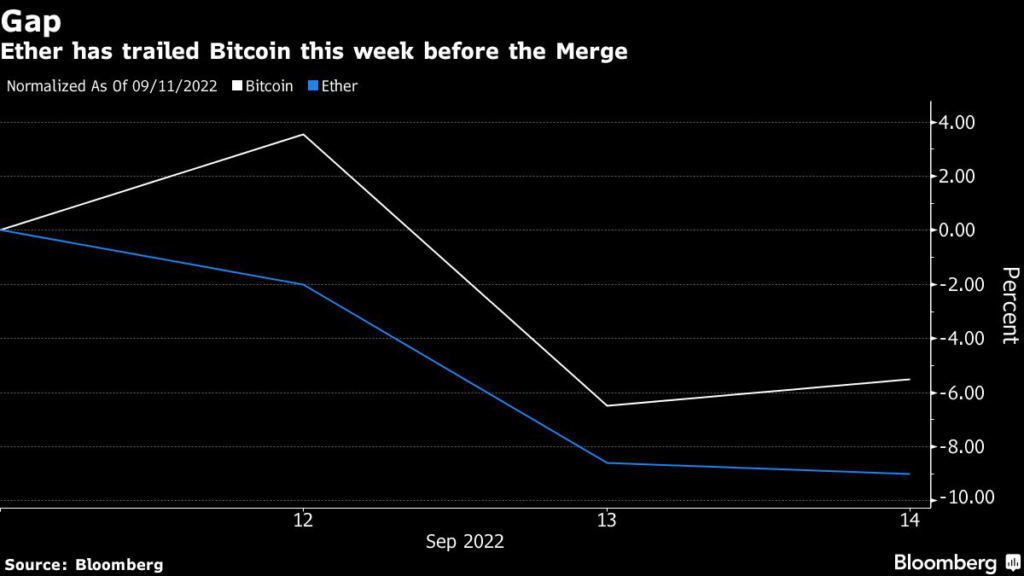
Bitcoin was down less than 1% to $20,140 as of 10:27 a.m. in New York after a near-10% plunge on Tuesday. Ether, the native token of Ethereum, decline for a third day, dropping about 1% to $1,590. Stocks, bonds and digital tokens plunged Tuesday after rising US inflation data pointed to further large Federal Reserve interest-rate hikes.

The Fed has no alternative but to “pump the brakes, tighten financial conditions, ratchet real yields higher and that’s just going to crunch on risky assets,” Charlie McElligott, cross-asset macro strategist at Nomura Securities International Inc., said on Bloomberg Television.

Such macroeconomic factors are currently overshadowing the Ethereum revamp, known as the Merge. But the upgrade to slash the blockchain’s energy use is due late Wednesday or Thursday and will come back into the spotlight.

An array of financial services are built atop Ethereum, making it a critical crypto highway, so any snafus in the software shift from a so-called proof-of-work to a proof-of-stake paradigm could ripple across digital assets.

“There’s been so much testing that the Merge itself is overwhelmingly likely to be very smooth,” Joseph Lubin, a co-founder of Ethereum, said on Bloomberg Television, drawing a comparison with an overnight iPhone update. Major Ethereum-based services are ready for the upgrade but some smaller ones may need to do more work, he added.

An Ether rally since mid-June, spurred partly by buzz around the Merge, has cooled of late. Both Ether and Bitcoin have more than halved in 2022.

Bitcoin could drop below $18,000 before prices reach a bottom in October, Mark Newton, head of technical strategy at Fundstrat, wrote in a note Tuesday.

More stories like this are available on bloomberg.com

©2022 Bloomberg L.P.

Microsoft’s Former Sustainability Chief Explains Why Private Equity Can Help Win the Race Against Climate Change: Q&A

(Bloomberg) — Microsoft Corp.’s former chief environmental officer, Lucas Joppa, was one of the architects of the software giant’s plan to remove more carbon than it emits by 2030 and set up a $1 billion climate investment fund to back emerging carbon-removal technologies. Brian Sheth, co-founder of Vista Equity Partners, has taken notice.

Sheth has tapped Joppa, 40, to serve as chief sustainability officer and sit on the investment committee at his new private equity firm, Haveli Investments, and given him a remit to help companies set meaningful sustainability goals. Haveli’s first fund will focus on gaming and is targeting a $750 million size, according to a person familiar  with the company’s plans who asked not to be named discussing private financial details. The company expects to expand into other areas in the tech industry in the future, the person said. Bloomberg Green spoke with Joppa about his new role.

Why did this role appeal to you?

I’ve always had a thesis of impact — prove that a company can take sustainability and begin to put it at the core of how it operates. That was what I was motivated to do when I joined Microsoft, it was almost like debugging that corporate operating system to be like, “Hey, can you actually get this thing running in the same direction, but running a little bit differently, a little bit more efficiently?” And if you’re going to try to get a company to do something, you might as well try to get a big, powerful company to do something.

So I was super lucky to have the opportunity that I did at Microsoft. It was the opportunity of the lifetime at that point in my life, and I think it ended up being hugely transformative for corporate sustainability globally. But then the second phase of the strategy was always, “Well, prove that you can replicate this.”

Why try to replicate it through a private equity firm?

If you want to replicate something you can either do it serially or in parallel. Parallel is to say, how would you operate across multiple companies at the same time, but in a way that is sensitive to what sustainability really requires at this point. It’s a longer duration of  engagement, a deeper engagement model and an engagement model that allows you to think about corporate operations and governance and ownership at the same time. When you follow that logical sequence, private equity is where you end up.

What made you think this was the right time to move?

Coming out of COP26 [last year’s global climate talks in Glasgow], the number one thing I came away from that event thinking was, “Wow, the money is starting to move.” I kind of knew this because I was moving money at Microsoft, but I really came away with, “The second sustainability wave has begun.” The first wave was all about big corporates setting meaningful commitments and showing progress on their pledges. The second was that corporate leadership was then going to start getting resources flowing across the economy. 

There’s a lot of corporate greenwashing. How seriously are companies really taking climate change and their own sustainability targets?

One of the reasons I went into this sector is because I am worried about the fact that we have to do this for real, and I hope people like me, who specialize in doing this for real, start moving into this space and start helping the sector out. That was really the part of the equation that led me to private equity. There’s a lot of early stage VC companies that want to get in the climate space — you have this tiny little minority ownership stake, you’re kind of vocal, you send this management team your thoughts and they maybe read it, or don’t. But what you really are looking for is that deeper engagement model that private equity and majority ownership allow you to have. 

We’re also seeing a backlash in some US states against ESG. What do we do about the ways in which these issues have become victims to the political divide?

What I’ve tried to do, over my career, is strike a really balanced tone. It’s obviously politically tone deaf to say this isn’t a political or partisan issue. But in reality, it isn’t. We’ve chosen in certain cases to make it that way, but ultimately, we know that companies today, particularly in Europe and in the UK —  and we’ll see what happens in the United States — the trend is going at the very least around more transparency in emissions, numbers reporting and things like that. So, base level, just the cost of doing business now includes doing this.

We’ve obviously seen a lot of extreme weather this summer, how do you remain optimistic that we can fix things before it’s too late?

I’m an optimistic person with a strong pessimistic streak. I would reframe that question — it’s already too late. The day we started to permanently manipulate our climate and broader environmental systems, it was too late. If you would have asked me two years ago, things were bad. If you asked me today, things are worse. 

How do we get to the solution space as fast as possible? Now that the ships have been redirected, it’s time to do this as quickly as possible. There is always a silver lining in these really negative events — our historical inaction on climate has shown us that, societally, we’re not going to do anything, we’re not going to be willing to pay the price, until we really meaningfully feel the impacts. The reason I remain optimistic is because that inflection point will occur before it is existentially too late. It’s unfortunate, because it means that we have to learn from our mistakes. I would much prefer we didn’t make the mistakes and then have to pay the price.

Will we make it?

I am very optimistic that we, as a species — we, as a global society — will respond to the inputs that are coming into our system. And the good news is that the solutions are starting to get built. The financing is now available. All of that’s happening. Sure, it’s a race against time, but I remain optimistic that it’s a race that we’re going to win.

This conversation has been edited and condensed for clarity

More stories like this are available on bloomberg.com

©2022 Bloomberg L.P.

Billionaire Adani’s Unit Eyes Acquisitions to Push Food Business

(Bloomberg) — Adani Wilmar Ltd., the kitchen essentials firm owned by Gautam Adani, is scouting for local and overseas acquisition targets as Asia’s richest man doubles down on boosting his empire’s food operations weeks after Reliance Industries Ltd. announced plans to launch a consumer goods business.

“We are looking at acquiring brands in staple foods and distribution companies to boost our consumer goods offering and reach,” Angshu Mallick, chief executive officer and managing director at Adani Wilmar, said in an interview Wednesday. “We are expecting to conclude a couple of acquisitions by March.” 

The company has earmarked 5 billion rupees ($62.9 million) from its initial public offering for purchases, Mallick said. Additional funding will come from internal accruals and the 30 billion rupees of planned capital expenditure for next year starting April, he said. The food company’s shares have more than tripled since its $486 million debut in February. 

Adani Wilmar Sees Two Milestones Since February Listing: Chart

Conglomerates such as Adani Group and billionaire Mukesh Ambani’s Reliance Industries are trying to grab a share of India’s food production industry which is pegged at $400 billion, according to the UN’s Food and Agriculture Organization. 

Adani Wilmar recently acquired several brands, including the Kohinoor cooking brand from McCormick Switzerland for an undisclosed amount. The acquisition gave Adani Wilmar exclusive rights over Kohinoor’s basmati rice and ready-to-cook, ready-to-eat curries and meals in India. The Adani Group Has been on a tear buying some 32 companies in the past year, valued at about $17 billion, many outside its core coal- and infrastructure-related businesses.

Richest Asian Is Also Busiest Dealmaker With a $17 Billion Spree

Reliance Retail Ltd., a subsidiary of Reliance Industries, announced its foray into the fast-moving consumer goods, or FMCG, business in August, with the aim of developing and delivering high quality products at affordable prices.

“Going forward, companies have to provide quality of products, value for money and robust distribution network,” Mallick said, adding his company is witnessing 50% growth in e-commerce distribution via Amazon and Flipkart.

More stories like this are available on bloomberg.com

©2022 Bloomberg L.P.

Twilio to Cut 11% of Staff After Growing ‘Too Fast’

(Bloomberg) — Twilio Inc., a maker of customer communication and marketing software, said it will cut about 11% of jobs and restructure the company in a push for profitability after a period of rapid expansion.

Sales strategy, research, and administrative staff will be most affected by the workforce reductions, Chief Executive Officer Jeff Lawson wrote in a letter to employees Wednesday. The shares rose 0.5% in New York. 

“Twilio has grown at an astonishing rate over the past couple years. It was too fast,” Lawson wrote. “At our scale, being profitable will make us stronger.”

San Francisco-based Twilio, best known for its direct-to-consumer text messaging services, is betting on an expansion into the wider market for customer service tools in a bid to compete more forcefully with Salesforce Inc. and Adobe Inc. Recent acquisitions have included identity verifier Boku Identity Inc., toll-free messaging service Zipwhip and customer data provider Segment. 

Its workforce has jumped over the past year, growing to 8,510 employees at the end of June from 6,334 employees a year earlier.

Twilio shares are down 73% this year, as the current stock market rout has particularly impacted unprofitable software companies. In August it projected about 31% sales growth to $970 million in the current quarter and a loss of as much as 43 cents a share, worse than analysts had expected. The company confirmed its forecasts in the filing. 

The company sees about $70 million to $90 million in charges from the restructuring, most of which it will incur in the third quarter, according to the statement. 

(Updates with background from first paragraph, adds shares in second paragraph)

More stories like this are available on bloomberg.com

©2022 Bloomberg L.P.

This Sell-Everything Rout Leaves a Sinking Feeling for Tech Stocks

(Bloomberg) — The last time technology stocks saw a selloff of the scale of Tuesday’s wipeout, the Nasdaq 100 Index was a week away from kicking off a monster rally thanks to unprecedented stimulus from the Federal Reserve. But panic-stricken bulls don’t have the Fed on their side this time.

Every single stock in the Nasdaq 100 ended Tuesday in the red after a surprisingly strong reading on consumer inflation. Though stocks are ticking higher on Wednesday, the ongoing equities exodus leaves the outlook gloomy. Rising chatter about the potential for a mammoth 1 percentage point rate hike by the Fed next week doesn’t help either.

“It’s a terrible environment for tech,” said Marija Veitmane, a senior multi-asset strategist at State Street Global Markets. The bank’s clients were “very concerned” about the inflation numbers, she said, adding that she sees further weakness in stocks.

The Nasdaq 100’s 5.5% drop Tuesday was the biggest since March 16, 2020, during the dark early days of the Covid-19 pandemic. While fiscal and monetary stimulus kept markets and economies buoyant until vaccines came along, those tools are off the table this time. Instead central banks are focused on containing raging inflation, even at the cost of crimping economic growth and employment.

Equities showed some modest stabilization on Wednesday, while the Nasdaq 100 rose 0.1%. Still, tech stocks seem to be immune to what little good news there is. 

Take Apple Inc., the world’s largest company by market value. The company lost $154 billion in capitalization Tuesday, just a day after analysts flagged that the new iPhone 14 Pro Max was the best-selling model and surpassed what the older version did in a similar timeframe. That’s pretty much symbolic of how business seems to be going on as usual, despite the soaring cost of living. And yet, investors went on to dump its shares.

“Relatively resilient earnings are still not enough to withstand macro headwinds from ever-aggressive central banks,” Veitmane said. 

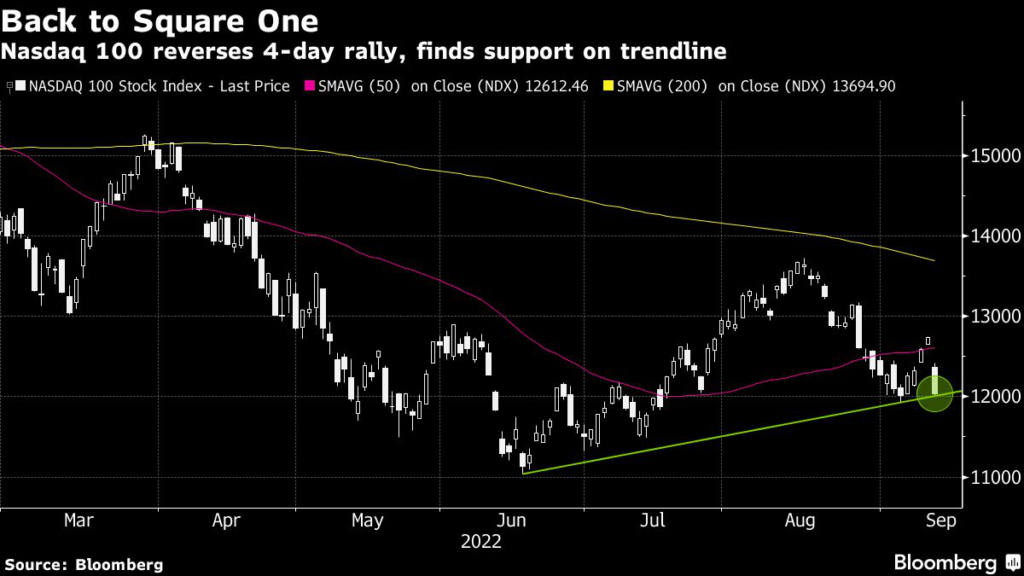
However, there are bits that keeps bulls’ hopes alive: The Nasdaq 100 is sitting right above a support level and the valuation has sunk to 20.7 times forward earnings, sitting close to the recent lows in mid-June.

The on-paper-support might not be enough for a turnaround.

“Tuesday’s selloff is a reminder that a sustained rally is likely to require clear evidence that inflation is on a downward trend,” said Mark Haefele, global wealth management chief investment officer at UBS AG. 

Tech Chart of the Day

Cathie Wood’s ARK Innovation ETF, the poster child for hyper-growth stocks, has been stuck to the lows after plunging 64% in the past year. Some of its holdings suffered from the end of the pandemic boom, while others were hurt by concern over higher interest rates.

Top Tech Stories

  • Google lost most of the first round of its battle to topple a landmark 4.3 billion-euro ($4.3 billion) European Union antitrust fine that struck at the heart of the U.S. tech giant’s power over the Android mobile-phone ecosystem.
    • An antitrust suit by US state attorneys general accusing Alphabet Inc.’s Google of monopolizing the technology underlying online advertising can move forward, a New York federal judge ruled.
  • International Business Machines Corp. said it would report a $5.9 billion one-time pretax charge in the third quarter as a result of an agreement to offload pension obligations to two life insurers.
  • Hong Kong Exchanges & Clearing Ltd. is discussing a system that will slash the revenue requirements for hard-tech companies to go public in the city, according to people familiar with the matter.
  • Tencent Music Entertainment Group is pressing ahead with its Hong Kong listing plans with a goal to start trading in the Asian financial hub as soon as next week, according to people familiar with the matter.
  • After a decades-long impasse that led to a threat to kick about 200 Chinese firms off New York stock exchanges, US inspectors may soon get their first look under the hood of some of China’s largest corporations, if all goes as planned.
  • Patreon Inc., which helps entertainers sell their work to subscribers online, is cutting about 17% of staff and closing two offices in Europe.


(Updates to market open.)

More stories like this are available on bloomberg.com

©2022 Bloomberg L.P.

Crypto and Dry Bulk ETFs Are Deadlocked for 2022’s Biggest Loser

(Bloomberg) — A historically aggressive Federal Reserve has put some of the exchange-traded fund industry’s previous high fliers in a race to the bottom. 

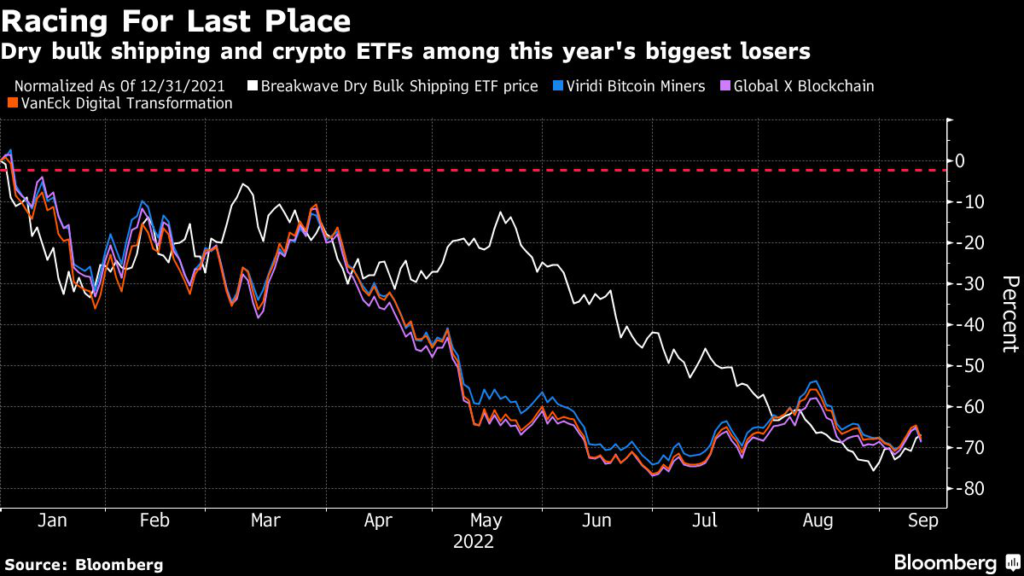
The three worst performances this year among non-leveraged ETFs all belong to crypto funds, with the $6 million Viridi Bitcoin Miners ETF (RIGZ) claiming the top spot amid a nearly 69% nosedive. The $46 million Breakwave Dry Bulk Shipping ETF (ticker BDRY) — which tracks a basket of dry bulk freight futures — is sitting in fourth with a 67% plunge, after soaring 283% in 2021 as supply chains choked.

Fueling the wipeout is a central bank intent on stamping out the hottest inflation in a generation, even at the expense of economic growth. A series of supersized interest-rate hikes has drained the speculative froth from financial markets, leaving a trail of crypto-linked ETFs in the wake. At the same time, the cost of shipping has dropped as higher rates crimp demand for physical goods and supply chains unsnarl, dragging down the likes of BDRY after a blockbuster 2021.

“These areas were clearly prime beneficiaries of plentiful monetary and fiscal stimulus. Now, dry bulk freight futures and crypto are both suffering from the same malady — a highly aggressive Fed,” said Nate Geraci, president of The ETF Store, an advisory firm. “The easy money party is over and both of these areas are now in the midst of brutal drawdowns.”

US inflation data Tuesday portends more pain ahead. The consumer price index climbed 8.3% in August versus a year earlier, above the median estimate, sparking wagers that the Fed might unleash a 100 basis point hike next week — a move that hasn’t been seen since 1984.

Though the Fed’s quest to quell inflation has rocked nearly every asset class this year, crypto-flavored funds have been hit the hardest. After RIGZ, the $74 million Global X Blockchain ETF (BKCH) and the $35 million VanEck Digital Transformation ETF (DAPP) are both nursing year-to-date losses of about 68%, outpacing Bitcoin’s roughly 57% decline. 

But even with the abysmal showings, all four ETFs are still sitting on net inflows so far this year, Bloomberg data show. Though BDRY’s total assets have more than halved from October 2021’s peak, the fund will likely always have a niche following among traders looking to wager on shipping rates, according to Bloomberg Intelligence’s Eric Balchunas. 

“It’s either going to crush or be crushed,” said Balchunas, a senior ETF analyst. “It has an audience, small but real.”

More stories like this are available on bloomberg.com

©2022 Bloomberg L.P.

Twitter Chairman Keeps Calm in Chaos of Musk’s Bid to Scrap Deal

(Bloomberg) — At a technology conference in June, Bret Taylor, the mild-mannered co-CEO of tech behemoth Salesforce Inc., was losing his patience. Taylor had joined the conference to talk about the future of work, but the moderator kept asking about Twitter.

Taylor declined to discuss his side gig as chairman of Twitter Inc. With a $44 billion acquisition on the line, he said it would be inappropriate to comment. Yet the moderator kept pressing: What are the chances that Elon Musk goes through with his agreement to buy the beleaguered social network? Has the deal stalled? Is it possible you’ll end up in the courts? With each question, Taylor’s grimace became more pronounced.

“Again—we intend to close the transaction and enforce the merger agreement,” he said, before successfully changing the topic.

In simpler times, the VivaTech conference in Paris could have been a triumphant moment for Taylor, just seven months into his tenure atop Salesforce, alongside billionaire Marc Benioff. The 42-year-old’s resume includes co-creating Google Maps, inventing the “Like” button, founding and then selling two companies, and driving Salesforce’s largest acquisitions.

But his role at Twitter has placed him at the center of the most visible dispute in business, opposite would-be acquirer Musk, 51, the world’s richest man and CEO of Tesla Inc. and SpaceX. Taylor has been trying to say as little as possible as Musk heckles Twitter publicly and privately. But his actions speak volumes: Under Taylor’s leadership, the company sued Musk to enforce the contract after he changed his mind about buying the social network.

There’s little reason for optimism that the deal, reached in late April, will go well for Twitter, however it shakes out. If the company wins, it ends up owned by a man who doesn’t want it, and whom Twitter’s lawyers have portrayed in court as a manipulative liar. If Twitter reaches a settlement to end the dispute, Taylor and other board members could be sued by shareholders for breaching their duties by foregoing the $54.20-per-share acquisition price Musk committed to, which was approved by investors at a meeting earlier this week.

Against this chaotic backdrop, Taylor has been Twitter’s deal quarterback, passing information between bankers, advisors and directors while trying to project a calmly professional demeanor. It’s up to corporate boards to approve acquisitions, which explains why it’s been Twitter’s board chair taking on many key responsibilities alongside Chief Executive Officer Parag Agrawal.

These duties include dealing with Musk, who has sent updates and threats directly to Taylor, sometimes over text, according to legal filings. In late March, Musk told Taylor that he could build a competing service if he didn’t get what he wanted at Twitter. Days before the acquisition was finalized in April, Musk promised Taylor he would initiate a hostile takeover—also known as a tender offer—if his $44 billion offer wasn’t accepted, according to filings in Twitter’s lawsuit against Musk. (A week earlier he had mockingly tweeted “Love me Tender,” a wink at his potential takeover strategy.)

It’s Taylor who fielded Musk’s advances, and now it’s Taylor who is serving as the public face of the company as it forces him to a courtroom. Both executives declined to comment for this story.


Taylor is known—in life and business—for being low-key, polite and by-the-book, according to conversations with 17 associates and friends. That puts him in stark contrast to the man sitting on the other side of the negotiating table. While Taylor has been saying “no comment,” Musk has given the media, and Twitter’s lawyers, plenty of material to work with. He’s posted memes hinting at his intentions, taunted Twitter’s executives and polled the public on Twitter’s future.

There was the time Musk tweeted a poop emoji at Agrawal, or challenged him to a public debate about bots. Musk’s posts were cited in Twitter’s lawsuit against the tech mogul, and will undoubtedly appear in the Delaware Court of Chancery come October, when the two sides are set for a trial.

Taylor, meanwhile, has sent only seven Tweets about the Musk entanglement, each time a sober update clearly vetted by lawyers, in a feed otherwise filled with smiling group photos, sports commentary and Salesforce product updates. He’s publicly refuted Musk’s claims about bots and spam and repeated the social network’s mantra about enforcing the deal in court.

Friends and colleagues say Taylor is suited for the role of calm intermediary—he’s efficient, has technical knowledge and deals experience, and works well with strong personalities. He’s sold multiple companies, and worked near the top of other tech giants over the past two decades, quietly becoming invaluable to A-list CEOs like Benioff and Meta Platforms Inc.’s Mark Zuckerberg. Part of why he functions so well in those situations is that Taylor is just fine operating behind the scenes, without seeking credit or the limelight, said one person at Twitter who works with Taylor. He has developed healthy coping mechanisms, like a new habit this year of doing 100 push-ups a day.

Taylor trotted a familiar path on his way to Twitter’s board. After graduating from Stanford during the dot-com bust of the early 2000s, he landed at Google, where he co-founded Maps and made a group of friends now composed of senior tech executives and unicorn founders who still play poker together.

After Google’s IPO, Taylor left to create FriendFeed, a social-media startup, which built the now-ubiquitous “Like” button. Funding eventually dried up, and Taylor negotiated a sale to Facebook over a weekend in 2009, while Twitter also angled to buy the startup. The fire sale hurt his pride as a founder but gave him two new mentors—Zuckerberg, whom he reported to as CTO, and another ex-Googler, Sheryl Sandberg, who built Facebook into an advertising behemoth. Taylor has said Facebook is where he learned to be a manager, and he got a front-row seat to several lightning-fast acquisitions, including the $1 billion Instagram takeover in 2012.  

When Facebook had to answer for early privacy controversies, the company sent the affable Taylor to Washington to testify before US Senators. Years later, he has said he still feels loyalty to Facebook and its leadership.

Taylor’s composure stems from his stable upbringing, friends say. His mother was a Chevron Corp. executive, eventually retiring to run wine country tours, and his father was a mechanical engineer who often had computers set up around the house. Both went to Stanford. Yearbook photos from high school in the 1990s show Taylor was a long-distance runner, wore a grunge band T-shirt and had long hair. Today, he lives with his wife and three kids a few miles from his own parents.

After Facebook went public, Taylor again ditched his flashy big-company gig. This time he pivoted to enterprise software and co-founded Quip, a company that let people collaborate on documents in the cloud, at a time when the norm was saving files on a personal computer.

He also accepted his first board seat, at Axon Enterprise Inc., maker of Taser stun guns and police body-cameras. That role gave Taylor his first lessons in boardroom diplomacy. When Axon’s directors had disagreements, Taylor was able to re-frame the issue in simple language and move things forward, said Axon Chief Executive Officer Rick Smith. “Bret would be the guy that would say, ‘OK, let’s pause for a second, take the emotion out of this, and let’s just put the factors on the board.’” Hadi Partovi, an early investor in blue-chip firms like Uber Technologies Inc. and Airbnb Inc. who was also on the Axon board and recruited Taylor, recalls that Taylor was preternaturally wise. “I think he was probably the youngest member of the board but also the one that folks most wanted to hear from,” he said.

Quip never gained mass adoption, but had one huge fan—Salesforce’s Benioff. In 2016, the startup had plenty of cash in the bank, but Benioff made an offer that Taylor couldn’t refuse—$750 million for a company that had raised less than a 10th of that. “Marc—if you’ve ever met him—is a really charming salesperson and convinced us,” Taylor said in a podcast appearance last year. “The price tag was, you know, motivational as well.”

The acquisition was widely seen as an expensive recruitment play. Benioff had been mentoring Taylor for years by that point, and had attended many of the dinners Taylor regularly hosted with prominent company leaders, venture capitalists and entrepreneurs. After the deal, some within Salesforce took to calling Taylor “the 750-million-dollar man.”

Taylor’s software wasn’t immediately embraced at Salesforce. The service was said to be so clunky at times that workers joked they were caught in “Quipsand.” Some had reservations about Taylor, too, especially after he was so quickly elevated to a senior leadership role. Salesforce was primarily driven by a sales and marketing culture, and some staffers questioned whether the engineer and product expert could be the kind of bombastic evangelist that Benioff is. One former employee distinctly remembered Taylor’s folksy manners, incorrectly believing that Taylor had grown up in Indiana. (He was actually born in Oakland.)

But Salesforce employees came around to Taylor’s quiet confidence—he’s picked up many responsibilities from his mentor over the years, stepping up for keynote speeches, TV appearances, and company all-hands presentations. Every Monday, he leads a three-hour executive check-in, and he often personally calls CEOs to close deals, Salesforce Chief Product Officer David Schmaier said in an interview. He’s also taken over delivering hard news, such as when he told protesting employees that the company wouldn’t cut business ties with the National Rifle Association after the school shooting in Uvalde, Texas.

Chief Marketing Officer Sarah Franklin said she’s seen Taylor become more relaxed and confident over time with the knowledge that he has built the loyalty of the company.  “I don’t think our leadership team has ever been more aligned and communicative,” she said.

His rapid ascent at the company is in large part due to his close relationship with Benioff, said many of the people interviewed for this story. The relationship works because the two are so different and “Bret doesn’t want to be Marc,” said someone who has worked for them both. “People who want to be Marc can’t always work with Marc.”

Taylor has even taken on the responsibility Benioff may be most famous for: acquisitions. He played a key role on the company’s three largest mergers, Slack, Tableau, and MuleSoft, worth a combined $50 billion. “Between Facebook and Salesforce, I’ve acquired as many companies as probably most people you meet at this stage,” Taylor said in a 2021 interview with Greylock Partners, a VC firm that invested in Quip.

Benioff was so impressed with Taylor when he bought Quip that he made an exception to his usual aversion to outside corporate boards. Benioff himself hasn’t been on one since leaving Cisco Systems Inc.’s in 2014. Former Salesforce SVP Niki Christoff said she was fired from the company for taking an outside board membership in 2020. Just weeks before the Quip deal was announced in 2016, Taylor had joined Twitter’s board, and Benioff let him remain after the deal closed.

It was Twitter, after all. How much work could it be?

Read more: Twitter Whistle-Blower Testimony Spurs Calls for Tech RegulatorWithin months of joining the board, Taylor had a front-seat to chaos. First, the company was itself on the block, holding discussions with several suitors including Salesforce, Disney and Google. Those talks fizzled out and Twitter remained independent.

A few years later, in early 2020, activist investors Elliott Management showed up at Twitter’s doorstep, forcing their way onto the board and pushing for changes to its governance structure, taking aim at co-founder and CEO Jack Dorsey. While Dorsey kept his job in the immediate wake of a settlement with Elliott that included specific growth and revenue goals, he resigned some 18 months after Elliott showed up. Dorsey was among those who wanted Taylor to take over as chairman, according to a person familiar with the situation, and he assumed the role in November as Dorsey left the board.

Taylor was one of the first people Musk spoke with as the billionaire became Twitter’s largest shareholder. When the company learned of his stake, it was Taylor who helped negotiate Musk’s board seat, and who first received the news that Musk had changed his mind about joining the board. When Musk offered Twitter’s directors $54.20 a share to buy the company on April 13, his offer letter was addressed to Taylor, and the two stayed in contact until Twitter accepted his bid almost two weeks later.

It was a whipsaw process, but Taylor had hashed out similar large M&A deals before, both as a buyer and as a seller, giving him the advantage of “pattern recognition,” said the Twitter source who has worked with Taylor. He understood when Twitter should seek counsel, and when decisions needed to be made quickly, said the source, bringing a “comfort level and sophistication” to the process.

On the day Twitter accepted Musk’s offer, Taylor solemnly addressed staff alongside Agrawal, explaining why the board decided to sell. Mostly, he defined “fiduciary duty” multiple times, explaining that his legal responsibility was to deliver high returns to shareholders. One employee asked if the deal could fall apart. Taylor wasn’t worried; he said that the board had taken steps to mitigate risks, which were mostly financial or regulatory. Perhaps he never suspected that Musk might just change his mind.

It was supposed to be a clean exit. Taylor told employees that Twitter’s board, and thus his job as chairman, would no longer exist under Musk’s ownership. Taylor, who has been so adept at reading such situations in the past, had apparently misjudged Musk’s capacity for mischief-making, and Twitter’s unique ability to find drama and foist its leaders into highly public no-win situations.

If the deal falls apart, Taylor and the rest of Twitter’s board will undoubtedly be second-guessed for brokering a deal in the first place with Musk, a man who used the deal’s per-share price to make a weed joke.

“The situation he’s dealing with is not being fought just in the court of law,” said tech investor Partovi, “but also the court of public opinion.”

More stories like this are available on bloomberg.com

©2022 Bloomberg L.P.

‘Dancing With the Stars’ Returns With an $8 Monthly Streaming Bill as Show Goes Online

(Bloomberg) — “Dancing With the Stars,” one of ABC’s biggest TV shows, returns on Sept. 19 with a little surprise: an $8 monthly streaming bill.

The popular competition series, which drew an average of 6.36 million viewers a night on ABC last season, is airing live on Disney+, forcing fans to sign up for a monthly subscription if they want to keep up with the long-running show.

It’s yet another sign of the changes sweeping the TV business as viewers increasingly tune into streaming services rather than the traditional channels. In the past few weeks alone, online viewing passed cable TV for the first time, the CW network was sold for next to nothing, and NBC, one of the biggest broadcasters, has floated the idea of eliminating an hour of prime-time programming.

Read more: Amazon Breaches TV’s Last Stronghold With $13 Billion NFL Bet

ABC, a unit of the Walt Disney Co., announced just three new shows for the coming fall season, half as many as five years ago, and one of them, “Celebrity Jeopardy!” has run many times in the past. Overall five major broadcast networks are premiering just 17 new shows this fall, compared with 25 three years ago, according to data from Ampere Analysis Ltd. The number of new scripted series is down to 10 from 16.

The popularity of “Dancing with the Stars” is nowhere near its peak more than a decade ago, when some 21 million viewers watched. And its success on Disney+ is no sure thing. 

‘Mark My Words’

“You guys are going to lose fans,” one irate viewer wrote on Instagram. “Mark my words.”

But the move could be a sign of what’s to come if the show ends up attracting more viewers and subscribers online, according to Rich Greenfield, an analyst at LightShed Partners. He notes that Disney+ wants to become a broader, general entertainment service.

Disney Chief Executive Officer Bob Chapek said the company still has a lot of programming for its traditional TV networks, which are a much-needed profit generator as the company builds out its still-money-losing online offerings. The programs that run online are of the same quality as those on the networks, he said. He’s reorganized the company so that a new centralized unit makes decisions on what the best home is for a program, and in their eyes the “Dancing” shuffle won’t hurt ABC.

“To take a great franchise like that and move it to streaming doesn’t in any way hamper or signal anything about our legacy business,” Chapek said in an interview. “Other than we look at the demographics of a show like that, we look at its potential and say, ‘What could it be like here?’”

Discount Offer

To encourage viewers to make the switch, Disney+ is offering a discounted $1.99 subscription for one month. The promotion expires Monday with the debut of the new “Dancing” season. The program is going to streaming just as the company prepares to introduce an ad-supported version of Disney+ on Dec. 8, a move that ironically makes streaming TV look a lot like the over-the-air broadcasts it’s replacing.

The median age for a viewer of “Dancing” was 63 years old last year, notes Brad Adgate, a consultant and long-time researcher of the TV business. While the move may prompt some older viewers to subscribe to Disney+, it may also be the case they just find something else to watch on cable or over the air.  

“This show is really old, and the streaming age profile is younger,” Adgate said. “It remains to be seen how great a fit this is demographically.”

Disney revealed the celebrity contestants on Sept. 8. It’s a list that ranges from 18-year-old TikTok personality Charli D’Amelio to 71-year-old former “Charlie’s Angels” star Cheryl Ladd, illustrating the broad audience the show is trying to reach. Disney made the announcement on ABC’s “Good Morning America” program.

More stories like this are available on bloomberg.com

©2022 Bloomberg L.P.
Ukraine Latest: Zelenskiy Visits Key City Retaken From Russians

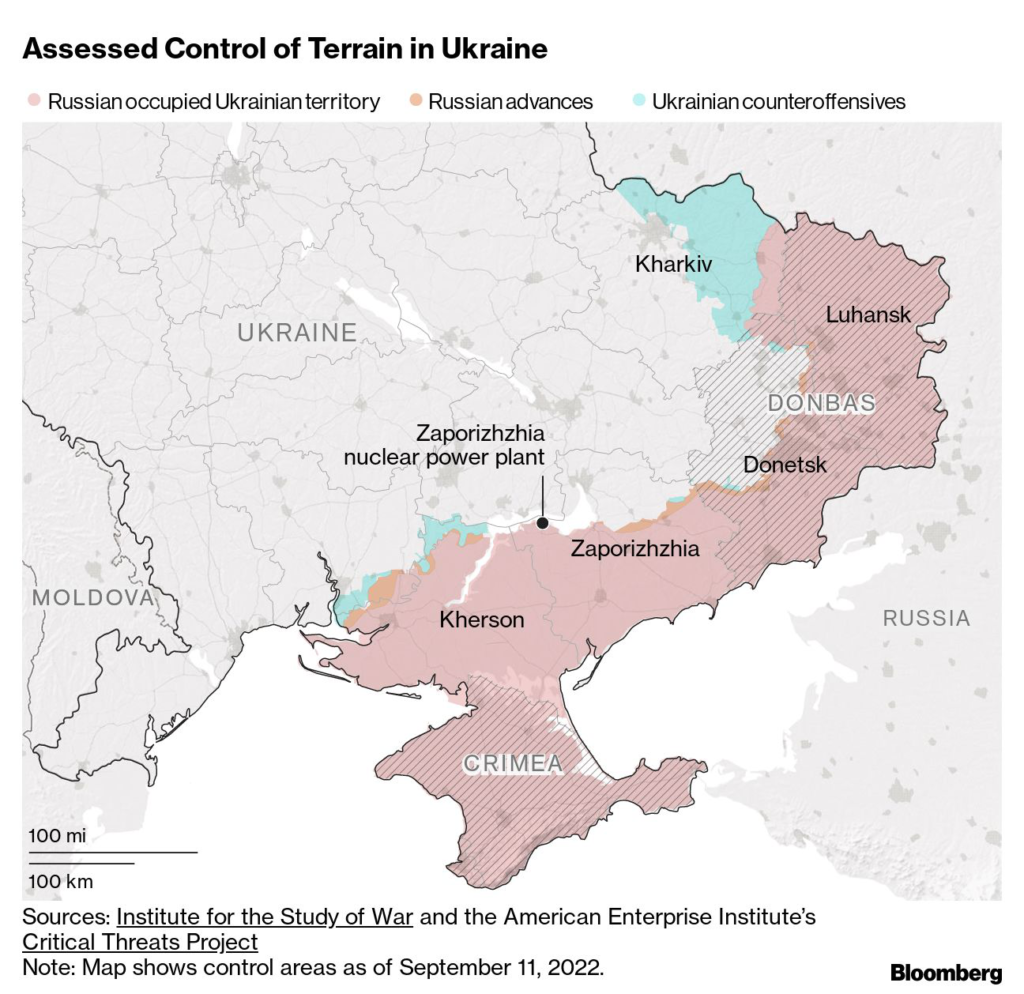
(Bloomberg) — Ukrainian President Volodymyr Zelenskiy visited Izyum, the biggest city recaptured last week during a counteroffensive in the country’s northeast that marked Ukraine’s most significant battlefield victory since repelling Russia’s attempt to seize Kyiv early in the war.

Ursula von der Leyen, the head of the European Union’s executive, pledged in her annual state of the union address on Wednesday to work to guarantee “seamless” access for Ukraine to the bloc’s massive single market to help its economy recover from the war. 

The US is preparing another package of aid to Ukraine, according to John Kirby, spokesman for the National Security Council, who cited a “shift in momentum” in the war after the government in Kyiv said it recaptured more than 2,300 square miles of occupied territory. 

(See RSAN on the Bloomberg Terminal for the Russian Sanctions Dashboard.)

Key Developments

  • Ukraine’s Leader Visits Largest City Seized Back From Russians
  • Xi Unlikely to Throw Putin a Lifeline as Ukraine Struggles Mount
  • Yuan’s Clout Gets a Boost From Russia Trade as Sanctions Bite
  • Azerbaijan-Armenia Fighting Resumes as US, France Urge Truce 
  • Russia’s Invasion Put Ukraine’s Renewables Gains in Jeopardy

On the Ground

Ukraine was consolidating control over territory retaken from occupying Russian forces during its recent counteroffensive, Zelenskiy said, following a push that shifted momentum in Kyiv’s favor. Fighting continued in the south, the Ukrainian military said. Russia again targeted civilian infrastructure, according to Ukraine’s General Staff, while local authorities said the cities of Mykolaiv and Nikopol were shelled overnight. Ukraine’s military destroyed several ammunition depots and is targeting Russian troops with artillery fire, military spokeswoman Nataliya Humeniuk told a briefing Wednesday. The Russian navy has also increased the number of missile carriers in the Black Sea to five with the total number of Kalibr type cruise missiles to 36. 

(All times CET)

Ukraine Seeks to Continue Electricity Export Without Zaporizhzhia (2:04 p.m.)

Ukraine expects to continue exporting electricity to European countries over the winter season despite the conflict and the idling of the Zaporizhzhia nuclear power plant, according to Volodymyr Kudrytskyi, chief executive of state-run power company Ukrenergo.

“We’re talking about more than 600 megawatts of export capacity for Poland, Romania, Slovakia and Moldova,” Kudrytskyi said. Ukrenergo plans to increase exports and is now preparing for winter season to ensure consumers have power. 

Zelenskiy Raises Ukrainian Flag in Izyum (12:40 p.m.)

Zelenskiy participated in a flag-raising ceremony in Izyum, which had been a key staging point for Russian troops before they retreated in the face of a lightning Ukrainian counteroffensive last week, according to a statement on the presidential website. 

The Kharkiv region city of Izyum, which was occupied by Russia since March, is one of the most strategically significant areas retaken during the counteroffensive. The speed of the Russian retreat last week was evident in the amount of military vehicles and ammunition left behind.

The Russian military said on Saturday it pulled troops out of two areas in the Kharkiv region to regroup its forces in the Donetsk region.  

Ukrainian Deputy Prime Minister Says Russia Sought Talks: France 24 (11:05 a.m.)

Russian officials reached out to Ukraine in recent days about negotiations, Ukrainian Deputy Prime Minister Olha Stefanishyna told France 24 in an interview.

Moscow doesn’t reject negotiations with Ukraine, Russian Foreign Minister Sergei Lavrov said on state television Sunday. However, the longer they are delayed, the more difficult the talks will be, he said.

There haven’t been substantial peace talks since the early days of the war, and the prospect of a settlement appears dim following Ukraine’s successful counteroffensive this month. Billionaire Roman Abramovich attempted to revive contacts between the sides in April but failed to achieve a breakthrough.

EU’s von der Leyen to Travel to Kyiv Wednesday (9:40 a.m.)

Von der Leyen, president of the European Commission, said she would make her third trip to Ukraine since the war began later Wednesday to discuss a plan to ensure “seamless access to the single market of the European Union” with President Volodymyr Zelenskiy.

“Europe’s solidarity with Ukraine will remain unshakable,” von der Leyen told European lawmakers in her annual speech in Strasbourg. Sanctions imposed by the EU against Russia following its invasion “are here to stay.”

Von der Leyen said she will travel to Kyiv with Ukraine’s first lady, Olena Zelenska, who attended the speech.

US Says Russia Gave $300 Million to Foreign Political Parties (7:30 a.m.)

Russia has secretly funneled more than $300 million to foreign political parties and candidates in more than two dozen countries since 2014 to influence elections, and may ramp up its efforts in the coming months in a bid to blunt the effect of sanctions, a senior US official said, speaking to reporters on condition of anonymity.

Russia transfers the funds — cash, cryptocurrency and non-monetary contributions — using intermediaries including security services, oligarchs and supposedly independent foundations or think tanks, the State Department said in a note to dozens of US embassies that was shared with reporters.

Biden Cites ‘Significant Progress,’ With Caveat (3:10 a.m.) 

President Joe Biden, asked if Ukraine’s recent battlefield successes marked an inflection point in the war, said Tuesday evening that “the question is unanswerable right now.”

“It’s clear the Ukrainians have made significant progress,” he told reporters after voting in Wilmington, Delaware. “I think it’s gonna be a long haul.”

US Cites ‘Shift in Momentum,’ Readies Another Round of Aid (8:25 p.m.)

The US is preparing another round of military aid for Ukraine, as the Biden administration sees a “shift in momentum” favoring Kyiv’s forces against its Russian opponents, National Security Council spokesman Kirby told reporters.

Additional supplies of weapons that will be announced in the “coming days” could help Ukraine keep up its counteroffensives against the Russians, Kirby said without detailing what will be provided.

Saying Ukrainians have made “more dramatic” advances in the country’s north than in the south, Kirby said. “I would let President Zelenskiy determine and decide whether he feels militarily they’ve reached a turning point. But clearly, at least in the Donbas, there’s a sense of momentum here by the Ukrainian armed forces.”

More stories like this are available on bloomberg.com

©2022 Bloomberg L.P.
Hedge Funds Are Betting Elon Musk Will Be Forced to Buy Twitter

(Bloomberg) — Hedge funds including David Einhorn’s Greenlight Capital and Pentwater Capital Management are wagering that Elon Musk won’t get his way this time. 

Musk, the world’s richest person and a renowned sparring partner with regulators over securities laws, is trying to back out of his agreement to buy Twitter Inc. for $44 billion. Several hedge funds have purchased stock, options or bonds — speculating that Musk will lose a trial scheduled to begin Oct. 17 in Delaware Chancery Court.

That could be a bright spot for a type of hedge fund having a tough year. So called event-driven funds, which often bet on mergers and acquisitions, are down 4% on average, according to research firm PivotalPath. 

The law is clear, Einhorn told investors in a letter last month. And “if it were anyone other than Musk, we would handicap the odds of the buyer wiggling out of the deal to be much less than 5%,” he said.

The money manager, whose firm bought Twitter shares at an average price of $37.24, dismissed speculation that the court would rule in Musk’s favor to avoid embarrassment should the man commanding a net worth of more than $250 billion simply choose to ignore its decision.

“We think that the incentive of the Delaware Chancery Court, the preeminent and most respected business court in the nation, is to actually follow the law and apply it here,” Einhorn wrote.

An attorney for Musk and a Twitter spokesperson declined to comment.

Pentwater, led by Matthew Halbower, bought more than 18 million Twitter shares in the second quarter, making his firm the seventh-biggest owner with a 2.4% stake. He told CNBC in July that he expected Musk, who offered to buy Twitter for $54.20 a share, to be forced to complete the purchase. 

Market Plunge

So far, the market appears to be supporting that view.

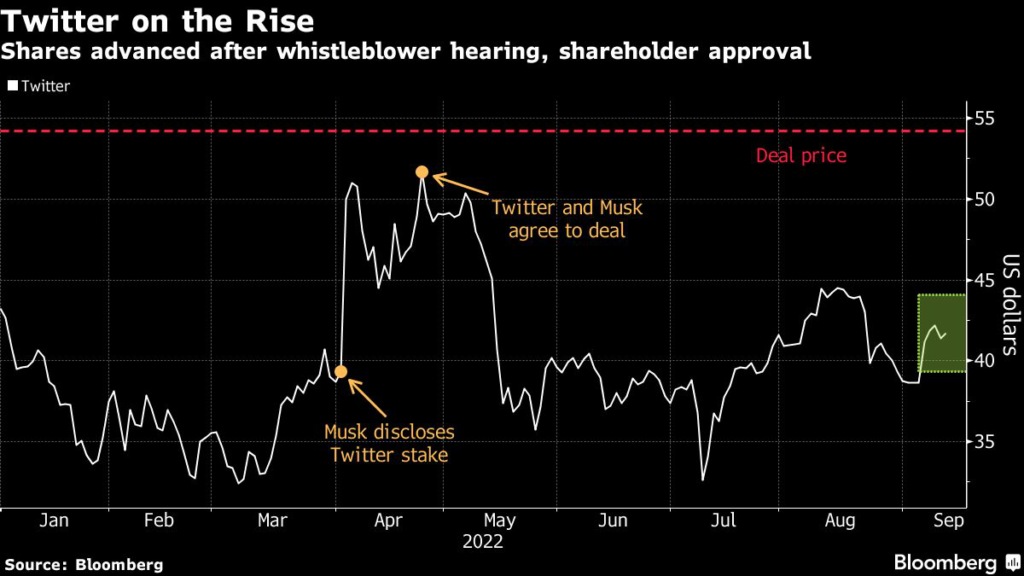
On Tuesday, when US equity markets plunged the most in more than two years, Twitter shareholders voted to approve the merger — and the stock was the second-best performer in the S&P 500, gaining 0.8% to $41.74. While it hasn’t closed above $44.50 since Musk first suggested in May that he might renege, some analysts and investors, including Einhorn, have said the stock would tumble to $20 if the deal falls apart.

The idea that Musk, the chief executive officer of both Tesla Inc. and SpaceX, could one day own Twitter took root in early April. That’s when he disclosed he had acquired 9% of the social media giant, making him its largest individual shareholder. Within weeks, the parties announced they’d reached an agreement. But less than a month later, Musk was threatening to pull out, accusing Twitter of understating the prevalence of bots on its platform. On July 8, he said he was terminating the deal. 

Since then, Musk’s lawyers have pointed to allegations from whistle-blower Peiter Zatko, Twitter’s former head of security, saying “egregious deficiencies” in the company’s defenses against hackers and privacy issues meant that Twitter had breached the conditions in the merger agreement.

An article in the New Yorker this week said that after Zatko’s claims became public, his former colleagues were contacted by researchers, sometimes offering money for information on the cybersecurity executive. At least a few of the researchers were gathering information for investment firms with bets on the deal, according to the report.

Read more: Twitter Whistle-Blower Testimony Spurs Calls for Tech Regulator

Some investors and analysts suggest the parties could reach a settlement before the trial, with Musk paying closer to $50 a share. 

Carronade Capital Management, a $900 million multi-strategy credit hedge fund, invested in various Twitter debt and equity securities, wagering that the deal will ultimately be done, either after a trial or through a settlement, according to people familiar with the matter. A representative for the firm declined to comment. 

Kellner Capital’s Chris Pultz said Musk and Twitter might agree to forgo a trial for a discount of 10% to 15% from the original deal price.

“Anything more than that and the Twitter board may say they would rather take their chances going to court,” said Pultz, whose firm manages about $250 million.

In April, when Musk brought in outside financing, including from fellow billionaires Larry Ellison and Saudi Prince Alwaleed bin Talal, Pultz acquired a small Twitter stake. When the stock plunged in July, approaching its low for the year, Kellner bolstered its position by 40%.

Cabot Henderson, a merger strategist at Jones Trading, said Twitter now has less incentive to accept a lower price because the company has been winning in pretrial hearings, making the odds of a settlement lower than he previously predicted. 

“At this point, people are mentally preparing that this thing is actually going to trial now,” Henderson said. “It’s hard to sometimes parse through the posturing, but it does seem there’s been a real hardening of attitudes.”

More stories like this are available on bloomberg.com

©2022 Bloomberg L.P.

Close Bitnami banner
Bitnami