Bloomberg

Barclays Expands Africa Offering to Target $2 Trillion of Wealth

(Bloomberg) — Barclays Plc is expanding private-banking services in Africa, looking to target the continent’s $2 trillion high-net worth market.

The British lender has hired nine bankers from Credit Suisse Group AG based in mainly Dubai, London and Zurich after agreeing a deal to handle clients referred by the Swiss rival, according to Barclays Private Bank Chief Executive Officer Jean-Christophe Gerard.

“Barclays franchise in Africa is experiencing an accelerated build-out across south, west and east Africa,” Gerard said in an interview. “This will be done through organic growth and the referral agreement we have with Credit Suisse.”  

The $2.1 trillion of private wealth held on the African continent is expected to rise by 38% over the next 10 years, according to the Africa Wealth Report published in April. The move by Barclays to expand in the area contrasts with its exit from retail banking in South Africa, where it recently sold the last of its holding in Johannesburg-based Absa Group Ltd.

About half of Africa’s super-rich individuals are from South Africa, Nigeria and Kenya, where a lot of the bank’s focus will be, Gerard said. The lender has about 15 bankers in South Africa though is looking to hire more, Barclays country CEO Amol Prabhu said in the same interview. Other staff elsewhere are focused on the expansion. 

Technology Startups 

Wealthy Africans are increasingly investing in technology firms, including those focused on agriculture, finance and health, according to Gerard. That’s helped contribute to a boom in startup investment on the continent.  

“Entrepreneurs like to invest in entrepreneurs and therefore many are keen to participate in the Barclays direct-assets program for instance,” said Gerard. 

Investment in UK real estate is also accelerating, he said, with Africa’s super rich either seeing the market as an investment opportunity or holiday home or both.  

More stories like this are available on bloomberg.com

©2022 Bloomberg L.P.

Here Are 10 of the Best New Features of iOS 16 for Your iPhone

(Bloomberg) — It’s that time of year again when your iPhone gets an upgrade, giving you a slew of new features to tinker with. Apple’s iOS 16 is available for download now for owners of the iPhone 8 and onwards. Apple says the new operating system offers “all-new personalization features, deeper intelligence, and more seamless ways to communicate and share.”

Here are just some of the new features you can expect to see when you upgrade:

Lock Screen

This time round, the company is making a big deal about how you can customize the look of your lock screen. New features include a gallery of screen style options and the ability to add widgets like the weather, live sports scores or upcoming calendar events. Users can now customize fonts and blend their background images with the time and date display. Focus settings will let you switch what notifications show up when choosing between lock screens.

Message Editing

Ever hit “send” and been hit by a shudder of immediate regret at an embarrassing typo — or worse? iOS 16 will let you edit anything you send in Messages up to 15 mins after you’ve sent it, with a maximum of five edits allowed. If you really don’t mean what you said, you can unsend a message altogether, providing you act within two minutes. In addition you can now mark a message “unread” if you want to come back to it later.

Audio Messages

Repeated listens of lengthy messages will be a thing of the past, with the ability to fast-forward and rewind audio messages.

Collaboration Invitations

If you want to get a project off the ground, this allows you to send a message to a group via Messages, and every recipient will be added to the document or spreadsheet you want to share. The feature will work with Apple’s Files, Keynote, Numbers, Pages, Notes, Reminders, and Safari, as well as third‑party apps. Then when someone makes an edit, to a Pages document for example, an update will be posted at the top of the Messages thread.

Share Tabs

Another one for the work collaboration crowd. This feature allows a user to share a group of Safari tabs with friends, which can then be added to by any of the users. The updates will be shared with the group instantly.

Siri Hangs Up

When you’ve got your hands full, ending a call can be a bind if you have to fumble to find the phone in your pocket. Now you can just ask Siri with the command “Hey Siri, hang up.” But beware if you’re trying to be discreet — the caller will hear you ask Siri to end the call.

Multi Stop Maps

Planning a trip with multiple stops along the way? Now you’ll be able to add several destinations en route and you’ll be directed from stop to stop.

Fitness and Health

iOS 16 adds a Fitness app for all users that uses the phone’s inbuilt motion sensors to provide an estimate of calories burned based on steps, distance traveled and the use of third-party fitness apps, even if you don’t have an Apple Watch. And a new Medications feature in the Health app lets you keep track of what you should be taking and when.

Lockdown Mode

This won’t be for everyone, but Apple says the new Lockdown feature “provides extreme protection for the very small number of users who face grave, targeted threats to their digital security.” The company says the  function “further hardens your device’s defenses and strictly limits certain functions, sharply reducing the attack surface that could potentially be exploited by highly targeted mercenary spyware.”

Camera Translation

Perfect for that holiday to far-flung regions, this allows you to translate text around you using the camera in the Translate app. Just hold the camera up to the words you want translated, pause the view and the translation will be overlaid on the text in a still picture, allowing you to zoom in for a closer read. Alternatively you can translate text on photos in your library.

More stories like this are available on bloomberg.com

©2022 Bloomberg L.P.

Netflix’s Megahit ‘Squid Game’ Director, Actor Win Emmy Awards

(Bloomberg) — Netflix Inc.’s “Squid Game” made history as the first foreign-language drama to secure the best director and actor awards at the Emmys.

Creator Hwang Dong-hyuk was awarded best director and Lee Jung-jae, who played the leading role in the South Korean drama, won the best male actor award.  

“Squid Game,” in which a group of indebted people compete in deadly versions of childhood games to win money as the super-rich watch, was Netflix’s biggest launch ever. The series boosted the popularity of Korean content worldwide and prompted global players including Walt Disney Co., Apple Inc. and Warner Media to invest in local-language titles and original series to lure subscribers. 

Bucket Studio Co., which holds a stake in the agency representing Lee, jumped as much as 12% in Seoul trading, the biggest gain since Aug. 8.


Story Link: Netflix’s Megahit ‘Squid Game’ Director, Actor Win Emmy Awards

More stories like this are available on bloomberg.com

©2022 Bloomberg L.P.

Depleting Reserves Spell Risks for Emerging Asian Currencies

(Bloomberg) — Emerging Asian central banks have seen a sharp depletion in their foreign-exchange reserves, stoking concerns it may crimp market interventions to curb currency losses in the face of the mighty dollar.

A closely-watched measure of reserves cover — the number of months of imports a country can finance with its foreign-exchange holdings — has dropped to about seven for EM Asia ex-China, the lowest since the global financial crisis in 2008, according to Standard Chartered Plc. It was about 10 months at the beginning of the year and as high as 16 in August 2020, pointing to an erosion of developing nation firepower to defend currencies. 

“The deterioration indicates that central bank intervention to support local currencies might be much more limited going forward,” Divya Devesh, head of Asean and South Asia FX research at Standard Chartered in Singapore said last week. “Overall, we expect central banks’ FX policy to turn less supportive.”

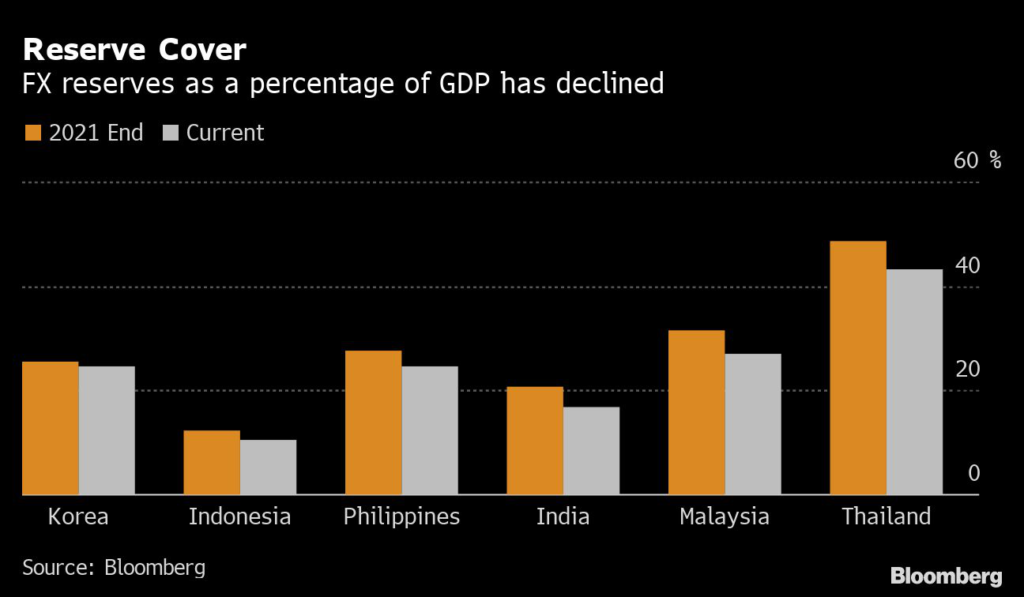
Thailand saw the biggest drop in reserves as a percentage of the gross domestic product, followed by Malaysia and India, according to data compiled by Bloomberg. Reserves cover about nine months of imports for India, six for Indonesia, around eight for Philippines and seven for South Korea, Standard Chartered said.

Central bankers across emerging Asia have relied on reserves to protect their currencies against a resurgent dollar as aggressive Federal Reserve policy tightening spurred flows back to the US. Any indication of a slowdown in market interventions may exacerbate losses for Asian currencies, many of which hit record or multi-year lows recently.

Central bank interventions may also see a change — from dollar sales to purchases — as their focus is likely to shift from containing imported inflation to boosting export competitiveness if Asia’s exports come under pressure, said Devesh. 

Using the drop in reserves as a proxy for FX intervention, India and Thailand have been among the most aggressive, with reserves declining by about $81 billion and $32 billion, respectively, this year. Reserves dropped by $27 billion in South Korea, $13 billion in Indonesia and $9 billion in Malaysia. 

Part of the decline was also due to dollar strength eroding the value of other currencies held in reserves.

“On current burn rates, Thailand remains worrying as does Philippines, India, Indonesia, and even Malaysia is becoming a bigger concern than it was earlier,” said Vishnu Varathan, head of economics and strategy at Mizuho Bank Ltd. in Singapore.

Still, emerging Asian markets remain in better shape than in previous crises having built up higher buffers. Investors have been turning to these markets in recent months, optimistic they can offer faster growth, policy support and potentially higher returns.

Read: Bond Markets Are Showing Turnaround Signs in Emerging Asia

The dollar surge has led to China’s yuan edging close to the key 7 level, while the risk-sensitive Korean won weakened to levels not seen since 2009. The Indian rupee and the Philippine peso hit record lows recently. Emerging Asian currencies traded mixed on Tuesday and the dollar extended declines as investors awaited US inflation for clues on interest-rate hikes.

Authorities in the region have ratcheted up their verbal interventions. Bank of Japan Governor Haruhiko Kuroda last week joined a number of officials expressing concern over sudden moves in the yen. Reserve Bank of India Governor Shaktikanta Das said the authority is in the currency market almost everyday, while the Bank of Korea said it will take active stabilization measures. 

“They are between a rock and a hard place,” said Varathan. “The conspiracy of bullish dollar, recession risks, and elevated inflation exacerbated by exogenous price shocks means that EM Asia central banks cannot assume that the worst risks are behind us.”

(Updates currency performance in 11th paragraph.)

More stories like this are available on bloomberg.com

©2022 Bloomberg L.P.

Indonesia Set to Pass New Data Privacy Law After Spate of Leaks

(Bloomberg) — Data operators could face up to five years in jail and a maximum fine of 5 billion rupiah ($337,000) for leaking or misusing private information, according to Indonesia’s new data privacy bill set to be passed by parliament this week. 

Institutions may collect personal information for a specific purpose but must erase the record once that purpose has been met, according to a copy of the draft law obtained by Bloomberg. Relevant parties have two years to comply with the rules once it becomes law.

Indonesia is under pressure to pass the law to improve its cyber security as breaches at companies and government institutions intensified in the past year. Just a few days ago, the country’s National Cyber and Encryption Agency said it’s investigating an alleged data leak of 105 million Indonesians. Earlier this month, authorities were investigating a data leak relating to mobile phone SIM cards that involved more than two million lines of data being released. 

The Personal Data Protection bill states that consent must be obtained from each individual for records such as name, gender, and medical history, with a clear agreement in place on how the data will be used, along with accountability measures. Each person has the right to withdraw their consent and receive compensation for any breaches. Anyone that fabricates personal data may face up to six years in jail and as much as 6 billion rupiah in fines.

Enacting the data privacy law is even more important as Indonesia’s digital economy is set to grow to $146 billion by 2025, according to the latest report by Alphabet Inc.’s Google, Singapore’s Temasek Holdings Pte. and global business consultants Bain & Co. Cloud data provider PT DCI Indonesia said in March a new project to set up a data center in Bintan will only proceed once the government issue a regulation on data safety and protection. 

“The new law is overdue and will, if administered correctly, be a much-needed boon for Indonesia’s large and growing tech sector,” said Joel Shen, who heads the technology practice in Asia for global law firm Withers. 

Sticking Points

Disagreements over the establishment of a new data protection oversight agency had held up the legislative process for months, said Almasyhari. Lawmakers argued that the agency must be independent, while the government wanted it to be managed under the ministry of communications and information technology. The two sides finally agreed to let the President design and control the agency, while parliament lays out its role.

The agency’s independence can only be safeguarded if the selection of its members is carried out in an open and accountable manner, said D. Nicky Fahrizal, a researcher at the Jakarta-based Centre for Strategic and International Studies. “Then, we must also examine the extent of the President’s power within the institution,” he told Bloomberg on Monday.  

The passing of the bill would make Indonesia the fifth Southeast Asian country to have a specific law on personal data protection after Singapore, Malaysia, Thailand and the Philippines.

More stories like this are available on bloomberg.com

©2022 Bloomberg L.P.

US and Mexico Express Optimism on Resolving Energy Dispute

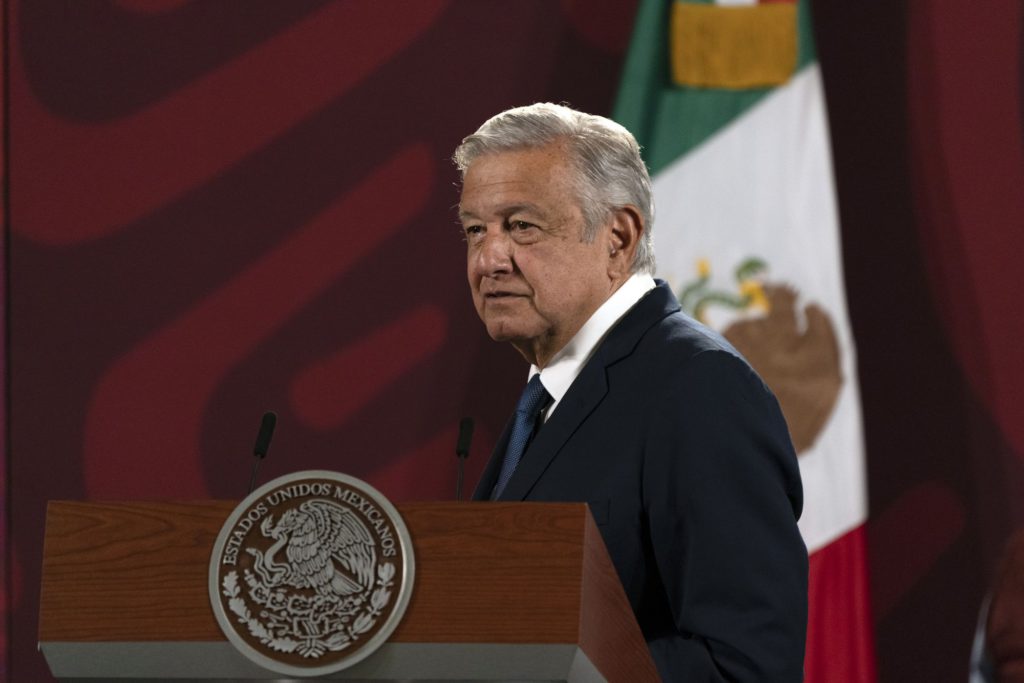
(Bloomberg) — Senior US and Mexican officials expressed optimism after a round of meetings in Mexico City that they can resolve a dispute over President Andres Manuel Lopez Obrador’s energy policies, though neither side gave a timetable for when that might happen.

Businesses are seeking predictability, fairness and transparency, Commerce Secretary Gina Raimondo told reporters at the close of Monday’s High-Level Economic Dialogue in Mexico City. She said Mexico would benefit from the Inflation Reduction Act and the Chips Act, both passed over the summer.

The two sides discussed how “to solve disputes through the dispute settlement mechanism” in the US-Mexico-Canada Agreement on trade, or USMCA, Mexican Economy Minister Tatiana Clouthier said. “That’s exactly what we’re doing right now. There’s interest on both sides to walk together to find solutions.”

Clouthier is leading Mexico’s team in talks with the US Trade Representative’s office about the energy issue. USTR in July requested the consultations over Lopez Obrador’s policy, which privileges state-owned oil producer Petroleos Mexicanos and the electricity provider known as CFE.

The trade representative’s office says this violates the USMCA, which went into force in 2020 to replace the two-decade-old Nafta pact. Canada filed a similar request for talks over Mexico’s electricity policy. Lopez Obrador denies that his policies violate the pact, saying that the US must respect Mexico’s sovereignty.

Secretary of State Antony Blinken, speaking at the opening of the economic conference after his meeting with the president earlier that afternoon, acknowledged that disagreements remain.

Pragmatic Way

“We have our differences, as any countries with relationships as deep and wide as ours are, but we will work through them in a pragmatic way,” he told Mexico’s Foreign Minister Marcelo Ebrard and Clouthier, adding that disputes would be handled with “mutual respect.”

Raimondo said the two sides didn’t talk extensively about the energy issue. Nonetheless, a US official said the Biden administration wanted to send the message that Mexico’s climate and energy policies were preventing the two nations from collaborating fully. The official asked not to be identified to discuss private deliberations.

While Monday’s dialogue wasn’t meant to be the forum for resolving the energy disagreement, it’s the overarching issue hanging over the economic relationship. If they can’t resolve their differences via consultations, it could go to a dispute panel that could allow the US to impose tariffs on billions of dollars of Mexican exports.

The US respects Mexico’s sovereignty and doesn’t see its request for consultations as challenging that, the US official said. Consultations are built into the USMCA to work through areas of disagreement, and Mexico has used that same process for its concerns with US policies, including on rules for the production of cars.

“It’s evident from conversations today that the US and Mexico see shared opportunity to build an energy future that advances climate goals,” Blinken told reporters. 

President Joe Biden’s administration sees Mexico as an opportunity for companies to move supply chains closer to the US to avoid a repeat of pandemic-era logistics snarls, according to the official. But the country risks missing out because many of Lopez Obrador’s energy policies — including for clean energy — prevent or dissuade investment, the person said.

On semiconductors, Mexico can benefit not just from the manufacturing facilities, but also from testing, packaging and assembly, and the CHIPS Act will create jobs and opportunities both for the US and its southern neighbor, Raimondo said.

More stories like this are available on bloomberg.com

©2022 Bloomberg L.P.

Senators Press Twitter Over ‘Mudge’ Whistle-Blower Claims

(Bloomberg) — The leaders of the Senate Judiciary Committee sent a detailed list of questions to Twitter Inc. on Monday night, hours before the committee will hear testimony from whistle-blower Peiter Zatko, who has accused the company of failing to adequately protect data on its users. 

In a letter addressed to Twitter Chief Executive Officer Parag Agrawal, the senators wrote that Zatko’s allegations, if true, “demonstrate an unacceptable disregard for data security that threatens national security and the privacy of Twitter’s users.” 

“The disclosure paints a disturbing picture of a company that has fallen short of basic security standards in the technology industry, failed to adequately mitigate attempts by foreign governments to gain access to sensitive user information, and willfully misled government regulators,” wrote Judiciary Committee Chair Dick Durbin of Illinois and the panel’s top Republican, Chuck Grassley of Iowa. 

Zatko, also known as “Mudge,” spent two years as Twitter’s head of security before he was fired earlier this year. In a series of complaints, he alleged that Twitter failed to patch up significant security flaws and flouted promises to the US Federal Trade Commission.

Twitter declined a request for comment on Monday night.

The committee invited Agrawal to testify at the hearing on Tuesday, which is scheduled to begin at 10 a.m. Washington time, but he didn’t accept, according to the letter. The senators asked Twitter to respond to its questions by Sept. 26.


The senators expressed concern about Twitter’s policies and procedures for protecting user data from “insider threats posed by foreign intelligence.” They pointed to the former Twitter employee who was convicted by a federal jury in August for acting as an unregistered foreign agent for Saudi Arabia. 

Twitter has denied Zatko’s claims and argued that he is a disgruntled former employee who was fired for poor management. 

More stories like this are available on bloomberg.com

©2022 Bloomberg L.P.

Senegal’s Parliament Elects New Speaker Over Bid to Block Vote

(Bloomberg) — Lawmakers in Senegal chose a new speaker of parliament in a chaotic vote after opposition members attempted to stop the vote from taking place.

Police had to intervene to restore order as Amadou Mame Diop, the candidate for President Macky Sall’s ruling coalition, was elected with 83 out of 84 votes. Eighty-one out of 165 lawmakers abstained from voting. 

Public broadcaster Radio Television Senegalaise showed images of shattered tables and plastic bottles on the floor of the National Assembly after the vote, which was delayed for several hours as opposition lawmakers called foul play.

The vote took place as parliament gathered for the first session since a legislative ballot in July that saw Sall’s Benno Bokk Yakaar deprived of the absolute majority it had held until then with one single seat.

Read more: Senegal’s Ruling Coalition Loses Its Parliamentary Majority

The July 31 poll was largely seen as a test for Sall 18 months ahead of presidential elections set for 2024. Sall, who was elected in 2012 for seven years and re-elected in 2019 for five years, has been vague about his future plans. He has promised to appoint a prime minister from the winning party in the July polls, a position he abolished in 2019 and reinstated in December 2021.

Diop, deputy mayor of Richard Toll, a town in northern Senegal, and managing director of the Societe Amenagement de la Petite Cote, charged with developing and promoting tourism along Senegal’s coast, succeeds Moustapha Niasse as speaker.

More stories like this are available on bloomberg.com

©2022 Bloomberg L.P.

Nikola Founder Milton Faces New York Jury in His Toughest Sales Job

(Bloomberg) — Trevor Milton sold investors on the idea his company was building the truck of the future. Now, he’ll have to persuade a jury his alleged lies weren’t material.

Two years after he abruptly resigned from the board of Nikola Corp. — the company he started — Milton is set to go on trial in New York on securities fraud and wire fraud charges, facing a maximum prison term of 25 years if convicted of the most serious charge.

Milton, 40, who founded Nikola in 2014, built the startup into a company that in June of 2020 was valued at $34 billion, more than Ford Motor Co. at one point. The meteoric rise — despite having no revenue at the time — was buoyed by investors in the height of the SPAC craze seeking the next Tesla Inc.

“The Milton trial involves the application of a traditional securities and wire fraud theory — alleging that the defendant made misrepresentations to the investing public to induce investments — to a novel factual backdrop: a de-SPAC transaction,” said Edward Imperatore, a lawyer at Morrison Foerster and a former federal securities fraud prosecutor in New York.

Along with meme stocks and cryptocurrencies, SPACs were a hallmark of the stimulus-fueled pandemic market that has sputtered out in 2022 as the Federal Reserve rapidly tightens monetary policy to cool off soaring inflation. Increasing scrutiny from US regulators has also deflated the blank-check mania. 

US prosecutors plan to argue that the Utah man induced retail investors to buy Nikola shares by making false statements about the company’s products and capabilities. Milton’s lawyers will likely make one focus of his defense the advice he relied on from the company’s lawyers and executives, saying that’s what determined what he told shareholders and he had no intent to defraud anyone. 

“They shared responsibility with Mr. Milton for the accuracy of the investor communications,” Kenneth Caruso, a lawyer for Milton, said at a pretrial conference last week.

US District Judge Edgardo Ramos last week denied Milton’s request to use in the trial advice that Nikola General Counsel Britton Worthen gave other employees, which was intended to bolster his defense. But he will be able to use communications between himself and Worthen to rebut prosecutors’ claims that he made public statements he knew were false.

Milton’s attorneys have pointed to evidence to support that argument, including a series of emails between Nikola executives and the founder about a podcast in which he allegedly misled investors  — which they say show his statements were approved by the company’s legal team.

The Phoenix-based Nikola kickstarted the SPAC trend among electric-vehicle makers in June 2020, three months before Milton stepped down as chairman, by combining with the blank-check acquisition vehicle VectoIQ.

Milton’s resignation followed a report from short seller Hindenburg Research that claimed Nikola deceived investors by making non-working products appear fully functional and staging misleading videos. Nikola shares plummeted on the report, which also spurred probes by the US Department of Justice and the Securities and Exchange Commission. Nikola shares closed at $5.42 Friday, valuing the company at $2.3 billion.

Milton called the report a “hit job,” and Nikola pushed back on Hindenburg’s allegations that it had overstated the capabilities of some of its earliest test trucks, saying the report underestimated its ability to produce hydrogen for its fuel-cell-powered trucks. Milton resigned saying the “focus should be on the company.” 

Read more: Nikola Founder Exaggerated the Capability of His Debut Truck

Even if prosecutors can convince jurors that Milton lied to shareholders, to show he committed securities fraud they will also have to prove that the misrepresentations were material to a reasonable investor, or central to their decision to invest.

“It is insufficient for the prosecution to show that the statements Milton made were false,” Imperatore said. “Instead, the prosecution bears the burden to prove also that Milton’s conduct was willful, in other words, that Milton had an awareness of the general wrongfulness of his conduct. The prosecution must also prove that Milton’s statements were important to a reasonable investor in making investment decisions.”

Nikola sees itself as a leader in clean-energy heavy vehicles in a high-potential field for zero emissions trucks that includes other aspirants such as Tesla Inc. and legacy players like Volvo AB. The company built 50 battery-electric semis in the second quarter, delivering 48 to dealers and missing its own forecast.

The trial before Ramos began Monday with lawyers spending almost the full day picking a jury. Opening arguments are scheduled for Tuesday. The trial is expected to last four to five weeks and is to feature testimony from experts from both sides as well as Nikola employees, including engineers who worked on prototypes, and company shareholders. At least two jurors were excused from the pool on Monday after they said they owned Nikola stock.

Milton’s relationship with the company he founded has been strained since he stepped down. They have fought over whether documents are privileged and Milton — Nikola’s largest shareholder, with more than 12% of the stock — opposed a company measure this year to issue new shares. The measure was approved by shareholders.

Nikola started making payments on a $125 million civil settlement with the Securities and Exchange Commission in February. The company has said it will seek reimbursement from Milton for those costs, even though it continues to cover his legal fees.

The case is US v Milton, 21-cr-478, US District Court, Southern District of New York (Manhattan.)

(Updates with jury selected)

More stories like this are available on bloomberg.com

©2022 Bloomberg L.P.

Peloton Founders Leaving Fitness Company in Latest Shake-Up

(Bloomberg) — Peloton Interactive Inc. Executive Chairman and co-founder John Foley is stepping down from the fitness company as part of a leadership shake-up, extending the turbulence at a business trying to pull out of a deep slump. 

Foley, who helped start Peloton in 2012 and served as chief executive officer for 10 years, is resigning effective Monday, the company said in a statement. Foley took the executive chairman role in February when he handed the reins to CEO Barry McCarthy, a veteran of Spotify Technology SA and Netflix Inc.

Chief Legal Officer Hisao Kushi, another co-founder, is also headed for the exits. He’ll be replaced in that role by Tammy Albarran, who Peloton recruited from Uber Technologies Inc. The chairman role, meanwhile, will be filled by Karen Boone, a former Restoration Hardware executive who currently serves as lead independent director.

Peloton investors initially applauded the changes, sending the shares up as much as 5.3% to $11.64 in extended trading on Monday. But the rally soon evaporated, with the stock declining more than 2%.

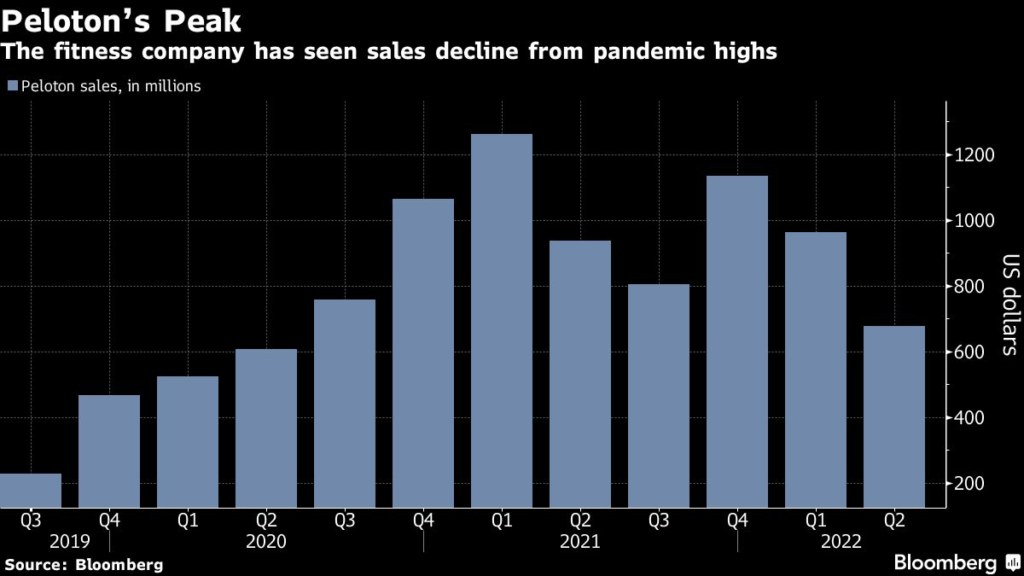
The reshuffling extends a year of upheaval at New York-based Peloton, which thrived in the early days of the pandemic but is now suffering from declining sales and mounting losses. Its shares are down about 90% over the past year, and the company has struggled to work through a glut of inventory.

As part of a turnaround plan, McCarthy has cut thousands of jobs and offloaded operations to third-party providers. But Peloton’s quarterly report in August signaled that his comeback effort has a long way to go.

McCarthy’s goal is to make Peloton cash-flow positive in the second half of the coming fiscal year. “We continue to make steady progress, but we still have work to do,” he said last month, while acknowledging that the company’s financial performance may cause some to doubt the “viability of the business.”

With Peloton’s longtime CEO now out of the picture, McCarthy may have a freer hand to make changes. The executive has said the company should prioritize its digital offering over hardware and is exploring allowing subscribers to beam content from their smartphones to non-Peloton fitness equipment.

Separately, Chief Commercial Officer Kevin Cornils is also leaving Peloton and won’t be replaced. Some of Cornils’s responsibilities will be assumed by Dion Sanders as he takes the role of chief emerging business officer, according to an internal memo from McCarthy reviewed by Bloomberg. Chief Content Officer Jen Cotter will assume control of apparel and accessories, showing that the company remains committed to that market.

Albarran will take over Peloton’s legal operations on Oct. 3. She helped oversee a corporate makeover at Uber, which set out to change its image in 2017 after its hard-charging style led to scandals and a strained relationship with drivers.

Peloton looks to draw on the experience of Albarran and Boone to “help move the company forward into our next chapter of growth,” McCarthy said.

Foley said he plans to build a business “in a new space” after leaving the company. The executive helped turn Peloton into an iconic fitness brand with a loyal following, but was criticized for not forecasting a sharp downturn in demand for its exercise bikes.

Some Peloton investors also had hoped that Foley — and then McCarthy — would consider selling the company. But no suitor emerged, and McCarthy has said that he didn’t take the CEO job to oversee a sale.

(Updates shares in fifth paragraph.)

More stories like this are available on bloomberg.com

©2022 Bloomberg L.P.
Close Bitnami banner
Bitnami