Bloomberg

GM’s Cruise Will Expand Robotaxi Service to Phoenix and Austin

(Bloomberg) — Cruise LLC, the self-driving car startup majority owned by General Motors Co., plans to expand its robotaxi business to Phoenix and Austin in the next three months with a target of adding $1 billion in revenue by 2025.

The autonomous-vehicle firm began charging fares in its ride-hailing business in June with a pilot in San Francisco. Kyle Vogt, Cruise’s chief executive officer, said the technology is performing well enough to justify the expansion.

“For the first time in eight years the technology for AV is no longer the bottleneck,” Vogt said Monday at a Goldman Sachs conference. “We’re in a position to grow and to do it very quickly.”

Cruise has a goal of growing its business to $50 billion in revenue by the end of the decade, making it a key piece of GM’s strategy to double its total sales to $280 billion by 2030. Cruise reported $51 million in sales in the first half of this year and an $868 million operating loss.

The surprise push comes after GM had to fix its software after an accident in San Francisco in June and also had about a dozen of its cars stop at an intersection in the city, hemming other vehicles in for almost two hours.

More stories like this are available on bloomberg.com

©2022 Bloomberg L.P.

Banks Kick Off $4 Billion Citrix Bond Sale as Loan Draws Demand

(Bloomberg) — Wall Street banks have kicked off the second part of a $15 billion debt package for the buyout of Citrix Systems Inc., as they look to offload risky loans they’ve been stuck with for months.

A group of lenders led by Credit Suisse Group AG will hold an investor call for a $4 billion secured bond offering at 10:30 a.m. New York time on Tuesday, according to a person with knowledge of the matter. It follows the launch of a similarly sized leveraged loan offering last week that has already received enough demand to be sold.

The financing is widely seen as a bellwether for high-yield markets that have been under pressure for months due to recessions fears, and could help set the tone for the rest of the year as other large debt deals wait in the wings. 

Read more: Citrix Buyout Deal Breaks the Ice for Troubled Junk Debt Markets

The secured bond deal was expected to be $3.5 billion in size, but has been increased on expectations that there is enough demand, according to different people with knowledge of the details, who asked not to be identified because discussions are private. 

The banks had said they may hold $3 billion of the original $7.05 billion loan commitment prior to the bond increase, according to an offering memorandum sent to investors last week, which will be lowered to $2.5 billion if the larger bond is sold.

Representatives for Credit Suisse, Bank of America Corp., which is leading the loan sale, and Goldman Sachs Group Inc., which is leading the unsecured portion of the financing, declined to comment. 

Struggle

Banks have been struggling to sell the Citrix debt commitments that they had agreed to provide in January to help finance the buyout of the software company by Vista Equity Partners and Elliott Investment Management. 

Representatives for Vista, Elliott and Citrix didn’t immediately respond to requests for comment.

Since then, the cost of borrowing has spiked well above the maximum that the lenders had agreed to, forcing them to offer steep discounts to lure buyers, and leaving them on the hook for hundreds of millions of dollars in potential losses. 

Lenders are waiting to see how Citrix goes before launching two other large transactions for the buyout of TV ratings company Nielsen Holdings and for auto parts firm Tenneco Inc. 

Early pricing discussions floated during pre-marketing for the Citrix bonds, which mature in 6.5 years and may price on Sept. 19, were for a yield in the high 8% range, Bloomberg previously reported. Commitments on the loan, offered at a steep discounted price of 92 cents on the dollar, are due the same day.

The $3.95 billion of unsecured bond debt commitments have been turned into a second-lien loan. The debt financing also includes a $1 billion revolving credit facility, according to a January filing. 

(Updates with details throughout.)

More stories like this are available on bloomberg.com

©2022 Bloomberg L.P.

Apple Rallies Most Since May on Strong iPhone Pre-Order Data

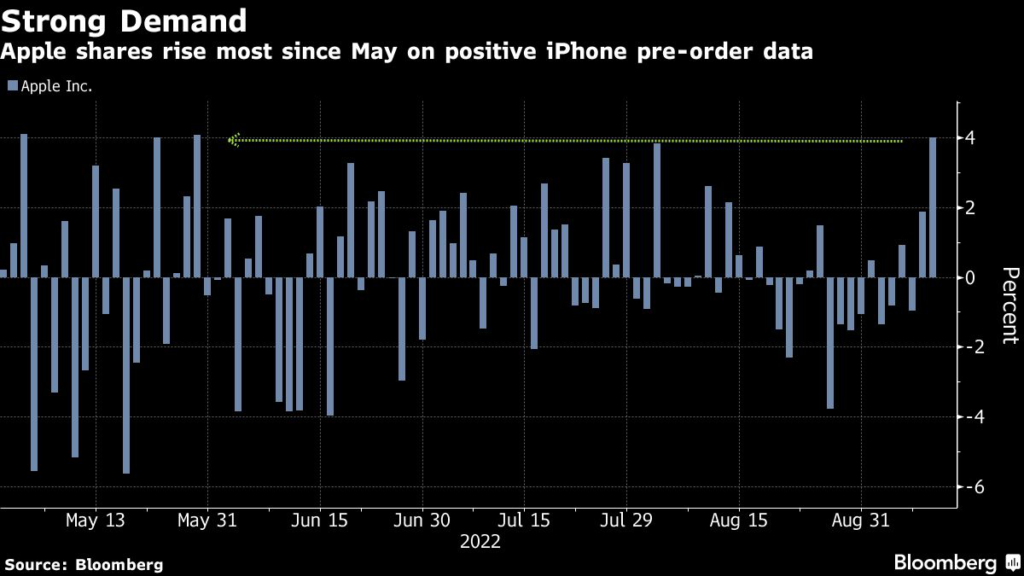
(Bloomberg) — Apple Inc. shares rallied the most since May as pre-order data showed the iPhone 14 Pro Max was the best selling model, surpassing what the older version did in a similar timeframe.

Shares of the tech giant rose 3.9%, their biggest one-day gain since May 27, and the stock closed above its 200-day moving average for the first time since August. Analysts from JPMorgan to Barclays wrote that the data point to strong demand for the latest mobile phone series, which was unveiled at its product launch event last week.

“Pre-order data shows that the iPhone 14 Pro Max is the best-selling model, and that it is doing better than the iPhone 13 Pro Max did at this point,” KGI Securities analyst Christine Wang wrote in a report. The pricing of the iPhone 14 series is positive for its future sales, she added. 

Apple’s Latest Devices Tighten Its Grip on Users: Power On

At its biggest product launch of the year, Apple introduced the iPhone 14, fresh AirPods Pro earbuds and new Apple Watch models. The iPhone retains the general look of the older version while getting camera enhancements and a long-anticipated satellite-messaging feature. The bulk of the iPhone upgrades are coming to the higher-end Pro line. Those devices will get a 48-megapixel camera and a screen that’s capable of always staying on in a low-power mode, similar to recent versions of the Apple Watch.

Read more: Apple Offers Few Surprises With IPhone 14, But No Price Hike

Apple is the top performing megacap technology stock this year, because investors have faith in its ability to tap into its more than 1 billion customers to earn more on its services including apps, video, fitness and gaming subscriptions. The next catalyst for the stock will be earnings for the September quarter, which is expected in late October.

Its shares are about 8% lower this year compared with the Nasdaq 100 Index, which has slumped about 22%. About 96% of the 50 analysts covering the stock recommend either buying Apple shares or holding on to their positions, while only two suggest selling, according to data compiled by Bloomberg.

(Updates to market close)

More stories like this are available on bloomberg.com

©2022 Bloomberg L.P.

Novogratz Says Fidelity to Shift Retail to Crypto Soon

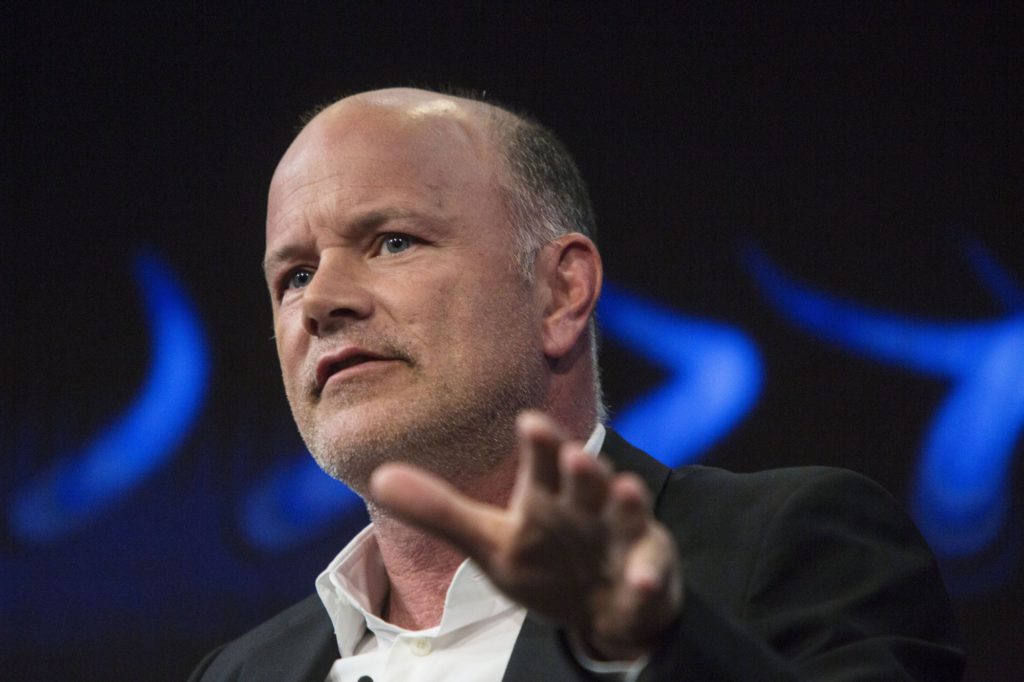
(Bloomberg) — Mike Novogratz, the founder and chief executive of Galaxy Digital Holdings Ltd., said he’s heard that Fidelity Investments will “shift retail customers into crypto soon.”

Fidelity has been one of the most visible institutional proponents of digital assets, saying earlier this year that it would have a product ready in coming months to allow 401(k) plan participants to direct a portion of their savings into Bitcoin. In June, people familiar with the situation said market makers Citadel Securities and Virtu Financial Inc. were building a crypto trading platform along with Fidelity and fellow retail brokerage Charles Schwab Corp. 

“A bird told me Fidelity is going to shift their retail customers into crypto soon enough,” Novogratz said during the SALT conference in New York on Monday. “I hope that bird is right. So we are still this institutional march and that gives crypto its floor.”

Cryptocurrency prices tumbled soon after Fidelity announced its plans for a 401(k) in the wake of the springtime collapse of the Terra stablecoin ecosystem. Bitcoin has slumped about 50% this year, while many so-called altcoins have dropped even more.   

“While we have nothing new to announce, expanding our offerings to enable broader access to digital assets remains an area of focus,” Fidelity said in a statement Monday. 

Novogratz was one of the highest-profile backers of the Luna token that was affiliated with Terra.  

(Adds comment from Fidelity in the fifth paragraph.)

More stories like this are available on bloomberg.com

©2022 Bloomberg L.P.

Crypto Traders Hedge Against Ether Disappointment Ahead of Merge

(Bloomberg) — More crypto traders are shorting Ether in the derivatives market, as the underlying blockchain is scheduled to go through its biggest technical upgrade this week, trading data shows.

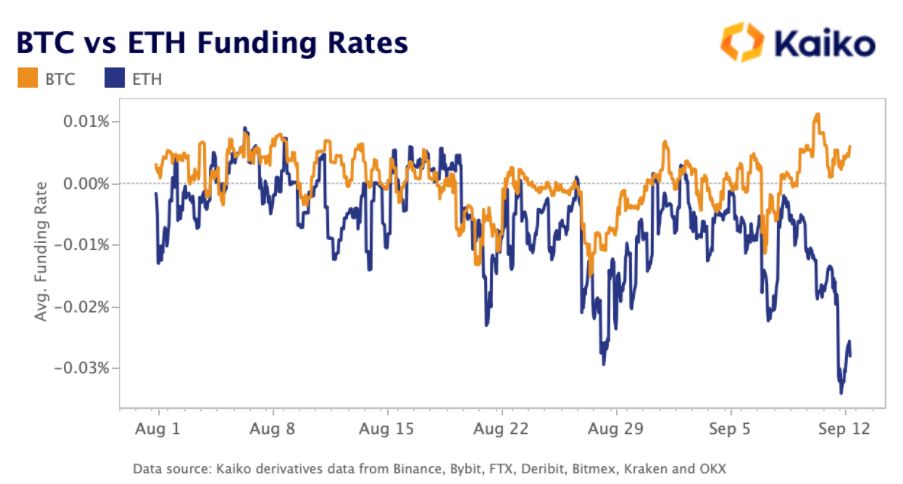
The funding rates of Bitcoin and Ether perpetual futures contracts diverged sharply over the past weekend, according to crypto data firm Kaiko. The funding rate for Ether dipped to its most negative since July 2021. Exchanges use the funding rate — or the cost to trade — to tether the contracts to their underlying spot price. When the rate is positive, those who hold long positions are paying interest to investors who are short, and vice visa. 

Crypto traders tend to favor perpetual contracts — which, unlike traditional calendar futures, don’t expire — in part, because it allows them to keep highly leveraged positions in place. Ether fell for the first time in six trading sessions on Monday, dropping as much as 3.7% to $1,694.

The growing short interest in Ether is happening as the Merge, the highly anticipated upgrade on the Ethereum blockchain, is expected to take place this week. The upgrade is set to move Ethereum’s current system of using miners to a more energy-efficient one using staked coins.

“With the Merge happening this week, it could be that folks are hedging as the price of ETH has mostly increased while funding rates have gone negative,” said Andrew Tu, head of growth for crypto algorithmic-trading firm Efficient Frontier. 

A lot of investors are hedging their long spot positions of Ether, according to Zaheer Ebtikar, portfolio manager at crypto hedge fund LedgerPrime. Shorting Ether on the derivatives market is one way to hedge their risk.

Another reason to be long Ether on the spot market, said Ebtikar, is that traders can receive “free money” from efforts by some Ethereum miners to keep a different version of Ethereum running by miners still.

Meanwhile, some traders also expect the Merge will become a “sell-the-news” event for the market. Ether surge fivefold last year and reached a record high of about $4,866 in November. It has dropped about 50% this year.

“Investors in the perpetual futures market broadly agree that most of Ether’s positive fundamental catalysts have already been priced, with little further upside expected following the Merge,” Gabriel Selby, lead research analyst at crypto exchange Kraken-owned CF Benchmarks, said.

An extreme negative funding rate means that short traders are paying expensive fees to keep their positions open.

“The mentality of a trader is also very different than a long-term investor — in this case they just think for that two-to-three days it’s fine to pay if they think that ETH will go down considerably,” Ebtikar explained. “If the bet is that this is ‘sell the news’ and that spot ETH will sell off, then it’s worth it.”

More stories like this are available on bloomberg.com

©2022 Bloomberg L.P.

Woodford Liability Threatens Dye & Durham’s Australia Deal

(Bloomberg) — The collapse of Neil Woodford’s fund in 2019 has thrown a wrench into a Canadian firm’s proposed acquisition of Australia’s Link Administration Holdings Ltd.

Toronto-based Dye & Durham Ltd. said UK regulators won’t approve the deal unless it agrees to cover restitution or other liabilities stemming from Link’s role in the Woodford blowup, to a maximum of £306 million ($358 million).

Dye & Durham is assessing the impact of that demand made by the UK’s Financial Conduct Authority, according to a statement Monday. If it can’t accept those terms, then the companies might not be able to close the $1.7 billion deal, which had already been repriced lower after the sharp selloff in technology stocks. 

Dye & Durham “must now decide whether to proceed with the transaction at a higher effective purchase price, renegotiate with Link and revise the terms of its offer to account for the incremental liability, or walk away from the deal,” BMO Capital Markets analyst Thanos Moschopoulos said in a note. 

Dye & Durham was down 2% to C$14.39 at 1:56 p.m. in Toronto. The shares have fallen 68% this year. 

Link was the fund administrator on the LF Woodford Equity Income Fund, which was liquidated nearly three years ago as Woodford, one of the UK’s most celebrated stock pickers, was ousted as its manager. The FCA began an investigation into Link in 2019 as the fund was beginning to unravel, according to Dye & Durham’s statement.  

Read more: Dye & Durham Agrees to $1.7 Billion Deal For Australia’s Link

(Updates with analyst comment, share price)

More stories like this are available on bloomberg.com

©2022 Bloomberg L.P.

Intel Aims for Lower, $30 Billion Valuation for Mobileye IPO

(Bloomberg) — Intel Corp. is scaling back expectations for its Mobileye initial public offering in the face of a broader stock slump and could delay the share sale until next year if conditions don’t improve, people familiar with the process said.

The company expects the IPO to value the self-driving technology business at as much as $30 billion — less than originally hoped — according to the people, who asked not to be identified because the deliberations are private. The original plan was to offer the stock around the middle of 2022, and Reuters and others reported potential valuations of more than $50 billion.

Intel Chief Executive Officer Pat Gelsinger is trying to capitalize on the Israel-based business, acquired in 2017, with a partial spinoff of its shares. Mobileye makes chips for cameras and drive-assistance features, and is seen as a prized asset as the car industry races toward fully automated vehicles. But Intel is running up against a bear market for chip stocks and a dearth of IPOs, making it harder to complete the deal.

If semiconductor stocks rebound, the offering could still be possible in 2022, according to the people. Otherwise, it will be pushed back.

Intel shares fell as much as 1.1% to $31.10 on Monday, reaching session lows, after Bloomberg reported the news. The stock recouped most of the losses by 1:45 p.m. in New York.

Representatives for Mobileye and Santa Clara, California-based Intel declined to comment. 

A successful Mobileye IPO could clear a growing logjam of chip-related assets waiting to come to market. SoftBank Group Corp. also is trying to sell shares of semiconductor designer Arm Ltd. by early next year. Ampere Computing LLC, a startup making processors for data centers, is planning an IPO as well. 

For Intel’s Gelsinger, a successful IPO would help show his turnaround plan is bearing fruit. The company has suffered from sliding sales and earnings, along with the loss of market share to rivals such as Advanced Micro Devices Inc. The CEO has outlined an ambitious spending plan to rebuild Intel’s manufacturing prowess, get into new businesses and restore its technological leadership. 

Intel will remain the majority owner after the transaction, which involves an offering of newly issued Mobileye stock, the company said in December.

The majority of the proceeds will be retained by Intel, Gelsinger has said, but Mobileye will be given a balance sheet that allows it to fuel its expansion plans, he said.

Mobileye has been a particularly bright spot. The business, acquired for about $15 billion, has consistently grown faster than its parent, which is on course to report a revenue decline of as much as 16% this year. In the second quarter, Mobileye posted sales of $460 million, a gain of 41% from a year earlier. That helped operating income rise 43% to $190 million. 

Intel’s shares have lost 39% of their value this year, worse than chip stocks overall. The Philadelphia Stock Market Semiconductor Index is down 31% in 2022. 

(Updates Intel shares in fifth paragraph.)

More stories like this are available on bloomberg.com

©2022 Bloomberg L.P.

Intel Lowers Target for Mobileye, Aiming for $30 Billion IPO

(Bloomberg) — Intel Corp. is scaling back expectations for its Mobileye initial public offering in the face of a broader stock slump and could delay the share sale until next year if conditions don’t improve, people familiar with the process said.

The company expects the IPO to value the self-driving technology business at as much as $30 billion — less than originally hoped — according to the people, who asked not to be identified because the deliberations are private. The original plan was to offer the stock around the middle of 2022, and Reuters and others reported potential valuations of more than $50 billion.

Intel Chief Executive Officer Pat Gelsinger is trying to capitalize on the Israel-based business, acquired in 2017, with a partial spinoff of its shares. Mobileye makes chips for cameras and drive-assistance features, and is seen as a prized asset as the car industry races toward fully automated vehicles. But Intel is running up against a bear market for chip stocks and a dearth of IPOs, making it harder to complete the deal.

If semiconductor stocks rebound, the offering could still be possible in 2022, according to the people. Otherwise, it will be pushed back.

Intel shares fell as much as 1.1% to $31.10 on Monday, reaching session lows, after Bloomberg reported the news. The stock recouped most of the losses by 1:45 p.m. in New York.

Representatives for Mobileye and Santa Clara, California-based Intel declined to comment. 

A successful Mobileye IPO could clear a growing logjam of chip-related assets waiting to come to market. SoftBank Group Corp. also is trying to sell shares of semiconductor designer Arm Ltd. by early next year. Ampere Computing LLC, a startup making processors for data centers, is planning an IPO as well. 

For Intel’s Gelsinger, a successful IPO would help show his turnaround plan is bearing fruit. The company has suffered from sliding sales and earnings, along with the loss of market share to rivals such as Advanced Micro Devices Inc. The CEO has outlined an ambitious spending plan to rebuild Intel’s manufacturing prowess, get into new businesses and restore its technological leadership. 

Intel will remain the majority owner after the transaction, which involves an offering of newly issued Mobileye stock, the company said in December.

The majority of the proceeds will be retained by Intel, Gelsinger has said, but Mobileye will be given a balance sheet that allows it to fuel its expansion plans, he said.

Mobileye has been a particularly bright spot. The business, acquired for about $15 billion, has consistently grown faster than its parent, which is on course to report a revenue decline of as much as 16% this year. In the second quarter, Mobileye posted sales of $460 million, a gain of 41% from a year earlier. That helped operating income rise 43% to $190 million. 

Intel’s shares have lost 39% of their value this year, worse than chip stocks overall. The Philadelphia Stock Market Semiconductor Index is down 31% in 2022. 

(Updates Intel shares in fifth paragraph.)

More stories like this are available on bloomberg.com

©2022 Bloomberg L.P.

Synchrony Would Be ‘Natural Partner’ in PayPal’s Loan Sale, CFO Says

(Bloomberg) — Synchrony Financial Chief Financial Officer Brian Wenzel said the store-card company would be a “natural partner” for PayPal Holdings Inc. as the payments giant looks to offload $6.2 billion in loan receivables. 

PayPal said last month it was weighing a sale of the portfolio as a way to free up cash and use that capital to pursue more profitable businesses. The move would follow the 2018 sale of about $6.8 billion in loans and receivables to Synchrony Financial at face value. 

“We stand ready to partner with them,” Wenzel said Monday at an industry conference. “We would be a natural partner for them if they try to do some of that.” 

A deal would be the latest tie-up between the two payments companies, which last year debuted a PayPal savings account that now offers an annual percentage yield of 2.05%. Synchrony is also the issuer behind PayPal’s popular Venmo credit card, and in 2017 it was named the exclusive issuer of PayPal’s online consumer-financing program for 10 years. 

Synchrony is the country’s largest store-card provider, counting Amazon.com Inc., JC Penney Corp. and Lowe’s Cos. as some of its biggest partners. The company continues to see cardholders keeping up with their bills even amid historic levels of inflation in recent months, Wenzel said.

“We do not see the consumer stressing at this point in time,” Wenzel said. “If we start to see some of those early indicators, we can take action. But we feel good.” 

More stories like this are available on bloomberg.com

©2022 Bloomberg L.P.

Jeff Bezos’s Blue Origin Rocket Suffers Failure Seconds Into Uncrewed Launch

(Bloomberg) — Blue Origin LLC aborted a launch of its suborbital New Shepard rocket shortly after takeoff in West Texas, the first major failure for Jeff Bezos’ company since transitioning to routine commercial flights.

No people were on board for Monday’s flight, which was carrying a host of payloads, though a similar version of the same vehicle is used to regularly take paying customers to the edge of space and back. The US Federal Aviation Administration said it would probe the incident.

#NewShepard is on the pad going through nominal checkouts in advance of today’s flight to space. The #NS23 launch window opens at 8:30 AM CDT / 13:30 UTC. The live webcast starts T-20 minutes to launch on https://t.co/7Y4TherpLr. pic.twitter.com/mfcctmUvT3

— Blue Origin (@blueorigin) September 12, 2022


Details of the failure haven’t been disclosed. Just over a minute after takeoff, the New Shepard rocket appeared to suffer an engine problem and veer off course, prompting the emergency abort system to kick in.

“This wasn’t planned, and we don’t have any details yet,” Erika Wagner, senior director of emerging space markets, said during Blue Origin’s livestream of the launch. “But our crew capsule was able to escape successfully.”

Once the failure occurred, the capsule on top of the rocket, used to carry payloads, ignited its thrusters and quickly separated from the rocket. The capsule landed safely under parachutes. A similar abort technique would be used to save passengers in case people were flying on board the rocket during a failing launch.

“You can see how our backup safety systems kicked in today to keep our payload safe during an off-nominal situation,” Wagner said. “Safety is our highest value at Blue Origin.” Blue Origin ended the launch livestream after the capsule touched down in the desert.

A Blue Origin representative said to stay tuned to twitter for updates.

This was the ninth planned flight of this particular New Shepard booster. The New Shepard is a fully reusable vehicle, and the booster is designed to land upright following a successful launch to space.

The New Shepard rocket has had a nearly perfect flight record up until now, save for one partial failure early in its testing campaign.

All-Payload Flight

This was the first all-payload New Shepard flight for Blue Origin since August of 2021. Blue Origin has started routinely flying passengers on New Shepard since July of 2021, when the company launched Bezos, its founder, to space.

Read this next: The Future of Space Is Bigger Than Jeff Bezos, Richard Branson, or Elon Musk

In September of 2021, a group of current and former Blue Origin employees penned a collective essay accusing the company of a toxic work environment, as well as alleging safety issues. In December, the FAA cleared Blue Origin after conducting a review of the company’s safety culture.

The FAA, which licenses commercial launches, said in a statement Monday that it would oversee the investigation of the New Shepard “mishap.” The FAA reviews incidents on space flights, but Congress has prevented it from enacting safety regulations beyond protecting uninvolved bystanders.

“No injuries or public property damage have been reported,” the FAA said, noting the booster landed within a designated “hazard” area. “Before the New Shepard vehicle can return to flight, the FAA will determine whether any system, process or procedure related to the mishap affected public safety.”

(Updates with FAA investigation details in second and final paragraphs)

More stories like this are available on bloomberg.com

©2022 Bloomberg L.P.

Close Bitnami banner
Bitnami