

Bloomberg

The Race for US Lithium Hinges on a Fight Over a Nevada Mine

(Bloomberg) — The high-desert mountain pass overlooking alfalfa fields and RV parks doesn’t look like a battleground that will shape the country’s clean energy future.

But when the rock samples here are pulverized, pulled apart and mixed with chemicals, they yield a metal increasingly seen as white gold: lithium, a critical ingredient for batteries used in electric vehicles, solar energy storage, and consumer electronics. 

In early 2021, the Trump administration approved plans for a $1 billion open-pit mine here at Nevada’s Thacker Pass, in a swath of government-owned land that covers 9 square miles above the country’s largest lithium deposit. The Biden administration has since defended that decision.

Supporters say the mine built by Lithium Americas, a Canadian multinational, could produce enough lithium each year to match 2020’s total global output. They also argue that expediting US battery manufacturing will help the country shift away from fossil fuels while shrinking supply chains disrupted by the pandemic and Russia’s invasion of Ukraine.

But the project has run into fierce local opposition.

A judge is weighing a bid to block the mine brought by an unlikely coalition: a rancher who contends the operation will consume precious groundwater that sustains his herd; environmental groups that support electric vehicles but see the vast mining operation as too destructive; and tribal members determined to preserve the legacy, lifestyle and land of their ancestors.

The outcome will ripple beyond this corner of Nevada. As the US Department of Energy implements a $7 billion battery supply-chain program and Congress’s climate bill rolls out tax credits for electric car makers, some see the state as ground zero for the fledgling industry. It already hosts the nation’s only other lithium mine, with plans for more.

“We can become the Lithium Valley here, based on everything else we have,” said Dev Chidambaram, an engineering professor at the University of Nevada, Reno, who started one of the country’s first battery and energy storage academic programs. “It’s better we do this, rather than somebody else.”

Extracting the Great Basin’s treasures

Some 16 million years ago, a supervolcano left a 30-mile-long crater that was then uplifted into a mountain range, forming a striking landscape on the Nevada-Oregon border that defines the Great Basin: long strands of majestic peaks with arid valleys below.

The land is loaded with treasures — gold, silver, mercury, uranium — that for centuries drew prospectors looking to strike it rich. It also provides a crucial habitat for sage grouse, raptors, golden eagles, elk and bighorn sheep, and features a sea of sagebrush and grasses that sustain grazing cattle herds.

The country’s drive for natural resources and political control rolled over the area’s original inhabitants. In 1865, shortly after Nevada became a state, the US Cavalry murdered dozens of Paiutes. Native tribes contend the massacre occurred at Thacker Pass, which they call Peehee mu’huh, or “rotten moon” in the Paiute language. Federal officials say the slaughter was actually 15 miles away.

The decades that followed brought mining booms and busts, but lithium extraction remained elusive. As the lightest metal, the energy-dense ore grew in demand as lithium-ion batteries began dominating consumer electronics in the 1990s.

Still, only one US lithium mine operates today: Albemarle’s Silver Peak in southwestern Nevada.

In recent years, Lithium Americas’ predecessor company developed a plan to also extract it around Thacker Pass. That coincided with Washington’s push to wean off imports from adversarial countries — extracting and processing lithium has been cheaper in South America and China — and rising demand from EV makers.

Global lithium prices soared more than 400% in 2021, and the surge looks likely to continue. Last month, California said it would ban the sale of gas-powered vehicles by 2035, and Honda announced plans for its first US lithium battery plant.

For mining companies, the race is on to win approvals and keep pace.

“Our project has to go now — we don’t have a lot of time,” said James Calaway, chairman of ioneer, an Australian firm developing a mine in southwestern Nevada.

‘Are we going to leave them with a desolate land?’

Thacker Pass sits amid a largely rural area with an economy focused on agriculture, mining and roadside businesses that cater to travelers along Route 95, a growing artery between Boise and California.

Winnemucca, the nearest city of about 8,000 people, is about an hour south, named for a 19th-century Northern Paiute chief. The reservation for the Fort McDermitt Paiute and Shoshone Tribe, with 500 people squeezed onto land near the Oregon border, sits about 50 miles north.

The tribe’s business, the Red Mountain Travel Plaza, was destroyed in a 2020 wildfire, and its gas pumps sit empty along the highway. The nearby McDermitt school and tribal government are now the biggest employers, with federal grants and contracts providing the most revenue.

The pandemic had shut down tribal council offices and limited interaction, so Fort McDermitt tribe Chairwoman Maxine Redstar didn’t learn the Trump administration had approved the mine until a few weeks after the decision in early 2021, she said. It felt like a slap in the face.

“I reached out to [Bureau of Land Management] and said, ‘Okay, hang on. Let’s back up,’” Redstar recalled during an interview in July at the Say When Casino, a faded pink gambling hall just off the reservation known for its cheeseburgers.

Her goal was to protect the land and water. The reservation’s drinking water is still contaminated by a mercury mine that closed in the 1970s; many blame that for high cancer rates among tribal members.

But she also thought about the project’s potential to lift the next generation.

“Are we going to leave them with a desolate land and do nothing with it and fight this corporate giant?” Redstar said. “Or are we going to work with that corporation and provide benefits for our young people that’s going to carry us into the future?”

Lithium Americas promises 300 permanent jobs paying an average salary of $62,000 — nearly twice the per-capita income of surrounding Humboldt County — as well as 1,000 construction jobs. Partnering with Great Basin College, the company has held job training seminars for tribal members, committed $5 million for a new preschool and cultural museum and invited some to oversee cultural surveys.

Its mine also has potential to be an economic engine for the rest of the community.

“My God, we’ve got to make sure this goes through,” said Illyssa Fogel, a Minnesota-born lawyer who for 20 years has owned the Diamond A Motel, a roadside stop near the Say When Casino.

She said she has broader fears about climate-fueled drought and wildfire, concerns instilled in her by her father, a hydrologist. “I just think you have to look at it from a far more global perspective than just local,” Fogel said.

Through 2021, Redstar had meetings with the Biden-led land bureau and mine officials. She left with assurances the site would be well regulated.

At the same time, tribal members who opposed the mine were building momentum.

They formed People of Red Mountain and joined other tribal groups angry they had not been consulted about the project. They successfully pushed a petition requiring the tribal council to “disengage” from talking to Lithium Americas. And they accused Redstar of capitulating to the company and denying them a say at a closed-door meeting she had with land bureau officials.

“They locked us out,” said Gary McKinney, a spokesperson for People of Red Mountain who led ceremonial prayer circles at the mine site.

He said the government and mining company are using a divide-and-conquer strategy to steamroll the proposal.

“If we don’t tell the people what’s really going to happen — the negative impacts, the takeaways — as opposed to only hearing the greenwashed version of how great lithium is and how it’s going to save us, we’re not going to get anywhere,” McKinney said. “We’re just going to keep getting smaller and smaller.”

Last year, they joined forces with Edward Bartell.

Lithium, sulfur and water

Bartell, a tall, soft-spoken rancher, has lived in the area since 2008, tending to more than 500 cattle that graze on BLM-leased land in the mountains above the Lithium Americas site and on 960 acres he owns below the site.

When he first heard chatter about the proposed mine, Bartell didn’t think much of it. Then, he said, he looked closer at the land bureau’s environmental impact statement.

In an almost 18,000-acre area, the operation would disturb more than 5,600 acres of land, including impacts to golden eagles and some sage grouse habitat. Trucks would haul sulfur within feet of the elementary school where his wife, Brenda, teaches.

The sulfur would be burned and mixed with water to produce as much as 5,800 tons of toxic sulfuric acid each day. Two 350-foot-high dumps with a capacity of 354 million cubic yards of mine waste would tower over the dirt road he uses to check on his grazing cattle in the mountains.

“They put this eco-friendly label on it,” Bartell said. “We see it as an environmental nightmare.”

He also sees a threat to his livelihood. Two neighboring ranches have sold Lithium Americas the water rights for their properties. Bartell says the drawdown will threaten his field of shoulder-high wild rye that taps into the groundwater and sustains his cattle through the late summer and fall.

In February 2021, Bartell and his ranch sued the bureau over its decision, alleging “irreparable harm” to fish, wildlife, wetlands and streamflows, including the habitat for the Lahontan cutthroat trout, listed as threatened under the Endangered Species Act.

By last summer, the People of Red Mountain and two other tribal groups had joined the case, echoing Bartell’s claim that the government had improperly rushed to approve the project and asking a federal judge to halt it. So did the Great Basin Resource Watch, an environmental group.

“It’s an enormous impact — in fact, it will change that community forever,” said John Hadder, the organization’s executive director. “Regardless of whether it’s a gold mine or lithium mine, our permitting process should be just as rigorous.”

The US Department of the Interior, which oversees the Bureau of Land Management, has declined to discuss the pending litigation or its outreach efforts. In court filings, Biden administration lawyers said it conducted proper outreach to tribes, took a “hard look at environmental impacts” and “provided a reasoned explanation for its decision.” They urged Judge Miranda Du to dismiss the suit.

If Du, who sits in Reno and is the chief judge for the federal courts in Nevada, declines, the court battle could rage on. If she accepts their argument, mining could begin in months.

Company officials say they have worked hard to earn local support.

Maria Anderson, a member of the Te-Moak Tribe of Western Shoshone Indians, was hired in November 2019 to serve as a community relations manager for Lithium Nevada, the subsidiary overseeing operations in the state.

Working out of a strip mall office in Winnemucca, Anderson has launched training initiatives for a variety of jobs, including construction and heavy equipment operators. She’s also met individually with 35 tribal members to discuss skills and look over their resumes, and after the approval last year teamed with Lithium Americas vice president Tim Crowley — who joined the company after leading the Nevada Mining Association — to host weekly meetings with residents.

“It’s terrible and it’s unfortunate that some mining companies didn’t do what they’re supposed to do” in the past, Anderson said, “but now we are.”

In July, Lithium Americas unveiled a 30,000-square-foot laboratory in Reno, where it showcases the extraction process, a draw for politicians, potential business partners and academics. Workers grind up rock samples and send them through stations that separate the clay and pull out the lithium, which ends up in a labeled glass jar.

The state’s governor, Democrat Steve Sisolak, and its previous governor, Republican Brian Sandoval, wore grins and touted oversized scissors at the ribbon-cutting ceremony.

The company has also had a flurry of meetings with battery makers and potential customers, Jonathan Evans, chief executive officer of Lithium Americas, said.

Those efforts are getting boosts from Washington. The $369 billion climate-and-tax law enacted in August includes tax credits for electric vehicles that, by the end of 2023, source 40% of their battery minerals from North America or US trade partners. That portion increases to 80% of battery minerals by 2027.

In May, Energy Secretary Jennifer Granholm pledged to support efforts to streamline permitting of mines. The Energy Department’s revamped Loan Programs Office is also weighing a loan for Lithium Americas.

“You’ll see a lot of investment in the coming months and years to get where we want to go,” Evans told Bloomberg Law in an interview. “You’ll see more private capital moving off the sidelines because there’s a confidence that there’s bipartisan support for these kinds of investments.”

Promises made

The tension around sites like Thacker Pass is a global issue, according to Aimee Boulanger, the executive director of the Initiative for Responsible Mining Assurance, which crafts independent global standards and counts Lithium Americas as a pending member.

“I do think the industry is hearing what’s being asked of them and is changing,” Boulanger said.

The group plans a new standard, due in mid-2023, for exploration and development that aims to bake sustainability into the design of a new mine.

But the conversations will be difficult, she said, because opponents believe they hear hollow promises identical to those made during the gold and silver rushes.

“So when they hear the same about new lithium proposals, they don’t trust it,” Boulanger said.

For tribal member Daranda Hinkey, the Thacker Pass project has been a possible blessing in disguise. It brought the 24-year-old college graduate home to the reservation where her father grew up and has mobilized people who never before had been active in indigenous rights movements.

Even if Thacker Pass clears its legal hurdles, it has awakened activism, Hinkey said. Tribal members are now monitoring lithium exploration even closer to the reservation and following chatter about gold and uranium development and its impact.

Hinkey, meanwhile, plans to stay firmly rooted on the reservation: She wants to teach science at McDermitt High School, educating students on the value of protecting Mother Earth.

“In our ceremonies, we pray to water, we pray with water,” she said, sitting outside a coffee shop called Somewhere Out West as the sun set over the Montana Mountains. “The environmental concerns are cultural concerns. I don’t see the line between them.”

Daniel Moore is a reporter for Bloomberg Law.


More stories like this are available on bloomberg.com

©2022 Bloomberg L.P.
European Stocks, US Futures Rise; Pound Rebounds: Markets Wrap

(Bloomberg) — European stocks rose as investors assessed responses by leaders to the region’s growing energy crisis ahead of the European Central Bank’s policy meeting later this week. US equity futures climbed.

Gains in retailers, autos and travel shares lifted the Stoxx Europe 600 Index, while energy underperformed as a rally in oil cooled. Both S&P 500 and Nasdaq 100 contracts advanced by more than 0.6%. Wall Street trading will resume later after the Labor Day holiday. 

The pound rebounded and an index of domestically focused UK stocks rose as traders assessed the agenda of incoming Prime Minister Liz Truss. The new leader is finalizing plans for a £40 billion ($46 billion) support package to lower energy bills for businesses, according to documents seen by Bloomberg. A dollar gauge was steady. 

Treasuries dipped, led by shorter maturities, taking the two-year yield to 3.46%. European natural gas prices eased with politicians scrambling to find solutions after Moscow switched off its main pipeline to the continent. Gains in oil prices sparked by an OPEC+ output cut faltered on demand risks from China’s Covid lockdowns.

Surging energy costs are adding to the complexities for monetary policymakers attempting to manage surging price pressures and the risk of recession. The focus turns next to the ECB, with economists at some of Wall Street’s top banks expecting it to announce a hike of 75 basis points on Thursday.

“The global economy, and in particular the European economy is really faced with a number of very difficult challenges, of which energy is sitting at the heart of everything,” Seema Shah, chief global strategist at Principal Global Investors, said on Bloomberg Television. “It does unfortunately mean that Europe despite all the help that governments are trying to provide for families and businesses, it’s simply not going to be enough to stave off a pretty significant downturn.”

In US premarket trading, Bed Bath & Beyond Inc. dropped as much as 25% after Chief Financial Officer Gustavo Arnal fell to his death Friday from a Manhattan skyscraper. Digital World Acquisition Corp. shares slumped as much as 33%, after the blank-check firm that is set to merge with former President Donald Trump’s social media group reportedly failed to get enough shareholder support to extend the deadline to complete the deal.

Elsewhere, Bitcoin again fell below the $20,000 level, while gold made gains.

One of Wall Street’s biggest bears is turning even more pessimistic on the outlook for US earnings against the backdrop of a slowdown in economic growth.

Morgan Stanley strategist Michael J. Wilson cut his expectations for earnings-per-share growth for the year, saying that a slowing economy is now likely to be a bigger concern for stocks, rather than scorching inflation and a hawkish Federal Reserve.  In 2023, he expects earnings to fall 3% even in the absence of a recession.

Are you bullish on energy-related assets? This week’s MLIV Pulse survey focuses on energy and commodities. Please click here to participate anonymously.

What to watch this week:

  • Apple event due to feature new iPhones, watches, Wednesday
  • Bank of England Governor Andrew Bailey at Treasury Committee, Wednesday
  • Fed’s Beige Book of regional economic activity, Wednesday
  • Cleveland Fed President Loretta Mester due to speak, Wednesday
  • European Central Bank rate decision, Thursday
  • Fed Chair Jerome Powell speaks at a Cato Institute conference in Washington, Thursday
  • Reserve Bank of Australia Governor Philip Lowe speaks at event, Thursday
  • China PPI, aggregate financing, money supply, new yuan loans, Friday
  • EU energy ministers extraordinary meeting on emergency intervention in electricity markets, Friday

Some of the main moves in markets:

Stocks

  • The Stoxx Europe 600 rose 0.5% as of 10:35 a.m. London time
  • Futures on the S&P 500 rose 0.6%
  • Futures on the Nasdaq 100 rose 0.7%
  • Futures on the Dow Jones Industrial Average rose 0.5%
  • The MSCI Asia Pacific Index fell 0.4%
  • The MSCI Emerging Markets Index rose 0.1%

Currencies

  • The Bloomberg Dollar Spot Index was little changed
  • The euro rose 0.2% to $0.9946
  • The Japanese yen fell 0.8% to 141.78 per dollar
  • The offshore yuan fell 0.4% to 6.9716 per dollar
  • The British pound rose 0.7% to $1.1593

Bonds

  • The yield on 10-year Treasuries advanced six basis points to 3.25%
  • Germany’s 10-year yield declined one basis point to 1.55%
  • Britain’s 10-year yield advanced two basis points to 2.96%

Commodities

  • Brent crude fell 2.2% to $93.61 a barrel
  • Spot gold was little changed


More stories like this are available on bloomberg.com

©2022 Bloomberg L.P.

Typhoon Leaves South Korea With Less Damage Than Expected

(Bloomberg) — Typhoon Hinnamnor left at least two people dead and created flooding and power outages as it passed through South Korea, though the destruction appeared to be less than had been forecast.

Hinnamnor hit near the southern city of Geoje at 4:50 a.m. local time on Tuesday and moved off the coast near Ulsan just a few hours later, the Korea Meteorological Administration said. Projections from the US Joint Typhoon Warning Center show the typhoon moving through Korea’s eastern sea, and potentially making landfall again in eastern Russia. 

At least two people were reported killed while at least 10 are missing, according to Yonhap. But South Korea appeared to avoid the worst predictions from what was expected to be the most powerful storm ever to hit the country. 

Businesses began to return to normal soon after the storm passed, with flights being restored to Busan and the resort island of Jeju. Companies including Hyundai Motor Co., Hyundai Heavy Industries Co. and Daewoo Shipbuilding & Marine Engineering Co. were ready to resume operations by the afternoon. 

Hinnamnor weakened Tuesday afternoon, with sustained winds of about 86 miles (138 kilometers) per hour with gusts around 104 mph, according to the US warning center. Still, the typhoon left its mark on South Korea and even parts of Japan. 

More than 3,500 people were evacuated along South Korea’s southern coast, while almost 90,000 homes nationwide suffered power outages as of 3 p.m., Yonhap reported. However, Korea Electric Power Corp. has restored electricity to more than 78,000 homes, Yonhap said.

Kyushu Electric Power Co., the utility provider for Japan’s southwestern prefectures in Kyushu, said that over 30,000 buildings in the region are without power due to the typhoon, while telecommunications providers KDDI Corp. and NTT Docomo said service has been disrupted in some parts of the country.

Posco said its steel plant in Pohang hasn’t resumed production after the storm. The South Korean company, which halted operations at the plant during the worst hours of the typhoon to minimize damages, is investigating how long it will take to restart the facility.

Six nuclear reactors on South Korea’s southeast coast had been running at lower rates ahead of the typhoon. They will operate at a reduced rate for now until the situation returns to normal, according to a spokeswoman at Korea Hydro & Nuclear Power Co.

Oil refiners, chemical operations and the nation’s oldest nuclear power plant had earlier taken precautions amid predictions the typhoon would hammer Jeju and the key industrial city of Ulsan on the country’s southeast coast. Hinnamnor has disrupted port operations, airline services and schools across Asia since developing last month. 

The typhoon was the second major storm to batter South Korea in a matter of weeks, after Seoul was hit by the heaviest rains in a century in early August, killing at least 11 people. President Yoon Suk Yeol faced criticism for his response to the floods and apologized to the nation for “inconveniences” caused by the storm.

Yoon, who had promised the government would stay alert to protect the lives and safety of citizens, said Tuesday morning that while the typhoon has made its way out to sea, it’s too early to express relief because areas with damage still need to be rescued. 

(Updates with details of typhoon’s impact.)

More stories like this are available on bloomberg.com

©2022 Bloomberg L.P.
Crypto Traders See Escape From Tightest Range in Two Years

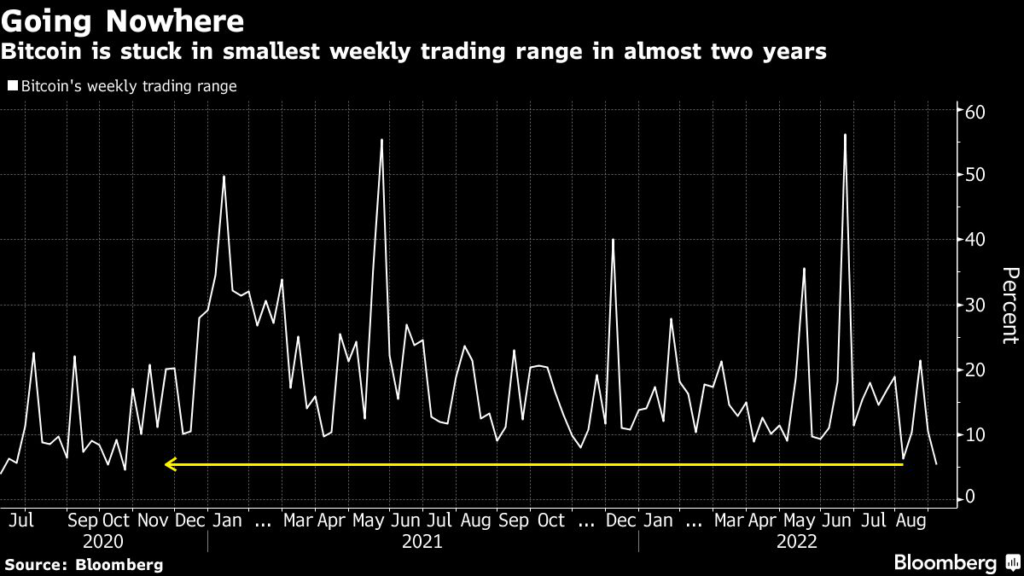
(Bloomberg) — The cryptocurrency market appears by some measures to be poised to break out of the narrowest trading range in almost two years.   

Based on one gauge, the leverage ratios for the two largest tokens by market value — Bitcoin and Ether — are at the highest on record even with prices of both down more than 50% this year. That is calculated by taking the amount of open interest for perpetual swap contracts and dividing that by the amount of coins held in reserve on exchanges, according to blockchain data-site CryptoQuant. 

“Folks think the market has stabilized and are willing to make bigger speculative positions,” said Darius Sit, co-founder of Singapore-based crypto investment fund QCP Capital, who pointed out that traders who see a so-called tail risk — or the chance of a loss happening due to a rare event — are “getting priced out.”  

Crypto traders tend to favor perpetual contracts — which, unlike traditional calendar futures, don’t expire — in part, because it allows them to keep highly leveraged positions in place.  

Bitcoin, which accounts for about 40% of the estimated market value of all cryptocurrencies, traded last week within a range of about 5.4%, the narrowest since October 2020, data compiled by Bloomberg show. The lull two years ago was followed by a months-long surge in prices that eventually pushed Bitcoin to a then-record high in April 2021.

Cryptocurrencies have stagnated since June, when prices tumbled in the aftermath of the collapse of the Terra stablecoin ecosystem, the demise of hedge fund Three Arrows Capital and the bankruptcies of Voyager Digital and Celsius Network. 

Bitcoin advanced 1.3% to $19,993 at 10:09 a.m. in London on Tuesday, while Ether was up 3.9% at $1,660. 

Despite recent hawkish comments from the Federal Reserve about inflation and the economic slowdown continuing to weigh on riskier assets including crypto, more traders appear to be putting on bullish leveraged bets.

Overall, the biggest catalyst of the growing leverage is likely the highly anticipated upgrade on the Ethereum blockchain later this month. The most commercially important network is set to move from its current system of using miners to a more energy-efficient one using staked coins. Data collected by blockchain research firm Kaiko show that perpetual swap contracts’ open interest denominated in Ether reached an all-time high at the end of August.

“As we get closer to the Merge, ETH leverage will continue to build up,” said Shiliang Tang, chief investment officer at crypto asset investment firm LedgerPrime.

At the same time, funding rates for both Bitcoin and Ether perpetuals have turned negative in the past few weeks, according to data-site Skew. Exchanges use the so-called funding rate — or the cost to trade — to tether the contracts to their underlying spot price. When the rate is positive, those who hold long positions are paying interest to investors who are short, and vice visa. 

Kaiko estimated that traders are biased to the downside because they’re either betting on an unsuccessful or delayed transition of Ethereum to proof of stake or are hedging long spot Ether positions ahead of the Merge.

“The growth of leverage with more bears could result in a short squeeze, as over-leveraged bears get liquidated if prices move up,” said Andrew Tu, head of growth for crypto algorithmic-trading firm Efficient Frontier, which takes neutral positions in trading. 

(Updates with Bitcoin, Ether trading in seventh paragraph.)

More stories like this are available on bloomberg.com

©2022 Bloomberg L.P.

Vulnerabilities in Crypto Security Have Investors Taking Notice

  • Listen to Bloomberg Crypto on the iHeartRadio App
  • Listen to Bloomberg Crypto on Apple Podcasts
  • Listen to Bloomberg Crypto on Spotify  

(Bloomberg) — It can feel as if everywhere you look there’s another crypto hack happening. 

By some estimates, major crypto hacks in 2022 have cost the industry nearly $2 billion in stolen tokens. That’s *just* this year. And those headline numbers typically don’t take into account smaller exploits that target individual consumer accounts. So, the real number is even bigger. 

In light of all this digital theft, crypto holders, venture capitalists and digital-asset companies seem to be finally focusing on security. How should crypto holders protect their assets? What kind of security measures is the industry considering? 

Bloomberg reporter Hannah Miller joins this episode.

Follow us on Twitter @crypto, and subscribe to the Bloomberg Crypto Newsletter at https://bloom.bg/cryptonewsletter


More stories like this are available on bloomberg.com

©2022 Bloomberg L.P.
Russia Privately Warns of Deep and Prolonged Economic Damage

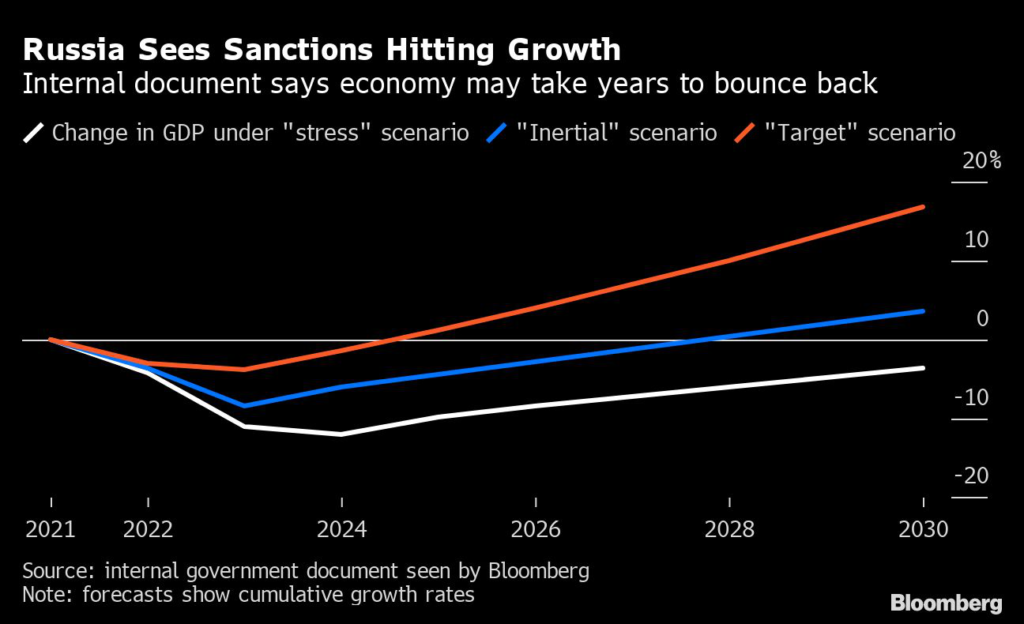
(Bloomberg) — Russia may face a longer and deeper recession as the impact of US and European sanctions spreads, handicapping sectors that the country has relied on for years to power its economy, according to an internal report prepared for the government.

The document, the result of months of work by officials and experts trying to assess the true impact of Russia’s economic isolation due to President Vladimir Putin’s invasion of Ukraine, paints a far more dire picture than officials usually do in their upbeat public pronouncements. Bloomberg viewed a copy of the report, drafted for a closed-door meeting of top officials on Aug. 30. People familiar with the deliberations confirmed its authenticity.

Two of the three scenarios in the report show the contraction accelerating next year, with the economy returning to the prewar level only at the end of the decade or later. The “inertial” one sees the economy bottoming out next year 8.3% below the 2021 level, while the “stress” scenario puts the low in 2024 at 11.9% under last year’s level.

All the scenarios see the pressure of sanctions intensifying, with more countries likely to join them. Europe’s sharp turn away from Russian oil and gas may also hit the Kremlin’s ability to supply its own market, the report said.

Beyond the restrictions themselves, which cover about a quarter of imports and exports, the report details how Russia now faces a “blockade” that “has affected practically all forms of transport,” further cutting off the country’s economy. Technological and financial curbs add to the pressure. The report estimates as many as 200,000 IT specialists may leave the country by 2025, the first official forecast of the widening brain drain.

Publicly, officials say the hit from sanctions has been less than feared, with the contraction possibly less than 3% this year and even less in 2023. Outside economists have also adjusted the outlooks for this year, backing off initial forecasts of a deep recession as the economy has held up better than expected.

Export Drop

The document calls for a raft of measures to support the economy and further ease the impact of the restrictions in order to get the economy recovering to pre-war levels in 2024 and growing steadily after that. But the steps include many of the same measures to stimulate investment that the government has touted over the last decade, when growth largely stagnated even without sanctions.

Asked about the Bloomberg report early Tuesday in Vladivostok, Economy Minister Maxim Reshetnikov called the forecasts “analytical estimates that we used to calculate what would happen if we don’t resist, don’t do anything,” according to Tass. 

What Bloomberg Economics Says…

“With diminished access to Western technologies, a wave of foreign corporate divestment and demographic headwinds ahead, the country’s potential growth is set to shrink to 0.5%-1.0% in the next decade. Thereafter, it will shrink further still, down to just above zero by 2050. Russia will also be increasingly vulnerable to a decline in global commodity prices, as international reserves no longer provide a buffer.” -Alexander Isakov, Russia economist

Over the next year or two, the report warns of “reduced production volumes in a range of export-oriented sectors,” from oil and gas to metals, chemicals and wood products. While some rebound is possible later, “these sectors will cease to be the drivers of the economy.”

No, Yale – Sanctions Have Not Triggered a Collapse in Russia

A full cutoff of gas to Europe, Russia’s main export market, could cost as much as 400 billion rubles ($6.6 billion) a year in lost tax revenues, according to the report. It won’t be possible to fully compensate the lost sales with new export markets even in the medium term. 

Oil Sector Hit

As a result, output will have to be reduced, threatening Kremlin goals for expanding domestic gas supplies, the report said. The lack of technology needed for liquefied natural gas plants is “critical” and may hamper efforts to build new ones.

Europe’s plans to stop importing Russian oil products — about 55% of exports went there last year — could trigger sharp cuts in production leaving the domestic market short of fuel, as well. 

Metals producers are losing $5.7 billion a year from the restrictions, the report said.

If the world economy slips into recession, the report warns, Russia could see exports cut further as it becomes the “swing supplier” on global markets, with demand for its products disappearing first. That could trigger a plunge in the ruble and a spike in inflation.

On the import side, “the main short-term risk is the suspension of production due to lack of imported raw materials and components.” Over the longer term, the inability to repair imported equipment could permanently limit growth, the report said. 

‘Critical Imports’

“There are simply no alternative suppliers for some critical imports,” it said.

Even in the farm sector, where the Kremlin has touted its efforts at replacing foreign supplies, dependence on key inputs could force Russians to reduce their food consumption as supplies dwindle, according to the report. 

Restrictions on access to western technology may push Russia a generation or two behind current standards as it’s forced to rely on less advanced alternatives from China and Southeast Asia.

The report warns that sanctions will also force the government to revise a range of the development targets that Putin had set before the war, including those for boosting population growth and life expectancy.

On a sectoral basis, the report details the breadth of the hit from sanctions:

  • Agriculture: Fully 99% of poultry production and 30% of Holstein dairy cattle output depends on imports. Seeds for staples like sugar beets and potatoes are also mostly brought in from outside the country, as are fish feeds and aminoacids.
  • Aviation: 95% of passenger volume is carried on foreign-made planes and the lack of access to imported spare parts could lead the fleet to shrink as they go out of service
  • Machine-building: only 30% of machine tools are Russian-made and local industry doesn’t have the capacity to cover rising demand
  • Pharmaceuticals: About 80% of domestic production relies on imported raw materials
  • Transport: EU restrictions have tripled costs for road shipments
  • Communications and IT: Restrictions on SIM cards could leave Russia short of them by 2025, while its telecommunications sector may fall five years behind world leaders in 2022.

(Updates with economy minister comment in eighth paragraph.)

More stories like this are available on bloomberg.com

©2022 Bloomberg L.P.
UAE Fintech Optasia Steps Up Global Expansion to Target Unbanked

(Bloomberg) —

United Arab Emirates-based Optasia plans to grow its financial-services business in Africa, Southeast Asia and Latin America in the next three years, seeking a larger market of under-banked customers.

The company already operates in more than 40 nations, offering services such as airtime, data, real-time credit scoring and micro-loans. It’s now considering expanding to Malaysia, Thailand, Colombia, Mexico and Brazil, founder and Chief Executive Officer Bassim Haidar said in an interview.

Latin America and Southeast Asia are “territories where we’ve just touched the tip of the iceberg currently,” he said. New African countries include Egypt, Kenya and Rwanda, the 51-year-old said. 

About 1.4 billion adults globally are unbanked due to a lack of money, distance to the nearest financial institution and insufficient documentation, according to the Global Findex 2021 survey. The market has been a target for fintech startups expanding aggressively to capture those types of customers who are also connected to the internet, particularly via a smartphone.

Haidar, a Nigerian-born Lebanese entrepreneur, is also trialling new products such as pre-scoring individuals on e-commerce websites to be able to buy-now-pay-later and providing street vendors that sell airtime and data with credit, he said. 

Founded in 2012, Dubai-based Optasia, formerly Channel VAS, is valued at more than $1 billion and backed by investors Ethos Capital Partners LLP, Development Partners International LLP and Waha Capital PJSC.

Trading in multiple jurisdictions has meant Optasia has been able to offset a sell-off in African currencies with those in the Middle East. The firm has grown at a faster pace than inflation, which is at multiyear highs in nations such as Ghana and Nigeria where it operates, Haidar said. Revenue is expected to increase 36% this year to $3.2 billion, according to the entrepreneur.  

The company may consider a dual listing on Africa’s largest bourse in Johannesburg and in either London or Dubai next year. It earlier scrapped a move to the Nasdaq due to unfavorable conditions, Haidar said.

“We’ll decide sometime next year on this, once the markets improve, hopefully,” he said.

Stock markets have slumped across the globe with central banks determined to quash inflation even at the cost of a recession, unleashing the most aggressive tightening of monetary policy in a generation. The MSCI World Index is down 19% this year and the MSCI Emerging Markets Index 21%.

More stories like this are available on bloomberg.com

©2022 Bloomberg L.P.

Tycoon Bets on Renewables in Biggest 2022 Philippine IPO

(Bloomberg) — Philippine billionaire Enrique Razon made his fortune operating ports and running casinos. His next target is the country’s nascent renewables industry.

The nation’s second-richest man is focusing on solar farms, battery facilities and water projects in an effort to attract international investors. His green push through Prime Infrastructure Capital, Inc., which will go public later this year, is aligned with broader plans by the government to increase the use of renewable energy to 50% by 2040.

The need for more energy of any sort is urgent in the Philippines, where growth in power demand has outpaced new capacity. The Southeast Asian nation, which imports almost all of its oil requirements, is looking to spend more on fuel subsidies as a cushion against higher prices. Developing domestic renewable sources will also help the nation reduce dependence on oil and coal. 

Prime Infra’s projects will be the first of their kind for Philippines’ renewable market, giving investors an early entry point. 

The country is “probably not where it should be in terms of power supply demand. We’re probably not where we should be in terms of water availability and sanitation, or probably not where we should be in terms of waste management and addressing climate change. If you take all that into consideration as an investor, it’s perfectly logical to invest into the Philippines and Prime Infra,” President and Chief Executive Officer Guillaume Lucci said in an interview.

It’s building a solar-and-battery facility that will displace annual consumption of about 1.4 million tons of coal, equivalent to nearly 6% of the nation’s annual needs. Also in the works are a 1,400-megawatt hydropower plant at Laguna de Bay just south of Manila, as well as two water projects that will provide 518 million liters of water to areas around the capital by 2025.

Getting these projects off the ground will depend on the firm’s planned 25.6 billion pesos ($449.2 million) initial public offering in November, which is poised to be the biggest IPO this year and among the largest ever in the Philippines. Only eight firms have listed in the nation this year, raising a total of 17.2 billion pesos. That’s set to be the worst showing since 2018 amid a global market slump. 

“It will be a major play on Philippine renewable energy, a narrative that’s still in the early stages of growth and a sector the government wants developed,” said Carlos Temporal, analyst at AP Securities. He said the IPO “could attract strong demand because of the industry it’s in and the company’s owner.”

Razon, who is also the chairman of International Container Terminal Services Inc., which operates more than 30 port terminals in 20 countries, is estimated to be worth $4.8 billion, according to the Bloomberg Billionaires Index.

The Philippines is seeking to increase renewables’ share to the overall energy mix to 50% by 2040 from just a fifth in 2019. President Ferdinand Marcos Jr. , in a speech in July, said solar, wind, hydropower and geothermal energy sources are key to achieving his climate agenda. 

Still, there are risks to Prime Infra’s renewable ambitions. Supply chain snarls are raising the price of solar panels for the first time in a decade, and strong competition as Europe and the US boost climate ambitions could mean prices stay higher than expected for the next few years. That would raise the cost of Razon’s big solar-battery project and potentially eat into its profitability.

At the moment, Prime Infra gets 80% of its revenue from Manila Water Co. Inc., which supplies half of the Philippine capital. In four to five years, revenue from electricity will account for 40% from below 20% currently, Lucci said. Prime Infra also plans to build landfills around the capital region, he said. 

While its first project was a 29-megawatt gas-fired power plant in Iraq, Razon’s infrastructure company plans to grow its power, water and waste-management portfolio in the Philippines before expanding overseas, the CEO said. 

(Adds landfill plan in 12th paragraph. An earlier version corrected company’s name in second paragraph.)

More stories like this are available on bloomberg.com

©2022 Bloomberg L.P.

Super Typhoon Leaves Several Dead as It Passes South Korea

(Bloomberg) — Super Typhoon Hinnamnor left at least two people dead and created widespread flooding and power outages as it passed through South Korea, though the destruction appeared to be less than had been forecast.

Hinnamnor hit near the southern city of Geoje at 4:50 a.m. local time and moved off the coast near Ulsan just a few hours later, the Korea Meteorological Administration said. Projections from the US Joint Typhoon Warning Center show the typhoon moving through Korea’s eastern sea, and potentially making landfall again in eastern Russia. 

At least two people in South Korea were reported killed while at least eight are missing, according to Yonhap. Earlier, the meteorological agency had warned of potential casualties from what was expected to be the most powerful storm ever to hit the country. 

Hinnamnor showed signs of weakening Tuesday afternoon, packing sustained winds of about 86 miles (138 kilometers) per hour with gusts around 104 mph, according to the US warning center. But the impact of the massive storm continued to be felt across South Korea and even parts of Japan. 

About 3,500 people were evacuated along South Korea’s southern coast, while more than 66,000 homes nationwide suffered power outages, Yonhap reported. However, Korea Electric Power Corp. has restored electricity to more than 18,000 homes in Jeju, the newspaper said.

Kyushu Electric Power Co., the utility provider for Japan’s southwestern prefectures in Kyushu, said that over 30,000 buildings in the region are without power due to the typhoon, while telecommunications providers KDDI Corp. and NTT Docomo said service has been disrupted in some parts of the country.

Still, businesses in South Korea began to return to normal soon after the storm passed. Hyundai Motor Co.’s union said the company was set to resume work before noon while Hyundai Heavy Industries Co. and Daewoo Shipbuilding & Marine Engineering Co. planned to restart in the afternoon. No casualties or damage were reported at the facilities of the automaker and two shipbuilders.

Korean Air Lines Co. and Asiana Airlines Inc. restarted flights to Jeju Island in the morning, while flights to Busan were scheduled to resume in the afternoon. 

Six nuclear reactors on the southeast coast had been running at lower rates ahead of the typhoon. They will operate at a reduced rate for now until the situation returns to normal, according to a spokeswoman at Korea Hydro & Nuclear Power Co.

Oil refiners, chemical operations and the nation’s oldest nuclear power plant had earlier taken precautions amid predictions the typhoon would hammer the resort island of Jeju and the key industrial city of Ulsan on the country’s southeast coast, disrupting ports and air traffic across the region. 

The nation suffered the second major storm in a matter of weeks after Seoul was hit by the heaviest rains in a century in early August, killing at least 11 people. President Yoon Suk Yeol faced criticism for his response to the floods and apologized to the nation for “inconveniences” caused by the storm.

Yoon, who earlier promised the government would stay alert to protect the lives and safety of citizens, said Tuesday that while Typhoon Hinnamnor has made its way out to sea, it’s too early to express relief because areas with damage still need to be rescued. 

Hinnamnor already disrupted port operations, airline services and schools across Asia since developing last month. Shanghai’s major container port of Yangshan briefly halted terminal operations. Some schools in both South Korea and China were closed for safety reasons.  

(Updates with death toll in the first paragraph)

More stories like this are available on bloomberg.com

©2022 Bloomberg L.P.

Billionaire Bets on Renewables in 2022 Philippine IPO

(Bloomberg) — Philippine billionaire Enrique Razon made his fortune operating ports and running casinos. His next target is the country’s nascent renewables industry.

The nation’s second-richest man is focusing on solar farms, battery facilities and water projects in an effort to attract international investors. His green push through Prime Infrastructure Capital, Inc., which will go public later this year, is aligned with broader plans by the government to increase the use of renewable energy to 50% by 2040.

The need for more energy of any sort is urgent in the Philippines, where growth in power demand has outpaced new capacity. The Southeast Asian nation, which imports almost all of its oil requirements, is looking to spend more on fuel subsidies as a cushion against higher prices. Developing domestic renewable sources will also help the nation reduce dependence on oil and coal. 

Prime Infra’s projects will be the first of their kind for Philippines’ renewable market, giving investors an early entry point. 

The country is “probably not where we should be in terms of power supply demand. We’re probably not where we should be in terms of water availability and sanitation, or probably not where we should be in terms of waste management and climate. If you take all that into consideration as an investor, it’s perfectly logical to invest into the Philippines and Prime Infra,” Chief Executive Officer Guillaume Lucci said in an interview.

It’s building a solar-and-battery facility that will displace annual consumption of about 1.4 million tons of coal, equivalent to nearly 6% of the nation’s annual needs. Also in the works are a 1,400-megawatt hydropower plant at Laguna de Bay just south of Manila, as well as two water projects that will provide 518 million liters of water to areas around the capital by 2025.

Getting these projects off the ground will depend on the firm’s planned 25.6 billion pesos ($449.2 million) initial public offering in November, which is poised to be the biggest IPO this year and among the largest ever in the Philippines. Only eight firms have listed in the nation this year, raising a total of 17.2 billion pesos. That’s set to be the worst showing since 2018 amid a global market slump. 

“It will be a major play on Philippine renewable energy, a narrative that’s still in the early stages of growth and a sector the government wants developed,” said Carlos Temporal, analyst at AP Securities. He said the IPO “could attract strong demand because of the industry it’s in and the company’s owner.”

Razon, who is also the chairman of International Container Terminal Services Inc., which operates more than 30 port terminals in 20 countries, is estimated to be worth $4.8 billion, according to the Bloomberg Billionaires Index.

The Philippines is seeking to increase renewables’ share to the overall energy mix to 50% by 2040 from just a fifth in 2019. President Ferdinand Marcos Jr. , in a speech in July, said solar, wind, hydropower and geothermal energy sources are key to achieving his climate agenda. 

Still, there are risk to Prime Infra’s renewable ambitions. Supply chain snarls are raising the price of solar panels for the first time in a decade, and strong competition as Europe and the US boost climate ambitions could mean prices stay higher than expected for the next few years. That would raise the cost of Razon’s big solar-battery project and potentially eat into its profitability.

At the moment, Prime Infra gets 80% of its revenue from Manila Water Co. Inc., which supplies half of the Philippine capital. In four to five years, revenue from electricity will account for 40% from below 20% currently, Lucci said.

While its first project was a 29-megawatt gas-fired power plant in Iraq, Razon’s infrastructure company plans to grow its power, water and waste-management portfolio in the Philippines before expanding overseas, the CEO said.

(Corrects company’s name in second paragraph.)

More stories like this are available on bloomberg.com

©2022 Bloomberg L.P.

Close Bitnami banner
Bitnami