

Bloomberg

Lombard Odier Adds ESG Screens After ‘Shocking’ Cyber Report

(Bloomberg) — Lombard Odier Investment Managers said the “shocking” results of an analysis into cybersecurity risks lurking in portfolio companies have led it to apply ESG processes far more broadly to protect its funds from losses.

The Swiss asset manager is now on a campaign “to push these companies to get their basic cyber hygiene in order,” said Jeroen van Oerle, portfolio manager of Lombard Odier’s Global FinTech fund. The firm wants to treat “cybersecurity risks the same way as we look at climate-related risks, or water usage risks, or corporate governance risks,” he said.

Since the summer, Lombard Odier has been screening more than 500 companies each month in an effort to detect software vulnerabilities. The analysis found that about 20% are running outdated software. “To me, that was shocking,” van Oerle said.

Investment managers have this year started sounding the alarm on hidden cybersecurity risks, with industries favored by ESG funds such as health care and technology often particularly exposed. By 2025, costs associated with cybercrime may well exceed $10 trillion, up from $6 trillion in 2021, Lombard Odier estimates. Researchers at Berenberg recently identified cybersecurity as a key ESG theme for 2022, while analysts at Goldman Sachs Group Inc. have singled out cyberattacks as an area of particular concern to ESG investors.

Van Oerle said he’s ready to sell shares of a company if he’s left with the impression that management isn’t doing enough to protect the business from cybersecurity risks. 

“The companies which are really slow in cybersecurity will probably somewhere down the line pay up for that,” he said. This could be “either in the form of a large data breach or in the form of losing clients because the trust is gone.”

Passive Strategies

Using ESG screens to catch cyber risks should be a strategy that’s also adopted by “the big passive funds out there who now are also voting on ESG topics,” van Oerle said. “Maybe they should also get involved more on cybersecurity and make that an agenda point as well on which they engage and on which they try to optimize the solutions for their investors.”

The pandemic has served as a catalyst for cybercrime, with much of the work that used to take place in offices now being conducted remotely via corporate networks. Almost two-thirds of security and information technology leaders surveyed across 15 industries found a measurable increase in cyberattacks, attributing it to more remote work, according to research by software company Splunk Inc. and the Enterprise Strategy Group.

Analysts at Berenberg recently published an ESG report noting that “many companies appear under-prepared” for cyberattacks. They also found that investment in measures to guard against such risks are picking up, with the extra spending coinciding with a “booming” cyber insurance industry, the Berenberg analysts said.

“It’s my personal conviction that any company can be hacked,” van Oerle said. “What we want to find out is if the company, first of all, is hacked, how fast can it respond? And is the company actually leaving all of the doors and the windows open so that it’s super easy to hack, or do they at least try to protect themselves as much as possible from it?”

(Adds comment on passive investing)

More stories like this are available on bloomberg.com

©2022 Bloomberg L.P.

US Futures, European Stocks Rise; Pound Rebounds: Markets Wrap

(Bloomberg) — US stock futures climbed, with dip buyers drawn to attractive valuations after three weeks of Wall Street declines. European stocks rose as investors assessed responses to the region’s energy crisis ahead of the European Central Bank’s policy meeting later this week.

S&P 500 and Nasdaq 100 contracts both advanced by more than 0.5%, with cash trading set to resume after the Labor Day holiday. Gains in retailers, autos and travel shares lifted the Stoxx Europe 600 Index, while energy underperformed as a rally in oil cooled. 

The pound rebounded and an index of domestically focused UK stocks rose as traders assessed the agenda of Prime Minister Liz Truss. The new leader is finalizing plans for a £40 billion ($46 billion) support package to lower energy bills for businesses, according to documents seen by Bloomberg. A dollar gauge edged higher. 

Treasuries dipped, led by shorter maturities, taking the two-year yield to 3.47%. European natural gas prices eased with politicians scrambling to find solutions after Moscow switched off its main pipeline to the continent. Gains in oil prices sparked by an OPEC+ production cut faltered amid risks to demand from China’s Covid lockdowns.


Soaring energy costs have added to the complexities for policymakers as they try to balance the need to act against surging inflation against the risks of tipping economies into recession. The focus turns next to the ECB, with expectations of a 75 basis-points hike in interest rates on Thursday.

“The global economy, and in particular the European economy is really faced with a number of very difficult challenges, of which energy is sitting at the heart of everything,” Seema Shah, chief global strategist at Principal Global Investors, said on Bloomberg Television. “It does unfortunately mean that Europe despite all the help that governments are trying to provide for families and businesses, it’s simply not going to be enough to stave off a pretty significant downturn.”

European energy trading risks grinding to a halt unless governments extend liquidity to cover margin calls of at least $1.5 trillion, according to Norwegian energy company Equinor ASA. Aside from inflating bills and fanning inflation, the biggest energy crisis in decades is sucking up capital to guarantee trades amid wild price swings.

In US premarket trading, Bed Bath & Beyond Inc. dropped as much as 25% after Chief Financial Officer Gustavo Arnal fell to his death Friday from a Manhattan skyscraper. Digital World Acquisition Corp. shares slumped as much as 33% after the blank-check firm that is set to merge with former President Donald Trump’s social media group reportedly failed to get enough shareholder support to extend the deadline to complete the deal.

Elsewhere, Bitcoin traded just below the $20,000 level, while gold was steady.

Meanwhile, one of Wall Street’s biggest bears is turning even more pessimistic on the outlook for US earnings against the backdrop of a slowdown in economic growth.

Morgan Stanley strategist Michael J. Wilson cut his expectations for earnings-per-share growth for the year, saying that a slowing economy is now likely to be a bigger concern for stocks, rather than scorching inflation and a hawkish Federal Reserve. In 2023, he expects earnings to fall 3% even in the absence of a recession.

Are you bullish on energy-related assets? This week’s MLIV Pulse survey focuses on energy and commodities. Please click here to participate anonymously.

What to watch this week:

  • Apple event due to feature new iPhones, watches, Wednesday
  • Bank of England Governor Andrew Bailey at Treasury Committee, Wednesday
  • Fed’s Beige Book of regional economic activity, Wednesday
  • Cleveland Fed President Loretta Mester due to speak, Wednesday
  • European Central Bank rate decision, Thursday
  • Fed Chair Jerome Powell speaks at a Cato Institute conference in Washington, Thursday
  • Reserve Bank of Australia Governor Philip Lowe speaks at event, Thursday
  • China PPI, aggregate financing, money supply, new yuan loans, Friday
  • EU energy ministers extraordinary meeting on emergency intervention in electricity markets, Friday

Some of the main moves in markets:

Stocks

  • Futures on the S&P 500 rose 0.6% as of 8:30 a.m. New York time
  • Futures on the Nasdaq 100 rose 0.5%
  • Futures on the Dow Jones Industrial Average rose 0.6%
  • The Stoxx Europe 600 rose 0.4%
  • The MSCI World index was little changed

Currencies

  • The Bloomberg Dollar Spot Index rose 0.2%
  • The euro was little changed at $0.9921
  • The British pound rose 0.4% to $1.1562
  • The Japanese yen fell 1.1% to 142.14 per dollar

Bonds

  • The yield on 10-year Treasuries advanced seven basis points to 3.26%
  • Germany’s 10-year yield was little changed at 1.57%
  • Britain’s 10-year yield advanced five basis points to 2.99%

Commodities

  • West Texas Intermediate crude was little changed
  • Gold futures were little changed


More stories like this are available on bloomberg.com

©2022 Bloomberg L.P.
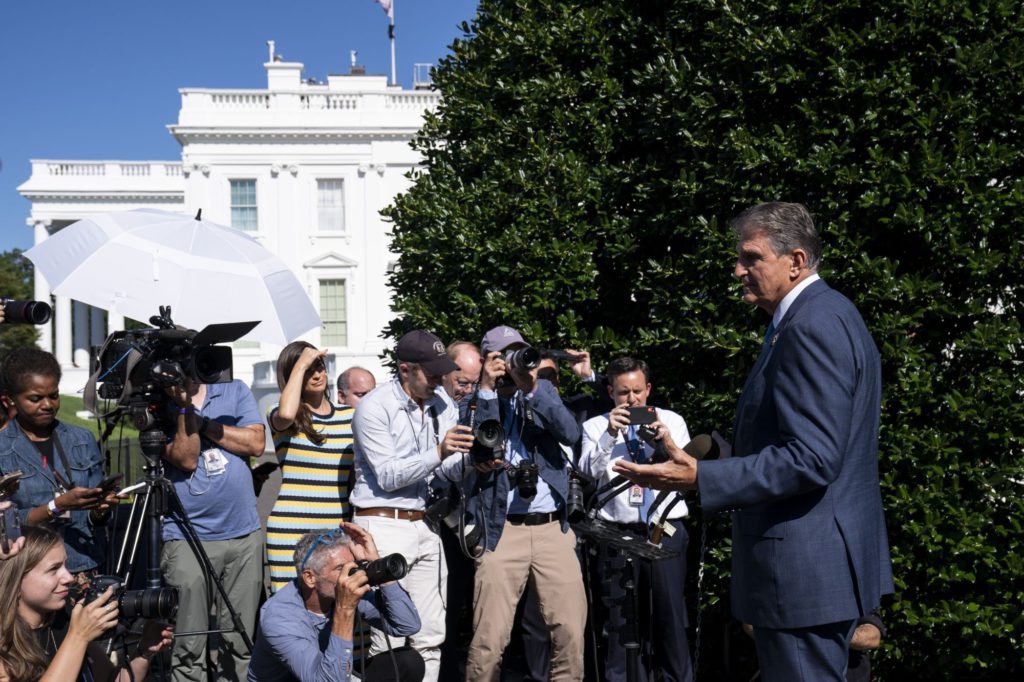
Manchin’s Plan to Fast-Track Energy Projects Headed for Showdown

(Bloomberg) — Congress is headed for a showdown this month over Democratic Senator Joe Manchin’s plan to fast-track federal approvals of energy projects ranging from natural gas pipelines to wind farms.

Manchin secured a pledge from congressional leaders to advance the legislation, but the proposal is already drawing fierce opposition from environmental activists and progressive Democrats, and the outcome is far from certain.

The deal, which was blessed by the White House, could deliver speedier approval for Equitrans Midstream Corp.’s stalled $6.6 billion Mountain Valley gas pipeline crossing Manchin’s home state of West Virginia. It also may expedite approvals for new clean energy projects spurred by the climate law enacted last month. It could also make changes to bedrock environmental laws, by putting two-year time limits on project reviews and limiting the power of states in Clean Water Act approvals.

If the legislation is passed, it would mark a big win for the oil and gas industry, which has long sought to accelerate federal permitting and scale back environmental reviews that can lead to years of delay and hundreds of millions of dollars in extra costs.

But even some of the measure’s champions doubt it would achieve the sweeping permitting reform that’s been promised. And it’s not clear that the legislation, which could be unveiled as soon as this week, will make it through Congress. Despite Senate Majority Leader Chuck Schumer’s promise to attach the measure to government-funding legislation or some other must-pass bill, some Democrats are deeply opposed.

“It’s basically an industry wish list that’s been around forever,” Representative Raul M. Grijalva, an Arizona Democrat who chairs the Natural Resources Committee, said in an interview. “I don’t feel compelled to back this up simply because it was a deal that was made in the Senate.”

Other Democrats insist they aren’t bound by the Schumer-Manchin agreement. “To pretend that all of our hands are tied because Chuck Schumer and Joe Manchin cut a deal?” said Representative Jared Huffman, a Democrat from California. “Sorry, I don’t think it works that way.”

Some Republicans, angry that Democrats jammed Manchin’s climate bill through the Senate on party lines, are also vowing to oppose the legislation even though it aligns with long-held energy industry priorities. Others say the legislation won’t achieve the permitting overhaul that’s needed.

Early drafts of the legislation sought to impose limits on government reviews, shorten the amount of time the public can comment on some project analysis and require the president to give priority status to a list of at least 25 fossil fuel and mining projects.

Read more: Manchin side-deal seeks to advance Mountain Valley gas pipeline

The 303-mile (488-kilometer) Mountain Valley Pipeline is seen as a prime beneficiary. Although developers say the pipeline that crosses into Virginia is more than 90% complete, construction work stalled after a federal court rejected a necessary permit for a national forest crossing. Manchin has complained about the slowdown and advanced proposals to finish the project, including by possibly moving litigation over the pipeline to a Washington, D.C.-based federal court. 

A summary circulated in recent days among Senate Democrats seen by Bloomberg emphasized the package wouldn’t weaken existing environmental statues. Instead, it cast the changes as critical to helping Biden achieve his climate and clean energy goals. For instance, the summary highlights how the measure would give federal regulators new authority to issue construction permits for power lines and transmission projects deemed in the national interest.

Past presidents and congresses have tried imposing deadlines on project reviews before — with mixed results — and it’s not clear this would dramatically accelerate the process. The legislation lacks teeth to force bureaucrats to move faster, and new deadlines might not be enforceable in court. Agencies also could stall official project reviews, effectively delaying the starting clock for analysis subject to new time limits.

Supporters of the legislation say that streamlined permitting is necessary to ensure that precious time to claim clean energy and advanced manufacturing tax credits under the climate law isn’t squandered waiting for federal authorizations. Expedited reviews can benefit renewable projects as well as onshore gas pipelines, they argue. Proposed offshore wind farms, for instance, must undergo reviews from numerous federal agencies in a process that can take years. 

“Without some reform and without a better system in place, we are very worried about being able to take advantage of these historic tax credits,” said Heather Zichal, head of the American Clean Power Association, an industry trade group that supports renewable developers. 

But environmentalists, many of whom are planning a Sept. 8 rally in opposition to the permitting reform deal steps away from the Capitol, counter that the reviews are as important now than ever.

“We’re about to have the biggest building spree this country has seen since the industrial revolution, and we would like to have some thoughtful planning,” said Abigail Dillen, president of the environmental advocacy group Earthjustice. “It doesn’t have to take forever, but it needs to be done well.”

More stories like this are available on bloomberg.com

©2022 Bloomberg L.P.
CVS Buys Signify Health in $8 Billion Deal Pushing Beyond Retail

(Bloomberg) — CVS Health Corp. reached a deal to buy home-health and technology services provider Signify Health Inc. for about $8 billion, as the drugstore chain continues to expand beyond its retail origins.

CVS is acquiring Signify for $30.50 a share in an all-cash deal, according to a statement Monday. The company emerged as the winning bidder over potential suitors that, Bloomberg News previously reported, had included UnitedHealth Group Inc., Amazon.com Inc. and Option Care Health Inc. 

Through its software and services, Signify aims to help clients — payers like health plans, government programs and employers — shift to value-based payment plans. It’s backed by New Mountain Capital, which formed the company in 2017, according to the private equity firm’s website.

Signify’s network has more than 10,000 clinicians in all 50 states in the US.

“Signify Health will play a critical role in advancing our health-care services strategy and gives us a platform to accelerate our growth in value-based care,” CVS Health Chief Executive Officer Karen S. Lynch said in the statement. “This acquisition will enhance our connection to consumers in the home and enables providers to better address patient needs as we execute our vision to redefine the health-care experience.”

The acquisition ranks among the biggest for CVS as it has broadened its health-care footprint. Its largest was its purchase of insurer Aetna Inc. in a deal valued at $68 billion including debt. That transaction, completed in 2018, followed its 2007 acquisition of Caremark RX Inc. for about $27 billion.

CVS and Signify said they expect their transaction to close in the first half of 2023.

Signify shares slipped less than 1% to $28.64 before regular trading Tuesday in New York, while CVS climbed less than 1%.

More stories like this are available on bloomberg.com

©2022 Bloomberg L.P.
Bitcoin Is Seen Poised to Escape From Tightest Range in 2 Years

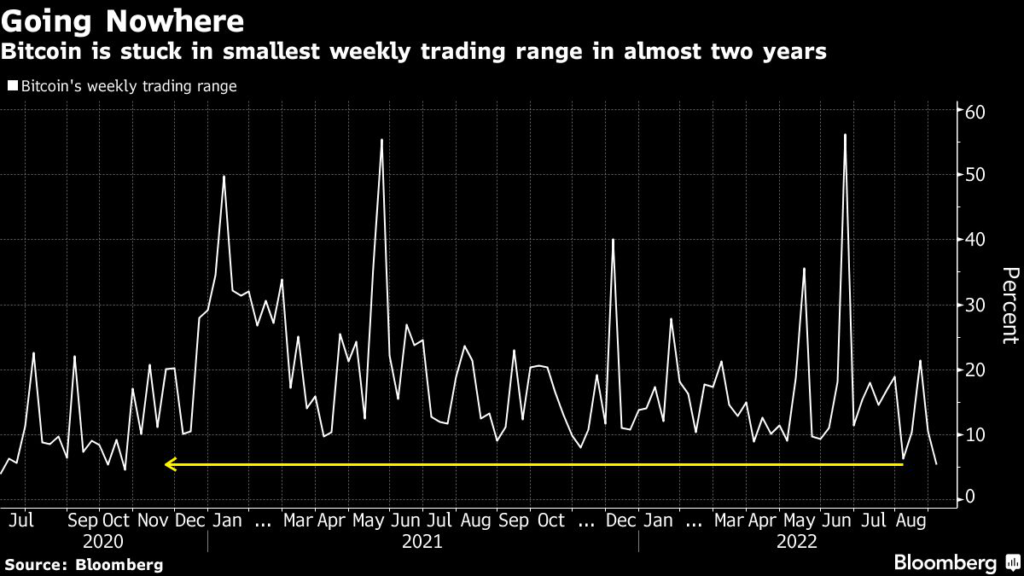
(Bloomberg) — The cryptocurrency market appears by some measures to be poised to break out of the narrowest trading range in almost two years.   

Based on one gauge, the leverage ratios for the two largest tokens by market value — Bitcoin and Ether — are at the highest on record even with prices of both down more than 50% this year. That is calculated by taking the amount of open interest for perpetual swap contracts and dividing that by the amount of coins held in reserve on exchanges, according to blockchain data-site CryptoQuant. 

“Folks think the market has stabilized and are willing to make bigger speculative positions,” said Darius Sit, co-founder of Singapore-based crypto investment fund QCP Capital, who pointed out that traders who see a so-called tail risk — or the chance of a loss happening due to a rare event — are “getting priced out.”  

Crypto traders tend to favor perpetual contracts — which, unlike traditional calendar futures, don’t expire — in part, because it allows them to keep highly leveraged positions in place.  

Bitcoin, which accounts for about 40% of the estimated market value of all cryptocurrencies, traded last week within a range of about 5.4%, the narrowest since October 2020, data compiled by Bloomberg show. The lull two years ago was followed by a months-long surge in prices that eventually pushed Bitcoin to a then-record high in April 2021.

Cryptocurrencies have stagnated since June, when prices tumbled in the aftermath of the collapse of the Terra stablecoin ecosystem, the demise of hedge fund Three Arrows Capital and the bankruptcies of Voyager Digital and Celsius Network. 

Bitcoin advanced 0.8% to $19,900 as of 7:07 a.m. in New York on Tuesday, while Ether was up 4.3% at $1,666. 

Despite recent hawkish comments from the Federal Reserve about inflation and the economic slowdown continuing to weigh on riskier assets including crypto, more traders appear to be putting on bullish leveraged bets.

Overall, the biggest catalyst of the growing leverage is likely the highly anticipated upgrade on the Ethereum blockchain later this month. The most commercially important network is set to move from its current system of using miners to a more energy-efficient one using staked coins. Data collected by blockchain research firm Kaiko show that perpetual swap contracts’ open interest denominated in Ether reached an all-time high at the end of August.

“As we get closer to the Merge, ETH leverage will continue to build up,” said Shiliang Tang, chief investment officer at crypto asset investment firm LedgerPrime.

At the same time, funding rates for both Bitcoin and Ether perpetuals have turned negative in the past few weeks, according to data-site Skew. Exchanges use the so-called funding rate — or the cost to trade — to tether the contracts to their underlying spot price. When the rate is positive, those who hold long positions are paying interest to investors who are short, and vice visa. 

Kaiko estimated that traders are biased to the downside because they’re either betting on an unsuccessful or delayed transition of Ethereum to proof of stake or are hedging long spot Ether positions ahead of the Merge.

“The growth of leverage with more bears could result in a short squeeze, as over-leveraged bears get liquidated if prices move up,” said Andrew Tu, head of growth for crypto algorithmic-trading firm Efficient Frontier, which takes neutral positions in trading. 

(Updates with Bitcoin, Ether trading in seventh paragraph.)

More stories like this are available on bloomberg.com

©2022 Bloomberg L.P.

Minister Halts Cash-Strapped Nigeria’s 5% Tax on Telecom Firms

(Bloomberg) — Nigeria suspended the implementation of a new telecommunications tax meant to help reduce the nation’s budget deficit that’s expected to hit a record next year. 

The government set up a committee to review the 5% levy, which would have come into effect this year, Communications Minister Isa Pantami said in an emailed statement. It will make a decision on the tax after a report is issued. Shares in MTN Group Ltd., the country’s biggest mobile provider, gained.

Africa’s biggest oil producer is looking for ways to boost income amid falling crude production, rising fuel-subsidy costs and low revenue. The country has one of the lowest tax-to-gross domestic product ratios in the world, at 6% in 2019, according to the Organization for Economic Co-operation & Development. 

The government this month proposed a budget of 19.8 trillion naira ($45.6 billion) for next year, with 63% of the spending plan to be funded through debt. The expected shortfall is about three times expected government revenue for the period and 5.5% of GDP, well above the 3% legal limit. 

The new tax would have boosted government income, but added to the rising cost of operations in the mobile industry in Africa’s largest economy “which is already overburdened with a plethora of taxes totaling about 41 categories” imposed by both federal, state and local governments, said Pantami, who opposed the levy. 

Excessive taxation has been the biggest challenge faced by Nigeria’s mobile industry, the minister said. “It is unfair to overburden such a sector that is so central to the nation’s growth and development,” he added. 

The tax, if implemented, would apply to all voice calls, text messages, and data services in addition to an existing 7.5% value-added tax.

Mobile-phone operators led by MTN’s Nigerian unit and billionaire Sunil Mittal-backed Airtel Africa Plc control more than half of Nigeria’s mobile market. Both firms’ share prices remained unchanged in early morning trading on the Nigerian Stock Exchange, while in South Africa, parent MTN advanced as much as 3.7%.

Telecom firms in Nigeria recorded $7.8 billion of revenue in 2021, according to data from the Nigerian Communications Commission. 

MTN Ghana blamed a slowdown in mobile-money revenue on a similar tax introduced in that country earlier this year.

More stories like this are available on bloomberg.com

©2022 Bloomberg L.P.

Text Scams With Receivers’ Names Trigger Probes in Philippines

(Bloomberg) — Text-message scams containing personal information of receivers have triggered probes in the Philippines, with initial findings showing that criminals may have bought data from different establishments.

“We believe that the recent smishing attacks are being perpetrated by local operators,” PLDT Inc. Chief Information Security Officer Angel Redoble said in a statement Tuesday. 

An electronic wallet, a messaging platform and mobile loan applications may have been used to harvest names, according to PLDT, which said it teamed up with police and government investigators to track down who’s behind the scams. 

Globe Telecom Inc. said in a separate statement that it has stringent measures in place to bar third-party breaches and guard against scammers. The nation’s privacy body said last week that it’s also investigating the unsolicited text messages.

Read: Philippines’ PLDT Blocks 23 Million Texts in Sign of Scam Threat

Digital payments have risen in the Philippines due to the pandemic, accounting for almost a third of retail transactions last year. The central bank aims to have at least half of the nation’s retail payments done digitally by end 2023. 

More stories like this are available on bloomberg.com

©2022 Bloomberg L.P.

Boots Plans Online Market for Beauty Brands in Digital Overhaul

(Bloomberg) —

Boots plans to start a new online marketplace for health and beauty products to upgrade the UK drugstore chain’s web offering amid increasing competition. 

The 173 year-old retailer will stock third-party brands online from next spring, Boots said in a statement Tuesday. With plans to stock hundreds of entrepreneurial brands, the company will be taking on the likes of THG Plc, whose Lookfantastic and Cult Beauty are already established in the online beauty domain. The site will be open to large and small brands alike.

The plan is to be first to market with emerging products, said Paula Bobbett, chief digital officer at Boots. 

Boots owner US health-care group Walgreens Boots Alliance Inc. abandoned plans to sell the retailer in June after failing to secure a bid for the desired sum of at least $6 billion. The chain has been battling to compete on main streets in the UK, with many of its large stores in need of renovation. Despite investment, its digital platform is still considered to be behind some rivals.

Boots currently has a website that sells some brands, which it says is the most-visited health and beauty website in the UK. The new marketplace would be much broader, offering more products spanning health, beauty, baby and wellness. 

The company is following a model already used by Next Plc and Asos Plc, which stock fashion from third parties and boutiques. 

More stories like this are available on bloomberg.com

©2022 Bloomberg L.P.

Italy’s Energy Agency Website Back Online After Malware Attack

(Bloomberg) — Italy’s energy agency Gestore dei Servizi Energetici SpA said its website is back online after a ransomware attack last week.

“GSE and all the competent authorities are working on reconfiguring systems and operativity of services,” the agency said in a statement Tuesday.

Oil giant Eni SpA also said last week that its internal protection systems had detected unauthorized access to its networks, though the consequences appeared to be minor. 

Italian Prime Minister Mario Draghi discussed hacker attacks on Eni and other energy companies with senior officials at a high-level security meeting last week, according to people familiar with the matter.

Read more: Draghi Discussed Eni, GSE Hacks With Top Officials Thursday 

More stories like this are available on bloomberg.com

©2022 Bloomberg L.P.

Electric Car Laggard Australia Prepares to Release the Brake

(Bloomberg) —

An impediment to electric-vehicle sales in one of the world’s biggest laggard markets may finally be on its way out.

The absence of fuel-efficiency standards in Australia has long been blamed for making the country a dumping ground for old and dirty models automakers aren’t allowed to sell elsewhere. Australia’s EV fans have meanwhile been left to scrap over the few pricey electric models available.

In a key step, Australia’s government will this month explore ways to introduce efficiency targets. The newly elected Labor administration is seeking carmakers’ views to help develop a strategy to catch up with markets that embraced EVs years ago.

New regulation would go some way to address Australia’s status as an EV anomaly — a developed nation that’s one of the biggest per-capita polluters where electric cars accounted for just 2% of new auto sales last year. As US EV sales break records and President Joe Biden offers tax breaks for going electric, Australia has defied the global shift. Wait times for a new Tesla in Sydney are so long that second-hand Model 3s are going for more than A$130,000 ($88,000).

Australia is the only OECD nation other than Russia that doesn’t have or isn’t developing fuel-efficiency standards, according to Australian Climate Change and Energy Minister Chris Bowen. There are just eight EVs priced under A$60,000 ($41,000) in Australia, compared with 26 in the UK, Bowen says.

Global manufacturing giants Volkswagen AG and Nissan Motor Co. are among those supporting the push for new fuel standards in Australia.

Volkswagen says countries that impose fines for missing fuel-efficiency targets jump up the priority list for EV shipments. “Greater supply inevitably leads to greater affordability,” said Paul Sansom, the German company’s managing director for Australia.

With car production cycles planned years in advance, Nissan says fuel-efficiency standards in Australia would establish certainty about the size of the local EV market.

“Australia does not currently get the range of choice of EVs that other markets enjoy,” Nissan said in an email. Without a long-term goal to decarbonize transport, “Australia will continue to be a laggard in terms of market uptake.”

Fuel-efficiency standards typically penalize carmakers if new vehicles exceed a certain level of carbon emissions. Automakers can gain credits to be traded with other manufacturers when their fleet beats emission targets.

Australia’s government should aim for all new-car sales to be zero-emission by 2035 to deliver on the country’s net-zero commitment by 2050, the country’s Electric Vehicle Council said.

While the scope and timing of Australia’s targets isn’t clear, they’re likely to have teeth. “Standards that lack ambition will leave us at the back of the global queue for longer,” Minister Bowen said last month as he announced the consultation paper for a national EV strategy.

Fuel-efficiency targets would boost EV supply, while the government’s planned EV tax credits will stoke demand, said Diane Kraal, a lecturer in business law and taxation who’s an EV researcher at Melbourne’s Monash University.

“We have to step up and bring ourselves in line with what’s happening in the rest of the world,” she said.

More stories like this are available on bloomberg.com

©2022 Bloomberg L.P.

Close Bitnami banner
Bitnami