

Bloomberg

Claim of TikTok Breach Spotlights Viral App’s Lure as Target

(Bloomberg) — TikTok, the short-video sensation that’s among the world’s most downloaded apps, is coming under increased scrutiny about its data security as it guards the personal information of over a billion users.

On Monday, several cybersecurity analysts tweeted about the discovery of what was purportedly a breach of an insecure server that allowed access to TikTok’s storage, which they believe contained personal user data. Only days earlier, Microsoft Corp. said it had found a “high-severity vulnerability” in TikTok’s Android application, “which would have allowed attackers to compromise users’ accounts with a single click.”

ByteDance Ltd.’s TikTok surpassed a billion monthly users a year ago and now ranks as many young people’s favorite app. That makes it an enticing target for hackers who may seek to hijack popular accounts or resell sensitive information. It was identified as a privacy threat by the Trump administration in 2020 and nearly banned because of concern about potential links between its Beijing-based parent company and the Chinese government.

TikTok said the claims of a breach discovered over the weekend were incorrect. “Our security team investigated this statement and determined that the code in question is completely unrelated to TikTok’s backend source code,” a spokesperson said.

Troy Hunt, an Australian web security consultant, went through some of the data samples listed in the leaked files and found matches between user profiles and videos posted under those IDs. But some details included in the leak were “publicly accessible data that could have been constructed without breach.”

“This is so far pretty inconclusive; some data matches production info, albeit publicly accessible info. Some data is junk, but it could be non-production or test data,” he posted on Twitter. “It’s a bit of a mixed bag so far.”

The vulnerability identified by Microsoft is a narrower issue that could have affected mobile phones running Android. It may have allowed attackers to access and modify “TikTok profiles and sensitive information, such as by publicizing private videos, sending messages and uploading videos on behalf of users,” wrote Dimitrios Valsamaras from the Microsoft 365 Defender Research Team.

A TikTok spokesperson said the company had responded quickly to Microsoft’s findings and fixed the security flaw, which was found “in some older versions of the Android app.”

However inconclusive or small the issues may be, there will be intense focus on TikTok and its parent firm at a time when the US may step up its measures against businesses with links to China. In June, nine US senators wrote a public letter to TikTok’s chief executive officer asking him to explain alleged security breaches.

President Joe Biden is expected to sign an executive order that would restrict US investment in Chinese tech companies and separate action targeting TikTok is a possibility, with the administration paying close attention to whether the Chinese government has access to American customer data. The company has told US lawmakers that it has taken steps to protect that data through a contract with Oracle Corp. 

“There’s a lot of attention on the way TikTok operates and there’s a big gap between how it operates and how it says it operates,” said Robert Potter, co-CEO of Australian-US cybersecurity firm Internet 2.0 Inc.

In July, Potter’s team said in a report that it had found “excessive data harvesting” carried out by TikTok on user devices, that the app checks device location at least once an hour and it has code that collects serial numbers for both the device and the SIM card. TikTok rejected the findings and said the report “misstates the amount of data we collect.”

The report received wide attention in Australia, and Clare O’Neil, the new Minister for Home Affairs, announced on Monday that she has ordered her department to investigate what data TikTok acquires and who can access it.

“We’ve got this basic problem here where we’ve got technology companies that are based in countries with a more authoritarian approach to the private sector,” O’Neil said in emailed remarks. “TikTok is not the beginning and the end of this. It’s one of the very large number of issues that’s given rise to by these very dominant technology companies and the role they are playing in our lives.”

(Updates with TikTok response to Internet 2.0 report)

More stories like this are available on bloomberg.com

©2022 Bloomberg L.P.
CVS Agrees to Buy Signify Health for About $8 Billion

(Bloomberg) — CVS Health Corp. has reached a deal to buy home-health and technology services provider Signify Health Inc. for about $8 billion, as the drugstore chain continues to expand beyond its retail origins.

CVS is acquiring Signify for $30.50 a share in an all-cash deal, according to a statement Monday.

CVS emerged as the winning bidder over potential suitors that, Bloomberg News previously reported, had included UnitedHealth Group Inc., Amazon.com Inc. and Option Care Health Inc. 

Through its software and services, Signify aims to help clients — payers like health plans, government programs and employers — shift to value-based payment plans. It’s backed by New Mountain Capital, which formed the company in 2017, according to the private equity firm’s website.

Signify’s network has more than 10,000 clinicians in all 50 states in the US.

“Signify Health will play a critical role in advancing our health-care services strategy and gives us a platform to accelerate our growth in value-based care,” CVS Health Chief Executive Officer Karen S. Lynch said in the statement. “This acquisition will enhance our connection to consumers in the home and enables providers to better address patient needs as we execute our vision to redefine the health-care experience.”

The acquisition ranks among the biggest for CVS as it has broadened its health-care footprint. Its largest was its purchase of insurer Aetna Inc. in a deal valued at $68 billion including debt. That transaction, completed in 2018, followed its 2007 acquisition of Caremark RX Inc. for about $27 billion.

CVS and Signify said they expect their transaction to close in the first half of 2023.

Signify rose 1.3% to close at $28.77 in New York trading Friday, giving it a market value of about $6.7 billion.

(Updates with details of Signify’s network in fifth paragraph)

More stories like this are available on bloomberg.com

©2022 Bloomberg L.P.
China Says US Hacked Aeronautics, Space Research University

(Bloomberg) — China accused a US spy agency of hacking a government-funded university with aeronautics and space research programs, in Beijing’s latest effort to hit back at Washington’s complaints of cybersnooping. 

The National Security Agency’s Office of Tailored Access Operations carried out the attacks on Northwestern Polytechnical University in Xi’an, China’s National Computer Virus Emergency Response Center said in a statement. A team from the center and 360 Security Technology Inc. analyzed the university’s information systems after an attack from overseas was reported in June, the center added.

The NSA conducted more than 10,000 “vicious” cyberattacks on Chinese targets in recent years, collecting more than 140 gigabytes of data of “great value,” it said. The NSA and State Department declined to comment on the allegations.

Beijing and Washington have been engaged in an increasingly testy war of words over cyberspying, with China becoming more direct in naming American government agencies in its accusations. The US has sought to draw a distinction between operations it conducts for national security purposes and the industrial espionage it has accused China of waging against American companies.

Federal Bureau of Investigation Director Christopher Wray warned Western companies in July that China aims to “ransack” their intellectual property so it can eventually dominate key industries. Both countries previously agreed to not condone cybertheft of intellectual property or trade secrets during Chinese President Xi Jinping’s state visit to Washington in 2015.

Blacklists, Trade and More U.S.-China Flashpoints: QuickTake

Samantha Hoffman, a senior analyst at the Australian Strategic Policy Institute, said there has been an uptick in specific Chinese accusations of US cyberattacks and that the US should respond with specific details of Chinese actors engaged in espionage.

“The US and allies need to focus on explaining why China’s activity in this space is abnormal — beyond what most intelligence agencies do,” she said. “Of course, China is likely to continue responding with similar accusations, which may or not be factual.”

China has in the past typically responded to such criticism by casting itself as a victim of hacking, dismissing the US an “empire of hackers” and pointing to former NSA contractor Edward Snowden’s revelations almost a decade ago about U.S. espionage. Among those were claims that the NSA had hacked into the computers of Tsinghua University, one of the China’s top research centers. 

More recently, Beijing has shifted its strategy by directly accusing the US of cyberattacks and naming targets. In February, Chinese cybersecurity firm Pangu Lab said it discovered US-sponsored hacking activity in China: malware in domestic IT systems it claims was created by hacking group Equation, “generally believed” to be linked to the NSA.

The shift has been an effort to increase public awareness of US activities and to regain the diplomatic initiative globally from the US and its allies, which have for many years accused China of attacks, said Greg Austin, an expert in Chinese cyberactivities at the Singapore-based International Institute for Strategic Studies.

“It’s a change of direction and probably about almost 10 years overdue,” he said. “The disparity between what the United States government and its allies have released on China and what China has released on American and ally attacks is massive. We knew almost nothing from Chinese officials on the scale of American attacks.”

At the same time, the US and its allies have escalated their investments in espionage and surveillance on China and Russia, he said.

Chinese Report on Suspected NSA Hack Shows Beijing Pushing Back

State broadcaster China Central Television and other major state media outlets reported on the alleged hacks at Northwestern Polytechnical University, which is affiliated with the Ministry of Industry and Information Technology and runs research programs in aeronautics, astronautics and marine technology engineering.

The Communist Party’s Global Times newspaper also tweeted about the report and put it on its Weibo social media account. The news was among the top trending topics on Weibo on Monday, attracting 210 million views.

Police in Xi’an said in a statement in June that the university reported it had detected phishing emails that posed a “serious security threat” to critical databases.

(Updates with NSA and State Department declining to comment on the allegations.)

More stories like this are available on bloomberg.com

©2022 Bloomberg L.P.
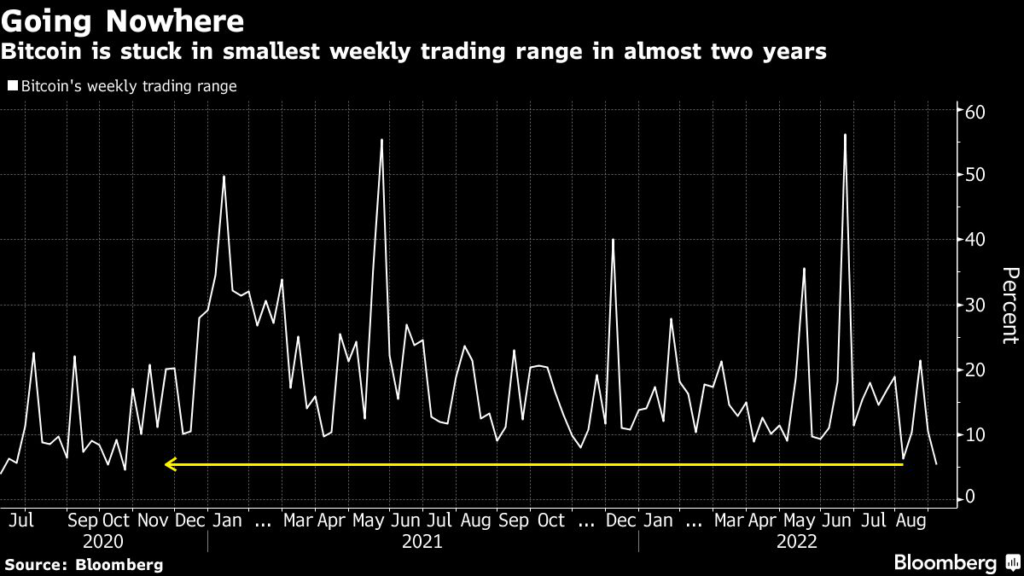
Crypto Traders See Escape From Tightest Range in About Two Years

(Bloomberg) — The cryptocurrency market appears by some measures to be poised to break out of the narrowest trading range in almost two years.   

Based on one gauge, the leverage ratios for the two largest tokens by market value — Bitcoin and Ether — are at the highest on record even with prices of both down more than 50% this year. That is calculated by taking the amount of open interest for perpetual swap contracts and dividing that by the amount of coins held in reserve on exchanges, according to blockchain data-site CryptoQuant. 

“Folks think the market has stabilized and are willing to make bigger speculative positions,” said Darius Sit, co-founder of Singapore-based crypto investment fund QCP Capital, who pointed out that traders who see a so-called tail risk — or the chance of a loss happening due to a rare event — are “getting priced out.”  

Crypto traders tend to favor perpetual contracts — which, unlike traditional calendar futures, don’t expire — in part, because it allows them to keep highly leveraged positions in place.  

Bitcoin, which accounts for about 40% of the estimated market value of all cryptocurrencies, traded last week within a range of about 5.4%, the narrowest since October 2020, data compiled by Bloomberg show. The lull two years ago was followed by a months-long surge in prices that eventually pushed Bitcoin to a then-record high in April 2021.

Cryptocurrencies have stagnated since June, when prices tumbled in the aftermath of the collapse of the Terra stablecoin ecosystem, the demise of hedge fund Three Arrows Capital and the bankruptcies of Voyager Digital and Celsius Network. 

Despite recent hawkish comments from the Federal Reserve about inflation and the economic slowdown continuing to weigh on riskier assets including crypto, more traders appear to be putting on bullish leveraged bets.

Overall, the biggest catalyst of the growing leverage is likely the highly anticipated upgrade on the Ethereum blockchain later this month. The most commercially important network is set to move from its current system of using miners to a more energy-efficient one using staked coins. Data collected by blockchain research firm Kaiko show that perpetual swap contracts’ open interest denominated in Ether reached an all-time high at the end of August.

“As we get closer to the Merge, ETH leverage will continue to build up,” said Shiliang Tang, chief investment officer at crypto asset investment firm LedgerPrime.

At the same time, funding rates for both Bitcoin and Ether perpetuals have turned negative in the past few weeks, according to data-site Skew. Exchanges use the so-called funding rate — or the cost to trade — to tether the contracts to their underlying spot price. When the rate is positive, those who hold long positions are paying interest to investors who are short, and vice visa. 

Kaiko estimated that traders are biased to the downside because they’re either betting on an unsuccessful or delayed transition of Ethereum to proof of stake or are hedging long spot Ether positions ahead of the Merge.

“The growth of leverage with more bears could result in a short squeeze, as over-leveraged bears get liquidated if prices move up,” said Andrew Tu, head of growth for crypto algorithmic-trading firm Efficient Frontier, which takes neutral positions in trading. 

More stories like this are available on bloomberg.com

©2022 Bloomberg L.P.
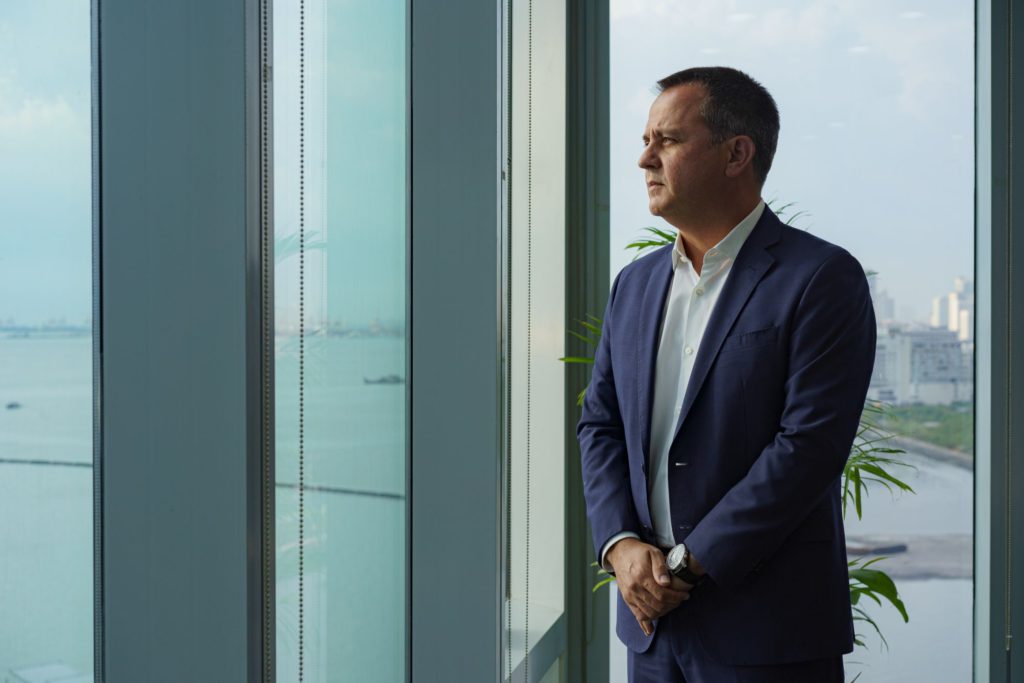
Billionaire Bets on Renewables in Biggest 2022 Philippine IPO

(Bloomberg) — Philippine billionaire Enrique Razon made his fortune operating ports and running casinos. His next target is the country’s nascent renewables industry.

The nation’s second-richest man is focusing on solar farms, battery facilities and water projects in an effort to attract international investors. His green push through Prime Infrastructure Holdings Inc., which will go public later this year, is aligned with broader plans by the government to increase the use of renewable energy to 50% by 2040.

The need for more energy of any sort is urgent in the Philippines, where growth in power demand has outpaced new capacity. The Southeast Asian nation, which imports almost all of its oil requirements, is looking to spend more on fuel subsidies as a cushion against higher prices. Developing domestic renewable sources will also help the nation reduce dependence on oil and coal. 

Prime Infra’s projects will be the first of their kind for Philippines’ renewable market, giving investors an early entry point. 

The country is “probably not where we should be in terms of power supply demand. We’re probably not where we should be in terms of water availability and sanitation, or probably not where we should be in terms of waste management and climate. If you take all that into consideration as an investor, it’s perfectly logical to invest into the Philippines and Prime Infra,” Chief Executive Officer Guillaume Lucci said in an interview.

It’s building a solar-and-battery facility that will displace annual consumption of about 1.4 million tons of coal, equivalent to nearly 6% of the nation’s annual needs. Also in the works are a 1,400-megawatt hydropower plant at Laguna de Bay just south of Manila, as well as two water projects that will provide 518 million liters of water to areas around the capital by 2025.

Getting these projects off the ground will depend on the firm’s planned 25.6 billion pesos ($449.2 million) initial public offering in November, which is poised to be the biggest IPO this year and among the largest ever in the Philippines. Only eight firms have listed in the nation this year, raising a total of 17.2 billion pesos. That’s set to be the worst showing since 2018 amid a global market slump. 

“It will be a major play on Philippine renewable energy, a narrative that’s still in the early stages of growth and a sector the government wants developed,” said Carlos Temporal, analyst at AP Securities. He said the IPO “could attract strong demand because of the industry it’s in and the company’s owner.”

Razon, who is also the chairman of International Container Terminal Services Inc., which operates more than 30 port terminals in 20 countries, is estimated to be worth $4.8 billion, according to the Bloomberg Billionaires Index.

The Philippines is seeking to increase renewables’ share to the overall energy mix to 50% by 2040 from just a fifth in 2019. President Ferdinand Marcos Jr. , in a speech in July, said solar, wind, hydropower and geothermal energy sources are key to achieving his climate agenda. 

Still, there are risk to Prime Infra’s renewable ambitions. Supply chain snarls are raising the price of solar panels for the first time in a decade, and strong competition as Europe and the US boost climate ambitions could mean prices stay higher than expected for the next few years. That would raise the cost of Razon’s big solar-battery project and potentially eat into its profitability.

At the moment, Prime Infra gets 80% of its revenue from Manila Water Co. Inc., which supplies half of the Philippine capital. In four to five years, revenue from electricity will account for 40% from below 20% currently, Lucci said.

While its first project was a 29-megawatt gas-fired power plant in Iraq, Razon’s infrastructure company plans to grow its power, water and waste-management portfolio in the Philippines before expanding overseas, the CEO said.

More stories like this are available on bloomberg.com

©2022 Bloomberg L.P.
Exiles Put Crypto, Fed Funds at Center of Myanmar Finance Plan

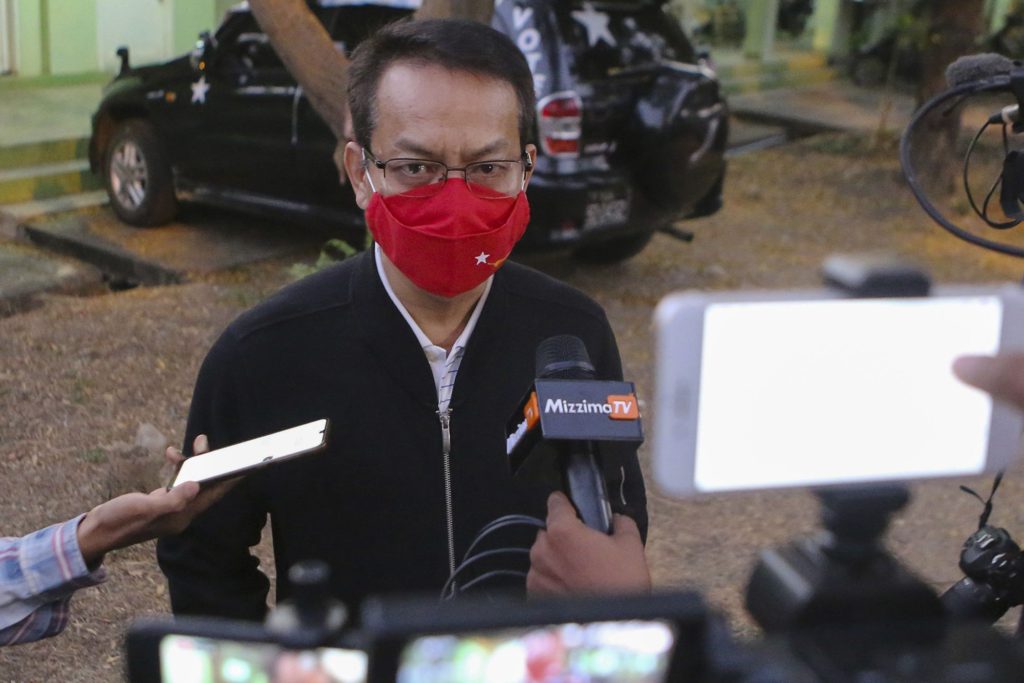
(Bloomberg) — Myanmar exiles ousted in a 2021 coup are pressing the Federal Reserve to endorse their bid to use $1 billion in funds frozen by the US to back a digital currency and a plan to establish a new central bank. 

It’s a long-shot measure to help the shadow government led by allies of deposed leader Aung San Suu Kyi bolster its support amid a worsening economic and political crisis in the country sparked by last year’s military coup. 

“We just need the US blessing that allows us to use the frozen money virtually,” Tin Tun Naing, the exiled National Unity Government’s minister of planning, finance and investment, said in a video interview with Bloomberg News from an undisclosed location. 

The amount sought by the exiled opposition leaders is part of Myanmar’s reserves that have been frozen by the Federal Reserve Bank of New York since February 2021, when the country’s armed forces seized power from the democratically-elected government. 

If the exiles can get US support, they would then seek to establish a new central bank that could issue the digital currency to help support the opposition’s “revolutionary efforts,” Tin Tun Naing said. He described the plan to issue currency against the reserves as a more feasible alternative to asking the US to free the cash entirely.  

Myanmar’s Path From Junta Rule to Democracy and Back: QuickTake

“We know perfectly well that the US is not going to release it in the foreseeable future but we are aiming at making use of these frozen assets virtually,” he said. “This means that we will use this as our foreign reserves when the Central Bank of NUG is established.”

The National Unity Government — largely made up of lawmakers and officials who won elections in 2020 — has shown an ability to creatively raise funds to sustain its operations outside Myanmar. The party has sold what it calls “Spring Revolution Special Treasury Bonds,” and held a mock auction of two mansions owned by junta leader Min Aung Hlaing and his family that raised about $53 million.

The US Treasury Department, which helps enforce sanctions, directed questions to the Federal Reserve Bank of New York. A spokesperson for the New York Fed declined to comment. 

Major General Zaw Min Tun, lead spokesman for Myanmar’s State Administration Council, didn’t answer calls seeking comment.

The balance of Myanmar’s foreign-currency reserves — believed to total in the low billions of dollars — are in Singapore, Thailand and Japan, Tin Tun Naing said. Officials with the central banks in those three countries declined to comment when asked about their holdings of Myanmar assets. 

Myanmar Sentences Suu Kyi to More Prison Time for Election Fraud

There is some precedent for the exiles’ bid. In a effort to pressure Venezuelan President Nicolas Maduro’s regime during the Trump administration, the US granted the country’s internationally-recognized “interim president,” opposition leader Juan Guaido, access to key government bank accounts based in the US. 

The goal of the US move was to “help Venezuela’s legitimate government safeguard those assets for the benefit of the Venezuelan people,” State Department deputy spokesman Robert Palladino said at the time. But it was never clear how much money was in the accounts granted by the US and the effort to oust Maduro soon stalled.  

Even if Myanmar’s exiled opposition can secure US support, there remain significant hurdles in the exiles’ plans. Despite lacking international recognition and facing a weakened economy and clashes with armed ethnic groups, the junta shows few signs of backing down. 

The junta has sentenced Suu Kyi, 77, to 20 years in prison, with eight more charges pending verdicts expected later this year. The Nobel Peace Prize laureate has denied all charges, which her supporters have said are politically motivated. 

Economically, the forecast is just as dire. 

Multinational companies including TotalEnergies SE and Chevron Corp. pulled out of their decades-long investments in Myanmar this year following international sanctions led by the US and its allies. 

The country’s currency, the kyat, has tumbled 37% against the dollar since the February 2021 coup, among the most in the world. The Central Bank of Myanmar early this month said it would sell US dollars for the first time in nearly six months to help bolster the kyat. 

Last month, the bank changed the reference exchange rate from 1,850 to 2,100 kyat per dollar as the national currency continues to weaken. But a huge gap remains between the official rate and market price.

International organizations including the International Monetary Fund and World Bank said they don’t have the latest data on Myanmar’s foreign exchange reserves. Commerce Minister Aung Naing Oo said in a response to Bloomberg News queries that Myanmar’s foreign reserves have improved a bit, compared to $6.04 billion recorded last October.

While the economy is expected to rebound from last year’s 18% contraction, the World Bank said in July that a “decade of progress on poverty reduction has been undone” with poverty doubling since March 2020. 

“There is no clear path out of this crisis,” Noeleen Heyzer, the UN secretary-general’s special envoy for Myanmar, said at an event on Sept. 5 in Singapore. “There will be no easy solutions.” 

More stories like this are available on bloomberg.com

©2022 Bloomberg L.P.

European Stocks, Euro Sink as Energy Woes Worsen: Markets Wrap

(Bloomberg) — European stocks slumped and the euro fell Monday as the region’s worsening energy crisis added to risks for a global economy already facing high inflation and a wave of monetary tightening.

The Stoxx Europe 600 Index dropped after Russia’s Gazprom PJSC halted its key gas pipeline indefinitely, although the benchmark gauge recovered from its worst levels as energy stocks rallied. Wall Street equity futures edged higher after the worst week for world shares since June. Cash Treasuries and US stocks are closed because of Labor Day.

The euro retreated to a two-decade low, while the dollar strengthened. The pound was steady after the UK’s Conservative Party named Liz Truss as its leader, clearing her way to become prime minister. Her plan to “turbo-charge” the economy by slashing taxes is already worrying investors amid double-digit inflation. 

Oil gained as OPEC+ unexpectedly agreed to make a token oil supply cut for October. Elsewhere, Bitcoin dropped below the $20,000 level. Gold was little changed.

Gazprom announced its move after Group of Seven leaders agreed to implement a price cap on Russian oil as the Kremlin continues its war in Ukraine. Natural gas surged more than 30% in Europe and nations there could roll out special steps at the end of the week to rein in power costs. Germany plans a $65 billion package to shield consumers.

“Economies have been preparing for some sort of energy constraint and the prospect of rationing, but obviously compared to expectations at the beginning of the year, this is pretty close to the worst outcome,” Wei Li, BlackRock global chief investment strategist, said on Bloomberg Television. “So as we head into rest of the year, underweight equities at this juncture feels appropriate.”

Monetary authorities including Europe’s central bank are set to keep hiking interest rates this week to fight inflation despite the darkening global economic outlook due to risks such as power shortages. The escalating energy crisis comes ahead of unprecedented tightening expected from the European Central Bank on Thursday in the form of a 75-basis-point rate increase.

An Asian equity index declined, paced by losses in Hong Kong, where tech shares slid as traders weighed the risk of curbs on investment from the US. China reduced the amount of foreign-exchange deposits banks need to set aside as reserves for the second time this year to boost the yuan after the currency hit a two-year low.

The view that global shares already hit their bear-market low back in June is looking increasingly precarious. Europe’s intensifying energy crisis is the latest hit to sentiment, which was already under pressure from a wave of monetary tightening.

READ: Xi to Give Boost to China Stocks But Not Yuan: MLIV Pulse

What to watch this week:

  • Australia rate decision, Tuesday
  • Apple event due to feature new iPhones, watches, Wednesday
  • Bank of England Governor Andrew Bailey at Treasury Committee, Wednesday
  • Fed’s Beige Book of regional economic activity, Wednesday
  • Cleveland Fed President Loretta Mester due to speak, Wednesday
  • European Central Bank rate decision, Thursday
  • Fed Chair Jerome Powell speaks at a Cato Institute conference in Washington, Thursday
  • Reserve Bank of Australia Governor Philip Lowe speaks at event, Thursday
  • China PPI, aggregate financing, money supply, new yuan loans, Friday
  • EU energy ministers extraordinary meeting on emergency intervention in electricity markets, Friday

Some of the main moves in markets:

Stocks

  • Futures on the S&P 500 rose 0.3% as of 4:36 p.m. New York time
  • Futures on the Dow Jones Industrial Average rose 0.4%
  • The MSCI World index fell 0.3%
  • Futures on the Nasdaq 100 rose 0.3%
  • The MSCI Asia Pacific Index fell 0.5%

Currencies

  • The Bloomberg Dollar Spot Index rose 0.2%
  • The euro fell 0.3% to $0.9929
  • The British pound was little changed at $1.1518
  • The Japanese yen fell 0.3% to 140.57 per dollar
  • The offshore yuan fell 0.4% to 6.9444 per dollar

Bonds

  • Germany’s 10-year yield advanced four basis points to 1.56%
  • Britain’s 10-year yield advanced two basis points to 2.94%

Commodities

  • West Texas Intermediate crude rose 2.2% to $88.82 a barrel
  • Gold futures were little changed

More stories like this are available on bloomberg.com

©2022 Bloomberg L.P.
Supreme Court Upholds Ruto’s Kenya Presidential Election Win

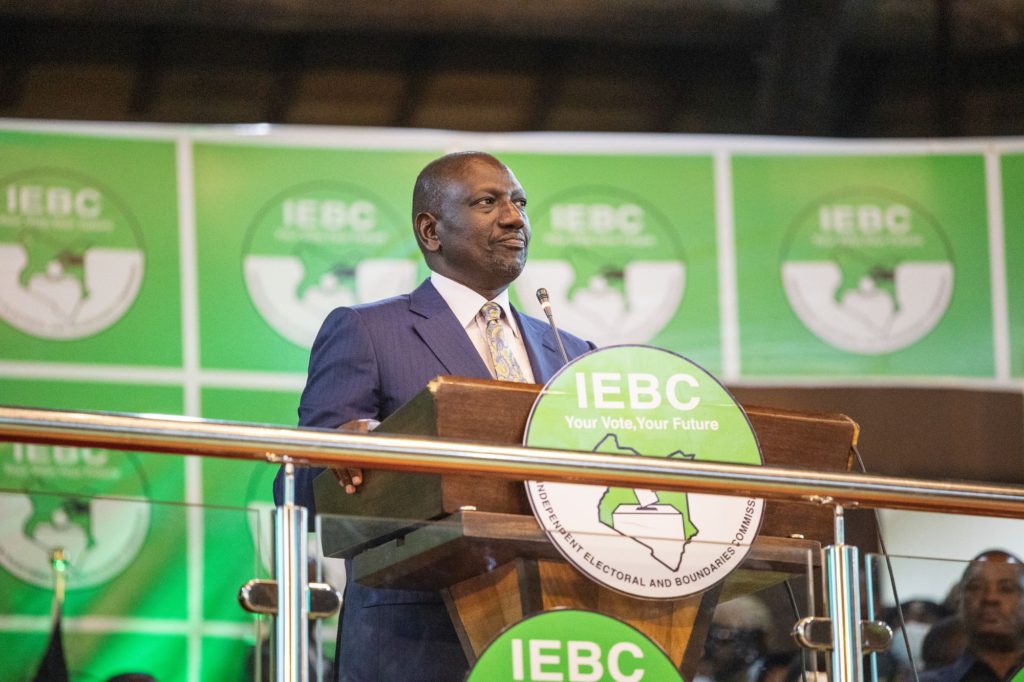
(Bloomberg) — Kenya’s Supreme Court upheld William Ruto’s victory in last month’s presidential election, dismissing his rival Raila Odinga’s claims that the vote was marred by rigging and irregularities.

The seven-member court found no discrepancies in the vote tallies and no credible evidence that the electoral commission’s computer systems and transmission network had failed or been breached, Chief Justice Martha Koome said in an abridged ruling handed down in Nairobi, the capital, on Monday. Allegations that some citizens had been prevented from casting their votes or that ballot boxes were tampered with were unproven, she said. 

“It is our finding that the declared president-elect attained 50% plus one of the votes cast” in accordance with the constitution, Koome said. “This is a unanimous decision of the court.” 

The official results showed Ruto, who has served as deputy president since 2013, won 50.5% support in the Aug. 9 vote and Odinga, a former prime minister, 48.8%. The judgment paves the way for Ruto, 55, to be sworn in as President Uhuru Kenyatta’s successor on Sept. 13. 

“We are vindicated by the choice of the people of Kenya,” Ruto said at a briefing in Nairobi. “With a unanimous decision of the Supreme Court of Kenya, our lengthy, suspenseful and protracted election has come to an end.” 

While four of the Independent Electoral and Boundaries Commission’s seven members distanced themselves from the election outcome, they didn’t explain why they considered it to have been compromised or substantiate their allegations that the verification process was opaque, Koome said. 

The court’s decision is a major step toward ending political uncertainty in East Africa’s biggest economy after Odinga’s rejection of the results fanned anxiety among the nation’s bondholders. 

Read more: Kenya Vote Backdrop Is Anger Over Living Costs, Debt: QuickTake

The yield on Kenya’s 2032 dollar bonds fell 36 basis points to 12.41%  at 5:15 p.m. in Nairobi on Monday, while the shilling was little changed at 120.25 per dollar.

Upholding the presidential election results “is likely to raise investor confidence as a return to normalcy will be in sight,” Nairobi-based AIB-AXYS Africa said in emailed comments.

Odinga, 77, has now made five unsuccessful runs for the presidency. In 2017, he successfully convinced the top court to nullify Kenyatta’s re-election, although he boycotted the rerun after he said the conditions weren’t in place for a fair contest. 

Kenyatta reconciled with Odinga in 2018 and publicly supported him after falling out with Ruto.  

Odinga said on Twitter that he respected the court’s ruling although he vehemently disagreed with it.

“I urge the country to respect the institutions that midwife our new leaders. And in doing so, I also urge citizens to constantly put them under scrutiny,” Kenyatta said in a televised briefing. “It is my intention to oversee a smooth transition to the next administration.” 

Ruto will have his work cut out for him, with the nation’s economic growth rate set to slow this year and the International Monetary Fund warning it is at high risk of debt distress. Kenya’s public debt-servicing costs are projected to climb to 1.39 trillion shillings ($11.6 billion) in the fiscal year through June 2023.

Read more: Business Mood Plunged to 16-Month Low in Kenya After Elections

Ruto has pledged to alleviate the nation’s debt burden, while ruling out the option of restructuring its loans — which Odinga had undertaken to do if he won. The president-elect also said he will channel more money into industries with the potential to create jobs for the five million young Kenyans he says aren’t working or studying. That will include investing at least 500 billion shillings in farming and small businesses.

“Any protests by Odinga’s followers in response to this result will not translate into prolonged unrest, despite international concerns of widespread violence,” said Ben Hunter, an Africa analyst at risk firm Verisk Maplecroft. “The unanimity of the legal ruling and the ongoing economic crisis will dampen the appetite for conflict.”

(Updates with comments from Kenyatta in 13th paragraph.)

More stories like this are available on bloomberg.com

©2022 Bloomberg L.P.
PMI Weighs Lowering Swedish Match Acceptance Threshold

(Bloomberg) — Philip Morris International Inc. is considering lowering the acceptance threshold on its $16 billion takeover bid for smokeless tobacco company Swedish Match AB, people with knowledge of the matter said. 

The Marlboro maker is studying the potential move as it seeks ways to increase the likelihood the acquisition will go through amid opposition from shareholders including Elliott Investment Management, the people said, asking not to be identified because the information is private. Philip Morris will likely decide in the next few weeks whether to make any changes to the deal conditions, the people said. 

The bid by Philip Morris was originally conditional on it getting more than a 90% stake in Swedish Match, a level that would normally allow it to squeeze out any remaining dissenters and take the company private. The idea of lowering the acceptance threshold raises the prospect that Philip Morris could end up with a majority stake in Swedish Match and keep it publicly traded, at least temporarily. 

Philip Morris is in close contact with Swedish Match and remains committed to getting the transaction done, the people said. It hasn’t made a final decision on any potential tweaks and could end up needing to increase its bid if it continues to face investor opposition, the people said.

Representatives for Philip Morris and Swedish Match didn’t immediately respond to requests for comment. 

Elliott said last week it’s built up a 5.25% stake in Swedish Match, confirming an earlier Bloomberg News report. The activist investor plans to oppose the deal under its current terms, people with knowledge of the matter said in July. Shareholders owning 0.24% of Swedish Match had tendered their shares as of Aug. 8. 

Last month, Philip Morris extended the acceptance period for the offer to Oct. 21 after European regulators indicated they need more time to review the deal. It’s offering 106 kronor per share in cash. Swedish Match shares were trading up 1% to 109 kronor at 5:23 p.m. Monday in Stockholm, indicating some investors are betting Philip Morris will increase its bid. 

Philip Morris already amended its credit agreements on Friday to give it more flexibility, getting lenders to agree to provide funding for the deal as long as its stake in Swedish Match exceeds 50%. The cigarette maker could increase its purchase price by 3% to 5% and still keep net leverage just under three times, Bloomberg Intelligence credit analyst Louise Parker wrote in a research note Monday. 

The company is seeking to avoid the same fate as other European takeovers that unraveled because of high shareholder acceptance thresholds. Advent International and Singapore wealth fund GIC Pte in December failed to secure 90% of drugmaker Swedish Orphan Biovitrum AB despite backing from the target’s management and biggest shareholder, torpedoing the $7.6 billion take-private.

Elliott has a history of building stakes in European targets to block full takeovers and secure a higher price, like Vodafone Group Plc’s purchase of German telecommunications company Kabel Deutschland Holding AG. 

(Updates with share movement, deal background from seventh paragraph.)

More stories like this are available on bloomberg.com

©2022 Bloomberg L.P.
Nordic Lawmakers Move on $33 Billion Backstop for Utilities

(Bloomberg) — Lawmakers in Sweden and Finland on Monday reviewed their $33 billion emergency backstop plans devised over the weekend to prevent utilities from defaulting after a fresh surge in energy prices.

On Sunday, the two governments announced liquidity facilities made up of loans and credit guarantees to avoid some power companies going into technical defaults as soon as Monday over climbing collateral requirements. The aim is to prevent Russia’s energy curbs from sparking a financial crisis. Sweden’s parliament approved the measure on Monday afternoon.

With price swings across the European energy space higher than ever, there are members on Nasdaq Inc.’s power market that are “facing hard times,” spokesman David Augustsson said on Monday without elaborating. The initiative for a guarantee package came from government and not the exchange, he said. 

“This is an extreme time of uncertainty and the addition of government liquidity guarantees will add an extra layer of stability to support orderly trading and energy companies,” he said by email. Overall margin requirements for traders using the power exchange are now four times higher than a year ago, he added. 

Finland’s Economy Minister Mika Lintila said on Sunday that several companies had been identified that could potentially be facing a liquidity crisis “quite quickly.” Vattenfall AB, the region’s biggest utility, said in a response to emailed questions on Monday that its finances were “stable,” and welcomed any initiatives that would help stabilize the market. 

The packages will be open to both larger and smaller utilities. Finland’s Fortum Oyj is currently in talks with the Finnish government on support. 

“Smaller utilities with slimmer cash balances and less established credit lines with banks might be feeling the squeeze currently,” Jakob Magnussen, global head of credit research at Danske Bank A/S, said by email. “And they will benefit and could potentially be a life-saver for some of them.”

The Nordic power market is the world’s oldest and was for a long time the most liquid too, until it was overtaken by Germany. Activity was gradually declining even before the massive price jumps that began last year. And in markets with low liquidity, prices tend to climb even more, which then inevitably leads to higher margin calls. 

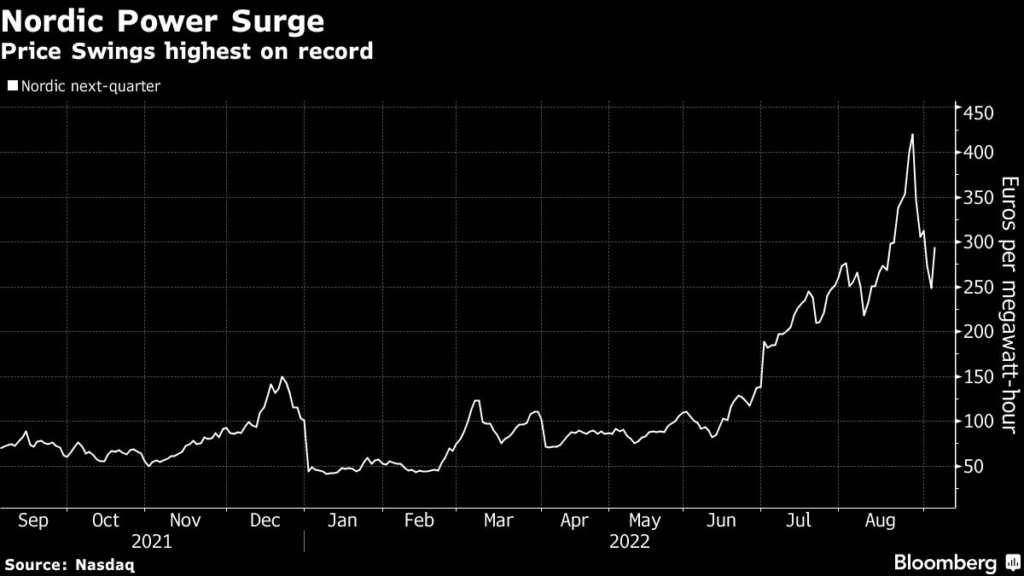
There were fears the market would spiral out of control on Monday after Russia kept its Nord Stream pipeline to Germany shut for the time being. But activity on Monday morning was “relatively calm,” according to Augustsson, with the benchmark next-quarter contract gaining 12% to 280 euros per megawatt-hour. It traded as high as 421 euros on Aug. 26. 

On Sunday, Sweden’s Finance Minister Mikael Damberg had warned that failing to act “could have contagion effects on the rest of the financial market,” even as the “issue is currently isolated to energy producers.” Sweden is home to Nasdaq Clearing AB, which sits at the heart of the Nordic power market, and also acts as the central counterparty for exchange and over-the-counter trades in equity derivatives and fixed income derivatives, among others.

The Finnish motion was sent to lawmakers on Monday as part of a third supplementary budget for 2022. 

“This has, in a way, the ingredients for an energy-industry Lehman Brothers” moment, Lintila said at a news conference in Helsinki on Sunday, referring to the US investment bank whose name has become synonymous with systemic risk after its collapse set off the global financial crisis in 2008.

Sweden is extending as much as 250 billion kronor ($23 billion) in credit guarantees, while Finland’s program worth as much as 10 billion euros ($10 billion) includes loans and guarantees. 

Norway’s government is closely monitoring developments in the financial power market but said it currently sees no need for measures of its own. Denmark is reviewing the situation for its energy companies, newspaper Borsen quoted Business Minister Simon Kollerup as saying.

Collateral Demands

The skyrocketing price of energy in Europe has made it more expensive for utilities to buy and sell electricity, because of the collateral required to guarantee trades. Fortum Oyj said Aug. 29 its collateral rose by 1 billion euros in a week to 5 billion euros, excluding funds posted by its German subsidiary Uniper SE.

The utility welcomed the government action, and said its discussions on liquidity support continue with the Finnish state, its majority owner. It had turned to the state for assistance to secure its liquidity needs until its hedged power contracts go to delivery and collaterals are released. Uniper, which has also sought further liquidity help, is not eligible for funds under the Finnish plan. The German company was bailed out just weeks ago after a massive shortfall in deliveries of natural gas from Russia led to huge losses.

The European Energy Exchange AG has also asked for more government support to traders to guarantee their buying and selling as billions of euros put up as collateral for trades are sapping liquidity and making prices even more volatile.

While the Finnish program has no set limits per company, the European Commission may impose such restrictions, the government said. As many as 30 companies are eligible to seek two-year loans under the plan, and the loans are a last resort after companies have exhausted options from banks and their owners, the government said. Only companies with 100 megawatts of production can partake, or those critical to the functioning of society. 

The Swedish guarantees will be provided by the National Debt Office, and are primarily aimed at Swedish companies, though entities based in other Nordic and Baltic countries can access them during the initial two weeks, or until their governments provide support. The move comes a week ahead of Sweden’s election, in which a constellation of conservative and liberal parties are seeking to unseat the Social Democratic minority cabinet, led by Prime Minister Magdalena Andersson.

The European Union is also preparing to step into the energy market to dampen soaring power costs. European leaders have been working for months to try to offset the impact of Russia’s squeeze on gas — a move they describe as the weaponization of energy. Ministers gathering for an emergency meeting on Friday will discuss measures from natural gas price caps to a suspension of power derivatives trading, according to a draft document seen by Bloomberg News. 

(Updates with Sweden’s parliamentary approval in second paragraph.)

More stories like this are available on bloomberg.com

©2022 Bloomberg L.P.

Close Bitnami banner
Bitnami
