Bloomberg

Once Southeast Asia’s Most Valuable Startup, Grab Falls $13 Billion Behind GoTo

(Bloomberg) — Singapore’s Grab Holdings Ltd., once Southeast Asia’s most valuable startup, is faltering behind GoTo Group in the public markets as it fights to gain ground on its Indonesian ride-hailing rival’s home turf.

The unprofitable companies are both struggling to convince investors of their moneymaking potential after staging their stock-market debuts in recent months. Yet GoTo has fallen less than its competitor and its market value of about $26 billion is now twice that of its Singaporean peer. The companies are each set to report quarterly earnings in the coming days.

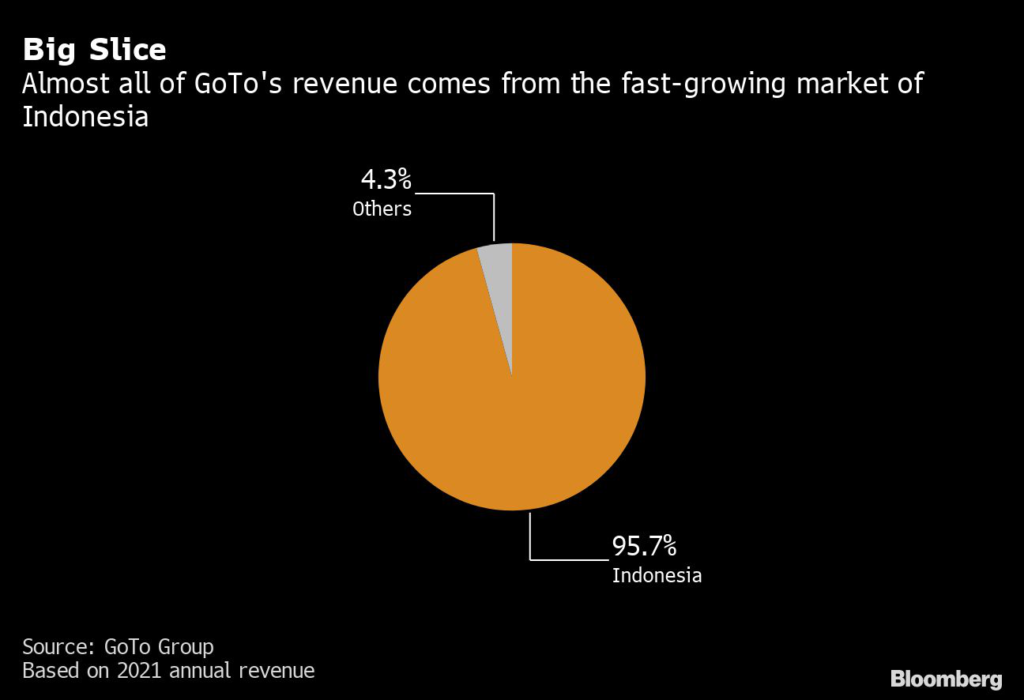
Grab and GoTo have been locked in an expensive battle for dominance over the past several years. Grab still counts the city-state of Singapore as its largest market even as it tries to expand in countries including Indonesia, Southeast Asia’s largest economy. GoTo is enjoying a leadership position in its home nation of more than 270 million people whose mobile-savvy consumers are shopping on its online-retail platform Tokopedia and ordering rides and food via its Gojek’s app.

The growth potential of Indonesia has helped GoTo outperform Grab, which became a publicly traded company through a merger with Brad Gerstner’s Altimeter Growth Corp. in December. GoTo has lost about 3% since its initial public offering in Jakarta in April, while Grab is down more than 60% since combining with the US blank-check company.

“GoTo’s advantage as a homegrown Indonesian brand and its synergy with Tokopedia may let the country’s biggest tech firm defend food-delivery market share from Grab, the category’s leader in Southeast Asia, and improve profitability,” Nathan Naidu, an analyst at Bloomberg Intelligence, said in a July 20 report.

While Gojek has a strong grasp of the crucial Indonesia market, Grab has made inroads in food delivery. Grab had 49% of the Indonesian food delivery market last year, compared with GoTo’s 43%, according to Momentum Works.

Grab is scheduled to report second-quarter results before US markets open on Thursday, while GoTo is set to release results on Aug. 30.

(Updates with Indonesia food-delivery market shares in sixth paragraph)

More stories like this are available on bloomberg.com

©2022 Bloomberg L.P.

Korea Trade Minister to Visit US Amid New Energy Bill Fallout

(Bloomberg) — South Korea’s trade minister will visit the US next month to lobby against President Biden’s new climate and energy tax laws that aim to increase domestic production of electric cars and reduce reliance on China for battery components and materials.

“The US seems to be seeking protection of local industries through the Inflation Reduction Act and the Chips Act,” Minister Lee Chang-yang said in a statement Thursday. The legislation contains “details that would put a burden on our companies, raising concerns in South Korea, Germany and Japan, which are also exporting electric cars to the US.”

Lee also said he expected Korean automakers including Hyundai Motor Co. to aim to speed up construction of new plants in the US while Korean battery makers, some of the biggest in the world, may look to increase investments in mines in countries that have free trade agreements with the US, such as Australia and Chile.

The US law requires carmakers to assemble their EVs in North America but Hyundai doesn’t have any operational electric car plants there at the moment. Meanwhile, all three of Korea’s main battery makers — LG Energy Solution Ltd., SK On Co. and Samsung SDI Co. — import most of their critical minerals from China. According to BloombergNEF, more than 50% of the precious metals needed for EV batteries globally are refined from Asia’s largest economy.

Read more: Hyundai and Korean Battery Makers Bristle at Biden Climate Bill

South Korean President Yoon Suk Yeol has pledged to bolster ties with the US since taking office in May, joining NATO meetings and reviving joint military drills. But his decision not to grant House Speaker Nancy Pelosi an in-person meeting earlier this month after she angered China by visiting Taiwan exposed a possible limit to his commitment to deepen South Korea’s alliance with the US.

Yoon has proposed talks on participating in the Biden administration’s Chip 4 alliance to safeguard the supply of semiconductors, after saying he would prioritize South Korea’s national interests. China’s opposition to the move could blow back on the country’s chip makers.

Lee’s US visit will add pressure after South Korea sent a letter to the US Trade Representative earlier this month expressing concerns that the Inflation Reduction Act may breach the US-Korea free trade agreement and World Trade Organization rules. South Korea also plans to talk with European Union member states, particularly Germany, whose transport companies share similar concerns.

Read more: Battery Giants, Hyundai Concerned by US Moves on China Supplies

Korea’s trade ministry added that the Chips Act has a so-called “guardrail” clause that prevents chipmakers from investing in China for the next decade if they receive incentives from the US. Still, Thursday’s statement said the ministry is seeking further negotiations, with the clause indicating some exceptions may be possible.

More stories like this are available on bloomberg.com

©2022 Bloomberg L.P.

Stocks Up as Traders Mull China Move, Await Powell: Markets Wrap

(Bloomberg) — An Asian stock index rose on Thursday as investors evaluated China’s latest steps to shore up its economy and awaited a key speech by Federal Reserve Chair Jerome Powell about the monetary policy outlook.

The regional gauge added about 0.5%, helped by gains in Japan. Morning trading in Hong Kong was scrapped due to a storm. US futures pushed higher in the wake of positive closes for the S&P 500 and Nasdaq 100.

China stepped up stimulus with a further 1 trillion yuan ($146 billion) of measures for an economy stricken by property-sector woes, Covid-linked mobility curbs and some power shortages. Mainland shares erased early gains, reflecting uncertainty about whether the efforts are sufficient.

Market angst ahead of Powell’s comments is centered on whether he will rebut expectations that slowing growth will temper monetary tightening in the next phase of the campaign against high inflation. 

Treasuries trimmed a slide but the two-year yield remained in sight of 3.40%. A dollar gauge dipped. Crude oil added to a rally that could feed into renewed jitters about whether price pressures have peaked.

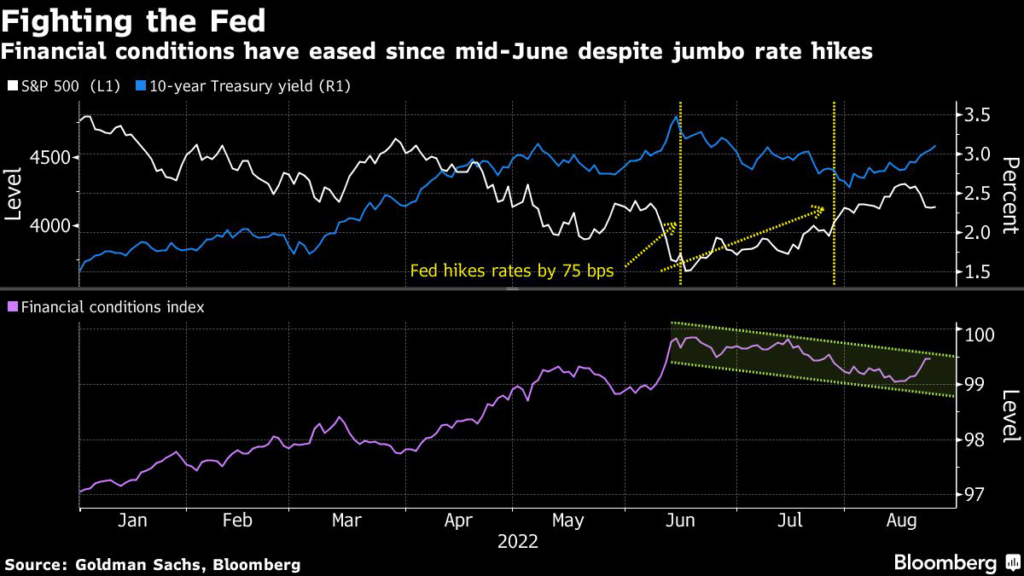
Fed officials in the run-up to Jackson Hole have been clear they see more monetary tightening ahead, a message that’s eroded a bounce in stocks and bonds from mid-June troughs. The tension in markets is whether those assets will continue to head back toward the lows of the year.

Powell on Friday has the opportunity to reset expectations of a pivot and even rate cuts in 2023 and “if there’s anything he’s likely to push back against, it’s that — the fact that rates may have to come down” Anastasia Amoroso, the chief investment strategist at iCapital, said on Bloomberg Television.

South Korea’s central bank raised borrowing costs and projected faster inflation. The won and bond yields advanced. The currency led an Asian basket tracked by Bloomberg.

In Europe, natural gas prices have surged to fresh highs, intensifying an energy crisis that threatens the euro-area economy and hence the global outlook.

Will the meme mania fizzle out? That’s the theme of this week’s MLIV Pulse survey. Click here to participate anonymously.

What to watch this week:

  • US GDP, initial jobless claims, Thursday
  • Kansas City Fed hosts its annual economic policy symposium in Jackson Hole, Wyoming, Thursday
  • ECB’s July minutes, Thursday
  • Fed Chair Powell speaks at Jackson Hole, Friday
  • US personal income, PCE deflator, University of Michigan consumer sentiment, Friday

Some of the main moves in markets:

Stocks

  • S&P 500 futures rose 0.3% as of 11:50 a.m. in Tokyo. The S&P 500 rose 0.3%
  • Nasdaq 100 futures rose 0.3%. The Nasdaq 100 rose 0.3%
  • Japan’s Topix index was up 0.4%
  • South Korea’s Kospi index added 0.9%
  • Australia’s S&P/ASX 200 index gained 0.7%
  • China’s Shanghai Composite index added 0.1%
  • Euro Stoxx 50 futures were little changed

Currencies

  • The Bloomberg Dollar Spot Index fell 0.2%
  • The euro was at $0.9986, up 0.2%
  • The Japanese yen traded at 136.75 per dollar, up 0.3%
  • The offshore yuan was at 6.8602 per dollar, up 0.2%

Bonds

  • The yield on 10-year Treasuries was steady at 3.10%
  • Australia’s 10-year yield climbed seven basis points to 3.70%

Commodities

  • West Texas Intermediate crude rose 0.6% to $95.46 a barrel
  • Gold was at $1,755.86 an ounce, up 0.3%

More stories like this are available on bloomberg.com

©2022 Bloomberg L.P.

EQT, KKR Among Bidders for $10 Billion Global Switch Deal, Sources Say

(Bloomberg) — Private equity firms including EQT AB and KKR & Co. are among bidders shortlisted to buy data center company Global Switch Holdings Ltd., according to people familiar with the matter.

Gaw Capital Partners, PAG and Stonepeak Partners have also been selected to participate in the next round of bidding for the London-based company, the people said, asking not to be identified because the matter is private. Suitors could start conducting due diligence in the coming weeks ahead of a deadline for binding offers, the people said.

Global Switch’s owners including Jiangsu Shagang Group Co. and Avic Trust Co. were poised to kick off a long-awaited sale, which could value the data center company at about $10 billion, Bloomberg News reported in May. Global Switch in June confirmed that its shareholders are exploring a potential divestment following strong international investor interest, while there’s no certainty that any transaction will happen.

Considerations are ongoing and no final decisions have been made, the people said. Some bidders could consider teaming up or not to proceed with the process, they added. 

Representatives for EQT, Gaw Capital, Global Switch, KKR and PAG declined to comment. A representative for Shagang said she has no knowledge of the issue and declined to comment, while a representative for Stonepeak didn’t immediately respond to requests for comment.

Data center companies have been attracting strong takeover interest, in part due to the perception of their having stable returns, and expectations of ongoing growth as people increasingly rely on technology.

Founded in 1998, Global Switch owns and operates 13 data centers in Europe and Asia Pacific spanning about 428,000 square meters, according to its website. It reported 251.4 million pounds ($297 million) in Ebitda for 2021, a 5.8% increase from the previous year, according to its annual report.

Global Switch previously attempted to go public in Hong Kong but aborted the initial public offering plans in 2019. In August of that year, Shagang bought another 24% stake in a 1.8 billion-pound deal from British billionaire brothers David and Simon Reuben, who had begun to whittle down their ownership in 2016. Shagang then became the largest shareholder.

(Adds more background in last paragraph.)

More stories like this are available on bloomberg.com

©2022 Bloomberg L.P.

SoftBank-Backed Agri Startup Turns Unicorn With $2.7 Billion Tag

(Bloomberg) — South Korean agriculture and food trading platform Tridge Co. raised 50 billion won ($37 million) at a 3.6 trillion won valuation, becoming the latest billion-dollar startup in SoftBank Group Corp.’s stable. 

DS Asset Management was the sole investor in the Seoul-based company’s Series D financing, joining earlier backers including SoftBank Ventures and Forest Partners and taking Tridge’s cumulative funding to 150 billion won. 

Founded in 2015 by Shin Hoshik, a former senior portfolio manager for Korea’s $200 billion sovereign wealth fund, Tridge has grown into a global platform for food and commodity trading with about 28,000 sellers and 100,000 buyers. It also operates a fulfillment service that distributes food and other products in 90 countries, saying it helps customers save about 20% on logistics and trading costs. About nine-tenths of its clients are foreign retailers.

Tridge — an amalgam of “transaction” and “bridge” — plans to use the funds to expand overseas and establish new services, it said in a statement to Bloomberg News. It said it seeks to solve problems ranging from supply chain disruption to agricultural inflation.

More stories like this are available on bloomberg.com

©2022 Bloomberg L.P.

Nvidia Gives Weak Forecast, Adding to Concerns Over Chip Slump

(Bloomberg) — Nvidia Corp., which warned earlier this month that its sales were slipping, gave a disappointing forecast for the current period that added to signs of weakness in the semiconductor industry. 

Fiscal third-quarter revenue will be about $5.9 billion, the company said late Wednesday in a statement. That compares with an average analyst estimate of $6.92 billion. Gross margin, the percentage of sales remaining after deducting the cost of production, will be 65%, minus certain items.

Nvidia issued the forecast just two weeks after warning that sales for the latest quarter would come in well below original expectations. The company blamed declining demand for chips used in gaming computers, citing “challenging market conditions.” 

The guidance suggests the tech slump is going to last. After a massive run-up during the Covid pandemic, the chip industry is bracing for a particularly sharp downturn as signs of trouble pile up. World Semiconductor Trade Statistics, a non-profit body that tracks shipments, just lowered its forecast for this year to the weakest pace since 2019.

Shares of Nvidia fell more than 4.7% in extended trading following the announcement. The stock was already down 41% this year through the close, making it one of the worst performers on the Philadelphia Stock Exchange Semiconductor Index.

Chief Executive Officer Jensen Huang said Wednesday that the company is deliberately shipping fewer chips to customers than they’re selling in their products. Nvidia wants to make sure excess inventory is cleared out — and is cutting prices to help — before it introduces new products, he said. 

“We’re going to sell into the market a lot fewer graphics cards than the market is buying to reduce inventory,” he said in an interview. “We should be through that before the end of the year.”

Nvidia’s sales of data-center chips hit a record last quarter, but still fell short of expectations for what has been a promising growth market. The company struggled to obtain enough support chips, including power converters and transceivers, to make as many data center products as it wanted to and that hurt sales. Because of the complexity of the supply chain, sorting out those challenges will take time, Huang said. 

Overall, the drop-off in demand started to hit around June and happened too quickly — driven by inflation’s impact on consumer spending — for the company to respond in time. That left Nvidia and its distributors with too many graphics chips, he said.

“It comes down to gaming and how long this will last,” said Daniel Morgan, a portfolio manager for Synovus Trust Co. “I would guess it’s going to work its way into 2023 because of tough comparisons they have with the big pandemic boom.”

Nvidia had been a growth engine in recent years, outshining other chipmakers. Prior to the three months ended in July, its worst quarter in the previous 10 came in 2021 when it posted a sales increase of 39%. 

Second-quarter revenue grew just 3% to $6.7 billion. And net income declined 72% to $656 million. Excluding some items, earnings came in at 51 cents a share. 

Like many of its peers that outsource manufacturing, Nvidia is contending with a rapid transition from supply shortages — which forced customers to pay in advance to secure what they needed — to having ballooning stockpiles of unsold products.

Nvidia is now saddled with advanced payments it made for materials and the manufacture of products at a time when its own demand is falling and its in-house stockpile of finished chips is growing.

Inventory was $3.89 billion in the latest quarter, up from $2.11 billion at the same point a year earlier. Gross inventory purchase and long-term supply obligations were $9.22 billion — almost double where they were a year earlier. Prepaid supply agreements were $3.14 billion, Nvidia said.

Nvidia’s GeForce graphics chips are a must-have for high-end personal computer owners looking for the most realistic gaming experience. The chips also became popular with digital currency miners, though the crypto rout and changes to the way the asset is mined have undercut that market.

Gaming revenue in the second quarter fell 44% from the previous quarter and 33% from a year earlier to $2.04 billion, Nvidia said, confirming preliminary numbers given earlier this month.

Nvidia’s rise to the top of the US chip industry by market valuation was driven by the explosive growth of its data center business. Owners of large cloud data centers are increasingly using its graphics chips for artificial intelligence computing. While revenue from that division increased 61% to $3.81 billion, it fell short of Nvidia’s projections, the company said. Performance was “impacted by supply chain disruptions.”

(Updates with industry context from fourth paragraph.)

More stories like this are available on bloomberg.com

©2022 Bloomberg L.P.

Singapore’s Genesis Targets $150 Million for Startup Debt Fund

(Bloomberg) — Genesis Alternative Ventures, a private lender to ventures and growth-stage companies, is looking to raise $150 million for a second fund to finance startups across Southeast Asia.

The Singapore-based firm has raised almost half of the fund at first close this month, with commitments from existing investors including Sassoon Investment Corp., Aozora Bank, Korea Development Bank, Mizuho Leasing and Silverhorn, Genesis said in a statement Thursday. Israeli investment firm OurCrowd Ltd. has joined as a new backer.

Venture lending, or loans offered to startups, has attracted growing interest in recent quarters as companies tap the debt market for capital rather than raising money at a lower equity valuation. Valuations for startups have been falling as they gather fresh funds amid stock market volatility, reversing years of soaring growth.

“We are seeing an increasing number of companies coming to venture lenders for debt financing,” Jeremy Loh, co-founder and managing partner of Genesis, said in a joint interview with co-founders Ben Benjamin and Martin Tang. “In the past 24 months, it has been burn, burn, burn to gain market access. Now for many VCs, path to profitability has become a very high priority. The market reset is a good thing in general.”

The company’s first $90 million fund has financed 25 startups from Series A to pre-IPO in Southeast Asia. Its portfolio companies include Sunnyvale, California-based Matterport Inc. and Jakarta-based online lender Akulaku Inc.

More stories like this are available on bloomberg.com

©2022 Bloomberg L.P.
Singtel to Sell Part of Stake in India’s Airtel to Finance 5G

(Bloomberg) — Singapore Telecommunications Ltd. will trim 3.3% of its direct stake in India’s Bharti Airtel Ltd. to raise about S$2.25 billion ($1.6 billion), which it will use to finance its 5G operations and expansion.

Southeast Asia’s biggest telecom operator will sell its stake to Bharti Telecom Ltd., its venture with Bharti Enterprises Ltd., the Singapore company said in a statement Thursday. Singtel is expected to own an effective stake of 29.7% in Bharti Airtel after the deal and have a net gain of about S$600 million.

Singtel has been streamlining its portfolio as it focuses on 5G operations and seeks new growth engines. It’s disposing off an advertising platform and is said to be weighing options including selling its cyber security business Trustwave Holdings Inc. and a possible stake sale in some fiber assets.

Singtel is not the only operator divesting assets. Vodafone Group Plc is divesting bits of its businesses and Japan’s NTT Ltd. is said to be mulling a sale of its controlling stake in an IT services firm.

Apart from funding 5G and growth in the next few years, the deal will “put us in a strong position to grow our dividends in a sustainable way,” Arthur Lang, Singtel’s group chief financial officer, said in the statement. “We remain committed long-term investors having invested approximately S$1.3 billion in Airtel over the last three years,” he said.

More stories like this are available on bloomberg.com

©2022 Bloomberg L.P.
Adam Neumann’s New Venture Could Compete With a Startup He Backed

(Bloomberg) — When the news broke that Adam Neumann’s latest venture, a residential real estate company called Flow, had raised about $350 million from Andreessen Horowitz, the startup’s premise sounded similar to another company Neumann had been involved in: Alfred Club Inc.

Neumann invested in Alfred in 2020, about a year after his ouster as the chief executive officer of WeWork Inc., the co-working company he co-founded. Alfred offers technology and services to improve the experience of renters in apartment buildings—and though details on Neumann’s Flow are scarce, it’s also focused on residential real estate and renters. 

That leaves the founders of Alfred, Marcela Sapone and Jessica Beck, in a tough spot. Their major investor, Neumann, is now running a potential rival. According to Forbes estimates, Neumann still owns about 10% of the company. 

Sapone and Beck spoke for the first time since the news of Neumann’s company in an interview with Bloomberg Television on Wednesday. The co-founders declined to comment on Neumann’s decision to start a competitor, but said that Andreessen Horowitz’s funding was nevertheless a good signal for venture capital interest in residential real estate. 

“Andreessen is a storied firm and fantastic investor, and we’re excited about the attention they’re bringing to the space,” Sapone said. Alfred has always been focused on residential as opposed to other types of real estate, she said. The company originally started as a service that added amenities to apartment buildings and has moved into providing the software to manage buildings. 

Despite Neumann’s spotty track record with WeWork — he was wrapped up in self-dealing, lavish spending and eccentricities, and the company once privately valued at $47 billion now trades at around $3 billion — Andreessen Horowitz has been a vocal backer of his new project. Sapone said Wednesday that she believes investors can benefit from giving female founders their fair shot. “Female-led companies — the ideas are no smaller, and our ability to execute is not less,” she said. “I think there’s a huge arbitrage opportunity for backing female founders.”

More stories like this are available on bloomberg.com

©2022 Bloomberg L.P.
Amid Recession Worries, Steelmakers See Some Signs of Recovery

(Bloomberg) — For all the talk of recession, steel demand in some key markets is showing signs of perking up.

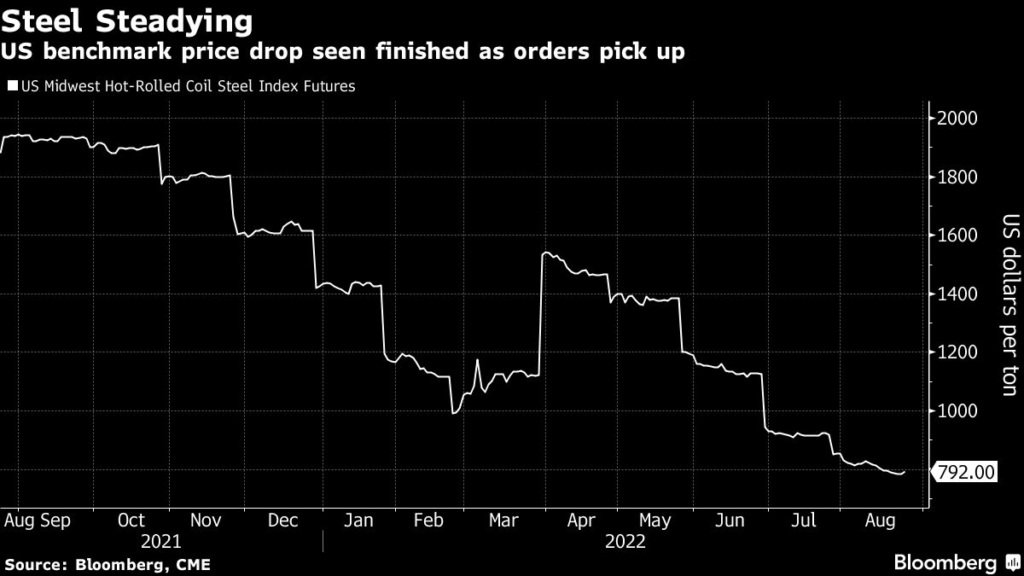
ArcelorMittal forecast consumption in Brazil to double within a decade as the nation tries to fill a huge need for infrastructure, and Stelco Holdings Inc., the biggest Canadian producer, said prices have bottomed following the biggest decline since at least the Great Recession. 

The comments from executives signal glimmers of hope for an industry that depends on demand for building everything from skyscrapers and automobiles to washing machines and tractors. It also offers some optimism for the broader economy that’s been battered by a downturn in China’s vast real estate sector, persistent semiconductor supply-chain issues that have slowed auto production, and an energy crisis in Europe and China that threatens to hobble manufacturing. 

Manufacturing indicators have been uneven, with US business activity contracting one day, capital goods orders rising the next. Caterpillar Inc., one of the world’s largest machinery producers, warned earlier this month of slowing sales in China and across Asia, and Deere & Co. trimmed its annual outlook due to rising costs and supply chains slowdowns. 

Still, within the gloom there are bright spots. Deere cited problems keeping up with orders, and Stelco said its books are again filling up across the Americas. Fellow steelmakers Cleveland-Cliffs Inc. and Steel Dynamics Inc. said that carmakers can’t get enough chips to produce enough vehicles to meet consumer needs. Construction, while currently weak, could be on the verge of getting a boost as soon as early 2023 from the US infrastructure bill, said Ken Simonson, chief economist for the Associated General Contractors of America.

Prices are likely to trade between $650 to $850 per ton by the end of the year from $792 Wednesday, according to steel executives, service centers, traders and analysts surveyed at two of the world’s largest steel conferences this week in Atlanta and Brazil. 

“There was a lull in the beginning of July and of late, things have been moving pretty quickly in terms of the order book,” Stelco Chief Executive Officer Alan Kestenbaum said Tuesday in a phone interview. “Things are going to stay steady as we get to the end of the year, and I don’t see any further breakdown in price.”


More stories like this are available on bloomberg.com

©2022 Bloomberg L.P.
Close Bitnami banner
Bitnami