
Bloomberg

Tesla Split Will Struggle to Feed $280 Billion Rally: Tech Watch

(Bloomberg) — After a $280 billion rally since late May, Tesla Inc. is using a trusted method for fueling further gains. It may not pan out like that.

The electric vehicle maker’s second stock split in as many years takes effect when US markets open on Thursday, a move aimed at bolstering an already strong retail investor base. The previous one in 2020 was among a number of factors that drove the stock up more than eightfold that year.

The latest split comes close on the heels of similar moves by Amazon.com Inc. and Alphabet Inc., whose subsequent stock performances have suggested this once dependable tactic to boost valuation is losing its potency amid the ravages of a bear market. Amazon shares fell more than 10% from when it announced the split to the day it became effective, while Alphabet lost 21% between those events.


“The stock split smoke-and-mirror boost is much more prevalent in a bull market when retail investors rush into stocks,” said Greg Martin, managing director and co-founder of Rainmaker Securities. “In bear markets retail investors tend to be less involved and the institutional players would never be fooled by a stock split to move into a stock.”

Shares of the Elon Musk-led company are down 12% since late-March when it declared its plan for a split, a far cry from 2020 when the stock surged 60% from announcement to the last close prior to the beginning of split-adjusted trading. Tesla traded at $303.04 as of 4:12 a.m. in New York premarket trading, up from a prior close of $297.10 when adjusted for the split.

Riskier growth stocks like Tesla have borne the brunt of a souring equities market mood this year amid the threat of a recession. The stock is down 16% year-to-date, headed for its first annual decline since 2016. And having rallied 42% through Wednesday’s close since hitting a year low on May 24, the rebound has hit a wall in August as broader enthusiasm among retail investors has started to flag again.

According to Vanda Research, investors tend to “drastically scale back” purchases of stocks in the weeks after a split takes effect. The firm doesn’t believe it will be any different for Tesla this time round, it said in a note.

Highly Valued

In addition to a tentative investor mood, the stock’s eye-watering valuation may also make gains harder to come by. Tesla trades at about 57 times forward earnings estimates compared with 17 times for the S&P 500 Index. And the average analyst price target implies a decline of about 3% over the next 12 months, even as the benchmark index is expected to rise more than 15%.

“There is a lot of hope, speculation, hero worship in the current valuation,” said Catherine Faddis, chief investment officer of Grace Capital. In order to buy the stock right now, an investor needs to believe that in 10 years Tesla will have revenue of $800 billion, Faddis said, almost 10 times estimates for this year.

Then there is the company’s litany of challenges — production troubles in China, the persisting supply-chain shortages across the automotive industry and high raw material costs, as well as Musk’s litigation with Twitter Inc. — that can dull the shine of any potential exuberance driven by the split.

Still, Tesla’s strong popularity with the mom-and-pop investing crowd can ensure a short-term bump in the stock, if wider investor sentiment improves again.

“A strong retail following is the key ingredient for a stock split to make a difference,” said Martin of Rainmaker Securities, adding that Tesla’s timing for the split may prove to be lucky as the climate act will “create substantial new demand for electric vehicles and Tesla is the market leader in the EV market.”

Tech Chart of the Day

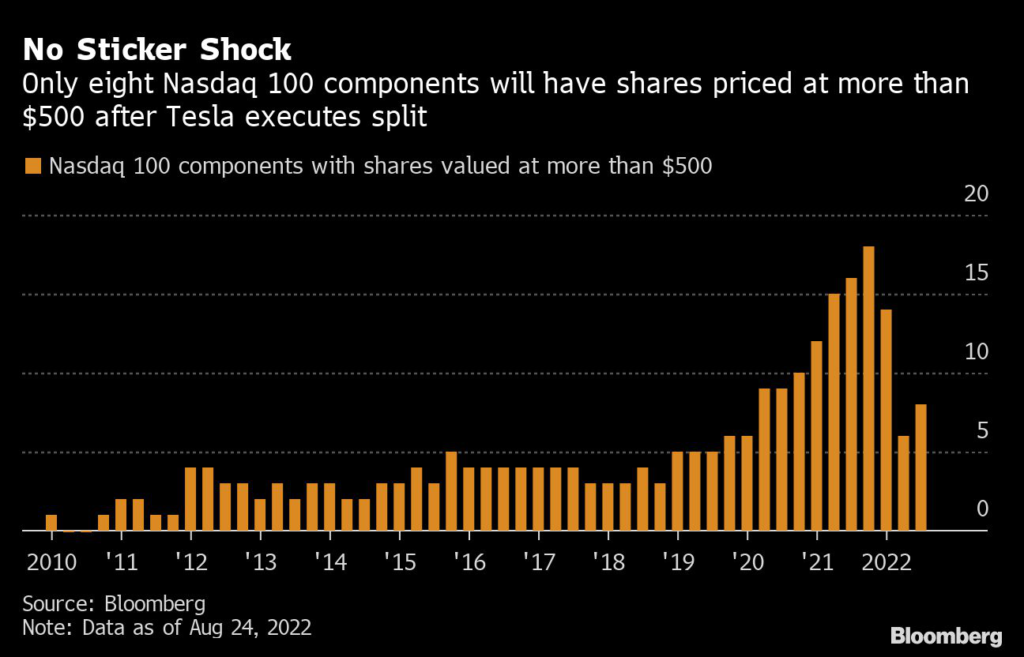
When Tesla executes its split there will be only eight Nasdaq 100 components with stocks priced at more than $500. This year’s market selloff, coupled with a series of splits, has meant that the number of companies with share prices exceeding $500 has halved from the beginning of the year.

Top Tech Stories

  • Nvidia Corp., which warned earlier this month that its sales were slipping, gave a disappointing forecast for the current period that added to signs of weakness in the semiconductor industry.
  • Pinterest Inc. is facing an investigation by the California Civil Rights Department, the company confirmed, after a number of employees brought forward discrimination claims in recent years.
  • Salesforce Inc. gave a forecast for quarterly revenue that fell short of analysts’ estimates, suggesting that a choppy economy may be causing some customers to slow spending on business software. The shares declined in extended trading.
  • Snowflake Inc. surged in late trading after its forecast for quarterly sales topped analysts’ estimates, reassuring Wall Street that companies are still investing in their technology systems to boost efficiency.
  • Amazon.com Inc. is closing its primary care and telehealth service, a sudden move that follows the company’s deal to buy the One Medical chain of clinics.
  • Singapore’s Grab Holdings Ltd., once Southeast Asia’s most valuable startup, is faltering behind GoTo Group in the public markets as it fights to gain ground on its Indonesian ride-hailing rival’s home turf.
  • South Korean agriculture and food trading platform Tridge Co. raised 50 billion won ($37 million) at a 3.6 trillion-won valuation, becoming the latest billion-dollar startup in SoftBank Group Corp.’s stable.
  • Nidec Corp. President and Chief Operating Officer Jun Seki is planning to leave the electric-motor maker ahead of a management overhaul by founder Shigenobu Nagamori, 77, people with knowledge of the matter said.

More stories like this are available on bloomberg.com

©2022 Bloomberg L.P.
Nidec’s COO to Resign After Being Sidelined by Founder Nagamori

(Bloomberg) — Nidec Corp. President and Chief Operating Officer Jun Seki is planning to leave the electric-motor maker ahead of a management overhaul by founder Shigenobu Nagamori, 77, people with knowledge of the matter said, underscoring the Japanese company’s struggles to put in place a succession plan.

Seki, 61, who was demoted from chief executive officer earlier this year, is being stripped of further responsibilities and being excluded from key communication among managers at the company, the people said. He plans to leave Nidec by the end of September and Vice-Chairman Hiroshi Kobe, 73, will take his place, according to some of the people, who asked not to be identified discussing non-public information. The new structure is scheduled to be announced early next month.

The world’s top supplier of motors for everything from hard drives to power plants is facing a worsening global economic outlook and needs to prepare by putting in place leaders with deep experience within the company, Nagamori told senior managers, according to one of the people.

In a statement, Nidec said that it wasn’t the source of information on Seki, and that the management revamp hasn’t been announced or decided. Nidec’s shares fell 2.4% on Thursday following the news, the most in a more than a month. 

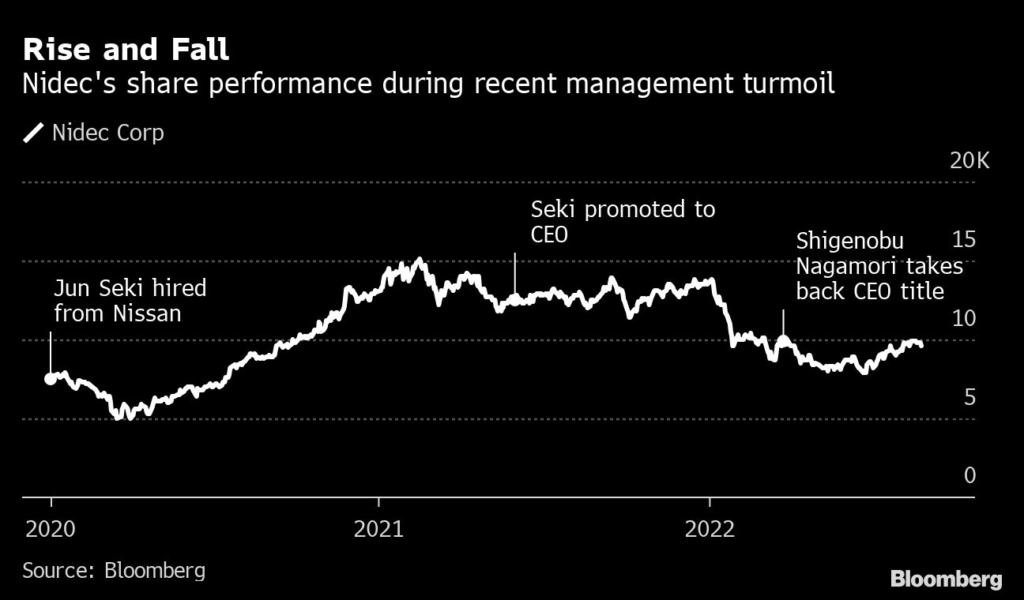
The revamp is the latest chapter in a turbulent period for Nidec. Nagamori brought in Seki, 61, a former Nissan Motor Co. executive, in 2020 as his successor and promoted him to CEO last year. Yet, after 10 months, Nagamori took back the reins amid what he described as lackluster performance at the company he founded in a shack in 1973. Although Nagamori has built a solid reputation turning the manufacturer into one of Japan’s biggest companies, for years he has struggled to find a successor.

In an interview with Bloomberg News last month, Nagamori vowed to remain at Nidec until he’s restored its shares to a record and put it on a path of steady growth. “Every day I was in agony” as the stock lost a third of its value after Seki’s appointment, Nagamori said. “The company’s performance was getting worse and worse.” 

When asked about the adoption of a new management structure Tuesday, Nagamori confirmed that plans were in place but declined to comment on Seki’s future. Seki didn’t respond to multiple requests for comment. 

A billionaire who is Nidec’s top individual shareholder, Nagamori is concerned about the global outlook and is seeking out trusted allies within the company to fight a recession head-on, according to the people. That will involve aggressive cost cuts and inventory management, as well as boosting new products and productivity, they said. 

Nidec’s travails reflect a wider dilemma across Japan’s corporate landscape, as leaders who came of age during the country’s economic boom run their company well into years when most people retire. It’s not the only company grappling with succession. Despite promising to retire at 65, Uniqlo founder Tadashi Yanai, now 73, still runs Fast Retailing Co. with a tight grip. Masayoshi Son, SoftBank Group Corp.’s 65-year-old founder and CEO, has parted ways with several potential successors in high-profile exits in recent years. 

The current saga began almost a year ago, when Nagamori began sounding alarms about Nidec’s performance. After Bloomberg News reported in January that the founder had soured on Seki and was taking steps to sideline his chosen CEO, local media reported that investors had gone to Nagamori to express concern about the succession turmoil and urged him to resolve the issue. Even so, Nagamori took back the CEO job in April and put Seki in the role of COO, overseeing the company’s automotive business. 

Despite Nagamori’s concerns, the manufacturer posted record profit and sales for the fiscal year that ended in March. Even so, the company’s shares are down about 30% this year, following a 4.1% climb in 2021. 

Nagamori’s goal, according to the July interview, is to restore Nidec’s share beyond its 2021 record of 15,175 yen and reach 20,000 yen in two years, at the latest — roughly double current levels. 

Analysts and investors have warned for years Nidec could lose its “Nagamori premium” without an orderly succession process. Potential CEO replacements brought in before Seki eventually left the manufacturer after the founder soured on their prospects.  

In the interview last month, Nagamori said that he can’t accept handing off Nidec and seeing it stumble as long as he’s alive. He turns 78 next week. 

“I built this company from the ground up and Nidec is like a part of my body,” he said then. “If the company were to become a failure it’d be like a physical wound for me.”

(Updates with company statement.)

More stories like this are available on bloomberg.com

©2022 Bloomberg L.P.
Hong Kong Short Squeeze Is Rising Risk for Morgan Stanley Quants

(Bloomberg) — The amount of bearish bets against Hong Kong stocks has risen to levels that could trigger a surge in share prices as traders rush to close out their positions, according to quantitative analysts at Morgan Stanley.

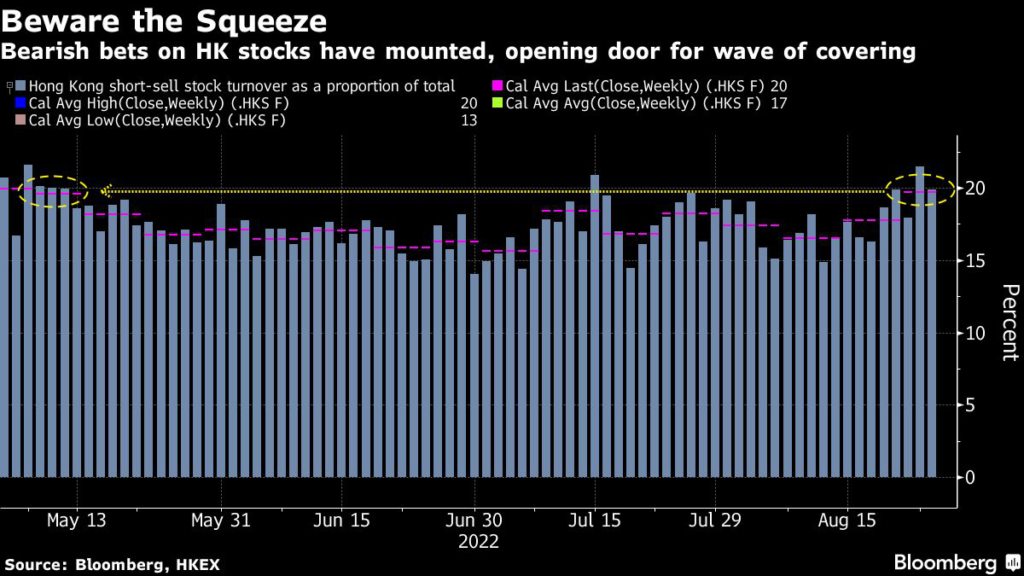
Hedge funds and other short sellers say they’re either covering bearish wagers or planning to do so, strategist Gilbert Wong wrote in emailed comments Wednesday. Short-selling activity was running at just under 20% of total turnover on the city’s stock market this week, a level not seen since May, calculations by Bloomberg based on exchange data showed. 

“We believe the risk of short squeeze in China and Hong Kong equities is rising,” Wong said. “Stay alert.”

Betting against Hong Kong’s stock market has proven to be a profitable trade this year, with the Hang Seng Index down over 20% at its low point in March on fears of an economic slowdown and regulatory overreach. Global investors are so underweight Chinese assets that bearish equity bets were considered one of the most-crowded trades in Bank of America Corp.’s investor survey earlier this year.

But it can also be a perilous one — in the middle of that month, a coordinated pledge from China’s top regulators to address investor concerns triggered a two-day, 17% surge in the benchmark.

Theories on what could lead to a rebound this time range from beaten-down valuations, low positioning after August redemptions and signs of increased stimulus from Beijing. The Hang Seng climbed as much as 3.3% Thursday after China announced additional measures to boost infrastructure spending. The Hang Seng Tech index rallied 5.3%, with Alibaba Group Holding Ltd. surging 8.1%.

While short-covering flows may have little to do with fundamental changes in the outlook for Chinese equities, some investors are behaving like the best of the bearish-China trade is behind them.

“They believe further market downside is limited from current levels because positioning is low and very defensive,” said Wong.

More stories like this are available on bloomberg.com

©2022 Bloomberg L.P.
Singtel to Sell Part of Stake in India’s Airtel to Fund 5G

(Bloomberg) — Singapore Telecommunications Ltd. will trim 3.3% of its direct stake in India’s Bharti Airtel Ltd. to raise about S$2.25 billion ($1.6 billion), which it will use to finance its 5G operations and expansion.

Southeast Asia’s biggest telecom operator will sell its stake to Bharti Telecom Ltd., its venture with Bharti Enterprises Ltd., the Singapore company said in a statement Thursday. Singtel is expected to own an effective stake of 29.7% in Bharti Airtel after the deal and have a net gain of about S$600 million.

“This is the largest monetization Singtel has done so far and it was to illuminate the value that we hold across our associate companies that are long-term strategic investments,” Arthur Lang, group chief financial officer, said in an interview. The company continues to work toward unlocking value to shareholders and is reallocating capital to areas of growth under its already announced strategic review plan, Lang said. 

Singtel has been streamlining its portfolio as it focuses on 5G operations and seeks new growth engines. It’s disposing off an advertising platform and is said to be weighing options including selling its cyber security business Trustwave Holdings Inc. and a possible stake sale in some fiber assets.

Singtel is not the only operator divesting assets. Vodafone Group Plc is selling bits of its businesses and Japan’s NTT Ltd. is said to be mulling a sale of its controlling stake in an IT services firm.

Singtel shares rose as much as 2.3% in Singapore — their biggest intraday jump in more than a week — while those of Bharti Airtel rose almost 4% in Mumbai before paring some gains. 

Apart from funding 5G and growth in the next few years, the deal will “put us in a strong position to grow our dividends in a sustainable way,” Lang said in the statement. “We remain committed long-term investors having invested approximately S$1.3 billion in Airtel over the last three years.”

(Adds CFO comments from interview in third paragraph)

More stories like this are available on bloomberg.com

©2022 Bloomberg L.P.

UK Intervenes in Veolia’s Deal for Suez: The London Rush

(Bloomberg) — Here’s the key business news from London-listed companies this morning.

Competition and Markets Authority: The UK’s markets regulator will unwind Veolia Environnement’s deal for Suez in the UK, asking the waste and water management company to sell three businesses. 

  • The CMA said the sales will protect councils and businesses from probable higher prices and lower-quality services 

CRH Plc: The building materials company managed to improve its earnings and margins in the first half of the year, despite what they called a “challenging and volatile cost environment.”

  • The company expects its European operations to continue to be impacted by inflation and macroeconomic uncertainty, but despite this expects full-year Ebitda higher than last year 

Hays Plc: Strong labour markets and wage inflation have buoyed the recruiting company’s full-year results, delivering what it says are record fees and “material” profit growth. ​​​​​​

Outside The City

Boris Johnson announced a £54 million support package for Ukraine, on his third visit to Kyiv since Russia launched its full scale invasion of the country. Johnson promised to provide thousands of drones and missile systems, taking the total military and financial aid provided by the UK since February to £2.3 billion. Elsewhere, The Resolution Foundation and British Chambers of Commerce called for Covid-style emergency support from the UK government to deal with high energy costs in two separate proposals.

In Case You Missed It 

Fertilizer producer CF Industries Holdings Inc. will halt ammonia production at its remaining UK plant in response to soaring natural gas prices, a move that could reduce carbon dioxide supply crucial to the food industry.

Schneider Electric SE said it’s considering a bid to buy out minority shareholders of industrial software developer Aveva Group Plc. Meanwhile,  Rio Tinto Plc boosted its offer for miner Turquoise Hill Resources Ltd to $3.1 billion as it moves to gain more control of a giant copper mine in Mongolia. Shares for both target companies jumped in trading yesterday.

Looking Ahead

Energy regulator Ofgem will announce its price cap on Friday, finally providing clarity to millions of households worried about the cost of their energy bills this winter. The news is expected to be grim, piling pressure on whoever will be the next prime minister to take swift action to ease the burden.

At least the country has the August bank holiday to look forward to, albeit with travel disruption hitting London’s Notting Hill Carnival. 

The Readout with Allegra Stratton will be back from its summer break on Aug. 30. In the meantime, here’s what Bloomberg journalists are reading this summer. 

More stories like this are available on bloomberg.com

©2022 Bloomberg L.P.
Bitcoin Options Signal Risk of Another Drop in Largest Token

(Bloomberg) — Bitcoin may be poised for another downward move if a slew of technical insights are on the mark.

The largest cryptocurrency by market value has retreated more than 50% this year and recently has been sitting in a range of about $19,000 to $25,000, contained by tightening monetary settings. It was little changed at about $21,566 as of 6:51 a.m. in London on Thursday. 

Options data show some investors are paying a premium for protection against a possible fall below the lower bound of the trading range. Seasonal patterns, meanwhile, peg September as a testing month for the digital token.

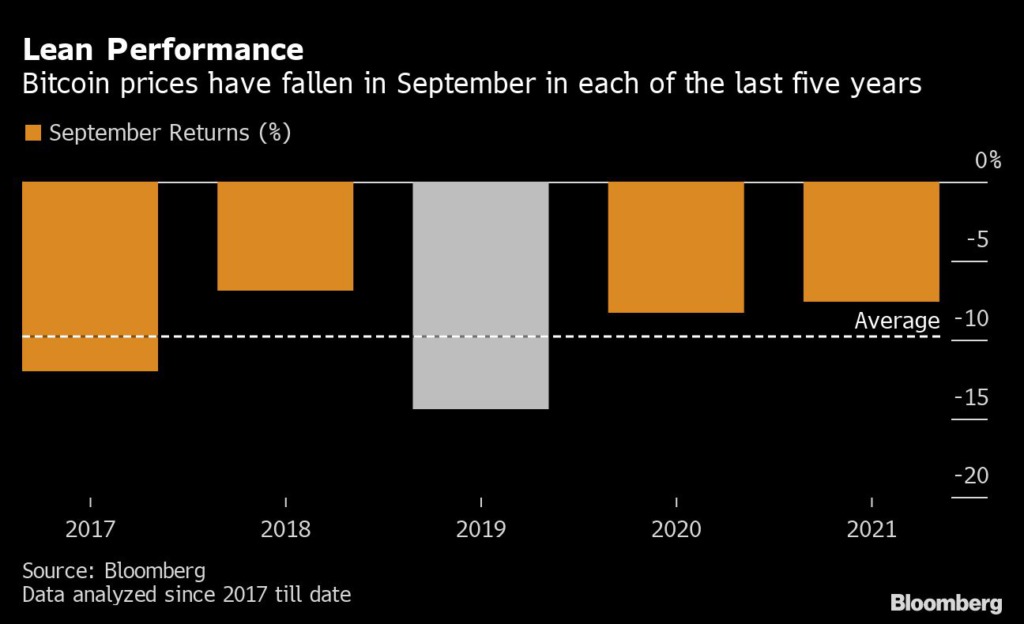
Here are four charts that bode ill for the original cryptocurrency:

Option Demand

Traders are paying a lot more for protection below $18,000. Implied volatility skew shows that traders are willing to pay elevated premiums for deep out-of-the-money puts — the jump is particularly steep closer to the $15,000 strike, which has the second-highest concentration of puts for the September expiry.

Seasonality

September tends to be the worst month for Bitcoin, seeing an average price drop of about about 10% over the last five years.

Open Interest

Data for options contracts expiring at the end of September show that $20,000 is the strike price with the maximum open interest, so a sustained break below there may force put sellers to hedge their positions, pressuring prices further and bringing the June lows back into focus.

Underperforming 

Bitcoin has been lagging behind No. 2 token Ether, which recently got a lift from a coming software upgrade of the Ethereum network to make it more efficient. A ratio of the virtual coins’ prices is testing a zone of support, and a break below would suggest further Bitcoin underperformance.


(Updates prices from the second paragraph.)

More stories like this are available on bloomberg.com

©2022 Bloomberg L.P.
Stocks Up Amid China Stimulus, Countdown to Powell: Markets Wrap

(Bloomberg) — An Asian stock index rose Thursday as China’s latest steps to shore up its economy steadied some nerves in the anxious wait for a key speech by Federal Reserve Chair Jerome Powell at the Jackson Hole meeting.

The regional gauge increased about 1%, paced by Hong Kong after a delayed start to trading there due to a storm. US and European futures pushed higher in the wake of positive closes for the S&P 500 and Nasdaq 100.

China stepped up stimulus with a further 1 trillion yuan ($146 billion) of measures for an economy stricken by property-sector woes, Covid-linked mobility curbs and some power shortages. Mainland share gains lagged, suggesting uncertainty about whether the efforts are sufficient.

Angst ahead of Powell’s comments due Friday is centered on whether he will rebut expectations that slowing growth will temper US monetary tightening in the next phase of the campaign against high inflation. 

Treasuries held a slide and the two-year yield remained in sight of 3.40%. A dollar gauge dipped. Crude oil added to a rally that could feed into renewed jitters about whether price pressures have peaked.

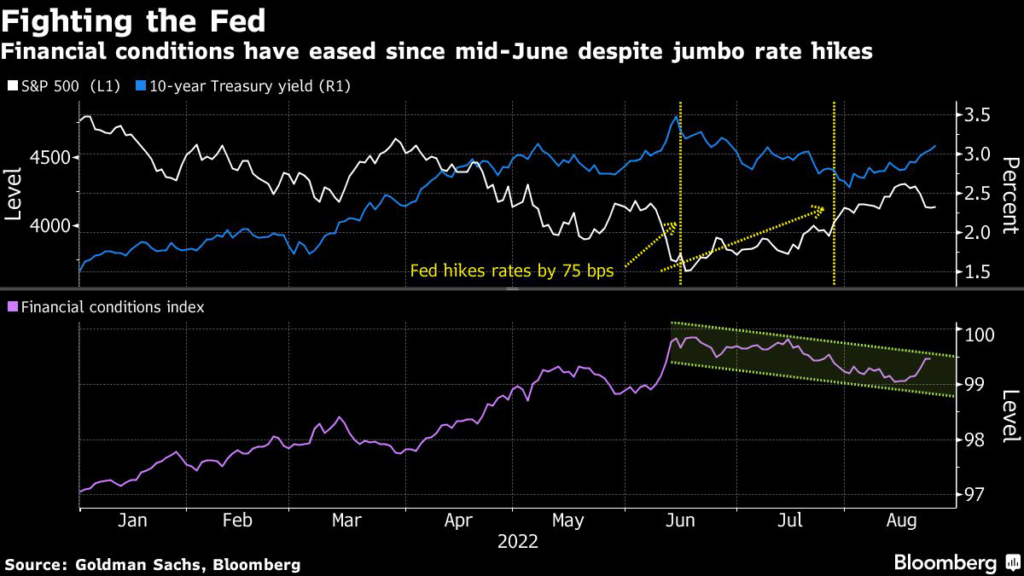
Fed officials in the run-up to Jackson Hole have been clear they see more monetary tightening ahead, a message that’s eroded a bounce in stocks and bonds from mid-June troughs. The tension in markets is whether those assets will continue to head back toward the lows of the year.

“The market is really trying to justify a bear market rally and is looking for that dovish pivot from the Fed and it’s unlikely to get that,” Mehvish Ayub, senior investment strategist at State Street Global Advisors, said on Bloomberg Television. “We have to continue to expect this volatility, not just ahead of Jackson Hole, ahead of any sort of narrative from Fed officials.”

South Korea’s central bank raised borrowing costs and projected faster inflation. The won and bond yields advanced. The currency led an Asian basket tracked by Bloomberg.

In Europe, natural gas prices have surged to fresh highs, intensifying an energy crisis that threatens the euro-area economy and hence the global outlook.

Will the meme mania fizzle out? That’s the theme of this week’s MLIV Pulse survey. Click here to participate anonymously.

What to watch this week:

  • US GDP, initial jobless claims, Thursday
  • Kansas City Fed hosts its annual economic policy symposium in Jackson Hole, Wyoming, Thursday
  • ECB’s July minutes, Thursday
  • Fed Chair Powell speaks at Jackson Hole, Friday
  • US personal income, PCE deflator, University of Michigan consumer sentiment, Friday

Some of the main moves in markets:

Stocks

  • S&P 500 futures rose 0.4% as of 7:00 a.m. in London. The S&P 500 rose 0.3%
  • Nasdaq 100 futures rose 0.4%. The Nasdaq 100 rose 0.3%
  • Japan’s Topix index was up 0.5%
  • South Korea’s Kospi index added 1%
  • Australia’s S&P/ASX 200 index gained 0.7%
  • China’s Shanghai Composite Index climbed 0.2%
  • Hong Kong’s Hang Seng Index surged 1.6%
  • Euro Stoxx 50 futures rose 0.2%

Currencies

  • The Bloomberg Dollar Spot Index fell 0.2%
  • The euro was at $0.9992, up 0.3%
  • The Japanese yen traded at 136.71 per dollar, up 0.3%
  • The offshore yuan was at 6.8584 per dollar, up 0.3%

Bonds

  • The yield on 10-year Treasuries was at 3.10%
  • Australia’s 10-year yield climbed four basis points to 3.67%

Commodities

  • West Texas Intermediate crude rose 0.4% to $95.25 a barrel
  • Gold was at $1,756.92 an ounce, up 0.3%

More stories like this are available on bloomberg.com

©2022 Bloomberg L.P.
Sneaker Maker Taking on Nike Leads Growth of Top Chinese Brands

(Bloomberg) — A sportswear company founded by an Olympic gold medalist saw the biggest surge in growth in a ranking of the 100 most valuable brands in China this year.

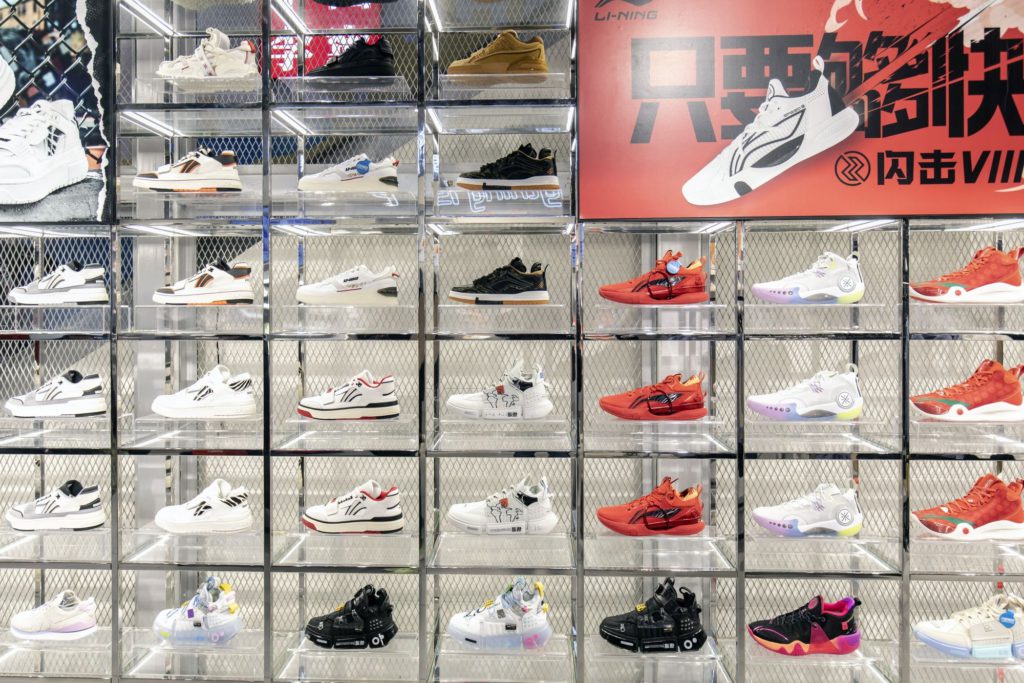
Athletic apparel maker Li Ning Co. had its brand value jump 66% to $3.4 billion, the quickest pace in the annual list compiled by Kantar BrandZ. Its rise was fueled by technical innovations and patriotic styling, the report said, with the latter feeding into a growing wave of consumer nationalism in China that’s unseated global companies like Nike Inc.

Read more: Nationalism in China Has Dethroned Nike and Adidas

The total value of China’s top 100 brands fell 20% to $1.24 trillion, as supply chain disruptions to rising inflation and Covid lockdowns challenged the business environment. Other key trends and major moves in the Kantar report include:

  • There are 47 brands building their value outside of China, up from 40 in 2021. They include consumer technology brand TCL, no. 94 in the ranking, which has signed endorsement contracts with FIBA, Copa América, and several international sports stars. The Top 100 brands’ overseas operations contribute 8.8% to their business.
  • Lifestyle-focused social platform Xiaohongshu was the highest-ranking new entrant to the list, coming in at no. 37 with a brand value of $6.6 billion. Social-commerce, a sales channel that allows users to buy products through social media and interact with live streamers, is an important tool for China’s Gen Z shoppers.
  • Home-appliance maker Haier Smart Home Co. rose two places to break into the top 10, with 26% growth in brand value due to global expansion and innovation.
  • Electric-vehicle giant BYD Co. was ranked no. 29, with a brand value of $8.7 billion.

Tencent Holdings Ltd. retained the top spot for a second year, Alibaba Group Holding Ltd. came in at no. 2, and liquor company Kweichow Moutai Co. rounded out the top three. 

Kantar BrandZ uses financial data and brand equity research to quantify the contribution of brands to business’ financial performance. It looks at brands that were originally created in mainland China; companies must be owned by a publicly traded enterprise, or financial records of the firm that owns the brand are audited by a major global accountant and published publicly; and unicorn brands must have their most recent valuation publicly available.

More stories like this are available on bloomberg.com

©2022 Bloomberg L.P.
Klarna’s Earnings to Show How New Credit Firms Cope Under Stress

(Bloomberg) — Klarna Bank AB went through one of the most dramatic “down rounds” in history last month as some investors took fright at its costly global growth spurt. The Swedish fintech will reveal next week whether they’re right to worry.

The buy-now-pay-later giant, familiar to Gen Z and millennials as a way to spread the cost of online purchases, was Europe’s biggest startup with a value of $45.6 billion last year. It’s worth $6.7 billion today. Klarna and its 150 million-and-counting customers are facing budget pressures as the firm prepares to publish its half-year results. 

“Rising rates due to higher inflation and liquidity drying up has stressed the BNPL business model and actually tested it for endurance,” said Anton Alikov, founder of New York-based Arctic Ventures, which holds shares in Klarna. The $800 million that Klarna just raised may not be enough to get the firm to profitability, he added. 

With financial markets in upheaval after Russia’s invasion of Ukraine and supply chains strained globally, many companies have decided against raising money this year. Klarna took the plunge as it seeks worldwide expansion along with more sustainable operating costs, having announced in May that it would jettison 10% of its workforce to brace for the “likely recession.”

Cash Burn

Before its fundraising, Klarna was burning through cash. Its reserves dropped by 7.3 billion Swedish kronor ($685 million) to 11.6 billion kronor in the first quarter. At that rate, even with its recent cash injection, the firm would run out by the end of 2022. 

Administrative expenses were 4.7 billion kronor in the first quarter, while credit losses were 1.2 billion kronor, both up steeply and contributing to a 2.6 billion-kronor loss for the period. 

“The two big problems for Klarna are credit losses and administrative expenses — employee salaries, offices — the cost of actually running the business,” said Chris Dinga, a payments analyst at GlobalData. “I don’t see how they can be profitable while these expenses are so high.”

Still, the company’s backers are confident in its prospects. British growth fund Chrysalis Investments — which first invested in Klarna in August 2019 — said the recent funding round “does not reflect Klarna’s progress” in the past three years. 

The firm has built a “dominant market position in several territories” and now has the capital to reach profitability, Richard Watts, co-portfolio manager, wrote in a note to his investors around the time of the downround. In a note this week Chrysalis said it had written down its investment by 78% but remained bullish.

Klarna Chief Executive Officer Sebastian Siemiatkowski said after the fundraising that the company was profitable for the first 14 years of its existence, noting on Twitter that the company has invested for growth in the US. 

Default Factor

As Europe and the US face sustained pressure on living costs, borrowers are continuing to spend and successfully repay their debts for now. However, there are some signs of potential distress, such as customers using interest-free loans for essentials. 

Michael Taiano, a fintech analyst for Fitch Ratings Inc. said there will be more demand for buy-now-pay-later on everyday purchases. “It’s a dangerous game — you see your loan volume pick up but if unemployment ticks up, this becomes defaults and that’s going to be a challenge,” he said. “We expect consumer delinquencies to increase and a lot of BNPL tends to play at the lower end of the credit spectrum, which is just more vulnerable to defaults.”

Klarna’s chairman, Michael Moritz, said in July that the business was at its strongest since his investment firm Sequoia Capital first invested in 2010. He blamed other venture capitalists for acting in the “opposite manner” during the fundraising after initially supporting the sector. “Eventually, after investors emerge from their bunkers, the stocks of Klarna and other first-rate companies will receive the attention they deserve,” said Moritz.

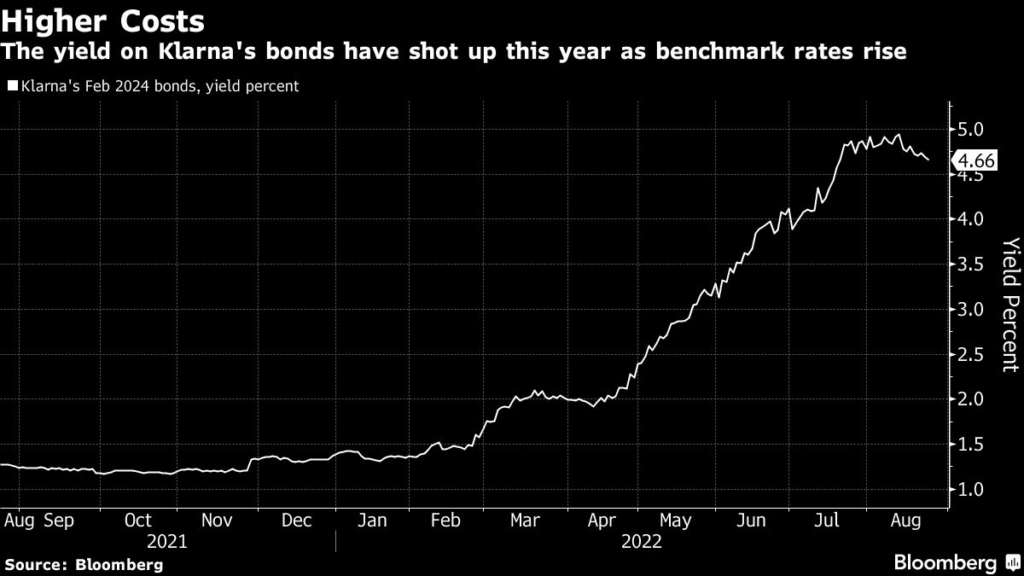
Others remain unconvinced that the buy-now-pay-later model will survive in its current guise, reliant on thin margins fuelled by cheap funding. Klarna offers interest free loans to customers and instead effectively charges the merchant anywhere between 2% and 4% — a decent margin when borrowing costs were on the floor. But in the past few weeks, the effective yield on Klarna’s February 2024 floating rate bonds approached 5%, according to data compiled by Bloomberg.

“They were able to benefit from a low interest rate environment and the cost of funding those loans was very, very low,” said Jeff Tijssen, head of global fintech at Bain & Co. “But rates have been rising quite significantly and they operate at razor thin margins. It’s fundamentally harder to build a profitable business that is sustainable.”

Klarna has cushioned itself from some of this risk by collecting deposits in savings accounts offered to customers in Sweden and German, which it can then use to fund credit. However, this backstop could also face challenges, in the form of more attractive rates offered by competitors as central banks raise benchmarks sharply to counteract inflation. 

Meanwhile, the likes of JPMorgan Chase & Co. and Apple Inc. in the US and NatWest Group Plc, Barclays Plc and HSBC Holdings Plc are entering the market with similar products.

“The competitive landscape has changed dramatically,” said Tijssen. “If you’re a pureplay BNPL firm, the future is very, very challenging.” 

What Bloomberg Intelligence Says: 

Klarna, Revolut, Monzo and Starling epitomize the breadth of product offerings and growth, now slowing rapidly, that fintechs have delivered. Future fundraisings and updated business plans must focus less solely on growth and incorporate efficiency, with down rounds — when a company raises funds by selling shares valued lower than previous raisings — still likely.

Jonathan Tyce, senior analyst, European banks and payments

More stories like this are available on bloomberg.com

©2022 Bloomberg L.P.

Pinterest Faces Investigation by California Civil Rights Agency

(Bloomberg) — Pinterest Inc. is facing an investigation by the California Civil Rights Department, the company confirmed, after a number of employees brought forward discrimination claims in recent years.

An agency attorney on Tuesday emailed several former employees, including Ifeoma Ozoma, who went public in 2020 with allegations of underpayment and racial discrimination. “CCRD is conducting an investigation into Pinterest Inc. and you have been identified as a potential witness,” the email says, according to a copy viewed by Bloomberg.

Pinterest confirmed the inquiry, which was earlier reported by Protocol.

“The California Civil Rights Department (CCRD) is conducting investigations of a number of companies, and Pinterest is one of them,” the company said in a statement Wednesday. “Our discussions with the CCRD are ongoing and we remain committed to reviewing and evolving our people practices to best support our employees.” 

In late 2020, Pinterest paid $20 million to settle a gender-discrimination case brought by former chief operating officer Francoise Brougher. She alleged she was paid less than her male peers, excluded from the company’s initial public offering process and eventually fired for speaking out about discrimination. 

She came forward after the public statements by two Black women, Ozoma and Aerica Shimizu Banks, who said they were underpaid and that the company’s human resources department had dismissed their claims of discrimination. Pinterest has previously said it investigated those cases and found no wrongdoing. 

The company added that it has been investing in policies to improve representation in the technology industry, and at Pinterest.

The CCRD, formerly known as the Department of Fair Employement and Housing, had no comment.

More stories like this are available on bloomberg.com

©2022 Bloomberg L.P.

Close Bitnami banner
Bitnami
