Bloomberg

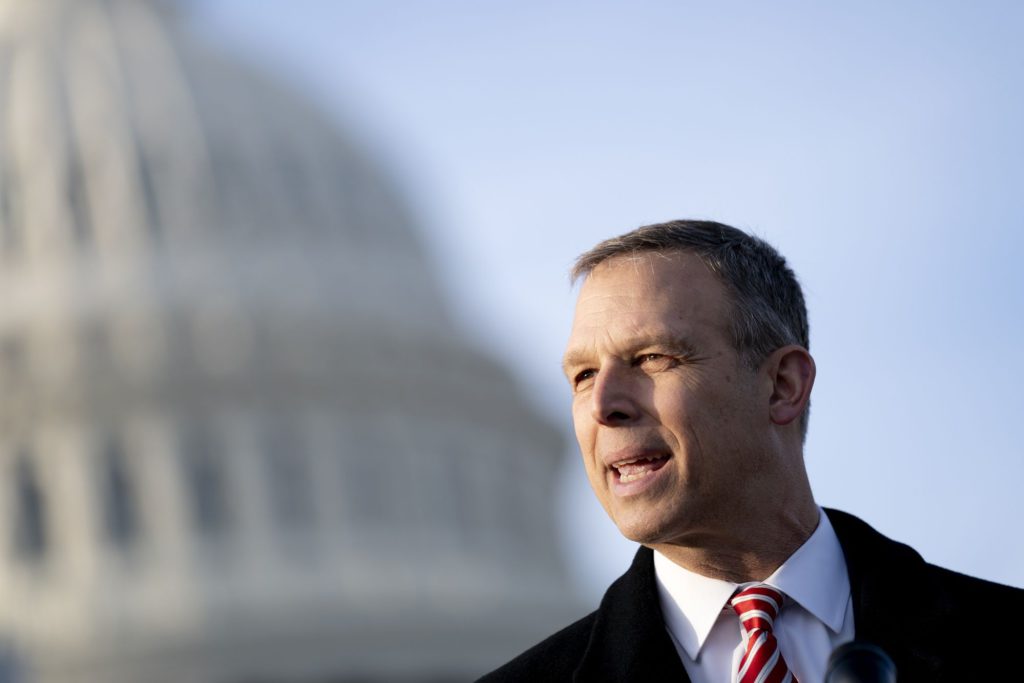
GOP Congressman Perry Asks Judge for Return of FBI-Seized Phone Data

(Bloomberg) — Republican Representative Scott Perry asked to pause his request that a federal judge order the Justice Department to return his mobile phone data after he entered into further negotiations with the government over access to the information.

Perry’s attorneys said in a filing Wednesday that they were in talks with the government about a process to prevent the disclosure of certain data that is privileged. The request came shortly after Perry’s motion for an order to return his “property.”

The Pennsylvania lawmaker earlier argued that he must determine which data is protected from disclosure rather than giving that power to members of the executive branch to “unlawfully” review the “protected materials,” according to a court filing in Washington. 

Perry was seeking a restraining order that would prevent the government from searching data taken from his phone until the court has ruled his request for its return.

On Aug. 9, special agents from the FBI seized Perry’s phone after a Pennsylvania judge issued a warrant. The seizure came after the House committee investigating the Jan. 6 Capitol riot held a hearing that showed Perry’s involvement in pushing the Trump administration to install Jeffrey Clark or someone else to lead DOJ who would pursue election fraud claims. 

Perry’s attorney asked to review the data for information protected by certain privileges such as attorney client and those afforded to lawmakers. Perry alleged that prosecutors considered a different approach where both parties could review the data and sort out what would be protected. 

Perry also claimed prosecutors said they would seek a second search warrant that would authorize them to review cell phone data if he refused to waive protections under the US Constitution’s Speech and Debate Clause, which prohibits questioning of members of Congress about legislative work. Perry declined to waive the protection.

A second search warrant hasn’t been issued yet, and Perry is unaware of any steps taken by the government to obtain his telephone records from AT&T, according to the filing.

Bill Miller, a spokesman for the US attorney’s office for the District of Columbia, declined to comment.

More stories like this are available on bloomberg.com

©2022 Bloomberg L.P.

Stocks Post Mild Gains as Traders Mull Fed Path: Markets Wrap

(Bloomberg) — Stock traders remained hesitant to make any huge bets ahead of Jerome Powell’s speech on Friday, which may provide clues on how hawkish the Federal Reserve will be in the face of mounting economic challenges.

After wandering aimlessly earlier Wednesday, the S&P 500 posted a small gain in another slow session. A gauge of megacaps like Apple Inc. and Tesla Inc. climbed, with Elon Musk’s electric-vehicle maker getting ready to trade on a split-adjusted basis Aug. 25. Big tech outperformed after being hardly hit during the equity rout earlier in the week as 10-year US yields topped 3% on renewed Fed jitters.

Those fears haven’t really gone anywhere despite the controversial dovish-pivot narrative cited by some as one of the reasons for the short-covering bounce from June lows. In fact, just before the prestigious Jackson Hole event that will be attended by Powell and global policy makers, traders had to digest more hawkish talk. Fed Bank of Minneapolis President Neel Kashkari said late Tuesday it’s “very clear” that officials need to tighten and bring inflation back under control.

“We don’t expect any shock-and-awe, Volcker-style, hyper-aggressive articulation by Powell or anyone else for that matter,” said Troy Gayeski, chief market strategist at FS Investments, referring to former Fed Chair Paul Volcker who tipped the economy into recession to conquer inflation in the 1980s. “However, it’s very clear that the rally since the June bottom works directly against what the Fed has been trying to achieve, which is tighter financial conditions to slow economic growth and slow inflation. So they have to push back and they’ve been doing that clearly.”

Central banks that hike borrowing costs too aggressively to tame supply-driven inflation risk exacerbating price gains, according to Nobel laureate economist Joseph Stiglitz. Meantime, Guggenheim Partners Chief Investment Officer Scott Minerd is warning investors away from junk bonds and stocks because slowing economic growth and higher interest rates likely will produce deeper losses in risk markets.

Read: Goldman Says Hedge Funds Back Betting Big on Megacap Tech Stocks

Economic reports have been mixed at best, underlining the delicate task policy makers face in bringing down high inflation without sparking a recession. Data Wednesday showed US pending home sales fell to the lowest since the start of the pandemic. While orders placed with US factories for core capital goods beat forecasts, the picture might change in the coming months amid higher borrowing costs and uncertainty about the growth outlook.

In corporate news, Peloton Interactive Inc. soared after saying it will sell bikes and certain accessories on Amazon.com Inc. in the US, breaking with a longtime practice of exclusively selling products via its own website and retail stores. Bed Bath & Beyond Inc. jumped after a report said that the home goods retailer has selected a lender to provide financing as it seeks to boost liquidity.

Will the meme mania fizzle out? That’s the theme of this week’s MLIV Pulse survey. Click here to participate anonymously.

What to watch this week:

  • US GDP, initial jobless claims, Thursday
  • Kansas City Fed hosts its annual economic policy symposium in Jackson Hole, Wyoming, Thursday
  • ECB’s July minutes, Thursday
  • Fed Chair Powell speaks at Jackson Hole, Friday
  • US personal income, PCE deflator, University of Michigan consumer sentiment, Friday

Some of the main moves in markets:

Stocks

  • The S&P 500 rose 0.2% as of 2:55 p.m. New York time
  • The Nasdaq 100 rose 0.3%
  • The Dow Jones Industrial Average was little changed
  • The MSCI World index was little changed

Currencies

  • The Bloomberg Dollar Spot Index rose 0.1%
  • The euro was little changed at $0.9961
  • The British pound fell 0.4% to $1.1787
  • The Japanese yen fell 0.2% to 137.07 per dollar

Bonds

  • The yield on 10-year Treasuries advanced six basis points to 3.10%
  • Germany’s 10-year yield advanced five basis points to 1.37%
  • Britain’s 10-year yield advanced 12 basis points to 2.70%

Commodities

  • West Texas Intermediate crude rose 1.1% to $94.80 a barrel
  • Gold futures rose 0.1% to $1,763.10 an ounce

More stories like this are available on bloomberg.com

©2022 Bloomberg L.P.

T-Mobile Gains After Musk Teases ‘Special’ SpaceX Event

(Bloomberg) — T-Mobile US Inc. shares rose after Elon Musk’s SpaceX said it would host an event on Thursday to reveal plans for the two companies to “increase connectivity.”

Musk will host the event at SpaceX’s Starbase in Boca Chica, Texas, with T-Mobile Chief Executive Officer Mike Sievert at 7 p.m. Central time, according to an announcement posted online. No additional details were given about the event, which Musk tweeted will be “something special.”

Space Exploration Technologies Corp., a private spacecraft manufacturer and launcher, owns Starlink, which provides internet access from space-based satellites. T-Mobile is one of the largest wireless phone and internet access providers in the US.

T-Mobile shares jumped as much as 1.8% after the announcement before paring the gain. The stock was up 0.9% at 1:59 p.m. in New York.

Starlink plans to have a constellation of satellites in low-to-middle Earth orbit, in order to beam broadband internet connectivity to the planet below. The company, which has several thousand satellites in orbit, has said it has 400,000 active users.

Musk has hinted in the past that SpaceX could eventually spin out Starlink and take the business public. However, he told employees recently that a Starlink IPO is probably three to four years away, CNBC reported.

More stories like this are available on bloomberg.com

©2022 Bloomberg L.P.

Ethereum ‘Bug Bounties’ Jump to $1 Million Before Software Upgrade

(Bloomberg) — The non-profit foundation behind the Ethereum blockchain is quadrupling the rewards it will pay to friendly hackers who uncover bugs in the code of its much ballyhooed software upgrade to as much as $1 million.

Until now, the so-called bug-bounty program was offering payments of up to $250,000 and a place on its leaderboard to hackers who uncovered critical errors. The increase was announced in a blog post Wednesday.

The bounty amounts are being raised to reduce the chance that a critical issue arises during what’s called the Merge, which is slated to take place between Sept. 10 and Sept. 20. The exact date will depend on any shifts in the amount of computing power supporting the network.

During the Merge, Ethereum will switch from using powerful computers called miners to order transactions to using a much more energy-efficient system called proof of stake. In proof of stake, wallets holding coins order blocks of transactions.   

More stories like this are available on bloomberg.com

©2022 Bloomberg L.P.

Twitter Is Facing Fresh SEC Scrutiny Over Spam-Account Calculations

(Bloomberg) — The US Securities and Exchange Commission recently pressed Twitter Inc. for more information on how the company identifies spam accounts, adding to scrutiny over the platform’s processes for keeping tabs on its user base. 

The SEC’s June 15 query to Chief Executive Officer Parag Agrawal, which was made public on Wednesday, centered on statements in the firm’s latest annual report. The company has said that spam and bot accounts comprise less than 5% of its user base. 

Twitter is on the defensive this week over how it tracks and keeps tabs on fake accounts after a whistle-blower complaint alleged the company didn’t do enough to deal with bot activity on its platform. While the company has denied those allegations from its ex-head of security Peiter Zatko, some legal experts say it could bolster Elon Musk in his attempt to walk away from a $44 billion buyout of the platform. 

“To the extent material, please disclose the methodology used in calculating these figures and the underlying judgments and assumptions used by management,” the SEC said in its June 15 letter to Agrawal, regarding statements in its annual report.

In response, Twitter’s lawyers told the SEC on June 22 that the company “already adequately discloses the methodology” that it uses. Twitter said that it randomly selects thousands of accounts to be reviewed by people each quarter and has done so for many years. Reviewers working for the firm use both public and private data to flag an account as fake or spam.

The SEC also posted on Wednesday a July 27 letter noting that it had concluded its review of the matter. “We remind you that the company and its management are responsible for the accuracy and adequacy of their disclosures, notwithstanding any review, comments, action or absence of action by the staff,” the agency wrote. 

Meanwhile, in its June 15 query, the SEC also asked Twitter to explain an error related to the company’s overstatement of daily average users between the first quarter of 2019 to the fourth quarter of 2021. The agency asked how the error, which was disclosed in the firm’s first quarter report, was discovered. It also asked why the social media giant determined it wasn’t a “material weakness” in internal controls over financial reporting. 

In response, the company said the over counting was related to letting users link separate accounts in order to easily switch between them. The overstatement “had no impact on Twitter’s financial statements,” the firm said. 

(Updates with details on whistle-blower allegations starting in third paragraph.)

More stories like this are available on bloomberg.com

©2022 Bloomberg L.P.

Apple Confirms Sept. 7 Launch Date for iPhone 14, New Watches

(Bloomberg) — Apple Inc. announced plans to hold a launch event on Sept. 7, when the tech giant is expected to unveil the iPhone 14 lineup and its next slate of smartwatches, confirming a date that was reported by Bloomberg News last week.

The company sent out invitations for a presentation titled “Far Out,” describing it as an in-person event at the Steve Jobs Theater at its headquarters in Cupertino, California. It starts at 10 a.m. local time. The company will also livestream the event on its website, continuing an approach it’s used since the pandemic began.

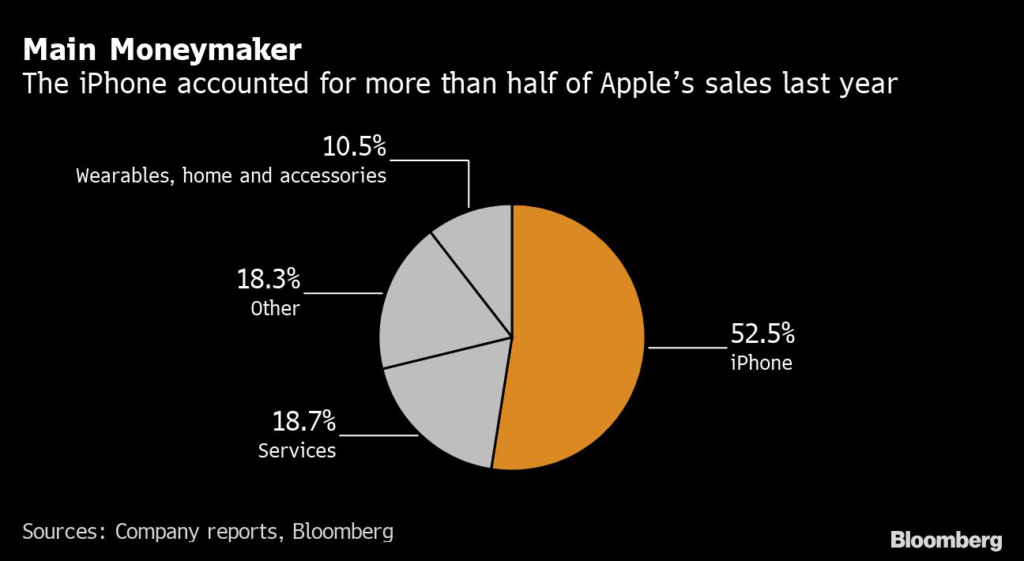
Launching a new iPhone is always a big moment for Apple, which counted on the device for more than half of its $366 billion in annual sales last year. But there’s additional pressure this year as the company faces a slowdown in consumer spending — particularly in the smartphone industry — and needs its latest technology to entice buyers. It’s also planning a more ambitious product rollout than usual in the coming months, with a flurry of new Macs, iPads, AirPods and even a mixed-reality headset expected by the first half of 2023.

The event will be Apple’s third of the year, following up on a March launch for the Mac Studio, 5G iPhone SE and new iPad Air, in addition to a preview of iOS 16, macOS Ventura and other new software features at the company’s June developer conference. 

At the Sept. 7 presentation, Apple plans to announce four new iPhone 14 models and three new versions of the Apple Watch, Bloomberg News has reported. The new iPhone line will continue to be split into two standard versions and two Pro models. For the first time, however, Apple will offer a large, 6.7-inch version of the standard iPhone. And it won’t offer a mini model the way it did with the iPhone 12 and iPhone 13. 

The bulk of enhancements this year will come to the iPhone 14 Pro line, which will gain a new 48-megapixel rear camera, a faster processor, improved battery life, video recording enhancements and a redesigned front camera system. On the Pro versions, the notch cutout introduced with the iPhone X in 2017 will be replaced with hole-punch and pill-shaped cutouts for the front camera and Face ID sensors. 

The new Apple Watch lineup will represent the company’s biggest set of changes to the device since its initial release in 2015. That will include an update to the Apple Watch SE with a faster processor. There also will be an Apple Watch Series 8 model with a body-temperature sensor and new features for women’s health. And the company is releasing a new high-end version that will likely be dubbed the Apple Watch Pro. 

While the Apple Watch Series 8 will look similar to last year’s Series 7, the Pro version will have a fresh design, a slightly larger display and a bigger battery. The new device will be aimed at sportier consumers and will come in a more rugged titanium material. 

Around October, Apple is planning to release significant updates to the iPad Pro and entry-level iPad, in addition to new Macs with M2 Pro-based processors. Earlier this week, the company confirmed a Bloomberg report that said iPadOS would be delayed until after iOS 16. The iPad software update will be released in October alongside macOS Ventura. 

(Updates with more details on the Sept. 7 event starting in sixth paragraph.)

More stories like this are available on bloomberg.com

©2022 Bloomberg L.P.

Russia Industry Surprises With Small Drop as Economy Adapts

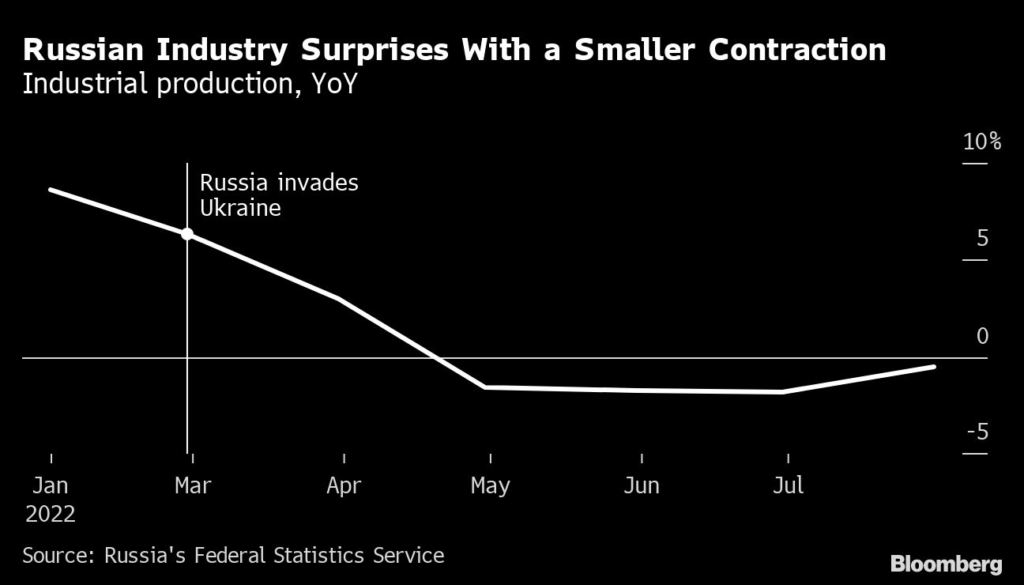
(Bloomberg) — Russia’s industrial sector recorded the smallest contraction in four months in the latest sign the economy is adapting to the sweeping sanctions imposed by the US and its allies for the Kremlin’s invasion of Ukraine.

Industrial production fell 0.5% in July, less of a drop than the 2.3% expected by analysts in a Bloomberg survey and the best performance since the first months of the war. On a seasonally adjusted basis, output was up from the previous month for the first time this year, according to data released by the Federal Statistics Service.

Increased mining and oil-product output, along with rebounds in sectors like pharmaceuticals, semiconductors and clothing that have benefited from the exodus of foreign competitors since the war began, contributed to the stronger-than-expected performance. 

Sanctions and the departure of many foreign companies have hit Russia’s economy, but the impact hasn’t been as deep as many feared at the start of the war. Overall, the economy contracted 4% in the first half and the central bank is forecasting a drop of 4-6% for the year. 

“Mining is running ahead of the rest but that’s to be expected,” said Renaissance Capital economist Sofya Donets. “But manufacturing is also showing improvement above expectations.”

Even the auto sector, which had all but shut down in recent months as the foreign companies that dominated the sector fled, showed some tentative signs of steadying, with output down only 58% in July compared to -66% in May. Local producer Avtovaz said Wednesday it would resume five-day-a-week production next month, Tass reported. 

But some economists saw reason for caution in the latest industrial-output report. “First, the July improvement in manufacturing seem to be localized in oil downstream and metals production, i.e. related to commodities,” said Dmitry Dolgin, economist at ING. “Second, the estimate for 1H22 was nearly halved from +2.0% YoY to +1.3% YoY, mainly on lower estimate for the commodities extraction sector.”

What Bloomberg Economics Says…

“Industrial output expanded by 1.2% compared to last month. Passenger-car manufacturing remains a shadow of its former self, but output is gradually edging up. Overall, the report confirms our above-consensus call of a shallow 3.5% GDP contraction.”-Alexander Isakov, Russia economist.

In August, business sentiment slipped a bit amid problems with imported supplies and labor, according to a central bank survey released Wednesday. But optimism remained about the outlook, with many companies expecting growth.

In the oil sector doubts linger about the coming months, especially as Europe prepares to impose new restrictions on sales of Russian oil, a vital export.

“We expect the trends to worsen in late 2022 and early 2023, particularly amid of the implementation of the European Union’s oil embargo,” Donets said.

(Updates with analyst comment in seventh paragraph)

More stories like this are available on bloomberg.com

©2022 Bloomberg L.P.

VCs’ Bad Diversity Track Record Gets Worse in the Downturn

(Bloomberg) — It’s a complicated time to be a Black entrepreneur. Some Black founders in recent years have created formidable startups with towering valuations. But there are still shockingly few large VC-backed startups with Black leaders, and recent months’ chaos in the venture capital market has taken a disproportionate toll on their companies—wiping out diversity gains in fundraising. 

On the heels of the Black Lives Matter movement, Black entrepreneurs raised record amounts of venture funding. In the second quarter of last year, they took in $866 million according to Crunchbase data, almost double the previous year’s US total. But in the second quarter of this  year, Black-founded companies raised just $324 million, a 63% drop. Meanwhile, the decline in the VC industry as a whole was not nearly as stark: PitchBook data shows that overall VC  funding in the US fell by just 23% in the same period. 

The precipitous decline in funding for Black founders—they have raised just 1.2% of venture capital dollars so far this year—means fewer opportunities for entrepreneurs to break out in an industry with a history of diversity problems. Of the more than 1,000 unicorn startups with valuations of at least $1 billion, only a handful have at least one Black founder or senior executive listed on their website, Bloomberg found in an analysis of companies compiled by CB Insights.

In the US, the percentage of funding going to Black founders has never exceeded 3% since Crunchbase started tracking the numbers. The situation is even more startling in the UK. Between 2009 and 2019, less than 0.25% of venture capital went to Black entrepreneurs, according to a report by Extend Ventures. The group also found that only 38 Black founders raised money in the country during the entire decade, an outcome Extend Ventures described as the smallest of any ethnicity.

But there are some Black-led startups that have managed to break out nonetheless, success that experts hope could propel the industry toward greater diversity.

For example, the UK’s first Black-owned unicorn, cross-border payments company Zepz, announced it had cleared the billion-dollar threshold last year. It’s now worth $5 billion and planning a public offering. When African immigrant Ismail Ahmed founded Zepz in 2010, “there were far fewer fintech businesses and probably none by African migrants,” he said. “These factors combined made our entry challenging.” But Zepz’s remittances business took off, and it’s now one of Europe’s most valuable companies. The second Black-led company in the UK to reach unicorn status was digital motor insurer Marshmallow, now worth $1.25 billion. 

Paula Groves, chief investment officer at London-based Impact X, which aims to fund underrepresented founders in Europe, said she hopes that Zepz and other companies like it signal the beginnings of a trend, despite the tumult in the market. “My hope is now that Marshmallow and Zepz have broken that billion-dollar valuation barrier, suddenly all these Black entrepreneurs can follow suit very quickly,” Groves said.

Groves lamented the scant progress the industry has made over time. “In 2001, less than 4% of venture capital dollars were allocated to women entrepreneurs and less than 1% of venture capital dollars were allocated to entrepreneurs of Black descent, and those numbers haven’t changed,” she said. “It’s quite disheartening if you look at it for too long of a time.” But Groves believes that if Black founders get the cash they need to launch their businesses, the companies could achieve much bigger growth in the future.

In the US, Cityblock Health Inc. is now worth about $6 billion. Chief Executive Officer Toyin Ajayi said the road was difficult, even though she was fundraising alongside a White co-founder. “Being a physician, being a Black woman, I was constantly in rooms where no one looked like me in the deal process or had a similar background to me,” Ajayi said. “I’m pretty sure they didn’t know anyone with a similar background to me in their network.”

“We’re nowhere near closing the gap,” Ajayi said. “But at least people are talking about this and focused in the right direction.”

Ajayi said she saw increased investor interest in the second half of 2020, as the Covid-19 pandemic and the Black Lives Matter movement highlighted the need for equality, both within health care and in society at large. “Folks that were indifferent to their association with me were now putting my name on newsletters, talking about companies they’ve invested in with a lot of diversity to them,” Ajayi said.

Erika Brodnock, co-founder of Extend Ventures, said Black founders are more likely to be viewed as risky by investors—prejudices that could exacerbate inequality during the downturn. In some cases, investors are committed to diversity in theory but hesitant to back individual companies. Said Brodnock: “We don’t need mentoring, we need contracts, we need cash, and we need contacts.”

More stories like this are available on bloomberg.com

©2022 Bloomberg L.P.

Voyager Gets Bankruptcy Court Approval on $1.6 Million in Key Employee Bonuses

(Bloomberg) — Voyager Digital Ltd. won a bankruptcy judge’s permission to pay $1.6 million in bonuses to employees deemed critical to the insolvent crypto lender’s future.

The payouts will go to 34 Voyager employees — none of whom are top executives — who work in areas like accounting and IT infrastructure, according to court papers. The bonuses are equal to 22.5% of each employee’s annual salary.

Voyager’s official creditor committee had earlier attacked the bonus plan as unnecessary, but dropped its objection after the crypto lender agreed to take steps including slashing the size of the bonus pool and to quickly cut $4.6 million of annual costs elsewhere.

US Bankruptcy Judge Michael Wiles in a hearing Wednesday said he would approve the bonuses. Preventing key employees from quitting will help Voyager maximize the value of its business and, in turn, maximize creditor recoveries, he said. 

Voyager customers with crypto stuck on the platform still haven’t recovered any of their holdings. Those who stored cash with the company have so far fared better: about $219 million, or 80%, of customer cash trapped in the platform since the start of the bankruptcy has since been returned, a lawyer for Voyager said in the hearing.

The bankruptcy is Voyager Digital Holdings Inc., 22-10943, U.S. Bankruptcy Court for the Southern District of New York (Manhattan). 


More stories like this are available on bloomberg.com

©2022 Bloomberg L.P.
Big Tech Leads Stocks Higher Before Jackson Hole: Markets Wrap

(Bloomberg) — Tech megacaps outpaced the broader stock market, with traders awaiting Jerome Powell’s speech on Friday for clues on how hawkish the Federal Reserve will be in the face of mounting economic challenges.

The S&P 500 pushed higher after fluctuating earlier in the day, while the NYSE FANG+ Index of giants like Amazon.com Inc. and Tesla Inc. rallied over 1.5%. Elon Musk’s electric-vehicle maker will start trading on a split-adjusted basis on Aug. 25. Hedge funds ramped up bets on US big tech and whittled down overall holdings to focus on favored names last quarter, with conviction climbing back to levels seen at the start of the pandemic, according to Goldman Sachs Group Inc.

Treasury 10-year yields traded above 3%, while the dollar was little changed.

There’s been no shortage of hawkish Fedspeak in the weeks leading up to the prestigious Jackson Hole, Wyoming annual event that will be attended by policy makers from around the world. The latest such remarks came from Fed Bank of Minneapolis President Neel Kashkari, who said Tuesday that it’s “very clear” that officials need to tighten policy to bring inflation back under control.

“We don’t expect any shock-and-awe, Volcker-style, hyper-aggressive articulation by Powell or anyone else for that matter,” said Troy Gayeski, chief market strategist at FS Investments. “However, it’s very clear that the rally since the June bottom works directly against what the Fed has been trying to achieve, which is tighter financial conditions to slow economic growth and slow inflation. So they have to push back and they’ve been doing that clearly.”

Economic reports have been mixed at best, underlining the delicate task policy makers face in bringing down high inflation without sparking a recession. Data Wednesday showed US pending home sales fell to the lowest since the start of the pandemic. While orders placed with US factories for core capital goods beat forecasts, the picture might change in the coming months amid higher borrowing costs and uncertainty about the growth outlook.

In corporate news, Peloton Interactive Inc. soared after saying it will sell bikes and certain accessories on Amazon.com Inc. in the US. Bed Bath & Beyond Inc. jumped after a report said that the home goods retailer has selected a lender to provide financing as it seeks to boost liquidity.

Read: Sell Side Vindicated as Price Targets Reap Alpha: Taking Stock

Will the meme mania fizzle out? That’s the theme of this week’s MLIV Pulse survey. Click here to participate anonymously.

What to watch this week:

  • US GDP, initial jobless claims, Thursday
  • Kansas City Fed hosts its annual economic policy symposium in Jackson Hole, Wyoming, Thursday
  • ECB’s July minutes, Thursday
  • Fed Chair Powell speaks at Jackson Hole, Friday
  • US personal income, PCE deflator, University of Michigan consumer sentiment, Friday

Some of the main moves in markets:

Stocks

  • The S&P 500 rose 0.5% as of 11:30 a.m. New York time
  • The Nasdaq 100 rose 0.7%
  • The Dow Jones Industrial Average rose 0.4%
  • The Stoxx Europe 600 rose 0.2%
  • The MSCI World index rose 0.3%

Currencies

  • The Bloomberg Dollar Spot Index was little changed
  • The euro was unchanged at $0.9970
  • The British pound fell 0.3% to $1.1801
  • The Japanese yen was little changed at 136.88 per dollar

Bonds

  • The yield on 10-year Treasuries advanced five basis points to 3.09%
  • Germany’s 10-year yield advanced four basis points to 1.36%
  • Britain’s 10-year yield advanced 11 basis points to 2.69%

Commodities

  • West Texas Intermediate crude fell 0.5% to $93.23 a barrel
  • Gold futures rose 0.3% to $1,766.10 an ounce

More stories like this are available on bloomberg.com

©2022 Bloomberg L.P.
Close Bitnami banner
Bitnami