

Bloomberg

Richemont Sells Stake in Online Business YNAP to Farfetch

(Bloomberg) — Swiss luxury conglomerate Richemont sold a stake in its online retail business YNAP to Farfetch Ltd., taking a $2.7 billion hit from its failed effort to attract rival high-end brands to the digital sales platform.  

Following months of talks, e-commerce rival Farfetch will acquire 47.5% of YNAP, which includes the Yoox and Net-a-Porter brands, with Richemont retaining 49.3%. After ceding control of YNAP, which has consistently lost money, Richemont will book a non-cash charge of about 2.7 billion euros ($2.7 billion). 

Richemont shares rose as much as 3.3% in early trading Wednesday. 

Richemont Chairman Johann Rupert abandoned plans to build a solo luxury e-commerce platform in 2021, opting to concentrate on a tie-up for the YNAP unit with Farfetch. The veteran investor, who’s grappling with an activist campaign led by Bluebell Capital Partners Ltd., has tried to bring in other major luxury players to create an industry wide internet platform but hasn’t been successful so far.

“We wanted to get this thing on the road,” Rupert said on a conference call with regards to doing a deal with Farfetch without other major luxury players. 

The South African billionaire said he still expects other brands to join the platform. “We’ve been pleading for seven years to have a neutral luxury platform available to all,” he said. 

Wider Brand Portfolio 

The deal offers a wider portfolio of brands for Farfetch, which is seeking to increase the number of shoppers using its platform in a highly competitive luxury e-commerce sector. Richemont brands including Cartier, Chloe and IWC will adopt the Farfetch platform for e-commerce sales and most, including Cartier and Vacheron Constantin, will launch sales concessions on the Farfetch portal.

“Obviously, it is a very good deal for Farfetch,” Rupert said. “It is a very good deal for us because we can start to use their technology.” 

Richemont has come under pressure from activist investor Bluebell to shake up its governance structure which gives Rupert control of voting rights even though he holds only 10% of the company’s share capital. 

Read More: Activist Bluebell Wants Ex-Bulgari CEO on Richemont Board (1)

Farfetch, meanwhile, is facing questions over its strategy and profitability, with its shares falling 82% over the past 12 months. E-commerce shares have been widely trounced as investors have soured on the sector as consumers return to stores post-pandemic.

Vontobel analyst Jean-Philippe Bertschy said the deal closes “years of underperformance and heavy investment in YNAP,” by Richemont. “We have been advocating a better capital allocation and an exit of YNAP for a number of years: it is now coming, at last, at a bitter price,” Bertschy said in a note to clients.

What Bloomberg Intelligence Says:

YNAP is poised for a positive turnaround, leveraging Farfetch’s industry-leading technology and know-how, while Farfetch propels its sales ambitions by offering a broader range of Richemont’s hard-luxury brands.

— Deborah Aitken, BI luxury-goods analyst and Andrea Ferdinando Leggieri, BI consumer-goods analyst

Farfetch’s Ambitions Propelled With Richemont YNAP Deal: React

Potential Acquisition 

Under the agreement announced Wednesday, Richemont will receive between 53 million and 58.5 million Farfetch Class A shares representing 10% to 11% of the fully diluted share capital of Farfetch and 12% to 13% of the issued share capital, the companies said in a statement.

Richemont will get $250 million in Farfetch shares on the fifth anniversary of the transaction which is due to complete before the end of 2023, it said. The companies will have respective put and call options that could see Farfetch acquire all the shares of YNAP if certain conditions are met.

That means Farfetch could end up owning all of YNAP as the transaction “will pave the way to a potential acquisition,” Farfetch Chairman and Chief Executive Officer Jose Neves, said in a statement. 

Neves also said on the call he expects Richemont’s YNAP business to return to profitability soon.

“This seems an excellent deal for Farfetch,” Bernstein analyst Luca Solca said in a note to clients. Farfetch is getting “a very welcome boost to traffic generation via the Richemont e-concessions,” he said. 

As part of the transaction Dubai property developer Mohamed Alabbar, Richemont and YNAP’s Gulf States partner, will become a shareholder, alongside Richemont and Farfetch. Alabbar will acquire a 3.2% interest in YNAP in exchange for its shares in the joint venture with YNAP in the Gulf Cooperation Council.

(Updates with Richemont chairman, Farfetch chairman and analyst comments)

More stories like this are available on bloomberg.com

©2022 Bloomberg L.P.
Stocks and Futures Waver on Policy, Growth Risks: Markets Wrap

(Bloomberg) — European stocks US index futures struggled for direction as investors digested the latest hawkish noises from the Federal Reserve amid mounting signs of a global economic slowdown.

The Stoxx Europe 600 index erased early losses to trade little changed, buoyed by the consumer-products sector as luxury-goods giant Richemont surged after selling a stake in its online business. Futures on the S&P 500 and Nasdaq 100 fluctuated between modest gains and losses, with markets on edge ahead of the Jackson Hole central bankers’ retreat later this week. The 10-year Treasury yield held above 3% and the dollar was steady.

Investors will pore over Fed Chair Jerome Powell’s speech at Jackson Hole on Friday for a sense of how hawkish the US central bank will be in the face of mounting economic challenges. A global rebound in equities from a June low has stalled ahead of the widely-anticipated event.

“Globally we haven’t seen a deceleration like this that has been so synchronized in many decades,” Frances Stacy, director of strategy at Optimal Capital Advisors LLC, said on Bloomberg Television. “I don’t want to be directional” in picking trades, she added.

The latest data showed economic activity weakening from the US to Europe and Asia, underlining the delicate task the Fed faces in hiking interest rates to bring down high inflation without sparking a recession. Still, Minneapolis Fed President Neel Kashkari said inflation is very high and the central bank must act to bring it under control.

The Fed “is probably going to use this weekend to reiterate the fact that rates have more room to climb because they really want to bring inflation down,” Kelvin Tay, Asia-Pacific chief investment officer at UBS Global Wealth Management, said on Bloomberg Television.

Elsewhere, WTI crude oil climbed above $95 a barrel, bolstered by shrinking US stockpiles and possible OPEC+ output cuts.

Will the meme mania fizzle out? That’s the theme of this week’s MLIV Pulse survey. Click here to participate anonymously.

What to watch this week:

  • US durable goods, MBA mortgage applications, pending home sales, Wednesday
  • US GDP, initial jobless claims, Thursday
  • Kansas City Fed hosts its annual economic policy symposium in Jackson Hole, Wyoming, Thursday
  • ECB’s July minutes, Thursday
  • Fed Chair Powell speaks at Jackson Hole, Friday
  • US personal income, PCE deflator, University of Michigan consumer sentiment, Friday

Some of the main moves in markets:

Stocks

  • The Stoxx Europe 600 was little changed as of 9:40 a.m. London time
  • Futures on the S&P 500 were little changed
  • Futures on the Nasdaq 100 were little changed
  • Futures on the Dow Jones Industrial Average were little changed
  • The MSCI Asia Pacific Index fell 0.5%
  • The MSCI Emerging Markets Index fell 0.5%

Currencies

  • The Bloomberg Dollar Spot Index was little changed
  • The euro fell 0.2% to $0.9947
  • The Japanese yen rose 0.2% to 136.54 per dollar
  • The offshore yuan fell 0.3% to 6.8773 per dollar
  • The British pound was little changed at $1.1826

Bonds

  • The yield on 10-year Treasuries declined one basis point to 3.03%
  • Germany’s 10-year yield was little changed at 1.32%
  • Britain’s 10-year yield advanced two basis points to 2.59%

Commodities

  • Brent crude rose 1.1% to $101.32 a barrel
  • Spot gold rose 0.2% to $1,751.29 an ounce

More stories like this are available on bloomberg.com

©2022 Bloomberg L.P.
Goldman Says Hedge Funds Back Betting Big on Megacap Tech Stocks

(Bloomberg) — Hedge funds ramped up bets on megacap US tech stocks and whittled down overall holdings to focus on favored names last quarter, with conviction climbing back to levels seen at the start of the pandemic, according to Goldman Sachs Group Inc.

The funds boosted tech and consumer discretionary holdings, while cutting energy and materials wagers, strategists including Ben Snider wrote in a note Tuesday. Separately, average weightings of top 10 holdings jumped to 70% in the three months ended June, the highest concentration since the first quarter of 2020.

Amazon.com Inc. supplanted Microsoft Corp. as the most popular long position, a timely call given that the former has rallied 26% this quarter versus an 8% climb in the latter. The funds also boosted bets on Nvidia Corp., Apple Inc., Atlassian Corp. and Tesla Inc., according to the report.

“Stymied by an uncertain market environment and poor recent returns, hedge funds have cut leverage, shifted back towards growth, and increased portfolio concentrations,” the Goldman team wrote. “Performance has recently improved, matching the typical experience during correction rebounds, though leverage has room to rise if the market remains resilient.”

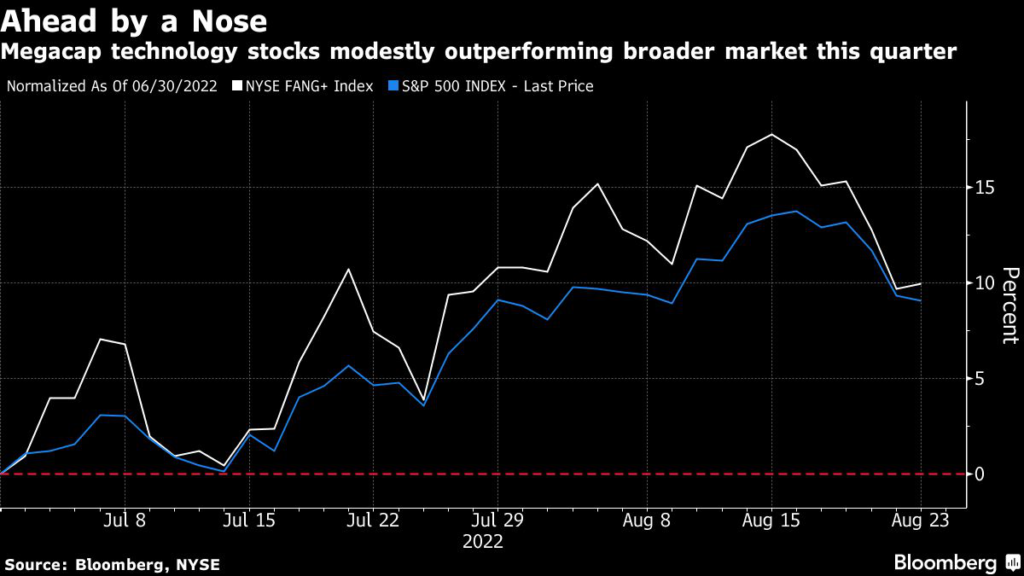
Beleaguered tech stocks got a shot in the arm in mid-June, as traders reassessed bets on the number of future rate hikes by the Federal Reserve after the US economy showed signs of slowing. A gauge of megacap tech stocks has risen 10% this quarter, compared to a 9% rise in the S&P 500 Index.

But the optimism has petered out heading into this week’s Jackson Hole conference on renewed hawkish concerns, with the market split on whether the Nasdaq 100’s near 13% jump in July was anything more than a bear market rally.

“There will likely be more pain ahead as markets are still under-pricing the Fed rate path,” said Charu Chanana, strategist at Saxo Capital Markets Pte. 

Within the broader tech space, hedge funds lifted their net exposure in the application software sub-sector where they are overweight, as well as in underweight industries including hardware and semiconductors, the Goldman report found.

In another sign of conviction, position turnover for the funds fell to a record low of 23%. 

The study analyzed the holdings of hedge funds with a combined $2.4 trillion of gross equity positions. The average fund gained 4% since the start of July, narrowing year-to-date losses to 9%, the strategists wrote. 

“The recent stabilization of hedge fund leverage and outperformance of the most popular hedge fund long positions are consistent with the typical patterns around previous equity market drawdown troughs,” they added.

(Adds details on tech exposure in eighth paragraph.)

More stories like this are available on bloomberg.com

©2022 Bloomberg L.P.
Stocks, US Equity Futures Fall Amid Cautious Mood: Markets Wrap

(Bloomberg) — An Asian stock index and US equity futures declined Wednesday as investors assessed the likely pace of further Federal Reserve monetary tightening and mounting signs of an economic slowdown.

The region-wide equity bourse shed about 0.5%, paced by slides in China and Hong Kong, where developer Logan Group Co. plunged — a careening stock price that again highlights the property crisis dragging on China’s economy.

The slump fed into wider risk aversion that saw S&P 500, Nasdaq 100 and European futures drop. Risk-sensitive currencies such as those in Australia and New Zealand slid. The 10-year Treasury yield held above 3%. Bitcoin wavered.

The latest data showed economic activity weakening from the US to Europe and Asia, underlining the delicate task the Fed faces in hiking interest rates to bring down high inflation without sparking a recession.


Investors will pour over Fed Chair Jerome Powell’s speech at the Jackson Hole symposium on Friday for a sense of how hawkish the US central bank will be in the face of mounting economic challenges. A global rebound in equities from a June low has stalled ahead of the much-anticipated event.

“Globally we haven’t seen a deceleration like this that has been so synchronized in many decades,” Frances Stacy, director of strategy at Optimal Capital Advisors LLC, said on Bloomberg Television. “I don’t want to be directional” in picking trades, she added.

Federal Reserve Bank of Minneapolis President Neel Kashkari said inflation is very high and the central bank must act to bring it under control.

The Fed “is probably going to use this weekend to reiterate the fact that rates have more room to climb because they really want to bring inflation down,” Kelvin Tay, Asia-Pacific chief investment officer at UBS Global Wealth Management, said on Bloomberg Television.

Elsewhere, crude oil held gains above $93 a barrel, bolstered by shrinking US crude stockpiles and possible OPEC+ output cuts.

Will the meme mania fizzle out? That’s the theme of this week’s MLIV Pulse survey. Click here to participate anonymously.

What to watch this week:

  • US durable goods, MBA mortgage applications, pending home sales, Wednesday
  • US GDP, initial jobless claims, Thursday
  • Kansas City Fed hosts its annual economic policy symposium in Jackson Hole, Wyoming, Thursday
  • ECB’s July minutes, Thursday
  • Fed Chair Powell speaks at Jackson Hole, Friday
  • US personal income, PCE deflator, University of Michigan consumer sentiment, Friday

Some of the main moves in markets:

Stocks

  • S&P 500 futures dipped 0.1% as of 7 a.m. in London. The S&P 500 fell 0.2%
  • Nasdaq 100 futures slipped 0.1%. The Nasdaq 100 was little changed
  • Japan’s Topix index shed 0.2%
  • Australia’s S&P/ASX 200 Index rose 0.5%
  • South Korea’s Kospi index rose 0.6%
  • Hong Kong’s Hang Seng Index fell 1.2%
  • China’s Shanghai Composite Index dropped 1.4%
  • Euro Stoxx 50 futures fell 0.2%

Currencies

  • The Bloomberg Dollar Spot Index climbed 0.1%
  • The euro was at $0.9952, down 0.2%
  • The Japanese yen traded at 136.58 per dollar, up 0.1%
  • The offshore yuan was at 6.8752 per dollar, down 0.3%

Bonds

  • The yield on 10-year Treasuries fell two basis points to 3.03%
  • Australia’s 10-year yield increased four basis points to 3.61%

Commodities

  • West Texas Intermediate crude was at $93.60 a barrel, down 0.1%
  • Gold was at $1,746.92 an ounce

More stories like this are available on bloomberg.com

©2022 Bloomberg L.P.

Three Arrows Liquidators Get Singapore Nod to Probe Crypto Fund

(Bloomberg) — Three Arrows Capital Ltd.’s liquidators secured a key court decision in Singapore that may give them greater insight into the collapsed crypto hedge fund’s remaining assets in a major jurisdiction, people with knowledge of the matter said.

The Singapore High Court on Monday granted a petition by advisory firm Teneo, which in June was appointed by a British Virgin Islands court to liquidate Three Arrows, to recognize the liquidation order in the country, the people said, asking not to be named as the proceedings were private. Teneo is trying to round up and preserve the hedge fund’s assets. 

Recognition in Singapore gives the liquidators authority to request access to any financial records the fund kept locally, the people said. They lacked the legal basis to do so before gaining formal recognition by a local court, according to the people.  

The liquidators plan to focus on establishing what assets held in Singapore — such as bank accounts, properties, cryptocurrencies, nonfungible tokens and stakes in companies — can be tied to Three Arrows itself, they said. 

Three Arrows, which operated from Singapore until at least early May, collapsed after the implosion of the Terra stablecoin project that month sent cryptocurrencies tumbling. Co-founder Zhu Su, whose family has two luxury homes in the city-state, had announced plans to move its headquarters to Dubai in April. The fund was registered in the BVI. 

Three Arrows Crypto Fund CEO Wants to Sell Singapore Mansion 

Claims

The liquidators have gained control of at least $40 million of Three Arrows’ assets, a fraction of the amount creditors including Voyager Digital LLC and Digital Currency Group Inc. say they’re owed, according to July filings. Creditors have filed paperwork indicating they’re owed more than $2.8 billion in unsecured claims, a figure expected to rise significantly, court papers show. 

WongPartnership LLP is representing Teneo in Singapore, while Solitaire LLP is working with Three Arrows’ local entity in the city-state. Representatives for Teneo, WongPartnership and Solitaire declined to comment. Zhu and co-founder Kyle Davies didn’t immediately respond to requests for comment. 

“We are unable to comment on cases that are before the Courts,” a spokesperson for the Singapore High Court said in an emailed response to questions. 

The Singapore court ruling follows Three Arrows’ filing for so-called Chapter 15 bankruptcy in the US in July. Shortly after that filing, lawyers for Teneo said in court papers that Zhu and Davies hadn’t been cooperating on the process. At around the same time, Zhu posted on his Twitter account that the founders had provided a spreadsheet of the fund’s assets to the liquidators. 

More stories like this are available on bloomberg.com

©2022 Bloomberg L.P.
China Bans Nationalist Blogger Who Rallied Against Tech Giant

(Bloomberg) — China has blocked the social media accounts of a nationalistic blogger who waged a campaign against a major Chinese tech firm, in the latest censorship of an outspoken patriotic voice.

Sima Nan’s Twitter-like Weibo account, where he has more than 3.1 million followers and regularly posts anti-American commentary, was marked restricted for “violating relevant laws and regulations” over the weekend, meaning he temporarily cannot post on the site.

His accounts on video-sharing platforms Bilibili and Douyin as well as digital platform Toutiao were also frozen, Chinese media including the state-owned Jinan Daily reported, although his accounts on those sites didn’t carry public notices on Wednesday. 

The restrictions come after Sima, whose real name is Yu Li, on Friday shared a video on Weibo accusing Lenovo Group Ltd. of manipulating public discourse against him. He made the claims after reports he’d bought a house in California in 2010 generated a hashtag on Weibo last week that was viewed 4.9 million times, as users accused him of hypocrisy.

Last year, the blogger known for his staunch support of the ruling Communist Party led an online campaign alleging Lenovo had sold state-owned assets too cheaply. The company’s largest shareholder at the time defended the asset sale in Chinese media, saying it had been legal. 

Lenovo hasn’t publicly responded to Sima’s new allegations, and a representative declined to comment on Wednesday.  

READ: Online Nationalists Pose a Dilemma for China’s Image-Making

President Xi Jinping’s government has tightened controls on the nation’s cyberspace, censoring not only viewpoints contrary to official political standpoints but, more recently, sometimes reining in bellicose nationalist voices that go beyond the party line.

After pro-Russian voices offered to “take care of” pretty female Ukrainian refugees earlier this year, for example, official Chinese news outlets warned citizens to discuss the war “rationally” and the offending social media accounts were deleted. 

Nationalist calls online for China to shoot down US House Speaker Nancy Pelosi’s plane on approach to Taiwan earlier this month led to disappointment among some at Beijing’s eventual reaction of unprecedented military drills. 

Another nationalistic blogger, Kong Qingdong, was also temporarily banned on Weibo this week, according to a notice on his account. It was not immediately clear what prompted the ban.  

Chinese social media faces even greater scrutiny ahead of a major leadership congress later this year, said Maria Repnikova, an assistant professor in global communication at Georgia State University. At that congress, Xi is expected to win a precedent-defying third term in office.

“Considering the sensitivity of this particular congress, I’m not surprised that the voices deemed as extreme or potentially destabilizing are silenced, including those on the nationalistic spectrum,” she said.

More stories like this are available on bloomberg.com

©2022 Bloomberg L.P.

Crypto Firm Coinhako Is Hiring to Woo Institutions, Wealthy

(Bloomberg) — Singapore-based cryptocurrency exchange Coinhako is hiring amid the downturn as it eyes expansion in Asia with a focus on institutions and the wealthy.

Coinhako is looking to grow in Southeast Asia and then more broadly throughout the region, Collin Cheong, director of corporate development, said in an interview. The firm, launched in 2014, is hiring “aggressively” in areas like institutional sales and trading, as it seeks to boost business with bigger firms and high-net-worth investors.

“More forward-looking institutions will be looking at this market downturn as an opportunity to get involved in the digital assets space by either investing in the asset class itself or building the necessary infrastructure to support the next step-up in digital assets adoption,” Cheong said.

Coinhako’s institutional arm has seen more activity and interest from clients like asset-management firms and family offices based in Asia looking to get access to digital assets, Cheong said.

Numerous firms like Coinbase Global Inc. and Crypto.com have been cutting back on their workforces amid a monthslong downturn in token prices, and as the industry copes with fallout from episodes like the Terra/Luna implosion and the downfall of hedge fund Three Arrows Capital. However, Coinhako isn’t alone in looking to hire — the likes of Binance and CryptoQuant have said they’re adding jobs as well.

More stories like this are available on bloomberg.com

©2022 Bloomberg L.P.

Buy-Now-Pay-Later Tech Pioneers Squeezed as Big Banks Muscle In

(Bloomberg) — Tech mavericks who made buy-now-pay-later an option for shoppers worldwide are grappling with mounting losses and investor skepticism. Now big finance is on their tail. 

British retail giants NatWest Group Plc, HSBC Holdings Plc, Barclays Plc and Virgin Money as well as Visa Inc. and Mastercard Inc. have recently launched new ways to spread the cost of purchases as they cater to the gradual shift from credit cards to the kinds of services offered by newcomers Klarna Bank AB, Affirm Holdings Inc. and Afterpay. 

“Even though banks are just getting started, they are well positioned to scale fast,” said Dilnisin Bayel, a managing director who specializes in credit in Europe at Accenture Plc. “Although the concept of paying in installments is more than a century old, the real-time delivery of BNPL on any card is new and convenient for users. Banks have an opportunity to put their unique stamp on the offer.”

This growing competition adds to pressure on buy-now-pay-later providers, which allow customers to split online purchases via their own apps or an extra button on retailers’ checkout pages. After several years of rapid growth, rising borrowing costs risk eroding their margins just as soaring inflation makes credit more tempting — and more dangerous — for many customers across Europe and the US. 

And investors, who viewed Klarna as more valuable than some of Europe’s banks last year, are rethinking their enthusiasm. Klarna’s latest fundraising in July slashed its valuation to $6.7 billion from $45.6 billion, while in the US, Affirm’s market capitalization has dropped more than 70% this year to $8.4 billion.

Traditional credit providers tend to have more funding and longstanding relationships with millions of customers, giving them a headstart in challenging the newcomers. They also have experience of the sort of regulatory clampdown that’s on the horizon for BNPL in the UK and elsewhere, with large firms encouraging stricter rules in future, to the chagrin of some startups. 

There’s lucrative business at stake: Barclays, for example, made £541 million, or about 16% of its UK income, from its Barclaycard UK consumer lending arm in the first half of the year. To be sure, it’s smaller than its business lending or mortgage operations, but it would be painful to lose this customer base.

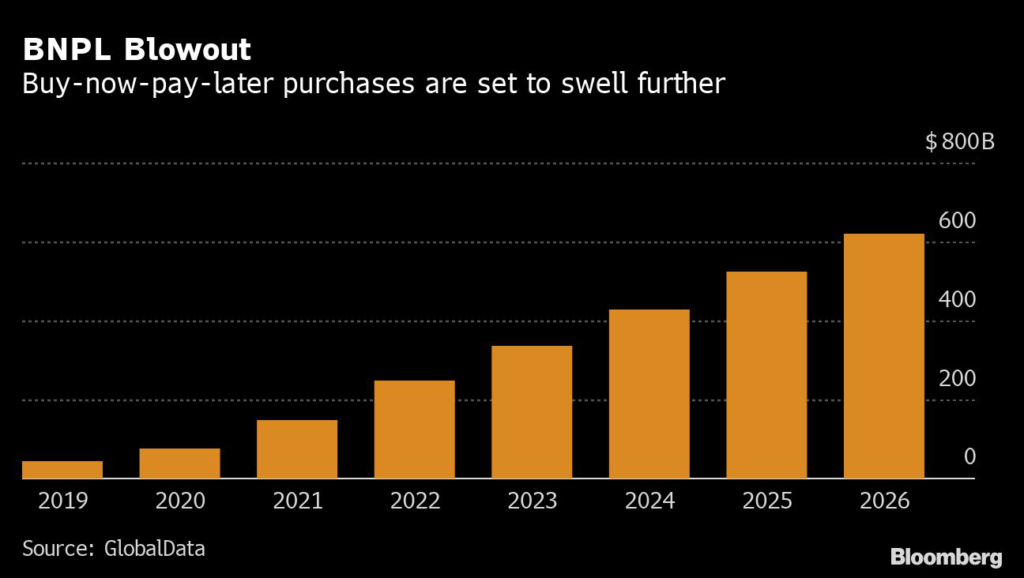
BNPL transactions reached about $147 billion in 2021, nearly doubling in a year to represent about 2.7% of global commerce transactions, according to GlobalData. The data firms believes this has room to rise to about 7.1% of global commerce by 2026. With more providers big and small joining the market, growth looks set to continue “especially in a macro-economic environment with inflationary pressures where consumers need to look for alternative sources of credit to cover living expenses,” said Jeff Tijssen, a partner at Bain & Co.

Bank On It

NatWest said in March it would enable its customers to spread payments over four installments — with no interest if payments are made on time, in line with many BNPL startups. It’s been followed by HSBC and Virgin Money. Barclays, which has offered financing at retail checkouts for years, teamed up with Amazon.com Inc. late last year to provide an installment option with the online marketplace.

Away from the established banks, fintechs Monzo and Revolut both have products in this space while Apple announced in June it will offer payments in four installments within its digital wallet, in partnership with Goldman Sachs Group Inc.

Also in the fray is payments giant PayPal Holdings Inc., which launched “Pay in 4” in August 2020, offering to spread the cost at 0% interest for purchases over £99. About 22 million consumers have now used the service globally. 

BNPL is the fastest-growing online payment method in many economies, helped by the pandemic-era shift to internet shopping and new generations of tech-savvy customers, according to Patricia Partelow, managing director at EY’s financial services consulting business. On Tiktok and Instagram, influencers share referral codes and show off their shopping hauls bought entirely with BNPL credit. 

“The rising popularity of BNPL also creates another risk for banks — losing access to millennial and Gen Z consumers attracted to this alternative form of financing,” Partelow wrote in an online post. 

Yet as rates continue rising, both big lenders and new firms funded by venture capital will be tested and stressed, analysts believe. The latest plunge in fintech valuations means banks are also considering acquisitions to grow in this space, according to Mike Abbott, Accenture’s global banking lead. “This could be an opportunity for liability-rich banks to improve their long-term return on equity, balance their lending portfolios and reduce dependency on commercial (often real-estate-heavy) lending,” he said. 

What Bloomberg Intelligence Says

Fintech and payments companies globally continue to face reality with share prices and private equity valuations rebasing lower, accelerated by a race to the bottom for margins in the heavily competitive space. As the need for cost cuts and slowdown in investment temper expectations, the relative performance and valuation hit of differing business models is increasingly stark.

Jonathan Tyce, BI banking analyst

Regulators, like banks, are playing catch-up. Under new rules planned in the UK, lenders would need to check loans are affordable for consumers and make sure advertisements are not misleading. Providers will also need approval from the Financial Conduct Authority — though regulation is unlikely before mid-2023. 

Banks are used to the regulatory scrutiny that new providers are facing for the first time. “We’ve made it part of our lending criteria,” NatWest Chief Executive Officer Alison Rose said as she talked about BNPL in July. “We treat it almost as if it’s a regulated product because I think it’s about making sure it’s responsible lending.” 

But this long track record with borrowers can also be seen as a drawback, if the banks use these relationships to encourage unaffordable borrowing, said Stella Creasy, a Labour MP who campaigned against payday lenders such as Wonga, which collapsed in 2018 after tighter regulations were introduced.

“At the moment it feels like what they are doing is getting people to put their expenses on overdraft without calling it an overdraft, without letting them know what the risks of taking on this form of credit is, what the consequences could be,” she said. 

More stories like this are available on bloomberg.com

©2022 Bloomberg L.P.

Stocks, Futures Fall as Cautious Mood Lifts Dollar: Markets Wrap

(Bloomberg) — An Asian stock index declined and the dollar pushed higher Wednesday as investors assessed the likely pace of further Federal Reserve monetary tightening and mounting signs of an economic slowdown.

The region-wide equity bourse shed more than 0.5%, paced by slides in China and Hong Kong, where developer Logan Group Co. plunged — a careening stock price that again highlights the property crisis dragging on China’s economy.

The slump fed into wider risk aversion that saw S&P 500, Nasdaq 100 and European futures drop. Risk-sensitive currencies such as those in Australia and New Zealand slid. The US 10-year Treasury yield held above 3%. Bitcoin fell.

The latest data showed economic activity weakening from the US to Europe and Asia, underlining the delicate task the Fed faces in hiking interest rates to bring down high inflation without sparking a recession.


Investors will pour over Fed Chair Jerome Powell’s speech at the Jackson Hole symposium on Friday for a sense of how hawkish the US central bank will be in the face of mounting economic challenges. A global rebound in equities from a June low has stalled ahead of the much-anticipated event.

“Globally we haven’t seen a deceleration like this that has been so synchronized in many decades,” Frances Stacy, director of strategy at Optimal Capital Advisors LLC, said on Bloomberg Television. “I don’t want to be directional” in picking trades, she added.

Federal Reserve Bank of Minneapolis President Neel Kashkari said inflation is very high and the central bank must act to bring it under control.

The Fed “is probably going to use this weekend to reiterate the fact that rates have more room to climb because they really want to bring inflation down,” Kelvin Tay, Asia-Pacific chief investment officer at UBS Global Wealth Management, said on Bloomberg Television.

Elsewhere, crude oil held gains above $93 a barrel, bolstered by shrinking US crude stockpiles and possible OPEC+ output cuts.

Will the meme mania fizzle out? That’s the theme of this week’s MLIV Pulse survey. Click here to participate anonymously.

What to watch this week:

  • US durable goods, MBA mortgage applications, pending home sales, Wednesday
  • US GDP, initial jobless claims, Thursday
  • Kansas City Fed hosts its annual economic policy symposium in Jackson Hole, Wyoming, Thursday
  • ECB’s July minutes, Thursday
  • Fed Chair Powell speaks at Jackson Hole, Friday
  • US personal income, PCE deflator, University of Michigan consumer sentiment, Friday

Some of the main moves in markets:

Stocks

  • S&P 500 futures dipped 0.3% as of 12:53 p.m. in Tokyo. The S&P 500 fell 0.2%
  • Nasdaq 100 futures slipped 0.4%. The Nasdaq 100 was little changed
  • Japan’s Topix index shed 0.2%
  • Australia’s S&P/ASX 200 Index rose 0.5%
  • South Korea’s Kospi index rose 0.1%
  • Hong Kong’s Hang Seng Index fell 1.3%
  • China’s Shanghai Composite Index dropped 1.4%
  • Euro Stoxx 50 futures fell 0.4%

Currencies

  • The Bloomberg Dollar Spot Index climbed 0.2%
  • The euro was at $0.9948, down 0.2%
  • The Japanese yen traded at 136.83 per dollar
  • The offshore yuan was at 6.8781 per dollar, down 0.3%

Bonds

  • The yield on 10-year Treasuries was at 3.04%
  • Australia’s 10-year yield increased four basis points to 3.62%

Commodities

  • West Texas Intermediate crude was at $93.46 a barrel, down 0.3%
  • Gold was at $1,745.25 an ounce, down 0.2%

More stories like this are available on bloomberg.com

©2022 Bloomberg L.P.

China Probes Property Executives for Possible Law Violations

(Bloomberg) — China is probing a number of executives at state-owned real estate companies, signaling an expansion of the government’s crackdown on misconduct that has centered on the financial and technology sectors. 

In a flurry of announcements this week, authorities said they were investigating at least four current and former top managers, including Xiamen C&D Real Estate Chairman Zhuang Yuekai, who is suspected of “serious” law violations. 

President Xi Jinping’s corruption clampdown on the nation’s sprawling financial sector has brought down more than 40 officials at state banks and regulators. The latest probes could signal authorities are widening the campaign to include the beleaguered property sector, which is already grappling with a crippling slowdown that’s hurting the world’s second-largest economy.

The investigations may “deal a further blow to investor confidence and cause market worries about the internal governance of some state-owned enterprises,” said Ting Meng, senior credit strategist at Australia & New Zealand Banking Group Ltd. Still, the impact on the companies may be limited given that decisions at SOEs tend to be made by more than one individual, she added. 

Other real estate executives being probed: 

  • Shi Zhen, chairman of state-owned C&D Urban Services, on suspicion of unspecified violations
  • Liu Hui, deputy general manager of state-owned Shenzhen Talents Housing Group, for “serious” law violations
  • China Resources Land Ltd.’s former Chairman Tang Yong, for severe disciplinary and legal violations.

Real estate stocks fell as a fresh round of profit warnings added to the gloom. A Bloomberg gauge of 33 mostly private Chinese developers plunged the most in almost six weeks, dropping 3.7% as of 11:45 a.m. 

Subsidiaries of Xiamen C&D Corp., where both Zhuang and Shi serve as executives, were hard hit. C&D International Investment Group Ltd., where Zhuang is chairman, tumbled as much as 30% in Hong Kong, and its services unit plunged a record 32%. A logistics service unit on the mainland declined as much as 9.9%. 

China has been investigating a string of high-profile officials and executives in the run-up to a sensitive Communist Party congress where key leadership positions will be decided. Xi, who’s expected to secure a third term in the shake-up, has consolidated power over the past decade in part due to his corruption campaign.

Investing in China is becoming increasingly precarious after Xi clamped down on broad parts of the private sector, including the real estate industry and big technology companies. Several China Construction Bank Corp. executives have come under scrutiny this year for their links to property developers. 

The country recently begun a series of investigations into key figures responsible for shaping chip policy and investment. In July it announced investigations into top executives at a state-backed semiconductor fund as well as Minister of Industry and Information Technology Xiao Yaqing. 

Meanwhile, the property sector’s more than year-long sales slump is hammering earnings. Powerlong Real Estate Holdings Ltd. became the latest developer to issue a profit warning on Wednesday, saying core profit may have dropped as much as 37% in the first half from a year earlier. 

Logan Group Co. shares plunged as much as 58% in Hong Kong after resuming trading following a three-month suspension for failing to report audited earnings on time. The developer announced those results late Tuesday, saying core profit fell 20% last year. 

Shenzhen-based Logan is among a growing number of Chinese real estate firms that are struggling to meet debt payments. The company is formulating a plan to deal with its obligations. 

(Updates with analyst comment in the fourth paragraph, share price reaction from the sixth.)

More stories like this are available on bloomberg.com

©2022 Bloomberg L.P.

Close Bitnami banner
Bitnami