Bloomberg

NFT Prices Diverge Sharply as Ethereum ‘Merge’ Mania Intensifies

(Bloomberg) — Prices of Ether and nonfungible tokens that often run on the Ethereum network have diverged sharply as investors snap up the second-largest cryptocurrency ahead of the blockchain’s highly anticipated software upgrade.

Ether has soared 54% between June 13 to Aug. 15, according to data compiled by Bloomberg. NFTs, on average, have declined almost 19% over the same period, according to researcher NonFungible. Cryptocurrencies hit a low in mid-June — with Ether falling below $1,000 on June 18 — after the collapse of the Terra blockchain and when its ripple effects began to topple hedge fund Three Arrows Capital and lender Celsius Network.

“The usual path was, if Eth went up or down, if Eth goes sideway, then NFTs had room to move,” said Sasha Fleyshman, portfolio manager at investment firm Arca. “Now it’s underperforming under any circumstances — up, down, sideways.”

Since the most valuable NFTs — such as artwork of bored apes and punky-looking characters — are sold for Ether, both typically tend to move in lockstep. In the past, NFTs often haven’t fallen as sharply as Ether and have, at times, appreciated more than the token, Fleyshman said.

That has changed as investors have piled into Ether with hopes that it’ll continue to appreciate ahead of the software upgrade known as the Merge. The upgrade is expected to take place in September after being kicked down the road for several years. Ether holders are also eager to get any additional coins that could result from offshoots from the main Ethereum chain around the Merge. 

But there’s no incentive to scoop up NFTs.

Instead, interest in NFTs has continued to wane and trading volumes have dropped precipitously in recent months, according to tracker DappRadar. The world’s biggest NFT marketplace OpenSea, is seeing its lowest monthly sales in a year, according to Dune Analytics. 

Many blue-chip NFTs haven’t fared much better either. Bored Ape Yacht Club’s floor price — the lowest price for an item in the collection — has climbed by less than 15% over the past month, according to tracker NFT Price Floor. Another popular NFT, CryptoPunks, saw its floor price increase by 13%, according to the site. 

Whether prices on existing NFTs ever come back is unclear, Arca’s Fleyshman said. The next wave of NFTs whose prices rise could be tied to club memberships, or access to gyms or golf courses, he said.

“I’d call this last cycle speculative,” Fleyshman said. “My hope is that the next cycle would be value driven.” 

More stories like this are available on bloomberg.com

©2022 Bloomberg L.P.

Just Eat Leads Food Delivery’s Stunning, Market-Beating Rally

(Bloomberg) — One of the most beaten-down corners of the European stock market is making a comeback. 

Food-delivery stocks Delivery Hero SE and Just Eat Takeaway.com NV are among the biggest gainers in the Stoxx Europe 600 Index this quarter as the companies take out some of investors’ most dire concerns one by one. The rally also has gotten a boost from optimism that central banks will avoid raising interest rates too much to cool inflation.

Just Eat has surged 53% and Delivery Hero is up 46% since June 30, a stunning reversal after featuring among the top 10 decliners in the first half. Deliveroo Plc has seen a smaller rise, up 15% from its lowest closing price this year.

The sharp rebound came after the companies put more emphasis on reducing losses and showcasing a path to profit while improving their balance sheets — just what investors have long been asking for. Just Eat’s stock surged Friday after it agreed to sell its stake in a Latin American joint venture.

“What I see now is much more comfort in that path of cash,” said Philip Webster, a portfolio manager at Columbia Threadneedle Investments who owns shares of Delivery Hero and Just Eat. “Balance sheet risk I just will not take.”

It’s not just the balance sheets that have improved. The outlook for earnings is better, thanks to higher service charges and lower marketing expenses. That has helped Delivery Hero to forecast a narrower loss this year and the other two to maintain their profit margin outlooks.

“The market was clearly looking for more rationality around profits in the second quarter,” said Andrew Porteous, an analyst at HSBC. “The messaging around profits has been even stronger than I was expecting.”

This new playbook, however, came at a cost of slower growth. Price increases put the sector at risk of losing cash-strapped customers amid surging inflation. In fact, both Delivery Hero and Deliveroo lowered their projections for growth in 2022, while transaction value at Just Eat’s platform undershot analyst expectations in the second quarter.

For now, a stronger commitment to earnings has given some investors a reason to look past dimmer growth prospects.

“I want to see this transition to profitability; this is much more important for me,” said Columbia Threadneedle Investments’ Webster. That’s because these food delivery businesses have gone through a period of “unbelievable compounding growth” but are still relatively unproven on their ability to monetize, he said.

Competition is showing more signs of easing. Deliveroo is pulling out of the Netherlands market, while Just Eat closed its operations in Romania and is eliminating hundreds of jobs in France. “We’re continuing to see rational behavior from players,” said Citigroup analyst Monique Pollard, who recommends buying Just Eat and Delivery Hero shares and downgraded Deliveroo to neutral last week. 

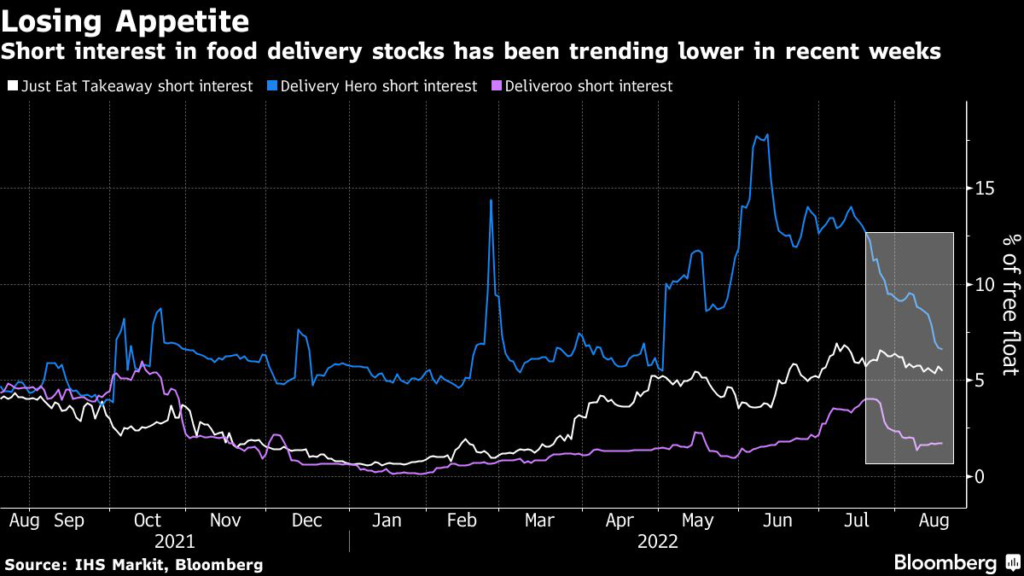
Still, caution may be warranted: The recent rebound in shares has been driven in part by bearish speculators reversing their bets on declines in the stocks, rather than just fresh buying by bulls. So-called short interest — a measure of how much of the stock has been sold by bears — has been declining for all three. 

The big uncertainty is whether the market’s expectations on these companies’ growth rates are at realistic levels, said HSBC’s Porteous, as their business models are set to be tested in an economic slowdown. And in the long run, investors are still unsure where these businesses will end up in an “extremely wide” range of outcomes, he said.

“We’ve got a couple of key quarters coming up from a consumer outlook perspective,” said Porteous, who has hold recommendations on Delivery Hero and Deliveroo and a buy on Just Eat. “It’s not like we are out of the woods yet.”

More stories like this are available on bloomberg.com

©2022 Bloomberg L.P.

Hong Kong Reopens Major Covid Site as Cases Hit Four-Month High

(Bloomberg) — Hong Kong will reopen one of its biggest Covid-19 isolation facilities as case numbers hit the highest in more than four months, putting strain on the hospital system and sparking uncertainty around whether the city can further ease virus policies.

Officials will have an additional 200 beds at Asia World Expo starting next week, with 100 health care workers to staff the facility, Lau Ka-hin, chief manager of quality and standards at the Hospital Authority, said at a briefing on Friday. It’s part of a new stage of Covid management to alleviate pressure on the health-care system. Non-emergency services at hospitals will also be further reduced in order to free up beds and manpower, he said. 

Read more: Hong Kong Suspends Some Hospital Services as Virus Cases Swell

Hong Kong reported 6,445 new cases, the highest since the end of March when the city was exiting a wave of infections that at one stage was the deadliest in the world. There are 1,898 Covid patients in hospitals, including 25 serious cases, 36 in critical condition and 10 in intensive care.

“We are very concerned,” said Lau. “We’ve come to a very key moment and we are worried that the situation may deteriorate further.” 

The increase in daily infections is being fueled by more transmissible omicron subvariants and, while it follows this month’s easing of quarantine rules for inbound travelers, imported cases make up a fraction of the total tally. Still, it casts uncertainty over whether there will be a further relaxation of measures as Hong Kong seeks to revive its reputation as a global financial hub.

Optimism had also been building that the city’s plan to host a high-level, government-sponsored financial forum in November, as well as a rugby tournament the same month, could become an opportunity for the city to open up. 

The rising number of cases are likely to be a hurdle in Hong Kong’s plans to reopen its border with mainland China, with discussions last year scuppered by swelling infections in the city. The Hong Kong government is studying whether it can offer quarantine services to local travelers trying to enter China, the Hong Kong Economic Times reported this week. 

Read more: Hong Kong Mulls Expansion of Traveler Flow to China: Report

More stories like this are available on bloomberg.com

©2022 Bloomberg L.P.

Crypto Firm Hodlnaut Reveals Singapore Police Proceedings

(Bloomberg) — Beleaguered cryptocurrency lender Hodlnaut said there are “pending proceedings” between the company and Singapore police and that it has slashed its workforce.

The proceedings also involve the city-state’s attorney-general and it’s unable to disclose any further information on the matter, Hodlnaut said in a statement Friday. The firm has laid off some 40 people, or about 80% of employees, according to the statement. 

The company said its founders are in Singapore and “working hard on the recovery plan.” Earlier this week, Hodlnaut said it had filed an application in Singapore to be placed under a form of creditor protection. The police are unable to comment on the case as the matter is before the courts, it said in response to a request for comment from Bloomberg News. 

Hodlnaut also said Friday it’s cutting all open-term interest rates to 0% as of 5 p.m. on Aug. 22 to stabilize liquidity.

This year’s crypto rout led to a number of blowups afflicting digital-asset exchanges, lenders and hedge funds. Some of those, as in the case of Hodlnaut, have hit Singapore.

Hodlnaut said its business has been hurt by losses at its Hong Kong subsidiary during the TerraUSD stablecoin crash. It also cited unusually large withdrawals, the overall crypto slide and “issues relating to certain user(s) who have deposited substantial amounts of cryptocurrency” with the firm.

Hodlnaut said it doesn’t have any secured creditors. It said that crypto lender Celsius Network has neither borrowed nor lent to Hodlnaut, adding that Hodlnaut has an account with Celsius but hasn’t deposited any assets with Celsius.

Read more: Crypto Lender Celsius Bankruptcy Trustee Wants Examiner Named

Hodlnaut aims to restore its asset-to-debt ratio to at least 1 and eventually allow users to withdraw the full value of their cryptocurrency deposits.

The company said its next update will likely be on Aug. 23.

(Updates with police response in third paragraph.)

More stories like this are available on bloomberg.com

©2022 Bloomberg L.P.

Crypto Newbies Have Family and Friends to Thank for Losses

  • Listen to Bloomberg Crypto on the iHeartRadio App
  • Listen to Bloomberg Crypto on Apple Podcasts
  • Listen to Bloomberg Crypto on Spotify  

(Bloomberg) — The fear of missing out, or FOMO, is a driving force behind some casual crypto investors. Usually, one doesn’t develop FOMO out of thin air. There’s typically someone or something behind it. That FOMO can be enhanced by watching friends and family enter the cryptosphere and succeed.

There’s some evidence that personal relationships are key in driving new money into crypto. That’s great for everyone when the investment is doing well, but what happens when the markets shift and they start losing money?

In this episode, Bloomberg crypto senior editor Anna Irrera speaks with Brian Hourigan and Adam Ghahramani, two friends with first hand experience of what it’s like to be in this position. 

Follow us on Twitter @crypto, and subscribe to the Bloomberg Crypto newsletter at https://bloom.bg/cryptonewsletter


More stories like this are available on bloomberg.com

©2022 Bloomberg L.P.

‘ESG’ Stripped From 23% of EU Sustainable Funds in Review

(Bloomberg) — Almost a quarter of funds that claim to “promote” sustainability under European regulations don’t deserve an “ESG” label, according to a fresh review by market researcher Morningstar Inc.

The analysis, which looked at funds classified as Article 8 within the EU’s Sustainable Finance Disclosure Regulation, shows that 23% don’t live up to environmental, social or governance investing principles, Boya Wang, ESG analyst at Morningstar, said in an interview. 

To justify an ESG tag within Morningstar’s definition of the term, a fund’s investment strategy can’t rely only on excluding so-called sin stocks like tobacco, coal or weapons, Wang said. “Many Article 8 funds will not be tagged as sustainable funds under our framework,” he said.

The assessment is the latest to raise questions around a key pillar of Europe’s efforts to become of global champion of sustainability. No other jurisdiction has raced ahead with such an ambitious program for transforming the entire asset management industry. But even regulators are starting to warn that the process has left too many opportunities for greenwashing.

The EU’s rulebook for ESG investing, SFDR, was designed to root out asset managers’ inflated sustainability claims. The framework, which was enforced in March last year, requires firms to classify their investment products under one of three categories: Article 6, which only addresses ESG risks; Article 8, which “promotes” ESG characteristics; and Article 9, which sets measurable ESG “objectives.” 

Arguably the vaguest of the three categories, Article 8 has become a magnet for fund managers. The latest Morningstar data reveals that asset managers have reclassified well over 600 funds previously listed as Article 6 to Article 8. A number of Article 9 funds were also downgraded to Article 8, it found. As of June, funds registered as Article 8 held 3.76 trillion euros ($3.8 trillion), compared with 420 billion euros allocated to Article 9 funds, Morningstar estimates.

It’s not the first time Morningstar has — within its own classification system — axed ESG tags from funds making sustainability claims. Earlier this year it removed the label from more than 1,200 funds representing well over $1 trillion in assets under management. The researcher is also on a campaign to ensure the fund industry doesn’t rely on empty jargon in its ESG marketing material, by targeting vague terms such as “ESG integration.” 

Such reclassifications have coincided with a crackdown by financial watchdogs on funds suspected of misstating the ESG-ness of their portfolios.

“There have been several indications from regulators to say, ‘we are watching closely and we will come knocking,’” said Sonali Siriwardena, partner and global head of ESG at Simmons & Simmons. Recent guidance from the EU “very clearly says one of the likely reasons for regulatory intervention would be that periodic reporting doesn’t support what is said in the product document.” 


There’s also evidence that investment clients are growing more cautious toward Article 8, as fund managers include atypical ESG sectors like defense, energy and commodities in the category. More than $30 billion was withdrawn from Article 8 products last quarter, while roughly $6 billion flowed into the stricter ESG category of Article 9, Morningstar data shows. 

In response to stricter rules and more demanding clients, some asset managers have started removing ESG labels from funds, rather than be accused of greenwashing. In the second quarter, six funds dropped sustainability-related keywords from their names, Morningstar found. 

“Dropping ‘ESG’ is related to broader rising expectations,” said Wang. Fund managers “think those strategies don’t fulfill the expectations of investors and regulators anymore, so the best way is to drop ‘ESG’ and ‘sustainability’ from their names,” he said.

The European Fund and Asset Management Association, which represents the industry, said the issue stems from the general absence of adequate ESG definitions.

“With a current lack of clear labeling standards, these disclosure classifications are often used as an indication of the ESG credentials of a fund,” said Vincent Ingham, director of regulatory policy at EFAMA. “However this is not what they were designed for. While it is less easily comparable or measurable, it is crucial to take into account other qualitative information on a fund when assessing its green credentials.”

European regulators have acknowledged the need to revisit some of the definitions currently guiding SFDR allocations. Verena Ross, chair of the European Securities and Markets Authority, said in May that regulators across the EU are working on reducing “what one might call over-disclosure by investment funds under Article 8, to avoid misleading disclosures to investors about the greenness of a product.”

Ross said that ESMA also supports future legislative efforts to create clear criteria for financial products making sustainability disclosures. That includes potentially introducing “sustainability labels” for financial products, “in order to help generate much needed clarity for retail investors.”

(Adds reference to ongoing purge of ESG label at Morningstar)

More stories like this are available on bloomberg.com

©2022 Bloomberg L.P.

Crypto Funds Weigh Market Data Options on Correlations

(Bloomberg) — In a sign of how close digital and traditional markets have become, cryptocurrency traders can no longer live without knowing what’s happening on stock exchanges. 

Tightening links between price moves in US equities and cryptocurrencies are forcing digital asset hedge funds to consider shelling out for expensive data from stock exchanges and other traditional markets, in a shift from previous years when it was possible for these firms to profit on Bitcoin’s moves without clues from other asset classes. 

The influx of traditional trading firms into crypto, who already have such inputs, is also adding to pressure to gobble up more data due to intensifying competition in digital asset markets.

As a result, large crypto trading firms could see their market data costs rise to as much as $500,000 per month, according to several hedge fund managers, from near zero currently. Other than leading to heftier market bills, the moves further tighten links between the world of digital assets and Wall Street.

“The headline here is that you absolutely need data from traditional markets,” said Jonah Van Bourg, global head of trading at Cumberland, the digital asset trading arm of DRW. “If you’re trading Bitcoin right now, you’re effectively trading macro so you need that data to survive and to make money.” 

As an offshoot of DRW, a Chicago-based trading giant, Cumberland has access to market data from all asset classes. This is a luxury that crypto native firms are craving. 

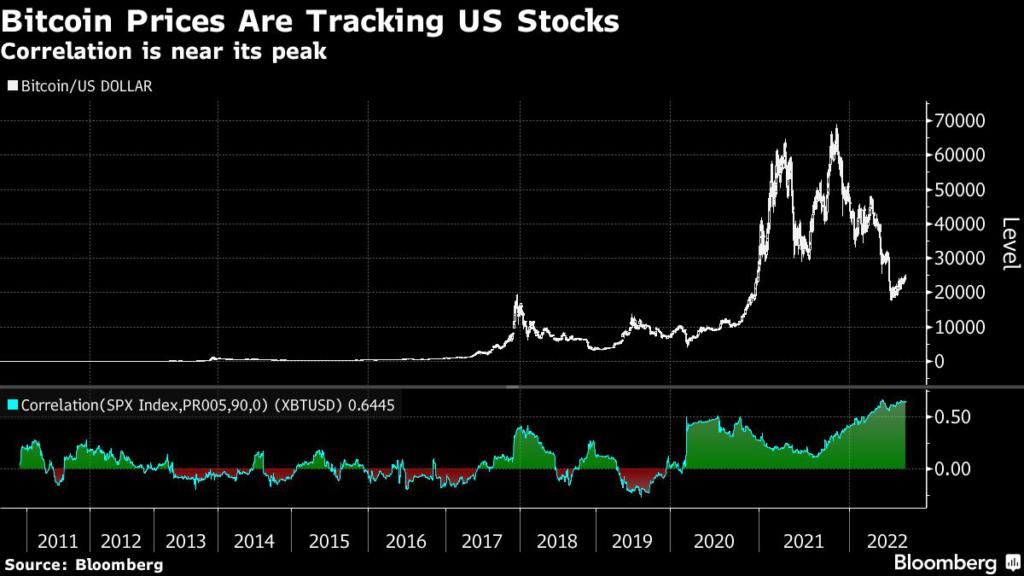
In recent months the price of cryptocurrencies moved in sync with US stocks, making the correlation between digital assets and two key indices, the S&P 500 and Nasdaq, the strongest since 2010. The close relationship has turned Bitcoin into a version of equities, an asset that goes up when investors are feeling optimistic about global financial conditions and sinks when concerns about growth flare up.

“Despite all the talk of Bitcoin being a good inflation hedge or it being the new gold, the only thing that mattered for prices were stocks,” said Francesco Filia, founding partner of crypto hedge fund Fasanara Capital. “It’s quite a clear correlation.” For now, Fasanara trades without input from traditional markets.


Wintermute is of of many companies weighing whether to add market data from futures and equity markets to its inputs, according to Evgeny Gaevoy, the London-based crypto market maker’s chief executive.

“With increased correlation between traditional and digital asset prices, we of course can’t ignore the traditional data feeds,” said Gaevoy, which trades as much as $7 billion worth of digital tokens a day.

Tyr Capital, a Geneva-based digital asset manager, is also planning to increase the type of financial data it buys. Tyr is gearing up to expand its activities and to trade tokenized commodities and oil, said Ed Hindi, chief investment officer at the fund. At this point, market data will become a key input, especially as Hindi expects these new strategies to become a big part of the fund’s trading strategies.

“Tyr Capital will need more market data from the TradFi world especially when we start actively trading tokenized financial assets in the coming 24 months,” Hindi said. For now, Tyr Capital relies on data from currency markets only. 

Paying for data would be a sharp shift from previous years when the funds and other crypto specialist trading firms could thrive simply by relying on free inputs from exchanges where Bitcoin and its peers are traded. That’s now changing. Unlike in stock and currencies markets, crypto exchanges give away trading information for free to their customers, rather than charging tens of thousands of dollars a year for information about prices and liquidity. 

The largest clients of LMAX Group’s institutional only crypto exchange are already subscribing to data feeds from LMAX’s other markets, such as FX and metals, said David Mercer, the company’s CEO. 

‘It is entirely natural as crypto becomes intertwined with TradFi that a wider range of market data will be required for all participating firms,” said Mercer.

Costs for crypto trading firms may also rise as they start requiring more mainstream tools to execute trades or other related services. Demand is growing for cross-asset trading software such as portfolio or risk management systems, technology companies and fund managers said.

Digital Asset order management system provider Talos has seen demand for its products including data spike over the last 6 months, said Chief Executive Anton Katz. Sell-side vendors are looking to provide their clients with the ability to price and trade currencies and crypto simultaneously to improve execution outcomes, he said. Buy-side crypto traders, such as hedge funds, are looking at new areas, where input from other markets is key.

The pressure to substantially increase costs comes at a time when the prices of crypto assets have slumped, further impacting the profitability of digital asset specialists. Market makers in crypto are also facing stiff competition from companies with roots in traditional finance, with firms including large players like hedge fund Brevan Howard and market maker Citadel Securities entering this space. These companies already have information and links to equities and commodities trading, which potentially provide an edge over those that do without additional data.

For now, some are hoping they can still hold off on a data shopping spree.

“If I wanted CME data that’s a significant lift for me financially,” said Michael Safai, a founding partner at crypto trading firm Dexterity Capital. “For the time being it’s not attractive but in the long run we will have to think about it. It’s only going one way.”   

(Fixes spelling of name in fifth graf of story originally published on Aug. 18.)

More stories like this are available on bloomberg.com

©2022 Bloomberg L.P.

UK Outlook Dims With Consumers Paying More to Buy Less in Shops

(Bloomberg) — Britain’s surging inflation rate is forcing consumers to pay more for the same amount of goods, underscoring a dimming outlook for the economy.

Retail sales volumes unexpectedly rose 0.3% last month, but the cost of those sales increased more rapidly by 1.3%, the Office for National Statistics said Friday. The volume gains came from a 4.8% surge from web-based stores, which offered discounts and promotions to draw in customers.

The figures came hours after a separate report showed consumer confidence plunged to its lowest since 1974, when oil supply shocks triggered a wage-price spiral and left industry working only three days a week. It capped a week of official data suggesting that the UK economy is starting to buckle under the weight of falling real wages and a squeeze on the cost of living. 


“The strain on the personal finances of many in the UK is alarming,” said Joe Staton, client strategy director at GfK. “Just making ends meet has become a nightmare. The crisis of confidence will only worsen with the darkening days of autumn and the colder months of winter.”

The pound fell after the reports, bringing the cumulative drop against the dollar to 12% so far this year. Yields on 10-year UK government bonds surged 9.2 basis points to 2.399%, with investors anticipating the Bank of England will continute raising interest rates sharply to fight inflation.

Internet retailers accounted for 26.3% of all retail sales in July, up slightly from the month before. Fuel sales fell 0.1% in the month, reflecting a surge in prices. Supermarkets had a small gain, but stores that don’t sell food showed a sharper drop. The gains online offset a decline in sales of clothing, household goods and second-hand items including antiques.

“The summer sunshine brought a slight uplift in sales,” said Helen Dickinson, chief executive officer of the British Retail Consortium. “Summer clothing, air conditioning appliances and outdoor foods all benefitted from record temperatures, but most retailers will still be seeing falling volumes in the face of rising inflation.”

Friday’s report follows a series of indicators that pointed to a rising risk of recession in the UK.

Real wages adjusted for inflation fell 3% in the second quarter, the sharpest pace on record. Consumer price growth broke into double digits last month for the first time since 1982. 

What Bloomberg Economics Says …

“The monthly rise in the UK’s July retail sales masks the bigger picture of a sector facing the most testing time since the pandemic. Soaring inflation will continue to squeeze household purchasing power and likely hit sales volumes in the coming months.”

–Niraj Shah, Bloomberg Economics. Click for the REACT.


“As summer passes, and holiday credit card bills arrive, other essential costs are also spiking,” said Paul Martin, head of retail at KPMG. “Many retailers are anticipating the consequence of this is an autumn drop in demand at a time when their own margins are coming under further pressure.”

More concerning is the outlook for the labor market. New job vacancies fell for the first time since August 2020. That’s a sign that demand for workers may be cooling, which would remove the strongest pillar of the economy since the pandemic.

The Bank of England is focused on bringing inflation back to its 2% target and has signaled that further interest-rate increases are likely — even if those curb growth. Investors anticipate a half-point increase in the benchmark lending rate to 2.25% and rates above 3.5% by the middle of next year.

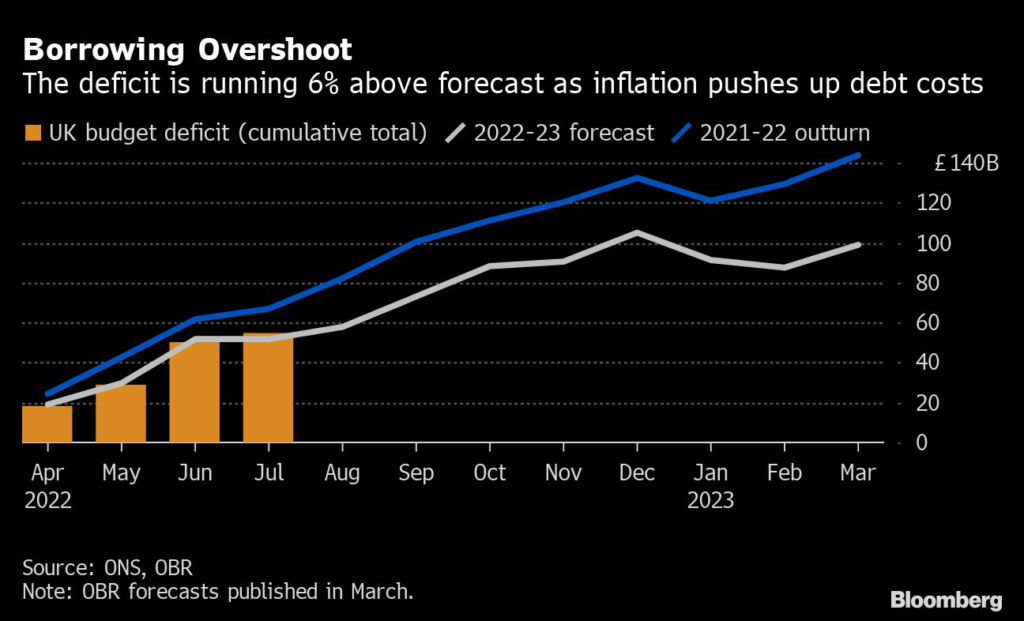
Another report this morning showed that UK government borrowing came in higher than forecast in the first four months of the fiscal year as soaring inflation drove up debt costs. 

A larger-than-forecast £4.9 billion ($5.8 billion) budget deficit in July took the total for 2022-23 so far to £55 billion pounds — £3 billion more than officials forecast in March. Debt-servicing costs surged by 81% from a year earlier.

“I know that rising inflation is creating challenges for families and businesses, and it is also putting pressure on the public finances by pushing up the amount we spend on debt interest,” Chancellor of the Exchequer Nadhim Zahawi said.

Read more:

  • UK Heat Wave Boosts Sales in Shops and Spending on ‘Staycations’
  • UK Real Wages are Falling at Their Fastest Pace on Record: Chart
  • UK Inflation Hits Double Digits for the First Time in 40 Years
  • Poorest UK Households Hit Hardest by Surge in Inflation
  • UK Retailers Report Prices Rising at Sharpest Pace Since 2005
  • UK Businesses Say Economic Growth Slowed to a Crawl in July

(Updates with market reaction.)

More stories like this are available on bloomberg.com

©2022 Bloomberg L.P.

One Answer to Europe’s Energy Crisis? More Electric Cars

(Bloomberg) — Paul Kershaw is not a God — that would be his dog, “God” — but he does harness the power of the wind and sun.

Every morning at his home near Cambridge in the UK, Kershaw charges up his Nissan Leaf, in part from the 12 turbines at the Red Tile Wind Farm a few miles west and the Ryston Solar Farm a few miles north. Every evening, Kershaw then unleashes that same power to his neighbors, right when they need it most. The 51-year-old, who is retired on disability, only drives his car on occasion — mainly when it’s time to take God on a scenic walk.

“It’s just a really great feeling knowing you’re doing something positive,” Kershaw says. “It’s not just a car anymore … the solution is in the problem.”

Kershaw is one of 350 UK residents who have been pumping electricity from their vehicles to surrounding homes and businesses since 2018, a nascent bit of energy arbitrage known as vehicle-to-grid charging, or V2G. The idea is for EVs to charge their own batteries when renewable energy is ripe — typically midday — and then discharge some of that electricity when power demand is high and renewable generation is low, usually around 5 to 10 p.m. 

For now, the UK’s V2G practitioners are just part of a trial, one of several in Europe. It’s confined to Leaf vehicles, and the cost of the smart-charging hardware was covered by a government subsidy. But with enough cars, compliant car owners and obliging utilities, V2G could set off a cascade of climate-positive electrical outcomes, helping utilities use more renewable energy, avoid firing up gas or coal-burning plants, and maybe even build fewer of them.

The timing is propitious: At the moment, the European energy market is a mess. There’s been a gush of renewable energy as costs decline for solar panels and wind turbines, but supply-demand mismatches mean that energy often goes unused, according to Kaluza, a UK company that builds software for global utilities, including the ones handling the V2G trial. When there is a demand peak, European utilities often have to fire up extra generation, typically by burning coal or natural gas, roughly half of which has traditionally come from Russia.

The result is a wholesale market that whipsaws wildly through the course of any given day and has only been exacerbated by the war in Ukraine and recent heat waves. In the UK these days, the price even goes negative a few hundred times a year; utilities are actually paying market participants to consume their electricity. 

Selling bi-directional charging

Many EVs don’t yet have the capacity to send power in the other direction, though it’s a feature of some of the fastest-selling models, including the Ford F-150 Lightning, the Hyundai Ioniq 5 and the Kia EV6. The success of those machines is forcing the hand of rivals, essentially making bi-directional charging table stakes in the EV game.

Other than a car with bi-directional capabilities, drivers need a charging unit that can switch the current coming from the car back to the home. Wallbox, a Barcelona-based hardware company, has sold about 250,000 smart chargers to date and is fast transitioning to units that pump power both ways, according to CEO Enric Asuncion.

Five years from now, Asuncion expects one in three EV owners will be sending battery power from the car back to the grid, or at least to their home. “A car is only used 10% of the time, so for users, it’s a way to save money,” he says. “And car companies are planning to make it very clear to them.” Having a car that serves as a backup battery or utility storage bank will become a particularly huge selling point for homeowners like Kershaw, who is also investing in energy-efficient heating and a water-saving showerhead, and in places with both a lot of renewable power and high demand peaks, including California and Texas.

That trajectory also suggests a potential flywheel dynamic. Ultimately, the ability to function as a tiny power plant may convince EV-curious consumers — or even EV skeptics — to take the leap. And if bi-directional charging sparks EV adoption, it will, in turn, spark more V2G capacity. “If you look at the marketing from car companies, it’s pretty high up there,” says Ryan Fisher, an analyst at clean energy research group BloombergNEF. “And people just kind of want that next level of fancy.”

Paying nothing for power

At the Kaluza nerve center in London, Conor Maher McWilliams, the company’s head of client solutions, monitors the UK’s 350 grid-supporting vehicles on a map, like soldiers in an electron battlefield. Each car is a dot and as the day progresses they transition from blue (charging), to gray (idle), and finally to green in the evening, as they pump power back onto the grid. 

“Our job is to take all of those status updates from the vehicles and [weather] forecasts and availability, and to turn that into like a big battery — a virtual power plant,” McWilliams says. 

Last year, the 350 cars plugged into Kaluza’s V2G platform collectively fed .891 gigawatts of electricity back to their adjacent homes and to OVO, Energy Ltd., one of the country’s largest utilities; that’s enough to power about 287 British homes for a year. The average participant made roughly $500 over the course of the year before paying the standard electric bill. Kershaw, who charges his car via a solar array on his roof before feeding the same power back to the grid, pays essentially nothing for electricity these days. 

By 2040, when the number of EVs in the UK is expected to hit 28 million, BNEF estimates V2G could supply enough battery capacity to power the entire country for almost two days, though the idle EV fleet would only be called on about 200 days a year. If those vehicles participated en masse, the share of electricity coming from renewable sources would surge from 76% to 82% and there would be an 11% to 19% reduction in CO2 from electricity generation. “It can have a really big impact,” says BNEF’s Fisher.

To make that kind of impact, however, utilities will first have to expand tiny trials into formal offerings open to any ratepayers with an EV snoozing in the driveway. Steve Kosowski, manager of long-range strategy at Kia America, thinks smaller, less official V2G projects might start popping up all over the place, “almost a community micro-grid. A utility might say, ‘We see you all have 15 EVs in this neighborhood,’” he says. “‘How would you like to save 20% on your electricity?’”

More stories like this are available on bloomberg.com

©2022 Bloomberg L.P.

SoftBank Taps Sumer Juneja to Oversee European Investments

(Bloomberg) — SoftBank Investment Advisers, which runs SoftBank Group Corp.’s Vision Funds, has given oversight of its European investment team to managing partner Sumer Juneja.

Juneja, who is also responsible for SBIA’s Indian investments, will relocate to London, according to a memo sent to staff by Rajeev Misra reviewed by Bloomberg. 

Juneja’s enhanced role comes amid the impending departures of managing partners Yanni Pipilis and Munish Varma, who are joining a new investment firm led by Misra. “Both have made a huge contribution to the firm’s investment activities over the past few years, building our core capabilities in Europe and India,” Misra wrote in the staff memo. 

A SoftBank spokesman declined to comment. 

U.K. and European companies backed by SoftBank Vision Fund 2 include buy-now-pay-later specialist Klarna, meal-kit maker Gousto and fantasy soccer platform Sorare.

Read more: Masayoshi Son’s Rough Week Is Capped by Elliott Selling SoftBank

More stories like this are available on bloomberg.com

©2022 Bloomberg L.P.

Close Bitnami banner
Bitnami