Bloomberg

Crypto Firm Hodlnaut Reveals Police Proceedings and Slashes Jobs

(Bloomberg) — Beleaguered cryptocurrency lender Hodlnaut said there are “pending proceedings” between the company and Singapore police and that it has slashed its workforce.

The proceedings also involve the city-state’s attorney-general and it’s unable to disclose any further information on the matter, Hodlnaut said in a statement Friday. The firm has laid off some 40 people, or about 80% of employees, according to the statement. 

The company said its founders are in Singapore and “working hard on the recovery plan.” Earlier this week, Hodlnaut said it had filed an application in Singapore to be placed under a form of creditor protection.

Hodlnaut also said Friday it’s cutting all open-term interest rates to 0% as of 5 p.m. on Aug. 22 to stabilize liquidity.

This year’s crypto rout led to a number of blowups afflicting digital-asset exchanges, lenders and hedge funds. Some of those, as in the case of Hodlnaut, have hit Singapore.

Hodlnaut said its business has been hurt by losses at its Hong Kong subsidiary during the TerraUSD stablecoin crash. It also cited unusually large withdrawals, the overall crypto slide and “issues relating to certain user(s) who have deposited substantial amounts of cryptocurrency” with the firm.

Hodlnaut said it doesn’t have any secured creditors. It said that crypto lender Celsius Network has neither borrowed nor lent to Hodlnaut, adding that Hodlnaut has an account with Celsius but hasn’t deposited any assets with Celsius.

Read more: Crypto Lender Celsius Bankruptcy Trustee Wants Examiner Named

Hodlnaut aims to restore its asset-to-debt ratio to at least 1 and eventually allow users to withdraw the full value of their cryptocurrency deposits.

The company said its next update will likely be on Aug. 23.

More stories like this are available on bloomberg.com

©2022 Bloomberg L.P.

Japan’s Largest Online Broker to Shut Crypto Mining in Russia

(Bloomberg) — SBI Holdings Inc., Japan’s biggest online brokerage, said it will shut crypto-mining operations in Russia, adding to the churn in the region sparked by the threat of US sanctions.

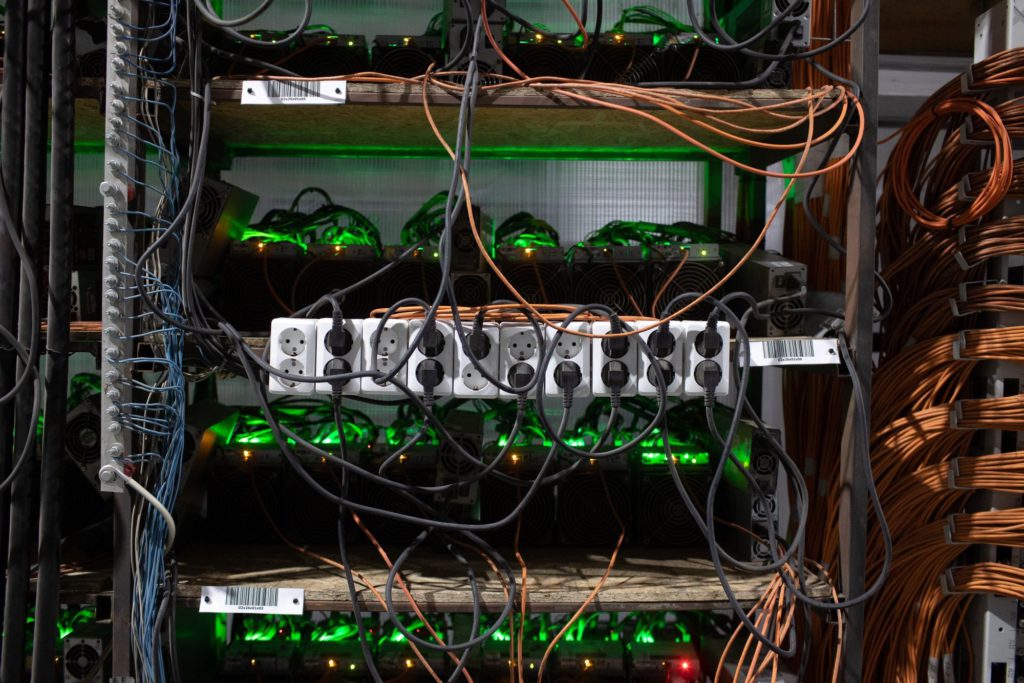
Russia’s invasion of Ukraine has created uncertainty over the prospects of the mining business in Siberia, while crypto’s global market rout has rendered it less profitable to mine tokens, a spokesman said in response to questions from Bloomberg News. Chief Financial Officer Hideyuki Katsuchi announced the plan to sell machinery and withdraw earlier this week.

Miners have flocked to Russia, in part to take advantage of low-cost power from natural gas and hydropower dams, that have made it a popular destination besides North America after Beijing’s crypto mining ban last May forced them out of China. 

But in April, the U.S. Treasury Department imposed sanctions on Switzerland-based crypto mining company BitRiver, targeting one of the industry’s largest data-center service providers over its operations in Russia. Shortly after, America’s Compass Mining Inc. sought to liquidate $30 million in hardware in Siberia to avoid sanctions. 

Losses

SBI Holdings, which has been quicker than most Japanese financial firms in expanding into digital currencies, suspended mining in Siberia soon after the war began, according to the spokesman. That contributed to the company’s crypto asset business reporting a pretax loss of 9.7 billion yen ($72 million) in the three months ended June 30. The group, backed by Sumitomo Mitsui Financial Group Inc., swung to a 2.4 billion yen net loss for the period, its first quarterly loss in a decade, he said.

SBI has yet to decide by when it will complete the withdrawal from Siberia, the spokesman said. The company has no other crypto business in Russia, and it intends to keep operating SBI Bank LLC, its Moscow-based commercial banking unit, he said.  

The International Monetary Fund warned in an April report that crypto mining may offer Russia a way around sweeping economic sanctions imposed by the US and other western countries. Sanctioned countries can leverage its energy resources to power mining, while generating revenue directly from transaction fees, it said.


More stories like this are available on bloomberg.com

©2022 Bloomberg L.P.

Bitcoin Continues Retreat as 200-Week Average Takes Focus Again

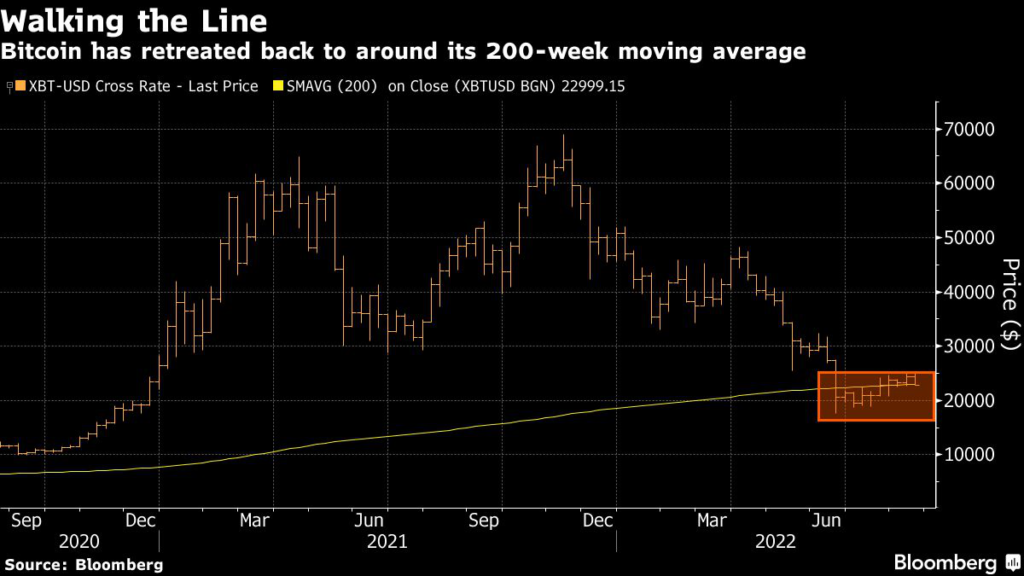
(Bloomberg) — Bitcoin fell for a fifth day in the past six in a continued retreat toward a key technical level as investors mulled mixed signals from Federal Reserve officials around the potential pace of interest-rate hikes.

The largest cryptocurrency dropped as much as 3% to $22,716.59, the lowest level since Aug. 10 and close to its 200-week moving average near $23,000, which Genesis Trading pointed to as a measure historically in focus for the market. Number two Ether dropped as much as 3.8%. The likes of Polygon, Solana and Avalanche declined 7% or more.

“The rally that brought it back to $25,000 has lost considerable momentum and that could begin to weigh more heavily on the price” of Bitcoin, said Craig Erlam, senior market analyst at Oanda, in a note Thursday. “A move below $22,500 may suggest the rally has run its course for now.”

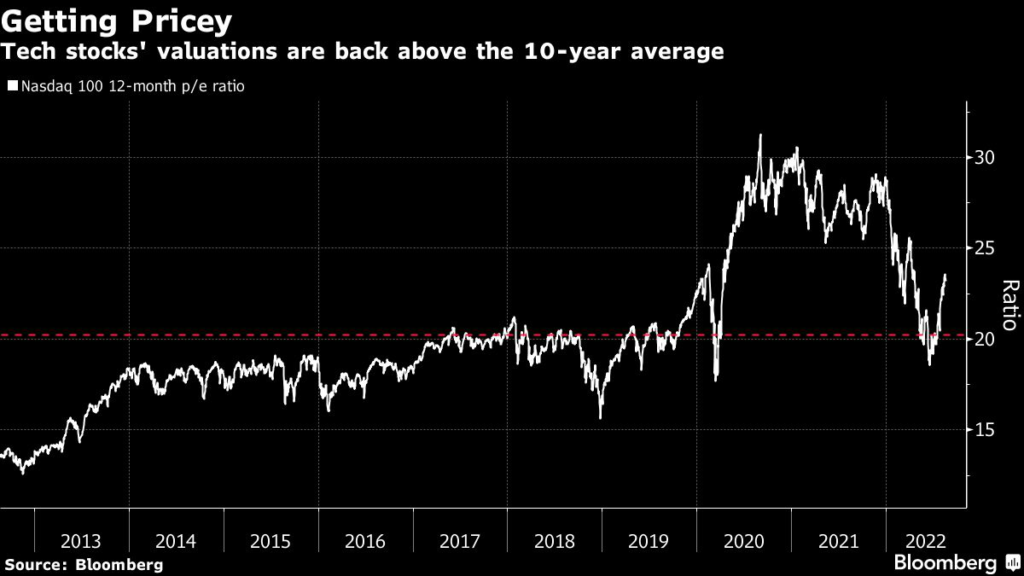
Cryptocurrencies have been battered this year as the Fed hiked rates amid elevated inflation readings, and risk assets more broadly, like big technology stocks, have struggled. Bitcoin and Ether are both down about 50% since Dec. 31. Still, they’re off their worst levels in mid-June amid tentative optimism that inflation may be peaking, and as the Ethereum network prepares for its much-anticipated Merge upgrade.

“In the short term, correlation risks are heightened as equities, especially technology names, are delicately poised at key resistance levels,” Jamie Douglas Coutts, senior market structure analyst at Bloomberg Intelligence, wrote in a note Thursday. 

In addition, crypto veterans may be cooling off in their buying.

“After a steady climb in the first half of 2022, the amount of Bitcoin that has not moved in over a year has leveled off, signaling a pause in the accumulation behavior of longer-term investors,” Genesis’s Ainsley To, Marc Chan and Noelle Acheson wrote on Thursday.

READ: Largest Bitcoin Miners Lost Over $1 Billion During Crypto Crash


More stories like this are available on bloomberg.com

©2022 Bloomberg L.P.

Asia Stock Gauge Dips; Dollar Nears One-Month High: Markets Wrap

(Bloomberg) — An Asian equity index fell on Friday amid mixed Federal Reserve policy signals on the likely pace of interest-rate hikes, while the dollar climbed as the spotlight fell again on geopolitical tension.

MSCI Inc.’s Asia-Pacific share index shed less than 0.5%. Moves across Japan, China and Hong Kong were fairly muted. S&P 500, Nasdaq 100 and European futures slipped after Wall Street shares posted a small gain on Thursday.

A greenback gauge hovered around a one-month high. Indonesian President Joko Widodo said China’s Xi Jinping and Russia’s Vladimir Putin plan to be at a Group of 20 summit in Bali later this year. That sets up a showdown with US President Joe Biden and other leaders as Russia continues its war in Ukraine.

Treasury yields drifted higher. Oil, gold and Bitcoin dropped. Later Friday, a $2 trillion options expiration could stir volatility in global markets.

The latest comments from Fed officials diverged a little: St. Louis’s James Bullard urged another 75 basis-point increase while Kansas City’s Esther George struck a more cautious tone, saying the case for hikes is strong but the pace is up for debate.

Investor sentiment has been boosted by expectations of slower monetary tightening on signs that high inflation is cooling. But hurdles remain for the 12% jump in world equities from June lows, not least the risk of entrenched global price pressures alongside economic slowdowns in the US and China.

While “lower volatility both in fixed income and in equities is starting to pull people back into the market,” events such as the Fed’s annual symposium in Jackson Hole, Wyoming next week will help determine if that’s sustainable, Nicholas Colas, co-founder at DataTrek Research, said on Bloomberg Television.

Traders will pour over Fed Chair Jerome Powell’s comments at the symposium. There is already speculation he may lean against a recent loosening in financial conditions that makes it harder to curb the cost of living.

Before that, Chinese banks will likely trim their benchmark loan prime rates Monday to help shore up the nation’s economy, where a power crunch is adding to drags from a property crisis and Covid-linked curbs.

Elsewhere, Indonesia’s president also said the nation could impose a tax on nickel exports this year.

Inflation remains the most closely-watched indicator in the second half. Will it come down gradually, or will it stay elevated, forcing the Fed to keep raising rates aggressively? Have your say in the anonymous MLIV Pulse survey.

Some of the main moves in markets:

Stocks

  • S&P 500 futures slipped 0.2% as of 10:49 a.m. in Tokyo. The S&P 500 rose 0.2%
  • Nasdaq 100 futures declined 0.2%. The Nasdaq 100 rose 0.3%
  • Japan’s Topix index was up 0.1%
  • South Korea’s Kospi index lost 0.4%
  • Hong Kong’s Hang Seng index was steady
  • China’s Shanghai Composite index added 0.1%
  • Australia’s S&P/ASX 200 index rose 0.1%
  • Euro Stoxx 50 futures slipped 0.2%

Currencies

  • The Bloomberg Dollar Spot Index rose 0.2%
  • The euro was at $1.0078, down 0.1%
  • The Japanese yen was at 136.24 per dollar, down 0.3%
  • The offshore yuan was at 6.8224 per dollar, down 0.3%

Bonds

  • The yield on 10-year Treasuries rose one basis point to 2.89%
  • Australia’s 10-year bond yield climbed one basis point to 3.35%

Commodities

  • West Texas Intermediate crude was at $90.46 a barrel
  • Gold was at $1,754.98 an ounce, down 0.2%

More stories like this are available on bloomberg.com

©2022 Bloomberg L.P.

Chinese Chip Software Maker Behind Mystery Buyer That UK Blocked

(Bloomberg) — A two-year-old Shanghai-based developer of chip design software was behind an attempt to buy a British firm that regulators blocked with little explanation, the latest example of Britain’s increasing hostility toward Chinese investment.

Super Orange HK Holding Ltd. was blocked from buying Bristol-based chip design software provider Pulsic Ltd., the British Business Secretary announced in a brief statement Wednesday. But that firm is in reality controlled by little-known Shanghai UniVista Industrial Software Group, according to Hong Kong public filings and Chinese corporate data. The Shanghai firm is backed by the National Integrated Circuit Industry Investment Fund — the powerful $50 billion state-backed vehicle known within the industry as the “Big Fund.”

It’s unclear what roles Super Orange’s controlling shareholders played in the takeover attempt. Pulsic’s would-be acquirer was founded in Hong Kong in August last year by Nanjing Puxin Software, according to local filings. That firm is in turn wholly owned by UniVista, according to Chinese corporate database Tianyancha. 

UniVista was incorporated only in 2020 and describes itself as a provider of Electronic Design Automation tools to the chip industry, or software kits vital to the design of semiconductors. Its No. 2 owner was the Big Fund, which typically bankrolls promising startups in their initial stages, according to Tianyancha.

Little is known about Puxin, the UniVista subsidiary that directly controls Super Orange. The office number listed in Puxin’s legal documents didn’t exist when Bloomberg News visited the Nanjing campus listed on Thursday. Several employees at the business park said the address didn’t conform with the usual format within the location.

Read more: Secretive Chinese Committee Draws Up List to Replace U.S. Tech

Representatives for Puxin and UniVista couldn’t be reached for comment. UniVista didn’t respond to an emailed inquiry sent to its registered email account, while phone calls to its offices went unanswered. 

The US has been leaning on allies from the UK to Japan to join in efforts to block China’s chip goals. Pulsic is also a player in EDA tools, employed by leading chipmakers from Taiwan Semiconductor Manufacturing Co. to Intel Corp. Beijing considers the sector, dominated by American firms Synopsys Inc. and Cadence Design Systems Inc., a key bottleneck in its ambitions to build a world-class semiconductor industry and wean China off US technology.

Read more: UK Blocks Takeover of Design Firm Amid Chinese Security Fears

Pulsic’s would-be acquirer — Super Orange HK Holding — had a sole and founding director identified as Zhou Nuo. In December, he ceded his post to Xu Yun, Hong Kong filings showed. Xu has the same name as the former head of Cadence’s Chinese business and is now a co-CEO at UniVista.

Xu, once named one of China’s most influential female chip executives, was also a director of the very similarly named Super Orange HK Ltd., a separate entity founded in March that’s in turn wholly owned by Shanghai UniVista Technology. Her co-CEO is Pan Jianyue, who headed Synopsys Inc.’s China and Asia-Pacific business before the pair founded the other UniVista Industrial in 2021. 

The parent entity of Puxin — Super Orange HK Holding’s sole owner — used a UniVista email address as its registered contact information in Tianyancha.

Stopping the Super Orange acquisition is a continuation of a recent trend.

The British government worked to end China General Nuclear Power Corp.’s involvement in UK projects and Boris Johnson’s administration also blocked Huawei Technologies Co. from participating in Britain’s 5G network.

And there are similar decisions in the pipeline. Britain is probing a Chinese-led takeover of Newport Wafer Fab, which owns the UK’s largest semiconductor plant, with a decision due in September. MPs are also calling for a ban on the sale of closed-circuit television cameras from the Chinese firms Hangzhou Hikvision Digital Technology Co. and Zhejiang Dahua Technology Co.

China’s Vast Blueprint for Tech Supremacy Over U.S.: QuickTake

More stories like this are available on bloomberg.com

©2022 Bloomberg L.P.

Indonesia’s Telkom to Combine Mobile, Broadband Businesses

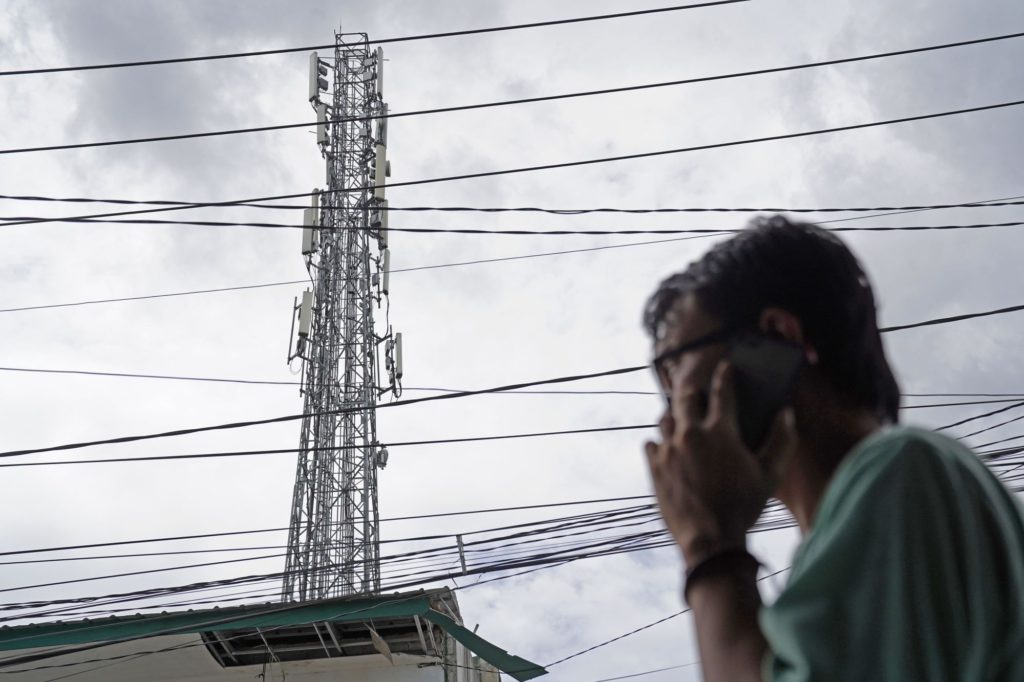
(Bloomberg) — PT Telkom Indonesia is planning to combine its broadband and wireless businesses as part of an overhaul of the sprawling state-owned telecommunications company, a senior executive said on Thursday.

The mobile business, known as Telkomsel and owned 35% by Singtel, counted 176 million subscribers in 2021, making it the largest cell provider in Indonesia, according to its latest annual report. The fixed broadband service had 8.6 million subscribers through its IndiHome brand and held a market share of around 80%.

Read More: Telkom Indonesia Readies Tower Shopping Spree to Win Price War

The Jakarta-based group is speaking with financial advisers about the deal, which could value the combined businesses at several billion dollars, people familiar with the matter said earlier. Telkom hopes to eventually separate its consumer-facing business from one focused more on corporate customers, the people said, asking not to be identified as the matter was private.

Telkom President Director Ririek Adriansyah confirmed via text message in response to a Bloomberg News query that the company was in the process of merging its fixed broadband and wireless businesses but did not provide further details. 

Digital Indonesia 

The business reorganization comes as Indonesia is poised for growth in areas such as e-commerce and financial technology. The country’s overall digital economy is set to double to $146 billion in 2025, according to a report last year by Alphabet Inc.’s Google, Temasek Holdings Pte and Bain & Co.

Telkom shares have climbed about 9% this year, valuing the company at around $29.6 billion. They rose 3.1% on Thursday, their largest increase in more than two weeks, on expectations that the company will benefit from measures in Indonesia’s annual budget supporting 30 million small businesses using digital systems by 2024.

The group counts a wide range of assets from mobile and broadband to satellite, towers and digital content. Last year, Telkom’s infrastructure services unit, known as Mitratel, raised about $1.3 billion in a Jakarta initial public offering.

(Updates with Thursday share move and budget measures in sixth paragraph.)

More stories like this are available on bloomberg.com

©2022 Bloomberg L.P.

Crypto Lender Celsius Bankruptcy Trustee Wants Examiner Named

(Bloomberg) — A government trustee handling the bankruptcy case for crypto lender Celsius Network is seeking the appointment of an examiner to help get additional information and clear up “confusion and anxiety.”

A representative for trustee William Harrington said in a hearing on Tuesday that they’re considering appointing an examiner to look into a slew of issues surrounding the bankrupt company. The representative, Shara Cornell, said in a filing dated Thursday that she hasn’t been able to get some additional financial information that would shed light on the crypto lender’s operations.

“There is no real understanding among customers, parties in interest, and the public as to the type or actual value of crypto held by the Debtors or where it is held,” the filing said. 

An independent examiner would analyze Celsius’s business model, operations, investments and lending transactions, among other things. An examiner would also look at Celsius management’s “role in creating the Debtors’ current illiquidity,” the filing said, as well as any “irregularities.”

Celsius filed for bankruptcy on July 13. Since then, more than 300 customers sent in letters, some of them claiming they were deceived and asking for the return of their money. A lawyer for Celsius on Tuesday said that it’s received multiple offers of fresh cash to help fund its restructuring process. The firm said it will meet with an unsecured creditors’ committee next week and is working “expeditiously” on the path forward.

The trustee also said in the filing that an examiner could clear up misconceptions about the case that might exist from sources like social media.

“The addition of social media in this case has amplified the Debtors’ transparency issues because there is a lot of information on the internet, but it is not vetted or explained, thereby leaving hundreds of thousands of customers to form their own conclusions based on the missing facts in this case coupled with the information passed around as truth on the internet,” the filing said. “The result has been confusion and anxiety. An examiner can fix this.”

More stories like this are available on bloomberg.com

©2022 Bloomberg L.P.
Rivian Cancels Least-Expensive Version of Electric Pickup Truck

(Bloomberg) — Rivian Automotive Inc. eliminated the least-expensive trim of its R1T electric pickup truck, the company confirmed via email, effectively raising the price of its entry-level model.

Demand for the Explore model, which retailed at $67,500, was smaller than anticipated, and eliminating it will help the EV manufacturer “streamline our supply chain and ultimately deliver vehicles more quickly,” according to a letter cited on the Rivian Owners Forum Thursday.

The “vast majority” of customers have ordered the next trim level, the $73,000 Adventure configuration, according to the letter.

Rivian confirmed it sent the letter to people who had preordered the Explore package. Customers will have until Sept. 1 to upgrade or cancel their order, the company said.

In March, the Irvine, California-based carmaker attempted to raise sticker prices of the R1T pickup and R1S SUV, citing higher input costs and a shortage of semiconductors, only to roll back the increases in the face of a customer backlash.

The Verge reported the discontinuation of the Explore configuration earlier Thursday.

More stories like this are available on bloomberg.com

©2022 Bloomberg L.P.
SpaceX Starship to Launch Satellite for Japan’s Sky Perfect JSAT

(Bloomberg) — SpaceX’s Starship has been chosen as the launch vehicle for a Japanese satellite, one of the first publicly disclosed commercial payloads for Elon Musk’s newest rocket.

The Superbird-9 is scheduled to be launched in 2024 to deliver broadcast and broadband signals primarily over Japan and Eastern Asia, Sky Perfect JSAT Holdings Inc. said Thursday in a statement.

Space Exploration Technologies Corp.’s Starship rocket is designed to be a reusable, multipurpose vehicle for carrying passengers, cargo and fuel. Last year, NASA awarded a contract for a lunar landing mission by Starship, and SpaceX Chief Executive Officer Musk eventually aspires to use it to take humans to Mars. 

The massive craft, which consists of a booster stage and second-stage spaceship, has yet to fly an orbital test flight. SpaceX said in May that Starship would conduct such a flight from Texas in June or July, but that has yet to happen. A booster rocket for the program caught fire during a test last month, appearing to cause “minor” damage, Musk said.

More stories like this are available on bloomberg.com

©2022 Bloomberg L.P.
Hong Kong Stock Index’s Revamp May Drag On to 2023, Analysts Say

(Bloomberg) — A historic revamp of Hong Kong’s benchmark stock index may drag into next year as the index compiler falls behind in boosting representation of new economy firms, market watchers say. 

Hang Seng Indexes Co. — which will announce results from a quarterly review late Friday — is still 11 members away from a plan to boost constituents to 80 by mid-2022. But the firm is “finding it tough to reach the target by excluding unprofitable companies” and is unlikely to attain its goal this year, Brian Freitas, an analyst who publishes research on Smartkarma, wrote in a note.

The goal is part of a wide-ranging overhaul of the Hang Seng Index announced in March 2021. Just three to four stocks have joined the 69-member benchmark in each of its quarterly rebalances since then, a pace that’s slower than some market watchers had expected. 

A representative for the compiler could not be reached for comment. 

Given the large number of additions pending, “Hang Seng’s revamp might not be finalized until 2023,” Bloomberg Intelligence analyst Marvin Chen wrote in a note. Baidu Inc., Kuaishou Technology and JD Health International Inc. are among the possible inclusions in the latest reshuffle, he added.

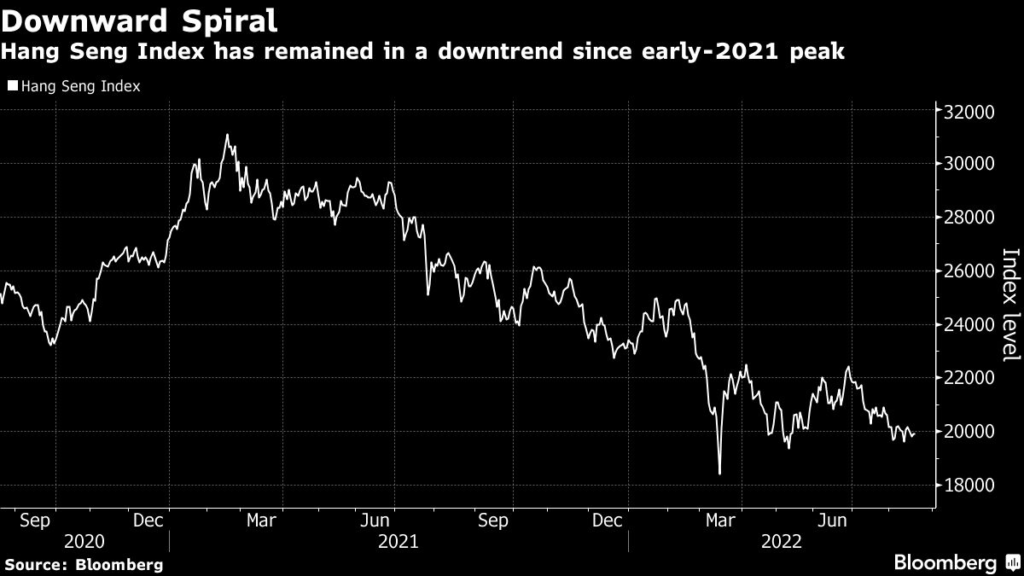
The Hang Seng Index has lost 16% this year amid a regulatory overhang, rising Sino-US tensions and China’s ongoing Covid outbreak.

The index review results are set to be published Friday evening local time. Hansoh Pharmaceutical Group Co., China Resources Gas Group Ltd. and Haier Smart Home Co. may also enter the benchmark this time, according to a note from China International Capital Corp. analysts.

In May, the index compiler named four additions, including Semiconductor Manufacturing International Corp. and China Hongqiao Group Ltd., and deleted AAC Technologies Holdings Inc.

More stories like this are available on bloomberg.com

©2022 Bloomberg L.P.
Close Bitnami banner
Bitnami