
Bloomberg

Biggest Africa Startup Battles Multiple Allegations in IPO Runup

(Bloomberg) — Africa’s largest startup Flutterwave Inc. is battling allegations of financial impropriety and personnel harassment from Lagos to Nairobi, as it considers pushing ahead with plans to list the company.

The Nigerian financial-technology company recently filled key positions including a chief financial officer as it prepares for an initial public offering potentially next year, people familiar with the matter said, requesting not to be identified because it’s private. It might, however, take longer as the company deals with a reputation crisis and amid a global market downturn, they said.

The business took a direct hit last month, when the Kenyan High Court froze Flutterwave’s bank accounts under anti-money laundering rules and the central bank said it isn’t licensed to operate payments services in the country. The company has for months been struggling with allegations in the media and lawsuits, including claims of refusing former employees stock rights, harassment and bullying. 

Flutterwave denied accusations of financial misconduct, including claims of money laundering in Kenya and irregularities related to stock options, and said it has taken action against those found culpable for any form of harassment in the company. It said the IPO plan is subject to market conditions.

It’s a blow for Flutterwave and its co-founder and Chief Executive Officer Olugbenga Agboola, who tripled the company’s valuation to $3 billion within a year after attracting investments from venture capital firms including B Capital Group and Tiger Global Management LLC. His stake in Flutterwave is worth more than $370 million as of the company’s January funding round, according to an analysis by the Bloomberg Billionaires Index using Pitchbook data.

Read More: Tiger-Backed Flutterwave Triples in Value to Over $3 Billion

“The Flutterwave story was one of an African fintech and it being the leader for Africa as the next frontier for fintech and venture investors. Then the unraveling of that story started and it hasn’t stopped yet,” said Raj Kulasingam, a corporate lawyer, who with investment banker Vishal Agarwal, have made fivefold returns funding African startups since 2017. “With all of this, I don’t believe that the international public markets are ready for a Flutterwave IPO.”

Bloomberg interviewed at least three former Flutterwave employees who said a culture of harassment and bullying from executives had developed under Agboola. The people asked not to be identified for fear of reprisals.

On the stock-award matter, a former employee, Gbemisola Ajayi, is suing Flutterwave. Ajayi is seeking $800,000 or the value of shares she said she was unfairly denied, according to court papers filed in Nigeria’s National Industrial Court. 

Ajayi said she decided to leave the company in March 2020 after the working environment “became toxic” and weighed on her mental health, according to the filings. The firm refused to award stock options she’d been promised out of “malice,” she said in the filings. 

Ajayi declined to comment beyond what was in the court fillings when contacted.

Flutterwave said conditions for the stock options award weren’t met before Ajayi resigned. The criteria included an audit and update on the company’s valuation, a vesting period and above-par performance, the company said in responding court papers. The case is next due in court in October. 

In a response to questions, Flutterwave said that the company “followed all legal processes and procedures to allow third parties, including former employees, to sell their shares to other third parties.” 

New Hires

The Lagos and San Francisco-based company was founded six years ago and facilitates cross-border transactions in multiple currencies for companies, including Alibaba’s Alipay, Uber Technologies Inc., in primarily emerging and frontier markets. 

For a highly-valued startup, taking weeks to respond to the allegations “was incredibly damaging to the overall ecosystem and this latest news drama has again hurt,”said Eghosa Omoigui, founder and managing general partner of early-stage funder EchoVC Partners LLC. 

In the financial impropriety case, Kenya’s Assets Recovery Agency accused Flutterwave of money laundering and obtained court orders to block access to more than $44 million in the company’s bank accounts, according to court documents. Flutterwave said the allegations are untrue, has records to verify that and is “working to ascertain the motive behind the false claims.”

Central Bank of Kenya Governor Patrick Njoroge said on July 28 that Flutterwave isn’t licensed to operate as a payment service provider in the country.

Flutterwave, which registered its business in Kenya in 2017, said it has been operating through partnerships with banks and mobile network firms. “We have been in constant engagement with the Central Bank of Kenya to ensure that we provide all the requirements, and we look forward to receiving our license,” it said. “We are committed to operating within the stipulated laws, regulations, and industry standards in Kenya.”

Agboola, 37, is seeking investors for Flutterwave’s IPO planned in the US and possibly Nigeria. Talks are still at an early stage and the company hasn’t yet mandated financial advisers, according to the people familiar with the matter who asked not to be identified discussing a private issue.

The company hired Oneal Bhambani from American Express in June to be chief financial officer, and named Gurbhej Dhillon, formerly head of Goldman Sachs Group Inc.’s lending platform, Marcus, as its chief technology officer. 

Strong Balance

“Given Flutterwave’s market position and strong balance sheet, the company has a significant growth opportunity over the next few years,” Bhambani said in an emailed response to questions on a possible listing. “Operationally, we are putting in place all aspects of controls, processes and infrastructure to prepare for an IPO subject to market conditions,” he said.

The firm bolstered its global finance team to include Rebecca Mendel, Danny Eidson, and Oscar Lan, from American Express and its Kabbage platform, said Bhambani.  

Bankers are skeptical about the timing, people familiar with the listing plans said. Flutterwave would benefit from holding off until at least next year to give the company time to address the various allegations, the people said, asking not to be identified discussing a private matter. Shareholders are also concerned about the general global market downturn, with technology firm-valuations among the worst hit, they said.

“Going to public markets is as much a public relations and marketing exercise as it is a fund raising. And at the moment Flutterwave’s brand equity is damaged,” said Agrawal. “They need to fix the problems.”

Bloomberg contacted more than a dozen of Flutterwave’s current investors, including Tiger Global and Whale Rock Capital, but did not receive any responses. 

“It is pertinent that foreign investors work very closely with trusted local investors to carry out the necessary due diligence and ongoing assessment of the health of their portfolio companies beyond growth metrics,” said Surabhi Nimkar, Partner at GreenHouse Capital which exited Flutterwave about two years ago. “Founders must carry their stakeholders along with transparency.”

More stories like this are available on bloomberg.com

©2022 Bloomberg L.P.

Ex-Arm Boss Resigns From SMIC’s Board as US-China Tensions Rise

(Bloomberg) — Tudor Brown, the former president of Arm Ltd., has resigned from the board of Semiconductor Manufacturing International Corp., stepping away from the Chinese chipmaker that has been hit with US sanctions.

Brown, a celebrated engineer who was part of Arm’s founding, is leaving SMIC after nine years on its board. He disclosed the move on his LinkedIn page.

“Bitter sweet day today. After 9 years I resigned from SMIC board. The international divide has further widened,” he wrote.

Brown, who’s also a director at top Chinese PC maker Lenovo Group Ltd., was a key executive at Arm from 1990 till May 2012, according to this LinkedIn profile. That was before SoftBank Group Corp. acquired the British firm in 2016.

Brown and SMIC didn’t immediately respond to requests for comment. 

SMIC is among a raft of Chinese semiconductor manufacturers contending with steadily tightening US export restrictions as Washington tries to contain Beijing’s technological rise. That’s on top of rapidly crumbling global electronics demand, as consumers leave a pandemic-era boom behind.

In response, homegrown firms have attempted to develop alternatives to American silicon. The Shanghai-based contract chipmaker has succeeded in advancing its production technology two generations this year to 7-nanometers, though industry experts caution that may not be based on the same standards employed by far larger rivals like Taiwan Semiconductor Manufacturing Co.

More stories like this are available on bloomberg.com

©2022 Bloomberg L.P.

Singapore Narrows GDP Forecast After Economy Shrinks in 2Q

(Bloomberg) — Singapore trimmed its 2022 growth forecast to reflect an increasingly challenging global environment, after the economy slipped into contraction in the second quarter.

Final data for the June quarter Thursday showed gross domestic product shrank 0.2% from the previous three months, and worse than the zero growth estimated by Ministry of Trade and Industry earlier. It also narrowed the full-year projection to a range of 3%-4% from 3%-5% seen before.

A 6.9% decline in retail trade services weighed heavily on the quarter-on-quarter performance, with wholesale trade as well as information and communications services output also registering a fall. Accommodation and food and beverage services notched up sizable gains, but those were mainly attributable to a weaker year-ago showing. 

The MTI flagged risks to the global recovery from aggressive monetary policy tightening as well as China’s ongoing struggles with Covid-19 and a property market downturn.

“Downside risks in the global economy remain significant,” Gabriel Lim, MTI’s permanent secretary, said in a briefing after the release, while counting any further escalation in Russia’s war in Ukraine as a key threat to inflation and global growth prospects. Financial instability caused by tighter monetary policies in advanced economies and possible further geopolitical tensions in Asia are added risks.

The Singapore dollar fell 0.2% to 1.3721 per dollar at 10:31 a.m. local time.

The trade-reliant city-state has sought to stave off further damage to its post-Covid growth recovery, stemming especially from supply-driven price shocks, through a combination of monetary policy tightening and targeted subsidies to aid the most vulnerable households. Singapore officials are bracing for further volatility in a global economy that the International Monetary Fund warned is on the brink of recession. 

“The bigger question is what is the 2023 outlook,” said Selena Ling, head of Treasury Research & Strategy at Oversea-Chinese Banking Corp. “Will there be recession in the major economies that will drag the global and Asian growth prospects down further?”

The trade ministry data Thursday also showed the economy grew 4.4% in the second quarter from a year ago, compared with an earlier estimate of 4.8% expansion. The government expects “slight” quarter-on-quarter growth for the remainder of the year, ruling out a technical recession, according to MTI.

Monetary policy is still appropriate after the tightenings this year, Edward Robinson, deputy managing director for the Monetary Authority of Singapore, said at the briefing. 

But “significant uncertainties” remain on the inflation outlook and third quarter will be a critical time to watch those pressures, he said. The closely-watched core inflation print is seen to “rise a bit” this quarter, Robinson said.

(Updates with sectoral performance in the third paragraph.)

More stories like this are available on bloomberg.com

©2022 Bloomberg L.P.
Hedge Funds Face SEC Push to Share More on Their Strategies

(Bloomberg) — Hedge funds would have to start giving the government significantly more information about their investment strategies under a proposal from the Securities and Exchange Commission to better keep tabs on risks to the financial system.  

The expansion of confidential filings that big managers must file quarterly with the SEC would mark one of the biggest increases in regulation for the private-fund industry in a decade. The effort is the latest move by Biden administration regulators to clamp down on a relatively opaque corner of finance that they say can have major impacts on markets. 

The plan represents a dramatic reversal of fortune for hedge funds after years of fending off tougher Washington oversight. In January, the SEC took a step toward requiring large hedge funds and private-equity firms to more quickly report major losses and redemptions. The regulator is also considering ways to make fees more transparent.

Private funds make up “a significant part of our financial system that is growing,” Gary Gensler, the agency’s chair, told reporters on Wednesday. “We can play a role by upping at least some of the transparency.”

While specific data included on the so-called Form PF isn’t made public, regulators can use it in enforcement actions and to assess broader market risks. The changes, which the agency’s three Democrats voted to propose during a commission meeting, immediately drew pushback from the industry and the SEC’s two Republican commissioners. 

“Alternative asset managers currently provide extensive information to regulators,” Bryan Corbett, the chief executive officer of the Managed Funds Association, said in a statement. “The SEC should focus on better utilizing this information rather than imposing new burdens on fund managers that are of dubious utility.”

According to Gensler, regulators need the additional data to keep pace with the growth of the industry. He said that funds have grown much larger and their structures more complex since the confidential filings were first required after the financial crisis. The changes would also give regulators more visibility into hedge funds’ exposure to digital assets and associated risks, he told reporters.

The US Commodity Futures Trading Commission also announced on Wednesday that it had voted to propose the changes.

Under the plan, big firms would have to separately report each component included in complex structures, such as master-feeder arrangements and parallel funds. The current practice of aggregated reporting “obscures risk profiles and makes comparisons of complex structures difficult,” the SEC said in a statement. Existing reporting by advisers may not fully identify the potential risks hedge funds and private-equity are taking on, the agency said. 

The additional information would help agencies, as well as the Financial Stability Oversight Council, which includes banking regulators, gain a better understanding of the industry’s potential as a source of systemic risk, the SEC said. The proposals would apply to hedge funds with net asset values of at least $500 million, the SEC said. 

Confidential information that funds file already can reveal the amount of debt piled onto the companies in buyouts, as well as where firms are investing. However, industry lobbyists have argued that the data gathered is of limited utility to regulators. What’s more, they say, the forms could reveal proprietary information behind investment strategies and pose a data security risk. As a result, access to the forms are very limited within the SEC. 

Republican SEC Commissioner Hester Peirce blasted the proposal as an attempt to “scrape up greater information about private funds” and expand regulation of private markets. She also said the SEC was leaning on a “false narrative” that systemic risk “lurks behind every hedge fund activity” in justifying the need for the proposal.

The regulator will take public comment for at least 60 days on the proposal and consider feedback it receives. The SEC may then revise the proposal before holding a second vote to finalize the regulation several months from now. 

(Updates with CFTC vote to also propose the changes in eighth paragraph.)

More stories like this are available on bloomberg.com

©2022 Bloomberg L.P.
South Korea’s Tech Exports Drop in Sign of Cooling Global Demand

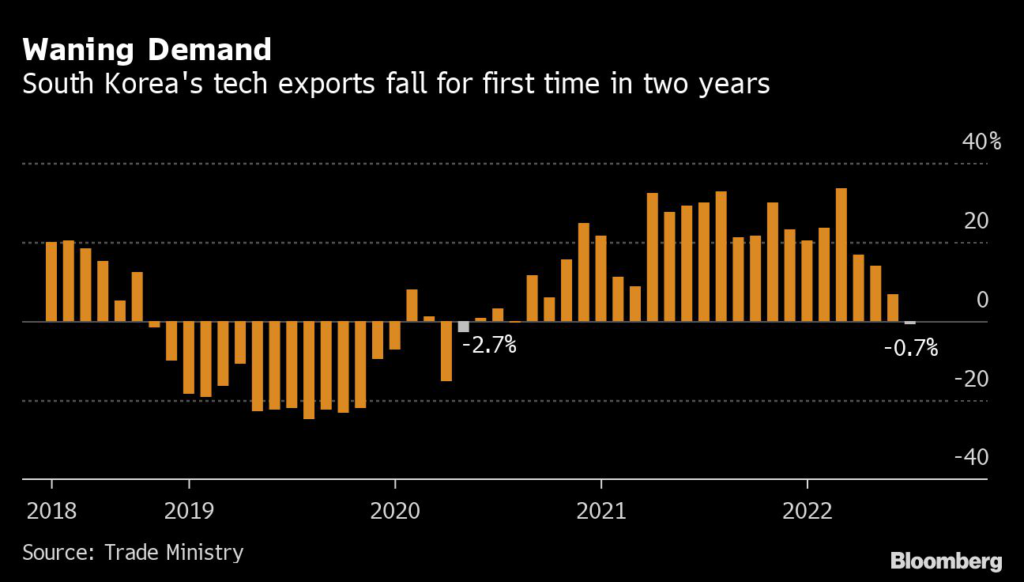
(Bloomberg) — South Korea’s technology exports declined for the first time in more than two years in July, in a sign that global demand is cooling as concerns mount about the outlook for the world economy. 

Exports of information and communications products edged down 0.7% from a year earlier, after a 6.8% gain in June, trade ministry data showed Thursday. Memory chips, produced by firms like Samsung Electronics Co., led the falls with a 13.5% drop, even though overall semiconductor shipments still rose 3.1%.

Technology exports account for almost a third of Korea’s overall shipments abroad and the government releases a breakdown following the monthly trade report on the first day of each month. The drop in tech in July contrasts with a 9.4% rise in overall exports in the month. 

Demand for semiconductors, computers and communications devices surged during the pandemic as many people around the world shifted to remote work and education to avoid the risk of infection. With the global economy emerging from the grip of the coronavirus, people are now spending more time outdoors and interacting, helping revive the services industry and similar sectors.

In further signs tech demand is slackening, South Korea’s smartphone sales dropped 29.2% and exports of computers and auxiliary devices dropped 21.9% in July from a year earlier. Display exports slipped 4.7%, the trade ministry said.

China, which has imposed strict Covid lockdowns on some of its cities this year, imported 8.2% fewer technology devices from South Korea compared with a year earlier. South Korea’s tech exports to the U.S. also declined 9.2%, while those to the European Union advanced 12.9%, the trade ministry said.

The customs office separately said Thursday that semiconductor shipments dropped 5.1% from a year earlier in the first 10 days of August. Overall exports increased 8.7% on average.

More stories like this are available on bloomberg.com

©2022 Bloomberg L.P.
MercadoLibre Eyes More Investments in Credit Business, CFO Says

(Bloomberg) — Latin American e-commerce giant MercadoLibre Inc. will keep expanding in the credit space as its fintech arm now accounts for almost half of the firm’s total revenue, according to Chief Financial Officer Pedro Arnt. 

The company’s credit book has been “very profitable” so far and it makes sense to keep investing, Arnt said in an interview with Bloomberg TV. Loan growth “has been a significant driver and catalyst of more adoption of our wallet,” while helping merchants and giving them greater access to working-capital, Arnt said. 


Read more: MercadoLibre Jumps After Results Show ‘Profitable Growth’ 

MercadoLibre saw its credit portfolio rise to almost $2.7 billion in the second quarter, up from about $2.4 billion at the end of March, and flagged that it has “adequately priced” the risk of a deterioration of credit quality across the region amid a tougher macroeconomic backdrop.

The Buenos Aires-based company posted record revenue and better-than-expected margins for the three-month period ended in June, with operations in Mexico turning a profit. A lot of investments MercadoLibre made throughout the pandemic in logistics and category expansion “to a certain degree are beginning to pay off,” Arnt said. 

More stories like this are available on bloomberg.com

©2022 Bloomberg L.P.

Coupang Raises Profit Forecast, Narrows Loss After Fee Hike

(Bloomberg) — Coupang Inc., the South Korean e-commerce giant backed by SoftBank Group Corp., raised its earnings forecast for 2022 and narrowed its losses as higher monthly membership fees and improved operational efficiency helped boost profitability. 

The company now expects to make a profit before interest, tax, depreciation and amortization, compared with an earlier projection for a $400 million loss. Its second-quarter operating loss narrowed to $75 million, compared with a $514.9 million loss a year earlier. Total net revenue rose 12% to $5 billion in the period, while the number of active clients rose 5%.

The shares rose 6% in New York in extended trading. 

The Seoul-based company has been trying for years to boost profitability in its core delivery business, most recently raising the monthly fee for its “Rocket Wow” service — similar to Amazon.com Inc.’s Prime membership — earlier this year. Founder and Chief Executive Officer Bom Kim has said the company’s expansion is helping profitability. 

“We do expect benefits to continue to come from greater economies of scale, improved operational excellence and the growth of higher margin categories and services,” Kim said on a post-earnings conference call. “But as we’ve stressed, the rate of improvement will not be consistent. As a result, the efforts will materialize unevenly.”

Kim mentioned there are some disruptions in near term due to higher inflation as well as fuel costs. In the long-term, the company will try to achieve targets of 7% to 10% or higher adjusted EBITDA, he said.

Amazon topped expectations for the June quarter, helped by its cloud computing division as it faces inflationary pressures in transportation costs and merchandise. The e-commerce giant is lowering costs by reining in hiring, but it is pursuing acquisitions to develop new growth opportunities. 

Coupang is also ramping up spending in entertainment and streaming content and on its food delivery service, as it searches for growth. It’s also preparing financial services such as installment loans, according to local media. 

(Updates with CEO comments from fifth paragraph)

More stories like this are available on bloomberg.com

©2022 Bloomberg L.P.
Cisco Hit by Cyberattack From Hacker Linked to Lapsus$ Gang

(Bloomberg) — Cisco Systems Inc. said it was the victim of a cyberattack in which a hacker repeatedly attempted to gain access to the Silicon Valley firm’s corporate network. 

Cisco said it became aware of a potential compromise on May 24, and disclosed it on Wednesday after the hacker leaked a list of the files it had stolen on the dark web.

An investigation determined that the hacker broke into Cisco’s network by cracking into an employee’s personal Google account, which synchronized their saved passwords across the web, the San Jose, California-based company said in a blog post published on Wednesday. The attacker then pretended to be trusted organizations during phone calls with the employee and successfully persuaded the employee to accept a multifactor push authentication notification to their device. That allowed the hacker to gain access to Cisco’s network using the employee’s credentials. 

Cisco had “not identified any evidence suggesting that the attacker gained access to critical internal systems, such as those related to product development, code signing, etc.,” according to the blog. “The only successful data exfiltration that occurred during the attack included the contents of a Box folder that was associated with a compromised employee’s account. The data obtained by the adversary in this case was not sensitive.”

Investigators said they believe that the attack was conducted by an adversary who has previously been identified as an initial access broker for several notorious cybercrime groups: UNC2447, Lapsus$ and Yanluowang ransomware operators. Initial access brokers attempt to gain privileged access to corporate computer networks and then sell it to other hackers.

UNC2447 is an “aggressive financially motivated group” that has targeted organizations with ransomware in Europe and North American, the cybersecurity firm Mandiant concluded last year. Yanluowang, named after a Chinese deity, is a ransomware variant that has been used against US corporations since August 2021, according to Symantec. The Lapsus$ group was accused of going on a rampage of high-profile attacks against technology companies including Okta Inc., Microsoft Corp. and Nvidia Corp.

Bloomberg News reported that the suspected mastermind was a 16-year-old British teenager living at his mother’s house.

Cisco said it found evidence that the hacker was preparing to encrypt files but hadn’t managed to do so before they were detected and booted out. There were repeated attempts to regain access after the attack had been evicted, according to Cisco.

The hack was previously reported by Bleeping Computer.

More stories like this are available on bloomberg.com

©2022 Bloomberg L.P.
Avaya Lenders Put Company On Notice After Earnings Report Delay

(Bloomberg) — A group of Avaya Holdings Corp. debt holders told the company’s loan agent that they intend to call a default on the telecommunications company if it fails to file its quarterly results by the end of a grace period. 

The lenders sent a letter to Goldman Sachs Group Inc., the loan’s agent, on Tuesday, according to people with knowledge of the situation. 

Avaya delayed filing quarterly results this week amid ongoing internal investigations related to a whistleblower letter and its financial results for the quarter that ended June 30. The group, working with Akin Gump Strauss Hauer & Feld, said the delay could constitute an earnings covenant breach if not remedied, according to the people, who asked not to be named because the matter is private. The size of the group couldn’t immediately be learned. 

Representatives for Avaya and Goldman declined to comment. A representative for Akin didn’t immediately respond to a request for comment. 

Avaya’s debt and shares tumbled this week after the company said it had “substantial doubt” about its ability to continue as a going concern, delayed its financial results and reported a steep revenue drop. 

The telecommunications software company has until mid-September to file the quarterly results before triggering an event of default under the loan, according to an estimate from CreditSights. 

Creditors organized after Avaya sold a $350 million leveraged loan and a $250 million exchangeable note in late June, and weeks later predicted a sharp decline in its financial performance and ousted its chief executive. 

Read more: Lenders Spurned by Avaya Tap Advisers Amid Fresh Debt Plunge

The Akin group, made up of holders of Avaya’s older debt, is concerned about the company and its bankers’ lack of disclosures when marketing the new deal, and potential moves the company may make to address its convertible notes due 2023. Goldman and JPMorgan Chase & Co. led the June deal. 

Holders of the newly-issued $350 million leveraged loan are working with FTI Consulting Inc. and Glenn Agre Bergman & Fuentes to explore their options, as reported by Bloomberg. Avaya hired AlixPartners LLC, Evercore Inc. and long-time counsel Kirkland & Ellis to weigh options for the convertible notes. 

Avaya’s shares closed at 67 cents on Wednesday, after plunging 46% on Tuesday. Its 6.125% bond due 2028 trades at around 47.75 cents on the dollar, while its convertible notes change hands for around 20 cents. The company’s older loans traded at roughly 49 cents, while the new loan reached a recent low of 65 cents, according to data compiled by Bloomberg.

More stories like this are available on bloomberg.com

©2022 Bloomberg L.P.

CVS Was Mystery Bidder for One Medical Before Amazon Struck Deal

(Bloomberg) — CVS Health Corp. was the mystery bidder that tried to buy primary-care company One Medical before Amazon.com Inc. swooped in to acquire it for $3.5 billion, according to people familiar with the matter.

One Medical was put into play by a company identified in a regulatory filing Wednesday as “Party A.”

Party A was CVS, the people said, asking to not be identified because the matter isn’t public. Bloomberg News reported in July that One Medical was exploring a sale after drawing takeover interest from companies including CVS.

The proxy filing with the US Securities and Exchange Commission Wednesday gives new insight into how one of the most high-profile deals in the health-care sector this year came together. It shows that CVS negotiated with the company for months, and even offered the same amount that Amazon ultimately agreed to pay. 

CVS first approached One Medical parent 1Life Healthcare Inc. about a deal in October 2021 and was in the mix to buy the company until weeks before it agreed to sell to Amazon, according to the filing. CVS had offered to pay $18 a share in cash for One Medical in June but later had concerns about moving at an “expedited pace,” according to the filing. 

Amazon entered the fray in February but paused M&A discussions in April. It restarted M&A conversations after it learned that 1Life had gotten an offer from someone else. On July 2, Amazon offered to pay $18 per share in cash, subject to due diligence. Amazon said it would stop engaging if its interest leaked.

Amazon ultimately reached an agreement to buy One Medical on July 20. The deal was announced the next day. 

CVS has said it plans to expand into primary care by partnering with doctors or making acquisitions as part of ambitions to make health care more convenient, personalized and affordable for consumers.

More stories like this are available on bloomberg.com

©2022 Bloomberg L.P.

Close Bitnami banner
Bitnami
