
Bloomberg

Hurricane Conditions Slam Europe’s Car Sector Before Hard Winter

(Bloomberg) —

Europe’s economic headwinds are catching up with the region’s auto industry.

Volkswagen’s finance arm expects earnings to decline this year because rising interest rates and inflation are starting to weigh on car demand. Customers are debating whether to buy a vehicle or push the leasing contract ahead a month over concerns including surging energy prices, Frank Fiedler, the chief financial officer of VW Financial Services, said Monday. That follows warnings from BMW last week that new-vehicle orders are retreating from high levels, particularly in Europe.

While Continental confirmed its outlook for the year on Tuesday, the German parts maker said it has to shoulder some €3.5 billion ($3.6 billion) in additional costs for raw materials, energy and logistics, with prices for overseas shipping containers jumping eightfold in some cases. Continental CFO Katja Duerrfeld described conditions as “rather like a hurricane” and predicted these pressures “will not subside any time soon.”

Signs of downturn are propping up like whac-a-moles. The German economy — Europe’s biggest — stagnated in the second quarter amid price gains, supply shortages and the threat of energy rationing in the event Russia cuts off gas flows. Economists reckon a recession is almost inevitable in the second half. The UK economy probably shrank in the second quarter, and the Bank of England now sees Britain entering a recession equivalent in scale to the one seen in the 1990s starting in the fourth quarter as the cost-of-living crisis deepens.

Carmakers have managed to overcome these drags for quite some time. While vehicle sales in Europe have slumped for the past year, Mercedes-Benz, VW, BMW and others have seen profits soar as they’ve focused their limited production on high-margin models. Automakers’ finance and fleet-management arms benefited because the chip crunch bolstered demand for used cars and propped up prices. Some manufacturers, including Stellantis and Mercedes, remain optimistic they can sustain strong earnings in the second half of the year.

But it’s increasingly less clear they’ll be able to outrun the economy’s underlying issues for much longer. While BMW said last week that orders remain high, the carmaker warned it won’t be able to fully pass on rising materials costs. And companies already are bracing for a bleak winter because of the region’s worsening energy crisis.

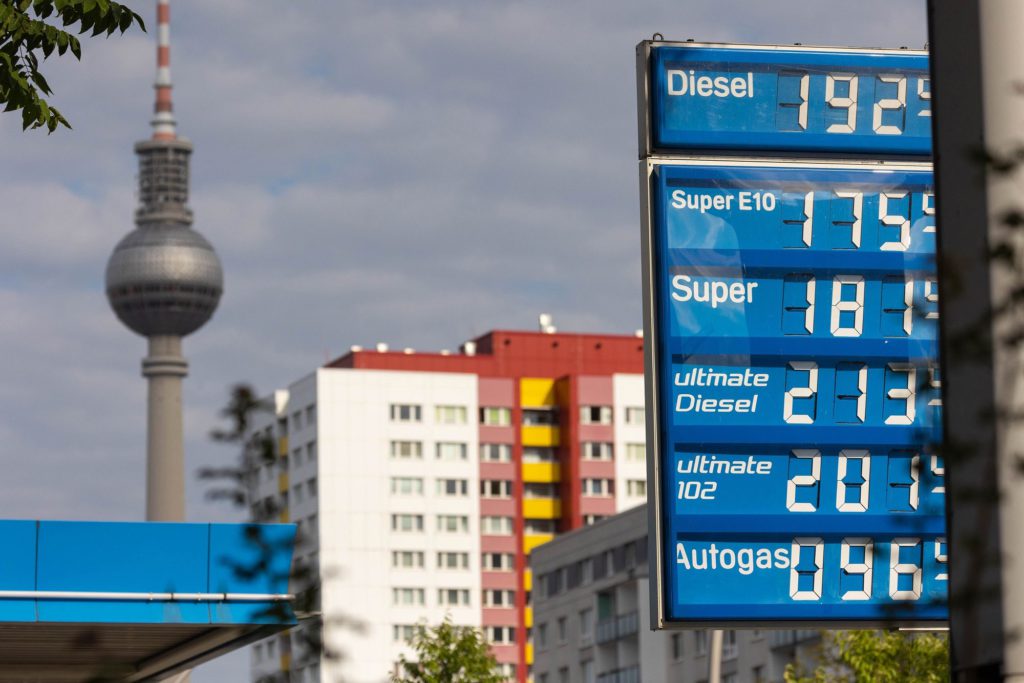
Electricity prices have smashed records in recent weeks as Russia limits gas supplies to Europe. An ongoing heat wave is disrupting waterways that are needed to ship coal to power plants and factories. Germany has already said it would prioritize gas deliveries to private homes over factories if there’s a shortage when it gets colder in the coming months. Other European countries are likely take similar actions.

Auto supplier Aptiv spooked investors and analysts last week when it cut its full-year guidance and warned automotive plants may have to idle this winter due to energy rationing. The company now predicts vehicle production will slump 5% in Europe this year, a stark cut from its previous forecast for 10% growth.

Aptiv “has historically been more right than wrong when calling production,” RBC Capital Markets analyst Joe Spak said in a note last week. “If Aptiv is correct on production, then everyone else is wrong and there is significantly more risk to other suppliers – especially European-heavy ones in our view.”

More stories like this are available on bloomberg.com

©2022 Bloomberg L.P.
Rivian Leads EV Slump After Investors Shun Money Losers

(Bloomberg) — Even a breakthrough US climate bill designed to encourage sales of electric cars has failed to revive investor interest in Rivian Automotive Inc., as the risk-hungry traders who catapulted its shares to dizzying heights last year shun companies for whom profitability is still years away.

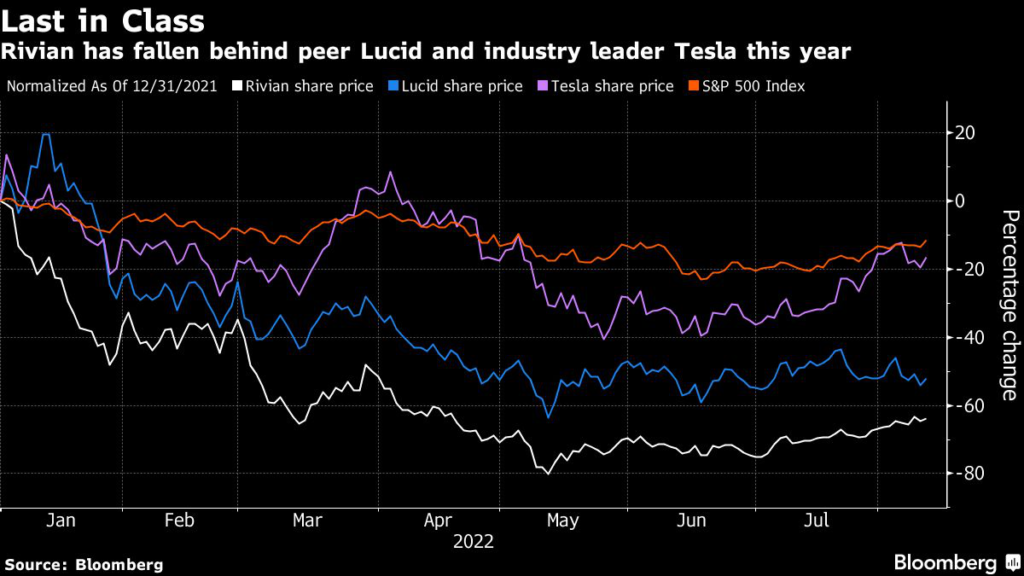
In a year that has been tough for growth stocks of all colors and stripes — especially EV companies trying to make room for themselves in a still-nascent industry while competing with century-old automakers — Rivian’s misfortune still stands out. Among the sizable EV startups in the US, shares of the electric-truck maker have fared the worst this year by a mile, down 64%.

Rivian, which counts Amazon.com Inc. and Ford Motor Co. among its largest shareholders, is paying the price for its landmark, $13.7 billion initial public offering in November. 

The listing valued the money-losing company so highly — $153.3 billion at its peak, or more than 35 times estimated sales versus 5.1 times for the Russell 1000 Growth Index — that it was bound to suffer more than rivals once the Federal Reserve started raising interest rates and investors fled riskier stocks. 

“More speculative investments — like EVs — may struggle as the Fed continues to withdraw liquidity from the market,” said Wiley Angell, chief investment officer at Ziegler Capital Management. “Though the current administration’s push for EVs may support sales on the margin, Rivian’s earnings are still expected to be negative for the next five years.” 

Rivian is due to report quarterly results after the market closes Thursday for the fourth time since its IPO. Shares of the Irvine, California-based company have fallen in the aftermath of two of the three previous reports, according to Bloomberg data. 

The stock finished Wednesday at $37.40, well below the $78 IPO price even after a brisk 82% rally from its low in May.  

Risks to the group are many — EVs are still far from mainstream and also more expensive than gas-fueled cars, and a surge in the battery raw materials means their prices will continue to rise before technology improves further and brings the costs down. To make matters worse, the stubborn supply-chain crisis that has plagued the automotive industry is even harder to navigate for startups. 

Last week, Lucid’s stock plunged 12% over two days after the company halved its 2022 production target, citing “extraordinary supply chain and logistics challenges.” On Tuesday, Workhorse Group Inc. sank 24%, as the company lowered its 2022 delivery guidance. 

Meanwhile, Rivian in early July reaffirmed its production forecast for the full year, sparking a surge in the stock. That means the company’s ability to maneuver the supply woes better than its peers is already built into the stock price, and may not be enough to provide a further meaningful lift to the shares, Redburn analyst Charles Coldicott said. 

Rivian probably will hit its full-year target, he said, adding that the most important thing for the company right now is the production ramp-up. 

And then there is the change of sentiment in the stock market, where the specter of a recession has turned investors risk-averse. 

“The market is clearly less forgiving of problems that delay the point at which these businesses become self-funding, because there is no longer a backdrop where equity markets are willing to write loss-making companies a blank check,” Coldicott added.

It brings the focus on Rivian’s one key advantage over its peer Lucid — its big cash pile. The company had $16.4 billion in cash and equivalents at the end of the first quarter, compared to Lucid’s $5.4 billion around the same time. 

“For Rivian’s quarter, key will be cash burn,” said Ivana Delevska, chief investment officer at SPEAR Invest. “They have a good product, but it was a lot easier to underwrite an investment when the stock was in the low $20s, trading close to the cash on the balance sheet than here in the mid $30s.”


Tech Chart of the Day 

Apple Inc. is close to erasing its losses for the year after softer-than-expected inflation data Wednesday fueled a rally in the stock market. The iPhone-maker edged 2.6% higher to $169.24 as investors piled back into stocks on bets the Federal Reserve could dial back the size of future interest-rate increases. Apple is down 4.7% in 2022, giving it a market value of $2.7 trillion.

Top Tech Stories

  • Walt Disney Co. is raising the price of its flagship Disney+ streaming service by 38%, part of a plan to generate more revenue for its money-losing online businesses and build on third-quarter results that beat estimates for sales, profit and subscriber growth.
  • Cisco Systems Inc. said it was the victim of a cyberattack in which a hacker repeatedly attempted to gain access to the Silicon Valley firm’s corporate network.
  • Apple, stepping up its spending on original podcasts, signed an agreement with a Pulitzer Prize-winning studio and is holding talks with other companies about additional deals.
  • Deutsche Telekom AG raised its 2022 earnings guidance for the year after forecasting accelerating customer additions in the US business and posting better-than-expected revenue growth in its European markets.
  • Elon Musk is accusing Twitter Inc. of hiding key witnesses in their legal battle over whether he must consummate a $44 billion buyout of the company, according to people familiar with the allegations.
  • Coupang Inc., the South Korean e-commerce giant backed by SoftBank Group Corp., raised its earnings forecast for 2022 and narrowed its losses as higher monthly membership fees and improved operational efficiency helped boost profitability.
  • SoftBank Group Corp. expects to post a gain of more than $34 billion from selling down its stake in Alibaba Group Holding Ltd., cashing in on its most storied investment to shore up finances as global markets deteriorate.
  • Africa’s largest startup, Flutterwave Inc., is battling allegations of financial impropriety and personnel harassment from Lagos to Nairobi, as it considers pushing ahead with plans to list the company.
  • Samsung Electronics Co. unveiled the latest generation of its foldable devices on Wednesday, keeping prices steady despite surging costs of materials and shipping.


More stories like this are available on bloomberg.com

©2022 Bloomberg L.P.

Deutsche Telekom Raises 2022 Outlook on US Customer Growth

(Bloomberg) — Deutsche Telekom AG raised its 2022 earnings guidance for the year after forecasting accelerating customer additions in the US business and posting better-than-expected revenue growth in its European markets. 

The German telecom giant raised its full-year guidance for earnings — before interest, taxes, depreciation, amortization after leases — to 37 billion euros ($38.1 billion) from 36.6 billion euros, the Bonn-based company said in a statement on Thursday.

This marks the second time this year that Deutsche Telekom has raised its guidance. Chief Executive Officer Tim Hoettges is working to take majority control of the T-Mobile US business, which has become the company’s primary growth driver. 

“Deutsche Telekom’s update to full-year Ebitdaal guidance on the back of both US and non-US business shows confidence in the outlook, especially as the growing macroeconomic headwinds have started to impact some of the carriers in Europe,” Bloomberg Intelligence analyst Erhan Gurses said.

During a press conference following the release of Deutsche Telekom’s results, Hoettges said the company was “not exposed to export markets like China or India, not exposed to areas outside the western hemisphere. 

“I believe that — in these times — that’s an important stabilizing anchor,” he added. 

Key Insights

  • Deutsche Telekom posted net revenue that rose to 28.2 billion euros in the quarter, compared to the average analyst estimate of 28.3 billion euros.
  • Second-quarter Ebitdaal was 9.89 billion euros. That compared to the average analyst estimate of 9.92 billion euros, according to data compiled by Bloomberg.
  • US revenue was about 18.6 billion euros in the second quarter, just under analysts’ average estimate of 18.9 billion euros. When measured in dollars, sales shrank about 1.1%. Deutsche Telekom attributed the decline to less revenue from leasing phones to mobile customers as it shifts the US business to a new strategy.
  • Sales from the company’s German and European business units were slightly ahead of analysts’ estimates in the quarter at 6.06 billion euros and 2.75 billion euros respectively.
  • Brookfield Asset Management Inc. and DigitalBridge Group Inc. agreed last month to buy a 51% stake in Deutsche Telekom’s German and Austrian business, GD Towers, for 10.7 billion euros in cash.
  • Deutsche Telekom has said it will use the proceeds to pay off debt and increase its stake in T-Mobile US.

Market Reaction

  • Deutsche Telekom shares were down less than 1% to 18.8 euros at 11:27 a.m. in Frankfurt on Thursday. The stock has gained about 15.6% this year.
  • That compares to a 0.9% decline on the Stoxx 600 Telecommunications Index.

Get More

  • Statement
  • Deutsche Telekom Sells Towers to Brookfield, DigitalBridge
  • T-Mobile Tops Subscriber Estimates After Rivals Hit Setbacks
  • Deutsche Telekom Edges Closer to T-Mobile Control After Deal

(Updates with CEO comment in 5th paragraph; share reaction.)

More stories like this are available on bloomberg.com

©2022 Bloomberg L.P.

Kim Jong Un Was ‘Seriously Ill’ in North Korea Covid Surge

(Bloomberg) — Kim Jong Un’s sister revealed the North Korean leader suffered from a “high fever” during a recent Covid outbreak, as she vowed to “eradicate” South Korean authorities if they continued to tolerate propaganda leaflets the regime blames for spreading the virus.

Repeating dubious claims that the pamphlets caused the recent Covid outbreak in the north, Kim Yo Jong blamed “South Korean puppets” for sending “dirty objects” across the border in leaflets carried by balloons, the official Korean Central News Agency reported Thursday. The revelation of her brother’s illness marked an unusual admission for a regime that rarely comments on the leader’s health — and then only to show that he shares the struggles of the people. 

Kim Yo Jong said in a speech the North Korean leader was “seriously ill” during his bout with fever, according to KCNA. Still, she added in a quivering voice that her brother “could not lie down for even a moment because of his concerns for the people,” with state TV showing audience members in tears as she delivered her remarks. She didn’t say whether the elder Kim was among what North Korea calls “fever cases” or specify the date of his illness. 

Overweight and a smoker, Kim Jong Un’s health has prompted speculation for years. His public appearances are closely tracked for insights about the autocratic and secretive regime in Pyongyang, especially since his family has a history of heart disease.

Kim Yo Jong delivered a carefully calibrated message to underscore that her brother has suffered, like the country’s citizens, said Rachel Minyoung Lee, regional issues manager at the Vienna-based Open Nuclear Network.

“It is consistent with North Korea’s leadership propaganda strategy in recent years that shifted from deifying the leader to portraying the leader as a regular human being who is constantly with the people and shares his life’s joys and sorrows with the people,” said Lee, who worked as an analyst for the CIA’s Open Source Enterprise for almost two decades.

Kim Jong Un went about 17 days without an appearance in state media last month, although the North Korean leader often drops out of view in summer to spend time at his seaside mansion and megayacht. He attended a ruling party meeting Wednesday in which he claimed “victory” in the “great quarantine war.”

North Korea hasn’t called its hundreds of thousands of reported fever cases “Covid,” perhaps because it lacks a sufficient supply of test kits. The country has refused vaccines from outside, with reports saying planned shipments have been put on hold because of its objections to rules from Covax, a World Health Organization-backed body. 

While Kim Jong Un made mention of South Korea in published remarks, his sister issued her first threat against the government of South Korean President Yoon Suk Yeol since it took power in May. “If the enemy continues to do such a dangerous thing that can introduce virus into our republic, we will respond by eradicating not only the virus but also the South Korean authorities,” she said in the speech to ruling party members.

The South Korean Unification Ministry expressed “strong regret” over Kim Yo Jong’s statement, calling her claims “rude” and unsubstantiated. Kim Yo Jong’s threats were couched in conditional terms, analyst Lee said, adding “it is uncertain as of now how far North Korea will go to escalate tensions with South Korea.”

North Korea’s heated rhetoric against Seoul could set the stage for a resumption of military provocations that have slowed in recent months, possibility due to the outbreak. North Korea appears to be readying to conduct its first nuclear test since 2017, government officials from Japan, South Korea and the US have said.

Any display of the weapons in its nuclear arsenal would serve as a reminder of the pressing security problems posed by Pyongyang that have simmered as US President Joe Biden’s administration has been focused on Russia’s invasion of Ukraine. 

There are plenty of places where the virus could have entered North Korea. While airports have largely been shut during the pandemic, the regime reopened a rail link with China in January and black-market traders frequently cross the border. A United Nations body has said there’s sea traffic at its international port of Nampho, and illicit trade is conducted on the open seas in violation of sanctions. 

North Korea — one of only two UN member states that has not launched a vaccination program — might be seeking to deflect blame away from its leader over an outbreak that was too big to ignore. The government has claimed that “alien things” sent across the border by balloons from the south brought the coronavirus into its territory — with health experts and the South Korean government saying there are no precedents for the type of transmission described by its neighbor.

“It is quite natural for us to consider strange objects as vehicles of the malignant pandemic disease,” Kim Yo Jong said adding her brother guided an “epoch-making miracle” in eradicating the virus.

Activist groups led by North Korean defectors have sent millions of anti-Pyongyang leaflets by balloon from South Korea for years, and Kim’s regime often seizes upon them when it wants to increase tensions.

Similar leaflets were at the center of a series of North Korean complaints in the summer of 2020 that culminated in the regime blowing up an inter-Korean liaison office on its side of the border. Kim Yo Jong was also at forefront of the rhetorical attacks then against the government of former President Moon Jae-in.

North Korea may be “paving its way to resume its trade with China” by claiming victory, said Yang Moo-jin, a professor at the University of North Korean Studies in Seoul who has advised the South Korean government. 

(Updates with comments from analyst.)

More stories like this are available on bloomberg.com

©2022 Bloomberg L.P.

Unlocking the Value in NFTs

  • Listen to Bloomberg Crypto on the iHeartRadio App
  • Listen to Bloomberg Crypto on Apple Podcasts
  • Listen to Bloomberg Crypto on Spotify  

(Bloomberg) — Nonfungible tokens, or NFTs, burst into pop-culture prominence in 2021, but they’ve been around since at least 2014. Despite current market conditions, new tokens and collections are still being launched daily, including by luxury brands such as Gucci and Prada. Tiffany’s, the iconic retailer, even announced a jewelry partnership with CryptoPunks, selling pendants based on those NFTs for around $50,000 each. During July’s Bloomberg Live Crypto Summit in New York, Managing Editor Stacy-Marie spoke with industry leaders about why they’re confident that NFTs will continue to be perceived as valuable and useful. In this episode, her conversation with Avery Akkineni, president of Vayner3; Helen Hai, executive vice president and head of charity at Binance; and digital artist pplpleasr, aka Emily Yang.

Follow us on Twitter @crypto, and subscribe to the Bloomberg Crypto Newsletter at https://bloom.bg/cryptonewsletter

More stories like this are available on bloomberg.com

©2022 Bloomberg L.P.

South Korea Makes First Arrests in Major Crypto-Linked Inquiry

(Bloomberg) — South Korean prosecutors made their first arrests in a probe of $3.4 billion worth of foreign-exchange transactions for possible links to illegal cryptocurrency-related activities. 

Three people were held on allegations including setting up paper companies and operating a cryptocurrency trading business without registration, the Daegu District Prosecutors’ Office said in a text message on Thursday.

The other charges were connected to false data submissions to banks and substantial foreign currency transfers abroad, according to the office.

The people arrested are linked to a firm that sent 400 billion won ($307 million) worth of funds overseas from a Woori Bank branch in Seoul to earn arbitrage profits, the Chosun Ilbo newspaper reported.

The prosecutors’ office didn’t give specific figures. Woori Bank declined to comment as it is not privy to the details of the ongoing investigation.

South Korea’s Financial Supervisory Service has said that unusual transactions totaling 1.6 trillion won took place at five branches of Woori Bank between May 2021 and June 2022. Similar transactions worth 2.5 trillion won were detected at 11 branches of Shinhan Bank between February 2021 and July 2022, it said. 

Both the banks last month declined to comment on the supervisory service’s investigation.

Asia’s fourth-largest economy used to stand out for the comparatively wide adoption of digital tokens there. 

But the $40 billion wipeout in South Korean entrepreneur Do Kwon’s Terraform Labs ecosystem delivered a damaging blow to confidence. The implosion sparked a global crypto rout after the TerraUSD stablecoin unraveled. 

More stories like this are available on bloomberg.com

©2022 Bloomberg L.P.

Philippines’ ABS-CBN to Buy 35% Stake in TV5 Network

(Bloomberg) — Philippine media company ABS-CBN Corp. has agreed to acquire 35% of free-to-air television company TV5 Network Inc., while selling stakes in its cable television service partly to fund the deal. 

ABS-CBN will buy shares in TV5 for 2.16 billion pesos ($38.9 million), the companies said in a statement released Thursday. The stake of media conglomerate MediaQuest Holdings Inc., owned by PLDT Inc.’s trust fund, in TV5 will be reduced to 64.8%. 

In 2020, ABS-CBN was ordered by government to shut its free TV and radio stations after its franchise expired. It since has been airing some of its shows on TV5 and other networks. 

ABS-CBN will also invest in TV5 convertible notes worth 1.84 billion pesos, allowing it to acquire additional shares that could boost its stake in the TV network to 49.9% after eight years, according to the statement. 

The transaction is expected to close this month. ABS-CBN shares closed 5.1% higher Thursday, outpacing the Philippine stock index’s 3.2% gain. PLDT rose 1.7%. 

“This partnership is consistent with the strategic intention of ABS-CBN to evolve into a storytelling company whose goal is to reach as wide an audience as possible,” ABS-CBN President and CEO Carlo Katigbak said. 

PLDT separately also announced that Cignal Cable Corp. will buy 39% of ABS-CBN unit Sky Cable Corp. for 2.86 billion pesos. 

Cignal Cable, a unit of MediaQuest, will also acquire exchangeable debt instruments and convertible notes, giving it an option to raise its stake in Sky Cable, according to the announcement. Proceeds will partly be used to pay ABS-CBN’s investment in TV5.

(Updates share price moves in fifth paragraph.)

More stories like this are available on bloomberg.com

©2022 Bloomberg L.P.
Siemens Sees Brisk Demand Persist Through Cost, Supply Pressure

(Bloomberg) — Siemens AG said strong orders from all markets are set to continue in coming months, helping the company combat mounting inflation and supply-chain problems that are weighing on returns. 

The German industrial giant, reporting a quarterly net loss that missed expectations Thursday, said it’ll double down on efficiencies to offset the drag as well as passing on higher costs to customers. 

“We see strong demand from our markets even going forward three to four quarters,” Chief Executive Officer Roland Busch said in an interview with Bloomberg Television. “With our price increases to customers, which we are moderately adapting, we can overcompensate the cost increases from our suppliers.”

The shares fell 1.7% at 9:30 a.m. in Frankfurt trading, taking losses this year to almost 30%. 

Manufacturers like Siemens have been fairly immune so far to an increasingly dim outlook marked by record inflation and slowing growth as well as the war in Ukraine. Supply-chain shortages, led by the chip crunch that’s now in its third year, have pushed order books to record levels and companies expect to take months to work down pent-up demand. Also Thursday, Daimler Truck Holding AG said it’ll struggle to fill truck orders for the rest of the year. 

At Siemens, orders have reached a record high of 99 billion euros ($102 billion) following strong growth during the quarter through June. Even so, there are signs of normalization, the company said. 

Normalization

In the key Digital Industries division, which makes factory-automation software and other labor-saving services, profitability during the third quarter was held back by semiconductor shortages and higher expenses for cloud-based activities, Siemens said. Future business will be “clearly influenced by price inflation,” Busch said in speech notes. The company expects to start working down its order book starting in fiscal 2023. 

The prediction echoes BMW AG’s view that improvements in the availability of semiconductors will help ease supply chain pressure allowing production to ramp up.  

Quarterly orders at the Smart infrastructure unit climbed by 26%, although revenues in China declined due to coronavirus lockdowns. Both the Digital Industries and Smart Infrastructure units are central to Siemens push into higher-margin software offerings. 

Writedown Cut

On Thursday, Siemens cut its expected increase of earnings per share to as much as 5.73 euros, down from as much as 9.10 euros because of impairment charges. Siemens in June wrote down the value of its stake in Siemens Energy AG by 2.7 billion euros following the turbine maker’s repeated profit warnings. On Thursday, it doubled impairments related to its exit from Russia to 1.2 billion euros.  

Further writedowns on Siemens’s business in Russia are possible in relation to its leasing business in the country, in the region of a small- to mid-three-digit million euro amount. 

While faced with a complex economic environment marked by sanctions on Russia, high inflation and effects of the pandemic, the company said it has avoided “larger disruptions” during the quarter.

Software Drive

Siemens is still in the process of revamping its business toward higher-margin, software-driven product lines. The company has sold off most of the smaller divisions destined for divestment and is shifting focus to areas with higher growth potential. In recent weeks, it has bought US software firm Brightly for $1.6 billion, started a new digital business platform and bought a minority stake in Volkswagen AG’s electric-car charging subsidiary Electrify America. 

Siemens’ Mobility division, which makes trains, won orders of 2.8 billion euros. Returns fell because of the exit from Russia, and the company cut its profit margin forecast to as much as 8.5%, down from as much as 10.5%. 

Profit from industrial business rose to 2.9 billion euros with returns of 17% slightly below analyst expectations. 

More stories like this are available on bloomberg.com

©2022 Bloomberg L.P.
Daimler Truck Shrugs Off Supply-Chain Issues With Rising Sales

(Bloomberg) — Daimler Truck Holding AG said demand for commercial vehicles will continue to outweigh supply in the second half of the year after the German manufacturer reported better-than-expected quarterly earnings.

Daimler Truck said Thursday second-quarter operating income came in at 1.01 billlion euros ($1.04 billion), above analyst forecasts for a 768 million-euro result. The company generated 12.1 billion euros in sales, also beating analyst expectations.

“Given the ongoing challenges with the supply chain, raw materials and energy prices we can be satisfied with our Q2 results,” Chief Financial Officer Jochen Goetz said in a statement. “However, the current year will continue to be demanding especially on the cost side.”

Daimler Truck, which split from luxury automaker Mercedes-Benz AG last year, has struggled to turn unrivaled industrial scale into profitability matching the likes of Volvo Group and Paccar Inc. The company is striving for a margin in excess of 10% by 2025.

Daimler Truck said strong demand for commercial vehicles and order backlogs would persist in the second half of the year, supporting its guidance despite rising cost pressures. Like automotive firms worldwide, the company’s production has been limited by a lack of semiconductors, although automotive executives have recently said supply of the components is normalizing.

Outlook Tweaks

The company still sees sales of as much as 50 billion euros this year. It slightly lowered its adjusted return on sales forecast for the Asia trucks segment and slightly raised return-on-equity expectations for its financial services business. 

The company expects global economic growth to slow to around 2.5% this year because of the war in Ukraine, Covid lockdowns in China, inflation and rising interest rates.

Daimler Truck said its outlook is subject to further developments related to the war in Ukraine. It expects supply-chain issues to decrease in the second half compared with the first six months of the year and sees no production downtimes over gas shortages.

German officials are working on plans to ration the fuel —  often used to generate heat in automotive paint shops — in case Russian President Vladimir Putin continues to reduce supplies to Germany.

(Updates with global growth forecast in seventh paragraph.)

More stories like this are available on bloomberg.com

©2022 Bloomberg L.P.
Aging Spain Issues Rallying Call for Workers From Latin America

(Bloomberg) — Spain is opening its doors to foreign workers to fix labor shortages and ease a demographic slump threatening its future prosperity. 

In contrast with more anti-immigrant politics in much of Europe, the government has loosened rules to allow the recruitment of employees in their countries, mostly in Latin America, for both skilled and unskilled jobs that are hard to fill.

The reform, which will take effect in coming days, offers an accelerated path to legal status for potentially tens of thousands of people currently working in the shadow economy.

With unemployment at its lowest since 2008, Spain — like much of western Europe — is struggling with the sort of severe labor shortages that led to travel chaos at European airports this summer. 

The euro zone’s fourth-biggest economy has glaring vacancies ranging from software developers and scientists to waiters, bricklayers and baggage handlers.  

While the post-pandemic rebound explains the most pressing job needs, the shortage also offers a glimpse of the deeper problems gripping industrialized economies with fewer babies, shrinking workforces, and spiraling public-finance costs to match. 

“An aging population means you will have to depend more on foreign workers to help European countries maintain welfare states and pensions,” Social Security and Migration Minister Jose Luis Escriva, the architect of the reform, said in an interview. “It is more of a medium-term problem, but this measure is designed with that horizon in mind.” 

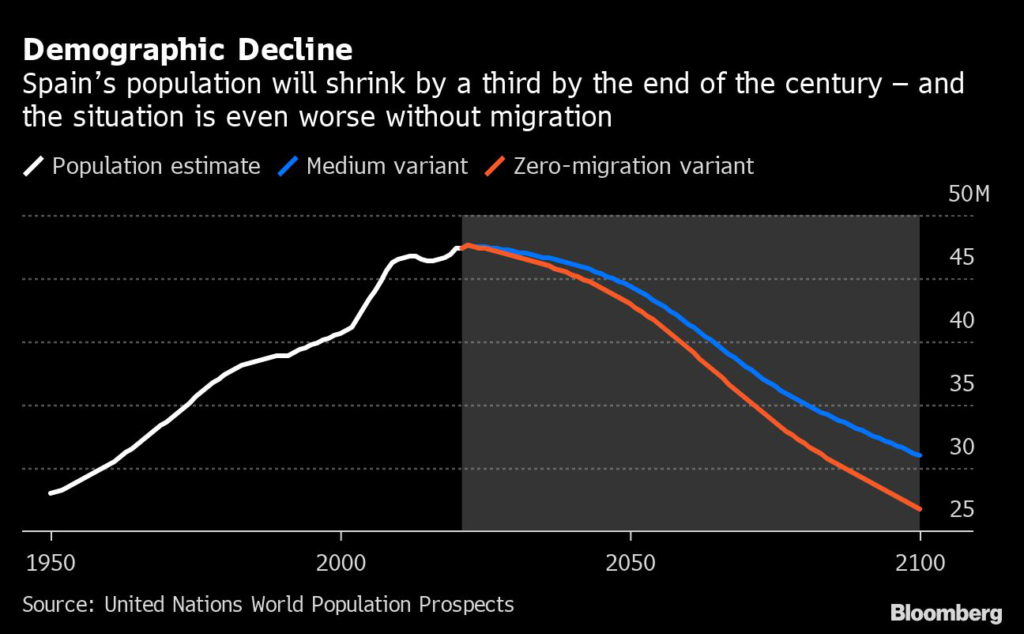
Spain has one of the world’s most rapidly aging societies. The share of its population over 65 years is now at 23%, reflecting particularly high life expectancy and low fertility rates. The number of Spaniards will shrink by a third by 2100, assuming normal immigration flows, United Nations projections show. 

Escriva, a former European Central Bank economist, predicts such challenges will increase competition to fill skill gaps in advanced economies. 

That may even be already happening as other countries welcome immigrants too. Germany plans a reform to allow over 130,000 foreigners to gain regular status, and Poland wants many of the 2 million Ukrainian refugees in the country to stay for good. 

Other nations are more determined to keep foreigners out. Italian far-right parties calling for a crackdown on illegal migrants are leading polls ahead of next month’s election. 

Meanwhile France’s nativist National Rally Party had its best showing ever at the ballot box in June, and the UK largely shut its borders to European Union citizens seeking work after its exit from the bloc.

In Spain, radical right-wing party Vox, the country’s third political force, has kept largely quiet about the immigration reform. The party is often less critical of workers from Latin American countries, which were under Spanish rule for centuries. 

Many opinion polls show relative tolerance to immigrants in Spain compared with other Europeans, which might be due to the relative ease that Latin Americans sharing a common language and religion have found integrating into society. 

Not all foreigners are equally welcomed. Although Spain already hires farm workers directly from Morocco, the government has kept a hard-line stance against most other African immigrants. 

In June, Socialist Prime Minister Pedro Sanchez defended the efforts of Moroccan and Spanish police to prevent hundreds from crossing a fence into the North African conclave of Melilla, which resulted in the death of at least 23 people.

According to Ignacio Conde-Ruiz, an economics professor at Complutense University in Madrid, Spain should open its borders faster to avoid missing out on a pool of workers that is likely to shrink in the future as fertility rates in Latin America drop too.

“More needs to be done if we want our economy to function properly and ease the strain on our pensions,” he said. “It will be more difficult to bring immigrants in the future.”

By far the biggest challenge to the sustainability of the pension system comes from the rising portion of elderly citizens relative to the economically active population, according to the Bank of Spain. 

The irony is that the country does actually have plenty of young people seeking work despite growing labor shortages. More than 840,000 people under the age of 30 could not find a job during the first quarter. 

At nearly 29%, Spain’s youth unemployment rate, one of Europe’s highest, reveals a mismatch between vacancies on offer and the skillset of its young workforce. 

Without deeper reforms to reduce an over-reliance on basic services related to tourism, the immigration reform won’t fix the labor scarcity, said Andreu Domingo, deputy head of the Barcelona-based Centre for Demographic Studies. 

“These measures are a good step, but they don’t address the real problem,” he said. “It doesn’t change an economic structure based on low productivity with low wages that will lead to a constant demand for low-skilled workers.”

More stories like this are available on bloomberg.com

©2022 Bloomberg L.P.

Close Bitnami banner
Bitnami
