Bloomberg

FCC Rejects Musk’s Bid for $886 Million Broadband Subsidy for Starlink

(Bloomberg) — Elon Musk’s request for $886 million in US subsidies for beaming broadband service to rural areas via his SpaceX satellites was rejected by US regulators.

Funding Musk’s network of Starlink satellites wouldn’t be the best use of limited broadband subsidies, the Federal Communications Commission said in a news release Wednesday.

“Starlink’s technology has real promise,” FCC Chairwoman Jessica Rosenworcel said in a statement. “But the question before us was whether to publicly subsidize its still-developing technology for consumer broadband — which requires that users purchase a $600 dish — with nearly $900 million in universal service funds until 2032.”

The FCC “cannot afford to subsidize ventures that are not delivering the promised speeds or are not likely to meet program requirements,” Rosenworcel said.

Musk, the world’s richest person, is chief executive officer of Space Exploration Technologies Corp. as well as Tesla Inc. SpaceX didn’t immediately respond to an emailed request for comment.

Rural internet service providers had called on the FCC to deny SpaceX funding after the company succeeded in a preliminary stage of consideration. They argued the service was being built without the aid and isn’t limited to rural areas.

The funding at issue is part of the $9.2 billion Rural Digital Opportunity Fund, a centerpiece of federal efforts to connect millions of people without home broadband. Many of them are in thinly populated areas that are costly to serve. The fund is poised to distribute public money to extend broadband in 49 states over 10 years.

SpaceX in 2020 won preliminary FCC approval for its plan to provide service to 642,925 locations in 35 states. But consumer advocates said those locations include parts of New York City and airports in Newark and Miami — places that don’t fit the goal of bringing service to rural people beyond the reach of broadband networks.

More stories like this are available on bloomberg.com

©2022 Bloomberg L.P.

Coinbase Under SEC Scrutiny Over Its Crypto-Staking Programs

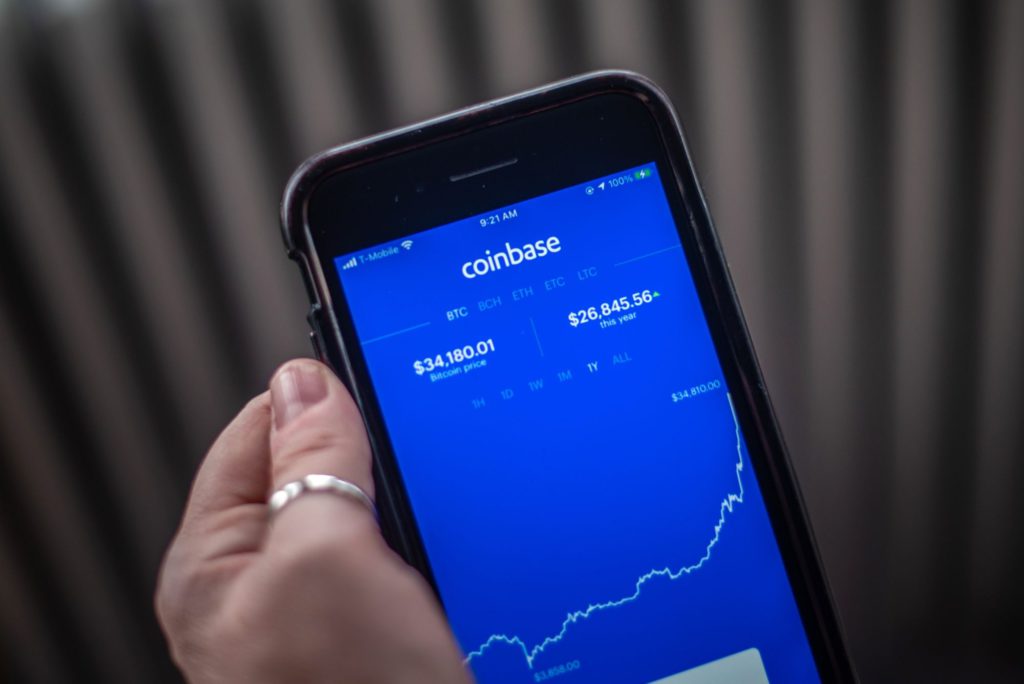
(Bloomberg) — Coinbase Global Inc. said it’s being probed by the US Securities and Exchange Commission over its staking programs, which allow users to earn rewards for holding certain cryptocurrencies. 

The company “has received investigative subpoenas and requests from the SEC for documents and information about certain customer programs, operations and existing and intended future products,” according to a quarterly regulatory filing. The requests relate to Coinbase’s staking programs, asset-listing process, classification of assets and stablecoin products, the company said. 

Staking services are offered by many crypto exchanges as a key way to diversify revenue from trading, which tends to drop during market downturns. It allows users to generate yield on certain crypto holdings by delegating them to help verify transactions and secure the blockchain network. 

At Coinbase, blockchain-rewards revenue, primarily from staking, accounted for 8.5% of net revenue in the second quarter. It fell 16% sequentially to $68.4 million during the quarter, less than the decline in trading revenue. 

In a shareholder letter Tuesday, Coinbase said the SEC in May sent a voluntary request for information, including about its listings and listing process, and it doesn’t know yet if the inquiry will become a formal investigation. The crypto exchange is under scrutiny by the SEC for potentially making unregistered securities available for trading, Bloomberg previously reported.

“As with all regulators around the world, we are committed to productive discussion with the SEC about crypto assets and securities regulation,” Coinbase said in the letter.

More stories like this are available on bloomberg.com

©2022 Bloomberg L.P.

Biden ‘Cautious’ on China Tariffs After Pelosi’s Trip, Commerce Chief Says

(Bloomberg) — House Speaker Nancy Pelosi’s visit to Taiwan has made geopolitics with China “particularly complicated” as President Joe Biden weighs the future of tariffs on more than $300 billion in goods from the US rival, according to his commerce chief.

“Certainly, it has made it a little more challenging,” Gina Raimondo said in an interview on Bloomberg Television’s “Balance of Power With David Westin” on Wednesday. “It’s harder, but I am hopeful that we will get beyond that and get back to a place where we can have more of those discussions.”  

Biden is considering what to do with the Trump-era tariffs and is weighing his options, Raimondo said. He is “very cautious” and doesn’t want to do anything that would hurt American workers, she said.

“But I know he’s looking at it. We’ve talked about it again recently, and I expect he’ll be making a decision before too long.”

Pelosi visited Taipei, Taiwan, last week in the face of threats and opposition from China, which regards Taiwan as part of its territory. She was the highest-ranking US politician to visit the island in 25 years, and Chinese officials called it “provocative.”

Read more: US Commerce Chief Hopes Chips Bill Spurs Up to $400 Billion

Former President Donald Trump imposed tariffs on more than $300 billion in Chinese imports from 2018 after an investigation concluded China stole intellectual property from American companies and forced them to transfer technology.

The duties covered goods including industrial inputs such as microchips and chemicals, and consumer merchandise such as apparel and furniture. While there’s been no direct indication of which duties may be removed, senior administration officials have said reducing tariffs on household items could help ease a surge in the US cost of living.

Consumer prices climbed 8.5% in July from a year before, down from the four-decade high of 9.1% in June, but still a pace that remains far faster than wage gains — eroding households’ purchasing power.

Soaring inflation has eroded support for the Biden administration in public surveys, endangering Democratic fortunes in November’s midterm congressional elections.

(Updates with inflation details in penultimate paragraph.)

More stories like this are available on bloomberg.com

©2022 Bloomberg L.P.

Video-Game Company Unity Software Wins Contract to Help US Government Defense

(Bloomberg) — Video-game software company Unity Software Inc. signed its biggest contract yet to provide its digital simulation technology in support of the US government.

On Tuesday, Unity announced a three-year, multi-million dollar partnership with information technology firm CACI International Inc., which has provided aerial surveillance and other military intelligence to government branches. 

“Through this relationship, Unity will help the government defining human machine interfaces or HMI for aerospace applications and beyond,” said Marc Whitten, a senior vice president at Unity, on the company’s earnings call on Tuesday. “These applications demand an interactive, robust user experience very much like games.” 

Known for its eponymous game engine, which provides the software that runs dozens of top video games, Unity is betting its next wave of growth will come from marketing its real-time 3D platform to non-gaming industries as part of its “digital twin” strategy. Automotive manufacturers, factory designers and even real-estate developers can visualize and study digital incarnations of their creations using the Unity Game Engine. Recently, the company has helped clients visualize and study the movements of people, like with its simulation of the Hong Kong Airport.

The contract with CACI is Unity’s “single largest digital twin solutions deal for Unity to date,” the company wrote in its earnings report Tuesday. The deal helps set up Unity’s 3D platform for “future systems design and simulation programs across the US Government.” Unity has previously held contracts with the US Defense Department, which has reportedly caused concern among some employees. The military has used Unity’s software to visualize plane runways attacked by live munitions and train drones on identifying ordnance. 

CACI has held multi-million and billion-dollar contracts to support the US Army and Customs and Border Protection. Caci was awarded a $1.4 billion contract with the Defense Threat Reduction Agency to counter and deter weapons of mass destruction. 

CACI didn’t respond to a request for comment and Unity declined to comment. 

More stories like this are available on bloomberg.com

©2022 Bloomberg L.P.

Ether Jumps Before Likely Final Test for Major Software Upgrade

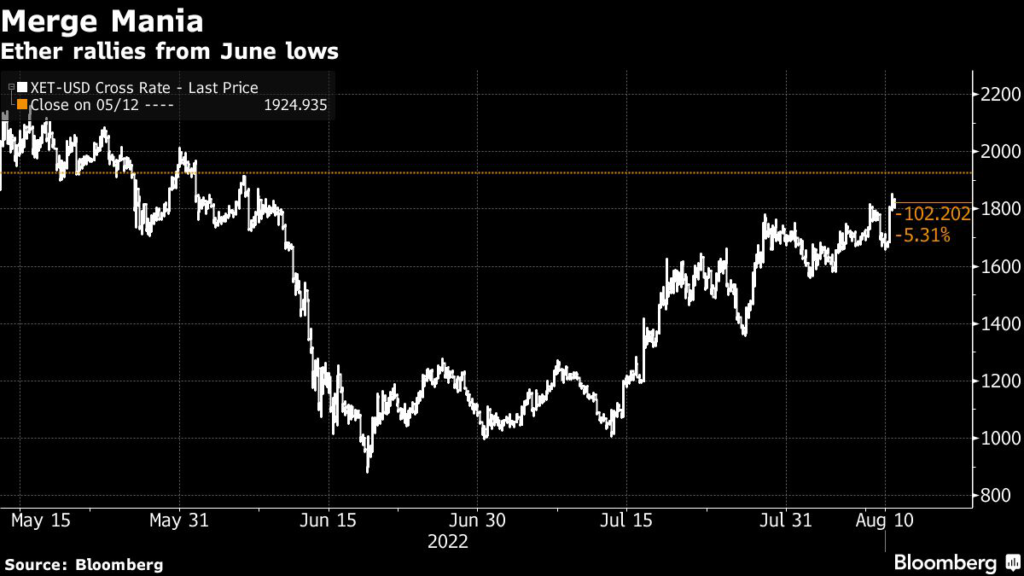
(Bloomberg) — Ether jumped as much as 9% amid optimism over what is being touted as the final test before the much-anticipated software upgrade of the Ethereum blockchain network. 

The native cryptocurrency of the most important commercial blockchain has surged about 67% since digital-asset prices bottomed in June. It has outperformed crypto market benchmark Bitcoin, which has increased around 15% during the same period.

The Goerli test — supposedly named after a train station in Berlin — is slated to commence late New York time on Wednesday and be instantaneous. It should be known whether the Goerli merge was a success within half an hour. The test network will be merging with a so-called proof-of stake test network — a transition that will mimic, on a smaller scale, Ethereum’s transition to a more energy-efficient system for ordering transactions. If the Goerli test goes well, Ethereum core developers may on Thursday set the date for when the blockchain undergoes its long-anticipated software update, called the Merge.

“This is the last testnet Merge before we do the real thing –it is the final dress rehearsal,” said Ben Edgington, lead product manager at ConsenSys and one of the key developers working on the Merge. YouTube viewing parties are popping up inviting users to watch the Goerli merge.

Developers have been working on the Merge software upgrade for years, and it’s been delayed many times as unexpected issues came up. Currently, it’s expected to take place in September, as on Sept. 19, an ominous-sounding difficulty bomb — code that should within weeks make the current Ethereum network unusable — should go off, pushing for the migration to the new proof-of-stake system.

In proof-of-stake, so-called validators use their stacks of Ether to order transactions on the network. Currently, powerful computers solve complex puzzles to accomplish the same task using more energy.

The Merge is expected to be a nail biter. Ethereum is the most important commercial highway in crypto, and any disruptions could cost billions and impact billions of users. The chain supports more than 3,400 active decentralized apps, allowing for everything from gaming to trading. Ether has a $223.5 billion market value, according to CoinMarketCap.

More stories like this are available on bloomberg.com

©2022 Bloomberg L.P.

BofA Starting Fresh Talks with Investors on Citrix Buyout Debt

(Bloomberg) — Bank of America Corp. plans to start fresh talks with investors on Monday to sell parts of a $15 billion debt financing for the buyout of Citrix Systems Inc., a deal that has been difficult for underwriters to offload.

The preliminary discussions are expected to focus on the secured portion of the financing ahead of official sales, or syndications, that could launch right after the US Labor Day holiday in early September, according to people with knowledge of the matter who asked not to be identified when discussing a private transaction.

Banks have been trying for weeks to figure out how to make the debt sale attractive to investors. The general syndication for Citrix is expected to include term loans in euros and US dollars as well as secured bonds, the people said. 

The underwriters are expected to retain some of the secured debt, and around $4 billion of unsecured, in an effort to avoid realizing losses on some of the holdings, according to the people. Hanging onto the debt will also reduce the total that they have to sell, making the syndication process easier.

The Citrix transaction is one of the biggest buyout debt deals that banks still have to unload. The financing, underwritten by a group of lenders led by Bank of America, Credit Suisse Group AG and Goldman Sachs Group Inc. toward the start of the year, has become a thorn in the side for much of Wall Street as prices have dropped for a wide range of risky assets, bringing losses to banks. 

Vista Equity Partners and Elliott Investment Management agreed in January to take Citrix private in a deal valued at $16.5 billion, including assumed debt, and to combine it with Vista portfolio company Tibco Software.

Representatives for Bank of America, Credit Suisse, Goldman Sachs, Vista and Elliott declined to comment.

The euro-denominated portion is expected to be small and may eventually be dropped depending on demand, according to one of the people familiar. Banks have also discussed the possibility of replacing the unsecured debt with second-lien loans if conditions in the junk-bond market remain difficult, though no final decision has been made, the person said.

While banks have informally sounded out investors about the Citrix deal before, the discussions starting next week would be the first since Citrix reported second-quarter earnings at the end of July.

(Adds details of euro tranche, discussions on second-lien loan in 8th paragraph.)

More stories like this are available on bloomberg.com

©2022 Bloomberg L.P.

Wall Street Defies CPI Skeptics With Risk-On Rally: Markets Wrap

(Bloomberg) — Stocks surged and the dollar sank as softer-than-expected inflation data fueled bets the Federal Reserve could pivot to a smaller pace of hikes — a view taken with a grain of salt by market watchers saying officials may still be a long ways from achieving their goal.

Traders went risk-on Wednesday, with the S&P 500 set for its highest since May. A surge in the Nasdaq 100 drove the tech-heavy gauge nearly 20% above its June bottom. The Cboe Volatility Index slumped below 20, a level last seen in April. The greenback slid the most since the onset of the pandemic. Treasury two-year yields trimmed a plunge that earlier reached 20 basis points.

For a market plagued by fears about the Fed’s struggles to tame sky-high inflation, the July consumer price index brought a sigh of relief — with both core and overall measures coming in below forecasts. Swaps are now suggesting a move of 50 basis points as more likely in September than a repeat of the 75-basis-point increases that officials have opted to implement at their past two meetings.

“This is overall good news for risky assets,” wrote Florian Ielpo, head of macro at Lombard Odier Asset Management, adding that “a lower growth rate of prices does not mean the end of inflation, and naturally the end of hawkish central banking. Inflation remains a situation that requires the Fed’s attention and more importantly the Fed’s measures.”

Read: Mocked by Everyone, Stock Rally Is at Cusp of Chart Landmark

One danger of the stock-market bullishness right now is that could cause an easing in financial conditions that would actually go against the Fed’s goals. It’s also worth looking back to the early 1980s, when then Fed Chair Paul Volcker eased policy as inflation peaked and the economy entered a recession. But the moderation of price pressures proved to be much slower than officials wanted — and they had to tighten again months later.

In fact, the CPI surprise is just one piece of the intricate puzzle officials are playing with at the moment — and possibly over the next several months — with the central bank still miles away from reaching its inflation target. Food prices in the US soared the most since 1979 in July, keeping the cost of living painfully high even as lower gasoline costs offered some relief to consumers.

Officials have said they want to see months of evidence that prices are cooling, especially in the core gauge. The US central bank will probably continue raising rates into next year to bring down “unacceptably high” inflation, Chicago Fed President Charles Evans noted. His Minneapolis counterpart Neel Kashkari said “the idea that we’re going to start cutting rates early next year, when inflation is very likely going to be well in excess of our target — I just think it’s unrealistic.”

“The easing of financial conditions likely annoys the Fed, and we should not be surprised to see Fed speakers continue to try to talk down the market and risk assets,” said Christian Hoffmann, portfolio manager at Thornburg Investment Management.

More comments on CPI: 

  • “The Fed still has significantly further to tighten and the US economy ultimately cannot avoid its fate. Enjoy today and the next few weeks, it won’t last for too long,” said Seema Shah, chief global strategist at Principal Global Investors.
  • “This data point will fuel talk of a policy pivot. But, for me, the issue really does boil down to the labor market. Wage growth is running red hot and absent a turn around in productivity, this will ultimately fuel higher prices,” wrote Neil Dutta, head of economics at Renaissance Macro Research.
  • “This is a step in the right direction but keep in mind we have many miles ahead of us before inflation normalizes. One month’s data point does not make a trend, however, so cautious optimism is likely the name of the game,” said Mike Loewengart, managing director of investment strategy at E*Trade from Morgan Stanley.
  • “Wow, finally the anecdotal evidence that inflation was easing has finally showed up in a mainstream inflation report. The Fed is rapidly losing its case for further tightening and this report reinforces for investors that either a new easing cycle has already begun or we are getting very close to one,” said Jim Paulsen, chief investment strategist at the Leuthold Group.

In corporate news, Tesla Inc. climbed after Elon Musk offloaded $6.9 billion of stock in the electric-vehicle maker to accumulate cash ahead of a trial that could force the billionaire to follow through on an agreement to acquire Twitter Inc. Wendy’s Co. became the latest restaurant chain to show signs of strain thanks to rising inflation as sales and restaurant margin fell short of Wall Street projections.

What to watch this week:

  • US PPI, initial jobless claims, Thursday
  • San Francisco Fed President Mary Daly is interviewed on Bloomberg Television, Thursday
  • Euro-area industrial production, Friday
  • US University of Michigan consumer sentiment, Friday

Respected for decades for combining decent returns and relatively low volatility, the 60/40 portfolio has generated a 11.5% loss so far this year. Is it time to put the strategy to rest entirely or does it just need a tweak? Have your say in the anonymous MLIV Pulse survey.

Some of the main moves in markets:

Stocks

  • The S&P 500 rose 1.9% as of 2:41 p.m. New York time
  • The Nasdaq 100 rose 2.6%
  • The Dow Jones Industrial Average rose 1.4%
  • The MSCI World index rose 1.7%

Currencies

  • The Bloomberg Dollar Spot Index fell 1.1%
  • The euro rose 1% to $1.0313
  • The British pound rose 1.3% to $1.2237
  • The Japanese yen rose 1.6% to 132.89 per dollar

Bonds

  • The yield on 10-year Treasuries was little changed at 2.78%
  • Germany’s 10-year yield declined three basis points to 0.89%
  • Britain’s 10-year yield declined two basis points to 1.95%

Commodities

  • West Texas Intermediate crude rose 1.5% to $91.88 a barrel
  • Gold futures fell 0.3% to $1,807.40 an ounce

More stories like this are available on bloomberg.com

©2022 Bloomberg L.P.

Mocked by Everyone, Stock Rally Sits at Cusp of a Chart Landmark

(Bloomberg) — It’s doomed, it’s a bear-market rally, a rebound that won’t last. All the mud thrown at equities over the last month may well turn out to be true. But it’s getting harder to brush aside the recovery in the S&P 500 as it hovers at a widely watched landmark in charts.

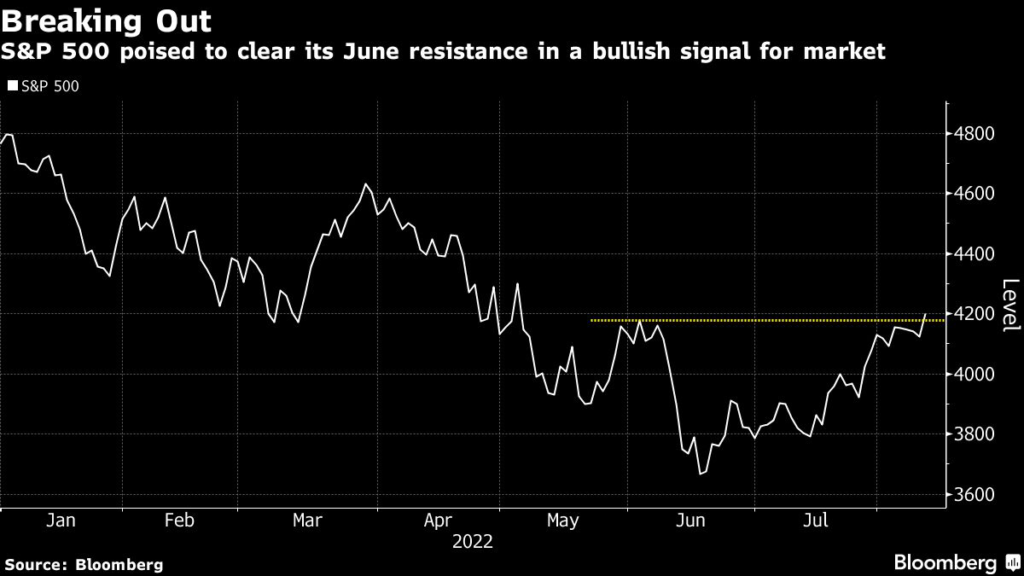
Four straight days of losses were erased in seconds Wednesday after inflation data came in cooler than expected. The S&P 500 climbed 1.9% as of 12:50 p.m. in New York, surpassing the 4,177 level that marked the peak during its May-June rebound. Overcoming the hurdle would produce what chartists refer to as a “higher high,” supposedly a signal that more sustained gains are in store. 

“We’ve been cautious all year,” said Jonathan Krinsky, chief market technician at BTIG. “Clearing June’s high on a closing basis would go a long way to suggesting the trend was shifting.” 

Wednesday’s inflation data — the first time since early 2021 that the headline reading was lower than economist forecasts — prompted traders to quickly pare back bets on the amount of tightening that the Federal Reserve is likely to do, sparking a bounce across risky assets.  

More than $5 trillion has been restored in equity values as the S&P 500 staged its strongest rebound this year, jumping 15% from its June trough. Stocks have rallied as better-than-expected earnings and economic data eased concern about an imminent economic recession. 

“Stocks have been in rally mode, so if you’ve been buying all along, this will do nothing to dissuade you,” said Steve Sosnick, chief strategist at Interactive Brokers. “While traders are eager for anything that can be interpreted as an all clear, it’s one report,” he added. “But it fits with the newfound bullish narrative.”

Along the way, warnings from strategists at firms like Morgan Stanley and Goldman Sachs Group Inc. have been getting louder. In a client survey conducted last week by Wolfe Research during a webcast, 75% of the participants said the S&P 500 has yet to reach a bottom. 

Underpinning the skepticism is the uncertain trajectory of the Fed’s hiking cycle and its impact on the economy. Already, gross domestic product contracted for two straight quarters. And major makers of computer chips warned about slowing demand. 

“We’re not yet convinced that the upturn in stock prices we’ve seen is yet a firm trend,” said Lisa Erickson, senior vice president and head of public markets group at US Bank Wealth Management. “Price pressures while they’ve come down in the recent CPI report still have a way to go. And the Fed also wants to see clear and convincing evidence for it to really change its monetary policy approach.” 

But the equity resilience has continued. One by one, what used to be resistance in price charts turned into support, and bears were forced to unwind their positions. A Goldman basket of most-shorted stocks has soared 30% since the start of July, burning anyone wagering on share declines.

This month, the June peak has become a battle line between bulls and bears. The index briefly topped that threshold on Monday, only to close below it as selling resumed and stocks wiped out their intraday gains. 

“Breaching the 4,177 level on the S&P 500 is important from a trend following perspective because it starts to establish a sequence of higher highs and higher lows, or what is more affectionately known as an uptrend,” Renaissance Macro Research co-founder Jeff deGraaf, wrote in a note last week. He was ranked as the top technical analyst in Institutional Investor’s annual survey for 11 straight years through 2015. 

Sam Stovall, chief investment strategist at CFRA, is not ready to call all clear until the S&P 500 recoups half its losses that incurred from January through June. To adherents of Fibonacci analysis, a technical tool based on a number sequence described by Leonardo of Pisa in “Liber Abaci” in 1202, reaching the midpoint is a signal that the market is poised to make a full recovery.  

“This remains a bear market rally until we close above the 4,232 level on the S&P,” Stovall said. “After that, history reminds us that no bear market ever recovered 50% of its decline only to set an even lower low. It would be an early signal that the bear is behind us.”

(Adds additional comments starting in sixth paragraph)

More stories like this are available on bloomberg.com

©2022 Bloomberg L.P.

US Commerce Chief Hopes Chips Bill Spurs Up to $400 Billion in Investment 

(Bloomberg) — A new US law that includes about $52 billion to boost domestic semiconductor production and research could unlock as much as $400 billion in investment, President Joe Biden’s commerce chief said. 

“Our goal is to maximize it,” Commerce Secretary Gina Raimondo said on Wednesday in an interview on Bloomberg Television. “It is an amount that we hope is enough to unlock two, three, $400 billion on behalf of private industry.”

Biden on Tuesday signed into law a broad competition bill that includes the funds for the semiconductor industry, calling it a “once-in-a-generation investment in America itself.”

The chips bill is at the center of the Biden administration’s effort to reduce dependence on Asian suppliers like Taiwan and South Korea, whose homegrown companies are leading the market, and to address supply-chain disruptions and resulting price hikes for certain goods containing semiconductors.

The bill also includes important caveats sought by Republicans and China hawks: Companies that receive the funding have to promise not to increase their production of advanced chips in China. 

“The fact that we got that bill across the finish line has been a huge signal to industry that they ought to invest in America, and not in Asia or Europe,” Raimondo said.

The chips bill is one in a slew of legislative wins for the White House in recent weeks. Senate Democrats on Sunday passed a sweeping climate and spending bill — a slimmed down version of Biden’s Build Back Better agenda — after lawmakers also approved veterans health and gun-safety bills with bipartisan support. 


More stories like this are available on bloomberg.com

©2022 Bloomberg L.P.

Flight Searches Out of Hong Kong Jump 290% With Bangkok Top Pick

(Bloomberg) — Online searches for flights out of Hong Kong surged by 290% in the 24 hours after the government announced shorter hotel quarantine requirements on Monday, according to travel company Expedia Group Inc. 

The top-trending destination was Thailand’s capital Bangkok, followed by Osaka in Japan, with flight searches jumping tenfold for both from the previous seven-day average, Expedia said. Travel within Asia was the most popular — strong demand was also seen for flights to Seoul, Phuket and Singapore. 

“Whilst the reduction of quarantine requirements has clearly played a key role in inspiring renewed travel interest, Expedia’s flight search data has indicated that Hong Konger’s interest in the resumption of overseas travel has been gradually picking-up over the course of the last six months,” Lavinia Rajaram, Expedia’s head of public relations in Asia, said in a statement Wednesday.


Interest in international flight searches on Expedia.com.hk grew 60% in April-June from the previous quarter, Rajaram said. 

Hong Kong has cut mandatory hotel quarantine to three nights from seven, with arrivals needing to take daily Covid-19 tests for the subsequent four days and restricted from so-called high risk places such as restaurants. Still, the easing lags most of the rest of the world, and arrivals run the risk of being sent to government isolation centers if they test positive. That’s left many calling for further loosening.  

Searches for shorter breaks of four to seven days in Asia doubled after Monday’s announcement, according to Expedia, which said such trips are “clearly in the minds of Hong Kong travelers in the immediate term, with end of summer escapes in the next two to three weeks proving popular.”

A study in June found that the main factors holding back Hong Kong residents from overseas travel were concerns over complex quarantine requirements and the high cost of quarantine, Expedia said. 

China’s largest online travel agency, Trip.com, said Tuesday that bookings for flights to Hong Kong jumped 249% after the new quarantine rules were announced, while outbound orders rose 176% from the previous day. 

More stories like this are available on bloomberg.com

©2022 Bloomberg L.P.
Close Bitnami banner
Bitnami