

Bloomberg

Stocks Roar as Wall Street Cheers CPI Surprise: Markets Wrap

(Bloomberg) — Stocks surged and bond yields sank as softer-than-expected inflation data fueled bets the Federal Reserve could pivot to a smaller pace of hikes — a view taken with a grain of salt by market watchers saying officials may still be a long ways from achieving their goal.

Traders went risk-on Wednesday, with the S&P 500 on pace for its highest level since May. A surge in the Nasdaq 100 drove the tech-heavy gauge 20% above its June low. The Cboe Volatility Index slumped below 20, a level last seen in April. The dollar fell against all of its Group-of-10 peers. Short-dated Treasury yields led the slide, with the two-year rate at one stage plummeting nearly 20 basis points to 3.07%.

For a market plagued by fears about the Fed’s struggles to tame sky-high inflation, the July consumer price index brought a sigh of relief — with both core and overall measures coming in below forecasts. As a result, swaps are now suggesting a move of 50 basis points as more likely than a repeat of the 75-basis-point increases that officials have opted to implement at their past two meetings.

Comments on CPI: 

  • “Wow, finally the anecdotal evidence that inflation was easing has finally showed up in a mainstream inflation report. The Fed is rapidly losing its case for further tightening and this report reinforces for investors that either a new easing cycle has already begun or we are getting very close to one,” said Jim Paulsen, chief investment strategist at the Leuthold Group.
  • “The weaker-than-expected CPI print suggests the Fed could adopt a more cautious pace of tightening going forward,” said Ellen Gaske, an economist at PGIM Fixed Income.
  • “The market is now pricing in a 50 basis point move at the September meeting and equities are responding in kind. This data point will fuel talk of a policy pivot. But, for me, the issue really does boil down to the labor market. Wage growth is running red hot and absent a turn around in productivity, this will ultimately fuel higher prices,” Neil Dutta, head of economics at Renaissance Macro Research.
  • “This is overall good news for risky assets. A lower growth rate of prices does not mean the end of inflation, and naturally the end of hawkish central banking. Inflation remains a situation that requires the Fed’s attention and more importantly the Fed’s measures,” wrote Florian Ielpo, head of macro at Lombard Odier Asset Management.
  • “This is a step in the right direction but keep in mind we have many miles ahead of us before inflation normalizes. One month’s data point does not make a trend, however, so cautious optimism is likely the name of the game,” Mike Loewengart, managing director of investment strategy at E*Trade from Morgan Stanley.
  • “With one more jobs report and CPI print on the docket ahead of the FOMC’s next scheduled session, it may be premature to say definitively how large of a rate hike is on the table for September, though as of now the debate would likely be over a 50 bps vs. 75 bps,” wrote Jason Pride, chief investment officer of Private Wealth at Glenmede.
  • “The Fed will be looking at today’s number with a sigh of relief. But it is not enough to convince them to take their foot off the brakes. The Fed still has significantly further to tighten and the US economy ultimately cannot avoid its fate. Enjoy today and the next few weeks, it won’t last for too long,” said Seema Shah, chief global strategist at Principal Global Investors.
  • “Both headline and core CPI inflation were surprisingly soft in July, but with recent wage and productivity data signaling prices pressures ahead, the Federal Reserve is unlikely to step back from the inflation fight just yet,” Bloomberg Economics’ Anna Wong wrote.

In fact, one danger of the stock-market rally is the possibility that would cause a relaxing in financial conditions that actually goes against the Fed’s goal of taming inflation. Former Treasury Secretary Lawrence Summers said last week he was concerned that a slowing in headline inflation in upcoming data would prompt the Fed to conclude its policies are working — when much more action is in fact needed. 

In corporate news, Tesla Inc. climbed after Elon Musk offloaded $6.9 billion worth of stock in the electric-vehicle maker, saying he wanted to avoid a sudden sale in the event he’s forced to go ahead with his deal to acquire Twitter Inc.

What to watch this week:

  • US PPI, initial jobless claims, Thursday
  • San Francisco Fed President Mary Daly is interviewed on Bloomberg Television, Thursday
  • Euro-area industrial production, Friday
  • US University of Michigan consumer sentiment, Friday

Respected for decades for combining decent returns and relatively low volatility, the 60/40 portfolio has generated a 11.5% loss so far this year. Is it time to put the strategy to rest entirely or does it just need a tweak? Have your say in the anonymous MLIV Pulse survey.

Some of the main moves in markets:

Stocks

  • The S&P 500 rose 2% as of 11:07 a.m. New York time
  • The Nasdaq 100 rose 2.6%
  • The Dow Jones Industrial Average rose 1.8%
  • The Stoxx Europe 600 rose 0.9%
  • The MSCI World index rose 1.9%

Currencies

  • The Bloomberg Dollar Spot Index fell 1.4%
  • The euro rose 1.5% to $1.0363
  • The British pound rose 1.6% to $1.2270
  • The Japanese yen rose 2.2% to 132.11 per dollar

Bonds

  • The yield on 10-year Treasuries declined four basis points to 2.74%
  • Germany’s 10-year yield declined five basis points to 0.87%
  • Britain’s 10-year yield declined three basis points to 1.94%

Commodities

  • West Texas Intermediate crude fell 1.9% to $88.76 a barrel
  • Gold futures rose 0.3% to $1,818.10 an ounce

More stories like this are available on bloomberg.com

©2022 Bloomberg L.P.
Ether Leads Crypto Market Surge After CPI Report Release

(Bloomberg) — Cryptocurrencies surged on Wednesday after a softer-than-expected inflation report, with Ethereum leading the pack with a greater-than-7% gain. 

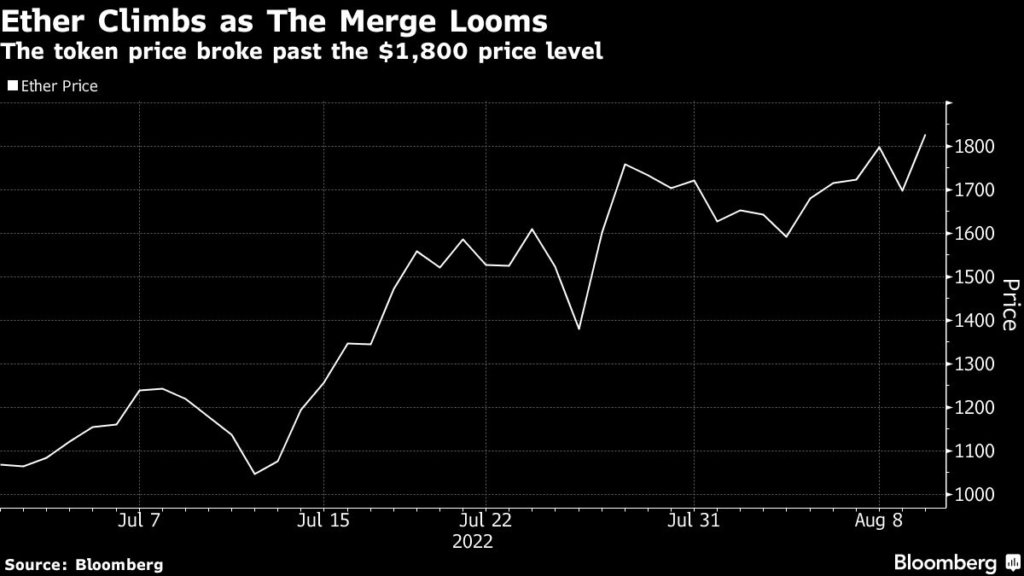
Ether’s native token, the second-largest cryptocurrency by market capitalization, rose around 8% to trade at $1,828 as of 10:17 a.m. in New York. Bitcoin added 3.5% to $23,950, and other altcoins like Polkadot and Avalanche also rallied, up 6% and 8%, respectively. An index of 100 of the largest digital assets was up 4.4%. 

The easing consumer-price pressure spurred speculation that the Federal Reserve could pivot to a less-aggressive pace of rate hikes, something that could potentially create a more comfortable environment for risky assets including cryptocurrencies.

“The CPI report should mean the Fed will be less aggressive. A less-aggressive Fed should be bullish for the cryptos,” Matt Maley, chief market strategist at Miller Tabak & Co. “I’m surprised they’re not rallying more.”

The consumer price index increased 8.5% in July from a year earlier, cooling from the 9.1% June advance that was the largest in four decades. Prices were unchanged from the prior month.

While the CPI report reduced some investors fears of further Fed hikes at a 75 basis-point clip, crypto markets have been rebounding off their lows prior the report, along with the stock market. Bitcoin and equities have strongly correlated over the past year.

Nevertheless, many market-watchers said Fed officials could still be a long way from achieving their inflation goals. 

“Today’s exuberance is an example of fast money going risk-on thinking we are on the path to recovery. We may see a bear rally for the time being, but the yield curve is a better barometer of where we’re at, and it’s inverted,” said Steven McClurg, co-founder and CIO at digital asset fund manager Valkyrie Investments, referring to a bond-market metric that indicates the risk of ann economic slowdown. “We are still in the beginning stages of recession.”

Ether, at its highest level since early June, has become a digital-asset market darling, as the highly-anticipated Merge, which will transition its verification protocol from Proof of Work to Proof of Stake, is nearing after years of delays.

More stories like this are available on bloomberg.com

©2022 Bloomberg L.P.
Biden Sees Signs Inflation Moderating After Promising July Data

(Bloomberg) — President Joe Biden said there are signs inflation is beginning to moderate after it slowed more than expected in July, giving him a much-needed boost ahead of the November midterm elections.

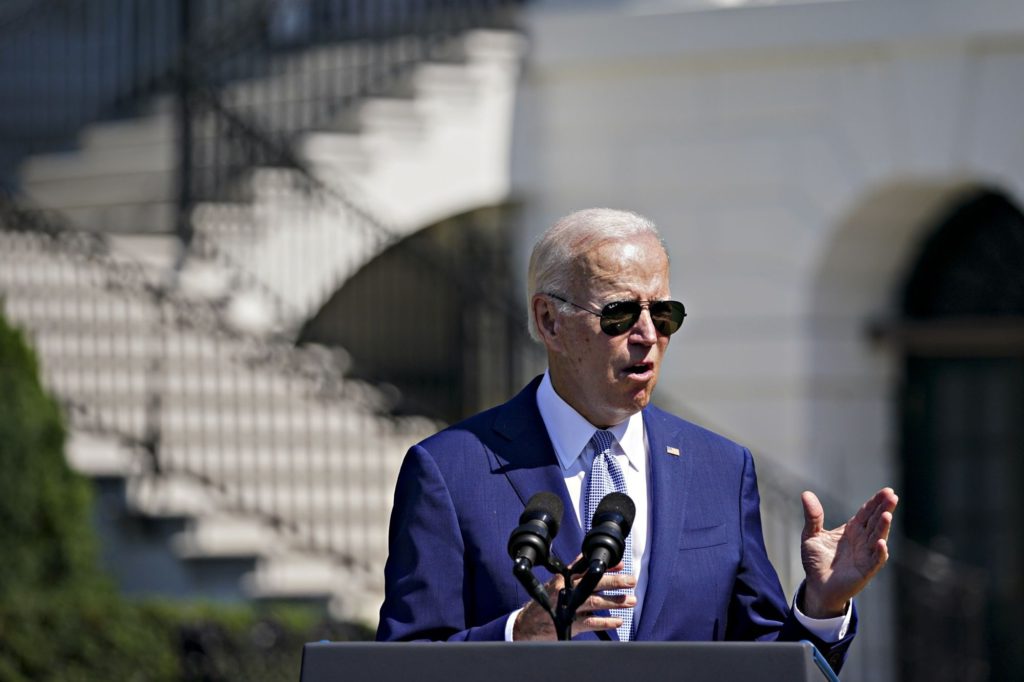
“We’re seeing a stronger labor market where jobs are booming and Americans are working and we’re seeing some signs that inflation may be beginning to moderate,” Biden said Wednesday before signing a veterans health-care bill, calling the numbers evidence his “economic plan is working.”

Yet he cautioned that the nation could still face economic headwinds in the coming months due to the war in Ukraine and supply chain disruption stemming from pandemic shutdowns in Asia.

“It’s far from done, our effort to bring inflation down, but we’re moving in the right direction,” said Biden.

High consumer prices have wreaked havoc on Americans’ budgets, causing political damage to Biden and Democrats that could cost them control of Congress in the fall. The president’s approval rating fell to a new low of 38% at the end of July, according to a Gallup poll. 

Related: US Inflation Runs Cooler Than Forecast, Easing Pressure on Fed

Since then, Biden has won several victories on key parts of his agenda, including the Senate’s passage of a hard-fought tax, health and climate bill. He also signed a new gun safety law, subsidies for US semiconductor manufacturing and protocols for Finland’s and Sweden’s entry to NATO. Democrats hope slowing inflation will add to their momentum and help them limit their losses in November. 

The consumer price index increased 8.5% from a year earlier, a still-high figure but down from the 9.1% spike in June that was the largest in four decades, Labor Department data showed Wednesday. Prices did not change compared to last month. A decline in gasoline and airfare offset increases in other areas like food and housing. 

The numbers beat the expectations of economists who projected in a Bloomberg survey a 0.2% rise in headline CPI from a month ago and an 8.7% compared to last year.

Republicans have blamed Biden’s policies for driving inflation, including last year’s $1.9 trillion coronavirus relief package, and warned that the Senate bill could further contribute to the problem.

More stories like this are available on bloomberg.com

©2022 Bloomberg L.P.
Crypto Broker Genesis Says Lending Fell Again in Second Quarter

(Bloomberg) — Genesis, one of the largest cryptocurrency lenders and brokerages for institutional investors, said it originated more than $40 billion in new loans in the second quarter, a 9% drop from the previous three-month period. 

The company had $4.9 billion in active loans as of the end of June, and said it saw more than $17 billion in spot volume trading during the second quarter, according to a report released Wednesday. Institutional activity was “muted” during the stretch and in June in particular amid an onslaught of negative crypto-centric events, including the implosion or bankruptcies of different hedge funds and lenders. Meanwhile, it saw a 66% drop in active loans outstanding to $4.9 billion from $14.6 billion in the first quarter. 

“Genesis was not immune to the market drop and the damage to overall sentiment,” the report said, adding that the company had loan exposure to hedge fund Three Arrows Capital, which infamously crumpled in June. 

Genesis is a subsidiary of Barry Silbert’s Digital Currency Group. It lends to borrowers such as crypto funds which use the assets to short digital currencies, hedge investments, or invest in yield-generating platforms. Wednesday’s report also showed that Genesis’s derivatives desk traded nearly $27 billion in notional value, a drop of 4% from the January-March period. 

Crypto lenders were under the spotlight at the start of the summer when a number of hedge funds and lenders said they were having trouble amid the drop in digital-asset prices. Bitcoin is down roughly 50% this year to around $24,000, and Ether, the second-largest coin, has lost a similar amount to trade around $1,834. In June, Bloomberg News reported that Genesis said its lending activity had still been strong and that clients were coming to it for yield opportunities.

Industrywide, crypto lending suffered a strong contraction in the recent quarter, resulting in a shift in market structure,” the report out on Wednesday said. “However, Genesis continued to be an active participant in yield markets in perpetuity and serviced all our clients’ needs on both the demand and supply side.” Crypto credit markets will continue to evolve, it said, and institutional lending will continue to be a core part of the company’s overall prime offering. 

More stories like this are available on bloomberg.com

©2022 Bloomberg L.P.

Musk Sells Another $6.9 Billion of Tesla Ahead of Twitter Trial

(Bloomberg) — Elon Musk offloaded $6.9 billion worth of stock in Tesla Inc. to accumulate cash ahead of a trial that could force the billionaire to follow through on an agreement to acquire Twitter Inc.

Tesla’s chief executive officer sold about 7.92 million shares during the last three days of trading, according to regulatory filings. Musk, who still owns almost 15% of the electric-car maker, tweeted that he was done selling and would buy Tesla shares if the Twitter deal doesn’t close.

“In the (hopefully unlikely) event that Twitter forces this deal to close *and* some equity partners don’t come through, it is important to avoid an emergency sale of Tesla stock,” Musk wrote.

Tesla rose 3% to $875.51 at 9:50 a.m. Wednesday in New York, while Twitter climbed 3.2% to $44.19.

Musk has now dumped about $32 billion worth of Tesla shares since November. The world’s richest person said less than four months ago he had no further stock sales planned and has attempted since then to terminate his $44 billion acquisition of Twitter. The social media company has sued to force Musk to go through with the deal, and a trial is scheduled for October.

“He is cashing up for Twitter,” said Charu Chanana, a strategist at Saxo Capital Markets Pte in Singapore, who believes Musk may be trying to take advantage of Tesla shares rebounding about 35% since late May. “The bear market rally has started to falter, and further repricing of Fed expectations could mean more pain for equities ahead, especially in tech.”

Investors had been skeptical that Musk, 51, was done offloading Tesla stock, with 68% of 1,562 respondents to an MLIV Pulse survey saying last month he was likely to sell more regardless of what happens with the Twitter deal.

“Musk said at the Tesla shareholder meeting that any weakness in the share price was a buying opportunity, and then 24 hours later started selling stock himself,” said Jim Dixon, a senior equity sales trader at Mirabaud Securities. It’s “very unlikely” Musk is done offloading the stock, Dixon said.

Musk May Keep Selling Tesla, With or Without Twitter: MLIV Pulse

Tesla’s market fortunes have been tied to the Twitter deal since Musk made his surprise overtures in April. The carmaker’s shares initially slumped out of concern the pursuit would distract him and the risk associated with the margin loan he intended to take out against his Tesla stake. The stock rallied when Musk abandoned the borrowing plan and in the weeks after he said he wanted to terminate the transaction.

When Musk dropped plans to partially fund the Twitter purchase with a Tesla margin loan, it increased the size of the equity component of the deal to $33.5 billion. He’s previously announced having secured $7.1 billion of equity commitments from investors including billionaire Larry Ellison, Sequoia Capital and Binance.

Over the weekend, Musk tweeted that if Twitter provided its method of sampling accounts to determine the number of bots on its platform, “the deal should proceed on original terms.” 

The Twitter deal included a provision that if it fell apart, the party breaking the agreement would pay a termination fee of $1 billion under certain circumstances. Legal experts have debated whether the conflict over spam bots is enough to allow Musk to walk away from the deal.

Musk’s disposals of Tesla stock started after he polled Twitter users on whether he should trim his stake. He remains by far the largest stakeholder, according to data compiled by Bloomberg.

Commenting before Musk’s tweets clarifying the reason for the sale, Gene Munster, managing partner of Loup Ventures, said he put the odds the billionaire will end up buying Twitter at 75%. 

“I’m shocked,” Munster said. “This is going to be a headwind for Tesla in the near term. In the long term, all that matters is deliveries and gross margin.”

Musk’s $250.2 billion fortune is the world’s largest, according to the Bloomberg Billionaires Index, though his wealth has shrunk by about $20.1 billion this year as Tesla’s stock has declined.

The carmaker’s shareholders approved a three-for-one stock split last week, a move designed to attract an even larger number of retail investors. Tesla’s better-than-expected second-quarter earnings have been a tailwind, along with landmark US legislation that includes tax credits for electric-car purchases and loans to companies constructing plants that make clean vehicles.

Musk tweeted separately that Tesla will start shipping its Semi truck later this year, followed by the Cybertruck in 2023. He’s said previously both would be in production next year, along with a new Roadster model.

More stories like this are available on bloomberg.com

©2022 Bloomberg L.P.
Amazon Joins Deal Revival Spurred by Lower Valuation: Tech Watch

(Bloomberg) — There’s no relaxing on the beach this summer for corporate acquirers — they’ve been busy snapping up technology companies, even after a stock rally over the past two months means the sector isn’t as cheap as it was back in June. 

Just look at Amazon.com Inc. The retail and cloud-storage giant announced a $3.49 billion deal to buy software company 1Life Healthcare Inc. last month, and last week it said it would pay $1.65 billion for iRobot Corp., maker of the Roomba vacuum. 

Just 10 days into August, about $13.4 billion of tech-related mergers and acquisitions have been unveiled in North America, according to Bloomberg data, which already would make it the busiest month since May. In the largest deal, buyout firm Vista Equity Partners agreed to buy tax software provider Avalara Inc. for $8.4 billion including debt. 

“August has historically been a quiet month for M&A, so it is surprising to see such a flurry of deals,” said Larry Feldman, a research analyst at United First Partners. Dealmaking may be getting a boost from improved market conditions for debt financing, he said.

And the sector still is cheaper than at the height of the roaring bull market early this year. The Nasdaq 100 Index is priced at 22 times estimated earnings now, down from a recent peak of 31 in September 2020, even if it is up from the June low of 18.6.

Amazon’s targets certainly aren’t selling at the peak: iRobot fell 77% from its high of $161.16 last year through last month as it struggled with supply-chain issues. Similarly, One Medical’s stock hit a record low of about $6 in May from 2021’s all-time high near $60, before agreeing to sell at $18. 

There are some headwinds deterring the biggest companies from massive acquisitions: They face stepped-up antitrust scrutiny in the US, which has some traders skeptical that recent marquee deals — such as Microsoft Corp.’s $69 billion purchase of Activision Blizzard Inc. — will go through. Activision’s shares are still trading about 15% below the offer price.

And Apple Inc., which used to acquire a company every three or four weeks, has dramatically slowed its dealmaking in the past two years.

Still, big companies and buyout firms are flush with cash, and plenty of smaller tech companies are looking at a slowing economy and tougher business environment in the near future.

“So this is a good time for them to get off the merry-go-around,” said Tim Pagliara, chief investment officer at CapWealth, a wealth management firm in Franklin, Tennessee. 


Tech Chart of the Day 

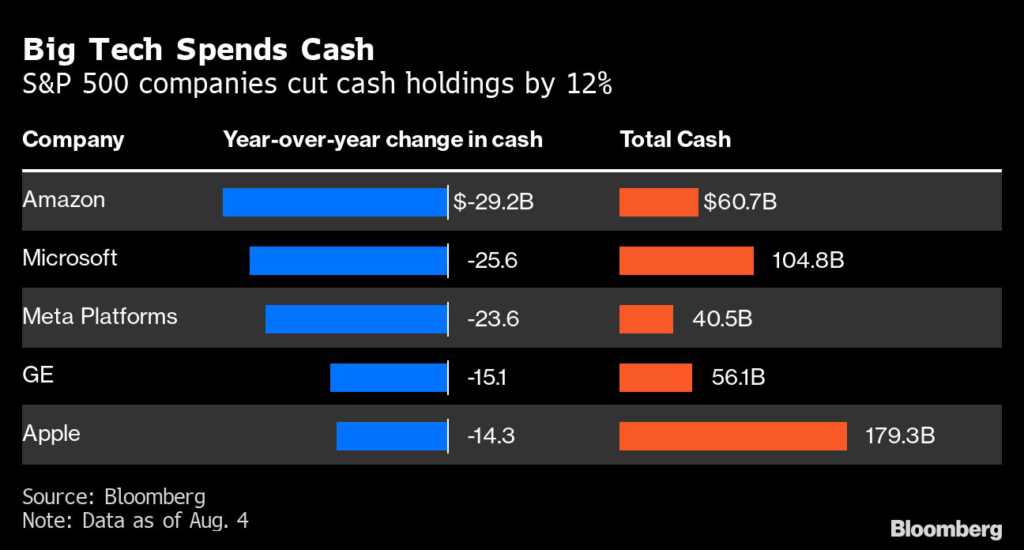
S&P 500 companies have cut cash holdings by 12% from a year earlier, according to data compiled by Bloomberg. Amazon is leading the pack with a $29 billion cut to its cash pile, following by fellow mega-caps Microsoft Corp., Meta Platforms Inc. and Apple Inc. Apple, Microsoft and Meta have used cash to fund their share repurchase programs, while Amazon has the biggest capital expenditure budget in the group.

Top Tech Stories

  • Elon Musk offloaded $6.9 billion of stock in Tesla Inc., the billionaire’s biggest sale on record, saying he wanted to avoid a last-minute selloff of the electric-car maker’s shares in the event he is forced to go ahead with his aborted deal to buy Twitter Inc.
  • Roblox Corp., a video-game platform aimed at preteens and teenagers, reported bookings that missed analysts’ estimates, becoming the latest gaming company to deliver disappointing results amid a post-pandemic industrywide slump.
  • Semiconductors stocks tumbled after Micron Technology Inc. warned of slowing demand, adding to concern the industry is heading into a painful downturn.
    • Micron Technology Inc. plans to slow hiring as it copes with a sudden drop in chip demand, but the company joined peers such as Intel Corp.and Nvidia Corp. in deciding that major job cuts aren’t yet necessary.
    • President Joe Biden signed into law a broad competition bill Tuesday that includes about $52 billion to boost domestic semiconductor research and development, calling it a “once-in-a-generation investment in America itself.”
  • Lenovo Group Ltd.’s profit jumped a better-than-projected 11% after the world’s largest maker of personal computers relied on businesses beyond PCs to counter a worsening slump in global electronics demand.
  • Hon Hai Precision Industry Co., the maker of most of the world’s iPhones, posted a profit that beat estimates as demand for its cloud products helped it weather supply-chain snarls and sluggish smartphone demand.
  • Taiwan wants to force Foxconn Technology Group to unwind an $800 million investment in Chinese chipmaker Tsinghua Unigroup, the Financial Times reported, citing unidentified people familiar with the matter.
  • A Nebraska woman was charged with two felonies related to an illegal abortion after authorities discovered information about the pregnancy through private messages on Facebook Messenger, according to court documents. The case renewed debate about how law enforcement may use social media accounts in cases involving reproductive choices.
  • Market Kurly became South Korea’s first billion-dollar online grocery app by delivering fresh produce to customers’ doorsteps by dawn the next day. Now it’s expanding to Singapore by offering products on Alibaba Group Holding Ltd.’s RedMart.
  • Telexistence Inc. and FamilyMart Co. are rolling out a fleet of AI-driven robots to restock shelves in 300 convenience stores across Japan.
  • Deliveroo Plc’s loss widened less than analysts had estimated after the company generated sales from its new ad platform and increased average customer fees.


(Adds deal spread in seventh paragraph)

More stories like this are available on bloomberg.com

©2022 Bloomberg L.P.
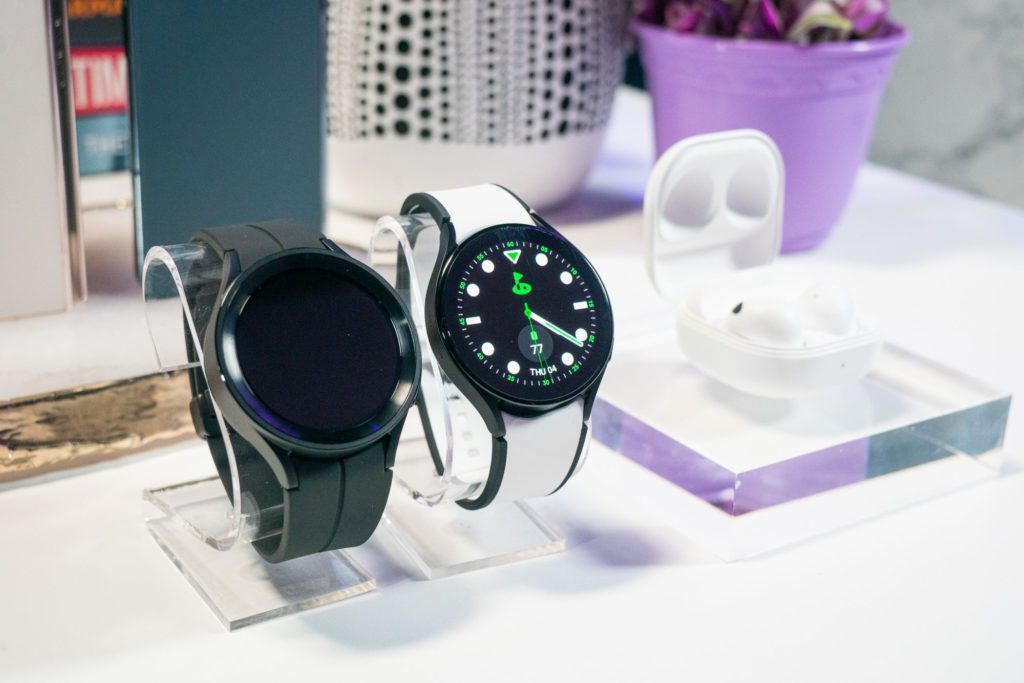
Samsung’s New Foldable Phones Have More Features, But Prices Stay the Same

(Bloomberg) — Samsung Electronics Co. unveiled the latest generation of its foldable devices on Wednesday, keeping prices steady despite surging costs of materials and shipping.

The new Galaxy Z Fold 4, which is about the size of a notepad and opens like one, and Z Flip 4, which is square when closed and opens out to regular smartphone size, come with a suite of incremental upgrades. This year’s Fold has a 45% more durable main display with minimized bezels, a slimmer hinge and upgraded cameras both on the back and under the display, Samsung said. Responding to user requests, the company upgraded the battery on the smaller Flip and added a larger max storage option of 512GB.

Samsung surprised industry observers a year ago when it launched the Flip 3 at $999, positioning it as a direct competitor to Apple Inc.’s iPhone range and a successor to the Galaxy Note lineup. The company benefited from its aggressive pricing with record sales of its foldable lineup since then and has stated its ambition to bring the category into the mainstream. This year’s disruptions to logistics, production and materials supply have pushed tech companies like Meta Platforms Inc. to increase pricing, but Samsung is maintaining the same levels as last year with the Flip 4 and the $1,799 Fold 4.

“Samsung’s setting up an ambitious goal to expand its foldable sales to 10 million this year but it’d be challenging considering the macroeconomic situations,” said Greg Roh, head of technology research at HMC Investment & Securities. The company sold about 6 million foldable devices last year and is looking for “a breakthrough with foldable phones as low-end phones sales are slumping.”

Samsung Adds to Risky Foldables Bet After Strong Debut

Prices are going up for Samsung’s accessory lineup, however. The company’s new smartwatch, the Galaxy Watch 5, costs $279 and its Galaxy Buds 2 Pro wireless earphones are $229, both $30 more than last year’s models. The Watch 5 has a skin temperature sensor, an improved glass curvature for more accurate health readings and Google services like Assistant and Maps. It’s rated to last for 50 hours on a charge and has a pricier Pro version that can go as long as 80 hours, according to Samsung.

Samsung opens pre-orders on Wednesday and will have its new foldables in stores Aug. 26.

More stories like this are available on bloomberg.com

©2022 Bloomberg L.P.

Futures Surge, Yields Sink as Fed-Hike Bets Recede: Markets Wrap

(Bloomberg) — Stock futures surged, while bond yields tumbled after softer-than-estimated inflation figures suggested that prices may have peaked, bolstering speculation on a smaller pace of Federal Reserve hikes.

S&P 500 contracts jumped, indicating the benchmark gauge will halt a four-day losing streak. The dollar fell against all of its Group-of-10 peers. Treasury 10-year yields plunged below 2.7%. The two-year rate briefly reached more than 58 basis points above the 10-year yield — a level last seen in the early 1980s, according to Bloomberg data — before shifting back to around 41 basis points.

Swaps showed the amount of tightening priced for the Fed’s Sept. 21 decision tumbling to around 59 basis points, suggesting a move of 50 basis points is seen as more likely than a shift of 75 basis points. The consumer price index increased 8.5% in July from a year earlier, cooling from the 9.1% June advance that was the largest in four decades. Prices were unchanged from the prior month. A decline in gasoline offset increases in food and shelter costs. 

Comments: 

  • “Wow, finally the anecdotal evidence that inflation was easing has finally showed up in a mainstream inflation report. The Fed is rapidly losing its case for further tightening and this report reinforces for investors that either a new easing cycle has already begun or we are getting very close to one,” said Jim Paulsen, chief investment strategist at the Leuthold Group.
  • “The weaker-than-expected CPI print suggests the Fed could adopt a more cautious pace of tightening going forward,” said Ellen Gaske, an economist at PGIM Fixed Income.
  • “While this is to be celebrated, 8.5% inflation is still well above what the Fed wants to see. 50-75bps are still on the table for September, and more data will come in by that point,” said Victoria Greene, chief investment officer at G Squared.

While the stock market is rallying, some traders point to the possibility that would cause a relaxing in financial conditions that actually goes against the Fed’s goal of taming inflation. Former Treasury Secretary Lawrence Summers said last week he was concerned that a slowing in headline inflation in upcoming data would prompt the Fed to conclude its policies are working — when much more action is in fact needed. 

In corporate news, Tesla Inc. climbed after Elon Musk offloaded $6.9 billion worth of stock in the electric-vehicle maker, saying he wanted to avoid a sudden sale in the event he’s forced to go ahead with his deal to acquire Twitter Inc.

What to watch this week:

  • US PPI, initial jobless claims, Thursday
  • San Francisco Fed President Mary Daly is interviewed on Bloomberg Television, Thursday
  • Euro-area industrial production, Friday
  • US University of Michigan consumer sentiment, Friday

Respected for decades for combining decent returns and relatively low volatility, the 60/40 portfolio has generated a 11.5% loss so far this year. Is it time to put the strategy to rest entirely or does it just need a tweak? Have your say in the anonymous MLIV Pulse survey.

Some of the main moves in markets:

Stocks

  • Futures on the S&P 500 rose 1.7% as of 8:56 a.m. New York time
  • Futures on the Nasdaq 100 rose 2.4%
  • Futures on the Dow Jones Industrial Average rose 1.3%
  • The Stoxx Europe 600 rose 0.8%
  • The MSCI World index rose 0.3%

Currencies

  • The Bloomberg Dollar Spot Index fell 1%
  • The euro rose 1.2% to $1.0332
  • The British pound rose 1.2% to $1.2228
  • The Japanese yen rose 1.5% to 132.96 per dollar

Bonds

  • The yield on 10-year Treasuries declined seven basis points to 2.71%
  • Germany’s 10-year yield declined four basis points to 0.88%
  • Britain’s 10-year yield declined three basis points to 1.94%

Commodities

  • West Texas Intermediate crude fell 0.2% to $90.32 a barrel
  • Gold futures rose 0.2% to $1,815.70 an ounce

More stories like this are available on bloomberg.com

©2022 Bloomberg L.P.

Flying Taxi Company Joby Expands Defense Department Deal to as Much as $75 Million

(Bloomberg) — Joby Aviation Inc., the electric aircraft company working on flying taxis, has increased the size of its contract with the US Defense Department to as much as $75 million. The company plans to announce the new agreement on Wednesday. 

The California-based company makes electric-powered, vertical takeoff and landing vehicles, or eVTOLs. Its Defense Department deal, which runs through 2025, more than doubled in size from a $30 million value and now includes the US Marine Corps. The contract reflects recent interest from Washington in electric aircraft that are cheaper to maintain than traditional helicopters and have zero emissions. 

“Continued momentum with government customers has always been an important part of how we go to market,” said Joby Executive Chairman Paul Sciarra. Sciarra said additional military users testing the aircraft will help Joby improve manufacturing, flight operations and other functions before it launches a taxi service to the public — a milestone the company aims to hit in 2024. 

Joby has been working with the Air Force for the past two years to test its prototype aircraft that transports four passengers at speeds up to 200 miles per hour and can fly 150 miles on a single charge. The lightweight vehicles aren’t designed for combat and will be used mainly for military logistics including medical emergencies and transporting supplies. Sciarra said that the Army and Navy have also identified eVTOL aircraft as a “critical area of interest” although they are not part of the contract expansion announced Wednesday. 

Like Archer Aviation Inc., Beta Technologies Inc. and other eVTOL competitors vying to remake urban transportation, Joby must surmount regulatory and logistical hurdles before taking off. In addition to earning commercial certification in the US and the UK and ramping up manufacturing, Joby will have to work to prevent accidents like the one which occurred earlier this year in a remote testing facility near Jolon, California. The company said at the time that the incident would not impact the company’s long-term plans because when craft broke in midair, it was traveling at well above the maximum speed it would fly in service. 

Joby has a market cap of $3.68 billion and will report its second-quarter financial results Thursday.

More stories like this are available on bloomberg.com

©2022 Bloomberg L.P.

SoftBank Gives Up a Third of Alibaba Stake for $34 Billion Gain

(Bloomberg) — SoftBank Group Corp. expects to post a gain of more than $34 billion from selling down its stake in Alibaba Group Holding Ltd., cashing in on its most storied investment to shore up finances as global markets deteriorate.

The investment giant’s board approved Wednesday the early physical settlement of prepaid forward contracts corresponding to about 242 million American Depositary Receipts. After the settlement, which will run from August to September, its stake in China’s e-commerce leader will fall to 14.6% from 23.7% as of the end of June.

The move raises the likelihood that SoftBank will reduce its stake in Alibaba over time, as the Japanese company’s slice of Alibaba dips below the 20% threshold for counting the Chinese e-commerce giant as an equity affiliate.

A series of record losses on sliding tech valuations has raised concern over SoftBank’s own financial stability, prompting founder Masayoshi Son to accelerate asset sales and emphasize pure investment return over strategic synergies between his holdings. 

Investors have long pressed SoftBank to cash in its shares in Alibaba, monetizing one of the most lucrative bets in venture capital history — and one that made Son’s reputation as a startup investor. The time may also be ripe to reduce exposure to the regulatory uncertainties roiling the world’s No.2 economy, and SoftBank has been trying to lower its holdings there.

“Competition in the China e-commerce space is heating up with many new entrants,” said Bloomberg Intelligence analyst Marvin Lo. “It may not be easy for Alibaba to stay at the top forever.”

Read more: SoftBank CEO Pledges Sweeping Cost Cuts After $23.4 Billion Loss

SoftBank has raised money by selling derivatives linked to Alibaba shares for years, opting for such complex transactions instead of a straight sale to reduce pressure on the Chinese company’s share price. In just the last four months, it raised a huge slug of capital by selling forward contracts on Alibaba, taking in $10.5 billion during the June quarter and another $6.8 billion through such contracts on and after July 1. 

Physically settling the contracts means SoftBank will relinquish its right to buy back the stock in the future, as it has often done. A rare moment when SoftBank committed to lowering its Alibaba holdings was in 2016, when it needed to finance its purchase of chip architect Arm Ltd.

But a prolonged global stock market downturn has sapped SoftBank’s ability to list its investment portfolio for liquidity to fuel more big bets. The company — which has funneled billions of dollars into hundreds of startups around the world in the last five years — is now paring holdings and lowering costs while it waits for valuations to turn upward, when it hopes to reap big gains on the eventual initial public offering of Arm. 

Son said he will play defense and slash costs throughout SoftBank’s operations. The investment group has begun talks to sell asset manager Fortress Investment Group, and is also selling part or all of its 9% stake in SoFi Technologies Inc. 

More stories like this are available on bloomberg.com

©2022 Bloomberg L.P.

Close Bitnami banner
Bitnami