Bloomberg

Novogratz ‘Doubtful’ Bitcoin Will Push Through $30,000 Soon

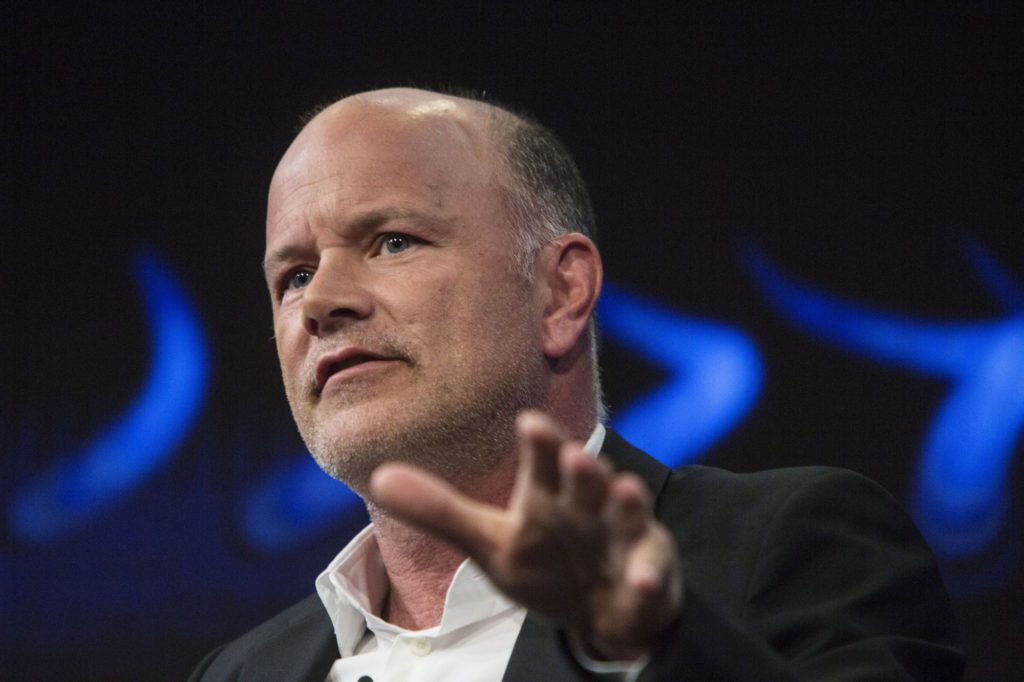
(Bloomberg) — Michael Novogratz, the billionaire who founded crypto financial services firm Galaxy Digital Holdings Ltd., said he expects Bitcoin to stay within its recent price range, and that there haven’t been significant inflows of institutional capital into the space. 

“Will Bitcoin get through $30,000 on this move up? We will see — I’m doubtful. I think we’re going to probably be in this range now. I quite frankly would be happy if we’re in a $20,000, $22,000 or $30,000 range for a while,” Novogratz said in an interview on Bloomberg TV. “We’re not seeing huge institutional flows, to be fair, but we’re not seeing anyone back away.” 

The chief executive officer of Galaxy said Ethereum could reach $2,200 or higher at the top of its range, given the momentum ahead of its software upgrade known as the Merge. Bitcoin gained as much as 4.2% and traded at around $23,960 as of 4:30 pm in New York, while Ethereum traded at around $1,790. The largest cryptocurrency rallied last week after a few difficult months of trading, sparking some analysts to set sights on a $25,000 target level.  

Read More: Bitcoin Leads Crypto Rally as Market Shrugs Off US Jobs Shock

With the Federal Reserve tightening rates, “I don’t see the mania that we saw in 2021 or 2017 reigniting,” he said. 

Galaxy, which offers businesses ranging from crypto trading and asset management to mining, posted a second-quarter loss of $554.7 million, compared with $182.9 million in the year-earlier period, against a backdrop of digital-asset price declines. The company said it has more than $1.5 billion in liquidity, including over $1 billion in cash. 

More stories like this are available on bloomberg.com

©2022 Bloomberg L.P.

Meme-Stock Frenzy Returns, Baffling Wall Street’s ‘Smart Guys’

(Bloomberg) — Retail traders who lurk in forums like Reddit’s WallStreetBets are back to betting against Wall Street pros and the Federal Reserve as rallies for meme stocks like Bed Bath & Beyond Inc. and AMC Entertainment Holdings Inc. show shades of last year’s mania.

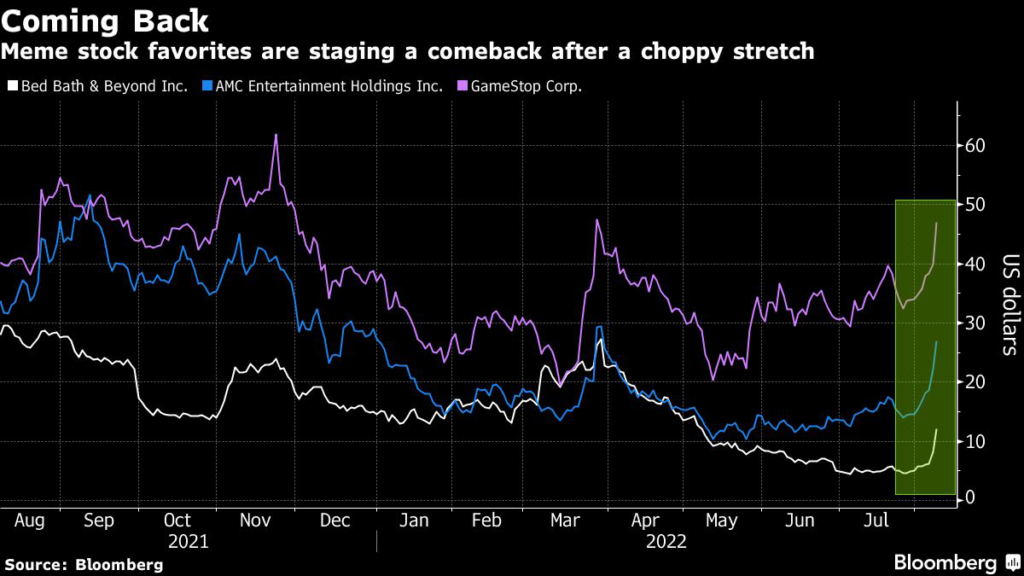
The home-good retailer nearly tripled at one point during its nine-day winning streak while the movie-theater firm capped a 65% rally of its own as speculative pockets of the stock market surge. The pair have powered a basket of 37 meme stocks tracked by Bloomberg higher by 10% over the past week while the most-hated stocks tracked by a Goldman Sachs Group Inc. basket is up roughly 17% over the same period.

The resurgence of more speculative areas of the market is likely fueled in part by individual traders willingness to jump on riskier trades and bet against hedge funds. A rally in tech shares and other growth stocks at one point on Monday pushed the Nasdaq 100 Index up 20% from a June low amid alarms from some on Wall Street that the Federal Reserve is set on fighting inflation regardless of the pain for the stock market.

The “smart guys” are “confused, baffled and fighting short positions from a position of weakness in terms of momentum and firepower,” said Mark Taylor, a sales trader at Mirabaud Securities. “The lack of real understanding of why a sudden resurrection of the meme-entum bid could lead to some nefarious speculation about things being manipulated but what would be as much sour grapes speculation as anything real.”

Bed Bath & Beyond’s taking of the meme stock baton resulted in a 40% rally Monday as a record 120.5 million shares changed hands with the stock being the second-most bought asset on Fidelity’s platform. AMC Entertainment was among the five most purchased stocks on the platform and saw trading volume triple what’s been normal over the past month. Both company tickers, along with GameStop Corp., were the most mentioned on Reddit’s WallStreetBets platform.

A basket of meme stocks tracked by Bloomberg rose 3.7%, extending a six-day rally of its own. Among the group’s top performers were GameStop and Express Inc. Newly-public Magic Empire Global Ltd., a little-known Hong Kong-based financial services firm, extended a 2,825% two-day surge since going public, attracting some retail attention.

Read more: Tiny IPO Spikes 2,325% During US Debut in Wake of AMTD Digital

“These meme stock rallies that are emerging will only last if US stocks broadly continue to head higher,” said Ed Moya, senior market strategist at Oanda. “After AMTD Digital reminded the WallStreetBets crowd of the potential skyrocketing moves, many retail traders are scanning their favorite plays and are looking to get back in.”

The rapid rise and subsequent fall for AMTD Digital Inc. both puzzled and captivated the markets. The stock posted an eye-popping surge of more than 32,000% at one point before erasing a chunk of gains. 

Heavily-shorted stocks like Wayfair Inc., Rent the Runway Inc., and those that went public via blank-check merger including 23andMe Holding Co. saw double-digit rallies at one point as investors braced for volatility.

Short Squeeze

Short covering from institutional investors may have boosted the recent surge, according to some on Wall Street. More than half of Bed Bath & Beyond shares available for trading are currently sold short, according to data from analytics firm S3 Partners, while AMC Entertainment, GameStop and Wayfair short interest each sit around 20%.

An index tracking hedge funds’ high-conviction bets rose 1.8% last week, trailing those favored by retail investors by 2.7 percentage points, the most since March, data compiled by Goldman Sachs show. While still early into August, the firm’s basket of retail favorites is on track for the best month since Jan. 2021 relative to firms favored by hedge funds. The retail basket carries names including Delta Airlines Inc., which just clocked the longest streak of weekly gains since 2020.

Read more: Hedge Funds Unwind Risk as S&P Rebound Continues: Taking Stock

“Retail traders have to move quickly, because one headline can change the entire trajectory of the stock market,” said Quincy Krosby, chief global strategist at LPL Financial. “Retail traders are daring the Fed and they’re daring some professional investors, and they’re doing well so far. It’s dicey because it can go in the other direction really fast.”

(Updates share movement throughout.)

More stories like this are available on bloomberg.com

©2022 Bloomberg L.P.

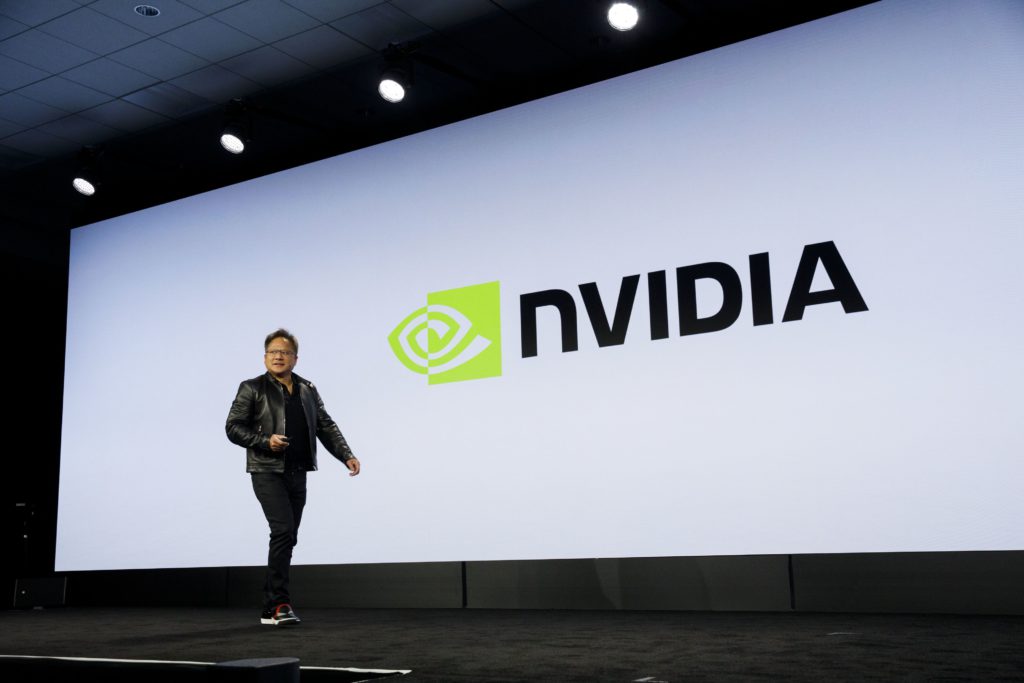
Nvidia Tumbles After PC Industry Slump Crushes Revenue

(Bloomberg) — Nvidia Corp.’s quarterly revenue missed its projections by more than $1 billion, surprising investors and piling on more evidence that demand for electronic components is drying up quickly after a two-year boom. 

Fiscal second-quarter revenue was about $6.7 billion, down from its earlier projection of $8.1 billion, the company said Monday in a statement. Shares of the most valuable publicly traded chipmaker fell 6.3% to $177.93, their worst decline in nearly two months, and the biggest drag on the Nasdaq 100 Index.

Nvidia’s report underscored a squeeze rippling across the industry: Declining consumer spending, growing inflation and a push to return to offices have reduced purchases of personal computers. Intel Corp., Western Digital Corp. and other companies that depend on PC sales have reported sharp declines in demand for their products.

Nvidia’s graphics chips are a staple of high-end PCs used to get the most realistic gaming experience. Most of the major gaming companies have reported falling sales or weaker outlooks this year, from PlayStation maker Sony Group Corp. to Microsoft Corp., which sells the Xbox console. The add-in card made by Nvidia also are a key part of systems used by currency miners, which make the company’s earnings vulnerable to fluctuations in those markets.

“Our gaming product sell-through projections declined significantly as the quarter progressed,” Nvidia Chief Executive Officer Jensen Huang said in the statement. “As we expect the macroeconomic conditions affecting sell-through to continue, we took actions with our gaming partners to adjust channel prices and inventory.”

Ambrish Srivastava, an analyst at BMO Capital Markets, called it “an ugly preliminary announcement” in a note to clients. “We had lowered our numbers last month as well, but clearly not enough,” he wrote. Nvidia will give its full report and projections for the current period on Aug. 24. 

Nvidia had already flagged strains on its performance in its second quarter, which ended July 31. The Santa Clara, California-based company said in May that Covid-19 lockdowns in China disrupted production and transportation lines, making it harder to capitalize on demand for chips. Russia’s invasion of Ukraine also weighed on its outlook, and together the problems were expected to cut sales by about $500 million in the fiscal second quarter, Nvidia said.

Gaming revenue in the second quarter fell 44% from the previous quarter and 33% from a year earlier to $2.04 billion, Nvidia said. 

Nvidia’s ascent to the top of the chip industry by market valuation has been partially driven by the explosive growth of its data center business. Owners of large cloud data centers are increasingly using its graphics chips for artificial intelligence computing. While revenue from that division increased 61% to $3.81 billion, it fell short of Nvidia’s projections, the company said. Performance was “impacted by supply chain disruptions.”

The quarterly results also will include about $1.32 billion of charges, “primarily for inventory and related reserves, based on revised expectations of future demand,” Nvidia said.

“The significant charges incurred in the quarter reflect previous long-term purchase commitments we made during a time of severe component shortages and our current expectation of ongoing macroeconomic uncertainty,” said Chief Financial Officer Colette Kress.

(Updates closing share price movement in the second paragraph.)

More stories like this are available on bloomberg.com

©2022 Bloomberg L.P.

Cathie Wood Says Regulatory ‘Uncertainty’ Spurred Paring of Ark’s Coinbase Stake

(Bloomberg) — Cathie Wood said Ark Investment Management’s sale of some of its Coinbase Global Inc. holdings last month came after what the firm viewed as regulatory “uncertainty” in the cryptocurrency world.

Three of the firm’s exchange-traded funds sold slightly over 1.41 million shares on July 26, which were worth about $75 million at the time, according to Ark’s daily trading data compiled by Bloomberg. The firm made the trade a few days after the Securities and Exchange Commission deemed some tokens listed on Coinbase’s platform as securities, Wood, the head of Ark said in Bloomberg TV interview Monday.

It was unclear how many tokens Coinbase would have to delist if it didn’t register them with regulators, or how the exchange’s business model would change if it did register them, Wood said. Shopify Inc. had also fallen, so Ark “swapped” some Coinbase shares with Shopify, she said.

Federal prosecutors at the time had also brought an insider trading case against a former Coinbase employee. Wood said that was not behind her fund’s decision to sell. Coinbase has rallied over 80% since Ark trimmed its holdings. The firm still owns about 7.1 million shares of the crypto exchange, making it one of the biggest holders of the stock.

Ark’s funds have been on volatile rides this year as Federal Reserve rate hikes battered growth stocks. The firm last month said it will shut down its Transparency ETF (CTRU), the first time it’s pulled the plug on a fund. The product tracked an index that shunned industries including alcohol, gambling, oil and gas, but it wasn’t explicitly labeled as an ESG fund.

Wood said her firm’s investments are “focused on doing the right thing” and are intrinsically good for the environment, but the boom in ESG-labeled investment products has gotten “way out of hand,” and “there was a lot of slapping lipstick on a pig.” 

The Ark CEO said the US economy is already in a recession and that the Fed will have to start loosening its policy some time next year. Her firm will stay fully invested throughout the downturn in “innovation,” as companies in that space will thrive in difficult times, she said.

Shares of the Ark Innovation fund rose 1.5% to $50.80, while Coinbase increased 5.3% to $98.02 as of 4 p.m. in New York. 

(Updates with details on Coinbase holdings in the fourth paragraph.)

More stories like this are available on bloomberg.com

©2022 Bloomberg L.P.

Tech Drives Stock Losses After Rally Fizzles Out: Markets Wrap

(Bloomberg) — Stocks failed to hold onto gains, with a gloomy forecast from giant chipmaker Nvidia Corp. weighing on technology shares and traders awaiting this week’s inflation data for clues on the pace of Federal Reserve rate hikes.

The S&P 500 wiped out an advance that reached 1% earlier in the day, while the Nasdaq 100 underperformed after a rally that briefly drove the tech-heavy gauge 20% above its June low. A plunge in Nvidia dragged the Philadelphia Semiconductor Index down 2.5%. Treasuries climbed.

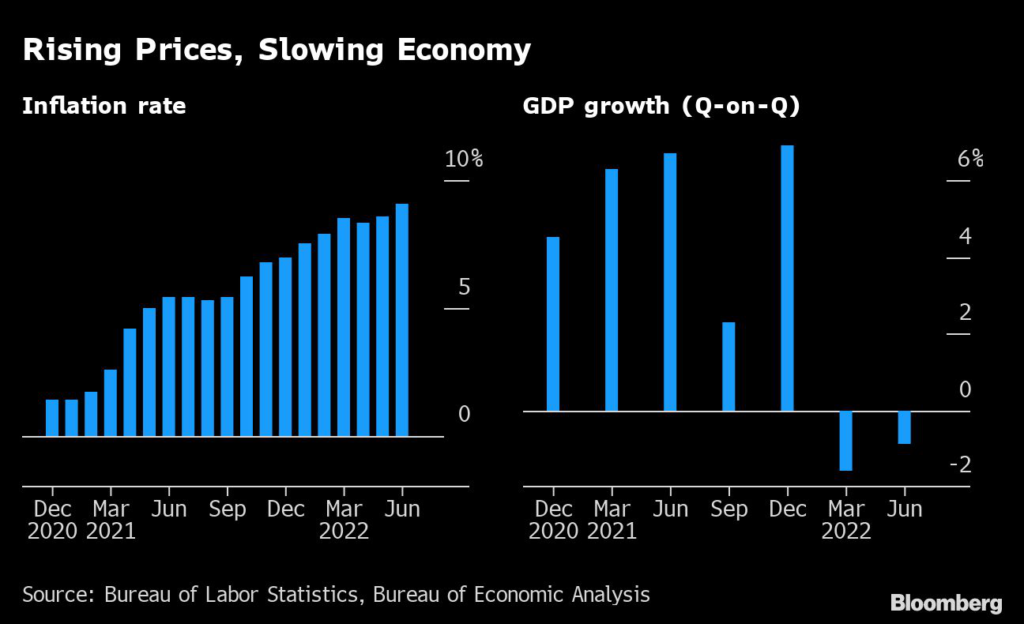
Mounting risks to growth have sparked earnings downgrades, and after recent figures showed gross domestic product shrank for a second straight quarter, some strategists have warned that cuts are only set to ramp up. Friday’s blowout jobs report spurred JPMorgan Chase & Co. and Evercore ISI to say bigger US rate hikes are now in store this year, with Citigroup Inc. seeing a risk of a 1 percentage-point hike in September.

“The economy still has to digest all this tightening and that will materially slow things,” wrote Tom Essaye, a former Merrill Lynch trader who founded The Sevens Report newsletter. “That hasn’t even really started to occur yet, so celebrating the resilience of earnings and economic data when we’re still in an expanding economy (regardless of the GDP prints) seems to be the equivalent of a coach declaring victory because the game plan should work.”

Morgan Stanley’s Mike Wilson, who correctly predicted this year’s equity selloff, called the recent rebound a “bear market rally” amid growing fears of a recession. While he believes inflation has peaked and “will probably fall faster than the market currently expects,” that still doesn’t bode well for stock markets as it’ll reduce operating leverage and weigh on company earnings, he said.

In fact, as major equity indexes climbed last week, global hedge funds unwound risky bets. That highlights a sentiment gap between professional speculators displaying a risk-off mood amid uncertainty about the aggressive pace of rate hikes and price action in the stock market, which seemed to reflect a takeaway from Fed Chair Jerome Powell’s press conference that monetary officials will taper the size of rate hikes if growth crumbles.

“Countertrend rallies are characteristic of secular bear-market downtrends, and from that perspective, 2022 has been remarkably similar to previous bear markets in history,” said Seema Shah, chief global strategist at Principal Global Investors. “Until inflation abates and the Federal Reserve rebalances its priorities away from inflation and toward growth, tempting rallies are likely to remain unsustainable.”

Consumer expectations for US inflation over the coming years declined sharply in the latest survey by the Fed Bank of New York, with a recent drop in gasoline prices playing a big part in those results and likely contributing to a lower headline rate of inflation for July when the Labor Department releases the data on Wednesday. Still, almost all inflation measures are running well above the Fed’s 2% target. 

What to watch this week:

  • US CPI data, Wednesday
  • Chicago Fed President Charles Evans and his Minneapolis counterpart Neel Kashkari due to speak, Wednesday
  • US PPI, initial jobless claims, Thursday
  • San Francisco Fed President Mary Daly is interviewed on Bloomberg Television, Thursday
  • Euro-area industrial production, Friday
  • US University of Michigan consumer sentiment, Friday

Some of the main moves in markets:

Stocks

  • The S&P 500 fell 0.2% as of 2:58 p.m. New York time
  • The Nasdaq 100 fell 0.6%
  • The Dow Jones Industrial Average was little changed
  • The MSCI World index was little changed

Currencies

  • The Bloomberg Dollar Spot Index fell 0.2%
  • The euro was little changed at $1.0190
  • The British pound was little changed at $1.2075
  • The Japanese yen rose 0.1% to 134.87 per dollar

Bonds

  • The yield on 10-year Treasuries declined six basis points to 2.76%
  • Germany’s 10-year yield declined six basis points to 0.90%
  • Britain’s 10-year yield declined 10 basis points to 1.95%

Commodities

  • West Texas Intermediate crude rose 1.6% to $90.43 a barrel
  • Gold futures rose 0.7% to $1,804.30 an ounce

More stories like this are available on bloomberg.com

©2022 Bloomberg L.P.

Biden Gets Big Economic Win as Inflation Threatens Legacy

(Bloomberg) — President Joe Biden raised the final pillar of his economic agenda with the Senate’s passage of a breakthrough climate and tax package, sealing a legacy that risks being undermined by an inflation surge he’s blamed for sparking.

The success of the Inflation Reduction Act will give Democrats a rallying cry for midterm elections and joins three other key bills as a foundation of what might be called Bidenomics: a combined $3 trillion push to reshape the US economy toward working families and domestic manufacturing, boost competition against China and avert the kind of stunted recovery Biden saw as vice president.

While the results in the later bills are more modest than the big structural changes and spending plans Biden had sought — the most recent is a fraction of his Build Back Better proposal — they’re still greater than what seemed possible over much of the past year as potential deals were repeatedly scuttled, at times by senators from his own party.

The risk now is that inflation, partly blamed on Biden’s first big steps in the outsized $1.9 trillion Covid-aid package, will end up confining him to a one-term presidency.

“This could be read as the best supply-side economics program since Eisenhower built the interstate highway system,” said Alan Blinder, a former Fed vice chairman and adviser in Bill Clinton’s White House, referring to the post-World War II road-building boom credited with feeding decades of growth. But as for a political payoff: “It’s a stretch unless and until inflation starts coming down,” he said.

The Inflation Reduction Act, expected to win final passage with a House vote Friday, comes on the heels of a bill offering subsidies to the semiconductor industry, which Congress approved with bipartisan votes last month. A bipartisan long-term infrastructure package was enacted in November. The American Rescue Plan passed in March 2021. 

Treasury Secretary Janet Yellen termed the administration’s vision as “modern supply side economics,” evoking the supply side theory most often associated with President Ronald Reagan.

But Biden described it as aimed at building the economy from “the bottom up and the middle out,” speaking to the sweeping reinvigoration of social investments in families aimed at reducing inequality. 

Unlike the Republican supply-side agenda of cutting taxes to boost productivity, Bidenomics offers government investments and incentives for domestic output, along with social support to bring more people into the labor market — while reducing environmental damage.

“They’re all working to build connectivity tissue between overall economic growth and prosperity for working families,” Jared Bernstein, a White House economist and longtime Biden aide, said of the economic legislation. “If you’re helping to bake the pie, you ought to get a fair slice.”

Job one after taking office was fighting the pandemic and its economic fallout with a more powerful response than Biden and then-President Barack Obama oversaw more than a decade before. The $787 billion package approved in 2009 is now regarded by many as having done too little to pull the US out of the Great Recession.

The kind of scarring endured in the 2010s has indeed been avoided. Unemployment has plunged from nearly 15% in April 2020 to 3.5% now, matching a half-century low. Wages also surged back; the lowest-earning quarter of the wage scale has even roughly kept pace with inflation. 

But the biggest surge in the cost of living in four decades has meant most households have endured a decline in purchasing power — leaving them without what Biden says he was trying to give: “breathing room.”

Economists estimate the cash handouts in the March 2021 pandemic-relief bill caused between one-half and three percentage points of the current inflation readings of 9.1% — among the highest in the Group of Seven and the worst since the stagflation misery a generation ago. The White House argues the impact was less than that.

The irony is that those cash handouts were a necessary political ingredient for achieving the rest of the economic legislation. Back in January 2021, control of the Senate hinged on a pair Senate runoff elections in Georgia, where stimulus checks were a core issue.

Democrats won on an explicit pledge to send more money to households enduring a grueling pandemic. That gave them the congressional control that likely enabled passage of the other three bills.

While economists attribute most of the inflation jump to pandemic-related global supply-chain issues and the impact on fuel and food prices from Russia’s invasion of Ukraine, Americans have effectively blamed Biden.

The latest bill is “really positive” but inflation is still running too hot, former Treasury Secretary Larry Summers said Friday, as it neared passage. “If we don’t act on it and act strongly on it, and that means raising real interest rates significantly, then we’re just setting the stage for stagflation,” Summers told Bloomberg Television’s “Wall Street Week.”

The president’s approval rating fell to 38% in Gallup’s July tracking, its lowest yet, and it may worsen if the Federal Reserve’s aggressive rate hikes tip a slowing economy into a job-killing recession.

Read More: Most Americans Since 2008 Say Economy Is Getting Worse

“US households and businesses are feeling the pain from the rising cost of living, falling equity markets and an uncertain outlook for the housing market,” said James Knightley, chief international economist at ING Financial Markets. “I doubt, for most people, the accomplishments will be felt in time to be rewarded in the voting booths.”

The other three packages — Infrastructure Investment and Jobs; CHIPS and Science; and the Inflation Reduction Act — aim to refine key pieces of industrial policy that are as much about economic security as growth. 

Whether it’s accelerating the transition to clean energy or shoring up critical supply chains, the agenda amounts to a necessary shift, said Julia Coronado, co-founder of MacroPolicy Perspectives and a former Fed economist. 

“The market isn’t going to magically fix these problems,” she said. “Policy needs to set a road map and then let the private sector do its work in figuring out the most profitable way to get there.”

Brian Deese, Biden’s top economic adviser, said, “The economic logic behind the infrastructure bill, the chips bill and the reconciliation bill we are working to get done really is around investing in long-term drivers of productive growth, in long-term drivers of American manufacturing and industrial strength.”

Conservative economists remain skeptical. Douglas Holtz-Eakin, a former director of the Congressional Budget Office and founder of the American Action Forum, dismissed the chips act — which won support from a number of Republicans in both chambers — as largely unnecessary government intervention, and feared the pharmaceutical provisions in IRA will blunt private investment in research.

Yet Holtz-Eakin gave high marks to the infrastructure bill. “It’s probably as good as you’re going to get if you do bipartisan work,” he said. “It represents a very solid contribution to supply and GDP.”

Whether it offers a solid contribution to Democratic fortunes in the November election remains to be seen.

The White House touts falling gas prices and help with health-care costs in the forthcoming package, along with a surprisingly strong job market, as reason for optimism.

As for the outcome, Biden batted away concerns that he has come up short with the latest bill. “It required many compromises,” he said in a statement Sunday. “Doing important things almost always does.”

(Updates with Summers comment in 18th paragraph. An earlier version of this story corrected a G-7 inflation comparison.)

More stories like this are available on bloomberg.com

©2022 Bloomberg L.P.

Twilio Employee and Customer Accounts Hacked in Text Scheme

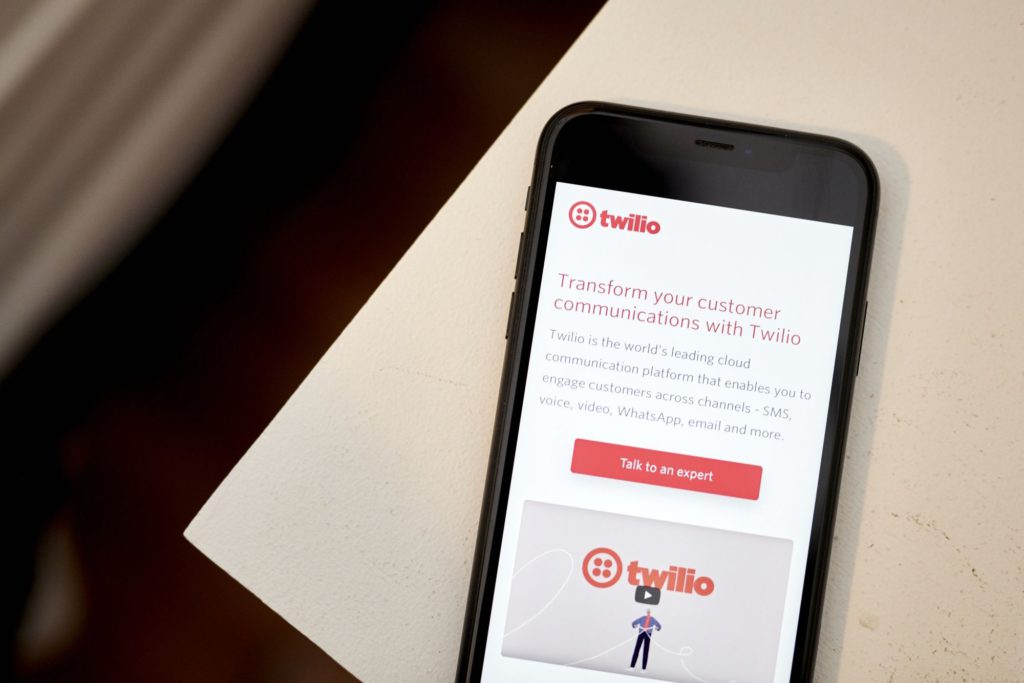
(Bloomberg) — Twilio Inc., which offers digital authentication solutions, said some of its employees and customers were hacked as part of a scheme in which outsiders duped employees into handing over their passwords. 

San Francisco-based Twilio represents a ripe target for hackers, because access to its service could potentially enable hackers to access Twilio clients, or the particular accounts. The company said it became aware of the incident on Aug. 4. 

“This broad-based attack against our employee base succeeded in fooling some employees into providing their credentials,” Twilio said in a blog post on Sunday. “The attackers then used the stolen credentials to gain access to some of our internal systems, where they were able to access certain customer data.”

Twilio said it hasn’t identified the specific hackers responsible for the breach, and that it has hired a computer forensics firm to assist in remediation of the breach. Twilio said that other companies were also subject to attacks, though it didn’t identify any by name. 

Attackers targeted the company’s employees with phony text messages stating that the staffers’ password credentials had expired. The texts included links to websites controlled by hackers that appeared to be legitimate. When employees entered their username and password into the website, hackers harvested that information. 

In the past three days, hackers have been targeting companies that provide two-factor authentication services in an attempt to steal cryptocurrency, compromise telecommunications companies and breach customer relationship management portals, according to three computer security professionals tracking the scheme. The alleged hackers have a particular interest in SIM swapping, the people said, referring to a criminal tactic where hackers compromise telecommunications providers to gain control of a target’s phone number. 

It’s not yet known if the same group of hackers are responsible for the breach of Twilio. 

Twilio’s shares had increased by 2% at midday Monday. 

“The social engineering method to gain access to credentials via text message to log in as the user and then steal data is becoming more common,” said Rachel Tobac, chief executive officer of SocialProof Security. “Cybercriminals starting the attack via text message can catch the victim off guard because many are used to hearing phishing as something that happens via email rather than text, and also gets the victim on a personal device with less protections.”

Security researchers noticed new websites being registered that bore similar names to the companies being targeted, including major telecommunication companies, cryptocurrency exchanges, and computer security companies. The websites were used to host fake pages designed to look like legitimate employee login portals. The researchers were able to link the fake domains because they were registered around similar times and had similar technical attributes. 

In March, the two-factor authentication provider Okta Inc. was compromised by a group of hackers dubbed Lapsus$. The hacking group embarked on a spree of hacks, breaching major firms like Microsoft Corp. and Nvidia Corp. Bloomberg News later reported that the alleged mastermind behind the group was a teenager in England, who was later charged with computer crimes. 

(Updates with Twilio value in eighth paragraph and a quote in ninth paragraph. A previous version of this story corrected a misspelling.)

More stories like this are available on bloomberg.com

©2022 Bloomberg L.P.
Meta’s AI Chatbot Repeats Election and Anti-Semitic Conspiracies

(Bloomberg) — Only days after being launched to the public, Meta Platforms Inc.’s new AI chatbot has been claiming that Donald Trump won the 2020 US presidential election, and repeating anti-Semitic conspiracy theories.

Chatbots — artificial intelligence software that learns from interactions with the public — have a history of taking reactionary turns. In 2016, Microsoft Corp.’s Tay was taken offline within 48 hours after it started praising Adolf Hitler, amid other racist and misogynist comments it apparently picked up while interacting with Twitter users.

Facebook parent company Meta released BlenderBot 3 on Friday to users in the US, who can provide feedback if they receive off-topic or unrealistic answers. A further feature of BlenderBot 3 is its ability to search the internet to talk about different topics. The company encourages adults to interact with the chatbot with “natural conversations about topics of interest” to allow it to learn to conduct naturalistic discussions on a wide range of subjects. 

Conversations shared on various social media accounts ranged from the humorous to the offensive. BlenderBot 3 told one user its favorite musical was Andrew Lloyd Webber’s “Cats,” and described Meta CEO Mark Zuckerberg as “too creepy and manipulative” to a reporter from Insider. Other conversations showed the chatbot repeating conspiracy theories.

In a chat with a Wall Street Journal reporter, the bot claimed that Trump was still president and “always will be.”

The chatbot also said it was “not implausible” that Jewish people controlled the economy, saying they’re “overrepresented among America’s super rich.” 

The Anti-Defamation League says that assertions that Jewish people control the global financial system are part of an anti-Semitic conspiracy theory.

Meta acknowledges that its chatbot may say offensive things, as it’s still an experiment under development. The bot’s stated beliefs are also inconsistent; in other conversations with Bloomberg, it approved of President Joe Biden, and said Beto O’Rourke was running for president. In a third conversation, it said it supported Bernie Sanders.

In order to start a conversation, BlenderBot 3 users must check a box stating, “I understand this bot is for research and entertainment only, and that is likely to make untrue or offensive statements. If this happens, I pledge to report these issues to help improve future research. Furthermore, I agree not to intentionally trigger the bot to make offensive statements.”

Users can report BlenderBot 3’s inappropriate and offensive responses, and Meta says it takes such content seriously. Through methods including flagging “difficult prompts,” the company says it has reduced offensive responses by 90%.

More stories like this are available on bloomberg.com

©2022 Bloomberg L.P.
Nvidia Plummets After PC Industry Slump Crushes Revenue

(Bloomberg) — Nvidia Corp.’s quarterly revenue missed its projections by more than $1 billion, surprising investors and piling on more evidence that demand for electronic components is drying up quickly after a two-year boom. 

Fiscal second-quarter revenue was about $6.7 billion, down from its earlier projection of $8.1 billion, the company said Monday in a statement. Shares of the most valuable publicly traded chipmaker fell as much as 9.2%, the greatest intraday decline in three months, and the biggest drop on the Nasdaq 100 Index.

Nvidia’s report underscored a squeeze rippling across the industry: Declining consumer spending, growing inflation and a push to return to offices have reduced purchases of personal computers. Intel Corp., Western Digital Corp. and other companies that depend on PC sales have reported sharp declines in demand for their products.

Nvidia’s graphics chips are a staple of high-end PCs used to get the most realistic gaming experience. Most of the major gaming companies have reported falling sales or weaker outlooks this year, from PlayStation maker Sony Group Corp. to Microsoft Corp., which sells the Xbox console. The add-in card made by Nvidia also are a key part of systems used by currency miners, which make the company’s earnings vulnerable to fluctuations in those markets.

“Our gaming product sell-through projections declined significantly as the quarter progressed,” Nvidia Chief Executive Officer Jensen Huang said in the statement. “As we expect the macroeconomic conditions affecting sell-through to continue, we took actions with our gaming partners to adjust channel prices and inventory.”

Ambrish Srivastava, an analyst at BMO Capital Markets, called it “an ugly preliminary announcement” in a note to clients. “We had lowered our numbers last month as well, but clearly not enough,” he wrote. Nvidia will give its full report and projections for the current period on Aug. 24. 

Nvidia had already flagged strains on its performance in its second quarter, which ended July 31. The Santa Clara, California-based company said in May that Covid-19 lockdowns in China disrupted production and transportation lines, making it harder to capitalize on demand for chips. Russia’s invasion of Ukraine also weighed on its outlook, and together the problems were expected to cut sales by about $500 million in the fiscal second quarter, Nvidia said.

Gaming revenue in the second quarter fell 44% from the previous quarter and 33% from a year earlier to $2.04 billion, Nvidia said. 

Nvidia’s ascent to the top of the chip industry by market valuation has been partially driven by the explosive growth of its data center business. Owners of large cloud data centers are increasingly using its graphics chips for artificial intelligence computing. While revenue from that division increased 61% to $3.81 billion, it fell short of Nvidia’s projections, the company said. Performance was “impacted by supply chain disruptions.”

The quarterly results also will include about $1.32 billion of charges, “primarily for inventory and related reserves, based on revised expectations of future demand,” Nvidia said.

“The significant charges incurred in the quarter reflect previous long-term purchase commitments we made during a time of severe component shortages and our current expectation of ongoing macroeconomic uncertainty,” said Chief Financial Officer Colette Kress.

(Updates with share price movement in the second paragraph.)

More stories like this are available on bloomberg.com

©2022 Bloomberg L.P.
Bed Bath & Beyond Jump Brings Some Meme Frenzy to Broad Rally

(Bloomberg) — Retail traders who lurk in forums like Reddit’s WallStreetBets are back to betting against Wall Street pros and the Federal Reserve as rallies for meme stocks like Bed Bath & Beyond Inc. and AMC Entertainment Holdings Inc. show shades of last year’s mania.

The home-good retailer nearly tripled at one point during its nine-day winning streak while the movie-theater firm is riding a more than 70% rally of its own as speculative pockets of the stock market surge. The pair have powered a basket of 37 meme stocks tracked by Bloomberg higher by 11% over the past week while the most-hated stocks tracked by a Goldman Sachs Group Inc. basket is up nearly 20% over the same period.

The resurgence of more speculative areas of the market is likely fueled in part by individual traders willingness to jump on riskier trades and bet against hedge funds. A rally in tech shares and other growth stocks at one point pushed the Nasdaq 100 Index up 20% from a June low amid alarms from some on Wall Street that the Federal Reserve is dead-set on fighting inflation regardless of the pain for the stock market.

The “smart guys” are “confused, baffled and fighting short positions from a position of weakness in terms of momentum and firepower,” said Mark Taylor, a sales trader at Mirabaud Securities. “The lack of real understanding of why a sudden resurrection of the meme-entum bid could lead to some nefarious speculation about things being manipulated but what would be as much sour grapes speculation as anything real.”

Bed Bath & Beyond’s taking of the meme stock baton, rising 63% at one point on Monday as the stock became the most bought asset on Fidelity’s platform. AMC Entertainment saw the second most purchases while both company tickers were the most mentioned on Reddit’s WallStreetBets platform.

A basket of meme stocks tracked by Bloomberg rose 4.8%, extending a six-day rally of its own. The top performers behind Bed Bath & Beyond and AMC Entertainment were GameStop Corp. and Express Inc. Newly-public Magic Empire Global Ltd., a little-known Hong Kong-based financial services firm, extended a 3,000% two-day surge since going public, attracting some retail attention.

Read more: Tiny IPO Spikes 2,325% During US Debut in Wake of AMTD Digital

“These meme stock rallies that are emerging will only last if US stocks broadly continue to head higher,” said Ed Moya, senior market strategist at Oanda. “After AMTD Digital reminded the WallStreetBets crowd of the potential skyrocketing moves, many retail traders are scanning their favorite plays and are looking to get back in.”

The rapid rise and subsequent fall for AMTD Digital Inc. both puzzled and captivated the markets. The stock posted an eye-popping surge of more than 32,000% at one point before erasing a chunk of gains. 

Heavily-shorted stocks like Wayfair Inc., Beyond Meat Inc., and those that went public via blank-check merger including 23andMe Holding Co. saw double-digit rallies at one point as investors braced for volatility.

Short Squeeze

Short covering from institutional investors may have boosted the recent surge, according to some on Wall Street. More than half of Bed Bath & Beyond shares available for trading are currently sold short, according to data from analytics firm S3 Partners, while AMC Entertainment, GameStop and Wayfair short interest each sit around 20%.

An index tracking hedge funds’ high-conviction bets rose 1.8% last week, trailing those favored by retail investors by 2.7 percentage points, the most since March, data compiled by Goldman Sachs show. While still early into August, the firm’s basket of retail favorites is on track for the best month since Jan. 2021 relative to firms favored by hedge funds. The retail basket carries names including Delta Airlines Inc., which just clocked the longest streak of weekly gains since 2020.

Read more: Hedge Funds Unwind Risk as S&P Rebound Continues: Taking Stock

“Retail traders have to move quickly, because one headline can change the entire trajectory of the stock market,” said Quincy Krosby, chief global strategist at LPL Financial. “Retail traders are daring the Fed and they’re daring some professional investors, and they’re doing well so far. It’s dicey because it can go in the other direction really fast.”

(Updates share movement throughout.)

More stories like this are available on bloomberg.com

©2022 Bloomberg L.P.

Close Bitnami banner
Bitnami