Bloomberg

Jake Paul’s New Sports-Betting Business Raises $50 Million

(Bloomberg) — Jake Paul, the social-media star turned professional boxer, is raising funds for a new sports-gambling and media venture focused on micro-betting as the industry opens up in more states across the US.

The $50 million funding round for his company, Betr, was led by Florida Funders, Aliya Capital Partners and Fuel Venture Capital, with the final closing scheduled for this quarter. Additional investors include Simplebet, Magic City Casino and Stronach Group, along with celebrities like rapper Travis Scott and former NFL players Richard Sherman and Dez Bryant.

Paul said sports-betting companies have relied upon young celebrities to push their products for years in an effort to attract more Gen Z gamblers, so the 25-year-old decided to try his own luck.

“They were paying me millions to promote their sportsbooks for my fights,” Paul, who has 70 million followers across social media, said in an interview. “They need the influencers. Now it’s our turn to take over from the dinosaurs.”

Betr has two divisions: media and betting. Paul, who has taken the role of president, runs the media arm, which seeks to serve a young sports audience through new social shows and promotions. He’ll host his own weekly show, create an influencer roster and lead marketing. Betr Chief Executive Officer Joey Levy, who previously cofounded Simplebet, will operate the gambling side of the business.

Micro-betting is a growing slice of the gambling market, allowing users to place bets on individual moments throughout games in real-time. 

Betr will spend the new capital on staff and development. Levy has been working on getting access to various betting markets and plans to announce initial partners in the coming weeks.

“We view this as a $50 million war chest,” said Levy, “to get the company to profitability without having to raise more.”

Paul has been a prominent figure in the boxing business in recent years, promoting big-money fights and signing top boxers including Amanda Serrano along with prospects like high-school star Ashton Sylve. Paul has also been investing through his venture firm, Anti Fund, putting money into companies such as cryptocurrency-payments firm Moonpay, blockchain startup Alchemy and mental-health platform Osmind.

More stories like this are available on bloomberg.com

©2022 Bloomberg L.P.

Nasdaq 100’s Big Surge Belies a Darker Outlook for Tech Profits

(Bloomberg) — Technology stocks have been on a tear over the past month, but behind the scenes the big picture for the sector’s profits has only gotten darker. 

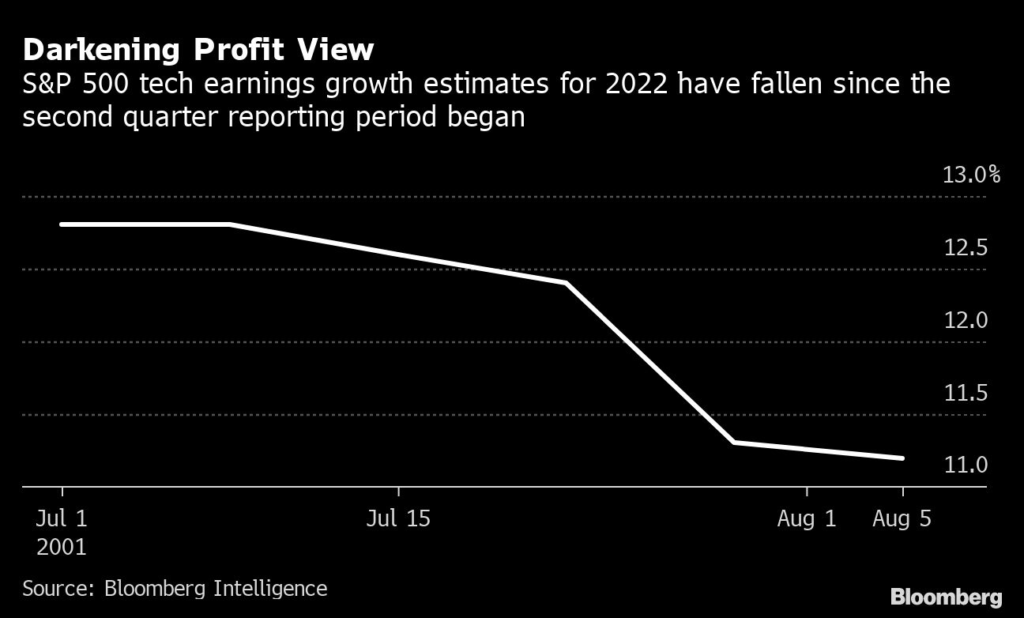
Analyst estimates for 2022 profit growth at S&P 500 tech companies have fallen about two percentage points since second-quarter earnings reports kicked off in July, according to data compiled by Bloomberg Intelligence. The decline has been even greater for 2023 projections, as Wall Street braces for a potential recession and slower revenue growth. 

At a time when the Federal Reserve is still aggressively hiking interest rates and inflation remains high, the deteriorating profit outlook is making many investors skeptical that the furious rally in the Nasdaq 100 Index is sustainable. 

“It’s highly illogical what’s going on right now,” said Mike Mullaney, director of global market research at Boston Partners. “If you look at the underlying facts, it doesn’t make a lot of sense.”

The Nasdaq 100 has gained 19% since closing at a nearly two-year low on June 16 as of the end of last week. The rally has been fueled by better-than-feared results from megacaps like Microsoft Corp., a decline in US Treasury yields and speculation that the economy may be able to skirt a recession. Technology stocks had simply fallen further than could be justified by fundamentals, bulls contend. 

Apple Inc. has gained 27% from the June low and sits less than 10% below the stock’s January record. Amazon.com Inc. has rallied back 36% and is threatening to overtake Alphabet Inc. in market value. 

With estimates falling and stocks rising, the S&P 500 technology sector’s price-to-projected earnings ratio now sits more than 20% above the average for the index, according to Bloomberg Intelligence strategists Gina Martin Adams and Michael Casper. 

“Even an average premium is tough to justify with rising rates, negative estimate revisions and earnings expected to trail the market” until at least the second half of 2023, they wrote in a research note last week. 

For Mark Haefele, chief investment officer at UBS Global Wealth Management, while the rally is encouraging, it’s too soon to aggressively move back into growth stocks. 

“With near-term uncertainty around inflation, Fed policy, and global growth, we continue to favor investing in value with a quality tilt,” he said.

Tech Chart of the Day 

The Philadelphia Stock Exchange Semiconductor Index has gained for five weeks, its longest streak of the year. A steady recovery in tech stocks and a series of positive earnings reports by chip firms has helped the index rebound from its July low. The index fell 1% on Monday, after Nvidia Corp. issued a revenue forecast for its fiscal second quarter that fell far below an earlier estimate due to a weaker outlook in the gaming industry. 

Top Tech Stories

  • India is seeking to restrict Chinese smartphone makers from selling devices cheaper than 12,000 rupees ($150) to kickstart its faltering domestic industry, dealing a blow to brands including Xiaomi Corp.
  • SoftBank Group Corp. reported a record 3.16 trillion yen ($23.4 billion) net loss as a selloff in global tech stocks continued to hammer its Vision Fund’s portfolio of investments.
  • Amazon.com Inc. is barreling ahead with an aggressive acquisition strategy despite intense antitrust scrutiny in Washington, with its $1.65 billion deal to buy Roomba vacuum maker iRobot Corp. as the latest example.
  • Baidu Inc. has won approval to deploy the first fully autonomous self-driving taxis on China’s roads, giving it an edge over rivals like Pony.ai Inc. and XPeng Inc.
  • Tom Alberg, co-founder of the venture capital firm Madrona Venture Group and an early investor in Amazon, has died. He was 82.
  • Alphabet Inc.’s Google was sued by an early adopter of its Workplace cloud productivity software who claims the company reneged on a promise to provide it with free access to the program for life.
  • Veon Ltd., the third-largest mobile-phone operator in Russia, may need to freeze its network rollout in the country if sanctions over the war in Ukraine continue to block imports of essential equipment, according to Chief Executive Officer Kaan Terzioglu.
  • Twitter Inc. co-founder Jack Dorsey tweeted the words “end the CCP” over the weekend in response to a report about China’s strict Covid-19 measures.

(Adds stock move in last paragraph.)

More stories like this are available on bloomberg.com

©2022 Bloomberg L.P.

Greek Premier Says He Was Unaware of Phone Tapping Operations

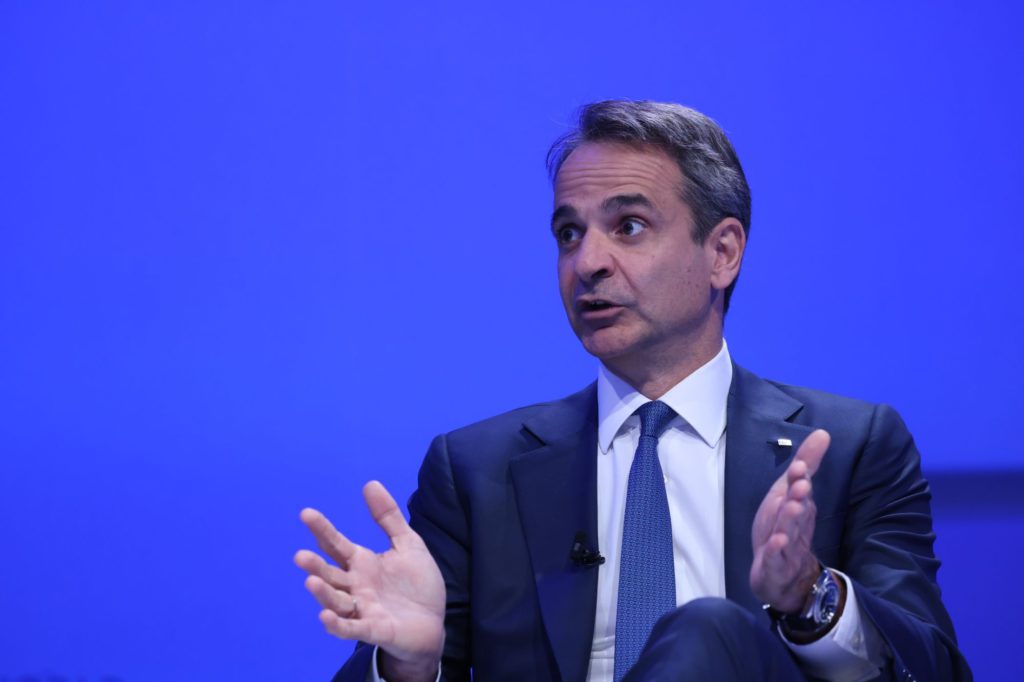
(Bloomberg) — Prime Minister Kyriakos Mitsotakis said he was unaware that Greece’s national intelligence service monitored the mobile phone of an opposition politician, and the premier pledged to reform how the unit is supervised. 

“What was done, may have been in accordance with the letter of the law, but it was wrong — I was not aware of it and obviously I would have never allowed it,” Mitsotakis said in a statement on Monday. Mitsotakis said he only learned of the phone tap a few days ago. 

The head of Greek intelligence, Panagiotis Kontoleon, resigned last week following a “mishandling of legal surveillance operations,” the prime minister’s office said at the time. Kontoleon told a parliamentary committee that his agency had monitored a journalist, Reuters reported last week week, citing two sources who said they were present at the meeting.

Adding to the turmoil in Athens, Grigoris Dimitriadis, the general secretary of Mitsotakis’s office and the premier’s nephew, quit the same day. Neither Dimitriadis nor the government provided a reason for the decision.

Mitsotakis said he asked for the resignation of Kontoleon while Dimtiradis assumed the political responsibility while the case highlighted the lack of additional “filters” in the operation of the intelligence services. The government agreed to establish a commission to investigate the matter, he said.  

Predator Software

A type of spyware called Predator was deployed against Nikos Androulakis, the leader of Greece’s opposition socialist Pasok party, and journalist Thanasis Koukakis, according to a forensic analysis by digital rights group Citizen Lab and the European Parliament. A Greek government spokesman denied the use of the Predator software. 

The surveillance of Androulakis — a member of the European Parliament — was legal and carried out before he was elected leader of the Pasok party in December, government spokesman Ioannis Oikonomou told Skai TV on Monday. He added that it was “politically unacceptable” for the mobile phone of an elected representative to be monitored.

The case has nothing to with the discussion about Predator and malicious software, Oikonomou said. “The Greek security forces, the Greek government has neither procured, nor does any government authority use in any way, directly or indirectly, this notorious malware,” he said. 

Oikonomou added that Greece would not go to early elections over the issue. Mitsotakis said in his address that the government would reevaluate the supervision of the intelligence services and strengthen its accountability by parliament.  

A report from Google’s Threat Analysis Group published in May suggested that the Predator software is routinely used by “government-backed actors” in nations including Greece, Egypt, Indonesia and Spain.

Androulakis filed a complaint July 26 with a prosecutor saying that someone had tried to tap his mobile phone and intercept personal data. Koukakis has alleged that his smartphone was infected with surveillance software, prompting a separate investigation by a prosecutor.

More stories like this are available on bloomberg.com

©2022 Bloomberg L.P.

Bitcoin Believers Are Back to Watching Stocks After Crypto Crash

(Bloomberg) — After a gut-wrenching bout of turbulence and existential angst, digital-asset investors are back to focusing on the mood of the US stock market as a gauge of whether the worst might be over. 

Stocks are mostly up over the last few weeks and so is Bitcoin, which has added roughly 25% since the start of July. The 90-day correlation coefficient of Bitcoin and the S&P 500, after weakening slightly in June, now stands around 0.65 once again, among the highest such readings in Bloomberg data going back to 2010. A coefficient of 1 means the assets are moving in lockstep, while minus-1 would show they’re moving in opposite directions.

Cryptocurrencies are poised for outperformance “if equities have bottomed,” said Mike McGlone, an analyst at Bloomberg Intelligence. “There are few more powerful forces in markets than when the stock market drops at high velocity as in the first half. Cryptos are part of that ebbing tide.”

Bitcoin on Monday rose as much as 4.2% to $24,241, the highest since the end of July. Other cryptocurrencies also rose, with Ether adding 5.6% at one point to reach $1,818.

That’s been the refrain all year, with both stocks and crypto moving in similar fashion. The background is a hawkish Federal Reserve that’s bent on tamping down four-decade-high inflation, something that’s been the source of volatility for all manner of assets in 2022. 

But whether equities and crypto have reached their lows is a question no one can call with any real certainty — bottoms are only perceptible after the fact, and it’s possible both revisit their lows later this year or even early next year. 

Bitcoin active addresses are firmly within “a well-defined downtrend channel,” according to analysts at Glassnode, a crypto researcher. They added that network activity “suggests that there remains little influx of new demand as yet.” But at the same time, transactional demand has traded sideways or lower in recent weeks, suggesting that “only the stable base of higher conviction traders and investors remain.” And on-chain transaction fees are in bear-market territory — seeing an uptick there could be a signal of recovery, once it happens. 

“The 2022 bear market has been historically negative for the digital asset space,” the analysts wrote in a note. “However, after such a sustained period of risk-off sentiment, attention turns to whether it is a bear market relief rally, or the start of a sustained bullish impulse.”

July was a great period for Bitcoin, Ether and others. Bitcoin rose 27% for the month, the most since October, while the No. 2 token added 70% in its best monthly performance since January 2021. Also during the month, total volumes of the Tether stablecoin for Bitcoin and Ether rose, according to CryptoCompare, suggesting investors were looking at them as safer places within the crypto universe. 

To be sure, though crypto has rallied in recent weeks, it’s still well off its highs reached toward the end of last year. Bitcoin has been hovering around $24,000, down from nearly $69,000 in November. And not even eye-catching developments, including Coinbase’s new partnership with BlackRock, have been able to shake the coin from its stupor and catapult it higher. 

“Crypto has more volatility so therein is riskier, and it would make sense that investors need to rebuild confidence after the downdraft they’ve suffered through,” said Katie Stockton, founder and managing partner of Fairlead Strategies, a research firm focused on technical analysis. Still, she added that crypto investors are taking cues from equities, but that the relationship works both ways. “It seems reasonable because both are risk assets.”

(Updates prices.)

More stories like this are available on bloomberg.com

©2022 Bloomberg L.P.

Cable Theft Disrupts Madrid-to-Barcelona High-Speed Train Link

(Bloomberg) — High-speed train services between Madrid and Barcelona were interrupted on Monday after 600 meters (1,968 feet) of fiber-optic and signaling cable was pilfered from the track linking Spain’s two biggest cities. 

Service was halted between the stations of Camp de Tarragona and Figueres-Vilafant, ADIF, the rail network operator, said in a statement. A 19-year-old man was detained in connection with the theft, according to El Pais newspaper. 

The rail disruption complicates an already complex summer travel season with tourism back at pre-pandemic levels. As passengers on Spain’s busiest high-speed train route between the tourist and business hubs faced delays, Ryanair Holdings Plc’s Spanish cabin crews were kicking off a series of strikes that will affect flights until early January.

Rail traffic between Madrid and Barcelona resumed at 11:15 a.m. CET, but further delays may still occur, Adif said in a separate statement. Spain’s state-owned railway company Renfe said 22 journeys were suspended between 6 a.m. and 11 a.m., affecting 7,200 travelers. 

Monday’s rail hold-ups came after 870 travelers on a train operated by Societe Nationale SNCF SA’s Ouigo service were left stranded for more than three hours in Soria province on Sunday due to mechanical problems, Europa Press news agency reported.

Ouigo had to cancel today’s 7:05am Madrid-Barcelona train and delayed other morning services, a representative for a communications agency working for the firm said by phone. In total, 5,000 Ouigo passengers suffered delays.

Meanwhile, the strike by Ryanair crews caused the suspension of at least 10 flights at Barcelona’s El Prat airport, according to the USO union and the carrier’s external public relations firm in Spain. The walkouts for four days a week are set to last until Jan. 7. 

More stories like this are available on bloomberg.com

©2022 Bloomberg L.P.

US Futures Rise as Traders Look Beyond Fed Worries: Markets Wrap

(Bloomberg) — US equity futures and European stocks climbed as bond yields pared their recent surge and investors looked beyond prospects for aggressive Federal Reserve rate hikes.

S&P 500 and Nasdaq 100 contracts both rose by at least 0.6% as the 10-year Treasury yield slipped below 2.8%. Signify Health Inc. jumped in premarket trading after a report that CVS Health Corp. plans a bid for the company. Technology led the advance as Europe’s Stoxx 600 rose the most in more than a week. 

Friday’s strong job data added to the case for more Fed monetary tightening, and traders are looking to inflation numbers due this week for clues on the policy path. Rate-hike expectations have pushed up Treasury yields and the dollar, while a key part of the US bond curve is close to the most inverted level since 2000, suggesting investors foresee a recession as the Fed applies the brakes on the economy.

US jobs beat forecasts by “enough to re-ignite the inflation debate and renew focus on US CPI prints,” said Peter McCallum, a strategist at Mizuho International Plc in London. “Indeed, a very unexpected move lower in US CPI is needed for the market to stop thinking about the Fed having to do more. And with more tightening, the probability of a hard landing rises.”

Crude oil slipped amid concerns over the potential hit to demand from an economic slowdown, while gold rose. Bitcoin pushed above $24,000, spearheading a rally in crypto tokens as investors turned to digital assets in the wake of the robust US jobs data.

A better-than-feared second-quarter earnings season sparked a rally in stocks last month as investors bet that margins could withstand inflationary pressure. Optimism around a dovish tilt in Fed policy amid weaker economic data has also lifted sentiment.

But strategists at Morgan Stanley and Goldman Sachs Group Inc. expect corporate profit margins to contract next year given unrelenting cost pressures, an outlook that is at odds with the mood in equity markets. According to Morgan Stanley’s Michael J. Wilson, among the most vocal bears on US stocks, “the best part of the rally is over.”

Morgan Stanley, Goldman Strategists See a Dimming Profit Outlook

US inflation data this week could inject more market swings. While price pressures may be topping out, it’s unclear if they will persist at stubbornly high levels. The latest comments from Fed officials left a question mark over wagers on a policy pivot toward reducing borrowing costs next year.

‘Far From Done’

San Francisco Fed President Mary Daly said the US central bank is “far from done yet” in bringing down price pressures. Governor Michelle Bowman said the Fed should keep considering large hikes similar to the 75 basis-point increase approved last month until inflation meaningfully declines.

The July US payrolls report is “likely to enhance the Fed’s inclination to front-load interest rate hikes until the policy rate overshoots neutral by a good margin over the next few months,” TD Securities strategists including Priya Misra wrote in a note.

Elsewhere, the US Senate passed a landmark tax, climate and health-care bill, speeding a slimmed-down version of President Joe Biden’s domestic agenda on a path to becoming law.

Stocks tied to renewable energy rallied in New York premarket, with First Solar Inc. and SunRun Inc. among those advancing. Electric vehicle manufacturers also got a boost, with Tesla Inc., Rivian Automotive Inc. and Lucid Group Inc. gaining.

US-China tension over Taiwan remains elevated. China’s military announced a new exercise near the self-ruled island in the fallout from US House Speaker Nancy Pelosi’s visit. 

The Worst Is Yet to Come for US Credit Markets: MLIV Pulse

What to watch this week:

  • Iran nuclear deal talks, Monday
  • US CPI data, Wednesday
  • China CPI, PPI Wednesday
  • Chicago Fed President Charles Evans, Minneapolis Fed President Neel Kashkari due to speak, Wednesday
  • US PPI, initial jobless claims, Thursday
  • San Francisco Fed President Mary Daly is interviewed on Bloomberg Television, Thursday
  • Euro-area industrial production, Friday
  • US University of Michigan consumer sentiment, Friday

Some of the main moves in markets:

Stocks

  • Futures on the S&P 500 rose 0.6% as of 8:26 a.m. New York time
  • Futures on the Nasdaq 100 rose 0.8%
  • Futures on the Dow Jones Industrial Average rose 0.4%
  • The Stoxx Europe 600 rose 0.9%
  • The MSCI World index rose 0.2%

Currencies

  • The Bloomberg Dollar Spot Index fell 0.2%
  • The euro was little changed at $1.0191
  • The British pound rose 0.3% to $1.2108
  • The Japanese yen was little changed at 134.88 per dollar

Bonds

  • The yield on 10-year Treasuries declined four basis points to 2.78%
  • Germany’s 10-year yield declined six basis points to 0.90%
  • Britain’s 10-year yield declined eight basis points to 1.97%

Commodities

  • West Texas Intermediate crude fell 1% to $88.08 a barrel
  • Gold futures rose 0.4% to $1,798.60 an ounce

More stories like this are available on bloomberg.com

©2022 Bloomberg L.P.

Hodlnaut Is Latest Asian Crypto Lender to Halt Withdrawals

(Bloomberg) — Hodlnaut, a cryptocurrency lender operating in Asia, halted customer withdrawals, making it the latest company in the digital-assets sector to succumb to the recent collapse in token prices.

In a statement on Monday the company announced that it was “halting withdrawals, token swaps and deposits with immediate effect” due to “recent market conditions.” Hodlnaut also said it had withdrawn its license application with Singapore’s central bank. 

The company, with operations in Singapore and Hong Kong, took the decision to focus on “stabilising our liquidity and preserving assets,” it said in the statement.

Launched in 2019, Hodlnaut allowed investors to earn interest on their crypto by lending out their tokens. It joins several other cryptocurrency firms including Celsius Network Ltd. in suspending withdrawals, leaving depositors high and dry, while underscoring the risks associated with virtual-token lending. 

A relatively small player globally, Hodlnaut said in February that it had more than $100 million in customer funds across over 1,000 users, up from $1 million a year earlier. By contrast, collapsed lender Celsius amassed more than $20 billion in assets and more than 1.7 million users.  

“Hodlnaut is a relatively small service so we do not expect this news to have a noticeable impact on the price of the major assets, especially since the markets show an arguably more bullish structure than they did when the crypto credit crunch started in June,” said Mikkel Morch, executive director at crypto investment fund ARK36. 

Bitcoin Leads Crypto Rally as Market Shrugs Off US Jobs Shock

Hodlnaut is one of several Asian crypto firms to have been hit by the rout in crypto that has wiped $2 trillion from the digital assets market since its peak. Firms to have suspended withdrawals over the last two months include lenders Babel and Vauld, alongside trading platform Zipmex. The latter has since partially unfrozen some client funds. 

“We are actively working on the recovery plan that we hope to provide updates and details on as soon as permissible,” Hodlnaut said. 

It remains unclear whether Hodlnaut had exposure to any of these firms, or to other large cryptocurrency companies that have filed for bankruptcy since the collapse of stablecoin project Terra in May. The $40 billion collapse of TerraUSD and its sister Luna token sparked a wave of collapses, highlighting some of the sector’s loose risk-management practices. 

“Given that many in the industry felt Hodlnaut to have stronger risk management than other firms, it would appear likely that the firm had exposure to a trading counterparty,” said Hayden Hughes, chief executive officer of social-media trading platform Alpha Impact. “Such counterparties have had their own liquidity issues as of late, and may well have locked some of Hodlnaut’s funds on their own platforms.”

(Updates to add details in third and fourth paragraphs.)

More stories like this are available on bloomberg.com

©2022 Bloomberg L.P.

Goldman Sachs Lends $150 Million to Mexican Startup Clara

(Bloomberg) — Goldman Sachs Group Inc has extended a $150 million credit line to Mexican startup Clara, which lends to corporations and helps manage their spending, the latest Latin American fintech to receive support from the New York-based banking giant.

The financing, which starts at $50 million with the option to upsize to $150 million, will help the Mexican unicorn boost its lending operations, accelerate its expansion throughout Latin America and invest in its technology, Clara chief executive officer and co-founder Gerry Giacoman said in an interview with Bloomberg News. Clara is working on expanding into Peru and Chile next.  

“This new credit line will allow us to more than double our coverage in Mexico, while focusing additional resources in our product and geographic expansion,” Giacoman said. 

Goldman has extended credit lines to several startups in the region as recently as this year, defying expectations across the industry that money for unicorns is drying up. The bank provided $160 million of support to Mexico’s Konfio, lent $233 million to MercadoLibre last month, and was involved in Nubank’s $650 million credit line earlier this year.

Partnering with Goldman Sachs is a solid step for Clara as it seeks to keep growing, Giacoman said. “It’s a partner that can grow with Clara for a long time as our client portfolio continues to expand,” he said.

Clara reached unicorn status, or a $1 billion valuation, in December, only seven months after its first funding round. The startup operates in both Mexico and Brazil and recently expanded to Colombia. It says it works with over 5,000 companies and aims to double that number by the end of the year.

Clara also said it hired RappiBank’s Andre Henrique Santoro as chief risk officer and former American Express vice president Tina Reich as an adviser. 

Clara plans to explore additional financing both through investment rounds and debt, but not in the immediate future, Giacoman said.

More stories like this are available on bloomberg.com

©2022 Bloomberg L.P.

Vista Equity to Buy Tax Software Maker Avalara for $8.4 Billion

(Bloomberg) — Buyout firm Vista Equity Partners agreed to acquire tax-management software provider Avalara Inc. for $8.4 billion including debt. 

Vista will purchase Seattle-based Avalara for $93.50 per share in cash, according to a statement Monday, which confirmed an earlier Bloomberg News report. The offer represents a 27% premium to Avalara’s closing price on July 6, the last trading day before news of a potential transaction first emerged. 

Private equity has been aggressively going after technology companies, which have seen their valuations plummet amid a broader market selloff in recent months. 

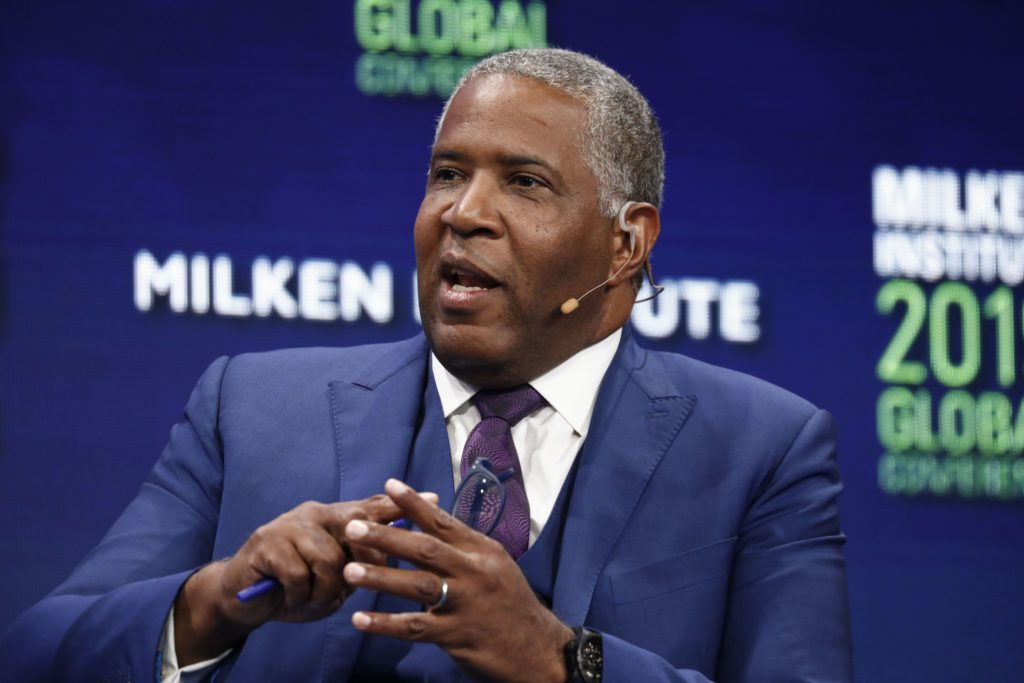
Led by billionaire Robert F. Smith, Vista invests in enterprise software and related businesses. The firm has raised more than $10 billion in capital for its eighth buyout fund as of July, according to a person familiar with the matter.

“Avalara is a mission-critical platform serving customers in a variety of end-markets, including retail, manufacturing, hospitality, and software,” Vista Managing Director Adrian Alonso said in the statement.

Cloud Platform

Vista started the year by joining with Elliott Investment Management to buy software maker Citrix Systems Inc. in January for $13 billion. In April, Vista agreed to sell its majority stake in software maker Datto Holding Corp. to Kaseya Ltd. in a deal valued at about $6.2 billion. Also that month, SecureLink, in which Vista was an investor, was bought by Imprivata.

In May, Vista sold a minority stake in software company iCIMS to TA Associates. Vista, which holds about a 9.7% stake in Ping Identity Holding Corp., is currently backing that company’s sale to Thoma Bravo.

Avalara’s cloud-based services help businesses maintain tax compliance, according to its website. It raised $207 million including so-called greenshoe shares in its 2018 initial public offering.

“We are pleased to partner with Vista and will benefit from their expertise in enterprise software as we build and improve upon our cloud compliance platform,” Scott McFarlane, Avalara’s co-founder and chief executive officer, said in Monday’s statement. 

Vista’s purchase is expected to close in the second half of the year, pending shareholder approval and regulatory clearance, according to the statement. The company will continue to operate under the Avalara brand after the deal, which isn’t subject to any financing conditions. 

Goldman Sachs Group Inc. advised Avalara on the sale. 

(Updates with confirmation throughout)

More stories like this are available on bloomberg.com

©2022 Bloomberg L.P.

Apple Slows Pace of Dealmaking Even as Its Tech Peers Plow Ahead

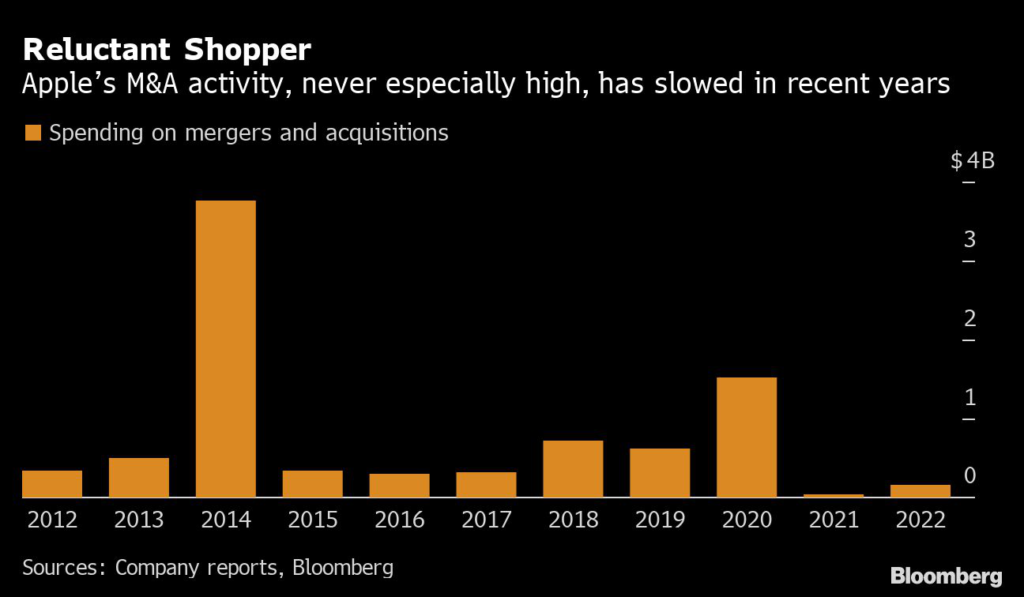
(Bloomberg) — Apple Inc., which used to acquire a company every three or four weeks, has dramatically slowed its dealmaking in the past two years, a sign the tech giant is being more choosy in the face of a shaky economy and heightened government scrutiny.

The company spent just $33 million on payments connected to acquisitions in its last fiscal year and $169 million in the first nine months of the current year, according to regulatory filings. That’s down from $1.5 billion in fiscal 2020.

Apple is famous for avoiding the kind of blockbuster acquisitions that have enticed its Silicon Valley peers. But the company has spent much of its history snapping up promising startups, some of which formed the basis for popular features such as Siri and Face ID. Just last February, Chief Executive Officer Tim Cook noted that Apple had acquired 100 companies in the past six years — more than one a month on average.

That deal flow has slowed to a trickle. Apple only made two known acquisitions in 2022: the UK-based startups Credit Kudos and AI Music. The first of those two companies developed technology for calculating credit scores, which will likely aid Apple’s efforts to build its own infrastructure for financial products. The latter business used artificial intelligence to generate tailor-made music.

Apple’s only known takeover in 2021 was the purchase of Primephonic, a classical-music streaming service.

Those numbers don’t factor in spending on content for Apple TV+, including purchased shows and distribution deals for Major League Baseball and Major League Soccer, but they stand in stark contrast to the recent big bets made by other tech giants.

Microsoft Corp. agreed to purchase Activision Blizzard Inc. in January for about $69 billion. Alphabet Inc.’s Google is buying Mandiant Inc. for $5.4 billion. And Amazon.com Inc. last week agreed to acquire IRobot Corp., the maker of the Roomba vacuum, for $1.65 billion.

Of course, Apple has plenty of money to spend if it wants to join the party. It ended last quarter with $179 billion in cash and marketable securities, and it could move quickly if it decides to do a deal. Cook attended last month’s Sun Valley Conference in Idaho, a popular spot for brokering megamergers. For now, though, the company has opted to put money toward stock buybacks and dividends.

Apple declined to comment on its acquisition strategy.

Even as tech deals multiply, they’re coming under more regulatory pressure than before. Like some other companies, Apple added language to its annual report last year noting that acquisitions face more risks now. That includes “failing to obtain required regulatory approvals on a timely basis or at all, or the imposition of onerous conditions,” the company said. Government scrutiny has only grown since then, with Apple coming under fire for its App Store practices and reluctance to open the iPhone’s tap-to-pay feature to outside services.

Other tech giants are under the microscope as well. In July, the Federal Trade Commission sued Meta Platforms Inc. to stop the acquisition of Within, the developer of a fitness app for virtual reality headsets. In February, Nvidia Corp. walked away from what would have been the biggest chip deal in history after the FTC sued to block it.

In a 2021 report, the FTC said that five of the biggest tech companies — Alphabet, Apple, Amazon, Microsoft and Meta — acquired hundreds of smaller businesses over the previous decade, often relying on legal loopholes to avoid notifying antitrust regulators about the deals.

Apple also is looking to rein in spending next year, which could further hamper M&A. The Cupertino, California-based company is slowing hiring and expenditures in some departments, Bloomberg reported last month. More recently, Cook said that Apple will be more “deliberate” in its spending in the near term.

Key parts of Apple — like its chip division, the multitouch technology behind the iPhone and iPad, and the operating systems at the heart of all of its products — stemmed from acquisitions. More recent deals helped lay the groundwork for the company’s weather, music and news services.

To date, Apple’s largest acquisition remains its $3 billion takeover of Beats Music and Beats Electronics in 2014. Over the years, analysts and investors have dreamed of more ambitious deals, such as Apple buying Netflix Inc., Tesla Inc. or Electronic Arts Inc.

The company rejiggered its management ranks in 2019 so that Apple M&A chief Adrian Perica reports directly to Cook — a move investors took as a sign that big-money deals were coming. The company spent over $600 million on small transactions that year and agreed to buy Intel Corp.’s wireless chip business for $1 billion, but a massive purchase never came.

During Apple’s last two earnings calls with analysts, Cook was asked about spending on acquisitions. He maintains that the company is on the prowl, but won’t just make a purchase to bulk up on revenue. Apple wants talent or technology that helps its strategy, he said.

During the call in April, Cook said he wouldn’t rule out making a larger deal if the right opportunity emerged. “I don’t want to go through my list with you on the phone, but we’re always looking.”

More stories like this are available on bloomberg.com

©2022 Bloomberg L.P.

Close Bitnami banner
Bitnami