
Bloomberg

Biden’s Democrats Seek Midterm Boost From Breakthrough Bill

(Bloomberg) — President Joe Biden and his party finally scored the win they’ve been waiting for heading into the November congressional elections.

But it’s uncertain it will be enough to save them from the nation’s sour mood over inflation. The tax and climate bill passed by the Senate Sunday was a shadow of the $10 trillion plan progressives sought more than a year ago. 

Nonetheless it represents a cornerstone achievement of the president’s first term, even if the White House stayed on the sidelines as Senate Majority Leader Chuck Schumer and two moderate Democrats, Joe Manchin and Kyrsten Sinema, shaped its final form.

“I ran for President promising to make government work for working families again, and that is what this bill does,” Biden said in a statement after the vote. “It required many compromises. Doing important things almost always does.”

In a time of high inflation and looming recession, the higher spending and taxes also offer Republicans plenty to campaign against.

Biden’s economic agenda has been bookended by his early success in passing the American Rescue Plan, which Republicans blame for triggering the current inflation surge, and now the Inflation Reduction Act, which most outside analysts have concluded will have modest effects on reducing prices.  

“Last year, Democrats jammed through trillions of dollars in reckless spending that fueled the worst inflation in 40 years. Now, Democrats insist on pouring fuel on the fire with another partisan tax-and-spending spree that will only further exacerbate a recession we’re already likely in,” Pennsylvania GOP Senator Pat Toomey said.

Unusual Unity

Getting there required Democrats to put aside more than a year of intraparty squabbling. They showed an unusual level of unity during a nonstop weekend marathon of votes on amendments, even rejecting proposals that in other circumstances most of them would have backed, in order to keep the bill — and the fragile coalition behind it — intact.

Progressive Democrats swallowed provisions for fossil fuels and other items that they stood firmly against earlier this year, settling for what they consider half-measures to get something out the door before the fall campaigns begin in earnest in September. 

Their House counterparts, who had been pushing hard for expansive action on climate change and more spending on social programs such as child care, have indicated they were ready to back the legislation when the chamber meets Friday for a vote on final passage. While many priorities were cut, the bill takes “real steps forward on key progressive priorities,” Representative Pramila Jayapal, chair of the Congressional Progressive Caucus, said in a statement.

The question still to be answered is whether it is enough to keep Democrats in control of Congress. 

Amy Walter, the editor of the Cook Political Report said passing the bill could motivate some in the Democratic base to turn out in the midterm elections. “For Democrats who have been struggling to find something good coming out of Washington in the past couple of months this can convince them to stick with the party,” she said. 

But Walter said that far more motivating for Democrats right now is the Supreme Court decision to overturn Roe vs. Wade and the persistence of Donald Trump on the political scene. 

An ABC News/Ipsos poll released Sunday showed that more than two-thirds of Americans fear the economy is getting worse and only 37% said they approved of the way the president is handling the economy.  Other polls show inflation — which is at a 40-year high — as the top issue for voters.

Republicans, who universally opposed the bill, have zeroed in on those sentiments, arguing that the Democrats’ legislation wouldn’t put the brakes on inflation and could tip the US into recession by taxing big companies. 

“The party in power is rarely, if ever, politically rewarded in midterms for bills it passes” said Kyle Kondik, managing editor of the non-partisan Sabato’s Crystal Ball at the University of Virginia. “Sometimes the party in power is punished.”

Democrats, who control the House and Senate by only the narrowest margin, clearly have those vulnerabilities in mind, giving the bill its aspirational name. 

Although the process started with Biden, it was Manchin, from Republican-dominated West Virginia, and Sinema, representing a closely divided swing state, who were center stage for the final act. Both are pivotal Democratic votes in the 50-50 Senate.

In the early stages, Biden wooed Sinema and Manchin with Oval Office meetings to lobby them to get behind his proposal. Last October, Biden publicly announced agreement on a framework on taxes and social spending plan that was meant to fulfill a central promise of his presidential campaign. 

Breakthrough Talks 

But that collapsed in December when Manchin walked away from a $2 trillion version of Biden’s agenda that would have provided paid family leave, as well as expanded child tax credits, Medicaid coverage, childcare subsidies and Medicare hearing coverage. Sinema rarely tipped her hand, but never embraced the larger plan.

An administration official said Sunday that Biden and top White House officials had been involved in keeping the efforts alive. Biden and Manchin held a series of private calls in recent months, and senior aide Steve Ricchetti maintained communication with the West Virginia senator. White House chief of staff Ron Klain held a dinner with Manchin in the spring, while Brian Deese, the head of Biden’s National Economic Council, traveled to West Virginia to speak with Manchin and his staff, which the official said helped generate a framework for the deal.

Meanwhile, Schumer re-engaged with Manchin in secretive talks this spring to revive a $1 trillion version. But those talks blew up in early July, when Manchin balked at the deal after data showed inflation topping 9%. Still, White House staff stayed in contact with Manchin and Schumer’s offices, including direct calls from Biden to the senators. Deese also traveled to Capitol Hill to meet with their staffers to discuss details. 


Later in July, Schumer and Manchin made a surprise announcement that the tax and climate provisions were back in the mix, shocking Washington out of summer doldrums. GOP Senator Rick Scott said on Bloomberg Television that he thought “Republicans were duped” because the deal was announced after they agreed to vote for an unrelated bill to provide billions to semiconductor manufacturers. Republican Senate leader McConnell had said that semiconductor vote would only happen if Biden’s economic agenda was done for.

Manchin agreed to the outline of the deal after he got some attention in it for fossil fuels and secured a promise to pass a separate bill easing environmental reviews of energy projects. Meanwhile, he and Schumer had kept their negotiations close to the vest, not even sharing them with Sinema because, in Manchin’s words, the deal could’ve gone “sideways” at any moment.

In the end, Democrats hailed it as a monumental step, the beginning of the messaging they will need to turn the bill into a political victory.

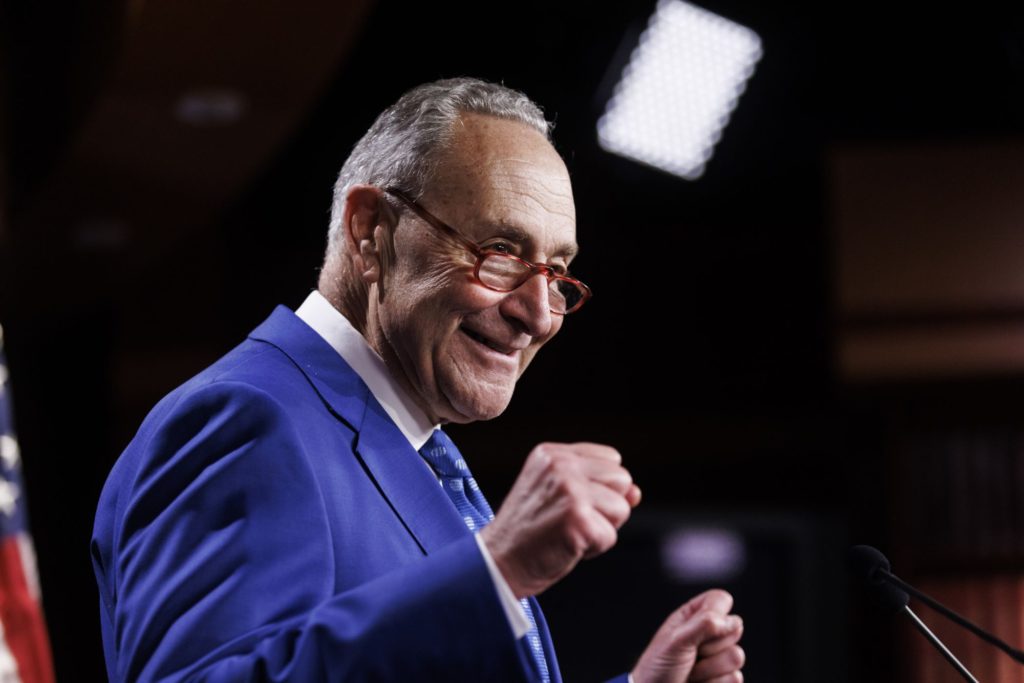
“We had many bumps in the road, many times when it looked like it wouldn’t happen, but we didn’t give up. We got it done,” Schumer said at a news conference after the vote. “I think it is going to help us in November tremendously.”

(Updates with polling from 12th paragraph.)

More stories like this are available on bloomberg.com

©2022 Bloomberg L.P.
Bitcoin Leads Crypto Rally as Market Shrugs Off US Jobs Shock

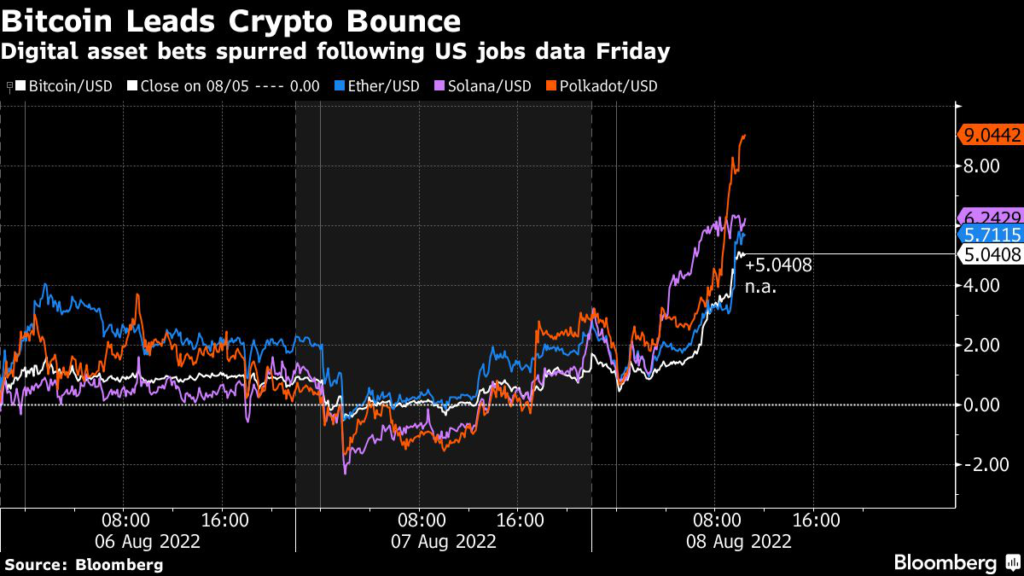
(Bloomberg) — Bitcoin spearheaded a rally in crypto tokens Monday as investors turned to digital assets in the wake of robust US jobs data.

The largest cryptocurrency by market value rose as much as 4% above the $24,000 mark by mid-morning trading in London, while Ether was up 3% at around $1,770. The sector was buoyed alongside similar moves in European stocks and US equity futures after the strong payrolls print suggested the world’s biggest economy may avoid a hard landing even as the Federal Reserve tightens aggressively.

Altcoins added to the sea of green, Bloomberg pricing data showed, with Solana’s SOL, Polkadot’s DOT and Avalanche’s AVAX all gaining more than 3% in the past 24 hours.

“Sentiment across the markets looks a little fragile this morning and yet crypto appears to have shrugged off Friday’s shock much more quickly,” said Craig Erlam, senior markets analyst at Oanda, in notel to clients. 

Bitcoin has its “sights set on $25,000 it seems”, he said, following its rally last week after a few difficult months of trading. “The momentum indicators will be fascinating here as the recovery appeared to be losing steam during the last ascent in late July.”

A prolonged bear market for cryptoassets has seen Bitcoin lose more than 47% of its value so far this year, and it remains roughly 65% below the all-time high of $68,991 that it achieved in November last year. Knocked by a spate of company bankruptcies and the failure of major decentralized finance project Terra in May, the crypto market has struggled to meaningfully recover ground in a series of miniature rallies this summer.

Despite crypto’s pitch to investors as a useful hedge against inflation, the prices of Bitcoin and other cryptocurrencies have become increasingly affected by traditional market drivers like monetary policy. Bitcoin maintains a strong relationship with indexes like the S&P 500 and the Nasdaq 100, with a correlation above 0.6 on Monday. A level of 1 would mean the two are trading in lock step, while 0 would mean they are not linked at all.

“With another 75 basis-point rate hike next month now the favoured outcome, although a lot can change in that time, it could be a nervy couple of days for investors ahead of Wednesday’s inflation report,” Erlam said.

More stories like this are available on bloomberg.com

©2022 Bloomberg L.P.
SoftBank CEO Pledges Sweeping Cost Cuts After $23.4 Billion Loss

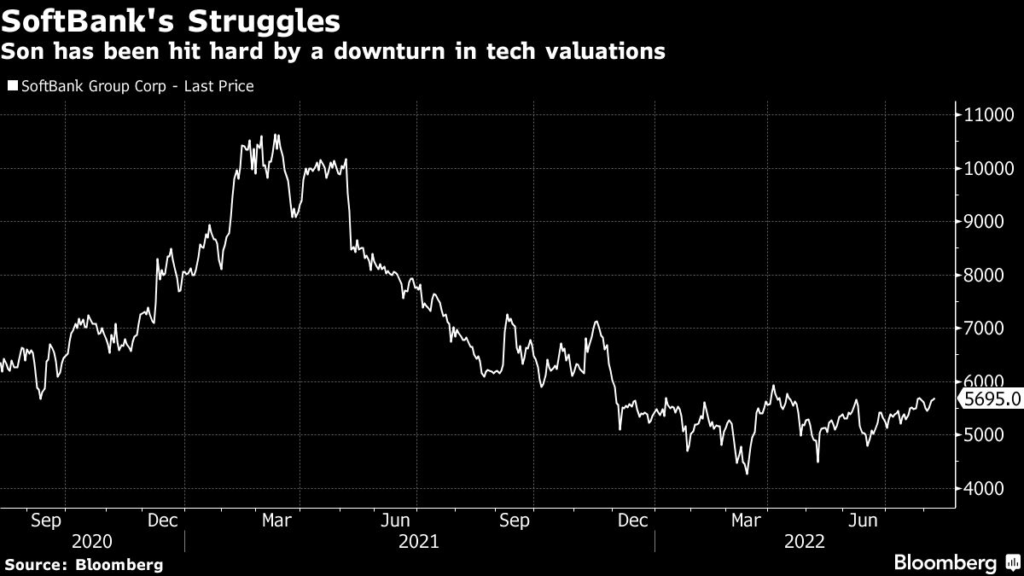
(Bloomberg) — SoftBank Group Corp.’s Masayoshi Son said he plans widespread cost cutting at his Japanese conglomerate and its Vision Fund investment arm after a record $23.4 billion loss on plunging portfolio valuations and foreign currency losses.

The Tokyo-based company lost the vast majority of that money — $17.3 billion — in the Vision Fund, as it marked down the value of holdings such as Coupang Inc., SenseTime Group Ltd. and DoorDash Inc. SoftBank also reported a $6.1 billion foreign exchange loss because of the weaker yen.

The 64-year-old struck a darkly somber tone after the results, taking responsibility for buying into startups at the height of the market and pledging to slash expenses to get back on track. Son said he will review “everything” for potential cuts without any “sacred cows.” SoftBank will scrutinize senior and junior employees in both front and back offices to an extent never experienced before.

“The loss is the biggest in our corporate history and we take it very seriously,” Son said during a press conference after the results. “We have to resort to big cost-cutting efforts at Vision Fund. The cost cutting efforts will have to include a reduction in head count – something I’ve made up my mind to do.”

Son detailed extensive problems and missteps in his portfolio, unusual for a self-made billionaire who tends to emphasize the positive. He said SoftBank had marked down 284 companies in its portfolio in the latest quarter, while only 35 went up in value. The markdowns included publicly traded portfolio companies, but also hundreds of private companies whose estimated values had dropped because of weak performance or lower comparisons. 

A quarter earlier, SoftBank still had profits of about 3 trillion yen ($22 billion) in its investment arm, which includes the first and second Vision Funds as well as Latin American funds. As of June, essentially all of those profits had disappeared. 

“We really believed we could do it and we had our heads in the clouds,” Son said. “Of course, the market was bad, there was a war, and there was the coronavirus. We can point to a lot of reasons, but these are all excuses. We have to self-reflect about the fact that if we’d been more selective and had invested more properly, it wouldn’t come to this.”

Asked about what lessons he has learned from the experience, Son said, “There are too many to count.”

With the first Vision Fund, Son said he was trying for home runs and struck out with companies like WeWork Inc. In Vision Fund 2, he tried a more modest approach of getting on base, but valuations were too high. Now, he will sharply scale back. “We’re currently strictly suppressing new investments,” he said.

SoftBank raised a huge slug of capital by selling forward contracts on Alibaba Group Holding Ltd., the Chinese e-commerce company that made Son’s reputation as a startup investor. He took in $10.5 billion during the June quarter and then procured another $6.8 billion through such contracts on and after July 1. 

Son also said SoftBank has begun talks to sell asset manager Fortress Investment Group, confirming a Bloomberg News report. The Japanese company bought Fortress for $3.3 billion in 2017, but it had to cede day-to-day control of the company to win US approval of the deal. 

“They have to sell what they can, and invest only in the good ones,” said Mitsushige Akino, a senior executive officer at Ichiyoshi Asset Management Co. in Tokyo. “It’s clear they’re still facing headwinds.”

To bolster SoftBank’s share price, Son unveiled a fresh program to buy back as much as 400 billion yen of its own stock. The company has turned to such repurchases repeatedly in recent years, including a 1 trillion yen program announced in November.

SoftBank’s Vision Fund, the world’s largest technology investment vehicle, holds large stakes in hundreds of unlisted technology startups. But low valuations have been draining SoftBank’s ability to turn public listings of its portfolio companies into liquidity to fuel further big bets. 

SoftBank said the Vision Fund losses included 293.4 billion yen for Coupang, 235.9 billion yen for SenseTime and 220.7 billion yen for DoorDash. It was also hit by drops at AutoStore Holdings and WeWork. SoftBank exited its holding in Uber Technologies Inc., the US ride-hailing giant that was supposed to be a star in its portfolio. 

SoftBank and Son are now trying to wait out the technology slump so that they can extract a return on their $32 billion purchase of chip designer unit Arm Ltd. The CEO is planning an initial public offering for Arm next year and has said he aims to make the offering the biggest-ever for a chip company.

Son is facing perhaps the steepest challenges of his career and he is taking more of the responsibility on his own shoulders. Chief Operating Officer Marcelo Claure left earlier this year, while former Chief Strategy Officer Katsunori Sago resigned in 2021.

Rajeev Misra, long-time head of the Vision Fund, is stepping away from most of his responsibilities and will start his own investment fund. Son said he will take over as chief executive of the second Vision Fund. 

Son, known for his eccentric presentations, began the press conference by showing an illustration of Tokugawa Ieyasu, one of the heroic figures in Japanese history. The image, however, shows the warrior after a defeat in battle, grim and dejected. Son said he was going to look at the image of the shogun-to-be to force himself to learn from his mistakes.

“I’m sorry what we shared today was depressing,” he said near the end of the event. “I wanted to be honest and transparent.”

More stories like this are available on bloomberg.com

©2022 Bloomberg L.P.
Taiwan Says Economic Ties to China Make More Sanctions Unlikely

(Bloomberg) — China’s economic measures against Taiwan are unlikely to have a major impact on trade between the two economies given how closely they’re intertwined, a finance ministry official in Taipei said Monday.

The remarks from the Finance Ministry’s chief statistician, Beatrice Tsai, came as Beijing-Taipei relations remain fraught, with the former slapping Taiwan last week with trade curbs on some fish and fruit imports and sand exports following US House Speaker Nancy Pelosi’s visit to the island.

“Right now Taiwan’s and China’s electronics industries are highly dependent on each other,” Tsai said, adding that Taiwan is China’s biggest source of imported integrated circuits. “Therefore we expect very little chance of China imposing stricter economic sanctions on Taiwanese businesses due to our highly reliant economic relations.”

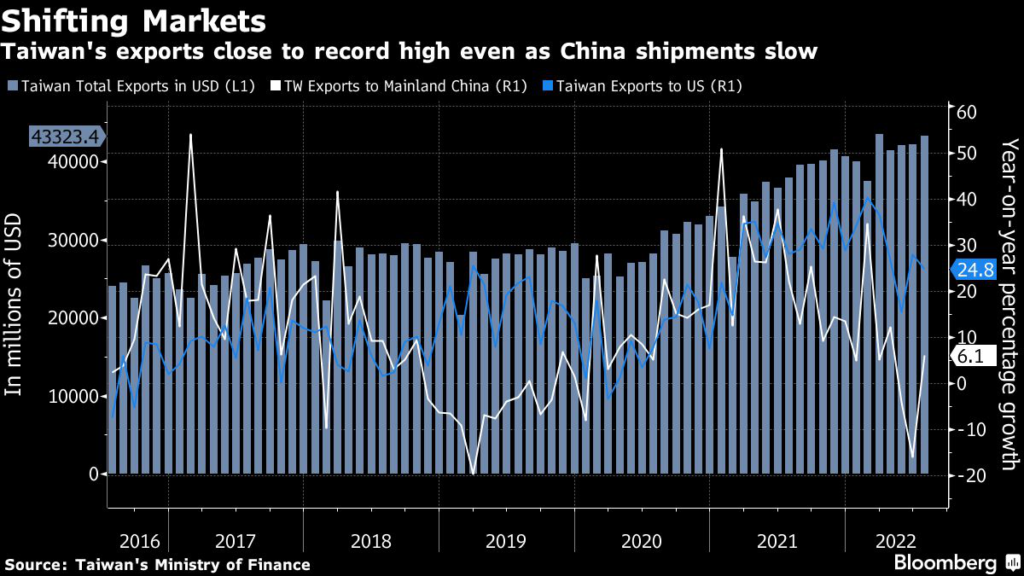
Taiwan on Monday reported stronger-than-expected trade data, with export growth rising 14.2% in July from a year ago. That was faster than the most bullish estimate in a Bloomberg survey of economists, and drove total shipments to $43.3 billion, the second-highest amount on record. 

Export growth to China has been sluggish this year as Beijing contends with Covid outbreaks and lockdowns. Shipments to China and Hong Kong increased just 3% year-on-year in July after contracting in June, compared with double-digit growth earlier in 2022. By contrast, shipments to the US surged 24.8% last month. 

Even so, China and Hong Kong combined remain by far Taiwan’s largest export market. Shipments totaled more than $16 billion in July, compared with nearly $7 billion in total exports to the US. 

Economists last week said the risk for Taiwan would likely rely on whether Beijing widened restrictions to cover the manufacturing sector and semiconductors. Agricultural exports accounted for only 0.6% of total exports last year, according to DBS Group Holdings Ltd., while China’s sand exports to the island amounted to just over $1 million last year — small compared with the bigger trade picture.

Another main concern was whether a series of military drills surrounding Taiwan would have a significant impact on the shipping industry. By Monday, however, shipping in the Taiwan Strait showed signs of returning to normal. 

Tsai said Monday the developing situation across the strait was difficult to predict. She pointed out, though, that exports were largely unaffected the last time Beijing significantly ramped up pressure on Taiwan in 1995 and 1996, even as financial markets and consumer confidence took a hit.  

Barring any major disruption to shipping lanes or new trade measures from China, Tsai said Taiwan’s total exports are likely to rise between 8% and 12% in August.

More stories like this are available on bloomberg.com

©2022 Bloomberg L.P.

India Seeks to Oust China Firms From Sub-$150 Phone Market

(Bloomberg) — India seeks to restrict Chinese smartphone makers from selling devices cheaper than 12,000 rupees ($150) to kickstart its faltering domestic industry, dealing a blow to brands including Xiaomi Corp.

The move is aimed at pushing Chinese giants out of the lower segment of the world’s second-biggest mobile market, according to people familiar with the matter. It coincides with mounting concern about high-volume brands like Realme and Transsion undercutting local manufacturers, they said, asking not to be identified discussing a sensitive matter.

Exclusion from India’s entry-level market would hurt Xiaomi and its peers, which in recent years have increasingly relied on India to drive growth while their home market endures a series of Covid-19 lockdowns that crippled consumption. Smartphones under $150 contributed to a third of India’s sales volume for the quarter through June 2022, with Chinese companies accounting for up to 80% of those shipments, according to market tracker Counterpoint.

Xiaomi’s shares extended losses in the final minutes of trading in Hong Kong on Monday. It slid 3.6%, extending their decline this year to more than 35%. It’s unclear whether Prime Minister Narendra Modi’s government will announce any policies or use informal channels to convey its preference to Chinese companies, the people said.

What Bloomberg Intelligence Says

Xiaomi smartphone shipments may fall by 11-14% a year, or 20-25 million units, with sales decreasing by 4-5%, we calculate, if India enacts a ban on China-made mobile phones retailing under $150. It accounts for 25% of the segment in India, which is Xiaomi’s most important overseas market, with 66% of its smartphones priced under $150, according to IDC.

– Steven Tseng and Sean Chen, analysts

Click here for the research.

New Delhi has already subjected Chinese firms operating in the country, such as Xiaomi and rivals Oppo and Vivo, to close scrutiny of their finances, which has led to tax demands and money laundering allegations. The government has previously employed unofficial means to ban Huawei Technologies Co. and ZTE Corp. telecom equipment. While there’s no official policy prohibiting Chinese networking gear, wireless carriers are encouraged to purchase alternatives.

The move shouldn’t affect Apple Inc. or Samsung Electronics Co., which price their phones higher. Representatives from Xiaomi, Realme and Transsion didn’t respond to requests for comment. Spokespeople from India’s technology ministry also didn’t respond to Bloomberg News inquiries.

Read more: India Accuses Chinese Phone Maker of Tax Evasion as Probes Grow

India amped up pressure on Chinese firms in the summer of 2020 after more than a dozen Indian soldiers died following a clash between the two nuclear-armed neighbors on a disputed Himalayan border. It has since banned more than 300 apps, including Tencent Holdings Ltd.’s WeChat and ByteDance Ltd.’s TikTok, as relations between the two countries fray.

Homegrown companies such as Lava and MicroMax comprised just under half of India’s smartphone sales before new entrants from the neighboring country disrupted the market with cheap and feature-rich devices. 

Chinese smartphone players now sell the vast majority of devices in India, but their market dominance has not been “on the basis of free and fair competition,” India’s junior tech minister told the Business Standard newspaper last week. Recurring annual losses posted by most Chinese handset makers in India, despite their leading position, add to criticism of unfair competition.  

In private, the government continues to ask Chinese executives to build local supply chains, distribution networks and export from India, suggesting New Delhi still very much wants their investment, the people said.

(Updates with analysts’ quote from the fifth paragraph)

More stories like this are available on bloomberg.com

©2022 Bloomberg L.P.
The EV Race Is Turning a Gold Rush Haven Into a Battery Hub

(Bloomberg) — Gold has long dominated the Western Australian city of Kalgoorlie, born in a late 19th Century prospecting rush and home to one of the world’s largest-open pit mines, nestled right next to residential streets. Blasts to dislodge precious-metal laced rock from the more than two-mile long Super Pit still frequently rattle the main street.

As about 2,700 executives, investment bankers and industry stalwarts gathered in the precious metals hub last week for Australia’s key annual mining forum it was clear where the industry’s focus lies. All attention is on the frantic hunt for battery metals to deliver the world’s shift to electric vehicles.

The most in-demand mining leaders are no longer those who’ve unearthed vast troves of glittering gold, but instead the companies delivering previously shunned projects to yield volumes of lithium, nickel, manganese and cobalt.

A rush of recent supply deals led by Ford Motor Co. to add contracts for battery metals from Australian mining companies are drawing new attention to a nation that already provides about three-quarters of Tesla Inc.’s lithium needs, and is aiming to deliver a rapid expansion in the production of a whole suite of raw materials.

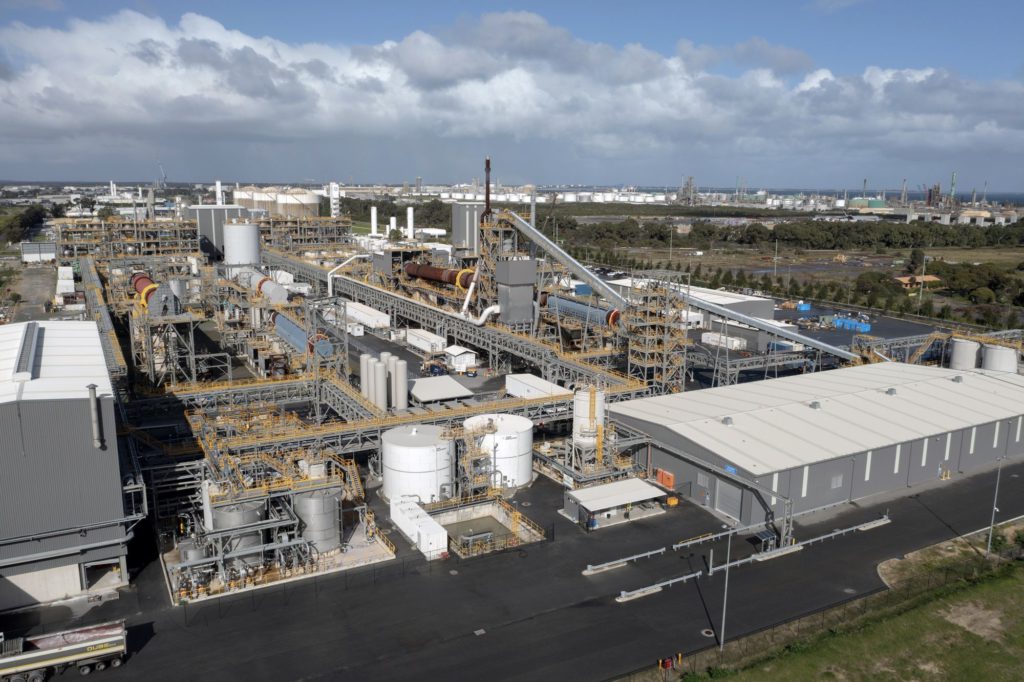
There are few better examples of that gold-to-electric-cars transition than IGO Ltd., which has added investments in nickel and lithium while selling off a stake in a underground gold operation. Executives shuttled conference delegates out to see Greenbushes, the largest hard rock lithium mine, and the Kwinana refinery that converts raw materials into specialist battery chemicals.

Hitting global net-zero goals will require a dramatic increase in renewable energy installations and in the adoption of electric vehicles, Peter Bradford, IGO’s managing director, told the conference. “To achieve it we are going to need lots and lots of metal,” he said. IGO and its partners aim to double production capacity at Greenbushes by 2027.

The mining sector’s largest company, Australia-based BHP Group, is also seizing on the outlook for rapidly increasing battery metal demand. BHP said on Monday it had made a takeover approach to add OZ Minerals Ltd., a producer of copper and nickel with mines in Australia and Brazil. Though the proposal has been rejected, analysts see the combination as compelling. OZ Minerals shares advanced 35% in Sydney trading Monday.

Read more: BHP Returns to Major M&A in Hunt for EV and Clean Energy Metals

BHP forecasts electric models will account for 60% of new car sales by 2030, rising to 90% by 2040, said Jessica Farrell, asset president of the Nickel West unit, a once-unwanted collection of mines, smelters and refineries, including an operation in Kalgoorlie, that’s had its fortunes transformed by EV sector demand. The unit this month added a potential supply agreement with Ford to earlier pacts with Tesla and Toyota Motor Corp.

“We anticipate demand for nickel in the next 30 years will be 200% to 300% more than the previous 30 years,” Farrell told the conference.

Lithium producers remain the most in demand. Liontown Resources Ltd.’s executives used the conference to celebrate recent pacts with Tesla, Ford and LG Chem Ltd., while Core Lithium Ltd. — which also has a tentative deal with Elon Musk’s carmaker — told delegates its project in the Northern Territory is on track to deliver a first shipment before the end of the year.

Pilbara Minerals Ltd., which counts Great Wall Motor Co. and battery producer Contemporary Amperex Technology Co. Ltd. among its partners, this month received a record-equaling bid for its spodumene — a partly-processed form of lithium — at one of its regular auctions. 

“What we’re seeing now is record breaking demand and prices,” Pilbara CEO Dale Henderson said in an interview at his company’s Pilgangoora site in a remote region in the north of Western Australia.

More stories like this are available on bloomberg.com

©2022 Bloomberg L.P.
UK Hiring Slowdown Hits Recruitment Shares Amid Recession Fears

(Bloomberg) — Recruitment companies’ shares fell after PageGroup Plc warned of a hiring slowdown as rising interest rates and inflation stoke fears that the economy will sink into a recession.

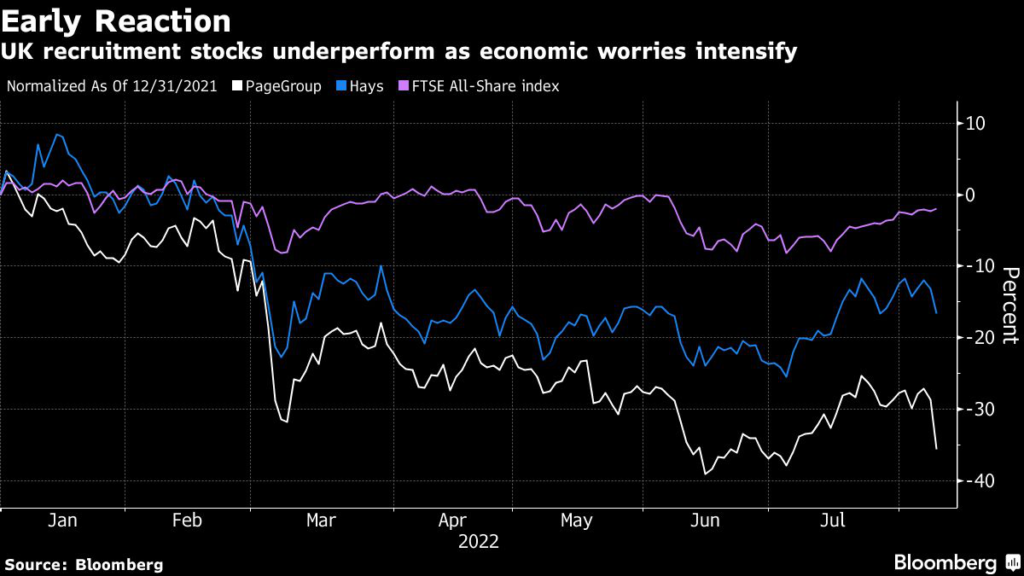
Page’s shares sank as much as 11%, the most since early March, after the company’s comments Monday. UK rivals Hays Plc and Robert Walters Plc fell 4% and 3.5%, respectively. SThree Plc, Randstad NV and Brunel International N.V. also slipped. 

“In July, we noted a slight slowing in time to hire in some of our markets,” the Surrey, England-based Page said in a statement, citing a “heightened degree of global macro-economic and geopolitical uncertainty, particularly with regards to increasing inflation.”  

The warning from Page comes as economists surveyed by Bloomberg News say UK output likely contracted in the second quarter. Gross domestic product data is due to be published on Friday.

Staffing companies’ shares tend to react early to an economic downturn and then outperform as bad news peaks, according to Citigroup Inc. “When the current macro storm abates, shares should correct towards normalized earnings-based valuations,” Citigroup’s Marc Van’T Sant wrote in a note, maintaining a buy rating on Page.

Page executives said on a call with analysts that hiring in July may have been affected by managers taking time off amid the recent heat wave.

“It’s the last couple of weeks in September that will really tell us whether things have slowed or whether actually this really was just a slightly early pack up for summer,” said Chief Financial Officer Kelvin Stagg.

More stories like this are available on bloomberg.com

©2022 Bloomberg L.P.

Corporations Join the Nuclear Fusion Craze

(Bloomberg) —

Nuclear energy is having a moment. Europe recently moved to issue green bonds for the power source, and Germany signaled that it may scrap plans to shut nuclear facilities given the country’s energy crunch. Silicon Valley is also embracing nuclear fusion, an unproven technology that promises abundant, cheap and clean energy in the not-too-distant future.

The new US Senate climate pact includes federal funding and incentives for fusion, building on last year’s surge of financing. Now, companies are getting in on the sector, plowing even more money into ventures that are taking the most difficult paths to make fusion’s promise a reality.

Last month, TAE Technologies Inc., a nuclear fusion company in southern California, raised $250 million. Industry watchers describe the company’s approach, which requires creating a fusion reaction in incredibly high heat, as perhaps the biggest scientific gamble in the field.

The company’s latest financing didn’t come primarily from venture capitalists or technology luminaries, the normal backers of these grand science experiments. Chevron Corp.’s venture arm invested, Google cut a check from its treasury department and Sumitomo Corp., a Japanese trading company, made its first investment in the sector with a pledge to bring TAE’s system to Asia. 

Michl Binderbauer, TAE’s chief executive officer, says more corporate partnerships are coming after his company demonstrated a key breakthrough in constructing viable reactors. TAE’s plan is to deliver power to energy grids by 2030, bringing “broader commercialization” in the next decade. “We’re in striking distance of what the machine needs to do,” says Binderbauer. 

Private investors poured a record $3.4 billion into fusion last year, according to research firm Pitchbook. Billionaires like Bill Gates and Jeff Bezos have joined rounds backing dozens of new ventures in the sector. (Microsoft co-founder Paul Allen financed TAE). These companies take slightly different approaches to long-shot fusion process but have a similar thirst for funds. TAE has raised $1.2 billion since it was founded in 1998, Commonwealth Fusion Systems, a Boston upstart, raised $1.8 billion last year alone, while Helion Energy completed a $500 million round in 2021. 

Chris Gadomski, an energy analyst with BloombergNEF, expects overall fusion funding this year to exceed $1 billion, despite a broader pullback in investing. The sources of that money tell a story about the industry. When there is a large showing of wealthy solo investors, “it doesn’t matter if they lose a billion dollars,” he says. “When you see other companies coming into the marketplace, that tells me that there’s much closer scrutiny going on, and it’s becoming closer to reality.”

A Sumitomo spokesperson said its investment is part of a plan to develop an “ecosystem” around fusion, “ultimately expanding its capabilities in the power production business.” Chevron said it sees fusion as “a promising low-carbon future heat and energy source” and noted it has previously backed the fusion startup Zap energy, a spokesman said. Google, which has financed Commonwealth, declined to elaborate on its investment. 

TAE is relying on an unusual approach to make fusion reality, melding hydrogen with boron, a material used in rocket fuel, in a contained magnetic field. It must do this in absurd heat. When announcing its financing, TAE shared that its current test reactor had managed to keep plasma stable at 75 million degrees Celsius (167 million Fahrenheit) — more than double the heat it initially aimed for. 

According to Binderbauer, a key reason for TAE’s recent progress wasn’t pricier equipment but advances in intelligence software. “The reactor prototype runs itself,” he explains. “It learns from its own incremental experimentation.” When Gadomski visited the TAE facility, shortly before the pandemic, he recalled seeing a dozen Google engineers hooking up the machine to data-collection ports. 

The challenge for years has been achieving net energy, where the energy produced exceeds the energy used, through slamming atoms together rather than splitting them. Companies tackling the problem are in a way beneficiaries of all the tech company investments “to make these things faster,” Binderbauer says, holding up his smartphone with a smile. “One or more of us will crack that nut.” 

Each TAE machine costs upwards of $250 million in capital spending, Binderbauer said. TAE’s current model is about the size of a double-decker bus and it plans to use the new funds to build an even larger machine, called Copernicus, to repeat the test in double the temperature.

In 2017, TAE formed a medical subsidiary to market components of its tech for cancer research, a chance to make actual money. (It hasn’t shared financial figures.) Multinationals like Google and Chevron are unlikely to be investing purely for financial returns. They want exposure to this cutting-edge research or early dibs if it eventually works, though Binderbauer says the recent financing doesn’t give funders exclusive access to TAE’s tech. 

Bloomberg Intelligence strategist Mike Dennis pegged the eventual nuclear fusion market at $40 trillion. Even if its initial contribution to the world’s total energy output is tiny, Dennis said fusion will remake energy markets the way Tesla remade the automobile industry.

More stories like this are available on bloomberg.com

©2022 Bloomberg L.P.
Stocks, Futures Rise as Traders Assess Fed Hikes: Markets Wrap

(Bloomberg) — Stocks and US equity futures climbed as bond yields pared their recent surge and investors weighed prospects of aggressive Federal Reserve rate hikes against reassuring earnings.

Technology led the advance in Europe’s Stoxx 600 benchmark as rates on benchmark German and UK government debt dropped. S&P 500 and Nasdaq 100 contracts both rose by at least 0.3%.

Friday’s stronger-than-expected US non-farm payrolls data added to the case for more Fed monetary tightening, and traders are looking to inflation numbers due this week for clues on the policy path. Rate-hike expectations have pushed up Treasury yields and the dollar, while a key part of the US bond curve is close to the most inverted level since 2000, suggesting investors foresee a recession as the Fed applies the brakes on the economy.

“The NFP miss was large enough to re-ignite the inflation debate and renew focus on US CPI prints,” said Peter McCallum, a strategist at Mizuho International Plc in London. “Indeed, a very unexpected move lower in US CPI is needed for the market to stop thinking about the Fed having to do more. And with more tightening, the probability of a hard landing rises.”

Crude oil slipped, while gold struggled to make much progress. Bitcoin pushed above $24,000.

A better-than-feared second-quarter earnings season sparked a rally in stocks last month as investors bet that margins could withstand inflationary pressure. Optimism around a dovish tilt in Fed policy amid weaker economic data has also lifted sentiment.

But strategists at Morgan Stanley and Goldman Sachs Group Inc. expect corporate profit margins to contract next year given unrelenting cost pressures, an outlook that is at odds with the mood in equity markets. According to Morgan Stanley’s Michael J. Wilson, among the most vocal bears on US stocks, “the best part of the rally is over.”

Morgan Stanley, Goldman Strategists See a Dimming Profit Outlook

US inflation data this week could shape views on the outlook for Fed policy and inject more market swings. While price pressures may be topping out, it’s unclear if they will persist at stubbornly high levels. Traders now see greater odds of another 75 basis-point Fed hike in September, part of a global wave of rate increases. 

The latest comments from Fed officials left a question mark over wagers on a policy pivot toward reducing borrowing costs next year.

‘Far From Done’

San Francisco Fed President Mary Daly said the US central bank is “far from done yet” in bringing down price pressures. Governor Michelle Bowman said the Fed should keep considering large hikes similar to the 75 basis-point increase approved last month until inflation meaningfully declines.

The July US payrolls report is “likely to enhance the Fed’s inclination to front-load interest rate hikes until the policy rate overshoots neutral by a good margin over the next few months,” TD Securities strategists including Priya Misra wrote in a note.

Elsewhere, the US Senate passed a landmark tax, climate and health-care bill, speeding a slimmed-down version of President Joe Biden’s domestic agenda on a path to becoming law.

US-China tension over Taiwan remains elevated. China’s military announced a new exercise near the self-ruled island in the fallout from US House Speaker Nancy Pelosi’s visit. 

The Worst Is Yet to Come for US Credit Markets: MLIV Pulse

What to watch this week:

  • Iran nuclear deal talks, Monday
  • US CPI data, Wednesday
  • China CPI, PPI Wednesday
  • Chicago Fed President Charles Evans, Minneapolis Fed President Neel Kashkari due to speak, Wednesday
  • US PPI, initial jobless claims, Thursday
  • San Francisco Fed President Mary Daly is interviewed on Bloomberg Television, Thursday
  • Euro-area industrial production, Friday
  • US University of Michigan consumer sentiment, Friday

Some of the main moves in markets:

Stocks

  • The Stoxx Europe 600 rose 0.5% as of 10:48 a.m. London time
  • Futures on the S&P 500 rose 0.2%
  • Futures on the Nasdaq 100 rose 0.4%
  • Futures on the Dow Jones Industrial Average rose 0.2%
  • The MSCI Asia Pacific Index was little changed
  • The MSCI Emerging Markets Index fell 0.4%

Currencies

  • The Bloomberg Dollar Spot Index was little changed
  • The euro was little changed at $1.0180
  • The Japanese yen was little changed at 135.02 per dollar
  • The offshore yuan was little changed at 6.7685 per dollar
  • The British pound was unchanged at $1.2073

Bonds

  • The yield on 10-year Treasuries declined three basis points to 2.80%
  • Germany’s 10-year yield declined six basis points to 0.90%
  • Britain’s 10-year yield declined seven basis points to 1.98%

Commodities

  • Brent crude fell 0.5% to $94.40 a barrel
  • Spot gold was little changed

More stories like this are available on bloomberg.com

©2022 Bloomberg L.P.
SoftBank in Talks to Sell Fortress After Logging Record Loss

(Bloomberg) — SoftBank Group Corp. has begun talks to sell asset manager Fortress Investment Group, as the Japanese company grapples with record losses, its chief executive said on Monday.

The Japanese investment group will need to “drastically cut costs,” SoftBank founder Masayoshi Son told a news conference, after the company logged a record 3.16 trillion yen ($23.4 billion) net loss in the quarter ended in June. “We are strengthening our defenses,” Son said.

The company is grappling with a sharp slide in global tech stock prices, which forced the company to write down the value of companies in its portfolio, including those of SenseTime Group Ltd. and Coupang Inc. 

SoftBank has been exploring options including a possible sale of Fortress, following the company’s inability to integrate its operations with its own Vision Fund team, people familiar with the matter have told Bloomberg News.  

More stories like this are available on bloomberg.com

©2022 Bloomberg L.P.

Close Bitnami banner
Bitnami
