Bloomberg

PayPal’s Job Cuts Cost the Company $71 Million in Second Quarter

(Bloomberg) — PayPal Holdings Inc. said restructuring costs tied to trimming its global workforce totaled $71 million in the second quarter. 

The job cuts will ultimately save the payments giant about $260 million this year, including approximately $100 million in stock-based compensation, according to a regulatory filing Wednesday. PayPal is looking to the staff cutbacks as a way to reduce expenses and satisfy investors, who have punished the firm’s shares in recent quarters. 

Earlier this year, “management initiated a strategic reduction of the existing global workforce intended to streamline and optimize our global operations to enhance operating efficiency,” PayPal said in the filing. “As part of this effort, we are focusing on reducing redundant operations and simplifying our organizational structure.”

In all, the San Jose, California-based company recorded $90 million in total restructuring and other charges for the quarter. The remaining amount came from PayPal’s efforts to shutter offices as it continues “to review our facility needs due to our new and evolving work models.”

The firm expects the job cuts and other activities to cost it an additional $15 million in restructuring charges this year.

PayPal soared 14% in late trading Tuesday after the company said its recent efforts to reduce expenses will result in $900 million in cost savings this year alone before ballooning to $1.3 billion next year. The company also announced it now counts Elliott Investment Management as one of its largest shareholders after the activist investor took a $2 billion stake in the payments firm. 

More stories like this are available on bloomberg.com

©2022 Bloomberg L.P.

Zomato Drops as Stake Matching Uber’s Put Up for Sale

(Bloomberg) — Shares of India’s Zomato Ltd declined as an undisclosed shareholder offered to sell 612 million shares at a discount, a stake matching that held by Uber Technologies Inc. 

Zomato fell 0.2% to close at 55.45 rupees ($0.7), after dropping as much as 9.5% shortly after opening on Wednesday.

The selling shareholder in the block trade offered the stock at between 48 rupees and 54 rupees a piece, according to terms of the deal seen by Bloomberg News late Tuesday. The discount versus the last closing price was as wide as 13.6%. BofA Securities is the sole bookrunner of the block trade. 

Indian daily Business Standard reported on Tuesday that Uber is the holder disbursing the shares. Uber owns 612.2 million shares in Zomato, according to data compiled by Bloomberg.

A spokesman for Uber did not immediately respond to a request for comment. 

Zomato raised $1.3 billion with its offering about one year ago, opening room for a slew of Indian startups that tapped investors through first-time share sales in the South Asian country. Shares of the Indian online food-delivery platform plunged last week following the expiry of a lock-up period for investors in the company prior to the offering. 

Pre-IPO investors in the New Delhi-based company include China’s Ant Group Co., Info Edge India, Uber Technologies Inc. and Sequoia Capital. 

Zomato shares jumped 20% on Tuesday, the most since the debut session last year, as a number of block trades changed hands after it released its quarterly performance report. The result showed a smaller-than-expected loss and revenue in line with analyst expectations. 

(Updates with company’s response in fifth paragraph.)

More stories like this are available on bloomberg.com

©2022 Bloomberg L.P.

US Futures Rise After Pelosi Wraps Up Taiwan Visit: Markets Wrap

(Bloomberg) — US stock futures climbed on Wednesday as some of the investor anxiety over tense US-China ties eased, while Treasuries extended a slide sparked by hawkish Federal Reserve comments. Oil rose as OPEC+ members agreed to a small production increase.

S&P 500 and Nasdaq 100 contracts both rose by about 0.6%. In New York premarket trading, Airbnb Inc. fell after the home-rental company missed estimates on bookings. Match Group Inc. dropped after the parent to dating apps including Tinder gave a weak revenue forecast. PayPal Holdings Inc. jumped as the payments giant said activist investor Elliott Investment Management is now among its biggest shareholders. 

US House Speaker Nancy Pelosi left Taiwan after a visit that has provoked an angry response from China, with markets calmer compared with the wave of anxiety that washed across assets ahead of her arrival. A dollar gauge was little changed.

The two-year Treasury yield added to its advance beyond 3% as bonds continued a selloff sparked on Tuesday by Fed officials indicating the central bank has some way to go to curb inflation. That lead traders to trim wagers on policy easing in 2023. 

While an immediate concern around US-China tensions may be fading Wednesday, investors still face a host of worries including inflation and how the policy response by central banks to surging prices could hobble global growth. Equities trading doesn’t reflect the headwinds confronting the market, according to Goldman Sachs Group Inc. strategist Sharon Bell.

“There’s a little bit of complacency in there and markets are not fully taking into account the risks,” Bell said in an interview with Bloomberg TV.

Europe’s Stoxx 600 was little changed as traders assessed the latest company earnings. BMW AG sank as the carmaker flagged softening demand, while Societe Generale SA rallied after the French lender outlined new revenue targets. MSCI Inc.’s Asia-Pacific equity index slipped 0.2% in a mixed day that included a jump in Chinese technology shares. 

Fed Signals

Meanwhile, comments from Fed officials including Mary Daly, Loretta Mester, Charles Evans and James Bullard served to highlight a challenging backdrop of rising borrowing costs, price pressures and slowing economic growth.

San Francisco Fed President Daly said the Fed has “a long way to go” on reaching price stability around a 2% inflation target. Cleveland counterpart Mester said she wants to see “very compelling evidence” that month-to-month price increases are moderating.

St Louis Fed President Bullard said in a CNBC interview Wednesday there would have to be “convincing evidence” of inflation easing before policy makers would be able to “feel like we’re doing enough.”

Elsewhere, oil rose above $95 a barrel as OPEC+ ministers agreed to a 100,000 barrels a day production increase for September, giving a tight market extra supplies at a much slower pace than recent months. Gold spot prices climbed and Bitcoin gained above $23,000.


This week’s MLIV Pulse survey is asking about your outlook for corporate bonds, mergers and acquisitions and health of US corporate balance sheets through the end of the year. It takes one minute to participate in the MLIV Pulse survey, so please click here to get involved anonymously. 

What to watch this week:

  • OPEC+ meeting on output, Wednesday
  • US factory orders, durable goods, ISM services, Wednesday
  • BOE rate decision, Thursday
  • US initial jobless claims, trade, Thursday
  • Cleveland Fed President Loretta Mester due to speak, Thursday
  • US employment report for July, Friday

Some of the main moves in markets:

Stocks

  • Futures on the S&P 500 rose 0.6% as of 8:15 a.m. New York time
  • Futures on the Nasdaq 100 rose 0.6%
  • Futures on the Dow Jones Industrial Average rose 0.5%
  • The Stoxx Europe 600 rose 0.3%
  • The MSCI World index was little changed

Currencies

  • The Bloomberg Dollar Spot Index was little changed
  • The euro rose 0.2% to $1.0187
  • The British pound rose 0.1% to $1.2183
  • The Japanese yen fell 0.4% to 133.67 per dollar

Bonds

  • The yield on 10-year Treasuries advanced four basis points to 2.79%
  • Germany’s 10-year yield advanced seven basis points to 0.89%
  • Britain’s 10-year yield advanced six basis points to 1.93%

Commodities

  • West Texas Intermediate crude rose 1.6% to $95.96 a barrel
  • Gold futures fell 0.5% to $1,780.70 an ounce

More stories like this are available on bloomberg.com

©2022 Bloomberg L.P.

Avaya, Goldman, JPMorgan Face Lender Ire After Loan’s Collapse

(Bloomberg) — Investors fuming over the rapid collapse of a leveraged loan issued in June have hired a law firm to examine legal options over what they view as inadequate disclosures during the debt’s marketing process. 

The loan, issued by technology company Avaya Holdings Corp., plunged nearly 30 cents on the dollar over the last week after the company slashed quarterly revenue and earnings expectations and jettisoned its chief executive officer. The rapid change in Avaya’s fortunes — revealed mere weeks after the debt hit investors’ accounts — left some buyers questioning why the information wasn’t disclosed when Avaya was marketing the deal with help from Goldman Sachs Group Inc. and JPMorgan Chase & Co.

Investors who bought the company’s $350 million incremental first-lien leveraged loan have hired law firm Akin Gump Strauss Hauer & Feld to explore their options, according to people with knowledge of the matter, who asked not to be named discussing a private transaction. Some holders of the company’s other first-lien loans have also joined the group, the people said. 

Representatives for Avaya, Goldman Sachs and JPMorgan declined to comment. A representative for Akin didn’t respond to requests for comment. LevFin Insights earlier reported on Akin’s hire, and other elements of the situation. 

Struggling Sale

Avaya, which offers communications software and services and competes with the likes of Cisco Systems Inc. and Microsoft Corp., wasn’t an easy sell in the leveraged loan market. The company needed to raise money to refinance convertible bonds due in 2023 that were deeply out-of-the-money. It brought the deal in a market weakened by recession fears, inflation and rising interest rates, after previously trimming its full-year earnings forecast. 

Investors balked at a proposed $500 million leveraged loan, forcing the company to split the planned issuance into a smaller loan and $250 million of privately-placed exchangeable notes, both secured on a first-lien basis. To get the deal done, Avaya agreed to hike the interest rate on the loan to 10% over the Secured Overnight Financing Rate — the highest margin of the year — include an upfront fee, and add other investor protections. 

JPMorgan and Goldman priced the debt on June 24. New investor Brigade Capital Management bought a $125 million chunk of the new exchangeable notes, one of the people said, while multiple investors purchased the rest, according to a July regulatory filing. A representative for Brigade declined to comment. 

Barely a month later, on July 28, Avaya said it was slashing its forecasted adjusted earnings for the third quarter by more than 60%, to between $50 million and $55 million. It also cut its revenue expectations by over 16%. 

Even more concerning to some investors, Avaya removed its CEO, James Chirico, and replaced him with Alan Masarek, former head of Vonage Holdings Corp. Hiring a new chief executive typically takes weeks or months, raising questions about why the company didn’t disclose the transition during the June debt offering, some of the people said. 

The news sent Avaya’s new term loan falling to quotes in the 60s as of Tuesday, different people said, from around 89 to 90 cents on the dollar. Its shares and other debt also plunged. 

Now, investors await the company’s full earnings release on Aug. 9. In the meantime, Avaya’s share price closed Tuesday around 82 cents, a potential threat to the company, which must maintain a $1 share price over a 30-day trading period to remain listed on the New York Stock Exchange. Under terms of its new exchangeable notes, Avaya must be listed on the NYSE or Nasdaq, according to a Friday report from S&P Global Ratings. 

The credit grader lowered its rating on Avaya two steps to CCC, saying the company may struggle to maintain the listing requirements or seek to restructure its debts. 

(Updates with graphic of stock price.)

More stories like this are available on bloomberg.com

©2022 Bloomberg L.P.

Pelosi Stares Down Xi’s Threats, Giving China a Reality Check

(Bloomberg) — In roughly 24 hours, Chinese officials and propagandists went from warning of a powder keg to pleading for patience as Beijing struggled to articulate a cohesive response to Nancy Pelosi’s landmark trip to Taiwan.

Ahead of Pelosi’s visit, the first by a US House speaker in 25 years, President Xi Jinping warned the Biden administration would get “burned” while nationalist Chinese commentators suggested she would “ignite the powder keg.”

Yet after Pelosi landed safely, stayed the night in Taipei and hailed US-Taiwan ties in a meeting with President Tsai Ing-wen, China’s tone shifted from belligerent to defensive. At a briefing on Wednesday afternoon, Foreign Ministry spokesperson Hua Chunying asked the public to give the government more time to follow through on threats to punish the US and Taiwan.

“We will do what we have said,” she said. “So please have some patience about that.”

China’s response to Pelosi reflects the complexity of dealing with Taiwan, the pragmatism of the Communist Party and Xi’s own political situation. The 69-year-old leader has been focused on eliminating risks to extending his rule at a party congress later this year, leaving little appetite for triggering a conflict that could spin out of control. 

Even if Pelosi’s visit ultimately convinces China’s leaders they won’t be able to settle their claims to Taiwan peacefully, that doesn’t mean Xi wants that fight now. The country is already grappling with a property crisis and slowing economic growth after more than two years of strict pandemic-control measures.

Missile Tests, Drills

“It’s important for Xi Jinping to respond strongly, but responding strongly and engaging in conflict are two very different things,” said Lev Nachman, assistant professor at National Chengchi University in Taipei. “There’s not going to be any kind of hot conflict because none of the three sides want that.”

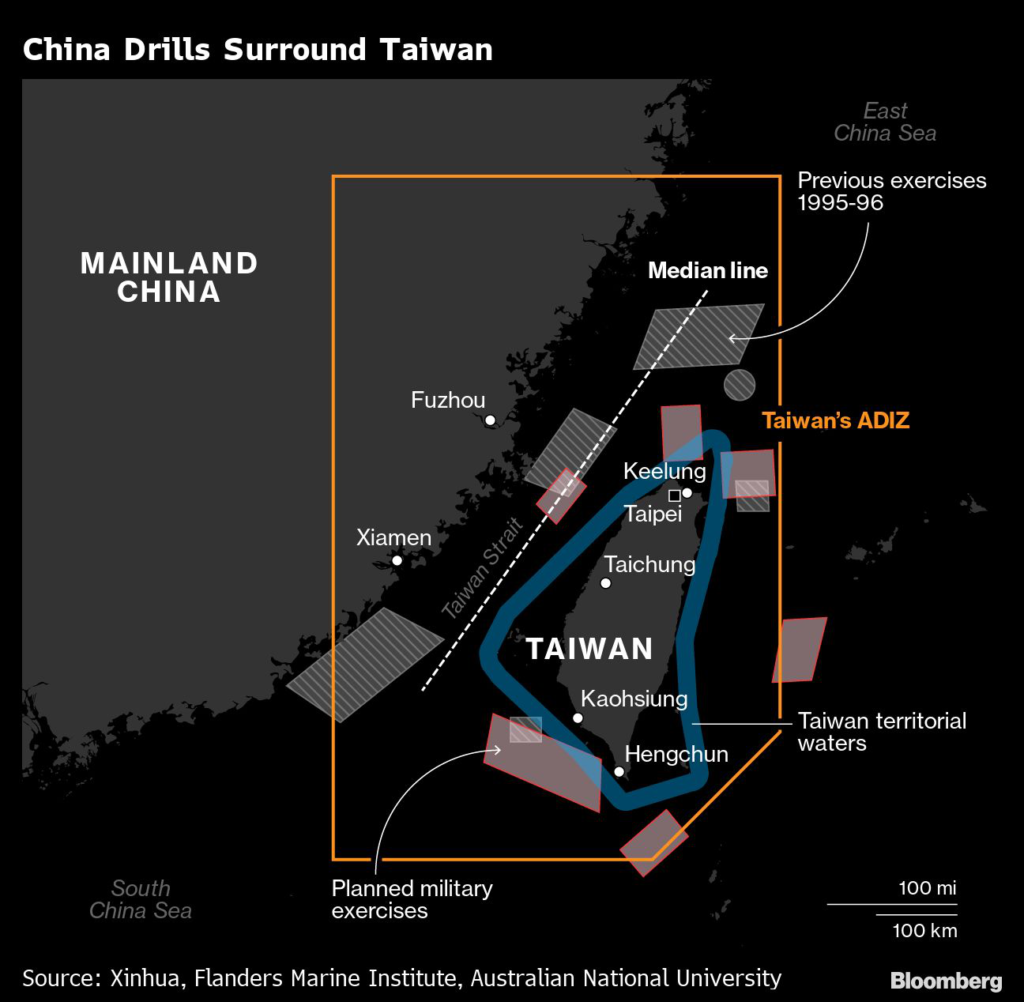
While China’s response disappointed some fervent nationalists, it could still rattle the region. Beijing announced missile tests that may take place anytime, and military drills starting Thursday that show a capability of surrounding the main island of Taiwan — all amounting to China’s most provocative actions in decades. 

The exercises threaten to disrupt shipping and airline routes in Taiwan, one of the world’s most-crucial suppliers of computer chips. Several airlines are planning adjustments to their flights, while pilots of Hong Kong’s Cathay Pacific Airways Ltd. were advised to carry 30 minutes worth of extra fuel for possible rerouting in Taiwan.

Taiwan has condemned the moves, saying they are tantamount to blockading its airspace and sea area. It’s not clear whether the three days of flight restrictions would be extended, adding to concerns over soaring commodity prices and supply-chain risks.

Still, the failure to deter Pelosi from visiting in the first place upset China’s most outspoken patriots. Hu Xijin, the prominent former editor-in-chief of the Global Times, accepted blame on Wednesday for suggesting measures that ultimately proved unfeasible. 

Beijing is clearly in a stronger position than the last major cross-strait crisis in the mid-1990s, but it’s also far away from being able to push the US around. And unlike Russia’s Vladimir Putin, Xi is much more averse to triggering a military conflict that could quickly spin out of control — particularly with no guarantee of success. 

“I don’t think they are eager to change the status quo,” said Bilahari Kausikan, the top bureaucrat in Singapore’s Foreign Ministry until 2013. “To launch an amphibious operation is beyond China’s capability and experience. They have never done something like that and that’s the most difficult kind of military operation.”

Over the years, China has seized on actions from opponents at home and abroad to change the status quo. 

Seizing Opportunities

In 2012, after Japan nationalized a set of uninhabited islands in the East China Sea, China began regular coast guard patrols in the area that never stopped. 

Around the same time, as the US began forcefully opposing China’s territorial claims in the South China Sea, Beijing seized the disputed feature of the Scarborough Shoal and proceeded to militarize other outcrops under its control.

And in 2020, after US politicians supported Hong Kong’s pro-democracy protesters, Xi’s government imposed a sweeping national security law that effectively crushed any opposition.

In a similar way, China could yet use Pelosi’s trip as a way to squeeze Taiwan, hitting the island economically while regularly impeding flights and shipping. On Wednesday, China suspended some fish and fruit imports, and also banned exports of natural sand used in construction. 

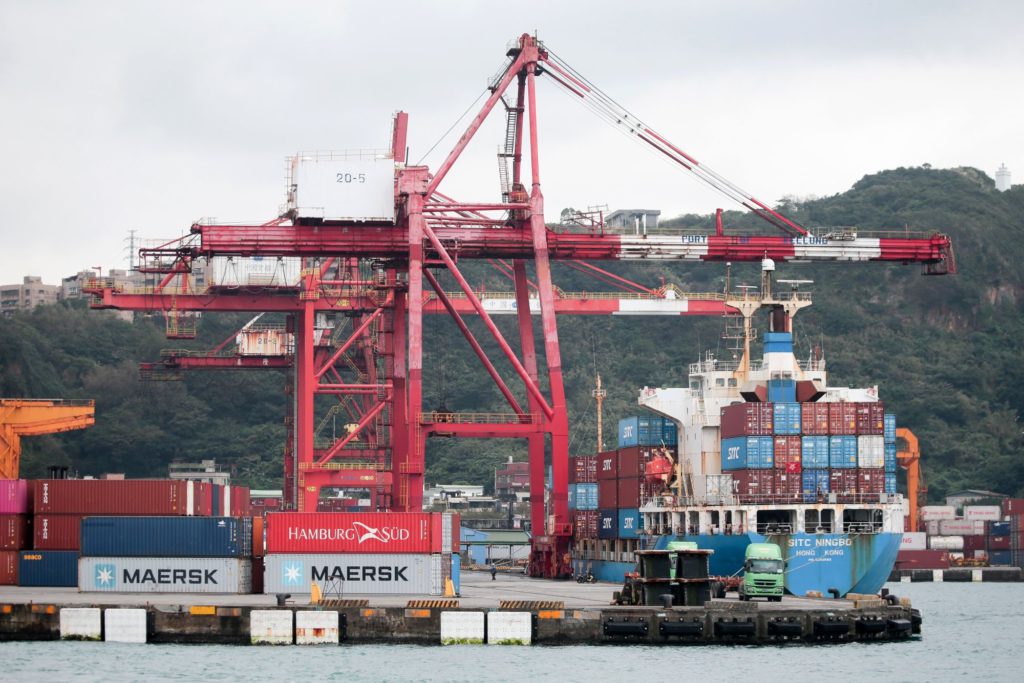
Yet the stakes are also much higher in Taiwan, raising the risk any provocative actions could blow back on China. The strait is one of the world’s busiest shipping lanes, with almost half of the global container fleet and a whopping 88% of the world’s largest ships by tonnage passing through the waterway this year.

China also faces the constant tension of seeking to woo Taiwan’s 23 million people even as it threatens them with force. Any move to seize Taiwan would fundamentally indicate a failure to convince the island’s residents that Beijing offers a better system than the democratic values advocated by the US and its allies.

‘Historic Mission’

At the same time, Xi has staked his legacy on getting Taiwan into the Communist Party’s hands. Last year he declared taking control of Taiwan as the party’s “historic mission” and an “unshakable commitment.”

But while Xi may not be ready for a military strike anytime soon, he’ll still face pressure to act tough — ensuring the Taiwan Strait will be even more of a flashpoint for years ahead. 

“Both sides feel that the other is changing the status quo in dangerous ways,” said Amanda Hsiao, senior analyst at Crisis Group, a Brussels-based policy research organization. “This visit may make any sort of understanding or agreement around Taiwan more difficult to achieve.”

More stories like this are available on bloomberg.com

©2022 Bloomberg L.P.

BMW Says Demand Is Softening as Inflation, Interest Rates Bite

(Bloomberg) — BMW AG says new vehicle orders are retreating from high levels as inflation and higher interest rates hit consumers, making the company the first among major carmakers to turn more cautious. 

The Munich-based manufacturer sees vehicle orders normalizing toward the end of the year, particularly in Europe, it said Wednesday. Current order books are at an all-time high because of pent-up demand due to the ongoing semiconductor shortage. 

“For new incoming orders, we register a reduction compared to last year,” BMW Chief Executive Officer Oliver Zipse said on a call with reporters. The retreat is most noticeable in Europe among the 1- and 2-Series compact vehicles while demand for BMW’s lucrative X-Series SUVs and the 5-Series sedans is still strong, he said. 

BMW stuck to a forecast of automaking returns at between 7% to 9% for the year on the back of strong vehicle prices and model lineup as well as demand for used cars. The manufacturer also said it won’t be able to fully pass on rising materials costs with internal savings helping to soften the impact. 

The company is sounding an early warning bell even as car demand has remained high so far amid a worsening global economic outlook and record inflation. Mercedes-Benz AG as well as others have raised their expectations for the year recently while warning that economic risks are building.  

BMW is the first carmaker “to signal caution on the demand,” Bernstein analyst Daniel Roeska said an a note. “This implies weakening sentiment today, even as production ramps up across the sector.”

The shares slumped as much as 6.2% in Frankfurt, the most since March 10, and declined 5% at 12:10 p.m. 

Gas Savings

The carmaker is also stepping up preparations for a potential gas shortage in Europe. BMW runs 37 gas-powered facilities that generate heat and electricity at its factories in Germany and Austria and is considering turning to local utilities instead.

“Shifting energy generation in that magnitude is not trivial and will be very expensive,” Zipse said. 

He also joined warnings by plastics maker Covestro AG about the impact of a total gas supply shutdown on the broader supplier network. 

“It’s not our direct suppliers, but the suppliers of our suppliers, those whose production is dependent on process gas” who are at risk, Zipse said. “For them, production will come to a standstill pretty soon if natural gas is completely cut off.”

(Updates with CEO comment in third paragraph)

More stories like this are available on bloomberg.com

©2022 Bloomberg L.P.

Telenor’s Thai Unit Merger Seen Delayed by Regulatory Scrutiny

(Bloomberg) — Telenor ASA’s plan to merge its Thai unit with a local mobile operator has run into fresh regulatory scrutiny and objections from a rival that it’s seeking to topple as the Southeast Asian nation’s largest carrier.     

The National Broadcasting and Telecommunications Commission said on Wednesday it needs more information on the proposed merger between Telenor unit Total Access Communication Pcl and True Corp before it can make a decision. The regulator still needs to analyse the structure of the new entity and the impact it will have on competition among other issues, Trairat Viriyasirikul, the commission’s acting secretary-general, said in a statement.

While a set of expert-panels appointed by the commission scrutinized the merger between Thailand’s second- and third-largest operators, their findings were incomplete to determine the potential impact, the regulator said. The commission hasn’t set a deadline for ruling on the planned merger.

The fresh regulatory scrutiny comes amid opposition to the combination from some consumer groups and market leader Advanced Info Service Pcl, backed by Thai billionaire Sarath Ratanavadi and Singapore Telecommunications Ltd. The opponents of the deal have raised monopoly concerns.

The Thai regulator said additional information is needed to design “measures to prevent acts that can cause monopoly or unfair competition in the telecommunication business.” 

Total Access, known as Dtac, and True said in a joint statement on Wednesday that the proposed merger complied with all applicable Thai laws. The companies said the regulator only needs to issue a notification to acknowledge the merger, and is not required to approve or disapprove such plans under the current rules.  

“Thailand needs two strong market players, not one strong and 2-3 weak players, which does not promote effective competition,” the two companies said in the statement. 

Tender Offer

The combined entity, valued at $7.56 billion at Tuesday’s closing price, will have more mobile subscribers than Advanced Info, the current market leader. Total Access and True, backed by Thai conglomerate Charoen Pokphand Group and China Mobile Ltd., are seeking to expand their presence in Internet and startup ventures by joining forces.

Under the terms of the proposed merger, first announced in November, True shareholders will receive 0.60018 shares in the new company for every stock held, while Total Access holders will get 6.13444 shares for every stock owned. True and Total Access will also make a tender offer for shareholders who oppose combining the two companies.

With the regulator planning more scrutiny, True and Dtac will miss a September deadline to list the new company on the Stock Exchange of Thailand. The CP Group would own 29% of the merged entity, Telenor would hold 27% and China Mobile would have 10.4% with the rest being held by minority holders, according to the proposed merger terms.

More stories like this are available on bloomberg.com

©2022 Bloomberg L.P.
Pelosi Vows US Won’t Abandon Taiwan in Face of China Threats

(Bloomberg) — House Speaker Nancy Pelosi pledged that the US wouldn’t abandon Taiwan, reaffirming American support for the democratically elected government in Taipei despite threats of fresh trade curbs and military actions by Beijing. 

Pelosi made her comments on Wednesday during a Presidential Office ceremony with Taiwanese leader Tsai Ing-wen. The California Democrat’s arrival in Taiwan late Tuesday made her the highest-ranking US official to visit in a quarter century, and the most high-profile success in Tsai’s six-year drive to attract greater foreign support and reduce reliance on China.  

“We will not abandon our commitment to Taiwan and we are proud of our enduring friendship,” Pelosi said. “Now more than ever American solidarity with Taiwan is crucial,” she added. “That’s the message we’re bringing here today.”

Tsai said Pelosi’s visit showed Taiwan’s staunch international support in the face of a years-long international pressure campaign led by Beijing, which claims the island as its territory. “Facing deliberately heightened military threats, Taiwan will not back down,” Tsai said, after conferring an award on the visiting US lawmaker. 

China has announced trade sanctions and its most provocative military drills in decades in the wake of Pelosi’s visit, which risks sparking a crisis between the world’s biggest economies. President Xi Jinping told President Joe Biden last week he would “resolutely safeguard China’s national sovereignty and territorial integrity” and that “whoever plays with fire will get burned.”

On Wednesday, Chinese Foreign Minister Wang Yi called Pelosi’s trip a “complete farce” and warned “those who offend China will be punished.” Still, China’s failure to follow through on some of the more extreme measures proposed by nationalists to stop Pelosi from visiting Taiwan left some on the mainland disappointed. 

Taiwanese shares closed 0.2% higher while China’s benchmark CSI 300 Index ended the day 1% lower. Pelosi’s US military plane left Taiwan at 6:01 p.m. local time, with her delegation scheduled to continue on to South Korea and then Japan. 

The House speaker’s vow to stand by Taiwan comes against long-running uncertainty over whether Washington would come to Taipei’s aide to prevent an invasion by Beijing. The US has faced calls for a clearer commitment to defend Taiwan following Russia’s invasion of Ukraine, which American weapons deliveries helped slow but couldn’t prevent. 

Andrew Gilholm, director of analysis for China and North Asia at Control Risks, said Pelosi’s pledge not to abandon Taiwan was “deliberately vague and rather meaningless.” 

“It’s kind of a cost-free statement because it obviously doesn’t reflect administration policy or is a change of policy,” Gilholm said.

Taiwan faced cyber-attacks late Tuesday, with the presidential office saying it suffered a 20-minute barrage in the early evening hours that was 200 times worse than usual. The Taiwanese Defense Ministry denounced China’s drills as “armed intimidation” and pledged to respond at the appropriate time.

John Kirby, spokesman for the National Security Council, said at a White House briefing that there was no reason “for Beijing to turn this trip, which is consistent with long-standing US policy, into some sort of crisis or use it as a pretext to increase aggressiveness and military activity in or around the Taiwan Strait.” The US had previously moved an aircraft carrier battle group into the region as part of what it said was a previously scheduled operation. 

Pelosi’s trip is the most high-profile among a wave of “unofficial” visits by foreign leaders in recent years, despite successful Chinese efforts to lure away Taipei’s formal diplomatic partners and block it from participating in international organizations. The House speaker touted US legislation that would support the chip industry and said an economic agreement with the US and Taiwan was imminent. 

“I just hope that it’s really clear that while China has stood in the way of Taiwan participating and going to certain meetings, that they understand that they will not stand in the way of people coming to Taiwan,” Pelosi said, adding that she didn’t want to see “anything happen to Taiwan by force.” 

The White House has sought to dial back rising tensions with China, emphasizing that Congress is an independent branch of government. Pelosi is the highest-ranking American politician to visit Taiwan since then-House speaker Newt Gingrich did so in 1997. That came after the last major Taiwan crisis, when China similarly declared drills near Taiwan and lobbed missiles into the sea near its ports. 

Under their 1978 agreement to normalize relations, the US recognized only Beijing as the seat of China’s government, while acknowledging — but not endorsing — the Chinese position that there is but one China and Taiwan is part of it.

The US has insisted that any unification between the island and mainland must be peaceful, and supplied Taiwan with advanced weaponry while remaining deliberately ambiguous about whether US forces would help defend against a Chinese attack. Biden said in May that Washington would intervene in such a crisis, before the White House later clarified he was referring to weapons sales done in accordance with existing agreements.

“Everyone will be extremely conscious of tensions and vigilant for any sudden moves,” Amanda Hsiao, a senior analyst at Crisis Group based in Taiwan, told Bloomberg Television. “This is a moment where all three sides have to tread cautiously to avoid dangerous encounter or misreading during what’s going to be extremely tense period of time.”

(Updates with Pelosi’s departure in seventh paragraph.)

More stories like this are available on bloomberg.com

©2022 Bloomberg L.P.
US Futures Rise as Pelosi Completes Taiwan Visit: Markets Wrap

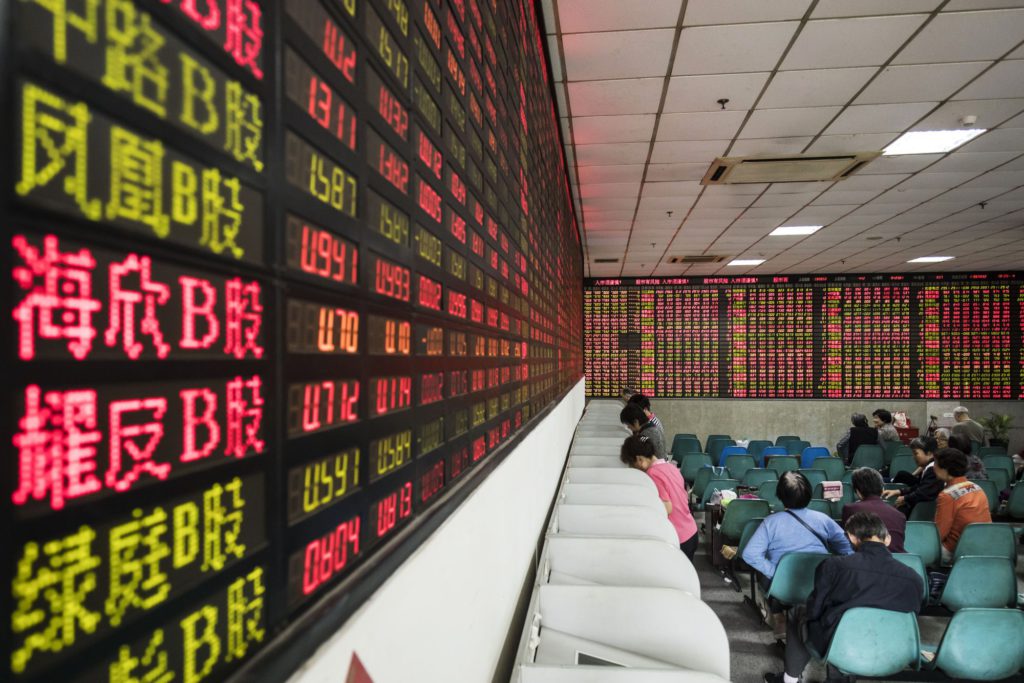
(Bloomberg) — US stock futures climbed on Wednesday as some of the investor anxiety over tense US-China ties eased, while Treasuries extended a slide sparked by hawkish Federal Reserve comments.

S&P 500 futures and contracts on the Nasdaq 100 both rose by about 0.4%. Europe’s Stoxx 600 was little changed as investors assessed signs of resilience in the latest company earnings. Societe Generale SA rallied as the French lender outlined new revenue targets and pledged higher profitability. BMW AG dropped after cutting its delivery outlook due to ongoing supply-chain snarls. 

US House Speaker Nancy Pelosi completed a visit to Taiwan that has provoked an angry response from China, with markets calmer compared with the wave of anxiety that washed across assets ahead of her arrival. The yen and a dollar gauge were little changed.

Read more: Strategists Fear Pelosi Trip to Have Deeper Global-Market Impact

The two-year Treasury yield added to its advance beyond 3% following a selloff in bonds on Tuesday sparked by Fed officials indicating the central bank has some way to go to curb inflation. That lead traders to trim wagers on policy easing in 2023. 

While an immediate concern around US-China tensions may be fading Wednesday, investors still face a host of worries including inflation and how the policy response by central banks to surging prices could hobble global growth. Equities trading doesn’t reflect the headwinds confronting the market, according to Goldman Sachs Group Inc. strategist Sharon Bell.

“There’s a little bit of complacency in there and markets are not fully taking into account the risks,” Bell said in an interview with Bloomberg TV.

MSCI Inc.’s Asia-Pacific equity index slipped 0.2% in a mixed day that included a jump in Chinese technology shares. 

In US premarket trading, Airbnb Inc. fell after the home-rental company missed estimates on bookings. Match Group Inc. sank after the parent to dating apps including Tinder, OkCupid and Hinge gave a weak revenue forecast.

Fed Signals

Meanwhile, comments from Fed officials including Mary Daly, Loretta Mester and Charles Evans served to highlight a challenging backdrop of rising borrowing costs, price pressures and slowing economic growth.

San Francisco Fed President Daly said the Fed has “a long way to go” on reaching price stability around a 2% inflation target. Cleveland counterpart Mester said she wants to see “very compelling evidence” that month-to-month price increases are moderating.

Elsewhere, oil traded at about $94 a barrel ahead of an OPEC+ crude production meeting. Gold climbed and Bitcoin held above $23,000.

This week’s MLIV Pulse survey is asking about your outlook for corporate bonds, mergers and acquisitions and health of US corporate balance sheets through the end of the year. It takes one minute to participate in the MLIV Pulse survey, so please click here to get involved anonymously. 

What to watch this week:

  • OPEC+ meeting on output, Wednesday
  • US factory orders, durable goods, ISM services, Wednesday
  • BOE rate decision, Thursday
  • US initial jobless claims, trade, Thursday
  • Cleveland Fed President Loretta Mester due to speak, Thursday
  • US employment report for July, Friday

Some of the main moves in markets:

Stocks

  • The Stoxx Europe 600 was little changed as of 10:54 a.m. London time
  • Futures on the S&P 500 rose 0.4%
  • Futures on the Nasdaq 100 rose 0.4%
  • Futures on the Dow Jones Industrial Average rose 0.4%
  • The MSCI Asia Pacific Index fell 0.1%
  • The MSCI Emerging Markets Index rose 0.1%

Currencies

  • The Bloomberg Dollar Spot Index was little changed
  • The euro rose 0.2% to $1.0185
  • The Japanese yen was little changed at 133.16 per dollar
  • The offshore yuan rose 0.3% to 6.7609 per dollar
  • The British pound was little changed at $1.2168

Bonds

  • The yield on 10-year Treasuries was little changed at 2.76%
  • Germany’s 10-year yield advanced five basis points to 0.86%
  • Britain’s 10-year yield advanced two basis points to 1.89%

Commodities

  • Brent crude fell 0.9% to $99.66 a barrel
  • Spot gold rose 0.3% to $1,765.07 an ounce

More stories like this are available on bloomberg.com

©2022 Bloomberg L.P.
China Hits Taiwan With Trade Curbs Amid Tensions Over Pelosi

(Bloomberg) — China halted some trade with Taiwan in retaliation to the high-profile visit of US House Speaker Nancy Pelosi to the island, with more disruptions likely as political tensions intensify.

China suspended some fish and fruit imports from Taiwan, citing excessive pesticide residue detected on products since last year and some frozen fish packages that tested positive for coronavirus in June. Exports of natural sand, used in construction, were also banned. 

With Taiwan’s agricultural exports accounting for only 0.6% of total exports last year, according to DBS Group Holdings Ltd., and China’s sand exports to the island amounting to just over $1 million last year, the trade bans imposed so far are likely to have only a marginal impact on Taiwan’s economy. However, the bigger risk is if Beijing widens the restrictions or shipments are disrupted as China conducts military exercises around the island.

“What needs to be watched is whether Beijing will broaden the trade bans into the manufacturing sector, particularly semiconductors/electronics going forward,” said Ma Tieying, senior economist at DBS. 

Chinese customs data show Beijing has also blocked the imports of over 2,000 food items from Taiwan out of about 3,200, spanning products from tea to biscuits to fish. It’s unclear when the imports were suspended though. On Monday, Taiwan media reported that China banned food imports from more than 100 of the island’s suppliers.

Beijing has often targeted Taiwan’s agricultural industry for punishment over political issues. Many of southern Taiwan’s fruit-producing regions are typically bastions of political support for President Tsai Ing-wen’s Democratic Progressive Party, which advocates for Taiwan’s formal independence. 

China is Taiwan’s largest trading partner, with bilateral trade rising 26% on year to $328.3 billion last year. Taiwan held a sizable surplus against China, with exports from the island exceeding imports by $172 billion, according to Chinese customs data. While Beijing could leverage that advantage by sanctioning exporters, China also relies on Taiwan for semiconductor supplies.

About a fifth of Taiwan’s total agricultural exports, or $1.12 billion, was shipped to China last year.

Shipping Disruptions

Even Pay, an analyst at consultancy Trivium China in Beijing, said more trade disruptions can be expected between China and Taiwan while tensions remain high. She said it was “common practice” for Beijing to identify minor compliance issues and enforce rules very strictly with trade partners, citing the example of Canadian canola after Meng Wanzhou, chief financial officer of Huawei Technologies Co., was detained.

“It looks like stepped up military exercises announced Tuesday night may disrupt shipping in the region through Sunday at least, particularly into ports in Taiwan and Fujian, but also for any cargoes that might typically pass through the area around Taiwan,” said Pay.

The disruptions, especially on the western coast of Taiwan facing the straits, however, may deal a heavy blow to the island’s commodity imports. Taiwan accounts for 5% of global coal imports, 5% of global LNG imports, 2% of global crude oil imports, 2% of global clean oil products, and 1% of global LPG imports, according to Banchero Costa & Co.

“For energy, Taiwan is almost entirely reliant on imports, hence a potential blockade on imports would be a disaster for the Taiwanese economy,” said Ralph Leszczynski, head of research at the shipbroker.

China caught Taiwan off guard last year when it suddenly blocked pineapple imports from there. Beijing later halted imports of wax and sugar apples last September. While most fruit produced in Taiwan is consumed domestically, the vast majority of exports go to China.

Taiwan downplayed the sand export ban on Wednesday, with the Ministry of Economic Affairs saying in a statement that the impact will be “limited.” 

With grains about 5 millimeters wide or less, natural sand is typically used to produce things like concrete and asphalt. Sands used in Taiwan’s construction industry, though, are mostly from the island, its Finance Minister Su Jain-rong said. Taiwan imported about 20,000 metric tons of natural sand from China in the first half of this year, according to the economic affairs ministry.

China previously halted natural sand exports to Taiwan in March 2007, citing environmental concerns, and lifted the ban about one year later. Taiwan activated a contingency plan at the time, including importing materials from the Philippines and using local river sand to close the gap. 

Taiwan imported 5.67 million metric tons of sand and gravel in 2020, with natural sand constituting about 8% of total, according to a report from Taiwan’s Ministry of Economic Affairs. More than 90% of Taiwan’s imported sand and gravel is from China, due to much higher transportation costs from other countries like Vietnam, the report said.

(Updates with an analyst quote and additional details.)

More stories like this are available on bloomberg.com

©2022 Bloomberg L.P.
Close Bitnami banner
Bitnami