Bloomberg

Uber Exits Online Food Delivery in India With Zomato Share Sale

(Bloomberg) — Uber Technologies Inc. sold its 612 million shares in India’s Zomato Ltd. at a discount, marking the ride-hailing giant’s exit from the country’s online food-delivery market following the expiry of an investor lock-up period.

Zomato fell 0.2% to close at 55.45 rupees (0.7 US cents), after dropping as much as 9.5% shortly after opening on Wednesday.

Uber off loaded the shares at 50.44 rupees apiece on Wednesday, BSE exchange data showed, after the stock was offered up in a block trade between 48 rupees and 54 rupees, according to terms of the deal seen by Bloomberg News late Tuesday. BofA Securities was the sole bookrunner of the trade. 

Uber’s retreat follows its sale of Uber Eats in India to Zomato in exchange for a 9.99% stake in 2020. Zomato raised $1.3 billion with its offering about one year ago, opening room for a slew of Indian startups that tapped investors through public offerings in the South Asian country. But the shine has come off and their shares have retreated as doubts persist about the valuations of loss-making technology firms.

Zomato, which is renaming itself to Eternal Ltd. and appointing new management, also saw its stock plummet last week following the end of its early investor lock-up. Pre-IPO investors in the New Delhi-based company include China’s Ant Group Co., Info Edge India, Uber and Sequoia Capital. 

Indian daily Business Standard first reported on Tuesday that Uber is the holder disbursing the shares. A spokesman for Uber didn’t immediately respond to a request for comment. 

Zomato shares jumped 20% on Tuesday, the most since its debut last year, as a number of block trades changed hands after it released its quarterly performance report. The result showed a smaller-than-expected loss and revenue in line with analyst expectations. Indian exchange data on Wednesday showed Fidelity’s emerging markets fund buying up 54.4 million shares, while ICICI Prudential Life Insurance Co. Ltd. purchased 45 million.

More stories like this are available on bloomberg.com

©2022 Bloomberg L.P.

French Tycoon Seeks to Acquire Vodafone Ghana in All-Cash Deal

(Bloomberg) — Telecel Group, headed by French tycoon Hugues Mulliez, said it’s in talks with Ghanaian authorities to get approvals for a deal to buy Vodafone Group Plc’s operations in the West African country in an all-cash deal.

The company said in a statement on Wednesday it’s signed a sales agreement with Vodafone for its operations in Ghana, as the British telecommunications giant looks to refocus on key markets. It hasn’t received approvals for the deal yet.

Read More: Vodafone Agrees to Sell Stake in Ghana Operations to Telecel

The tycoon, who’s a shareholder in the Association Familiale Mulliez — owner of French retailers including Decathlon and Leroy Merlin — will fund the acquisition with Telecel’s partners. The potential sale of Vodafone Ghana’s towers aren’t being considered as part of the the deal funding.

Telecel plans to spend about $500 million in the first three years to expand and refinance Vodafone’s network across the country.

Vodafone entered Ghana in 2008, when it paid the government $900 million for 70% of Ghana Telecommunications Co. The state retains a 30% holding in the business.

More stories like this are available on bloomberg.com

©2022 Bloomberg L.P.

Global Payments Agrees to Buy Evo for $3.36 Billion

(Bloomberg) — Global Payments Inc. agreed to buy Evo Payments Inc. to expand into new markets in Europe and South America. 

The equity value of the transaction is $3.36 billion, according to a spokesperson for Global Payments. The buyer will pay $34 a share, according to a statement Monday. That’s about 24% higher than the closing price Friday and roughly 40% above the stock’s 60-day average price.

“The acquisition of Evo is highly complementary to our technology-enabled strategy, and provides meaningful opportunities to increase scale in our business globally,” Global Payments Chief Operating Officer Cameron Bready said in the statement.

The payments sector has been consolidating following a period of rapid growth that accelerated when the pandemic intensified consumers’ shift away from using cash. Global Payments last year agreed to buy real estate software company Zego from Vista Equity Partners in an all-cash transaction valued at $925 million.

The Evo transaction will expand Global Payments’ presence in new regions including Poland, Germany and Chile, and enhance its scale in existing markets such as the US, Canada, Mexico, Spain, Ireland and the UK, according to the statement.

(Corrects equity value in headline and second paragraph in story published Monday.)

More stories like this are available on bloomberg.com

©2022 Bloomberg L.P.

Automakers Blitz Congress to Fix an EV Tax Credit They Can’t Use

(Bloomberg) — Automakers including Ford Motor Co., General Motors Co. and Toyota Motor Corp. are making a last-ditch lobbying push to change Democrats’ proposed new spending bill over concern that they stand to lose out from strict new limits on electric-vehicle credits.

An extension of the popular $7,500 tax credit available to EV buyers was included in the surprise breakthrough deal reached by Senator Joe Manchin and Senate Majority Leader Chuck Schumer last week. Manchin, a West Virginia Democrat, has long been a skeptic of the credit, dismissing it as “ludicrous” and arguing that it subsidizes production of Chinese-made batteries.

The extension was a huge win for companies such as General Motors Co. and Tesla Inc. that had reached a 200,000-EV-sales threshold at which the perk begins to phase out. But to win Manchin’s support, the credits also included tough new limits on how much the EVs can cost, how much income their buyers can earn, and where the batteries and vehicles are made. With the Senate seeking to pass the hard-fought compromise bill in coming days, automakers are running out of time to get the tax-credit rules tweaked.

“Unfortunately, after they are implemented, at this point it looks like companies won’t be able to use them in the short run,” Senator Debbie Stabenow, a Michigan Democrat who has been instrumental in the negotiations over the credits, said in an interview. 

Limiting the credit could hamper President Biden’s ambitious goal of making 50% of new-vehicle sales emission-free by 2030, a move he said was needed to help curb ever-worsening climate change. Anyone seeking big changes to the climate and spending package face long odds because of the momentum among Senate Democrats who have been seeking a deal that Manchin would bless for over year.

So far, automakers aren’t making much headway, with senators unwilling to consider any substantial changes that would upset support for the bill, according to people familiar with the talks who asked not to be identified.

Content Restrictions

Among the restrictions of most concern: Requirements that would render EVs made with any battery components manufactured by China and other “foreign entities of concern” ineligible to receive the credit after 2023. And beginning in 2025, that prohibition extends to the use of any critical mineral in a battery that is extracted or processed by those countries. 

That could pose a big hurdle to automakers who have a connection to the Chinese supply chain. The processing of critical minerals typically used in EV batteries, such as lithium, nickel cobalt, and manganese, is done almost exclusively in China, Morgan Bazilian, director of the Payne Institute at the Colorado School of Mines, said in an interview.

“The processing piece is an enormous issue for all of this,” Bazilian said. “What battery manufacturers need is processed chemicals, not rocks.” 

Ford, General Motors, Toyota and Stellantis NV are lobbying for more time to comply with those content requirements, according to people familiar with the matter. The companies are making their case to lawmakers including Manchin, Schumer and Stabenow to extend the start of those requirements by multiple years, the people said.

Other automakers, such as electric car maker Rivian Automotive LLC, are lobbying to extend the transition time before new limits on vehicle price and income for buyers take affect. The Senate spending deal would cap the credit to an income level of $150,000 for a single filing taxpayer and $300,000 for joint filers for new vehicles. It also includes a cap on the suggested retail price of eligible vehicles of $55,000 for new cars and $80,000 for pickups and SUVs. 

That effectively excludes many Rivian models, which cross that price point as options to the vehicles are added, James Chen, vice president of public policy for Rivian, said in an interview. The company has sold roughly 7,000 vehicles, far from the existing 200,000 vehicle cap, but the new limits would take affect starting in 2023. 

“If the legislation is passed as drafted it pulls the rug out — it cuts Rivian out entirely,” said Chen. “Congress is throwing up a big stop sign to American-made electric trucks and SUVs.”

Sales Cap

General Motors said it’s eager to remove the 200,000-vehicle limit for individual manufacturers — a level that both it and Tesla hit in 2018, triggering a phaseout on the credit available to buyers of their EVs. “We remain hopeful that Congress will advance legislation to address energy and economic security that includes a modification to the EV tax credit,” a GM spokesman said in an email.

Discussions about potential tweaks to the credit are ongoing, Senator Gary Peters, another Michigan Democrat, said in an interview. But any changes to the fragile deal could be fraught. Manchin, whose opposition earlier prompted Democrats to ax a proposed $4,500 addition to the credit, has very publicly railed against the incentive, arguing  it would subsidize Chinese battery producers. 

“We’re making our batteries for our cars to be here, made in America, before you get any credits whatsoever,” Manchin said on CNN Sunday. The deal he eventually agreed to also includes billions in funding for the construction of new clean-vehicle manufacturing facilities and other incentives to help automakers comply.

The underlying legislation, which over all contains some $370 billion in funding for tax credits and other measures to combat climate change, also includes aid to help automakers develop a domestic battery supply chain. 

It includes as much as $20 billion in loans for the construction of new clean-vehicle manufacturing facilities, $2 billion in grants to retool existing auto-manufacturing facilities to make clean vehicles and a $10 billion investment tax credit to build clean-technology production sites, according to a summary of the bill by the Zero Emission Transportation Association. 

“Nearly every part of the effort to secure our supply chain is getting some level of support in the bill,” Joe Britton,  the head of the Zero Emission Transportation Association, said in an interview. 

(Adds comment from association head in last paragraph.)

More stories like this are available on bloomberg.com

©2022 Bloomberg L.P.

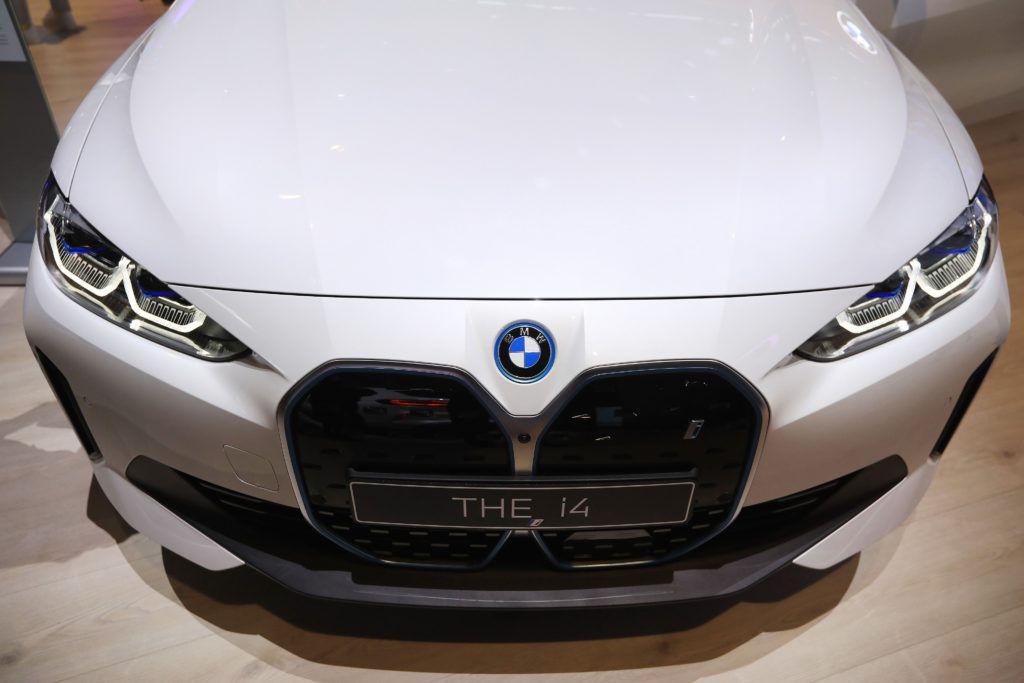
BMW Sees Demand Softening as Inflation, Interest Rates Bite

(Bloomberg) — BMW AG says new vehicle orders are retreating from high levels as inflation and higher interest rates hit consumers, making the company the first among major carmakers to turn more cautious. 

The Munich-based manufacturer sees vehicle orders normalizing toward the end of the year, particularly in Europe, it said Wednesday. Current order books are at an all-time high because of pent-up demand due to the ongoing semiconductor shortage. 

“For new incoming orders, we register a reduction compared to last year,” BMW Chief Executive Officer Oliver Zipse said on a call with reporters. The retreat is most noticeable in Europe among the 1- and 2-Series compact vehicles while demand for BMW’s lucrative X-Series SUVs and the 5-Series sedans is still strong, he said. 

Demand for electric vehicles has stayed strong across the board and battery-only cars are set to account for 10% of total deliveries this year, he added. 

BMW stuck to a forecast of automaking returns at between 7% to 9% for the year on the back of strong vehicle prices and model lineup as well as demand for used cars. The manufacturer also said it won’t be able to fully pass on rising materials costs with internal savings helping to soften the impact. 

The company is sounding an early warning bell even as car demand has remained high so far amid a worsening global economic outlook and record inflation. Mercedes-Benz AG as well as others have raised their expectations for the year recently while warning that economic risks are building.  

BMW is the first carmaker “to signal caution on the demand,” Bernstein analyst Daniel Roeska said an a note. “This implies weakening sentiment today, even as production ramps up across the sector.”

The shares slumped as much as 6.2% in Frankfurt, the most since March 10, and declined 5% at 12:10 p.m. 

Gas Savings

The carmaker is also stepping up preparations for a potential gas shortage in Europe. BMW runs 37 gas-powered facilities that generate heat and electricity at its factories in Germany and Austria and is considering turning to local utilities instead.

“Shifting energy generation in that magnitude is not trivial and will be very expensive,” Zipse said. 

He also joined warnings by plastics maker Covestro AG about the impact of a total gas supply shutdown on the broader supplier network. 

“It’s not our direct suppliers, but the suppliers of our suppliers, those whose production is dependent on process gas” who are at risk, Zipse said. “For them, production will come to a standstill pretty soon if natural gas is completely cut off.”

(Updates with CEO comment in fourth paragraph.)

More stories like this are available on bloomberg.com

©2022 Bloomberg L.P.

This $500 Machine Makes Cocktails and Coffee. Just Add Water (and Capital)

(Bloomberg) — Like robot pizza makers or autonomous baristas, an area of food technology that has captivated numerous venture capitalists is at-home drink machines. Cana Technology Inc. has been pitching an all-in-one beverage maker that can produce cocktails, coffee, seltzer or wine by adding water to its machine-mixed concoctions. The company is backed by the Production Board, which counts Alphabet Inc. and Laurene Powell Jobs as investors and said in January that it had poured $30 million into Cana and planned to expand its staff.

But in a sign of how quickly the venture capital market has turned, Cana’s subsequent fundraising efforts have stalled, and the startup in June quietly laid off 16% of its staff, said people familiar with the business. The cuts included the heads of the company’s product and marketing divisions.

Cana is still actively seeking funds, said Rachel Konrad, a spokeswoman for the Production Board, which incubated Cana and is the primary backer. The staff cuts were a result of supply chain issues that delayed the product’s debut and eliminated the need for certain jobs, she said. Cana is now hiring for several new roles, Konrad said.

The vision for Cana is to build “the world’s first molecular beverage printer.” Whereas a Keurig cup contains a tiny filter and some coffee grounds, Cana mixes together ingredients from various replaceable cartridges, containing alcohol, sugar and other elements, to concoct a simulacrum of a drink chosen from the device’s touchscreen. The company says the product will begin shipping to the first customers next year for $499, and the price will eventually jump to $799. There’s also a membership fee of at least $49 a month.

Cana will require more work to deliver on its vision. Matt Mahar, the chief executive officer, demonstrated a Cana prototype to a reporter in March at the company’s Redwood City, California, headquarters. The grapefruit sparkling water was what you’d expect from a can or a SodaStream: citrusy and effervescent. But the cold brew coffee was watery, and the mimosa tasted like a Capri Sun masquerading as a cocktail. (The Production Board spokeswoman said customers will be able to select an option on the machine to make the coffee stronger.)

A new age of austerity in Silicon Valley threatens unproven hardware projects like Cana’s, said Brian Frank, the founder and general partner of FTW Ventures, which invests in food and agriculture companies. Funding to technology startups last quarter fell the most in over a decade. Job cuts and hiring freezes are widespread across the technology industry, but making electronics typically requires much more capital and time than software. Makers of electric bicycles, electric cars and autonomous vehicles have made significant cutbacks just in the last month.

“Cana has a really audacious goal of trying to make the Star Trek replicator for beverages,” Frank said. “There’s a couple different miracles that need to happen for their business to be successful.”

The company, too, sees itself in missionary terms. The name is a reference to Cana of Galilee, the site where Jesus is believed to have turned water into wine.

Venture capitalists have pursued countertop drink machines in various forms for years, among them the phenomenally successful  SodaStream and the ill-fated Juicero. Work on Cana began in 2019 as a research project within the Production Board, which is run by Dave Friedberg, who sold a previous company, Climate Corp., to Monsanto for $1 billion in 2013. Friedberg said in January that Cana spent years developing a catalog of beverages by turning up and dialing down different ingredients to simulate profiles found in complex drinks.

As part of its beverage development process, the company holds blind taste tests to compare them with options already on the market. Several years ago, staff were asked to sample a wine that unintentionally evoked the taste and smell of barbecue sauce, according to two people who were present for the tasting.

The Production Board specializes in the creation and funding of new agriculture, health and bio-manufacturing businesses and says its goal is to “reimagine Earth.” One of Cana’s main goals is to reduce waste associated with bottling and transporting beverages, the company says. The Production Board established Cana as a standalone business and in February, brought in Mahar, a former product manager at  Nike Inc. and Vivint Smart Home Inc.

Mahar has expressed ambitious expectations for the company. A month on the job, Mahar told Bloomberg he planned to nearly double headcount by the end of the year to 100. His pitch to prospective investors in recent months projected annual revenue of $1 billion within five years, said people familiar with the presentation who asked not to be identified because the details are private.

The latest fundraising hasn’t gone smoothly. Cana had been seeking $60 million to $80 million, at least double what the Production Board had put into the company so far, the people said. Securing investment has taken longer than anticipated and was a factor contributing to the layoffs, the people said. But the effort continues.

Once the product becomes available, the membership fee will give customers refills of the ingredient cartridges by mail. (Alcohol cartridges cost $39 apiece.) Cana is looking to nail the main drinks and expand the catalog for subscribers over time, Mahar said in March. He envisions Cana could eventually add smoothies and food. Asked whether they would resemble real meals or something like the roast beef gum from Willy Wonka and the Chocolate Factory, Mahar lit up. Willy Wonka, he said coyly, was an inspiration for the company.

More stories like this are available on bloomberg.com

©2022 Bloomberg L.P.

Nick Clegg Returns to London in Meta Shift to Remote Work

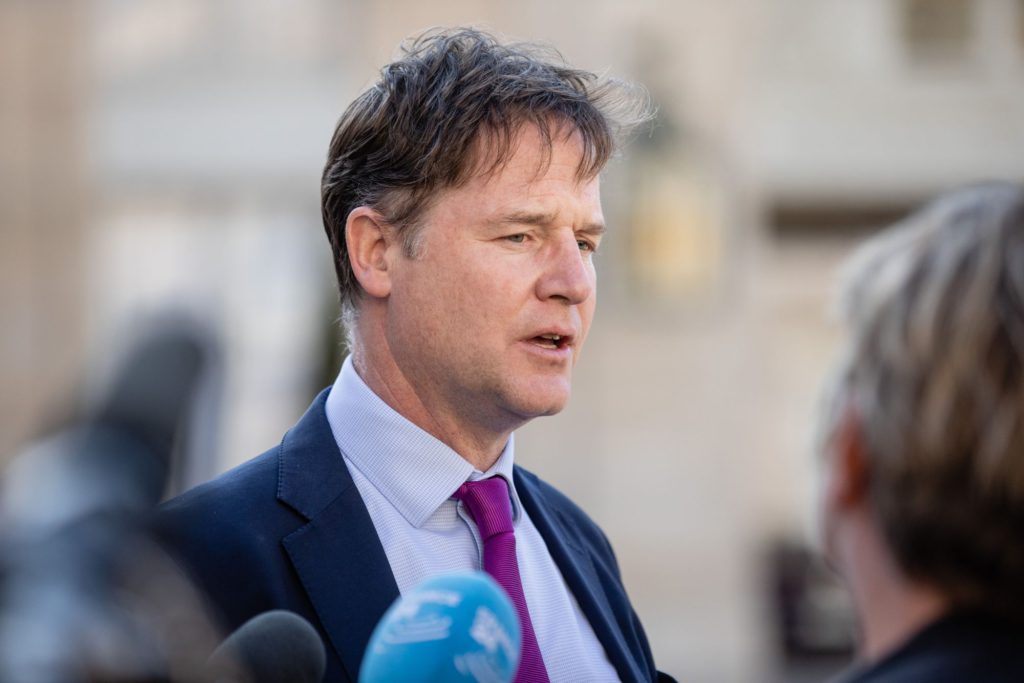
(Bloomberg) — Nick Clegg, Meta Platforms Inc.’s president of global affairs, has become the latest top executive from the social media giant to relocate to London. 

Clegg will split his time between California and London, which will be a base for traveling to represent Meta’s interests in government relations and policy, a spokesperson said. 

The head of Meta’s Instagram business, Adam Mosseri, will also move to London, which serves as the company’s largest engineering base outside of the U.S. Alex Schultz, Meta’s head of marketing and analytics, has also relocated to the British capital, according to his LinkedIn profile. 

The U.K. has been striving to attract tech talent, and Meta’s location in King’s Cross was opened by the Prince of Wales and Duchess of Cornwall in 2022. The London offices house more than 4,000 employees including a team dedicated to Instagram. 

The moves were first reported by the Financial Times. 

Once serving as the leader of the Liberal Democrats and deputy prime minister, Clegg joined Facebook in 2018 as vice president for global affairs and communication. He relocated with his family to California after taking up the position.

Meta has previously said that employees who leave Silicon Valley may face pay cuts, but the spokesperson didn’t confirm whether Clegg’s pay would be docked due to the move.

Along with other Meta executives, Clegg’s move represents a shift to remote leadership. In June, the company announced it would allow all full-time employees to apply to work remotely if possible. Chief Information Security Officer Guy Rosen is now based in Israel, according to a report in the Financial Times. Chief Executive Officer Mark Zuckerberg spends much of his time at his home in Hawaii. 

More stories like this are available on bloomberg.com

©2022 Bloomberg L.P.
Infineon, AMD Stock Prices Show Diverging Fortunes in Chip Industry

(Bloomberg) — With an industrywide boom in semiconductor sales running out of steam, the sector is dividing into two camps. 

Chip companies that cater to automakers, data centers and industrial firms are still trying to keep up with demand, while those exposed to consumer electronics are stuck with inventory as sales slow. 

The results are playing out in the stock market, with Infineon Technologies AG and Advanced Micro Devices Inc. the latest examples. Infineon shares rose Wednesday after the company increased its revenue forecast thanks to auto-industry demand, while AMD fell after saying a slump in the personal-computer business will crimp revenue. 

“We always had people making a blanket statement for chips in general,” said Dan Morgan, a senior portfolio manager at Synovus Trust Co., which has about $21.7 billion in assets under management. “You can draw a line in the sand right now.”   

Sales of both memory and PC chips got boosts during the pandemic as demand surged for mobile phones, computers and other work-from-home electronics. The catalysts driving those products are now fading, said Morgan.

A string of companies have reported in line with the divergent trends. 

Texas Instruments Inc. and NXP Semiconductors NV issued bullish forecasts last month on strong demand for industrial and auto products, and their shares have risen since then. Apple Inc. supplier SK Hynix Inc. and Qualcomm Inc. announced underwhelming outlooks tied to a dip in demand for consumer electronics, and their stocks have fallen. Memory-chip maker Micron Technology Inc. is an outlier, with its stock gaining since June 30, when it published a surprisingly downbeat forecast.   

Intel Corp., the biggest maker of personal-computer processors, last week also slashed sales and profit forecasts for the rest of the year. The stock is down about 10% since then.

“Intel suffers from significant overshipping in the PC channel in past several quarters,” Tristan Gerra, an analyst at Robert W. Baird & Co., wrote in a note. “Shift in consumer patterns away from Covid-times at-home entertainment devices, combined with weak first-half seasonality, suggests no PC recovery near-term.”

Intel also shocked Wall Street with an unexpected 16% drop in revenue from expensive server chips that power data centers, a sector that is still seeing healthy demand but heightened competition from the likes of AMD and Nvidia Corp.  

The Chip Supply Chain Is Getting Harder to Trade: Tech Watch

Global semiconductor revenue, which jumped by more than 26% last year, will increase 7.4% in 2022 and drop 2.5% next year, according to research firm Gartner, with chip sales from personal computers set to fall 5.4% in 2022.

With a slowdown on the horizon, chip stocks are already one of the cheapest sectors in the Nasdaq 100 Index. Among the least-expensive stocks in the tech-heavy benchmark are Micron at 9.2 times estimated earnings for the next year, Qualcomm at 11 and NXP at 13, versus the index at 22 times.

“Right now it’s better to focus on the areas of the semiconductor industry that are seeing faster growth, like data center, while auto-focused chips should also continue to be a good market despite supply shortages,” said Margaret Patel, senior portfolio manager at Allspring Global Investments.

Tech Chart of the Day 

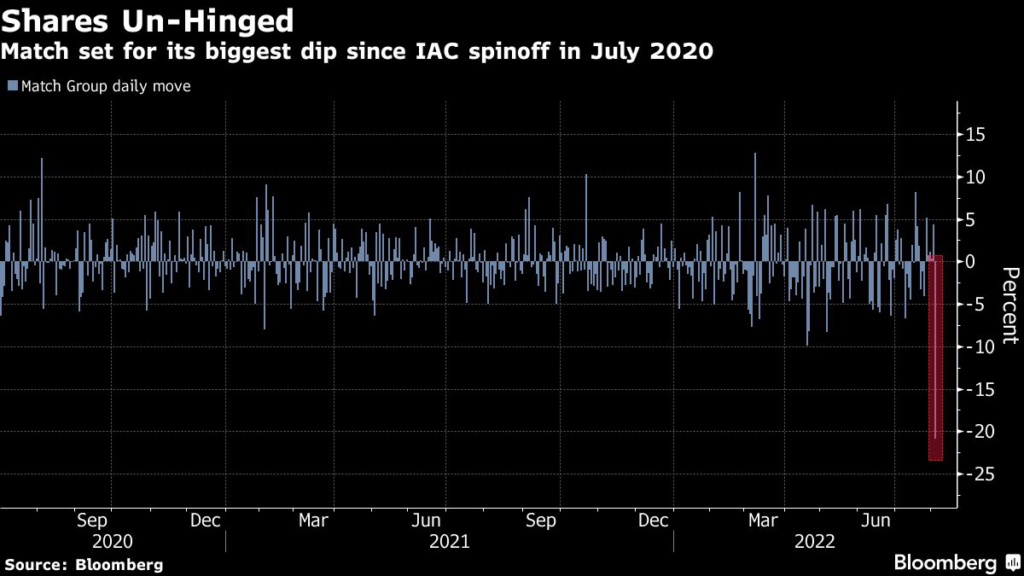
Shares of Match Group Inc., which owns dating apps including Tinder, OkCupid and Hinge, tumbled 21% Wednesday after the company issued a weaker-than-expected forecast. If the losses hold, it could set the company up for its biggest dip since it was spun off from IAC in July 2020. Rival dating company Bumble, which reports earnings next week, dropped 5.2%.

Top Tech Stories

  • Nintendo Co. reported worse-than-expected first-quarter earnings Wednesday as a weaker yen failed to offset declining hardware and software sales.
  • US House Speaker Nancy Pelosi’s visit to Taiwan briefly crashed Weibo, the Chinese equivalent of Twitter, as millions in the country discussed and debated her Asia trip.
    • One of Pelosi’s key meetings on her whirlwind tour of Taiwan reportedly is TSMC, the island’s most valuable company and world’s biggest contract chipmaker.
  • Twitter Inc. subpoenaed records from equity investors including a unit of Brookfield Asset Management Inc., and sought information on Marc Andreessen and a host of venture capital figures, over Elon Musk’s financing of the $44 billion buyout it sued him to complete.
  • MicroStrategy Inc. co-founder Michael Saylor gave up his chief executive officer title and said he’ll focus more on Bitcoin after the enterprise-software maker reported a loss of more than $1 billion related to the second-quarter plunge in the price of the cryptocurrency.
  • Microsoft Corp. is coming under pressure from an activist shareholder group that is seeking greater transparency about political giving to groups and individuals that oppose abortion rights, asking the software giant to end donations and lobbying that might conflict with its stated support for employees accessing reproductive health care.
  • Hackers targeted the Solana ecosystem early Wednesday with thousands of wallets affected in the latest hit to the cryptocurrency market after bridge protocol Nomad was attacked at the start of the week.
  • Shares of India’s Zomato Ltd. declined as an undisclosed shareholder offered to sell 612 million shares at a discount. The stake matches the size of that held by Uber Technologies.

(Updates stock moves and chart.)

More stories like this are available on bloomberg.com

©2022 Bloomberg L.P.
The Questionable Science Behind Sports ‘Recovery’ Tech

(Bloomberg) — The “recovery” technology industry claims to help athletes bounce back after training. Players have endorsed everything from massage guns to cryo-chambers, and even professional sports leagues are getting in on the action. But the science behind many of these products is questionable—at best.On this episode of “ Business of Sports,” we explore how the industry got its start, how recovery tech has become really big business, and how even if there isn’t a lot of peer-reviewed research behind it, what stars are using on the sidelines, in locker rooms and at home might help them excel in unforeseen ways.  

More stories like this are available on bloomberg.com

©2022 Bloomberg L.P.
Airbnb Falls as Summer Bookings Boom Undercut by High Expectations

(Bloomberg) — Airbnb Inc. reported record revenue in the second quarter and said the current period would produce another all-time high. The home-rental company also swung to a profit in the three months ending in June as desperate travelers continued to book accommodations despite rising prices.

But that wasn’t good enough for Wall Street, which punished the company by sending shares down 6.1% in New York on Wednesday. The market was disappointed by Airbnb’s forecast for nights and experiences booked in the third quarter, which the company expects to increase about 25% from a year earlier, a similar rate to the second quarter.

Airbnb Chief Executive Officer Brian Chesky and other travel executives have been trumpeting a historic summer season for months, expecting demand to surpass 2019 levels by overcoming strains from new Covid variants, rising prices and Russia’s invasion of Ukraine. Airbnb fulfilled those expectations, reporting revenue that grew 58% from a year earlier to $2.1 billion, reflecting its strongest second quarter ever. The company also recorded $379 million of net income in the second quarter, the highest ever for that period. 

JPMorgan analyst Doug Anmuth said Airbnb’s results were “mostly solid,” and the “controversial” part of the release was the lighter-than-expected number of nights and experiences booked. 

Consumers booked 103.7 million nights and experiences in the second quarter, the highest quarterly number ever and proving a willingness to travel despite rising prices. But analysts had been looking for 106 million nights in the second quarter. On Wednesday the average analyst forecast for nights and experiences in the third quarter was down to about 101 million, from earlier forecasts of 109 million in the third quarter, in line with Airbnb’s updated guidance.


Rising average daily rates are driving revenue and gross bookings, rather than an expanding number of nights and experiences. Daily rates on Airbnb averaged $164 in the second quarter, a 40% increase compared with the same period in 2019, and a record. Higher rates will offset the softness in bookings in the current quarter, but the risk of a further slowdown in demand amid a challenging economy could temper growth further over coming quarters, Truist Securities Inc. analyst Naved Khan wrote in a report Tuesday. 

Airbnb has struggled this year to catch a break from the market. The company ended 2021 with what Chesky called the company’s best year in its history, and said Airbnb was heading into this year even stronger than before the pandemic. Initially the arrival of Covid-19 sent Airbnb’s prospects plunging as international travel was halted and cities imposed lockdowns. Airbnb almost shelved its initial public offering in 2020. But the pandemic wound up being a boon for the company as people sought refuge from crowded big cities by renting homes in rural towns and took advantage of flexible work policies to rent those homes for longer periods of time. Even the outbreak of war in Ukraine didn’t seem to dent Airbnb’s expectations for a record summer.  

“During the height of the pandemic, we made many difficult choices to reduce our spending, making us a leaner and more focused company,” Airbnb said in a letter to shareholders. “We’ve kept this discipline ever since, allowing our hiring and investment plans to remain unchanged since the beginning of the year. Airbnb is well positioned for whatever lies ahead.”

Despite hitting several record results in recent quarters, the market has continued to punish Airbnb’s shares, which are down 30% this year. Booking Holdings Inc. and Expedia Group Inc. have also suffered, with their shares down 18% and 43% respectively. Booking reports after the close of trading Wednesday and Expedia on Thursday. 

The early summer optimism has also been tarnished by the chaos at airports, especially in Europe, and rising costs for tickets and lodging. US flight delays rose to the highest level on record in July as carriers struggle to hire and retrain employees. British Airways was forced to halt ticket sales out of London’s Heathrow airport earlier this month to make room for passengers whose flights were scrapped after the airport placed caps on capacity. Airbnb said it did see more cancellations than it expected in the second quarter, which the company attributed to airlines canceling flights.

JPMorgan’s Anmuth said demand “looks to be relatively resilient,” though analysts expect Airbnb and broader online travel to remain “controversial” given the overall state of health in the travel industry is still a key topic of debate.

“We do really feel good about these stable bookings in Q3,” Dave Stephenson, Airbnb’s chief financial officer, said on a call with analysts Tuesday. “To see further quarter-over-quarter acceleration, we just need to see continued recovery in Europe” and the Asia Pacific region, “which remains significantly depressed.”

More stories like this are available on bloomberg.com

©2022 Bloomberg L.P.
Close Bitnami banner
Bitnami