
Bloomberg

Taiwan Tensions Raise Risks in One of Busiest Shipping Lanes

(Bloomberg) — The standoff between the US and China over Taiwan has thrown a spotlight on growing risks to one of the world’s busiest shipping lanes — even a minor disruption could ripple through supply chains.  

The Taiwan Strait is the primary route for ships passing from China, Japan, South Korea and Taiwan to points west, carrying goods from Asian factory hubs to markets in Europe, the US and all points in between. Almost half of the global container fleet and a whopping 88% of the world’s largest ships by tonnage passed through the waterway this year, according to data compiled by Bloomberg. 

Any actions over Taiwan that affect the strait would be another blow to global shipping. Supply chains, which have been reeling since the start of the pandemic, have been struggling to recover this year from lockdowns in China’s cities and Russia’s invasion of Ukraine.

The Taiwan Taiex Shipping and Transportation Index slumped as much as 3.2% on Tuesday, among the worst-performing sub-indexes in Taiwan’s benchmark stock index. Taiwanese carrier Evergreen Marine Corp. dropped as much as 3.7%.

Taiwan has long been a flash point between the US and China, and tensions have been exacerbated by US House Speaker Nancy Pelosi’s expected visit on Tuesday. China regards Taiwan as part of its territory and has promised “grave consequences” in response to a visit by the No. 3 US official. 

US National Security Council spokesman John Kirby on Monday detailed possible actions the US expects China could take in response to Pelosi’s trip, including firing missiles into the Taiwan Strait, making “spurious” legal claims about the strait and launching new military operations. During the last major Taiwan crisis in 1995-96, China lobbed missiles into the sea near Taiwanese ports, disrupting shipping traffic, and then-President Bill Clinton sent two aircraft carrier battle groups to the area.

Even if the US and China manage to avoid another repeat of that crisis, Russia’s invasion of Ukraine has undermined confidence that the international community could prevent Beijing from attempting similarly disruptive military action across the Taiwan Strait in the coming years. The US’s top uniformed officer, General Mark Milley, has told Congress that Chinese President Xi Jinping is seeking the capability to take Taiwan by 2027. 

The US and key allies say much of the Taiwan Strait constitutes international waters, and they routinely send naval vessels through the waterway as part of freedom-of-navigation exercises. But Chinese officials have in recent months repeatedly asserted that the strait isn’t international waters in meetings with US counterparts, Bloomberg News reported in June.

China, as the world’s largest exporting nation, would have much to lose by taking any military action that disrupts its own commercial links to the world. The Foreign Ministry has rejected American concerns that Beijing might use its growing naval power to restrict global trade routes, saying in a fact sheet in June that the country “actively safeguards the security of and unimpeded passage through international shipping lanes.”

“Blocking the entire strait would be very difficult and risk a confrontation that ultimately may work to China’s disadvantage,” said Carl Schuster, a former operations director at the US Pacific Command’s Joint Intelligence Center. “Doing it once would make a very important and symbolic political-military point, but I don’t think Xi is that confident this administration would do nothing.”

Still, one lesson from Russia’s blockade of Ukraine’s Black Sea ports has been the capacity of a conflict in one region to ripple across the globe, crimping commodities markets and driving up prices. Considering the number of vessels traversing the Taiwan Strait, even a minor disruption could have an impact on world trade during the peak season for shipping goods to the US for the Christmas season.  

About 48% of the world’s 5,400 operational container ships passed through the Taiwan Strait in the first seven months of this year, providing a steady supply of clothing, appliances, mobile phones and semiconductors. If only the largest 10th of the fleet is considered, the waterway accounts for 88% of traffic, with many of those vessels servicing transcontinental routes to Europe.

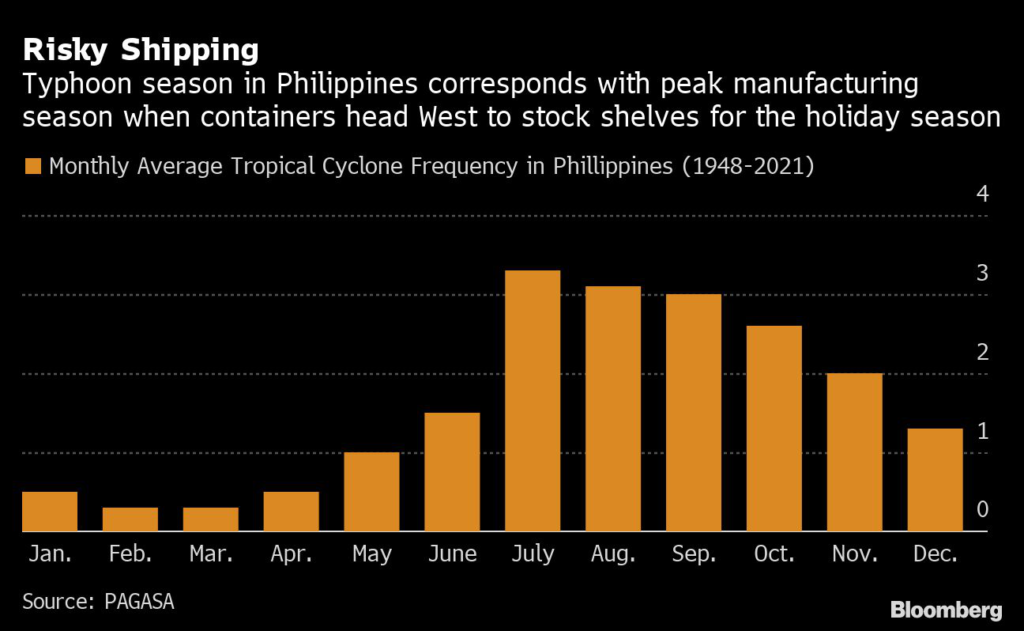
While ships can divert around the eastern coast of Taiwan through the Philippine Sea, which would add only a few extra days to the journey, alternative routes pose difficulties. The Luzon Strait between the Philippines and Taiwan offers a possible north-south path, but the typhoon season in South China Sea makes it risky to travel. 

More tropical cyclones enter the region surrounding the Philippines than anywhere else in the world, with an average of 20 per year, according to the Philippine Atmospheric, Geophysical and Astronomical Services Administration. Three typhoons made it far enough west to scatter ships out of ports in Hong Kong and Shanghai in 2021, causing major supply-chain disruptions.

More stories like this are available on bloomberg.com

©2022 Bloomberg L.P.

Crypto Bridge Nomad Drained of Nearly $200 Million in Exploit

(Bloomberg) — Nomad, a bridge protocol for transferring crypto tokens across different blockchains, lost close to $200 million in a security exploit on Monday, according to security firm PeckShield Inc. 

The software system was drained of funds over hours and in small batches by various accounts, blockchain data shows.

“An investigation is ongoing and leading firms for blockchain intelligence and forensics have been retained,” the company said in a statement. “Nomad’s goal is to identify the accounts involved and to trace and recover the funds.”

The attack makes Nomad the latest bridge to suffer an exploit this year. Bridges are software that enable different types of blockchains and their respective tokens to interoperate, rather than work in silos.

They have become frequent victims of hacks in recent years, with more than $1 billion stolen from bridges in 2022, according to a June report by forensics firm Elliptic.

Axie Infinity’s Ronin bridge lost about $600 million in March and Harmony’s Horizon was drained of $100 million in June. 

The hack comes days after Nomad announced the full list of investors in its $22 million seed round, which was led by Polychain Capital, with participation from backers including Ethereal Ventures, Hack VC, Coinbase Ventures and Crypto.com Capital.

Nomad, which describes itself as a “security-first” cross-chain messaging protocol, had a vulnerability in its code that allowed attackers to broadcast fake messages and drain funds, PeckShield said.

One of the exploiters on Nomad was also involved in the $80 million hack from Rari Capital’s Fuse platform from April, according to PeckShield. 

More stories like this are available on bloomberg.com

©2022 Bloomberg L.P.
Flying-Taxi Startup Skyports Wins Funding From ST Engineering

(Bloomberg) — Skyports Ltd., which builds takeoff and landing sites for flying taxis, drew investment from Singapore Technologies Engineering Ltd. amid plans for a terminal in the city for airborne electric cabs.

Aerospace company ST Engineering is the final investor in a Series B capital raise and takes the latest round of fundraising to $26.1 million, Skyports said Tuesday. The first Series B round in March raised $23 million. 

Interest in electric vertical take-off and landing vehicles, or eVTOLs, has grown in recent years, with airlines around the world ordering hundreds of them. Skyports said in April it expects to start operating its first eVTOL terminal in Singapore in 2024.

Read more: Singapore’s Tiny Second Airport Eyes Future as a Flying Taxi Hub

Skyports, which also provides drone services, said the “heavily oversubscribed” fundraising showed investors were confident in the UK company’s future. 

More stories like this are available on bloomberg.com

©2022 Bloomberg L.P.
Bitcoin Down for Third Day as Caution Washes Over Global Markets

(Bloomberg) — A bout of jitters in global markets over deepening US-China tension weighed on cryptocurrencies, pushing Bitcoin lower for a third day. 

The largest digital token fell as much as 1.6% to $22,769 on Tuesday and was trading at $22,860 as of 2:57 p.m. in Tokyo. Ether at one point shed 3.7%, while smaller coins ranging from Polkadot to Cardano were also in the red.

US House Speaker Nancy Pelosi is set to land in Taiwan on Tuesday and would be the highest-ranking American politician to visit in 25 years. China views the island as its territory and has warned of consequences if the trip happens. The risk of escalation led investors to dump stocks and US equity futures.

Before the latest gyrations, Bitcoin made a weekend run toward $25,000 on the way to rounding out its best monthly gain since October last year. The climb has encouraged the view the worst of this year’s crypto rout — Bitcoin is down about 51% — is in the rear-view mirror.

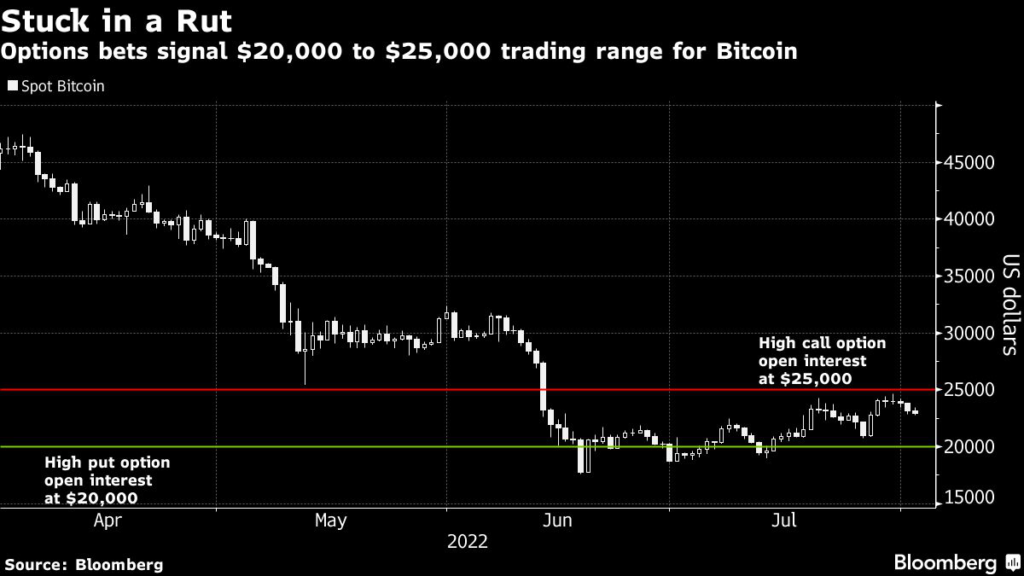
Bets in the options markets suggest speculators see $25,000 as a ceiling for Bitcoin and $20,000 as a floor. This is because of a high number of outstanding call and put contracts — so-called open interest — at those strike prices respectively, according to data compiled by Coinglass.

For Craig Erlam, senior market analyst at Oanda, Bitcoin’s rebound last month had “all the feeling of a bear-market rally as we may be seeing in equity markets.”

“That doesn’t mean it won’t have further to run,” he wrote in a note.

More stories like this are available on bloomberg.com

©2022 Bloomberg L.P.
Spain Short on Takers for $12 Billion in Semiconductor Subsidies

(Bloomberg) — The Spanish government’s plan to pour more than 12 billion euros ($12.3 billion) into building a domestic semiconductor industry from scratch has run up against a major problem: chipmakers ready to take on the challenge are few and far between.

Financed by European Union cash allocated to offset the economic impact of the Covid-19 pandemic, Spain’s chips push is being hampered by stiff competition from other EU countries to win over major investors, according to people familiar with the situation.

The main challenge has been to attract companies willing to commit to long-term investments that can run into billions of euros, said the people, who asked not to be identified discussing confidential information. Firms have opted instead for nations like Germany that have a semiconductor ecosystem with suppliers and talent already established.

Spain’s ambitious effort is meant to contribute to achieving the EU’s goal of producing a fifth of the world’s microchips by 2030, up from about 10% in 2020. Enshrined in the bloc’s so-called Chips Act, the plan allows member nations to provide state aid to chip producers with projects designated “first of a kind” on the continent.

Manufacturers have shown interest in the government’s chips drive since it was unveiled two months ago but they need time to make investment decisions, according to an emailed statement from Spanish Prime Minister Pedro Sanchez’s office in response to Bloomberg questions. “We are fully confident that these conversations will soon bear fruit in relevant announcements,” the statement read.

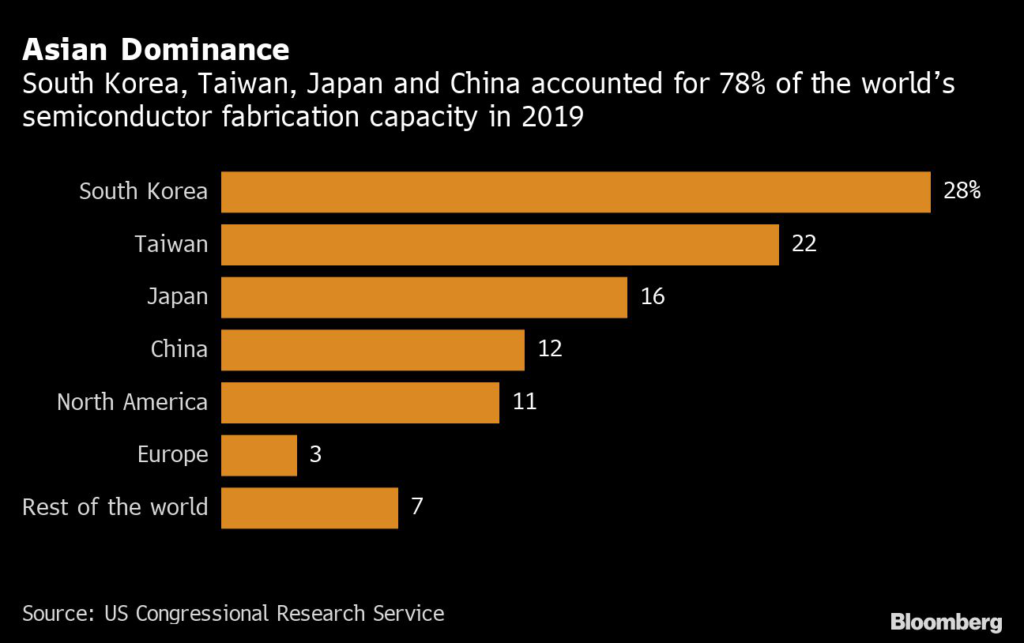
After facing significant supply-chain disruption during the pandemic, the EU and the US are racing to increase chip production, with governments keen to reduce their dependence on countries like Taiwan and South Korea.

The US Chips Act passed both houses of Congress last week, including $52 billion in grants and incentives for domestic semiconductor manufacturing, and China is also investing heavily to catch up.

The EU’s chips plan has gained momentum in nations with existing semiconductor industries, putting them in competition with one another.

Spain has tried to lure Taiwan Semiconductor Manufacturing Co., but the company is expected to opt for Germany, where there is already a large chip ecosystem in the eastern state of Saxony. TSMC, the world’s premier chip foundry based in Taiwan, has been talking to the German government for over a year about setting up a factory, but a decision is unlikely anytime soon.

The former East Germany also got a huge boost back in March when Intel Corp. announced it would invest 17 billion euros to build a cutting-edge production site in Magdeburg.

Global Foundries Inc. and STMicroelectronics NV last month unveiled a 5.7 billion-euro project to make energy-efficient chips in France, while Samsung Electronics Co., another leader in semiconductors, floated the idea of a European expansion years ago but it has yet to materialize.

Spain’s Sanchez, a trained economist, sees the government’s chips project as a way to boost the country’s industrial base, which has shrunk since the turn of the century due to tougher competition from abroad.

The investment is also important for supplying the Spanish auto sector, which is Europe’s second-largest and accounts for about 10% of gross domestic product.

Some of the money will go toward research projects via the EU’s microelectronics IPCEI, or important projects of common European interest. These allow governments to channel state aid to smaller research projects.

Spain will also likely get EU funds to house a pilot production line from Imec, a Belgium-based research hub, according to a person familiar with the plan.

More stories like this are available on bloomberg.com

©2022 Bloomberg L.P.
Asian Unicorns Are Trading 40% Cheaper in Private Markets

(Bloomberg) — Asia’s most well known startups are trading 40% cheaper than six months ago in private transactions amid a rout triggered by Chinese regulatory headwinds and the global economic slowdown.  

The affected billion-dollar companies range from financial technology and e-commerce to mobility and consumer, according to AJ Patel, a senior member of the venture capital secondaries team of the Toronto-based advisory firm Setter Capital. 

“For some of the unicorns, we are seeing very limited demand,” Patel said, adding that bid offers are 25% to 50% lower compared with the firms’ latest fundraising valuations. He declined to disclose names. 

Asia has attracted more than $1 trillion of venture capital money since 2012, according to researcher Preqin, buttressing the valuations of companies including ByteDance Ltd. and Shein. Yet both are now trading at significant discounts. Investors are seeking for opportunities in North America out of concerns about China’s regulatory environment, Patel said. 

The region represented 28% of the 1,170 private businesses valued above $1 billion, according to the CB Insights global unicorn list. China is home to 174 unicorns alone, making it the largest base of such startups after the US. 

ByteDance’s valuation dropped at least 25% to well below $300 billion, people familiar said last month. Buyers of Shein are evaluating bids 30% cheaper than its $100 billion valuation in April, people familiar said. The third quarter may see further declines. 

“There will be down rounds, or companies will revalue their shares lower for internal reporting,” said Patel. “Public mutual funds will re-mark their portfolio at lower valuation” in the third quarter. 

More stories like this are available on bloomberg.com

©2022 Bloomberg L.P.
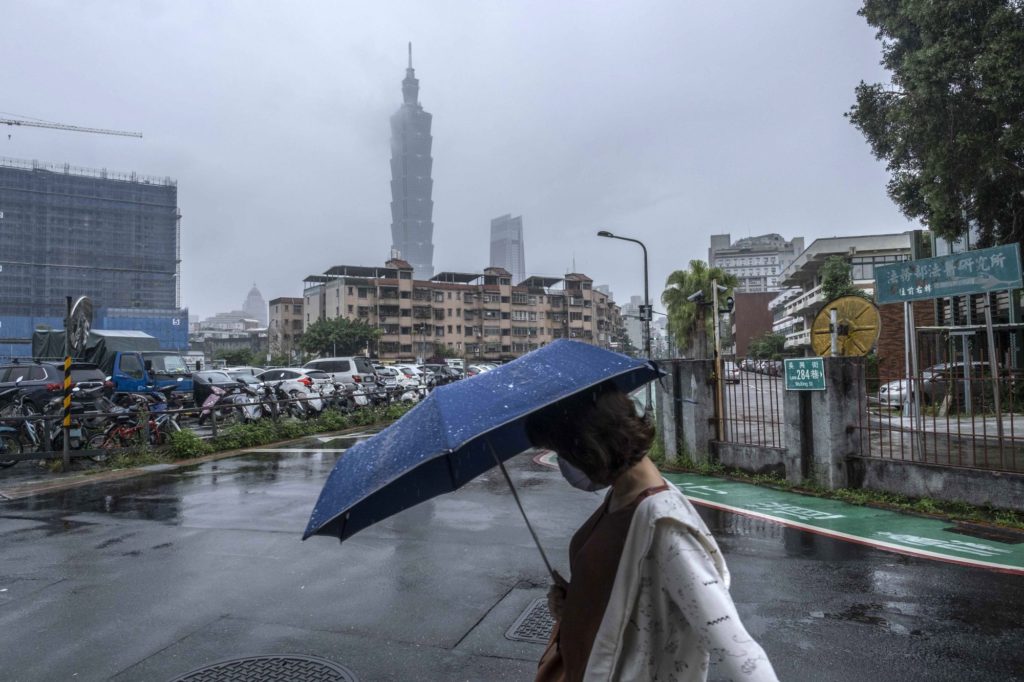
Taiwan Stocks Decline as US-China Tensions Sap Risk Appetite

(Bloomberg) — Taiwan stocks fell after an expected visit by US House Speaker Nancy Pelosi renewed concerns over an escalation of US-China tensions.

The benchmark Taiwan Stock Exchange Weighted Index declined as much as 2.1%. Shares of Taiwan Semiconductor Manufacturing Co. sank 3.1%. 

China views Taiwan as its territory and has warned of consequences if Pelosi’s trip takes place. The visit may worsen the pressure on the island’s stocks, which have been hit by selling by global funds and fears of a US recession.

Pelosi Taiwan Trip to Hurt China Stocks, Boost USTs: Street Wrap

The benchmark equity gauge has climbed more than 7% since reaching the year’s low in July but remains almost 20% below the peak reached early this year.

More stories like this are available on bloomberg.com

©2022 Bloomberg L.P.

Stanford Alum’s 26-Year-Old Winemaker Braves India IPO Market

(Bloomberg) — While recession fears have seen new listings grind to a halt this year, one of the few companies currently seeking to go public in Mumbai is testing investor appetite for India’s growing wine market.

Sula Vineyards Ltd., which last month filed for an initial public offering, says it has over a 50% share of India’s small but rapidly growing wine market. The 26-year-old company has opened tasting rooms and hosted an annual music festival as part of its effort to make the drink fashionable in a young country with an expanding middle class.

“When Sula entered the market, wine was seen as something aspirational — for people above 45 years of age,” said Abhay Kewadkar, an independent alcoholic beverage consultant. “They cleverly changed that perspective by targeting younger consumers.”

The winemaker is looking to go public at a time when IPOs have dried up in India, as in much of the world, amid concerns of a recession. Young retail traders who helped drive the local stock market over the past couple years have been burned in recent months by plunges in high-flying tech unicorns such as Zomato Ltd. and Paytm parent One 97 Communications Ltd.

The S&P BSE IPO Index, a gauge tracking the performance of Indian shares for the first two years after listing, has fallen 24% so far in 2022 after nearly tripling in the previous three years.

Sula hasn’t yet disclosed a value for the planned of sale of about a third of its existing equity, including shares held by founder and Managing Director Rajeev Samant. The company posted sales of $57 million for the year ended March 31, around a tenth of the revenue at Zomato and Paytm, though unlike the two tech firms Sula is profitable.

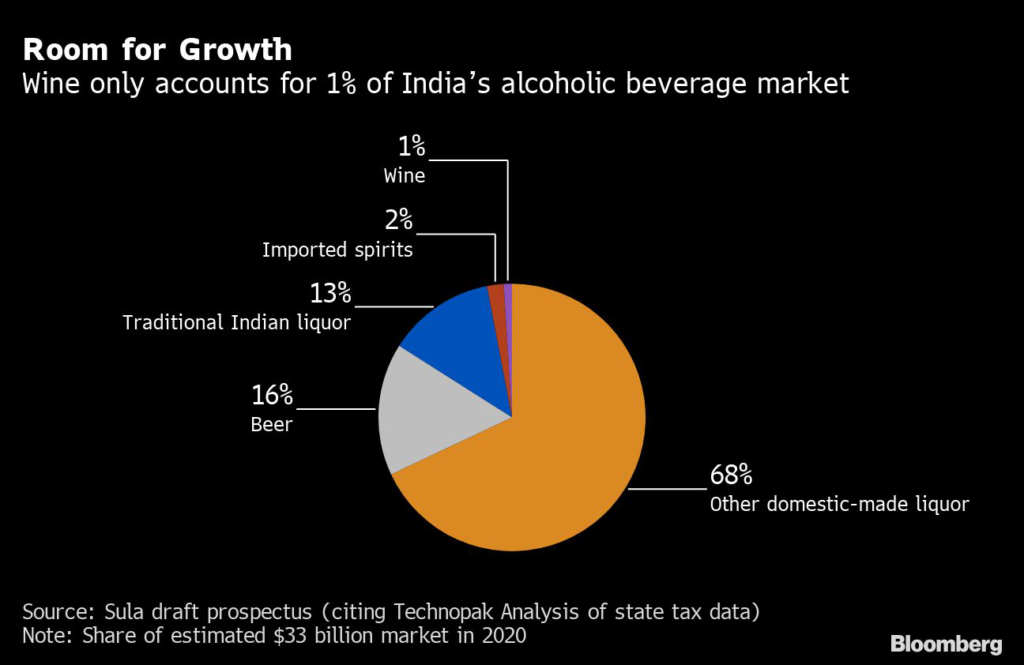
In its draft prospectus, Sula claims that India is the world’s third-largest market for alcoholic beverages, at $33 billion in 2020, but wine only accounts for 1%. The company believes this allows much room for growth, projecting total Indian sales of 3.4 million cases of wine in 2025, up 70% from the level in 2021.

Samant, a 55-year-old Stanford graduate, has worked to boost demand by promoting wine tourism in Sula’s production base of Nashik, which is seen as India’s version of Napa Valley. The company says social media has also helped lift the beverage’s profile, and claims Sula is among the top 10 most-followed vineyards on Instagram globally.

Sula will raise no money from the IPO itself, but hopes the listing will boost its visibility and brand image. It could also have a halo effect for the whole industry, with the company’s local competitors including unlisted Fratelli Wines and Grover Zampa Vineyards.

“This IPO will bring the wine segment into the limelight,” said Ronak Soni, analyst at Equirus Securities Pvt. “It’s a fast-growing segment.”

More stories like this are available on bloomberg.com

©2022 Bloomberg L.P.

US to Stop TSMC, Intel From Adding Advanced Chip Fabs in China

(Bloomberg) — As the US Congress passed an historic $52 billion federal program to boost domestic chipmaking capabilities, it included one significant caveat: Companies that receive the funding have to promise not to increase their production of advanced chips in China. 

It’s a condition that will certainly add to escalating tensions between Washington and Beijing. The curbs will hit companies like Intel Corp. and Taiwan Semiconductor Manufacturing Co., leading chipmakers that have tried to build their businesses in China. TSMC won’t be able to substantially upgrade or expand its existing facilities, effectively losing some growth opportunities in the world’s biggest semiconductor market.

Specifically, the Chips and Science Act bars companies that get federal funding from materially expanding production of chips more advanced than 28-nanometers in China — or a country of concern like Russia — for 10 years. While 28-nanometer chips are several generations behind the most cutting-edge semiconductors available now, they are still used in a wide range of products including cars and smartphones. The ban covers both logic and memory chips.

An exception can be made if the chipmakers concerned are adding production of 28-nanometer semiconductors or older generations to serve the China market predominately or the foreign country of concern involved. Recipients who violate the restrictions and fail to remedy the breach may need to pay back the federal subsidies in full. 

The White House, which is expected to sign the Act shortly, has voiced its support for the measure. 

Intel has been lobbying hard against the move to curb US investments in China’s chip sector. In late 2021, the American chipmaker wanted to increase production in China but that plan was spurned by the White House. 

Intel ended up selling its wafer plant in Dalian to South Korea’s SK Hynix Inc. as part of a broader deal for the American company’s Nand memory business. Intel still has chip packaging and testing facilities in China.

“Legislation this complex and important requires input from all stakeholders. Intel and many companies in our industry have come together with our trade association to provide input to policymakers in order to ensure that we have the best legislation possible and don’t inadvertently undermine the global competitiveness of companies that receive CHIPS funds,” Intel spokeswoman Nancy Sanchez said. 

While China’s chipmaking champion Semiconductor Manufacturing International Corp. can make chips that are more advanced than 28 nanometers, its technology is still at least six years behind industry leader TSMC. 

SMIC has been facing virtually insurmountable challenges in catching up with TSMC after the Trump administration pressured the Dutch government to prevent ASML from selling its most cutting-edge extreme ultraviolet lithography systems to China. The Chinese chip industry encountered a further setback in recent days as Washington had quietly tightened China’s access to relatively advanced chip equipment, sending stocks tumbling. 

A large chunk of the federal grant is expected to go to Intel, TSMC and South Korea’s Samsung Electronics Co., all of which are now building new chip fabrication facilities worth tens of billions in the US.

Among potential recipients of the federal grant, only TSMC is making relatively advanced chips in China at the moment. Its facility in the southern Chinese city of Nanjing makes 28-nanometer and more advanced 16-nanometer chips, roughly the equivalent of the most sophisticated product SMIC can make. 

TSMC and Samsung declined to comment. 

More stories like this are available on bloomberg.com

©2022 Bloomberg L.P.

Baidu-Backed Carmaker Jidu Seeking $400 Million in Funding, Sources Say

(Bloomberg) — An autonomous electric vehicle startup backed by Chinese tech giant Baidu Inc. is considering raising about $300 million to $400 million in fresh funds, according to people familiar with the situation.

Jidu Auto, a joint venture set up by Baidu with China automaker Zhejiang Geely Holding Group, is sounding out potential investors and could seek a valuation of about $3.5 billion in the round, the people said, asking not to be identified discussing a private matter.

The autonomous-driving electric vehicle maker’s latest funding round could mark the introduction of backers other than Baidu and Geely, which jointly invested $400 million in the startup’s series A fundraising in January. Jidu sought a valuation of as much as $2 billion in that round, the people said.

Discussions with outside investors are at an early stage and details such as Jidu’s valuation and the proposed funding size could still change, the people said. Representatives for Baidu, Geely and Jidu didn’t immediately respond to requests for comment.

Founded in 2021, Jidu is 53.2% owned by Baidu, according to the internet firm’s latest annual report. The startup unveiled a concept version of its self-driving EV in June, and is eyeing mass production for the vehicle in 2023. 

Jidu also wants to use the model for its robotaxi service planned to launch the same year, potentially leveraging Baidu’s autonomous driving technologies that have been in development since 2013. Baidu was among the first to obtain a permit in April to operate self-driving robotaxis in China. Its Apollo system has logged 27 million kilometers of safe autonomous test driving and is being tested in over 30 cities, a press release shows. 

Carmakers are racing to commercialize driverless technology amid scrutiny from regulators and skepticism that full automation is truly within reach. Tesla Inc.’s top artificial intelligence executive announced his departure last month, casting doubt on its goal of launching a robotaxi-focused vehicle next year and start mass production in 2024. Geely’s electric car brand Zeekr said last year it is partnering with Alphabet Inc.-backed Waymo on a vehicle for deployment in its autonomous robotaxi fleet in the US.

Some Chinese tech companies seeking to make electric cars are not having an easy ride in a sector teeming with rivals. Xiaomi Corp. is facing difficulties getting regulatory approval for its EV project, Bloomberg News has reported.

Read More: Xiaomi’s $10 Billion Car Project Hits Regulatory Barrier  

(Updates with Apollo system details in sixth paragraph.)

More stories like this are available on bloomberg.com

©2022 Bloomberg L.P.

Close Bitnami banner
Bitnami