
Bloomberg

Apple Sells $5.5 Billion of Bonds to Fund Buybacks, Dividends

(Bloomberg) — Apple Inc. tapped the US high-grade bond market Monday with a $5.5 billion sale in four parts. 

The longest portion of the offering, a 40-year security, yields 118 basis points over US Treasuries, down from initial price discussions in the 150 basis points range, according to people familiar with the deal. The order book for the sale peaked at more than $23 billion, a person with knowledge of the demand said.

Proceeds from the bond sale are earmarked for general corporate purposes, including the financing of share buybacks and dividends, said the people, who asked not to be identified as the details are private. 

Read more: IG ANALYSIS: Apple, UBS Headline Calendar; Edison Struggles

The sale comes after the primary market for US investment-grade bonds sprang back to life in the second half of July amid a credit market rally. Many of the big banks brought large debt sales after reporting earnings, helping supply beat expectations for the month. The momentum is expected to continue into this week with Wall Street syndicate desks expecting around $30 billion of new high-grade bond supply. 

Apple, one of eight companies that sold new high-grade bonds Monday, appears to be taking advantage of the recent stability and relatively cheaper cost of funding in the corporate market. The yield on Bloomberg’s benchmark investment-grade index hit a nearly two-month low on Friday.

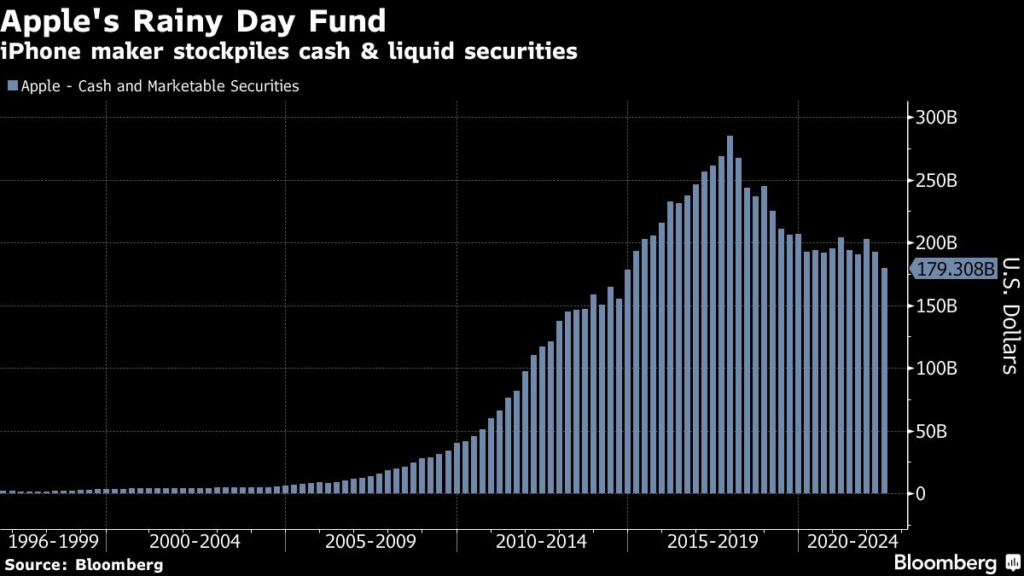
The iPhone maker’s cash and cash equivalents stockpile sits at nearly $180 billion, while it has paid out around $14 billion dividends each of the last three years. 

“Apple consistently borrowing tens of billions of dollars annually is due more to its confidence in expanding cash flow than operational needs,” Bloomberg Intelligence analyst Robert Schiffman wrote Monday. 

Goldman Sachs Group Inc., JPMorgan Chase & Co. and Bank of America Corp. managed the sale. 

In December, Apple’s long-term credit was upgraded to Aaa by Moody’s Investors Service, putting it in an exclusive club with Microsoft Corp. and Johnson & Johnson as the only US corporations in the S&P 500 with the highest possible credit rating. 

(Updates to reflect throughout that the bonds sold)

More stories like this are available on bloomberg.com

©2022 Bloomberg L.P.
Stocks Snap Rally as Fed Pivot Seems Less Likely: Markets Wrap

(Bloomberg) — US equities snapped a three-day rally as investors digested hawkish comments from Federal Reserve officials and data showing slower growth in the manufacturing sector. 

The S&P 500 fell on Monday after notching its best month since 2020. The tech-heavy Nasdaq 100 was little changed after rising as much as 1.1%. Both indexes struggled for direction throughout the session. US Treasuries rallied, with the 10-year yield declining to around 2.59%, the lowest since April. 

After hinting at a possible pivot last week, Fed officials suggested that the central bank will need to raise rates further to bring inflation under control. A purchasing managers index of manufacturing was the latest data point to show that aggressive Fed tightening is starting to slow economic growth.

Stocks had roared in July on speculation the central bank was close to the end of its rate-hiking cycle on signs that runaway inflation may have peaked. Investors are now scrutinizing data, where any above-expectation reading could upend bets on a Fed pivot. At the same time corporate earnings have largely shown that companies are able to deliver profit growth. 

Read More: Revival of Bear-Market’s Laggards Shows Perils of July Rebound

“July delivered a nice relief rally on a dovish interpretation of Fed comments and tech earnings that were not as dismal as expected, but it’s not surprising that we would see a retrenchment after that sort of performance,” said Dana D’Auria, co-CIO at Envestnet Inc. “We are still facing a rising rate environment and an economy that is probably technically in recession.”

Geopolitical tensions also kept markets on edge, with China again warning that its military would take action if House Speaker Nancy Pelosi makes a landmark visit to Taiwan. The offshore renminbi was down as much as 0.6% on the day in the wake of the report, while non-deliverable forwards on the Taiwanese dollar indicated a weakening of the island’s currency.

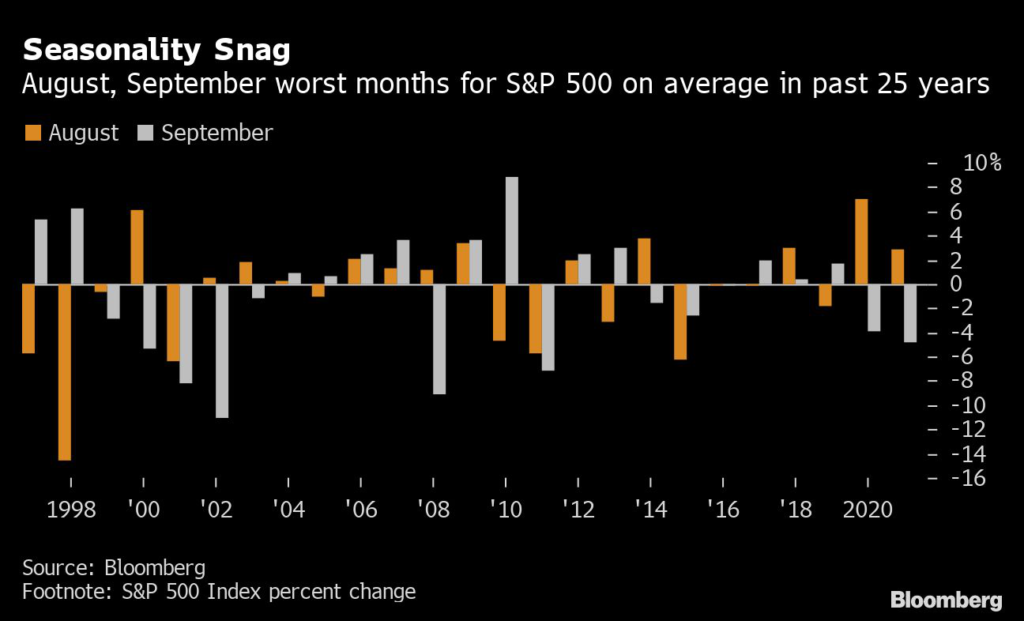
Despite a 12.6% advance from a low on June 16, the S&P 500 could face an ugly stretch. Wall Street lore says October is the most dangerous month for the stock market, but August and September are actually worse, with the S&P 500 averaging declines of 0.6% and 0.7%, respectively, over the past 25 years.

Read More: Surging Stock Market Is Heading Into Riskiest Months of the Year

While more than half of the S&P 500 companies that reported earnings so far have exceeded analyst estimates, the rate of earnings beats still trails the 62% average pace set in the last five quarters. And companies are worried about the economy, with executives and analysts on track to use phrases related to an economic slowdown three times more on second-quarter calls than they did during first-quarter results.

“The Fed does not want to trigger a recession, but their first and much stronger priority is to get inflation under control. If that means driving risk assets lower, that is what they will do,” wrote Dennis DeBusschere, the founder of 22V Research.

Oil declined after poor Chinese economic data added to concerns that a global slowdown may sap demand. West Texas Intermediate dropped below $96 a barrel after sinking almost 7% in July in the first back-to-back monthly loss since late 2020.

The dollar fell. Bitcoin dropped after reaching the highest levels since mid-June on Saturday, fueled by optimism that the market may have recovered from its worst levels.

Read More: Here’s What the Six Key Official Indicators of US Recession Show

What to watch this week:

  • Airbnb, Alibaba and BP are among earnings reports
  • Reserve Bank of Australia rate decision, Tuesday
  • US JOLTS job openings, Tuesday
  • Chicago Fed President Charles Evans, St. Louis Fed President James Bullard due to speak at separate events, Tuesday
  • OPEC+ meeting on output, Wednesday
  • US factory orders, durable goods, ISM services, Wednesday
  • BOE rate decision, Thursday
  • US initial jobless claims, trade, Thursday
  • Cleveland Fed President Loretta Mester due to speak, Thursday
  • US employment report for July, Friday

Some of the main moves in markets:

Stocks

  • Futures on the S&P 500 fell 0.3% as of 4:34 p.m. New York time
  • Futures on the Dow Jones Industrial Average fell 0.2%
  • The MSCI World index rose 1.2%

Currencies

  • The Bloomberg Dollar Spot Index fell 0.3%
  • The euro rose 0.4% to $1.0258
  • The British pound rose 0.7% to $1.2254
  • The Japanese yen rose 1.2% to 131.62 per dollar

Bonds

  • The yield on 10-year Treasuries declined six basis points to 2.59%
  • Germany’s 10-year yield declined four basis points to 0.78%
  • Britain’s 10-year yield declined six basis points to 1.81%

Commodities

  • West Texas Intermediate crude fell 4.8% to $93.88 a barrel
  • Gold futures rose 0.4% to $1,788.60 an ounce

More stories like this are available on bloomberg.com

©2022 Bloomberg L.P.
Short Bets Against MicroStrategy Surge to a Record After Its Shares Rebound

(Bloomberg) — Skeptics who are betting against MicroStrategy Inc.’s Bitcoin strategy are piling onto positions that the cryptocurrency company’s latest rebound will flame out. 

A record 51% of MicroStrategy’s available shares are currently sold short, carrying a notional value of $1.35 billion, according to financial analytics firm S3 Partners. The all-time high of 4.73 million shares shorted has soared by 1.2 million shares over the past 30 days alone, S3 says. 

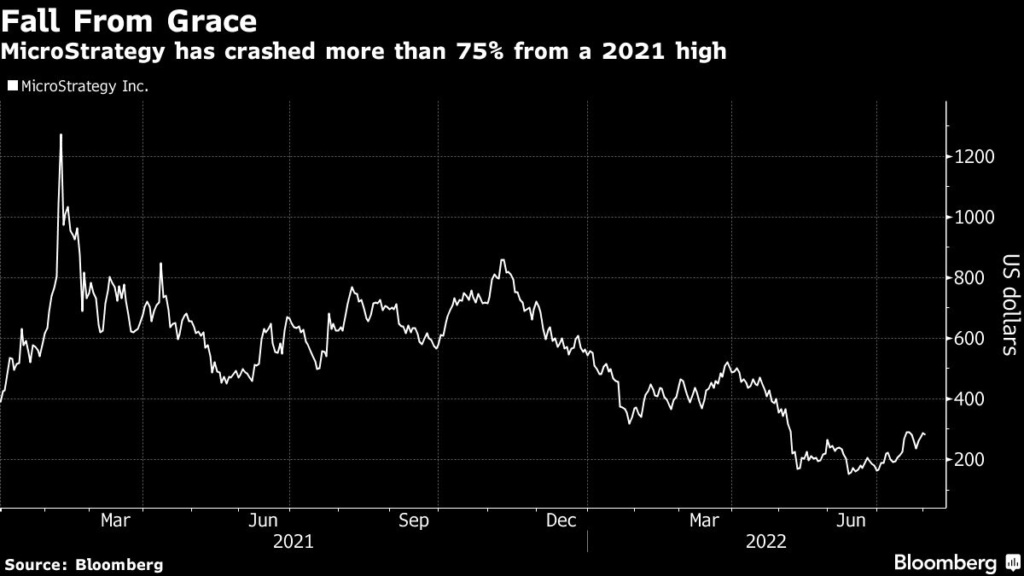
The tech company whose stock serves as a vehicle to invest in Bitcoin has erased more than three-quarters of its value from a February 2021 peak. The stock, which has rallied 68% from the end of June amid a broader risk-on trade, hasn’t closed above its 200-day moving average since December.

Short interest is up 680,000 shares over the past seven days showing that “it certainly looks like shorts are selling into the recent strength,” according to Matthew Unterman, a director at S3.

MicroStrategy is set to report second-quarter results after the market close on Tuesday. The stock fell 3.6% to $275.74 on Monday, snapping a three-day winning streak.

(Updates share movement in third, final paragraphs.)

More stories like this are available on bloomberg.com

©2022 Bloomberg L.P.
Revival of Bear Market’s Laggards Shows Perils of July Rebound

(Bloomberg) — Last month, an index of meme stocks rallied 12% and Cathie Wood’s flagship exchange-traded fund added 13%. Even cryptocurrencies recovered in July, with Bitcoin posting its best month since October.

In other words, the most speculative corners of the market got a lift as traders started to dial back their bets on the Federal Reserve’s policy tightening path amid slower economic growth. In July, the S&P 500 notched its best month since November 2020. But some market watchers warn that such gains can’t be sustained.  

“Easing of financial conditions and the decline in yields has helped support the riskiest portions of the market,” said Dennis DeBusschere, the founder of 22V Research. 

However, the most speculative assets require easier credit and financial conditions, he said. “A broad easing of financial conditions is anathema to the Fed’s goals of reducing inflation though, limiting that support. That is why we think the riskiest parts of the markets should be faded.” 

As August kicks off, here’s a rundown of some of risky assets’ moves.

The Solactive Roundhill Meme Stock Index rose 12% in July, its best 30-day stretch since its inception at the end of last year. The gauge counts companies like Carvana Co., MicroStrategy Inc. and Coinbase Global Inc. as its top holdings. Meanwhile, a fund of newly public companies added 8%. 

Wood’s flagship Ark Innovation ETF (ticker ARKK) had its first month of gains since October 2021, increasing by 13%. So far this year, the fund has seen inflows every month, except in June. Still, it has had a rough stretch, losing roughly half its value since 2021 started as higher interest rates dulled the appeal of its tech holdings. 

Tech stocks are very volatile, Jay Willoughby, chief investment officer at TIFF Investment Management, said.

“So, when markets go up, they’re likely to go up the most,” he said. “And when markets go down, they’re likely to go down the most. That’s the way we would look at it. So ARKK is a really good example.”

The through-line for the meme index and ARKK is digital assets. Both include companies connected to crypto. ARKK invests in Coinbase, for instance. 

Bitcoin, the largest digital coin by market value, gained 27% in July, the most since October of last year. Ether, the No. 2 cryptocurrency, staged an even more impressive rally, adding 70% amid optimism around an anticipated network upgrade for the Ethereum blockchain. An index of 100 of the largest tokens rose 28% last month.

Not Just Risky Assets

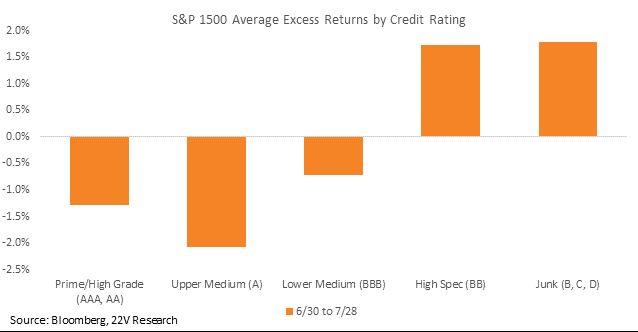
Separately, DeBusschere grouped S&P 1500 stocks by their credit ratings, showing that highly speculative and junk-rated firms have rallied while investment-grade companies underperformed. 


To be sure, it wasn’t just speculative assets that gained over the past four weeks. Technology bellwethers Microsoft Corp., Apple Inc., Amazon.com Inc. and Alphabet Inc. — the “trillion-dollar market cap” club — posted strong gains days after reporting earnings last week, adding a total of $420 billion in market value, according to Bespoke Investment Group in a research note on Friday.

“For the major US indexes to get back into rally mode and stay that way, they need these mega-caps to trend higher,” the note said. The recent upside “to earnings is a bullish start.”

While inflation will likely peak and start to come down, the Fed will continue to raise rates, Stephanie Lang, chief investment officer at Homrich Berg, said in a phone interview. Therefore, “we’re a little bit cautious on this rally,” she said.

More stories like this are available on bloomberg.com

©2022 Bloomberg L.P.
Is the US Economy in Recession? Here Are Eight Offbeat Indicators to Watch

(Bloomberg) — After two quarters of contracting gross domestic product in the US, a debate has raged across Wall Street and Washington about when the country will be in a recession — and whether we’re already in one. Technically, the call is made by a panel of experts looking at monthly indicators of employment, consumer spending, personal income and manufacturing, among others. But with inflation at a four-decade high, many Americans already feel like the country is in a recession.

Throughout history, pundits have looked to a range of unusual measures to read as signposts. Here are a few.

Men’s Underwear Index

Former Federal Reserve Chair Alan Greenspan was a fan of tracking men’s spending habits on underwear based on the thesis that they will put off buying boxers and briefs as times get tough. This proved to be true during the financial crisis of 2008 and again during the pandemic quarantine of 2020, according to Euromonitor data. Purchases of apparel across the board fell as unemployment rose and spending declined, Morningstar analyst David Swartz said. “If you were to use it as a barometer, the most important retail sales to watch are Fruit of the Loom and Hanes at Walmart and Target, where most of America buys its underwear.” Hanesbrands Inc. might provide a clue when it reports second-quarter earnings on August 11. Walmart Inc., which reports on Aug. 16, recently cut its profit forecast, in part because of deeper discounts needed to reduce a buildup of slow-selling merchandise such as apparel.

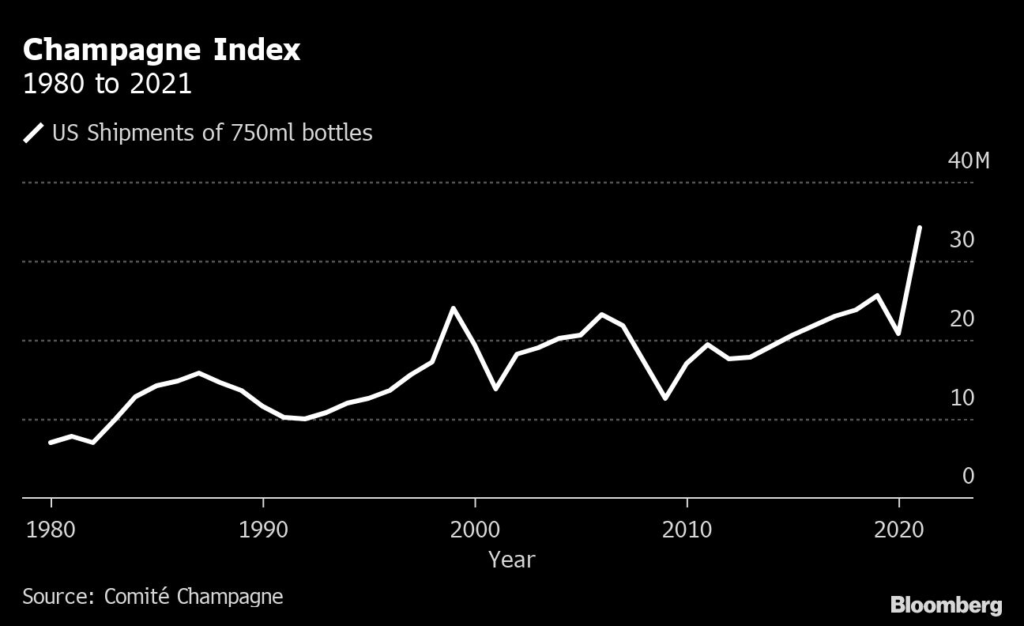
Champagne Index

Bubbly, which is often used to celebrate good times, has been seen as a harbinger of things to come since the mid-1980s, when shipments soared during Wall Street’s boom. Consumption hit 15.8 million bottles in 1987, then crashed during the recession that followed, declining to 10 million bottles by 1992, according to data from the Champagne Bureau. This pattern repeated during the Great Recession: Consumption soared to 23.2 million bottles in 2006, then plunged to 12.6 million by 2009. Although 2022 data is not yet available from the Champagne trade association, NielsenIQ data shows US sales of sparkling wine down every month from the previous year, falling in a range of 7% to 8% in May and June.

Lipstick Index

In the early 2000s, Estee Lauder Chairman Leonard Lauder coined the term “Lipstick Index” when he remarked that women were indulging in little luxuries like lipstick to make themselves feel better during the downturn. Data analytics firm NPD seems to back this up: Of the 14 discretionary retail spending industries that it tracks, beauty is the only one showing growth in unit sales this year. NPD in a recent report pointed to the industry’s strong, double-digit growth. 

Hemline Index

Skirt lengths have been closely watched since the Great Depression, when it was first observed that hemlines go up during bull runs and down during busts. Flappers’ short skirts of the Roaring Twenties were replaced with long dresses during the Great Depression and mid-length outfits during World War II. More recently, mini-skirts were popular during the period of prosperity preceding the pandemic. But with Covid fatigue, the ongoing war in Ukraine, and economic uncertainty, midi and maxi dresses are now all the rage. 

Diaper Rash Index

Then there’s the diaper rash theory: Some believe parents try to save money by changing diapers less often during downturns, which causes an uptick in sales of ointments and creams to treat irritation. IRI data shows sales volume in 2022 for these products are substantially higher than prior years, while unit sales of diapers are down versus before the pandemic. However, IRI’s president of client engagement, Krishnakumar Davey, said that could be due to a range of other factors and may not be related to the economy.

Cardboard Box Index

Cardboard-box shipments are often used as a measure of manufacturing activity since many goods are transported in them. In the second quarter, demand was lower than expected and likely to remain flat as Americans shift their spending habits, International Paper Co. Chief Financial Officer Tim Nicholls said in an earnings call last week. “I think it’s a reaction to inflation,” he said. “Inflation is real and people are making choices.” US demand for shipping pallets has also cooled.

R-Word Index

In the early 1990s, the Economist invented the “R-Word Index” to count the number of stories in newspapers that mention “recession” and used it to call the start of US recessions in 1990, 2001 and 2007. Google Trends is seen as a similar measure. Searches for “recession” spiked during periods defined as recessions by the National Bureau of Economic Research — and have been on the rise since June. 

Tech Slowdown 

Apart from federal labor reports, Bloomberg has been tracking tech companies commenting on hiring slowdowns — a number that has been steadily increasing in recent months. Last week, Amazon said it had cut 100,000 jobs in the quarter and has been adding jobs at the slowest rate since 2019. Meta Platforms Inc. Chief Executive Officer Mark Zuckerberg told employees that he’s anticipating one of the worst downturns in recent history.

More stories like this are available on bloomberg.com

©2022 Bloomberg L.P.
Amazon Hires Senior Senate Aide, Boosting Efforts to Stymie New Tech Antitrust Bill

(Bloomberg) — Amazon.com Inc. hired a senior Republican congressional aide, bolstering its efforts to stymie a new antitrust bill aimed at US technology companies, according to two people familiar with the hire. 

Judd Smith was the Senate Judiciary Committee’s counsel as the panel wrote and approved a bill that would restrict the way Amazon can offer products to consumers and interact with its competitors. His move to Amazon, the e-commerce giant that has been vilified by lawmakers for its market dominance, will play into efforts to ensure that the legislation doesn’t receive a vote in the full Senate. By hiring him, Amazon is bringing in a powerful voice on the top issues facing the committee.

Smith helped negotiate changes to the legislation as he worked with Republican offices to push the bill forward, according to two other people familiar with his work. Smith was the lead antitrust aide for Iowa Senator Chuck Grassley, one of the original Republican cosponsors of the bill, according to one of the people. 

While Smith will be barred from lobbying Senate Judiciary staff and members for a year after his departure from the committee, he could be influential in convincing House Republicans to vote against the measure if it passes the Senate. Smith previously worked with former Pennsylvania Representative Tom Marino, who was the top Republican on the subcommittee responsible for antitrust. 

The American Innovation and Choice Online Act would prohibit major online platforms like Amazon, Alphabet Inc.’s Google, Facebook parent Meta Platforms Inc., and Apple Inc. from giving advantages to their own products over those of rivals. The bill’s sponsors and its advocates had pushed Senate leadership to take up the measure before lawmakers leave for a four-week summer break.

The House Judiciary Antitrust Subcommittee has advanced a similar bill aimed at concentration in the internet economy. The House and Senate would have to pass the same version of the bill for President Joe Biden to sign it into law.

Smith will join the public policy team with Amazon Web Services to help lobby Republicans, said two of the people. All four of the people asked not to be identified discussing an internal decision. 

Amazon and Smith didn’t respond to requests for comment.

Minnesota Democrat Amy Klobuchar has led efforts to get the bill on the Senate floor, but Senate Majority Leader Chuck Schumer said the Senate won’t have time to take it up this week before the August recess.

(Updates with additional details beginning in the third paragraph)

More stories like this are available on bloomberg.com

©2022 Bloomberg L.P.

N.Y. Attorney General Courts Crypto Whistle-Blowers

(Bloomberg) — New York wants to hear from people who have been burned by crypto firms.

Attorney General Letitia James issued an alert on Monday calling for people to contact her office’s Investor Protection Bureau if they believe they have been deceived, or found themselves unable to access their accounts or investments. 

Some crypto companies have suspended withdrawals and trading — or have gone bankrupt entirely — amid the recent market volatility. James also urged workers in the industry to blow the whistle on any wrongdoing that they may have witnessed. 

“The recent turbulence and significant losses in the cryptocurrency market are concerning,” she said in a statement. “Investors were promised large returns on cryptocurrencies, but instead lost their hard-earned money.”


More stories like this are available on bloomberg.com

©2022 Bloomberg L.P.
Morgan Stanley, BofA Subpoenaed by Twitter in Musk Fight

(Bloomberg) — Twitter Inc. subpoenaed records from Morgan Stanley and other financial firms as part of its legal fight with Elon Musk over his canceled $44 billion acquisition of the social media platform.

Morgan Stanley was Musk’s chief financial adviser on the proposed deal and pledged up to $5.5 billion in financing. In a series of subpoenas posted Monday in Delaware Chancery Court, Twitter also sought documents from Bank of America, Barclays PLC, BNP Paribas, Citigroup Inc. and several other banks that committed to backing Musk’s acquisition.

The pre-trial request for information seek a wide range of communications and documents about Musk’s bid to acquire Twitter for $54.20 a share, which he nixed over claims that the company failed to provide him with information about spam and bot accounts. 

Among the documents sought are those relating to Musk’s initial plans to partially fund his Twitter purchase with a margin loan tied to his Tesla Inc stake. In May, Musk dropped the margin loan and provided additional equity financing.

Twitter itself was advised on the deal by Goldman Sachs Group Inc. and JPMorgan Chase & Co.

In its suit seeking to compel Musk to complete the acquisition, Twitter argues that the world’s richest person is using his bot account claims as a pretext to walk away from the deal. 

Delaware Chancery Court judge Kathaleen St. J. McCormick has scheduled a five-day trial starting on Oct. 17.  

On Friday, Musk’s lawyers filed an answer to Twitter’s suit under seal. 

The case is Twitter v. Musk, 22-0613, Delaware Chancery Court (Wilmington). 

(Updates with detail on records sought in subpoenas.)

More stories like this are available on bloomberg.com

©2022 Bloomberg L.P.
UnitedHealth Deal Gives ‘One-Way Look’ Into Rivals, DOJ Says

(Bloomberg) — UnitedHealth Group Inc. will gain access to “vast amounts of data” on how rival insurers do business if its proposed acquisition of Change Healthcare Inc. goes through, the Justice Department said opening arguments in a trial challenging the deal.

UnitedHealth countered that it already has data on competitors through its Optum services unit and has a track record of treating the information appropriately. The company is contesting the case and plans to call top executives from both UnitedHealth and its Optum Insight health information technology unit to testify.

As the Justice Department’s trial seeking to block the $7.8 billion deal got underway Monday in federal court in Washington, prosecutor Eric Welsh said UnitedHealth’s proposal to divest some of Change’s business and wall off the competitively sensitive information isn’t enough.

Change’s data is “the prize in the merger,” said Welsh. It would give UnitedHealth a “one-way look” into moves by its rivals. The deal could harm competition due to UnitedHealth’s financial ability and incentives, Welsh added. 

UnitedHealth’s lawyer Craig Primis called the government’s case a “novel and unprecedented legal theory” that rests on a “daisy chain of speculation.” 

The trial is a test of the Biden administration’s more aggressive antitrust policies and the first challenge to a health-care merger to go to trial under the new approach. A verdict to block the deal could have implications for dealmaking in other industries where sensitive data would change hands as the result of an acquisition, while a win for the companies would mark a setback in a cornerstone of Biden’s economic policy. 

Change operates the largest electronic data clearinghouse that connects doctors, hospitals, dentists and pharmacies with insurance companies to obtain reimbursement, handling about 1.7 billion in insurance claims each year. No other clearinghouse works with as many insurers and health-care providers as Change, though United’s Optum unit is its next biggest rival, Welsh said.

The deal also would give United a “near monopoly” on certain types of claims reimbursements, Welsh said. United has proposed a narrow divestiture to private equity firm TPG Capital LP, which he added has no experience in this aspect of health care. The divested assets are a “narrow sliver” of Change’s business that could only offer a limited product compared to the company’s current offerings, Welsh said. 

While United has proposed a firewall to safeguard the confidential data and offered commitments to Change’s customers, that doesn’t assuage the DOJ’s concerns, Welsh said.

United’s “commitments are not worth the paper they are written on,” he said. The company’s proposed fixes “are all flawed and have risks.”

UnitedHealth already manages competitively sensitive data for other insurance companies through its Optum unit, Primis said. Misusing the information would raise the risk of alienating them, violating health privacy laws and damaging its own business, he said.

“If they use this data for improper purposes, it would be economically devastating,” Primis said. “We are not going to sacrifice our reputation for a few extra insurance customers.”

The Justice Department has previously approved deals with firewalls, Primis noted, including in the health-care sector with the 2019 merger of CVS Health Corp. and insurer Aetna Inc. 

TPG, which Primis said is a leading investor in health care and health-care technology, has offered to pay $2.2 billion for Change’s ClaimsXten product, which he noted demonstrates the private equity firm believes the divested business has value. The Change product is generally sold to insurers on its own, he said.

UnitedHealth fell 1.4% as of 3 p.m. in New York, while Change dropped 1.7%.

The case is US v UnitedHealth Group et al., 22-cv-481, US District Court for the District of Columbia.

More stories like this are available on bloomberg.com

©2022 Bloomberg L.P.
US Audit Watchdog Insists on Full Access in China-Delisting Case

(Bloomberg) — The US’s top auditor watchdog is throwing cold water on a workaround that’s been floated as a way to avoid the delisting of nearly 200 Chinese companies from American stock exchanges.

A company’s decision to leave the New York Stock Exchange or Nasdaq voluntarily might not keep the Public Company Accounting Oversight Board from demanding to review its audit work papers, PCAOB Chair Erica Williams said on Monday. 

“We need to have complete access,” she said in an interview Monday at Bloomberg’s Washington office. “No loopholes, no exceptions,” Williams added. 

China and Hong Kong are the lone two jurisdictions worldwide that don’t allow the PCAOB inspections, with officials there claiming national security and confidentiality concerns. The clock is ticking to avoid a congressionally imposed deadline of 2024 for kicking off businesses that don’t comply. 

As US and Chinese officials try to reach a deal, speculation has been mounting that a solution could involve companies that Beijing deems sensitive voluntarily exiting US markets. However, Williams said Monday that the PCAOB’s authority to inspect was retrospective, meaning the watchdog could still demand work papers from those companies even after they leave. 

“If a firm or issuer decides to delist this year, it really doesn’t matter to me because I need to know if you engaged in fraud last year,” Williams said, not referring to any company specifically. 

The US and China have been at odds for two decades over the legal requirement, which is meant to protect investors from accounting frauds and other financial malfeasance. The 2024 deadline stems from a 2020 law called the Holding Foreign Companies Accountable Act that was popular with both Democrats and Republicans.

Williams declined to say Monday how far back PCAOB inspectors would want to look, noting that the 2020 law doesn’t place a time limit on its authority. “Timing is also not an exception that we are willing to discuss” in reaching a deal with the Chinese, she said.

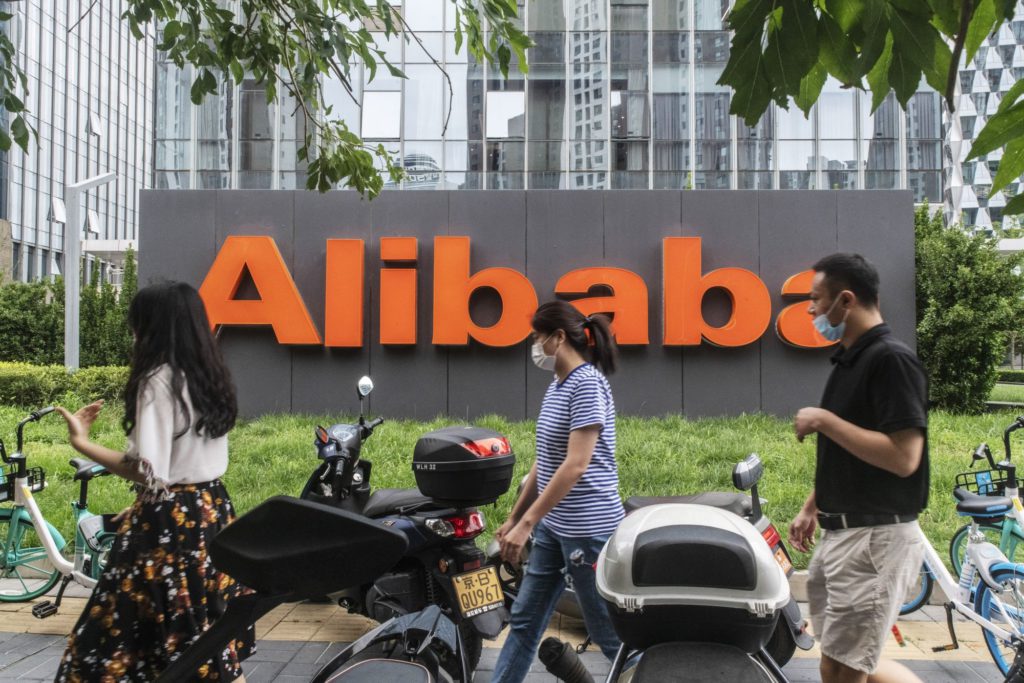
Alibaba Group Holding Ltd. said last week it was seeking primary listings in Hong Kong, joining Bilibili Inc. and Zai Lab Ltd. which made the move earlier. The switch could help companies tap more Chinese investors while providing a template for other US-listed Chinese firms that face delisting should Washington and Beijing fail to settle audit disputes. 

Alibaba said in a Monday corporate filing that it would try to maintain its listing on the New York Stock Exchange and Hong Kong Stock Exchange. 

The US Securities and Exchange Commission on July 29 added Alibaba to a growing list of companies that could be kicked off American exchanges if the two countries fail to reach a deal. Congress is considering legislation that could speed up that process to as soon as 2023, adding further pressure for the two sides to quickly reach a deal.

Meanwhile, some companies have switched from Chinese- to US-based auditors in a bid to avoid the delisting threat. However, Williams said that’s not sufficient, adding that the PCAOB decides if China and Hong Kong are complying as entire jurisdictions, rather than basing its determinations on individual firms. 

“Whether or not you’re going to be audited by a firm in China or a firm in the US, we have to have complete access” to audit papers, she said. 

The PCAOB chair declined to provide a definitive date by which an agreement with Chinese authorities must be reached, but reiterated it would need to be soon. The regulators’ staff, which includes Mandarin speakers, is ready to use all of its resources to conduct the inspections if they do take place, Williams said. 

“We have teams ready to go” if an an agreement is reached, Williams added in a Monday interview on Bloomberg Television’s “Balance of Power With David Westin.” “Time is of the essence because this agreement is just the first step,” she said.

(Updates with comments from PCAOB chair throughout.)

More stories like this are available on bloomberg.com

©2022 Bloomberg L.P.

Close Bitnami banner
Bitnami
